“Real conflict for me at least always turns out to be wordless, which is why I find drama and the theatre so unreal.” (Margaret Drabble, The Garrick Year)

Back in June I was inspired by heavenali’s a year with Margaret Drabble to read the author’s first novel, A Summer Bird-Cage (1963). I was really impressed by what she’d achieved when she was just 24, and so I was keen to pick up her second novel The Garrick Year (1964), which was written only a year later. Once again I found the sure style really striking.

“All that strange season, that Garrick year, as I should always think of it, which proved to me to be such a turning point, though from what to what I would hardly like to say.”

Emma is an ex-model and mother to toddler Flora and baby Joe. She’s a bit adrift as to what she wants to do with her life, but is keen when offered a newsreader’s job. Unfortunately her selfish, self-serving husband David also gets offered a job, which involves moving from London to Hereford for a year so he can act in the local theatre productions by acclaimed director Wyndham Farrar.

At first David seems an outright pig, telling Emma she has no choice and he’s already signed the contract. It turns out this isn’t true and Emma never thought it was. Still, they both know it might as well be. This is the early 1960s and while staying behind for a year might be theoretically possible for a married woman with small children, it’s not hugely likely even with a nanny.

“I could hardly believe that marriage was going to deprive me of this [job] too. It had already deprived me of so many things which I had childishly overvalued: my independence, my income, my twenty-two inch waist, my sleep, most of my friends who had deserted on account of David insults, a whole string of finite things, and many more indefinite attributes like hope and expectation.”

Drabble captures that compelling mid-twentieth century time where women are starting to have a sense of more possibilities and life choices opening up, but these options still don’t seem wholly obtainable.

So David isn’t quite as dreadful as he first appears, but neither is he particularly likable. And he’s about to get worse, as he brings his roles home with him:

“this time I was condemned to a whole season of Flamineo who happened to be a self-centred existentialist pimp.”

As in her first novel, The White Devil by John Webster is heavily referenced. I’d be interested to know why this slightly bonkers, bloody Jacobean play seems so significant for Margaret Drabble at the start of her career. (And I say that as someone whose MA was on ritualistic bloodshed on the early modern stage – bonkers and bloody theatre is right up my street 😀 )

But The Garrick Year isn’t a pity-fest for Emma in contrast to David. She’s young and self-centred too, an intellectual thinker but not personally reflective. She can be quite bitchy, describing ingenue Sophy “as stupid and as shiny as an apple”, but I don’t think we’re supposed to take pronouncements like: “The provinces have never appealed to me, except as curiosities.” entirely seriously. Emma knows she can be a snob, and contrary.

“I feel that I’m insulting something when I am bored… My tastes are shallow; My life is shallow; and I like anonymity, change and fame. In Hereford I could have none of these things: I was condemned to familiarity, which beyond anything I find hard to maintain with ease.”

Her insight is limited, so when she starts an affair with Wyndham, she doesn’t really understand why she would do such a thing. It’s not particularly passionate, and remains unconsummated for the majority of its frankly tedious duration (tedious in terms of events, not portrayal!)

Drabble balances really well the spiky, sharp observations of Emma with a degree of sympathy for her. I don’t think as readers we’re supposed to necessarily like her, but not despise her either. Rather we’re encouraged to recognise how incredibly thwarted and frustrated she is, at a time when she has agency and choices but not enough of either.

“I personally, I myself, the part of me that was not a function and a smile and a mother, had been curled up and rotten with grief and patience and pain.”

I’ve read somewhere that Drabble goes off the boil in later novels, but these early ones are really hitting the spot for me now. I find women’s lives in this period endlessly interesting, and she captures that time so well. She’s not afraid to make her characters recognisably real even when they are not particularly appealing, and she incorporates her intellectual considerations seamlessly so they never obscure characters or plot. I’m looking forward to exploring her further.

To end, I may be a fellow Londoner but I’m baffled as to Emma’s problem with lovely Hereford:

“Everything alters, yet does remain the same.” (Anthony Powell)

This is the eighth instalment in my 2024 resolution to read a book per month from Anthony Powell’s A Dance to the Music of Time sequence. Published between 1951 and 1975, and set from the early 1920s to the early 1970s, the sequence is narrated by Nicholas Jenkins, a man born into privilege and based on Powell himself.

The eighth volume, The Soldier’s Art, was published in 1966 and is set in 1941.Unlike the previous few novels, this only had three chapters, the middle one depicting Nick’s leave in London, bookended by his experiences in the army while still billeted in Northern Ireland.

As I mentioned in the previous volume’s post, Nick doesn’t really fit in with army life. But he doesn’t particularly labour on this, or feel sorry for himself. I enjoyed this exchange when he runs into Bithel again:

“’Told me you were a reader – like me – didn’t you?’

‘Yes I am. I read quite  a lot.’

I no longer attempted to conceal the habit, with all its undesirable implications. At least admitting to it put one in a recognisably odd character of persons from whom less need be expected than the normal run.”

In this volume I felt I saw a much fuller picture of Nick’s touchstone Widmerpool. Is machinatious a word? If it isn’t, the character of Widmerpool suggests it should be, because his machinations inform his behaviour through and through.

Nick is acting as his secretary, desperate to get away.

“Indeed, it was often necessary to remind oneself that low spirits, disturbed moods, sense of persecution, were not necessarily the consequences of serving in the army, or being part of a nation at war, with which all inclusive framework depressive mental states now seemed automatically linked.”

Nick manages to stay out of Widmerpool’s connivances due to the latter’s egomaniacal need for control. However, he can observe his senior officer’s behaviour at much close quarters than before, including:

“An amateur soldier in relation to tactical possibilities, and … a professional trafficker in intrigue”

“[My] incredulity was due, I suppose, to an underestimation, even after the years I had known him, of Widmerpool’s inordinate, almost morbid self-esteem.”

By the end of the novel Widmerpool is moving on, and I had a horrible feeling that by the end of this novel sequence he might be Prime Minister…

Another of Nick’s schoolfriends is present in the company. Stringer, maintaining his sobriety, turns up as a mess waiter.

“Friendship, popularly represented as something simple and straightforward – in contrast with love – is perhaps no less complicated, requiring equally mysterious nourishment”

Stringer is an intriguing character, with a deep sense of sadness about him. We’ve never learnt what led him to self-medicate with alcohol, and now he is sober he seems to have an extreme resignation to life. He seems too equanimous, knowing no joy. I find him quite haunting.

In the middle chapter Nick uses his leave to visit friends in London. His wife Isobel and young child get a passing reference. If I was Isobel I’d be mightily annoyed that my husband spent his army leave in Blitz-torn London rather than in the country with his newly-expanded family, but maybe she’s more tolerant than I am.

This middle section was hugely moving. Powell conveys the tragedy of war, of lives cut short without warning. Of the senseless waste and cruel arbitrariness of it all. He does it all with understatement which perfectly drives home the horror, and how this became a regular occurrence for so many. It was an astonishing chapter.

It is in army life that Powell finds his comedy and satire. This was probably the most sad, most moving, and most silly and funny of all the volumes I’ve read so far.

I particularly enjoyed a completely daft dinner scene between two Colonels, one called Eric, one called Derrick. Powell uses the rhyming names to full effect, having both of them end their sentences with the other’s name, as they engage in a furious, but politely mannered argument.

“Both habitually showed anxiety to avoid a junior officer’s eye at meals in case speech might seem required. To make sure nothing so inadvertent should happen, each would uninterruptedly gaze into the other’s face across the table, with all the fixedness of a newly engaged couple, eternally enchanted by the charming in appearance of the other.”

There’s also Nick’s experience of inciting the wrath of a General, when he admits he doesn’t like Trollope and prefers another author:

“‘There’s always Balzac, sir.’

‘Balzac!’

General Liddament roared the name. It was impossible to know if Balzac had been a very good answer or a very bad one.”

The more I read of this sequence the more impressive I find it. Powell’s wit, humanity, clear-sightedness, and ability to balance the various aspects of life are really extraordinary. And he does it all with such a light touch.

“All the same, although the soldier might abnegate thought and action, it has never been suggested that he should abnegate grumbling.”

To end, I’m feeling quite smug for working out that I can shoehorn in an 80s pop video by choosing one by some of the Blitz Kids (and fair to say 80s pop videos did not generally follow an Anthony Powell-esque light touch 😀 ):

“Literature illuminates life only for those to whom books are a necessity.” (Anthony Powell)

This is the seventh instalment in my 2024 resolution to read a book per month from Anthony Powell’s A Dance to the Music of Time sequence. Published between 1951 and 1975, and set from the early 1920s to the early 1970s, the sequence is narrated by Nicholas Jenkins, a man born into privilege and based on Powell himself.

The seventh volume, The Valley of Bones, was published in 1964 and is set at the start of World War Two, when Nick has joined the army as an officer.

I’ve said when reading previous novels in the sequence that I’m intrigued by Nick’s outsider’s view, as it’s not clear where it comes from since he seems so much a part of the society he portrays. In the army, the distinction is clearer. Nick finds himself billeted to South Wales within a company made up mostly of bankers, very different to his bohemian artsy London life.

“I indicated that I wrote for the papers, not mentioning books because, if not specifically in your line, authorship is an embarrassing subject for all concerned.”

Nick casts his sharp eye over these new associates in the same way he has for his friends, family and acquaintances up to this point. A central character is Captain Rowland Gwatkin, a man who seems simultaneously devoted to the army and entirely bewildered by it too:

“Gwatkin lacked in his own nature that grasp of ‘system’ for which he possessed such admiration. This deficiency was perhaps connected in some way with a kind of poetry within him…Romantic ideas about the way life is lived are often to be found in persons themselves fairly coarse- grained.”

Gwatkin is really tightly wound, and there is a sense of impending doom at best, destruction at worst with him.

Nick is an indifferent soldier, neither very good nor absolutely awful. There is some consideration of philosophical theories of war, but primarily Nick is interested in those who surround him:

“It is a misapprehension to suppose, as most people do, that the army is inherently different from all other communities. The hierarchy and discipline give an outward illusion of difference, but there are personalities of every sort in the army, as much as out of it.”

Powell brilliant portrays the simmering tensions in the company, both from the mix of personalities attempting to work together within and the increasing threat from Hitler without. There are those with alcohol problems, death by suicide, and broken hearts, yet the days mostly pass in utter tedium. Nothing changes even after the company is uprooted to a posting to Northern Ireland:

“At Castlemallock I knew despair. The proliferating responsibilities of an infantry officer, simple in themselves, yet, if properly carried out, formidable in their minutiae, impose a strain in wartime even on those to whom they are a lifelong professional habit; the excruciating boredom of exclusively male society is particularly irksome in areas at once remote from war, yet oppressed by war conditions.”

As Adjutant Maelgwyn-Jones observes: “That day will pass, as other days in the army pass.”

Yet there is some light relief too, such as an inspection from a visiting General, seemingly obsessed with breakfast foodstuffs:

“The General stood in silence, as if in great distress of mind, holding his long staff at arm’s length from him, while he ground it deep into the earth the surface of the barnhouse floor. He appeared to be trying to contemplate as objectively as possible the concept of being so totally excluded from the human family as to dislike porridge.”

And Nick does get some weekend leave in order to catch up with his family. There he finds people thrown together, behaving oddly and under strain. In other words, not so very different from his army posting. As his pregnant wife Isobel observes: “the war seems to have altered some people out of recognition and made others more than ever like themselves.”

In The Valley of Bones Anthony Powell shows himself uninterested in the glorification of war or in any sort of jingoism. He also doesn’t fall into the trap of a wholly satirical, detached point of view either. He manages a delicate balance between conveying the seriousness of war alongside the human inadequacies and frailties of those expected to enact it.

He also pulls an absolute masterstroke at the finish. The boredom, the admin, the essentially unthreatening – if somewhat self-destructive – colleagues are turned upside down in an instant, and Nick finds himself carried forward, powerless in a situation about which he has a deep sense of foreboding. It’s a chilling ending and I’m anxious to see how it plays out in the next volume, The Soldier’s Art.

“In the army – as in love – anxiety is an ever present factor where change is concerned.”

To end, a song absolutely synonymous with wartime Britain for many, which seems particularly apt for Nick as he’s always running into people he met previously:

“The good ended happily, and the bad unhappily. That is what Fiction means.” (Oscar Wilde, The Importance of Being Earnest)

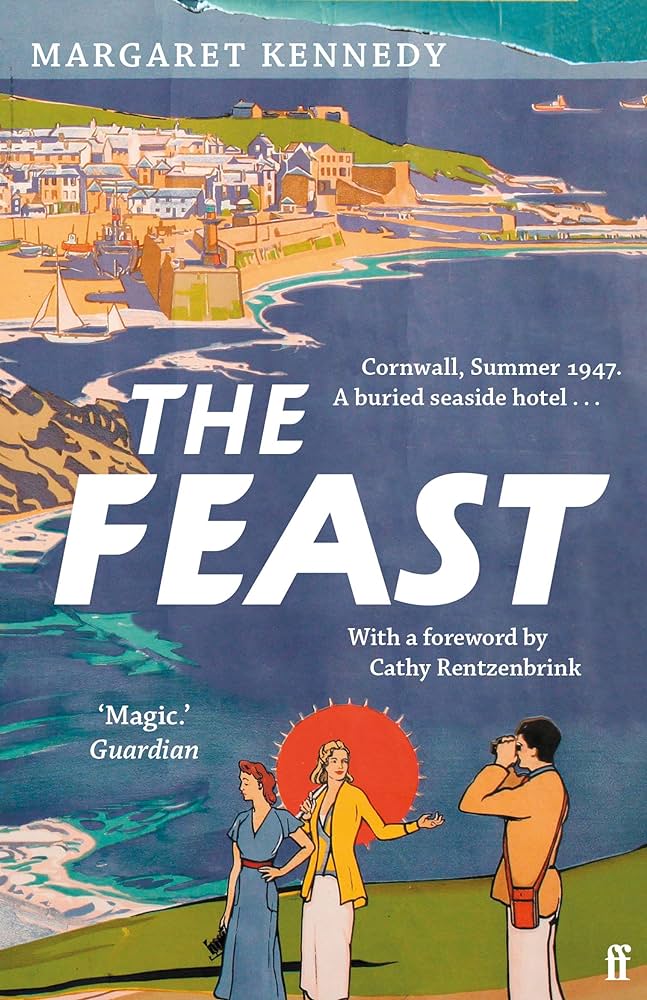
Summer seems to have finally arrived here in the UK, for a few days at least 🙂 So I thought I would post about a summer read which I really enjoyed recently. The Feast by Margaret Kennedy was published in 1950 and it’s set in 1947. Republished by Faber in 2021, they’re definitely marketing it as a summer read:

To describe the premise of The Feast is to do it a disservice in a way, because it sounds so trite and contrived. But I promise you that Kennedy is such a skilled writer that it works beautifully.

She sets it up the plot enticingly in the prologue. Two clergyman are holidaying together, but one of them has to work. Within Reverend Bott’s Cornish parish, there has been a catastrophe. A cliff has subsided into the sea, burying Pendizack Manor hotel and several of its inhabitants. Others escaped as they were at the titular picnic at the time, and they’ve told him quite a story… we then go back to seven days before the event to meet all the guests and staff who were there in run-up to the disaster.

It’s here that the overarching contrivance occurs – among the characters are representations of the seven deadly sins. We have the guests: Lady Gifford as greed; Mrs Cove as covetousness; Mrs Lechene as lechery; Canon Wraxton as wrath; and Mr Paley as pride. Amongst the staff we have owner Mr Siddal as sloth and housekeeper Miss Ellis as envy. Some of these characters are monstrous in their behaviour and yet Kennedy always keeps them recognisably human.

Lady Gifford is comparatively benign, albeit entirely self-serving, self-pitying and unconcerned with the impact she has on her family. Her husband no longer loves her, and the holiday brings their marriage to breaking point:

“For a few minutes he could not reply. At last he said, “I shall never live with you again. There’s nothing in life you value more than your saucer of cream.”

“Why shouldn’t I? I can afford cream. Why shouldn’t I go to live where the cream is?”

“I won’t live with you any more. You’re not human.”

Lady Gifford closed her eyes and lay back upon her pillows. Hard words break no bones, as both of them knew very well. He left her and went downstairs.”

While the Gifford’s children are disregarded, Mrs Cove actively wishes her children harm. She is one of the most disturbing characters in the book, neglecting her children to the point of abuse. As her daughter Blanche reflects:

“She did not love her mother. None of them did, nor had it ever occurred to them that they ought to do so. She had never asked for their affection. But neither did they criticize or rebel against her. She pervaded and ruled their lives like some unpropitious climate, and they accepted her rule as inevitable, evading its harshness by instinct rather than by reason. […] Nothing of importance had ever been said to them in their mother’s voice and many characters in their favourite books were more real to them than she was. They seldom thought about her.”

The younger members of the Gifford and Cove families join forces and provide some solace – and danger – for each other.

“The children vanished, rising up like a flock of starlings immediately after luncheon and betaking themselves to some hidden place. They retired into their own world, as children will when their elders misbehave. Bewildered, unable to judge, they turned their backs upon the ugly memory.”

Meanwhile, among the adults, alliances are forged and romances begun. The biggest change occurs in Canon Wraxton’s brow-beaten daughter Evangeline. At the start of the novel she has deeply worrying habit:

“Perhaps it was a waste of time, to grind up glass with a nail file, but surely nothing worse? Because she would never use it, she would never do anything wicked with it. And that little pill box full of powdered glass was such a relief to possess. They said it could never be detected in a person’s food…It was a very powerful little treasure, that box. She kissed it sometimes.”

But she develops a really touching friendship with Mrs Paley, whose marriage to the prideful Paul is utterly dead, and things start to change for them both:

They found a comfortable little hollow in some heather close to the shelter and lay upon their backs, side by side, watching the stars come out and discussing the best way to make the tea ration last. Neither felt the least impulse, just then, to confide in the other. But they knew what united them. They were a little astonished at themselves and inclined to giggle, as women will when they embark upon some daring adventure.”

But if I’ve made The Feast sound very dark, I’ve done it a disservice. Kennedy doesn’t shy away from the worst of human nature and her astute characterisation makes the behaviour all too real. But there are lighter moments too. Those of you who dislike historical fiction might enjoy Mr Siddal’s description of Anna Lechene’s craft:

“She writes well. Everybody does nowadays. She writes this biographical fiction, or fictional biography, whichever you like to call it. She takes some juicy scandal from the life of a famous person, and writes a novel round it. Any facts that don’t suit her go out. Any details she wants to invent come in. She’s saved the trouble of creating plot and characters and she doesn’t have to be accurate because it’s only a novel, you know.”

I also enjoyed this description of Sir Henry’s politics, breaking up a tense scene:

“Everybody seemed to be very angry. They were saying many things which Sir Henry himself had thought during the course of the day, but with which he now began to disagree. For he was a Liberal – the kind of Liberal which turns pink in blue surroundings and lilac at any murmur from Moscow.

In Pendizack Lounge he inclined to pink.”

The tension in the narrative occurs precisely because the reader knows what is going to happen and as the portraits of the various characters built over the week, I really hoped some of them ended up under the cliff while others survived!

The Feast is an enjoyable, compelling read with plenty to say and plenty to entertain.

To end, an English PEN event took place when Faber re-released The Feast. The discussion is really interesting particularly in giving some wider context around Kennedy’s writing:

“Love is at once always absurd and never absurd.” (Anthony Powell)

This is the sixth instalment in my 2024 resolution to read a book per month from Anthony Powell’s A Dance to the Music of Time sequence. Published between 1951 and 1975, and set from the early 1920s to the early 1970s, the sequence is narrated by Nicholas Jenkins, a man born into privilege and based on Powell himself.

The sixth volume, The Kindly Ones, was published in 1962 and is set around the start of World War Two. This felt a bit of a departure from previous volumes in some ways. We learn a lot more about Nick in this novel; he features much more directly in his own narrative. Powell also shockingly almost approaches a plot in The Kindly Ones, confounding my expectations 😀

The volume starts by looking back in time, with Nick remembering his childhood at Stonehurst, just before World War I broke out. My favourite character from At Lady Molly’s makes a reappearance: General Alymer Conyers, proving himself good in a crisis and kind to those who need it most.

He is visiting Nick’s parents, and I was interested to learn more about them. They are presented with the same clear-sighted economy with which Powell treats so many of his characters, which I found striking in consideration of close family. Nick doesn’t seem to like his father particularly, but there is no rancour or resentment there either:

“’I like to rest my mind after work,’ he would say. ‘I don’t like books that make me think.’

[…]

The one thing he hated, more than constituted authority itself, was to hear constituted authority questioned by anyone but himself. This is perhaps an endemic trait in all who love power, and my father had an absolute passion for power, although he was never in a position to wield it on a notable scale.”

Powell has a knack of presenting his characters with discernment, but without the heavy moral judgement which would make the volumes pretty unreadable. It’s an intelligent, sensitive approach and I think it contributes to writing that is so of its time still managing not to date badly.

It’s hard to see where Nick’s objectivity and distance from his entirely conventional upbringing has occurred, although his friend Moreland suggests maybe Nick’s life wasn’t as conservative as it seemed, in comparison to his own:

“’Ours was, after all, a very bourgeois Bohemianism,’ he used to say. ‘Attending the Chelsea Arts Ball in absolutely historically correct Renaissance costume was regarded as the height of dissipation by most of the artists we knew. Your own surroundings were far more bizarre.’”

Moreland isn’t doing so well, and in the second part of the novel Nick and Isobel have gone to stay with him and Matilda in the country.

“It became clear these fits of ennui were by no means a thing of the past. He would sit for hours without speaking, nursing a large tabby cat called Farinelli.”

They end up at a party with Sir Magnus Donners, where Nick’s old schoolfriend Templar is present with his wife Betty, who is thoroughly depressed. I was struck by the portrayals of female mental illness in this volume. Within this tale are two women who are suffering greatly and Powell treats them with understanding and compassion, never dismissing it with misogyny around ‘hysteria’ which I suspect was much more prevalent at the time.

At the start of the novel the Jenkins’ housemaid Billson has what we would probably now call a dissociative episode, which is where General Conyers intervenes in the manner I mentioned above. At Donner’s party years later, Nick’s compassion is with Betty rather than his friend:

“She had been shattered by the unequal battle. The exercise of powerful ‘charm’ is, in any case, more appreciated in public than in private life, exacting, as it does, almost as heavy demands on the receiver as the transmitter, demands often too onerous to be weighed satisfactorily against the many other, all too delicate, requirements of married life. No doubt affairs with other women played their part as well.”

The plot I was so surprised to find occurs in the next part of the story. During the childhood episode that begins the novel, we encounter mystic/charlatan Dr Trelawney. He reappears as Nick makes a visit to sort out his Uncle Giles’ effects at a seaside hotel and a somewhat dramatic scene ensues, which Nick helps to resolve by dredging up childhood memories. Dr Trelawney is a sinister character, as Nick observes in his room: “A scent vaguely disturbing, like Dr Trelawney’s own personality.” But he is not a comic creation, rather adding to the sense of foreboding around world events:

“There was something decidedly unpleasant about him, sinister, at the same time absurd, that combination of the ludicrous and alarming soon to be widely experienced by contact with those set in authority in wartime.”

If I’ve made The Kindly Ones sound very heavy though, I’ve done it an injustice. There are still plenty of comic moments to enjoy, such as the reappearance of the fortune-telling Mrs Erdleigh, who had met Nick’s late mother-in-law:

“’Lady Warminster was a woman amongst women,’ said Mrs Erdleigh.’ I shall never forget her gratitude when I revealed to her that Tuesday was the best day for the operation of revenge.’”

There is also Nick’s continued gentle ribbing of his brother-in-law: “Erridge, a rebel whose life had been exasperatingly lacking in persecution.”

And Widmerpool behaves with pomposity, even though he is always underscored by a sense of menace:

“I recognised that a world war was going to produce worse situations than Widmerpool’s getting above himself and using a coarsely military boisterousness of tone to which his civilian personality could make no claim.”

The novel ends with Nick getting his longed-for commission in the army as an officer. He could have joined as a squaddie but obviously that would never do 😀 (I can’t be too scathing about Nick’s reluctance/snobbery, given I’d be terrified to join the army and utterly useless if I did.)

I expect the next volume will cover the war years which have been building throughout the last few volumes. Given its title of The Valley of Bones, I wonder if Powell will allow Nick to sustain that ironic distance. I’ll be intrigued to find out.

“At the back of one’s mind sounded a haunting resonance, a faint disturbing buzz, that was not far from fear.”

“A sister can be seen as someone who is both ourselves and very much not ourselves – a special kind of double.” (Toni Morrison)

Many of you will know that Ali who blogs at heavenali is doing a year with Margaret Drabble throughout 2024. Ali’s posts of her Drabble reading so far have been really enticing and so I was determined to pick up this author whom I had never read.

A Summer Bird-Cage (1963) was Drabble’s first novel and was published when she was just 24. It’s a really impressive achievement and has definitely encouraged me to read more by her. (Which is lucky as someone cleared out their Drabble collection into my local charity bookshop recently, so there were several Penguin paperbacks with appalling 1980s covers available. Yes, I know it was preposterous to buy them all, but there was something about them all coming from the same reader and staying together that I liked. Also I’ll justify my book-buying any which way 😀 I think the same reader also cleared out their Penelope Livelys and I’m trying to resist…)

(I am genuinely perverse because I honestly wish, if I am going to have these monstrosities, that they were all the same style and the worst one, which to my eyes are the ones with the faces and the dark backgrounds. I just have to reassure myself that they’re all pretty terrible 😀 )

A Summer Bird-Cage is the examination of the relationship between two sisters, from the point of view of the younger one, Sarah, recently graduated from Oxford. She feels directionless and is returning from tutoring in Paris to see her older sister married. Louise also went to Oxford and she is academically less successful than Sarah; she is also breathtakingly beautiful.

A Summer Bird-Cage is an interesting period piece in many ways, as it captures that time when women had more freedom and more choices, but not quite enough. The expectations and pressures towards domestic fulfilment are still significant.

“I thought about jobs, and seriousness, and about what a girl can do with herself if over-educated and lacking a sense of vocation. Louise had one answer, of course. She was getting married.”

The sisters are not close at all and A Summer Bird-Cage is written with a refreshing lack of sentimentality but also a lack of any real jealousy. (Drabble’s sister was AS Byatt and they were both quite open about the fact that while they had a reasonable relationship most of the time, they also weren’t close.) At times Sarah may envy Louise her beauty, and the choices brought by her husband’s wealth, but most of the time she has a bemused indifference.

“There is just this basic antipathy, this long rooted suspicion, that kept us so rigorously apart.”

Sarah is definitely not jealous of Louise’s cold, snobbish husband Stephen, and I really liked this scene from a conversation she has with him at the wedding reception as Stephen pontificates on Art with a capital A:

“ ‘No no, the well-observed norm, that is what art is about. The delicacy of the perception will compensate for any lack of violence.’

 I think he was quoting from one of his reviews.”

We don’t really get to know Louise because Sarah doesn’t know her, and Drabble resists the temptation for fully-drawn, psychologically rounded portraits which would compromise the first-person point of view. Instead the novel portrays the unknowingness of other human beings, even those who are consistently in our lives to a greater or lesser degree.

“I wondered why she was such a mystery, why she didn’t fit together, why she was so unpredictable.”

There isn’t a plot as such, rather we follow Sarah through her first year out of university while her boyfriend is at Harvard; the unhappy lives of her friends; and the unhappy marriage of Louise. Sarah is young, and she can be snarky and judgemental. But what stops her being unbearable is that she fully acknowledges her own shortcomings, and will direct her snarkiness towards herself as much as anyone else:

“Sometimes it seems the only accomplishment my education ever bestowed on me, the ability to think in quotations.”

It’s astonishing to me that Drabble wrote A Summer Bird-Cage at just 24. There is the occasional sentence that is a bit too clever-clever and clunky, and the denouement felt a little bit clumsy given the way the sisters’ relationship had been portrayed up to that point, but these are really minor quibbles. If this is what she achieved in her first novel I can’t wait to see what heights she climbs to later in her writing.

“I don’t know why, but it was only then that I began to realise she was vulnerable. It seemed at the time like a clever and perceptive discovery, but I suppose that in fact it was extremely belated.”

You can read Ali’s wonderful review of this novel here.

To end, a trailer from the RSC’s 2014 production of The White Devil by John Webster, which is where the title of the novel comes from. Of course Sarah would name her book through a literary reference:

“The life of every man is a diary in which he means to write one story, and writes another.” (JM Barrie)

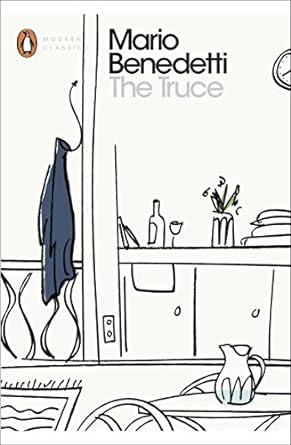
Continuing my endeavour to try and get some momentum back in my Around the World in 80 Books reading challenge, today I’m off to Uruguay, with Mario Benedetti’s The Truce: The Diary of Martín Santomé (1960, transl. Harry Morales 2015) which I was alerted to by Fiction Fan’s glowing review at the start of the year.

As the title suggests, the novella is in diary form, as Martín records his days in the run-up to his retirement, reflecting on how to live out his days. He is a quiet man in an administrative job; things are predictable.

“Today was a happy day; just routine.”

He is a widow of twenty years, and although he still has an eye for women (particularly their legs) he hasn’t had another relationship:

“The entire machinery of my emotions came to a halt twenty years ago when Isabel died. First there was pain, then indifference, then, much later, freedom, and then, finally, tedium. Long, lonely, constant tedium.”

His children Esteban, Jaime and Blanca are essentially unknown to him:

“At least Blanca and I have something in common: she, too, is a sad person with a calling for happiness.”

But although Martín is recording a lot of sadness, it’s not overly depressing. He has an acceptance of his life, and he makes quietly humorous observations, such as an old acquaintance learning of Isabel’s death:

“There is a sort of automatic reflex which makes one talk about death and then immediately look at one’s watch.”

Or his grief when his mother died:

“Only a fervent hatred of God, relatives and fellow man sustained me during that period.”

But things are about to change for Martín in ways he didn’t expect, when he falls in love with Laura Avellaneda, a work colleague half his age. While this would naturally raise questions about power dynamics and appropriateness, I felt it worked in The Truce, as Martín has been established as a gentle man, uninterested in wielding any sort of power or manipulation, and he is very respectful of Laura:

“I’m not going to demand anything. If you, now or tomorrow or whenever, tell me to stop, we won’t discuss the matter anymore and we’ll remain friends.”

In this short novel Benedetti perfectly evokes the gentle, slowly evolving love of Martín and Laura, and of Martín’s grief and acceptance of all he has lost in life alongside all that he still has. It suggests hope is still a realistic thing to hold onto, at any time.

The Truce isn’t sentimental, and although it depicts a romance it’s not rose-tinted. There is one point in particular where Martín behaves badly. He is not a perfect human-being and he causes hurt as well as joy to people.

But it is an empathetic tale, warmly clear-sighted towards ordinary people and all the foibles, weaknesses and strengths that we all carry.

The Truce is realistic, in a way that suggests even the most painful experiences can still be worthwhile. It explores how to not let pain overwhelm, and the importance of compassion for others and for the self:

They suffer from the most horrible variant of solitude: the solitude of someone who doesn’t even have himself.

This was my first experience of Benedetti and I’d be interested to read more by him. Apparently he wrote over ninety books so there’s plenty for me to choose from!

“Apparent simplicity of outlook is always suspicious.” (Anthony Powell)

This is the fifth instalment in my 2024 resolution to read a book per month from Anthony Powell’s A Dance to the Music of Time sequence. Published between 1951 and 1975, and set from the early 1920s to the early 1970s, the sequence is narrated by Nicholas Jenkins, a man born into privilege and based on Powell himself.

The fifth volume, Casanova’s Chinese Restaurant, was published in 1960 and begins by considering a bombed-out pub from World War Two, which triggers memories of the past and events of the 1920s and 1930s. It expands on relationships from the previous novels and portrays various marriages.

This shifting back and forth through time means characters who have died are resurrected, and minor ones expanded upon. Although perhaps they would rather not be, finding themselves the subject of Powell’s razor-sharp observations:

“The sight of Mr Deacon always made me think of the Middle Ages because of his resemblance to a pilgrim, a mildly sinister pilgrim, with more than a streak of madness in him, but then in every epoch a proportion of pilgrims must have been sinister, some mad as well.”

“[St John Clarke’s] name was rarely seen except in alphabetical order among a score of nonentities signing the foot of some letter to the press.”

The gathering alongside Mr Deacon at the pub leads to two of the main characters in this volume: Moreland the composer whom Nick befriends, and his acquaintance, the really quite disturbing music critic Maclintick.

“Under his splenetic exterior Maclintick harboured all kind of violent, imperfectly integrated sentiments. Moreland, for example, impressed him, perhaps rightly, as a young man of matchless talent, ill equipped to face a materialistic world.”

Marriage is the major theme of this volume, and the scenes of Maclintick’s domestic life are truly horrible. Only marginally more disturbing are the descriptions of Nick’s schoolfriend Stringham battling with his alcoholism, and his childhood secretary Miss Weedon opportunistically using it to control him.

There are of course lighter sides to the tale too. Powell takes his satirical eye to relationships between the sexes, both in dating:

“Barnby always dismissed the idea of intelligence in a woman as no more than a characteristic to be endured.”

And later in marriage, as Moreland laments: “I shall be glad when this baby is born. Matilda has not been at all easy to deal with since it started. Of course, I know that is in the best possible tradition.”

Powell doesn’t dwell on Nick’s marriage to Isobel in great detail, but in the brief glimpses we have they seem happy together, despite sadnesses to contend with. Nick also seems to enjoy his extended, eccentric in-laws. Erridge has gone to fight in the Spanish Civil War, without success:

“His time in Spain seems to have been a total flop. He didn’t get up to the front and he never met Hemingway.”

There’s also Nick’s description of his mother-in-law Lady Warminster, more affectionate than biting: “She looked as usual like a very patrician Sibyl about to announce a calamitous disaster of which she had personally given due and disregarded warning.”

By far my favourite scene was at Lady Warminster’s party, where the reader gets to know St John Clarke further, his having made only brief appearances in previous volumes:

“He came hurriedly into the room, a hand held out in front of him as if to grasp the handle of a railway carriage door before the already moving train gathered speed and left the platform.

‘Lady Warminster, I am indeed ashamed of myself,’ he said in a high, rich, breathless, mincing voice, like that of an experienced actor trying to get the best out of a minor part in Restoration comedy. ‘I must crave the forgiveness of you and your guests.’

He gave a rapid glance round the room to discover whom he had been asked to meet, at the same time diffusing about him a considerable air of social discomfort.”

Nick’s touchstone of Widmerpool only makes brief appearances: “I should never have gone out of my way to seek him, knowing, as one does with certain people, that the rhythm of life would sooner or later be bound to bring us together again.” but he manages to seem an entirely menacing background presence regardless.

I’m enjoying A Dance to the Music of Time more and more. Powell’s satire is never bitter or leaves me feeling uncomfortable, as satire can sometimes do. He’s clear-sighted and affectionate without being sentimental. Returning to the sequence is starting to feel like catching up with your wisest, wittiest friend. An absolute delight.

“Marriage, partaking of such – and thousand more – dual antagonisms and participations, finally defies definition.”

To end, if either of The Proclaimers are married, then I hope they wore nicer suits at their actual weddings:

“I record these speculations…to emphasise the difficulty in understanding, even remotely, why people behave as they do.” (Anthony Powell)

I’ve just managed to keep up my 2024 resolution to read a book per month from Anthony Powell’s A Dance to the Music of Time sequence this April! It’s been a bit of a month and May looks equally challenging so I won’t be doing my Novella a Day in May this year, though I will focus on novellas for the month as I had some lined up that I’m really keen to read.

Back to A Dance to the Music of Time! Published between 1951 and 1975, and set from the early 1920s to the early 1970s, the sequence is narrated by Nicholas Jenkins, a man born into privilege and based on Powell himself.

The fourth volume, At Lady Molly’s, was published in 1957 and is set in the 1930s before the start of World War Two. Politics is only mentioned very occasionally though, and the focus remains on the relationships between an insular set of people.

This is the volume where I started to get a sense of the dance. With marriages a strong theme, the characters circle around, encountering one another for periods before spinning off again. Others weave in and out.

 Nick is now working as a script writer and his affair has ended. At the start of the novel he is taken by a colleague to a party at Lady Molly Jeavons. Once again he runs into acquaintance/talisman Widmerpool:

“Yet, for some reason, I was quite glad to see him again. His reappearance, especially in that place, helped to prove somehow rather consolingly, that life continued its mysterious, patterned way. Widmerpool was a recurring milestone on the road”

Widmerpool is engaged to Mildred Haycock, who is quite a few years older than him and has a colourfully described past. Later we learn that Widmerpool’s political aspirations are growing, and there is a chilling speech he gives Nick over lunch at his club, in favour of appeasement of Hitler.

Once again I was struck by Powells astute, clear-sighted assessment of people. Surrounded as it is by a satirical comedy of manners, he can really pack a punch when he chooses.

“Sentiment and power, each in their way, supply something to feed the mind, if not the heart. They are therefore elements operated often to excess by persons in temperament unable to love at all, yet at the same time unwilling to be left out of the fun, or to bear the social stigma of living emotionally uninteresting lives.”

There are lighter portraits too of course. My favourite in At Lady Molly’s was retired General Alymer Conyers. In his eighties, he spends his retirement reading Virginia Woolf, practising the cello, and learning about psychoanalysis:

“‘Been reading a lot about it lately,’ said the General. ‘Freud – Jung – haven’t much use for Adler. Something in it, you know. Tells you why you do things. All the same, I didn’t find it much help in understanding Orlando.’

Once more he fell into a state of coma.”

Quiggin and Mona Templar reappear (“She was like a strapping statue of Venus conceived at a period when more than a touch of vulgarity had found its way into classical sculpture.” Ouch.) living in a cottage owned by Erridge, who is now Lord Warminster. The lord of the manor dresses in scrappy clothes, has a big beard and gives a lot of his money away to good causes. I work near Shoreditch so none of this sounds like remotely remarkable manhood to me, but to his 1930s aristocratic family he seems mad. I’ve read somewhere he may have been based on George Orwell!

Nick meets two of Erridge’s sisters when he visits, including Isabel, “a bit of a highbrow when she isn’t going to night clubs”. He falls in love at first sight but their courtship happens entirely away from the eyes of the reader. Powell’s interest isn’t romance, but rather the dynamics of relationships and how these play out in the wider world.

“Women may show some discrimination about whom they sleep with, but they’ll marry anybody.”

There are so many ways A Dance… is of its time (which I think is exactly as intended) but it also doesn’t age, through Powell’s astute characterisation. I was very struck by this comment early on in At Lady Molly’s:

“One of those men oddly prevalent in Victorian times who sought personal power through buffoonery”

You don’t have to look very far back through our Prime Ministers to find a much more recent example…

I absolutely whizzed through At Lady Molly’s and I’m really looking forward the next volume, Casanova’s Chinese Restaurant.

To end, a beautifully simple rendition of a song about Molly:

“It was an uncertain Spring.” (Virginia Woolf, The Years)

This is my final post for the brilliant1937 Club, which has been running all week and hosted by Kaggsy at Kaggsy’s Bookish Ramblings and Simon at Stuck in a Book. In the end I did stick to my planned reads for the week:

Apparently Leonard Woolf thought The Years the poorest of Virginia’s novels, but it was also far and away her best-selling work. So I was intrigued to know how I’d find it…

The titular years of this novel are 1880;1891;1907;1908;1910; 1911;1913;1914;1917;1918; and the Present Day. And so Woolf covers the end of the Victorian era to World War I and beyond, through the lens of the middle-class Pargiter family. Except for 1880, she portrays one day in their lives, some with significant events, others very ordinary.

In 1880, Rose Pargiter, mother to young adults Eleanor, Morris and Edward, teenagers Milly and Delia, and pre-teens Martin and Rose, is in bed in their London townhouse, dying from a long illness. Woolf captures the conflicted feelings and strain for the family around this time, particularly for Delia:

“She longed for her to die. There she was – soft, decayed but everlasting, lying in the cleft of the pillows, an obstacle, a prevention, an impediment to all life. She tried to whip up some feeling of affection, of pity. For instance, that summer, she told herself, at Sidmouth, when she called me up the garden steps…But the scene melted as she tried to look at it.”

Over in Oxford where Edward is studying, their cousin Kitty is trying to find a role for herself and struggling against the constraints of late Victorian womanhood:

“”When I was your age,” Miss Craddock continued, remembering her rôle as teacher, “I would have given my eyes to have the opportunities you have, to meet the people you meet; to know the people you know.”

“Old Chuffy?” said Kitty, remembering Miss Craddock’s profound admiration for that light of learning.

“You irreverent girl!” Miss Craddock expostulated. “The greatest historian of his age!”

“Well, he doesn’t talk history to me,” said Kitty, remembering the damp feel of a heavy hand on her knee.”

Each time Woolf jumps forward, she trusts the reader to keep up and doesn’t get bogged down by lots of explanation or exposition. We are given a snapshot the characters, whoever she is focussed on, and we fill in the gaps to a greater or lesser extent.

There are phrases and echoes across the different sections, tying them all together and giving a coherence to what could have been a more fragmentary, less satisfying novel. I also liked the repeated motif of starting each section with a birds-eye view of the time of year. I was particularly fond of this opening to 1908:

“It was March and the wind was blowing. But it was not “blowing.” It was scraping, scourging. It was so cruel. So unbecoming. Not merely did it bleach faces and raise red spots on noses; it tweaked up skirts; showed stout legs; made trousers reveal skeleton shins. There was no roundness, no fruit in it. Rather it was like the curve of a scythe which cuts, not corn, usefully; but destroys, revelling in sheer sterility. With one blast it blew out colour – even a Rembrandt in the National Gallery, even a solid ruby in a Bond Street window: one blast and they were gone. Had it any breeding place it was in the Isle of Dogs among tin cans lying beside a workhouse drab on the banks of a polluted city.”

As the above shows, Woolf grounds her tale in a recognisable topography and as always I found her descriptions of London detailed and realistic, and of Oxford too, even all these years later.

Alongside these recognisable realities, there was also plenty to enjoy regarding Woolf’s unique and arresting descriptive powers. I’m a big fan of Woolf and I just love her way of capturing inner moments, especially unreal, discombobulating moments, such as Eleanor at a dinner party during an air raid:

A little blur had come round the edges of things. It was the wine; it was the war. Things seemed to have lost their skins; to be freed from some surface hardness; even the chair with gilt claws, at which she was looking, seemed porous; it seemed to radiate out some warmth, some glamour, as she looked at it.”

Woolf brings all the characters together in the final section for a party given by Delia. She emphasises the fallacy of a reunion by highlighting the aloneness felt by many of the family. North, son of Morris, is back after many years abroad and feels detached from everything. His sister Peggy is somewhat bitter and frustrated. She tries to get Eleanor to talk about the Pargiters childhood, but Eleanor is much more interested in life now.

“That was odd, it was the second time that evening that somebody had talked about her life. And I haven’t got one, she thought. Oughtn’t a life to be something you could handle and produce? – a life of seventy odd years. But I’ve only the present moment, she thought. Here she was alive, now, listening to the fox-trot. […] Yes, things came back to her. A long strip of life lay behind her. Edward crying, Mrs. Levy talking; snow falling; a sunflower with a crack in it; the yellow omnibus trotting along the Bayswater Road. And I thought to myself, I’m the youngest person in this omnibus; now I’m the oldest…Millions of things came back to her. Atoms danced apart and massed themselves. But how did they compose what people called a life?”

There isn’t a plot so much in The Years, only as much as there are plots to any life. Woolf captures times and places for a particular family without trying to drive the novel unrealistically. Yet The Years is still a pacy read, the driving forces being the times that are lived through and the human will to carry on.  

To end, some footage of 1930s London, although I doubt Virginia ever got herself caught up with rush hour workers: