“Never despise the translator. He’s the mailman of human civilization.”(Alexander Pushkin)

This week I thought I’d use Kaggsy and Lizzy’s #ReadIndies event to focus on one indie publisher, and finally get to four books that have long been languishing in the TBR. Pushkin Press “publish some of the twentieth century’s most widely acclaimed and brilliant authors” and they are one of my favourite indies, ever-reliable. Which hasn’t stopped four from their Collection series remaining unread by me for far too long!

Today I’m starting with The Buddha’s Return by Gaito Gazdanov (1949-50, transl. Bryan Karetnyk 2014). Gazdanov was a Russian writer exiled in France and this short novel, described by the publishers as “part detective novel, part philosophical thriller, and part love story” is set in Paris, as much as it is set anywhere – reality is not a consistent concept in this story at all.

The narrator is a student who is experiencing prolonged periods of hallucinations. He tells us from the start that he is an unreliable storyteller:

“Nowhere was there any logical pattern in this, and the shifting chaos clearly failed to present even a remote semblance of any harmonious order. And so, accordingly, at that point in my life, which was marked by the constant attendance of chaos, my inner existence acquired an equally false unwavering character.”

We slide back and forth between a recognisable reality of his poverty-stricken life in Paris and his disturbing, disorienting visions, without always knowing which is which. Early on in the novel he falls to his death from a sheer mountainside, later he is arrested and interrogated by the Central State. The government’s accusations of treason are entirely surreal and illogical, yet this is also what makes them horribly believable.

There is political commentary running through the novel, but the kaleidoscopic nature of the narrative means it is not a sustained satire on any particular country, ruler or party, but rather a wider condemnation:

“The ignorant, villainous tyrants who so often ruled the world, and the inevitable and loathsome apocalyptic devastation apparently inherent in every era of human history.”

Around halfway through, more of a plot emerges as Pavel Alexandrovich, an older man whom the student befriended, is murdered and his golden statuette of Buddha stolen. As the last person to see Alexandrovich alive, the student falls under suspicion. The real-life interrogation by the investigators has shades of the surreal fantasy interrogation by the Central State:

“If we can find the statuette, you’ll be free to return home and continue your research on the Thirty Years War, the notes on which we found in your room. I must say, however, that I completely disagree with your conclusions, and in particular your appraisal of Richelieu.”

As that quote shows, there is humour in The Buddha’s Return and this lightens a tale which has a lot of dark elements: visceral war scenes, squalor, and of course murder.

Apparently, The Buddha’s Return was originally published in instalments and I can see it would work well in this format. I enjoyed it but for me the more plot-driven second half arrived at just the right time, when I’d started to feel it was losing momentum. As it was I enjoyed this consistently surprising tale which still had enough recognisable humanity in it to be involving, and I’d be keen to read more by Gazdanov.

“I have a suspicion that you just dreamt the whole thing up. It’s because you read too much, eat too little and spare hardly any thought for the most important thing at your age: love.”

“Borderline, feels like I’m going to lose my mind.” (Madonna)

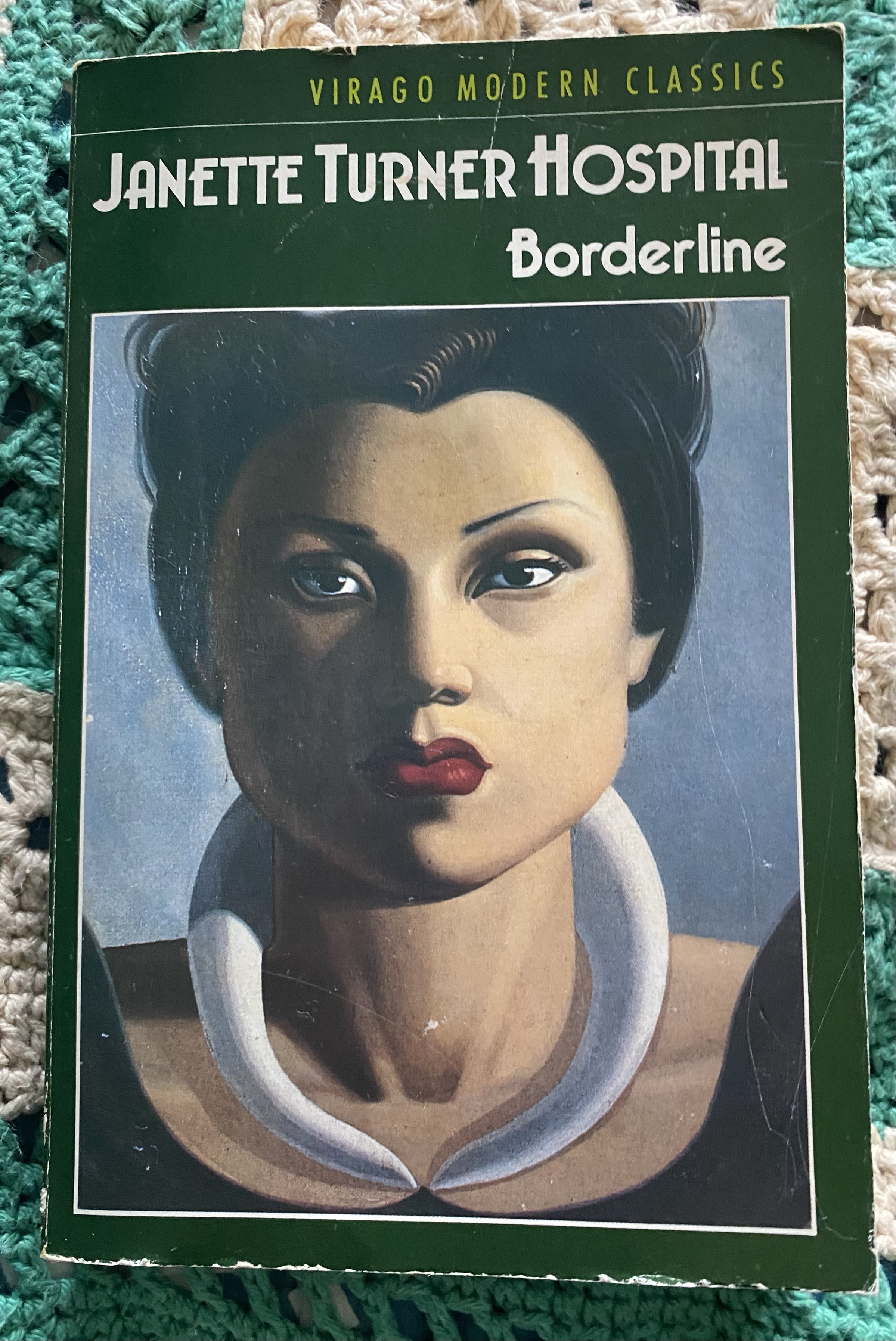
Somehow I’ve accumulated several Janette Turner Hospital books in the TBR, without ever managing to get round to reading any of them. So thank goodness for AusReading Month 2023 hosted by Brona at This Reading Life which finally got me to pick one up!

Borderline is JTH’s third novel, published in 1985. The blurb on the back describes it as a metaphysical thriller, but I don’t think that’s a helpful description. There are thriller elements but what JTH is more concerned with is the unreliable narratives we tell ourselves and others; how we can love those who remain so unknown to us; and the unpredictability of all our lives that can change in an instant. These themes don’t lend themselves to definite resolutions, so those seeking a thriller will be disappointed.

However, if you’re happy to go along with an exploration of these ideas that ends without any neat answers, there’s a lot to enjoy in Borderline.

The narrator is Jean-Marc, a man who has always had a slightly Oedipal relationship with his father’s girlfriend, Felicity. Seymour aka Old Volcano, was an artist much older than Felicity, who was nearer in age to her stepson.

“When I was five, my father was already famous and my mother was mostly distraught. Later she escaped. She made a quantum leap into banality. Which is the true secret of happiness – a second marriage, a very ordinary life, other children. Naturally she does not care to see me, a revenant from that earlier bad time, and I do not blame her at all.”

Felicity and Seymour’s relationship inevitably ends, and Felicity becomes a successful art dealer. She is returning from a trip when, at a border crossing between the United States and Canada, she makes the impulsive decision to smuggle Dolores Marquez, a refugee from El Salvador, with the help of a man called Gus.

Gus’ full name is Augustine, he’s a salesman who is routinely unfaithful to his wife. Felicity calls Dolores La Magdalena after a painting. People in this novel have different names, different roles, splintered lives. They disappear and no-one knows where to begin looking for them.

Gus’ daughter Kathleen turns up at Jean-Marc’s house, and their relationship seems to almost transgress boundaries, but not quite. As they try and locate their loved ones, Jean-Marc acknowledges that he is filling in a lot of gaps with very little to go on:

“Her stories bombard me, they seem to have become my own memories, they writhe and change and regroup in the way true memories do. They are like photographs in her grandfather’s dresser, a deluge of the ever-present past.”

The plot of Borderline is enough to pull the reader along, but this is not the novel to read if you want a plot-driven story. Jean-Marc tracks Felicity as best he can, but she remains out of reach. The stories in Borderline are unclear in origin: what Jean-Marc has experienced, what he has been told, what he is making up.

“Her days are baroque, they curl into each other like acanthus leaves, she lives somewhere between now and then. She moves in and out of her life.”

“Still, I have to admit, there has always been a quality of absence about her; which is why her disappearance itself seems insubstantial, merely a figure of speech, or a trick of the light, a momentary thing.”

I would completely understand if someone experienced this novel as a frustrating and disappointing read. However, I felt Borderline was an effective exploration of how human beings try and make sense of themselves, each other and the world when so much remains unknown and chaotic. It has some truly breathtaking passages and JTH is absolutely a writer I’d like to explore further.

To end, let it never be said that I shy away from the obvious in my 80s song choices 😀

Novella a Day in May #7

After Claude – Iris Owens (1973) 206 pages (cheating my own criteria by 6 pages)

Trigger warning: mentions rape

I bought this one day when I finished the book I was reading more quickly than expected and I was waiting for a friend, who was late. I don’t like being without a book to read on my person and I found a late-opening charity shop. Amongst the Da Vinci Codes and James Patterson’s entire back catalogue I was thankful to spy a New York Review of Books logo. They’re a reliable, interesting publisher and so I found myself launched into the acerbic wit of Iris Owens, totally unprepared.

After Claude is funny, but it also features a despicable heroine. Kudos to Owens for not feeling it is necessary to write an attractive, likeable female for her lead, but really, Harriet Daimler is one of the most infuriating, obnoxious and unpleasant people ever committed to paper. She moves from friend to friend, sponging off them until her unrelenting selfishness alienates them and they chuck her out. She may be depressed: she sleeps all day, watches trashy quiz shows and eats, that’s it. But any sympathy the reader may feel is limited by her rudeness, prejudice and manipulations towards all who cross her path. She frequently uses homophobic language; she is racist; she denies her own Jewishness without realising that her denials illuminate that which she is trying to hide:

“ ‘Mazeltov,’ he congratulated me in an unfamiliar tongue.”

Who doesn’t know what Mazeltov means?  Harriet is also completely delusional. The story begins “I left Claude, the French rat.” What quickly emerges is that Claude has thrown her out, sick of her utter selfishness and bitterness.

“Claude, who had learned his English in England, spoke with one of those snotty, superior accents, stuffed into a slimy French accent, the whole mess flavoured with an occasional American hipsterism, making him sound like an extremely rich, self-employed spy.”

What Claude quickly learns is that trying to throw someone out who won’t listen and is totally self-interested, is no mean feat.

“ ‘Me a bore?’ I laughed, amazed that the rat would resort to such a bizarre accusation. I have since learned never to be amazed at what men will resort to when cornered by a woman’s intelligence.”

Over the course of the story we learn how Harriet and Claude met, when she was thrown out of her friend Rhoda’s house, for something horrific which I won’t include for fear of spoilers, but would you live with someone who treated you thus?

“Had I been insensitive when I told her ‘Rhoda, I have nothing per se against your karate classes but rather than pin all your hopes on a rapist, wouldn’t a cruise make more sense?’”

What kept me reading was partly wanting to see what would happen to someone so extremely selfish and self-serving that normal rules don’t apply: Harriet could do anything. Also, amongst the rancour are some bitingly funny observations, such as this regarding a friend’s marriage:

“It goes without saying that though ideally suited and ecstatically happy, Jerry and Maxine had flown directly from their wedding ceremony to group therapy, paying top prices for the privilege of insulting each other in front of an audience.”

What happens to Harriet after Claude is bizarre. She meets a guru-type and ends up begging to be allowed to join their cult, even after suffering sexual humiliation at their hands. Ultimately then, Harriet is both horrible and pitiful, extremely vulnerable but bent on destroying anyone who might want to help.

Like a pratfall in which someone ends up genuinely hurt, After Claude is funny but you feel you shouldn’t laugh; it’s painful and you want to tear your eyes away. Owens is an accomplished writer but I’m not sure I could have stood a much longer novel.