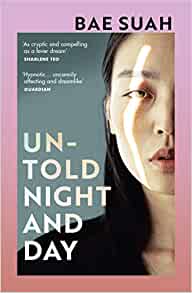
Untold Night and Day – Bae Suah (2013 trans. Deborah Smith 2020) 152 pages
When I see writing described as dreamlike, I often think of highly metaphorical language, perhaps with a heavy emphasis on sensory experience, and with an unreal quality. Untold Night and Day is definitely dreamlike, but not quite in the ways I’ve described.
It initially seems very much grounded in everyday experiences. Where it becomes dreamlike is that it follows its own logic, jumping about with recurring motifs, in a way that makes sense within itself but becomes more disconcerting the more you consider it.
“A man carrying a kitten in a birdcage pressed himself against the opposite wall of the alley to avoid her car. He was a preacher, a well-known figure in this alley; he went around surreptitiously stuffing pieces of paper bearing Bible verses into people’s pockets, so he’d been mistaken for a pickpocket and arrested more than once. While she waited for the lights to change at the end of the alley, the woman driving the green car took her hand off the wheel and raised a bottle of water to her lips. Still with the phone to her ear. Against the regular growl of the engine, the hum of the air conditioning.”
These images and characters recur throughout the novella, each time with their context slightly shifted. There are other repeated motifs, including to The Blind Owl, a deeply disturbing novella which I read back in 2019. The shifting repetitions unsettle the story but also ground it in its own world.
Ayami is a former actor who works at an audio theatre. We join her at the end of her last shift, in the oppressive heat of Seoul, where through the night she and her boss search for their missing friend Yeoni. The following day, she shows round a German writer who never wanted to be in Korea in the first place.
The two times echo each other and almost merge, but whenever the narrative almost seems on the verge of entirely disintegrating, it holds on to that interior logic and somehow pulls you along, trying to work out what is happening and where Yeoni could be.
“That was the secret of night and day existing simultaneously. Ayami discovered this through a single movement, bending down to pick up the pebble. And, remembering this simultaneous existence more vividly than she remembered herself, became unable to remember anything else.”
I realise this may be an entirely unhelpful review as I’ve not really said very much! But hopefully I’ve given a sense of why this novella is hard to describe and hard to review. I enjoyed it, but definitely not one to read when you’re in the mood for a linear plot and all questions answered at the end…
“I have to record whatever comes into my head in the same place it happens. Things occur to me as images, and as forms, not as words arranged into sentences. The images quickly dissipate after the moment’s passed, and once that happens there’s no way for me to capture them in language.”
 madame bibi lophile recommends