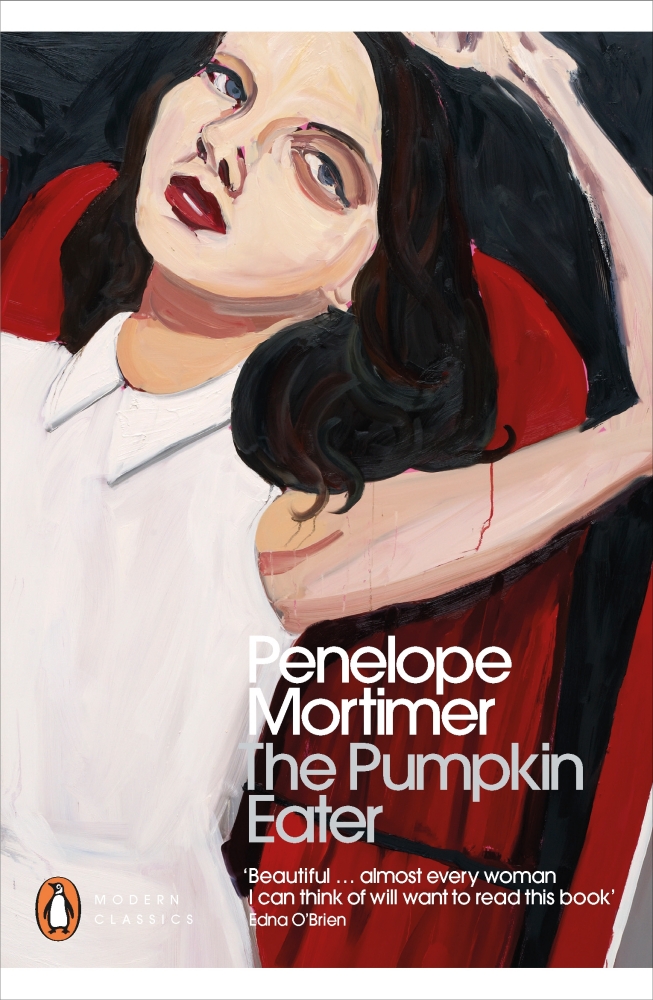
The Pumpkin Eater – Penelope Mortimer (1962) 144 pages
The Pumpkin Eater begins with a woman speaking to her psychiatrist, a silent interlocutor with whom she reflects on the pressures her unhappy marriage exerted on her mental health. We come to know her as Mrs Armitage, wife of a successful screen writer, Jake Armitage, who is selfish and unfaithful. Although Mrs Armitage has been married before, she feels as trapped in this marriage as any 1960s wife who would be reluctant to ask for a divorce.
“It must have been then, I think, that Jake and life became confused in my mind, and inseparable. The sleeping man was no longer accessible, no longer lovable. He increased monstrously, became the sky, the earth, the enemy, the unknown. It was Jake I was frightened of; Jake who terrified me; Jake who in the end would survive. He rolled over, his mouth slightly open, and began to snore.”
Mrs Armitage lives in London while they are building a big glass tower of a family home in the countryside. Jake frequently travels, leaving her with their ever-increasing number of children. As tensions between them increase, Mortimer brilliantly portrays “the complex, subtle and occasionally tragic conversations which are the last resort of communication between men and women.”
It is thought that this novel was semi-autobiographical, detailing the disintegration of the author’s marriage to John Mortimer, and it is absolutely scathing in its treatment of the male protagonist:
“His eyes were still quite empty, and I realised now that they never changed, even in love.”
However, Mortimer does not just tear Jake/John apart, The Pumpkin Eater is better than that. She is interested in the destructiveness of human relationships, with those we claim to love.
“We should have been locked up while it lasted, or allowed to kill each other physically. But if the choice had been given, it would not have been each other we would have killed, it would have been ourselves.”
I’ve made this sound heavier than it is; I think Mortimer writes this unflinching dissection of a marriage with a heavy dose of bone-dry humour. Ultimately, The Pumpkin Eater is, if not exactly optimistic, about how we survive such pain and how it possible to endure.
“I began, very tentatively, to believe in myself. It was as though I were feeling my own face with my fingertips in the dark.”
 madame bibi lophile recommends
Nope, not even tempted! Hurrah! Keep it up! 😉
LikeLiked by 1 person
Nooo! I can’t have this. Must think of some FF-friendly novellas double quick!
LikeLiked by 1 person
That final quote offere a much-needed note of hope.
LikeLiked by 1 person
Yes, I think I’ve done this one a slight injustice and made it sound much bleaker than it is. It’s certainly a tough portrait of a marriage but it’s resolute and hopeful too.
LikeLiked by 1 person
I wanted to read this one a couple of years ago and it was in the basement reserve stock section of the local library. I ordered it and then they said they couldn’t find it. I think I’m in the market for bleak portrayals of marriage – especially if they are hopeful too!
LikeLiked by 1 person
That’s a shame, hopefully a copy will cross your path soon. The marriage is fairly bleak but the woman is strong and not destroyed by being married to someone so awful, so it’s a good one to read!
LikeLike
On my wishlist, I haven’t read enough by this author.
LikeLiked by 1 person
This was the first of hers I read & I was impressed. I hope you enjoy it when you get to it Ali. I’ve just started Daddy’s Gone a-Hunting now, a lovely Persephone edition 🙂
LikeLike
Well, I’m very tempted – and I think I actually have a copy somewhere!!! *runs off to check* 😁
LikeLiked by 1 person
Excellent – I hope you find it!
LikeLiked by 1 person
I found some funny bits in it:) See the quotation where Ireen thinks her life is over because they have to holiday in Littlehampton instead of Spain: https://anzlitlovers.com/2015/06/21/the-pumpkin-eater-by-penelope-mortimer-bookreview/
LikeLiked by 1 person
Great review Lisa! For some reason on my phone I can’t get a comments box to come up on your blog so apologies for not leaving a comment. It is a funny book, I think I did it a disservice in this review not emphasising that enough. And the scene with the wool you mention in your review is actually quite chilling: it’s easy to forget how far we’ve come in such a short space of time.
LikeLike
Pingback: “When a Welsh person loves you, you’ll finally know how it feels to belong to poetry.” (Kamand Kojouri) | madame bibi lophile recommends