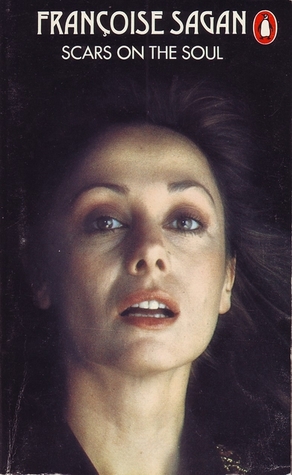
Scars on the Soul – Francoise Sagan (1972 trans. Joanna Kilmartin 1974) 124 pages
This is a strange novella. It’s a story of a Swedish brother and sister living in France, and an extended reflection on Sagan’s writing life: a direct address to the reader.
“It isn’t literature, it isn’t a true confession, it’s someone tapping away at her typewriter because she’s afraid of herself and the typewriter and the mornings and the evenings and everything else.”
Sagan tells the story of Sebastian and Eleanor van Milhelm who are entirely feckless and devoted to one another.
“Life without her, drink without her, were like lukewarm water, Not a bad thing, all said and done, to have one’s life circumscribed to that extent by someone who – whatever she might say – was as much his slave as he was hers.”
While they are not quite incestuous, they certainly have an unhealthy attachment to one another. They move around living off their looks, finding benefactors who will pay for their lifestyle so that neither have to get jobs.
“ ‘Someone’ being that providential person who, because of their charm, their wit, their luck, would act as temporary provider for brother and sister. This person so far had never failed to materialise and was usually discovered by Sebastian, Eleanor, as in this case, being too lazy to go out.”
Yet the van Milhelms are not despicable. They are not malicious or even particularly manipulative; there is the sense that those they live off share an understanding whereby everyone knows what the deal is. There is a sense of ennui as their lives are essentially empty, yet it’s a sad story rather than a depressing one.
Scars on the Soul is certainly a post-modern novella, drawing attention to the art of Sagan as a writer and the artifice of the novel.
“There are moments when I’m on the point of writing ‘But I digress,’ an old-fashioned courtesy to the reader, but pointless in this case, since my purpose is to digress. Nevertheless, this blow-by-blow account of eroticism has irritated me. I’m returning to my van Milhelms ‘who frequently indulge in that sort of thing but never talk about it.’”
I think this novella wouldn’t be for everyone, as it is neither one thing nor the other – not fiction or non-fiction, not short story or essay. Yet I found it satisfying. I was invested in the van Milhelms story and I enjoyed Sagan’s witty reflections on writing and her fame after many years (this was written in her late 30s after the success of Bonjour Tristesse at the prodigiously young age of 18). It’s not something to read when you want a meaty, plot-driven story but Sagan is a hugely talented, skilled writer and there is much of interest here both in the fiction and in the portrait of one writer’s life.


This sounds quite different from the other Sagans I’ve read, mostly on account of the dynamic between the two siblings. I do think she has a real ability to convey her characters’ emotions through her writing; it’s something that always comes through very clearly.
LikeLiked by 1 person
I’ve only read Bonjour Tristesse so I don’t know how different this is, but it’s certainly an unusual novel. I totally agree – she’s wonderful at capturing the feelings of her characters, they’re always so believable.
LikeLike
How interesting! As I read your introduction Delphine de Vigan’s Based on a True Story popped into my head. Sagan’s novella sounds like a piece of autofiction, quite unusual in the ’70s I would think. I wonder how it was received.
LikeLiked by 1 person
I’ve not read Based on a True Story though I’d like to. I’m not sure what the response was at the time, but I think you’re right, it would have been an unusual piece of writing for the time – it still is in many ways.
LikeLiked by 1 person
Sagan can be…. strange! I’ve read a couple of the early titles and then a later one and it was a bit odd. Her writing is excellent as you say, but I think her plots sometimes suffer…. 😉
LikeLiked by 1 person
Yes, I’m not really sure this could claim to have a plot! I did enjoy it though.
LikeLiked by 1 person
It reminded me of Based on a True Story too, a book I abandoned halfway through… 😀
LikeLiked by 1 person
I’ve failed you again FF! *shameface* but there’s at least one I’ve got planned for this week that I think you’ll like…
LikeLiked by 1 person
I’ve always meant to read more of Sagan’s work, having only read Bonjour Tristesse. This does soubd intriguing.
LikeLiked by 1 person
It’s really unusual Cathy. I’d like to read more of her work too, maybe a more plotted novel like Bonjour Tristesse.
LikeLike