Mallika at Literary Potpourri’s wonderful event Reading the Meow has been running all week, do check out all the great posts prompted by our feline friends! Here is my post just in time…
I’m grateful to Reading the Meow for finally getting me to pick up The Master and Margarita by Mikhail Bulgakov (finished in 1940, published in 1966) which is part of my Le Monde’s 100 Books of the Century Reading Challenge and has been languishing in my TBR for years. Although not ostensibly a book about cats, one does feature prominently as these various edition covers will attest:

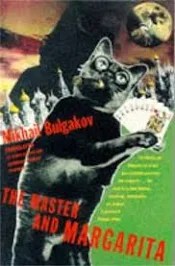
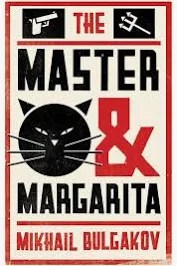

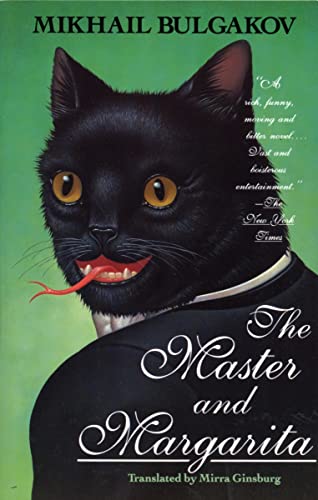
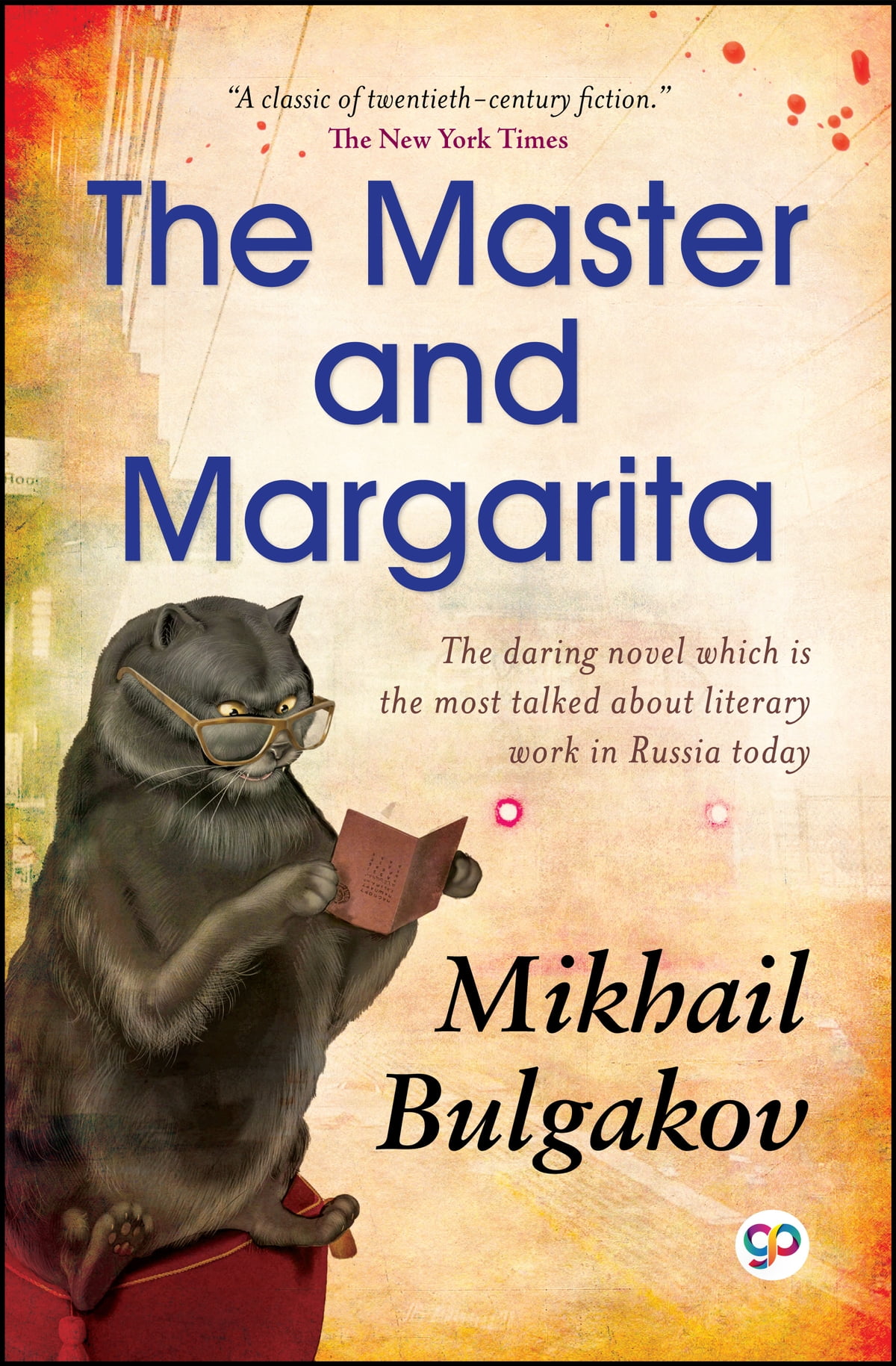
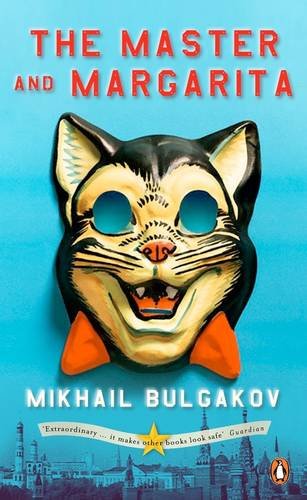
The reason it had lain unread for so long was because I’m (aptly) a big scaredy-cat. I was really intimidated by this classic of twentieth-century fiction and I thought it would be far too complex and clever for me to understand. Which as it turned out, was broadly correct. I’m sure I didn’t pick up all the allusions and references, even with the notes in the back of my edition to help me (Alma Classics, trans. Hugh Aplin 2020 – I definitely recommend this edition and translation). However, I still found it very readable and a lot to enjoy, especially regarding Behemoth, the character that meant I was reading it this week particularly.
The Devil arrives in 1930s Moscow as a Professor Woland, along with his entourage: red headed, bizarrely dressed Korovyev; sinister vampiric Azazello; beautiful Hella; and Behemoth, an enormous cat that walks on his hindlegs, talks, drinks vodka and plays chess.
The proceed to wreak havoc for three days in a series of carnivalesque scenes, using the greed and corruption of people against them. It’s absolute chaos and carnage, but brilliantly Bulgakov shows that the devil doesn’t have to push very hard for all this to occur.
At the start of the novel, Woland predicts the shocking and absurd death of Berlioz, head of Massolit, a literary organisation. Once people hear of his death, this description of a barrage of statements in order to get Berlioz’s apartment is a good example of how Bulgakov balances social realism, satire, the comic and the desperate throughout:
“In them were included entreaties, threats, slanders, denunciations, promises to carry out refurbishment at people’s own expense, references to unbearably crowded conditions and the impossibility of living in the same apartment as villains. Among other things, there was a description, stunning in its artistic power, of the theft of some ravioli, which had been stuffed directly into a jacket pocket, in apartment No.31, two vows to commit suicide and one confession to a secret pregnancy.”
Meanwhile, Margarita, beautiful and unhappily married, is distressed because her lover, The Master, has committed himself to an institution and renounced his writing.
This is interspersed with the story of Pontius Pilate and Yeshua (Jesus), with the two stories echoing one another, and it emerges that this was the novel The Master was writing.
It is through the titular characters that Bulgakov prevents his satire becoming too bitter and alienating. Their devotion to each other and Margarita’s belief in The Master’s work is truly touching.
I don’t really want to say too much more as The Master and Margarita is such a complex, riotous piece of work that I think the more I try and pin it down the more I’ll tie myself in knots! It tackles the biggest of big themes; religion, state oppression, the role of art, love, faith, good and evil, how to live… It is a deeply serious work that isn’t afraid to be comical too.
But as this post is prompted by Behemoth, here is my favourite scene with him, getting ready for Satan’s Grand Ball on Good Friday and trying to distract from the fact that he is losing at chess:
“Standing on his hind legs and covered in dust, the cat was meanwhile bowing in greeting before Margarita. Around the cat’s neck there was now a white dress tie, done up in a bow, and on his chest a ladies mother-of-pearl opera glass on a strap. In addition, the cat’s whiskers were gilt.
‘Now what’s all this?’ exclaimed Woland. ‘Why have you gilded your whiskers? And why the devil do you need a tie if you’ve got no trousers on?’
‘A cat isn’t meant to wear trousers, Messire,’ replied the cat with great dignity. ‘Perhaps you’ll require me to don boots as well? Only in fairy tales is there a puss in boots, Messire. But have you ever seen anyone at a ball without a tie? I don’t intend to find myself in a comical situation and risk being thrown out on my ear! Everyone adorns himself in whatever way he can. Consider what has been said to apply to the opera glasses too, Messire!’
‘But the whiskers?’
‘I don’t understand why,’ retorted the cat drily, ‘When shaving today Azazello and Korovyev could sprinkle themselves with white powder – and in what way it’s better than the gold? I’ve powdered my whiskers, that’s all!’
[…]
‘Oh, the rogue, the rogue,’ said Woland shaking his head, ‘every time he’s in a hopeless position in the game he starts talking to distract you, like the very worst charlatan on the bridge. Sit down immediately and stop this verbal diarrhoea.’
‘I will sit down,’ replied the cat sitting down, ‘but I must object with regards your final point. My speeches are by no means diarrhoea, and you’re so good as to express yourself in the presence of a lady, but a series of soundly packaged syllogisms which would be appreciated on their merits by such connoisseurs as Sextus Empiricus, Martianus Capella even, who knows, Aristotle himself.’
‘The kings in check,’ said Woland.
‘As you will, as you will,’ responded the cat, and began looking at the board through the opera glass.”
I think overall I probably admire The Master and Margarita more than love it, and I enjoyed Bulgakov’s A Country Doctor’s Notebook more. But there is so much in this extraordinary, unique novel that will stay with me, and I’m sure it will reward repeat readings too.
To end, I tried to get my two moggies to pose with the book. With typical cattitude, they flatly refused 😀 So it’s back to 80s pop videos:
 madame bibi lophile recommends
Like you, I’ve avoided this one, slightly intimidated by it, but it’s sounds as if it’s a book that can be read deeply or you can just go along for the ride. And what a collection of covers, some quite mad!
LikeLiked by 1 person
Yes, you can definitely just go with it, and I can imagine it’s also one of those books that people spend years studying and still find something new!
Those covers are quite extraordinary aren’t they? It’s impossible to convey the contents but some of them get close to the carnivalesque feel of it all.
LikeLiked by 1 person
Thank you so much for joining in, Madame Bibi 🙂 I’m so pleased (and impressed) that Reading the Meow got you to finally pick up The Master and Margarita. I still haven’t but am very encouraged by your review, for even if it doesn’t all make sense, there is so much food for thought (and much to challenge one’s mind) and also all of the entertaining elements. I do like that conversation between Behemoth and the professor that you’ve quoted.
LikeLiked by 1 person
Thanks so much for hosting it Mallika! I’ve really enjoyed the posts this week for the event and I’m delighted it gave me the push to pick this up.
TMAM does make sense by it’s own surreal, chaotic logic, but it’s definitely riotous! As you say, plenty to think about and entertain. I’m so glad you enjoyed that scene, it was one of my favourites. Behemoth is somehow cat-like even though he’s absolutely not a typical cat in so many ways 🙂
LikeLiked by 1 person
Lovely post, Madame B. There is indeed much to unpack in the book and I’ve read it twice in different translations and would no doubt get more out of another read. Additionally, I think your response is going to vary depending on how much you know of the Russia of the times e.g. the significance and importance of the primus stove, the housing crisis etc etc. But it is such fun and a wonderful insight into Soviet life and times! You’ve made me want to read another translation to see what I pick up this time round!!!
LikeLiked by 2 people
Thanks Kaggsy. And thank you for guiding me away from P&V, I compared the first pages of theirs and this translation and Aplin’s was miles better. The notes for this were also good at filling in the gaps in my knowledge but I’m sure you’re absolutely right, the more you know the more you’ll get from this richly layered novel. I hope you enjoy a revisit with another translation!
LikeLiked by 1 person
Most welcome! I read the P/V first, knowing no better, but my second read was the Burgin/O’Connor version which I absolutely loved. I have the Aplin version on the shelves and it’s the one I want to pick when I revisit the book!
LikeLiked by 1 person
Well, I must say that sounds really quite dreadful! I’m glad you enjoyed it overall, and I’m glad you reviewed it too because I’m now 99% certain I don’t even want to try to read it. It’s not often my TBR actually reduces as I wander round the blogosphere, so thank you! 😉
LikeLiked by 1 person
Hahaha! Oh no FF, I hate to be reducing your TBR! You know, loads of people really love this novel, maybe you’ll be one of them… 😉
LikeLiked by 1 person
Ha ha, I did this at university, and even with the help of the clever people there, I’m sure I missed most of its allusions too.
But I remember liking it, and I kept it with a view to re-reading it one day…
LikeLiked by 1 person
That’s reassuring to hear Lisa! And great to hear you liked it too. I hope you enjoy the re-read when you get to it.
LikeLike
I think there are a lot of modernist books which are intimidating, which make us feel like failures if we don’t understand what the author is trying to do. (This feeling is worse if we feel that we are somewhat accomplished readers.)My approach is to read on and skim over stuff that I don’t understand in the hope that it will become clearer. But if it becomes just too hard, it’s time to jettison the book.
LikeLiked by 1 person
I agree – this seems like a sound approach. And often I find the intimidating books aren’t so impenetrable as I feared!
LikeLiked by 1 person
I’m not sure anyone ever catches all the allusions and references–there was an interesting recent piece in Lit Hub from a writer who was born in the Soviet Union writing about his own journey(s) with the book. But what a fascinating window it is into the sheer madness of Stalin’s regime and Bulgakov’s imagination!
LikeLiked by 1 person
Yes very true Julé! That article sounds really interesting, thank you – I will go and find it 🙂
LikeLiked by 1 person
I’ve been intimidated too, but this sounds so fun! And I love that 50th anniversary cover.
LikeLiked by 1 person
Glad this sounds fun Laura! I think that 50th anniversary cover is my favourite too.
LikeLike
right, hmmm. . . I have this on my TBR and I’m not sure how I feel about the prospect now! I have the P&V copy but will take your advice, especially with all the notes. I’m quite intrigued but . . .
LikeLiked by 1 person
Oh no, I hope I haven’t put you off Jane! It’s not one that can be rushed but it is very readable. I liked the translation of my edition and Kaggsy mentions the Burgin/O’Connor version, both of which might be more enjoyable than the P/V. I hope you do enjoy it if you decide to risk it 🙂
LikeLiked by 1 person
I’ve always been a bit scared of this one too, but it’s great to see how much you got out of it, even it’s a book you admired rather than loved! The Alma Classics / Hugh Aplin edition sounds great, and just the right amount of background information to make sense of the most significant references. I love the cover with the snake tongue (in your second row of pics) – it’s wild, in the best possible sense!
LikeLiked by 1 person
Glad to hear I’m not alone in finding this a bit of a scary prospect Jacqui! But the Alma Classics edition definitely helped to make it more approachable. The snake tongue picture is very apt – there’s so much that is almost familiar but given a disconcerting twist in the novel, just like that cover!
LikeLike
Well done on tackling this one. I can now confess that I have been similarly intimidated by it. I am encouraged by your experience finding it so readable.
LikeLiked by 1 person
I’m glad you feel encouraged Ali! It was much more approachable than I expected.
LikeLiked by 1 person
Pingback: “Dogs are our link to paradise.” (Milan Kundera) | madame bibi lophile recommends
Pingback: Book Review: The Master and Margarita (1940/1967) by Mikhail Bulgakov – Literary Potpourri