November is the month of many reading events, and I definitely won’t manage them all, but I’m starting with Novellas in November, hosted by Cathy at 746 Books and BookishBeck.

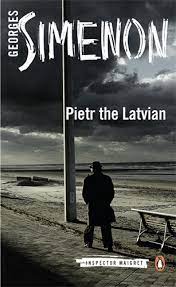
I’m taking this as a good opportunity to carry on with my much-neglected Le Monde’s 100 Books of the Century reading challenge, reading Pietr the Latvian by Georges Simenon (1930, transl. David Bellos 2013) which is No.84 in the list.
This was Maigret’s first outing and Simenon clearly had a very thorough understanding of his policeman from the start. Like many Maigret stories it is novella length, coming in at 162 pages in my English translation.
“Not that he looked like a cartoon policeman. He didn’t have a moustache and he didn’t wear heavy boots. His clothes were well cut and made of fairly light worsted. He shaved every day and looked after his hands.
But his frame was proletarian. He was a big, bony man. Iron muscle shaped his jacket sleeves and quickly wore through knew trousers. He had a way of imposing himself just by standing there. His assertive presence had often irked many of his own colleagues.”
In this first story, Maigret is in pursuit of a thief and conman, Pietr the Latvian, who may not even be from Latvia. (I was anticipating some xenophobia, which there wasn’t in the novel, but be warned there is Antisemitism at points.)
There is intelligence that Pietr has travelled to Paris from the Netherlands and Maigret is tasked with apprehending him. At the Gare du Nord he thinks he spots Pietr, but is then called to a train to identify the body of a man who also matches the description.
Following the first man takes Maigret into the world of well-heeled Parisian hotels:
“Maigret persisted in being a big black unmoving stain amidst the gilding, the chandeliers, the comings and goings of silk evening gowns, fur coats and perfumed, sparkling silhouettes.”
Things become more complex as Maigret follows various leads around the first man. His unshowy, procedural approach is evident from the start as he doggedly pursues evidence throughout Paris and to Fécamp at the coast. The conman knows Maigret is closing in and the danger grows.
I’ve not read all the Maigrets as there are at least eleventy million of them, but I would say from my limited knowledge that this isn’t the strongest. For such a short novel, it is repetitive at times and I wonder if this is because it was published firstly as a serial. In that format the repetitions would work well, but in the novel they weakened the story and it could have done with an edit with the new format in mind.
However, there is still so much to enjoy. The evocation of Paris, the character of Maigret and the novella length make this a quick, entertaining read. Simenon’s affection for his creation is evident and this makes his Detective Chief Inspector so appealing.
“The Latvian was on a tightrope and still putting on a show of balance. In response to Maigret’s pipe he lit a cigar.”
 madame bibi lophile recommends
That’s such a great quote at the end of your review. I’m not a crime reader but I really feel I should make an exception for Maigret. Lots on the shelves to choose from as my partner’s an ardent fan,
LikeLiked by 1 person
They’re a very quick, engaging read so a good option for a non-crime reader! I hope you enjoy him if you try him Susan 🙂
LikeLiked by 1 person
I was pleased to get started on Maigret last month. Interesting to see that the painstaking way of working is something that defined him from the start; glad this was enjoyable even if not the best.
LikeLiked by 1 person
Yes still a lot to enjoy! Glad you enjoyed your start with him Mallika 😊
LikeLiked by 1 person
This one’s been on my to-read list for ages. Thanks for the glimpse and the reminder to check it out!
LikeLiked by 1 person
I hope you enjoy it!
LikeLike
I haven’t read them all, and yes there are tons! But I do always find them enjoyable and particularly the wonderful evocation of Paris – marvellous!!
LikeLiked by 1 person
Absolutely! And Simeon being so prolific means there’s always plenty left to read!
LikeLiked by 1 person
This is the only Maigret I’ve read and although quite liking his character I didn’t enjoy it and it’s put me off reading any others, oh dear everyone seems to enjoy them so much!
LikeLiked by 1 person
I definitely don’t think this is a strong one Jane, so if you fancy giving him another try you might like another one more. But then, so many books, so little time… 🙂
LikeLiked by 1 person
Well now you have eleventy-million MINUS ONE on your stack. Hee hee
LikeLiked by 1 person
That’s a good way of looking at it! 😀
LikeLike
This one is my least favourite to date and I’m always rather sorry that a lot of new readers will probably read it as their first Maigret simply because it’s the first. But as you say it does set up the character of Maigret very well.
LikeLiked by 1 person
That is a shame, you’re right. I just started anywhere with Maigret, I don’t think you need to read them in order. Hopefully it won’t put too many people off as there’s so much to enjoy with Simenon.
LikeLiked by 1 person
I think I have a copy of this one. I’ve never red Simenon’s Maigret and wondering if this might be a good place to start.
LikeLiked by 1 person
It’s probably not the best place to start in a way, I think he got much more into his stride. But still a lot to enjoy!
LikeLiked by 1 person
That’s such a great title quotation, and I love that you say there are “eleventy million” of these books. Like Cathy746books, I haven’t read any yet and wonder if this might be a place to start.
LikeLiked by 1 person
Thanks Jeanne. I think it’s probably not the best place to start, other Maigret’s I’ve read have been stronger in terms of storytelling. But still enjoyable characterisation and Paris to enjoy here!
LikeLiked by 1 person
I remember liking this one, but there are definitely stronger entrants in the Maigret series. Your last quote is great though, very evocative!
LikeLiked by 1 person
Yes I did still enjoy it, even though it’s not his best. He is a very evocative writer!
LikeLike
Skimming your review Madam B, as you’ve reminded me I have a Kindle copy of this which I could read this month. I read the Maigret Christmas stories late last year and have been meaning to read more ever since.
LikeLiked by 1 person
I hope you enjoy it Ali! Maigret Christmas stories sound such a treat, I will look out for them.
LikeLike