“Money is our madness, our vast collective madness.” (D. H. Lawrence)

For this final week of Kaggsy and Lizzy’s brilliant #ReadIndies event, I’m focusing on three books from Boiler House Press, and their Recovered Books series edited by Brad Bigelow, founder of www.neglectedbooks.com, which brings “forgotten and often difficult to find books back into print for a new generation to enjoy.”

Five years ago, I read Wish Her Safe at Home by Stephen Benatar and it’s a novel that really stayed with me. The portrait of an isolated woman’s descent into serious mental illness, told from her own perspective, was deeply unsettling. I was put very much in mind of it when reading William’s Wife by Gertrude Trevelyan (1938).

At the start of the novel Jane is in her twenties and marrying the older, widowed Mr William Chirp, a local business owner.

“Jane had worked for her money, she knew the value of it. Knew how to save, and knew how to spend, too. All good quality, all of the very best. Mr Chirp might have done worse for a manager.”

But this is near the turn of the last century, and women are not managers of shops, they are managers of homes which are not as easy to leave. Jane is not a pleasant manager; she is quick to judge her maids and condescending, such as this early interaction over a fire:

“‘Why isn’t it laid,’ she asked haughtily, ‘this time of year?’ All alike.

‘The master wouldn’t never have it laid, not unless someone come. Will I lay it now, mum?’

Jane turned round sharply. ‘And quite right too. Wasting coal. No, certainly not.’”

Jane soon learns that it doesn’t matter if she knows how to spend on quality items, her husband will not have her spending at all. He is a man who knows the price of everything and the value of nothing. His want of generosity is spiritual as well as financial: he has no hobbies, no interests and no friends. His inability to value anything beyond material wealth accumulation for its own sake is brought into shocking focus during World War I:

“What the war was costing, that was what upset him. All those millions they wrote down in the papers. Though what was that to the government? The same as a few shillings to people like them. His face getting longer and longer, while he read about it. You’d think he was paying for it himself.”

Told in the third person from Jane’s perspective, the novel brilliantly builds the oppression of her marriage to this appalling person. Having Jane as not likable but still very sympathetic is a masterstroke by Trevelyan. It stops the tale becoming sentimental or easily dismissed as unrealistic. Instead, it is horribly believable.

The portrait of William is comical at times too, and this is finely judged. It doesn’t detract from the horror of Jane’s life with him at all. His reported speech is so minimal and trite as to be almost nonsensical. But his ridiculousness adds to the oppression: she is stuck with this man whose ignorance is so extensive as to make him absurd.

“At the end of April they stopped having the fire laid; the grate was filled in with crinkly blue paper in a fan. William sat with his feet in the fender and his hands, when he forgot, cupped over the paper fan.”

We see Jane scrabble to accumulate her own wealth through various small deceptions, necessary as her husband controls all her money and monitors it minutely. After he retires, William extends his miserliness to the time Jane spends away, commenting on the time whenever she returns from town. There is no physical violence in the marriage and no suggestion of what he will do if she takes longer than he thinks appropriate, but the control is absolute.

SPOILERS ahead: But further horrors await Jane when William dies. Her feelings of oppression do not dissipate, nor does her tight hold of money.

“It wasn’t until she found her money in the bag at the bottom of the basket and tipped it out carefully, with a cushion under, on the table, so that it shouldn’t chink, that she remembered William wasn’t about to hear it. It did seem queer, not having to be careful. Though it was all for the best, taking care; you never knew who might be about outside, listening to what was going on.”

She has taken on William’s prejudice, paranoia, and inability to spend. This escalates steadily, resulting in Jane moving several times and living in more and more straightened circumstances:

“She was so happy, having got away to herself, away from all that peeking and tittle-tattling, you wouldn’t believe. It wasn’t likely she was going to give away where she was, and have them all coming round again, like flies around a honeypot.”

This is heartbreaking – there is no ‘all’. She has no friends, has alienated her step-daughter, and is entirely alone. As she stops washing herself and her clothes, she is far from a honeypot for anyone. We are kept inside Jane’s unhappy mind, recognising far more than she does about her behaviour and how she is viewed by others.

William’s Wife is a novel that really gets under your skin. The oppression that Jane suffers, firstly through her marriage and then through a mind traumatised by all the years she has endured within that institution, is subtly evoked but relentless. It is a novel of great compassion written with such clear-sightedness that its power – eighty-six years later when women in the UK have far greater financial rights – remains undeniable.

“Technological progress is like an axe in the hands of a pathological criminal.” (Albert Einstein)

For the final week of Kaggsy and Lizzy’s brilliant #ReadIndies event, I’m focusing on three books from Boiler House Press. Specifically their Recovered Books series edited by Brad Bigelow, founder of www.neglectedbooks.com, which brings “forgotten and often difficult to find books back into print for a new generation to enjoy.”

My second read from the series is Two-Thousand Million Man-Power by Gertrude Trevelyan (1937). The title is the only part of this novel that feels cumbersome; Trevelyan writes with fluency and deftness that is so readable.

She follows Katherine and Robert from 1919 to 1936, from their meeting as young idealists through the strains of their marriage and the economic pressures exerted by forces beyond their control.

They belong to “The half-generation between the war and the post war. They had been brought up in one world and jerked out into another” and the novel explores this notion of them being somewhat lost, even from each other. They both struggle to know what to cling to in a time of rapid change.

When they meet, Robert is working as a cosmetic scientist during the day, and on his own formula for the nature of time from his dingy lodgings in the evening:

“He ate quickly, with appetite, undiscriminating. Turning his back on the meal he lit the gas over a small table near the window and felt in his pocket for the scrap of paper with the dotted figures. As the gas came up, the roofs outside the window turned dark grey. The drawer of the table stuck, half open. He banged it back and wrenched at it and found a wad of notes and pulled in his chair. The roofs outside turn black against the sky and then the sky blacked out.”

Katherine believes in lots of things that need capital letters:

“Katherine believed in progress. She believed in the League of Nations and International Goodwill, in Gilbert Murray and Lord Robert Cecil and H.A.L. Fisher, and in the wonders of Science.”

And so she gifts Robert these capital letters, deciding he is “Working Something Out.”

But gradually the societal forces they both wish to resist make themselves felt. They decide to marry, despite Katherine’s disdain:

“She had, besides, a contempt for married women – content with homes and babies and indifferent to the things that mattered: happy, she thought with a slight sneer, in an emotional and humiliating bondage – which made her, illogically, despise even their efforts to escape.”

She is monumentally judgemental of people. Katherine is an intellectual snob, but her love of ideas doesn’t involve any examining of her own life. This means she can stay secure in her absolute belief that she is somehow better and different to those she looks down on, despite appearing remarkably similar to them externally:

“‘We didn’t marry for bourgeois conventional reasons. Our marriage isn’t bourgeois. We married because we wanted to, that’s quite different, not because we were afraid.’”

Katherine loses her teaching job because married women weren’t allowed to continue in posts. Robert then loses his job due to the world economic crisis. This puts immense strain on them both. Katherine takes a private teaching job she despises; Robert very nearly breaks down entirely.

Throughout, Trevelyan weaves in summaries of world events before returning to the tight focus on Robert and Katherine. I’m not entirely sure how she managed it, but somehow this never felt gimmicky or jarring.

“Agricultural machines in France were grading and marking eggs at the rate of a hundred and twenty a minute. Escalators were speeding up, the biggest building in the Empire was in course of construction at Olympia, Katherine and Robert were in their white-enamelled kitchen one Sunday afternoon, washing the tea things in instantaneous hot water and hanging them to dry in an electrically heated rack.”

The fault lines in Robert and Katherine’s marriage, exposed by the economic strain, only widen. Hilariously, Katherine believes herself to be a communist, when she is in fact a relentless materialist. Trevelyan doesn’t judge her too harshly for this:

“She wanted security and comfort and a Life Worth Living. She wanted Robert to get a sound, decent, progressive job.”

Nothing wrong with any of that, except it does also involve Katherine thinking the world owes them some sort of moral obligation – that they ought to have” things, and sustaining a consumerism that she entirely fails to see as such. Unable to see how her ideals of progress and modernity have become warped, she continues to position herself as intellectually and morally superior, when really it is only tastes in furnishings that separate her from those she is so condescending towards.

Robert meanwhile finds a way to survive in his work while his big idea amounts to very little, as the reader always knew it would. He has insight but no energy, Katherine the opposite. Two-Thousand Million Man-Power isn’t depressing, but I did find it sad. Ultimately Robert and Katherine seemed so isolated and stymied in very different ways.

I came away from this perceptive, clever and compassionate novel keen to read more by Trevelyan, so I was pleased I’d also ordered William’s Wife (1938). Of which more tomorrow!

“A gentleman is simply a patient wolf.” (Lana Turner)

During this final week of Kaggsy and Lizzy’s brilliant #ReadIndies event, I’m going to focus on three books from Boiler House Press, and their Recovered Books series, which brings “forgotten and often difficult to find books back into print for a new generation to enjoy.”

I bought these books last year after Brad Bigelow, founder of www.neglectedbooks.com and inspiration for the series, tweeted about how precarious things were. This is why #ReadIndies is such a great event for encouraging support and celebration of indie publishers, whose survival is never guaranteed.

 In this first post, I’m looking at a tragi-comic novella, Gentleman Overboard by Herbert Clyde Lewis (1937).

Henry Preston Standish, “one of the world’s most boring men”, is aboard the SS Arabella steamship en route from Hawaii to Panama. When he slips on some grease he finds himself plunged into the middle of the Pacific Ocean, with hopes of rescue looking pretty slim.

When he first falls overboard, he finds it hard to raise his voice to shout for help, so deeply ingrained is his social conditioning.

“Men of Henry Preston Standish’s class did not go around falling off ships in the middle of the ocean; it just was not done, that was all.”

As he treads water waiting for the Arabella to notice his absence, he reflects on a life where “He did all the proper things, but without enthusiasm.” It’s a real masterstroke that Lewis makes Standish so ordinary, and places him in a situation that is both extreme but also unchanging – a vast expanse of calm ocean. Rather than making the novella dull, it enables a tightly-focussed narrative with a protagonist that inspires sympathy precisely because he is an everyman.

“The whole world was so quiet that Standish felt mystified. The lone ship ploughing through the broad sea, the myriad of stars fading out of the wide heavens – these were all elemental things that both soothed and troubled Standish. It was as if he were learning for the first time that all the vexatious problems of his life were meaningless and unimportant; and yet he felt ashamed at having had them in the same world that could create such a scene as this.”

Poor Standish takes time to realise the hopelessness of his situation, veering from imagined conversations with his family – still framing his experience within his social milieu even when the nearest person is miles away –  to considering drowning as an abstract notion rather than an impending reality:  

“It would not be so terrible to drown if a man went about it sensibly, without losing his head.”

Back on the Arabella, the remaining eight passengers take time to realise Standish is missing. Once they do, they invent a trauma for him – his loyal wife has, in their minds, run off with a “gigolo” – and start rewriting their experience of him in this light.

The humour in Gentleman Overboard is finely balanced. Standish’s desperate holding onto behavioural norms which are gradually shed as the enormity of his situation dawns on him, and the entirely fictional life story the other passengers invent for him, poke fun at the ridiculousness of human behaviour. But Lewis never suggests it is funny that Standish is in mortal danger, or that his dullness should mean it’s any easier for the reader to bear witness to his imminent death.

Brad Bigelow’s Afterword explains reviewers thought Gentleman Overboard both too short (The Saturday Review) and too long (Evelyn Waugh). I agree with those who felt the length was just right. It was long enough to create a moving portrait of a man, but short enough that the tight narrative’s commentary on human existence was made with the lightest touch. Truly memorable.

“But now he saw clearly that life was precious; that everything else, love, money, fame, was a sham when compared with the simple goodness of just not dying.”

“While there is life there is always the chance that something might happen.” (Antal Szerb)

This week I’m focussing on Pushkin Press as part of Kaggsy and Lizzy’s #ReadIndies event in order to read four books that have long been in the TBR. For this final post, my read is Love in a Bottle by Antal Szerb (1922-1943, transl. Len Rix 2013)

This was a really interesting collection, because the stories are presented chronologically and there’s a big gap whereby Szerb’s style changes considerably.

The first three stories are from 1922-23. Ajandok’s Betrothal, The White Magus, and The Tyrant all have a fable-like quality. Told in the third person, they are set in a timeless period and within realities that verge on mythical. While they were very well written, and diverting enough, I didn’t find them hugely interesting.

The rest of the stories are from 1932-1943 and these I found much more original and compelling. The first is Cynthia, a fragment which Pushkin Press omitted in a previous edition as Szerb probably didn’t intend it for publication. It begins:

“When they threw me out of Cambridge for my poor taste in neckties and generally immoral conduct, I enrolled at University College London, whose chief claim to fame (though they kept this private) was that its Dean was obliged, as a matter of principle, to see off any clergymen who dared set foot on the premises.”

I immediately felt hopeful that this change in tone and setting would be much more to my liking 😀

The tale itself is told from the point of view of an unpleasant but believable lothario who doesn’t seem to like women very much. This persona recurs through some of the other stories. In A Dog Called Madelon, a man laments that he has never been able to sleep with aristocratic women, despising the shop assistant he is with:

“He had been reflecting on the way his whole life had been frittered away on a procession of frightful little Jennys, when ever since boyhood he had yearned for a Lady Rothesay. History held the sort of erotic charge for him that others found in actresses’ dressing rooms – a truly great passion required three or four centuries historical background at the very least.”

In Musings in the Library, an “anti-Don Juan” who finds “women rarely please me” manages to completely fumble a fledgling love affair.

What stops these characters from being completely alienating to the reader is firstly, the wry humour that runs through the stories, and secondly the deep inadequacy of the protagonists. They are not meant to be heroic in any way, but rather deluded and sad. The stories all end in their failure, often with ironic circumstances.

In the titular tale, Szerb returns to mythology with Sir Lancelot and his love for Guinevere, but this is markedly different to the previous myth-like stories. Love in a Bottle has a more individual, authentic voice to the narration, and the humour of the contemporary-set tales is evident here too.

Szerb seems to view romantic love in these stories with some scepticism, but not disdain. It is the flawed characters which mean love is never fully realised, rather than problems with the idea itself. In fact, there is a feeling of hope towards love in the way Szerb consistently returns to the theme, but it is the humans involved who make it become ridiculous.

His tone is never bitter though, and he doesn’t judge his characters too harshly. To me Szerb seemed to be highlighting foibles while suggesting no-one was above them.

I also enjoyed Fin de Siècle where Szerb seemed to be having a lot of fun satirising writers. Thus Dr Johnson is noted for his “immortal banalities” and a group of writers who gather together include:

“Lionel Johnson, who would deliver his observations about the weather in the manner of a revelation: ‘There was a thick fog in Chelsea this morning.’ he would regularly announce, and glare balefully around the room, his hand clapped on some invisible sword.”

The humour, intelligence and readable style of the stories in Love in a Bottle has made me keen to explore Szerb more. Fortuitously I have Journey by Moonlight lined up for Kaggsy and Simon’s 1937 Club which is running 15-22 April – can’t wait!

“Looking back on the blissful days of my youth, as they begin to slip away from me, I can see now the best of them were those spent in the Bibliothèque Nationale in Paris.”

“My world was small and terrible.” (Isaac Babel)

This week I’m focussing on Pushkin Press as part of Kaggsy and Lizzy’s #ReadIndies event to finally read four books that have long been in the TBR. For this third post today my read is Odessa Stories by Isaac Babel (1916-1937 transl. Boris Dralyuk 2016).

The Introduction to this volume by translator Boris Dralyuk is really informative and provides some fascinating context to Babel’s writing. Odessa was a booming port when Babel was born in 1894; in 1900 around 140,000 of its 400,000 population was Jewish. Babel was part of a well-to-do family but was drawn to Odessa’s underbelly, writing stories about the legendary gangsters of the city.

Dralyuk also explains about translating the melting-pot language of Odessa, so I highly recommend reading the Introduction before you start on the stories (I often read Introductions at the end). Babel was only 45 when he was killed in Stalin’s purges.

The volume is divided into three parts: Gangsters and Other Old Odessans; Childhood and Youth; and Love Letters and Apocrypha. I always struggle to write about short story collections and generally Babel’s stories are so short that I don’t want to give spoilers. Here I just want to give a flavour and you can see if you might want to seek out these stunning stories for yourself.

The first part is mainly told in the third person and weaves together tales of violence and corruption, with recurring characters including “Benya Krik, gangster and King of the gangsters”. The tales are colourful and carnivalesque, but Babel never allows the broader strokes to obscure the unlawful methods that so many live by:

“At this wedding they served turkey, roast chicken, goose, gefilte fish and fish soup in which lakes of lemon glimmered like mother-of-pearl. Flowers swayed above the dead goose heads like lush plumage. Does the foamy surf of Odessa’s sea wash roast chickens ashore?”

At the same time, he doesn’t position the reader above the gangsters or way of life. Babel suggests that this side of Odessa is as it is because this the logical way to be, and it has emerged as part of the society, laws and political structures that surround it:

“Let’s not throw dust in each other’s eyes. There’s no one else in the world like Benya the King. He cuts through lies and looks for justice, be it justice in quotes or without them. While everyone else, they’re as calm as clams. They can’t be bothered with justice, won’t go looking for it – and that’s worse.”

The second part of the stories in Childhood and Youth becomes more personal, with first-person tales that follow on from one another in some instances. I understand The Story of My Dovecote is the most famous, and rightly so. Within this brilliant collection, it still stands out. (Skip the next two paragraphs if you don’t want to know any details in advance.)

A young boy has spent five of his ten years coveting a dovecote. He manages to find ways around the anti-Semitism at his school to do well academically and get the reward of finally being able to buy his doves. He sets out to the market with his money and gets his beloved birds, tucking them into his jacket. If your heart is sinking at this description, you are absolutely right…

The story is fifteen pages in this edition and completely devastating. I would urge anyone to read it, but it will absolutely stay with you. It will rip your heart out and stamp all over it. The final word of this story is “pogrom”.

There are lighter stories in this section too, such as The Awakening, about a precocious young man:

“Writing was a hereditary occupation in our family. Levi Yitzchak, who went mad in his old age, had spent his whole life composing a tale titled A Man With No Head. I took after him.”

Odessa Stories was my first experience of reading Babel and I was blown away. Babel clearly enjoyed the almost fabulist tales of Benya the King, but somehow never glamorised him. His writing is hugely entertaining but also truthful – the violence towards people and animals suddenly appears in the midst of the stories and jolts the reader to remember the visceral realities of what is being described.

In evoking the worst of human behaviour in Dovecote, Babel is restrained and absolutely drives home the tragedy.

Babel’s writing is intensely human, marrying together humour, violence, pathos and beauty seamlessly. I will definitely seek out more by him on the strength of Odessa Stories. Sadly, there isn’t much as his life was cut short. However, Pushkin Press publish Red Cavalry, another short story collection.

“For the first time I saw my surroundings as they actually were – hushed and unspeakably beautiful.”

“I had a lion inside me that wouldn’t shut up!” (Ingrid Bergman)

This week I’m focussing on Pushkin Press as part of Kaggsy and Lizzy’s #ReadIndies event to finally read four books that have long been in the TBR. Today it is a book of two essays, City of Lions by Józef Wittlin and Philippe Sands.

Pushkin Press’ website describes the volume: “Lviv, Lwów, Lvov, Lemberg. Known by a variety of names, the City of Lions is now in western Ukraine. Situated in different countries during its history, it is a city located along the fault-lines of Europe’s history. City of Lions presents two essays, written more than half a century apart – but united by one city.”

The book comes with maps of Lwów and Lviv within the French flaps and photographs throughout which are both useful and illustrative, making a really lovely edition. It also forms another stop on my Around the World in 80 Books reading challenge.

Józef Wittlin was a poet and novelist and his essay My Lwów (1946, transl. Antonia Lloyd-Jones 2016) beautifully evokes his longing for a city he knows has gone forever, with his writing full of nostalgia and loss.

Wittlin is completely aware of his skewed view of the city, having left in 1922 and writing his essay sat in New York so many years later:

“Nostalgia even likes to falsify flavours too, telling us to taste nothing but the sweetness of Lwów today. But I know people for whom Lwów was a cup of gall.”

Yet still he longs for city of his past.

“Alright, so Lwów hasn’t got a decent river, or a legend. What would it need a river for? The urban planners and tourists say that if Lwów were graced with a river, it would be a second Florence. In my view Lwów has more greenery than Florence, though less of the Renaissance. Moreover, it resembles Rome…”

But as Wittlin evokes the cityscape, its smells, food and people with great artistry and passion, world events – recent at the time of his writing – do filter through. In his evocation of a culturally mixed European city in the early twentieth century, he would have been aware that the Jewish population which had made up around a third of Lwów’s inhabitants had been almost entirely wiped out.

“It is not Lwów that we yearn after all these years apart, but for ourselves in Lwów.”

Philippe Sands essay My Lviv (2016) is written in conversation with My Lwów and views the city through the eyes of someone who never lived there, but whose family history – and the reason they had to leave –  is firmly rooted there.

“I could have chosen to turn away from the stories stuffed into the cracks of each building, or what was hidden behind freshly plastered walls. I could have averted my gaze, but I didn’t want to. Observing with care was part of the reason for being there, seeking out what was left, traces of what came before.”

Sands essay is deeply personal as he revisits his grandfather Leon’s home city. It is an experience he feels deep in his bones:

“I understood it to be part of my hinterland, one that was buried deep because Leon would never speak of that past. His long silence hid the wounds of a family that was left and then lost, but from the moment I set foot in the place it felt familiar, a part of me, a place I had missed and where I felt comfortable.”

At the same time, Sands is visiting with broader knowledge of devastation wreaked by the Holocaust, and he sees these layers within Lviv, even when they aren’t overtly commemorated:

“The first time I stood in the courtyard behind the school, in the autumn of 2012, I had no idea what that yard had been used for. Now armed with that knowledge, that this vast and empty place was a gathering point for thousands of final journeys […] it was a place of terrible silences, the expression of a conscious desire not to remember.”

I found City of Lions a deeply moving read. It is an elegy for a lost time, a eulogy for those lost, and a stark reminder that history is lived and died through by ordinary people. Cities grow and change, but they build upon and contain all that has gone before. It is all there if we take the time and care to look.

At the same time, what these two very different evocations of the same city demonstrate so well is that we experience our surroundings through ourselves. Wittlin and Sands are writing as much about themselves as they are about the city, but the essays are no less fascinating for that.

“Never despise the translator. He’s the mailman of human civilization.”(Alexander Pushkin)

This week I thought I’d use Kaggsy and Lizzy’s #ReadIndies event to focus on one indie publisher, and finally get to four books that have long been languishing in the TBR. Pushkin Press “publish some of the twentieth century’s most widely acclaimed and brilliant authors” and they are one of my favourite indies, ever-reliable. Which hasn’t stopped four from their Collection series remaining unread by me for far too long!

Today I’m starting with The Buddha’s Return by Gaito Gazdanov (1949-50, transl. Bryan Karetnyk 2014). Gazdanov was a Russian writer exiled in France and this short novel, described by the publishers as “part detective novel, part philosophical thriller, and part love story” is set in Paris, as much as it is set anywhere – reality is not a consistent concept in this story at all.

The narrator is a student who is experiencing prolonged periods of hallucinations. He tells us from the start that he is an unreliable storyteller:

“Nowhere was there any logical pattern in this, and the shifting chaos clearly failed to present even a remote semblance of any harmonious order. And so, accordingly, at that point in my life, which was marked by the constant attendance of chaos, my inner existence acquired an equally false unwavering character.”

We slide back and forth between a recognisable reality of his poverty-stricken life in Paris and his disturbing, disorienting visions, without always knowing which is which. Early on in the novel he falls to his death from a sheer mountainside, later he is arrested and interrogated by the Central State. The government’s accusations of treason are entirely surreal and illogical, yet this is also what makes them horribly believable.

There is political commentary running through the novel, but the kaleidoscopic nature of the narrative means it is not a sustained satire on any particular country, ruler or party, but rather a wider condemnation:

“The ignorant, villainous tyrants who so often ruled the world, and the inevitable and loathsome apocalyptic devastation apparently inherent in every era of human history.”

Around halfway through, more of a plot emerges as Pavel Alexandrovich, an older man whom the student befriended, is murdered and his golden statuette of Buddha stolen. As the last person to see Alexandrovich alive, the student falls under suspicion. The real-life interrogation by the investigators has shades of the surreal fantasy interrogation by the Central State:

“If we can find the statuette, you’ll be free to return home and continue your research on the Thirty Years War, the notes on which we found in your room. I must say, however, that I completely disagree with your conclusions, and in particular your appraisal of Richelieu.”

As that quote shows, there is humour in The Buddha’s Return and this lightens a tale which has a lot of dark elements: visceral war scenes, squalor, and of course murder.

Apparently, The Buddha’s Return was originally published in instalments and I can see it would work well in this format. I enjoyed it but for me the more plot-driven second half arrived at just the right time, when I’d started to feel it was losing momentum. As it was I enjoyed this consistently surprising tale which still had enough recognisable humanity in it to be involving, and I’d be keen to read more by Gazdanov.

“I have a suspicion that you just dreamt the whole thing up. It’s because you read too much, eat too little and spare hardly any thought for the most important thing at your age: love.”

“The business of her life was to get her daughters married.” (Jane Austen)

It’s month two in my 2024 resolution to read a book per month from Anthony Powell’s A Dance to the Music of Time sequence. It was published between 1951 and 1975, and set from the early 1920s to the early 1970s. The sequence is narrated by Nicholas Jenkins, a man born into privilege and based on Powell himself.

After reading A Question of Upbringing in January, I think I’ve adapted to Powell’s unusual prose style with long, meandering sentences. I had to remind myself in A Buyer’s Market (1952) that it was likely that very little was going to happen. Once I’d readjusted to the lack of plot, the style made more sense. It has the feel of extended reminiscences, with the reader listening in.

In A Buyer’s Market, Nick has left university and is working for a publishing house focussed on art books. That is about as much as we hear of his career, as the novel is concerned with the social life of the upper classes and the parties that form part of the season for debutantes. The time isn’t specified but it seems to be around the late 1920s.

Sometimes I joke with my mother that she gave birth 77 years too late. That, had I been born in 1900, it would have worked perfectly for me in terms of an adulthood in the era of my tastes in books, films, fashion, decor and architecture. But, as I don’t fancy being poor before the invention of the NHS, I’d have to be born into much richer circumstances and become a flapper. Well, A Buyer’s Market thoroughly disabused me of that notion. Goodness me, the round of parties seemed unutterably tedious. It says something for Powell’s writing that the novel wasn’t tedious at all.

The novel begins, after a brief flashback scene, with Nick attending a dinner party at Lady Walpole-Wilson’s:

“her comparative incapacity to control her own dinner parties, at which she was almost always especially discomposed, seemed to me a kind of mute personal protest against circumstances – in the shape of her husband’s retirement – having deprived her of the splendours, such as they were, of that position in life owed to her statuesque presence; for in those days I took a highly romantic view, not only of love, but also of such things as politics and government: supposing, for example, that eccentricity and ineptitude were unknown in circles where they might, in fact, be regarded – at least insofar as the official entertaining of all countries is concerned – almost as the rule rather than the exception.”

(Please note the quote above is one sentence!)

At this point Nick believes he is in love with Barbara Goring, but it is when she plays a prank on Nick’s old Eton associate Widmerpool, that he rapidly changes his mind. This is not through sympathy for Widmerpool to whom he still has ambivalent feelings, but there remain hints at the greater role he will play in Nick’s life:

“I did not, however, as yet see him as one of those symbolic figures, of whom most people possess at least one example, if not more, round whom the past and the future have a way of assembling.”

Nick and Widmerpool are having coffee at a street stand when they bump into Mr Deacon, an old artist friend of Nick’s parents, who is touting  disarmament pamphlets with a young woman, Gypsy Jones. Nick’s old schoolfriend Stringham arrives, and this unlikely quintet go to a second party at Mrs Andriadis’ – a more bohemian affair than the dinner, but one where Nick identifies  “almost exactly the same chilly undercurrent of conflict”.

If the cynicism wasn’t apparent enough in this volume’s title, Powell makes his feelings abundantly clear. The parties of this circuit are not joyful affairs, they are occasions where everyone wants something: spouses, social advancement, career advancement, money.

“Everyone used to say that dances bored them; especially those young men – with the honourable exception of Archie Gilbert – who never failed to respond to an invitation, and stayed, night after night, to the bitter end. Such complaints were made rather in the spirit of people who grumble at the inconvenience they suffer from others falling in love with them.”

It all sounds a bit desperate and boring.

Later in the novel Nick attends a party at Sir Magnus Donner’s castle, where many of the characters from the party appear again. It is a small social set but not an intimate one. Sir Magnus seems particularly unlikable and even sinister. One of my favourite passages was Nick’s spiky assessment of his host:

“Sir Magnus himself did not talk much, save intermittently to express some general opinion. His words, wafted during a comparative silence to the father end of the table, would have suggested on the lips of a lesser man processes of thought of a banality so painful – of such profound and arid depths, in which neither humour, nor imagination, nor indeed, any form of human understanding could be thought to play the smallest part – that I almost supposed him to be speaking ironically, or teasing his guests by acting the part of a bore in a drawing room comedy. I was far from understanding that the capacity of men interested in power is not necessarily expressed in the brilliance of their conversation.”

I mentioned when reading A Question of Upbringing that it was the satire that saved the novel for me and it is the same here. I doubt Anthony Powell saw himself as a subversive but he definitely has an assessing gaze regarding the privileged upper classes. I also thought it was notable what he doesn’t comment on. The need for an abortion is detailed but not judged, gay male characters have their sexuality mentioned in passing but again not judged. Both these were still illegal in the UK when this novel was published.

Although the theme of the novel is about commodification and how “Human life is lived largely at surface level”, I did feel the reader had a growing intimacy with Nick. Barely present in his own story in the first volume, in A Buyer’s Market Nick reported more of his own speech, motivations and feelings. This strengthened the storytelling and I’m looking forward to seeing what he does next.

To end, after reading this novel, not even Liza can persuade me to come to the debutante’s ball:

“All fiction is about people, unless it’s about rabbits pretending to be people.” (Margaret Atwood)

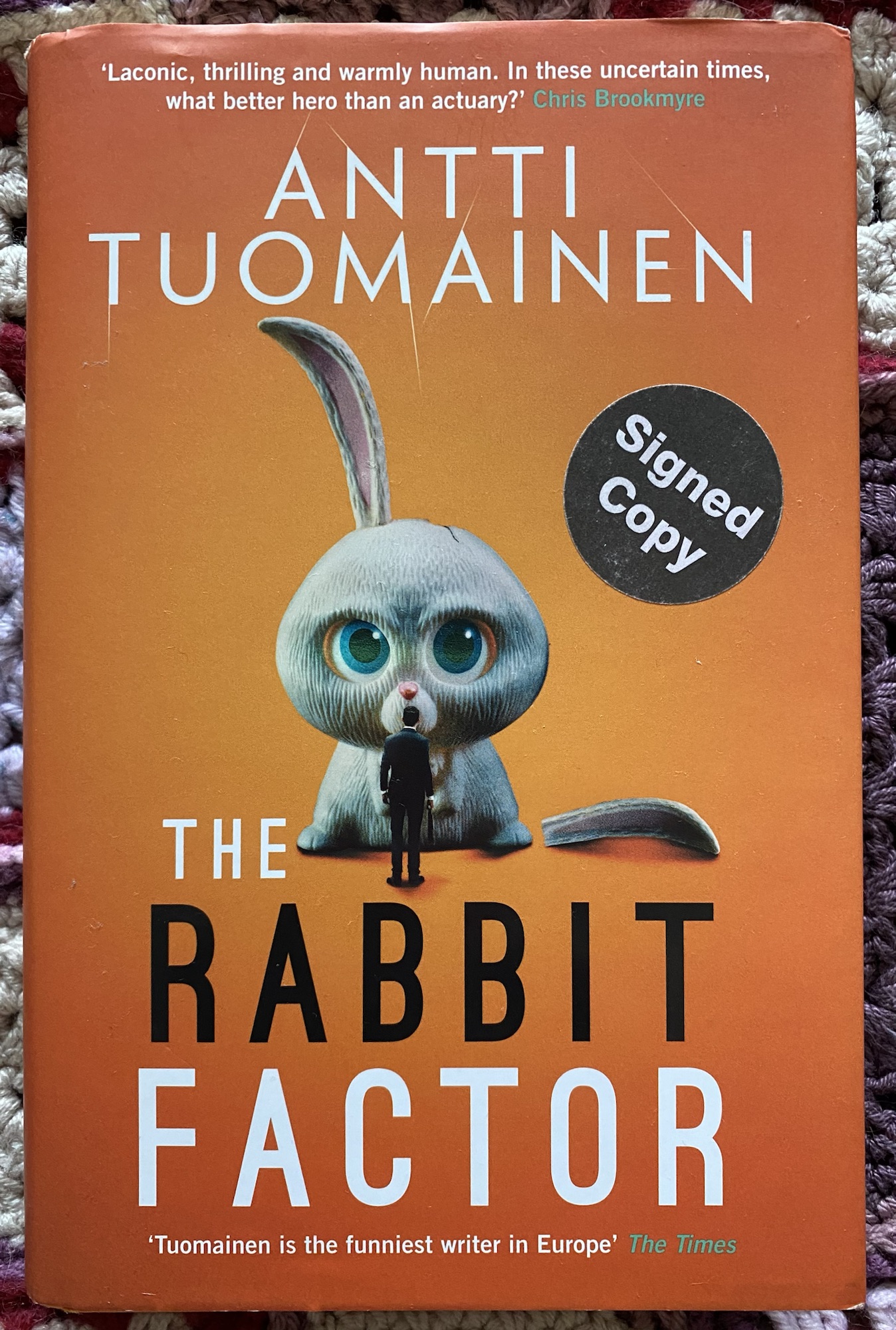
This is my first contribution to Kaggsy and Lizzy’s wonderful #ReadIndies event, running all month. The Rabbit Factor by Antti Tuomainen (2021, transl. David Hackston 2021) is published in the UK by Orenda Books, who describe themselves on their website as: “a small independent publisher based in South London. We publish literary fiction, with a heavy emphasis on crime/thrillers, and roughly half the list is in translation.”

The Rabbit Factor is the first in a trilogy about actuary Henri Koskinen, which had somehow completely passed me by until I read Annabel’s review of the final part, The Beaver Theory. A little while later I saw The Rabbit Theory in my local charity bookshop and took it as A Sign. (As I have mentioned before, I’ll take pretty much anything as A Sign in that shop, and it always results in me buying more books 😀 )

Henri is a man who likes a well ordered, predictable life: “At the age of forty-two I had only one deep-held wish. I wanted everything to be sensible.”

His job as an actuary suits him, using mathematics to predict risk. Unfortunately, what doesn’t suit him is the modern workplace – open plan, noisy and full of corporate-speak about self-actualisation. He is forced into resigning by his boss who hides his bullying behind pseudo-beneficent jargon.

Not long after, Henri is told his brother Juhani has died and he has inherited YouMeFun, an adventure park (not an amusement park) in Vantaa. Unfortunately, before he died his brother inherited their parents’ chaotic approach to life and so Henri finds himself faced with:

“An unbearable lack of organisation, staggering maintenance bills, unproductive use of man hours, economical recklessness, promises nobody could keep, carts that quite literally moved at tortoise speed? I raised my fingers to my throat and checked the position of my tie. It was impeccable.”

Juhani was also in hock to gangsters, two of which – Lizard Man and henchman AK – keep turning up to menace Henri with horrible regularity and conviction. No less threatening, but considerably less violent, is police officer Osmala who similarly seems very interested in YouMeFun and Henri. And so Henri finds himself under enormous pressure and with only his maths skills to fall back on.

“I resigned because I couldn’t stand watching my workplace turn into a playground. Then I inherited one.”

I think maybe this novel passed me by because it can be classified under Nordic-noir, and I don’t read a great deal of that. What I read I enjoy, but I choose carefully because I am a delicate flower and not really in the market for gruesome crimes. Now, there are gruesome deaths in The Rabbit Factor, but I managed these fine. The details aren’t dwelt upon and they are surrounded by such surreal silliness that the focus is more on the ridiculousness of Henri’s situation than violence.

The tone is also not noirish. One of the blurbs in my edition mentions the Coen brothers, and this is a good parallel: while there is darkness to the tale, there is also humour and humanity. Henri’s unlikely colleagues include Esa, the US-marine obsessed security officer; sweet Kristian who is unable to see that his total ineptitude is what prevents him from becoming general manger; Minttu K who seems to know about marketing if she could only stop self-medicating with alcohol; Venla who never arrives for a shift; and quietly efficient Johanna who runs the kitchen and actually seems able to do her job.

There is also Laura Helanto, manager and frustrated artist, who causes feelings to arise in Henri that he doesn’t fully understand. It’s a confusing time for him all round…

“But recent events have taught me that what once seemed likely, as per the laws of probability, is more often than not in the realm of the impossible. And vice versa: what once I would have been able to discount through a simple calculation of probability ratios and risk analysis is now in fact the entirety of my life.”

I really enjoyed The Rabbit Factor. The deadpan narration of Henri is so well-paced that it manages to also be completely engaging. His focus on detail grounds the ridiculousness of his situation so it remains believable, carrying the reader along on Henri’s absurd journey.

“Even as a child I saw mathematics as the key. People betrayed us, numbers did not. I was surrounded by chaos, but numbers represented order.”

The characterisation is equally finely balanced. Henri and his colleagues could so easily be caricatures but instead you end up rooting for these disparate individuals. Tuomainen isn’t remotely sentimental but he is kind to the people he creates. The humour is derived from the situation, never laughing at the people themselves. They change under Henri’s stewardship, and he in return finds himself behaving in ways that surprise him more than anyone:

“I say something I could never have imagined hearing myself say. ‘This doesn’t make any sense. But it has to be done.’”

Last year I decided I would buy one book a month from an independent publisher or bookshop. I think Henri would agree that the probability of my next two purchases in this regard being his adventures in The Moose Paradox and The Beaver Theory are pretty high…

To end, I was so tempted to choose Chas & Dave’s Rabbit, as I absolutely loved that song when I was little (it was released when I was four years old, and I thought they were singing about actual rabbits). But alas, my adult sensibilities prevent me from adding a song about silencing women to the blog 😀 So instead here is a literature-inspired song about drugs rabbits: