I’m not sure there’s much I can add to the cacophony of praise that Trespasses by Louise Kennedy (2022) has garnered. In fact I did consider not writing a post at all. But in the end because it moved me so much I thought I’d jot a few thoughts down as part of Reading Ireland 2024 aka the Begorrathon, hosted by Cathy at 746 Books. It’s also a stop on my Around the World in 80 Books reading challenge.
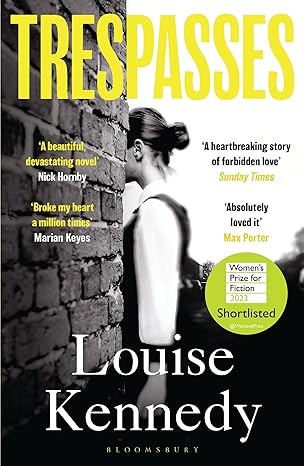
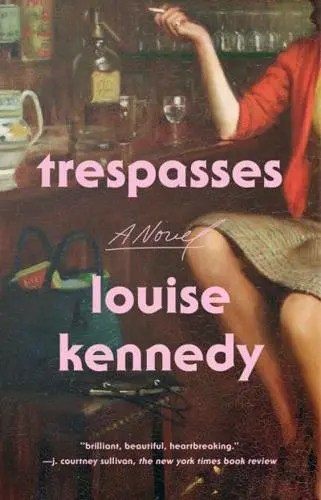
A summary of the plot doesn’t do this finely-crafted tale justice.
Cushla Lavery is a Catholic teacher, twenty-four years old and working at a school in a garrison town in 1970s Northern Ireland. She also helps out at her family’s pub, which is where she meets Michael Agnew – around twice her age, Protestant, and married. The attraction is instant and mutual.
“Countless times she had replayed the evening in her head, searching for the word or gesture or pronunciation that had repelled him, that had shown she was too young, too unsophisticated, too Catholic. It seemed piteous now that she had opened her college Irish books at Penny’s messy, elegant table, desperate to impress him. Perhaps she had been too obviously besotted with him.”
They know they have to keep their relationship secret. At the height of the Troubles, they are different religions and Michael already attracts attention through his work as a barrister defending those accused of killing members of the Royal Ulster Constabulary (RUC).
This is a time when politics and violence are woven through the daily lives of people in an immediate way. Cushla has to tread carefully around British soldiers in the pub, the threat of their brutality insidious and palpable. On the way to a party with her colleague and friend Gerry, they are stopped at an army checkpoint. At the flat where Cushla and Michael meet, she tells him not to sit with the lights on and curtains open, and her trepidation is not only due to their forbidden relationship…
Meanwhile, other aspects of life don’t stop. Her grieving mother Gina is self-medicating with gin. A boy in Cushla’s class, Davy McGeown, is bullied because he is from a mixed-marriage family and he ‘smells’ – his mother can’t hang the washing out because the neighbours throw dog dirt at it. His vulnerability is noticed by the priest Father Slattery, who everyone knows shouldn’t be left alone with children.
“Michael said there were all kinds of families. Cushla’s was an unhappy one. What was his like?”
The strain of daily life, living under the misuse of power both political and religious, is brilliantly realised. The narrative is incredibly tense, and the 1970s details are vivid.
The contrast of these tensions with the tender love between Cushla and Michael is subtly portrayed and never jars. Their relationship is believable, and while Michael is known to be “Fond of the women, by all accounts. Sure he’d charm the knickers off you.” he never seems creepy. Cushla is young but not naïve. They know what they have is unlikely to end well and yet they cling to it, the human need for love asserting itself over all that would seek to subdue it.
“She was overcome with a feeling of utter defeat. She wanted to lie on her bed and sleep, but had been unable to say no to him. It wasn’t because he had been kind to her. It was because each time she saw him she was afraid it would be the last time.”
It was the resilience Kennedy portrays which ultimately I found so moving. Not only with Cushla and Michael but in those that surround them, and particularly with Davy McGeown, a bright child caught up in a situation he barely comprehends.
“Booby trap. Incendiary device. Gelignite. Nitroglycerine. Petrol bomb. Rubber bullets. Saracen. Internment. The Special Powers Act. Vanguard. The vocabulary of a seven-year-old child now.”
Kennedy is not remotely sentimental but she is compassionate. She doesn’t judge people or the situation. Through creating recognisable, fully realised characters struggling to live the best way they can, Trespasses is a stunning exploration of the endurance of human spirit.
“For the umpteenth time Cushla wished her parents had called her Anne or Margaret or Rose – not Mary, with its connotations of Marian shrines and rosaries – any name that didn’t mark her out as so obviously a Catholic. She felt guilty for the thought which, she realised, also marked her as a Catholic.”
 madame bibi lophile recommends
So glad you liked this, I thought it was very good. I did prefer her short story collection, but this was still very powerful.
LikeLiked by 1 person
That’s good to know Cathy, I’ll look out for her short stories. I can imagine her style suits that form very well.
LikeLiked by 1 person
I also found this very powerful and moving. And not just because Cushla shares my surname!
LikeLiked by 1 person
Ha! Good to hear this resonated with you too, whatever the reason 😀
LikeLike
Pingback: Reading Ireland Month 2024 is here!
Wonderful review Madame B. This does sound powerful, and I can’t imagine what it must be like to have lived through times like that (though maybe I could after reading this book). I live through the era when the Troubles were on the news all the time, and it seems shocking look back on it. A really good choice for this month I would say!
LikeLiked by 1 person
Thanks Kaggsy! It does show really well what it was like for these characters living through the events we saw on the news, and the daily sense of oppression. I thought it was really well done.
LikeLiked by 1 person
I haven’t read this, it does sound very good.
LikeLiked by 1 person
It is Jane, it’s very powerful and very readable.
LikeLiked by 1 person
I’m so glad you enjoyed this one. I thought it was a remarkable first novel. I’d recommend her short story collection, The End of the World is a Cul de Sac, if you’ve not already read it.
LikeLiked by 1 person
It’s so impressive and especially as a first novel. Thank you for the recommendation! I’ll definitely look to read her short stories now. I can imagine its a very powerful collection.
LikeLiked by 1 person
I thought the ending was touching; otherwise, I thought it didn’t really live up to all the hype.
LikeLike
I thought the setting and characterisation in this one were so well done, though I wasn’t quite as enamoured of the love affair as most people were. I liked how she showed how for the most part people just got on with their lives, despite the ever-present fear of violence. And the way the young boys were sucked into extremism is sadly too relevant to today – different causes, same results.
LikeLiked by 1 person
Yes, it was the resilience within every day lives that I found the most moving aspect for sure. It felt very real and you completely saw how young people were drawn in.
LikeLiked by 1 person
I’m so glad you loved this one, Madame Bibi. It’s so compelling, true-to-life and beautifully written, “Kennedy is not remotely sentimental but she is compassionate.” Yes…100% yes!
LikeLiked by 1 person
Compelling is exactly right Jacqui, she creates a story that really draws you in and holds you there.
LikeLike
I enjoyed reading your thoughts about this, I thought Tresspasses was a brilliant novel. I have recommended it to lots of people. It’s such a powerful, memorable novel, and a great choice for read Ireland month.
LikeLiked by 1 person
Thanks Ali. Great to hear how much you liked this one too. I’m sure it will stay in my memory, as you say.
LikeLiked by 1 person
This sounds like a delightfully complex story that leaves readers to navigate the moral questions off-the-page in a very satisfying way.
LikeLiked by 1 person
Yes, that’s it exactly Marcie. It doesn’t take sides at all.
LikeLike