Idol, Burning by Rin Usami (2020 transl. Asa Yoneda 2022) took me into a world I knew nothing about – that of having an oshi. It is a complex culture and there are lots of interesting articles online about it. For the sake of brevity in this post I’ll describe it as where fandom is taken to another level, with devotional idolatry of your oshi, with apologies for huge oversimplification.
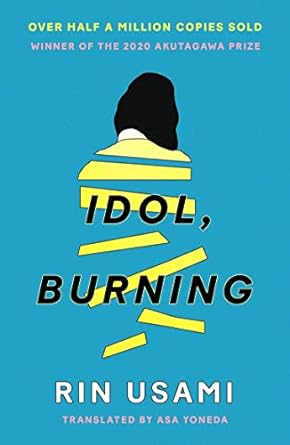
At the start of the novel, sixteen-year-old Akari is waking up to her social media DMs going into overdrive: her oshi, Masaki Ueno, part of boy band Maza Maza, has punched a fan. We follow her through the subsequent days as she struggles with the fallout of his behaviour.
Akari struggles even when things were going well with her oshi. She not academic, she doesn’t like her part-time job but she needs it to pay for all the merchandise associated with her oshi. (Without hammering it home, Usami makes it really clear the financial demands of having an oshi, and how this is exploited by merchandisers.) Her father is away overseas and she’s aware she frustrates her mother and studious sister.
Akari’s mind troubles her with a lack of focus outside her oshi, and her body troubles her too:
“Just being alive took a toll. To talk to someone you had to move the flesh on your face. You bathe to get rid of the grime that built upon your skin and clicked your nails because they kept growing. I exhausted myself trying to achieve the bare minimum, but it had never been enough. My will and my body would always disengage before I got there.”
What helps is her oshi:
“When my eyes met his, they reminded me how to really see. I felt an enormous swell of pure energy, neither positive nor negative, come rising up from my very foundation, and suddenly remembered what it felt like to be alive.”
Akari lives a substantial amount of her life online. Following her oshi’s accounts; blogging about her oshi; chatting with others who share her obsession and understand.
“Narumi sounded the same in person as she did online. I looked at her face, the round eyes and concerned brows overflowing with tragedy, and thought, There’s an emoji like that.
[…] Her facial expressions changed like she was switching out profile pictures.”
What was really clever in this novella (115 pages) and its translation is how Usami changed Akari’s tone and language depending on the medium she was using. The reader could see clearly how the person she created online through her blog and social media interactions wasn’t entirely authentic. It wasn’t entirely inauthentic either, and some of her closest relationships are with those she speaks to online – who of course, may not be entirely authentic either.
“When I pictured a world without Masaki, I thought about saying goodbye to the people here, too. It was our oshi that brought us together, and without him, we’d all go our separate ways. Some people moved over into different genres like Narumi had, but I knew I could never find another oshi. Masaki would always be my one and only. He alone moved me, spoke to me, accepted me.”
It’s a lonely world and there are hints Akari has been diagnosed with depression.
Through her devotion to Masaki we see all that Akari can do: she can be focussed, she can be insightful and she can be sensitive. It’s just that nothing other than her oshi prompts these behaviours.
We never learn the truth of Masaki’s actions and I was pleased about this. It is not his story, and while demonstrating the fallout of a celebrity flaming, Usami keeps the focus tightly on Akari. There is a Q&A with the author at the back of the novel and I wasn’t surprised to read that she has an oshi herself, because her portrayal of Akari is never patronising or pitying.
What Idol, Burning explores is how we all have to find a way to live, and that when this is focussed on something external and unpredictable – like a person and their constructed celebrity persona – then you can be in an incredibly vulnerable position. The novella ends on a tentatively positive note and I hoped Akari would learn to be the protagonist of her own life, rather than giving that power over so completely to someone else.
To end, I should definitely choose some J-pop, but I know absolutely nothing about it. So it’s back to 80s cheese, which I do know about 😀 Idol by name, Idol by nature…
 madame bibi lophile recommends
I found this quite disturbing when I read it. An entire culture, complete with merchandising, of course, built on a fixation. Deeply unhealthy for both the obsessed and the object of obsession.
LikeLiked by 2 people
Yes, Akari isn’t in a good place at all, she’s so deeply unhappy. I was glad the ending was more hopeful for her – at least that’s how I took it, maybe because I wanted some hope of a more fulfilling life for her!
LikeLiked by 1 person
That’s how I interpreted it, too.
LikeLiked by 1 person
This novella sounds intriguing – different, thought provoking and as if it would stimulate an interesting discussion. Thanks for drawing it to my attention, Madame Biblio.
LikeLiked by 1 person
Yes, it would be a good book club read from that point of view! So much about Akari is left unexplained, as is her devotion to her oshi.
LikeLike
That kind of obsessive fandom does sound intriguing although unhealthy. The K-pop fans always seem like that to me on Twitter, though they seem to have faded recently – presumably moved to Tik-Tok. It kind of suggests an emptiness in real life, which is a feeling I often get when reading Japanese fiction about young people.
LikeLiked by 2 people
It’s definitely part of a range of unhealthy behaviours that Akari has, and the most extreme. It did feel very sad and empty, so I was glad there was some hope for her at the end.
LikeLiked by 2 people
I read this last year and found it really intriguing. I’ll take Billy Idol over K-Pop any day!
LikeLiked by 1 person
It is intriguing – so much is unexplained. I do love Billy 😁
LikeLiked by 1 person
Sounds fascinating Madame B, and a little unnerving too. This is a world I know nothing about although obsessive fan behaviour seems to exist all over social media. It’s worrying how people can let this kind of thing take over their life.
LikeLiked by 1 person
Yes that’s it Kaggsy, it is unnerving because you wonder how it will play out when objectively Akari’s behaviour is quite baffling.
It is worrying how it takes over – it’s clear for Akari it’s a focus/crutch that insulates her a bit but it’s such a precarious position to be in.
LikeLiked by 1 person
This sounds very intriguing and perhaps a little dark. It’s resonates strongly in a world obsessed by celebrity culture where social media plays such a big part. I have never quite understood that extreme level of fandom, it’s a fascinating premise though.
LikeLiked by 1 person
It is a bit dark, not in tone so much but content definitely. I don’t understand that level of fandom either, but I think it’s easy to write-off fans like that as sad/pathetic and I was really pleased the author avoided those pitfalls. It’s a really interesting exploration.
LikeLiked by 1 person
What a fabulous example of how wide the world of literature can open our eyes to different experiences we’ve not had for ourselves. It seems like the kind of book that would have to be told in the first person voice, but I’m also curious, how might the story have been, if told from outside perspectives?
LikeLiked by 1 person
That’s a really interesting idea Marcie, because Akari’s obsession is clearly taking a real toll on her mother and sister, but they are not her focus so we don’t hear much about them. But Akari’s behaviour doesn’t exist in a vacuum at all. I’m sure they’d have very interesting perspectives on it all.
LikeLike
This sounds excellent. Have often wondered about the ‘fan’ culture now – when I was a teenager, it was limited by what you could see on TV and print media – I was always desperate for the new edition of Smash Hits! magazine.
Related – I recently met a man that looked exactly like a young Barry Gibb. I didn’t say anything to him (he might not have liked the comparison) but needless to say I could hardly take my eyes off him. (I LOVE Barry, and the Bee Gees – Barry will always be one of the best concerts I’ve ever been to).
LikeLiked by 1 person
Absolutely – we’re a similar age and so my teenage years didn’t involve the internet. These days there’s so much more access, and although it probably offers a lot of fun/camaraderie it can clearly be so unhelpful too.
Oh my goodness – surely he knew he looked like Barry? That’s incredible! Personally I like that whole 1970s beardy look – although young Kris Kristofferson is my first choice in that regard 🤣
LikeLiked by 1 person
Oh yes, a young Kris Kristofferson… The Barry-lookalike I met also kept shaking his mane/ hair, a la Barry style. He MUST have known!
LikeLiked by 1 person
🤣
LikeLike
Pingback: Sample Saturday – unmoving, an idol and a river | booksaremyfavouriteandbest