Continuing my endeavour to try and get some momentum back in my Around the World in 80 Books reading challenge, today I’m off to Uruguay, with Mario Benedetti’s The Truce: The Diary of Martín Santomé (1960, transl. Harry Morales 2015) which I was alerted to by Fiction Fan’s glowing review at the start of the year.
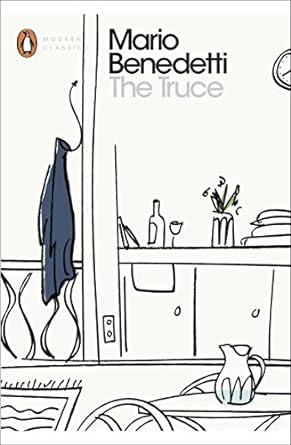
As the title suggests, the novella is in diary form, as Martín records his days in the run-up to his retirement, reflecting on how to live out his days. He is a quiet man in an administrative job; things are predictable.
“Today was a happy day; just routine.”
He is a widow of twenty years, and although he still has an eye for women (particularly their legs) he hasn’t had another relationship:
“The entire machinery of my emotions came to a halt twenty years ago when Isabel died. First there was pain, then indifference, then, much later, freedom, and then, finally, tedium. Long, lonely, constant tedium.”
His children Esteban, Jaime and Blanca are essentially unknown to him:
“At least Blanca and I have something in common: she, too, is a sad person with a calling for happiness.”
But although Martín is recording a lot of sadness, it’s not overly depressing. He has an acceptance of his life, and he makes quietly humorous observations, such as an old acquaintance learning of Isabel’s death:
“There is a sort of automatic reflex which makes one talk about death and then immediately look at one’s watch.”
Or his grief when his mother died:
“Only a fervent hatred of God, relatives and fellow man sustained me during that period.”
But things are about to change for Martín in ways he didn’t expect, when he falls in love with Laura Avellaneda, a work colleague half his age. While this would naturally raise questions about power dynamics and appropriateness, I felt it worked in The Truce, as Martín has been established as a gentle man, uninterested in wielding any sort of power or manipulation, and he is very respectful of Laura:
“I’m not going to demand anything. If you, now or tomorrow or whenever, tell me to stop, we won’t discuss the matter anymore and we’ll remain friends.”
In this short novel Benedetti perfectly evokes the gentle, slowly evolving love of Martín and Laura, and of Martín’s grief and acceptance of all he has lost in life alongside all that he still has. It suggests hope is still a realistic thing to hold onto, at any time.
The Truce isn’t sentimental, and although it depicts a romance it’s not rose-tinted. There is one point in particular where Martín behaves badly. He is not a perfect human-being and he causes hurt as well as joy to people.
But it is an empathetic tale, warmly clear-sighted towards ordinary people and all the foibles, weaknesses and strengths that we all carry.
The Truce is realistic, in a way that suggests even the most painful experiences can still be worthwhile. It explores how to not let pain overwhelm, and the importance of compassion for others and for the self:
“They suffer from the most horrible variant of solitude: the solitude of someone who doesn’t even have himself.“
This was my first experience of Benedetti and I’d be interested to read more by him. Apparently he wrote over ninety books so there’s plenty for me to choose from!
 madame bibi lophile recommends
That last quote you’ve pulled out is so arresting. Definitely one for the list.
LikeLiked by 1 person
Wonderful! I hope you enjoy it Susan.
LikeLiked by 1 person
Oh, this sounds marvellous Madame B – will definitely look out for it! (And good news that he has such a backlist…)
LikeLiked by 1 person
I hope you enjoy it Kaggsy! It is an incredible backlist – I had no idea he was so prolific!
LikeLiked by 1 person
I recall liking this a lot when I read it a few years but I never got around to writing it back then, probably due to a lack of time. Maybe I’ll pop it back on the re-read pile for another time as your review has reminded me of its charms!
LikeLiked by 1 person
Charms is the right word Jacqui! I hope you enjoy your re-read if you get to it.
LikeLike
PS I can also recommend ‘Who Among Us?’ by the same author if you’re looking to try another. 🙂
LikeLiked by 1 person
That’s really good to know Jacqui, thank you!
LikeLike
You seem to be enjoying your travels Madame Biblio! I like the sound of this one. It has just been added to the ‘wants’ list; I really loved the extracts you quoted.
LikeLiked by 1 person
I’m so pleased to hear that – I hope you enjoy it when you get to it!
LikeLike
I’m glad you enjoyed it! I also loved Springtime in a Broken Mirror, though it’s much more about the political side of life.
LikeLiked by 1 person
Great to know! I’ll look out for it as I definitely want to read more by him.
LikeLiked by 1 person
“It suggests hope is still a realistic thing to hold onto, at any time.”
This sounds so rewarding. One I would definitely enjoy, by the sounds of it. I also appreciate the very simple cover illustration: it seems to suit (even though I recognise it’s part of a series for that imprint, or at least I think it was).
LikeLike
This sounds like a lovely novel, I don’t think I am familiar with this author at all. However Martin sounds like a lovely character.
LikeLiked by 1 person
He is – he doesn’t always behave well, but he’s very real and there’s a sense of honesty in his diary because he’s only writing for himself.
LikeLike
90 books? Goodness! How wonderful if they’re all as good as this one!
LikeLiked by 1 person
Absolutely! He was certainly prolific!
LikeLiked by 1 person