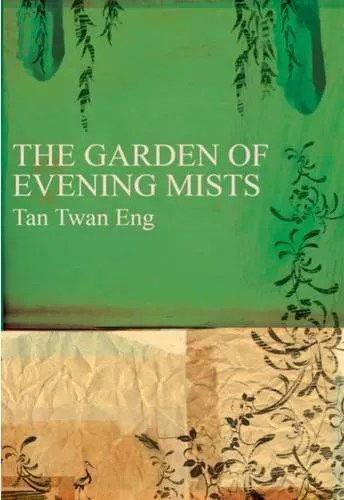
Continuing my plan to try and take my Around the World in 80 Books reading challenge by the scruff of the neck, today I’m off to Malaysia. The Garden of Evening Mists by Tan Twan Eng (2012) has been hugely lauded and it had completely passed me by. I rectified this situation by taking it with me on a long weekend in the New Forest recently, and it definitely suits those moments when you have a decent amount of time to commit to it.
Back at the end of May when Kim at Reading Matters very kindly invited me to take part in her Triple Choice Tuesday, I chose The Secret Garden as a book that changed my world due to its themes of gardens and healing. So The Garden of Evening Mists was always going to be a winner for me as it explores these themes.
The story opens in the 1980s, Yun Ling is a high court judge, just about to retire. This means she is leaving the bustle of Kuala Lumpur to return to her home in the Cameron Highlands.
“Most people in Kuala Lumpur couldn’t bear the stench, especially when the river was running low between monsoon seasons, but I had never minded that, in the heart of the city, I could smell the mountains over a hundred miles away.”
She hasn’t been back for years, and her return encourages her to reflect on her past:
“The garden’s name in English: Evening Mists. I felt I was about to enter a place that existed only in the overlapping of air and water, light and time.”
The main focus of her reflections is the time she spent as apprentice to a gardener who had been employed by the Emperor of Japan. Nakamura Aritomo is a mysterious figure, best known to his South African neighbour Magnus Pretorious, who still doesn’t know him hugely well, or why he seems to be in self-imposed exile in this remote part of Malaysia.
The past narrative begins in 1951 and Teoh Yun Ling is the sole survivor of a Japanese POW camp, where her sister died. She wants to build a Japanese garden in memory of her sister:
“Yun Hong kept our spirits up by talking about the gardens we had visited in Kyoto, describing even the smallest details to me. ‘This is how we’ll survive,’ she told me, ‘this is how will walk out of this camp.’”
In order to build her garden, Yun Ling is going to need the help of Aritomo, and for that to happen she needs to learn to trust a Japanese man despite associating him with her torturers.
“The imminent rain in the air smelt crisp and metallic, as though it has been seared by the lightning buried in the clouds. The scent reminded me of my time in the camp, when my mind had latched onto the smallest, most inconsequential thing to distract myself: a butterfly wafting from a patch of scrub, a spider web tethered to twigs by strands of silk, sieving the wind for insects.”
The relationship between Yun Ling and Aritomo is undoubtedly the centre of the story, but this is an ambitious novel and covers a great many themes, including the aftermath of World War Two and pre-independence Malaysia. (There are a few info-dump moments but not many.) It shows how power is achieved through violence, during British colonialism and beyond.
Within a carefully evoked historical context, Tan Twan Eng explores how we heal from trauma; how we reconcile to ourselves and to others; how we find redemption, and how we can forgive. It’s an immensely powerful story, and Yun Ling has to navigate her survivors guilt and overwhelming anger, to try and work out how on earth she is going to continue with her life.
“Walking in the garden I had heard about almost half a lifetime ago, I wished Yun Hong were here with me. She would have enjoyed it more than me. I wondered what I was doing here, living the life that should have been my sister’s.”
From goodreads I know some readers found Yun Ling too detached and remote a voice within her own story. Although some of the characterisation in the novel felt thin at times, I didn’t have a problem with Yun Ling’s voice. I thought it worked well in conveying her detachment through trauma, and it also balanced the style of storytelling. The descriptions are so richly detailed (sometimes a bit too much for my austere tastes) that to have a highly emotive voice amongst it all would have been too much.
“Birdsong song sparkles the air; mists topple over the mountains and slide down their flanks, slow and soundless as an avalanche witnessed from miles away. Instinctively I turn to look behind me, expecting Aritomo to chide me with a look or a scathing word. I see only my own footprints on the dusty floorboards as the bamboo blinds creak softly in the wind.”
Amongst this beauty are some gruesome scenes too, both in the 1950s setting and in Yun Ling’s memories of the camp. I didn’t find this gratuitous at all and thought they were responsibly handled, but wanted to warn any readers late to The Garden of Evening Mists like me that it is certainly not an unrelentingly pretty read.
Underpinning all periods is the theme of memory, effectively evoked through the shifting back and forth between timelines. Tan Twan Eng demonstrates how we cling to memory, how important it can be despite its unreliability. He shows how this can limit our knowledge of ourselves, others and circumstances, yet it remains vitally important.
The Garden of Evening Mists presents complex people and situations and demonstrates how, even when we don’t know everything and can’t rely on what we do know, all are worthy of compassion.
“Are all of us the same, I wonder, navigating our lives by interpreting the silences between words spoken, analysing the returning echoes of our memory in order to chart the terrain, in order to make sense of the world around us?”
To end, has anyone seen the adaptation from 2019? From this trailer I can’t decide if I want to watch it…
 madame bibi lophile recommends
Lovely review! An old friend gave me a copy of this several years ago and I was so impressed by it. Beautiful writing which doesn’t duck the trauma of the period described.
LikeLiked by 1 person
Thanks Susan! It’s so impressive how he balances the beauty with the traumatic scenes isn’t it? Neither one undermines the other.
LikeLiked by 1 person
I thought this was an excellent book, and I really liked his more recent House of Doors. We don’t often get books from Malaysia, so he’s pretty special IMO.
LikeLiked by 1 person
I’ll look out for a copy of House of Doors, I’m keen to read more by him as this was so impressive.
LikeLiked by 1 person
How lovely, to simultaneously spend time in Malaysia and the New Forest! I have not read this (yet?!) either. As usual, after reading your thoughtful reflections, I am much more likely to do so. It does sound an evocative and compelling story, which does not shy away from some deep and difficult themes.
I like the cover of the book too. I don’t think I would be brave enough to watch a film adaptation though!
LikeLike
Yes both settings were lovely! I hope you enjoy this if you do pick it up.
Good point about the film – I’ll have my finger poised on the fast forward button for some scenes…
LikeLike
I did read this quite a few years ago and thank you for reminding me of the beautiful writing because what I’ve really remembered is the tattoo on her back, which I hated!
LikeLiked by 1 person
Oh yes, the tattooing sounded soooo painful! Those descriptions were incredible. Thankfully he evoked the beautiful setting just as vividly!
LikeLiked by 1 person
Sounds fascinating Madame B, if a little difficult in places. Those quotes are lovely, though, and good writing might make me overlook the less pleasant aspects…
LikeLiked by 1 person
It’s very well balanced Kaggsy. There’s enough of the more traumatic elements to represent the events responsibly, but they’re not gratuitous or dwelt upon. I’m quite hesitant with that sort of content, and I found it tough but ok! I hope you enjoy this if you give it a try.
LikeLiked by 1 person
I’ve not seen the movie, nor have I read the book, but I vividly recall reading the first maybe-20 pages on a streetcar (trolley) on a very rainy mid-afternoon and just loving the opening of it. (I’d thought I’d be able to renew it, but I wasn’t able, and I didn’t get back to it afterwards. That used to happen far more often-still does occasionally, though I’ve gotten more suspicious. heh)
LikeLiked by 1 person
I hope you have the chance to get back to this as you enjoyed the opening!
The discipline of library books is helpful, but I too have those I returned unread and never got back to…
LikeLike
Ah that’s interesting Jacqui. I’m the other way around, maybe because my memory is mainly visual? So I find it much harder to watch the images on screen than read the words.
But maybe I also self censor, and don’t fully create in my mind what I’m reading about. That said, I don’t really read gruesome books because I do find such scenes horrible to read. So I don’t read much modern crime at all.
LikeLike
Pingback: “People are better inside your head.” (Donal Ryan, The Thing About December) | madame bibi lophile recommends
This sounds so very good Madame Bibi. I’ve not really read anything around colonial and World War experiences in Malaysia so far; will look this one up!
LikeLiked by 1 person
I hadn’t either Mallika – it was really interesting from that aspect.
LikeLiked by 1 person