I’m hoping to complete my Around the World in 80 Books reading challenge this year. I want each book to be written by someone from that country and so at this stage I need to actively seek the books rather than just see what comes into my path. However, The Baghdad Villa by Zuheir el-Hetti (2016, transl. Samira Kawar 2023) did turn up in my local charity bookshop, helping me to add Iraq to my list.
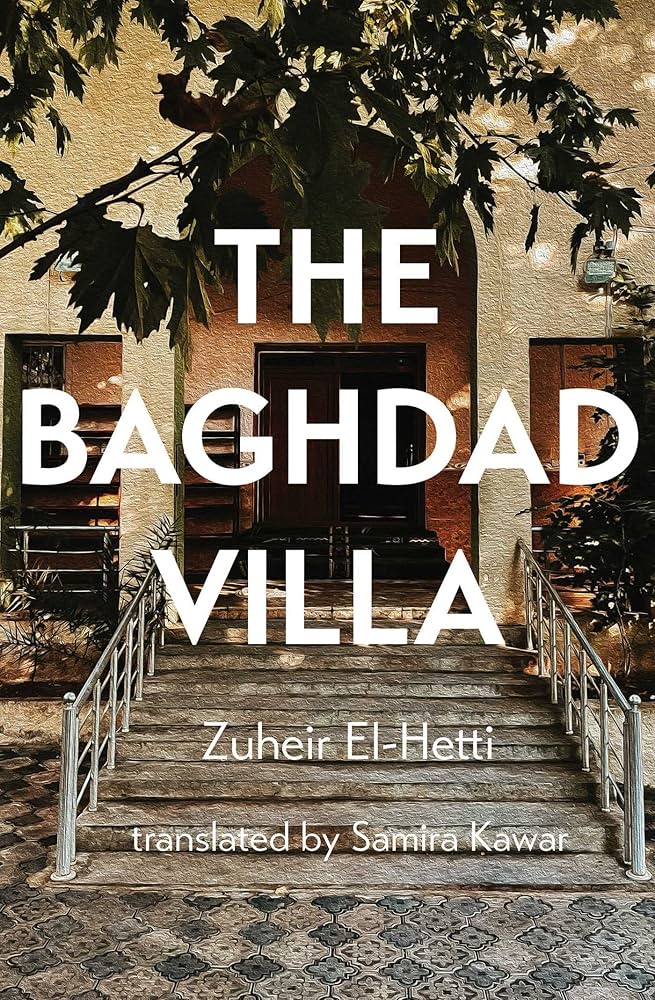
Set in 2003 after the American invasion and toppling of Saddam Hussein, the narrative is from the point of view of Ghosnelban, a young woman from an aristocratic family who is racketing around the titular building, remembering the glory days of her relatives as life outside the grounds changes beyond all recognition.
“We had been brought up according to strict rules of speech and behaviour. The use of words that breached the limits of politeness and respect was prohibited. We had carefully preserved that strict moral linguistic code, which we shared with our few gradually vanishing acquaintances and relatives, fearing that its demise would signal the loss of our identity.”
Ghosnelban’s only company is her one remaining member of staff, the housekeeper Mamluka, and her brother Silwan, who is very unwell.
“He had been a soldier in an army that had been epically crushed in the battle to free the oil-rich desert. He came back to us, but did not return, because he had left his mind there, on the road between Basra and Nasiriya. He came back filled with horrifying nightmares, leaving behind all that was human. Then he began to endlessly narrate what he had experienced and seen on that accursed road, like an endless black waterfall.”
Ghosnelban knows her situation is unsustainable. At the start of the novel she receives a bullet in the post – a warning to leave her home or be killed. She meditates on seven artworks on the walls, Masters collected by her grandfather, each painting giving its name to a chapter in the book.
Ghosnelban is not likable. She is an elitist who freely admits to othering people who are not like her “Truly, did the lives of such human beings have meaning?” At the same time, clinging onto her elitism in the face of overwhelming destruction of her way of life is an act of defiance and resistance.
“I was, after all, the descendant of a highborn family and had learned to sculpt hatred and to turn it into a lethal weapon that I threw everyone to confront the vulgarity prevailing around me.”
As much as I didn’t like Ghosnelban, her voice was so distinctive and strongly evoked from the start, I was quicky drawn into her story. And as this develops, of course she becomes more complex than the superior, condescending snob the reader is initially introduced to.
She finds freedom in a friendship with sex worker Regina:
“I wanted to escape my own skin into which I had been placed by my family and it’s ancient history. She didn’t know who I was, was completely ignorant of my family’s history… and was totally uninterested in lineage.”
We also learn of Ghosnelban’s experience of love and passion with someone whose position makes the match entirely unsuitable. Perhaps it is this that encourages her to try and find who is when not defined by her family:
“My grandparents seemed supremely elegant, but cheerless. Their gazes expressed a hauteur that seemed natural to them, two people who never allowed colourful emotions to draw close […. ] Tears were an absolutely forbidden weakness. Displays of yearning were cheap. Love was demonstrated through action, not mawkishness; smiling was a feeling, not a meaningless stretching of the lips. We had learned that list by heart, and I remembered it nostalgically.”
While Ghosnelban seems to retreat into inaction, gazing at her grandfather’s paintings and reflecting, el-Hetti brilliantly builds the sense of impending threat and violence from which she cannot escape. Ghosnelban is not stupid and she knows she has to take a decision or inaction becomes a decision. For such a reflective, interior narrative, The Baghdad Villa becomes unbearably tense.
The Baghdad Villa is a compelling, complex character study which widens to explore the impact on individuals during moments of rapid societal and political change. It demonstrates how moments of great humanity can exist in the most extreme circumstances; as well as the extremes to which human beings can be driven.
Much to my surprise, it became a real page-turner as I hoped Ghosnelban wouldn’t be destroyed along with her family’s villa. On finishing, I knew I was really going to miss Ghosnelban’s snooty, fierce and vulnerable voice.
 madame bibi lophile recommends
Great review Madame Bibi – a wonderful way to travel in the mind without endangering the body! When you first described Ghosnelban, I was put off rather, because I do find I often need to like (at least in some ways) the main character in a book in order to really enjoy it. Nevertheless, I did change my mind as I read on and, if I see a copy of this one in the wild then I will pick it up. Thanks for broadening my reading horizons!
LikeLiked by 1 person
I thought it was a really brave decision to show Ghosnelban at her most unlikable at the start of novel. But the portrait deepens and she’s not as she initially appears. It’s a very skilled character portrait. I hope you enjoy this if you do see a copy!
LikeLike
I’m impressed with how strict you’ve been with the Around the World challenge (I have counted books set in different countries – for the most part it’s the same country as where the author is from, but that hasn’t always been the case). Anyway, a book that I have found helpful (and interesting regardless of the challenge) is Lonely Planet’s Armchair Explorer, which has book, movie and music recommendations for each country – a wealth of information.
LikeLiked by 2 people
Actually, sing out if you want me to check the entries for any particular countries!
LikeLiked by 1 person
I’ve really enjoyed the challenge and I don’t feel any pressure with it, so being strict has been fine! Thanks so much for reminding me about the Armchair Traveller – it sounds a great book so I’ll have a hunt for it – my library may have a copy. If not, I’ll definitely call on you 🙂
LikeLike
Iraq isn’t a country I’ve ever explored in my reading, so I’m certainly going keep an eye out for this one. Even if Ghosnelban isn’t particularly likeable, I’m curious to know from your description what her life was like and what her decision will turn out to be.
LikeLiked by 1 person
Although she’s not likable, especially at first, her voice is so well realised I found myself alongside her. I hope you enjoy this if you get to it Mallika!
LikeLike
I don’t think I’ve read any Iraqui fiction. Adding this one to my list. Hope you’re enjoying the Tallack
LikeLiked by 1 person
I hope you enjoy this when you get to it Susan! Yes, liking the Tallack very much so far 😊
LikeLiked by 1 person
Sounds like a fascinating book, Madame B, and yes – very brave to start out with the character being so unlikable. That can sometimes be offputting in a book but it definitely seems to have worked well here. And I so admire the breadth of your reading for this challenge – I don’t think I’ve ever read any fiction from Iraq.
LikeLiked by 1 person
It was really interesting Kaggsy. I thought the characterisation worked so well, she was very believable.
I’m really enjoying this challenge – I think this is the first novel from Iraq that I’ve read.
LikeLiked by 1 person
Fabulous review! I must admit that superficially this novel didn’t appeal (I’m afraid my reading choices are provincial; I’ve had to make an effort to read translated fiction). This changed rapidly as I proceeded through your review; you’ve really gotten me very interested in the novel, which is now on my TBR! I’ve also been looking at your Around the World Challenge, which is such a great way to explore some fascinating reading experiences!
LikeLiked by 1 person
Thanks so much! I’m so glad this appeals and I hope you enjoy it when you get to it.
The challenge has been great, I’ve really enjoyed it so far and it has encouraged me to seek out new reading 😊
LikeLiked by 1 person
Your most interesting review sent me to check if I had ever read anything set in Iraq, and it seems I have, but five of them are by blow-ins (or possibly written without ever actually going there). The only one by an Iraqi writer in Iraq is Frankenstein in Baghdad (2013), by Ahmed Saadawi, translated by Jonathan Wright, which is also set after the toppling of Saddam Hussein amid the chaos that followed.
LikeLiked by 1 person
I’d be really interested to read that now, to see another portrayal of the time. Thank you for alerting me to it Lisa!
LikeLiked by 1 person
It’s so interesting the characters that stay with us isn’t it, they don’t have to be ‘nice’! I’m getting on so badly with my Wonderlust challenge that I do wonder if changing to this challenge would be a better way for me to read globally? I’ll have a look at your master list/post, and I see the note about Armchair Explorer which I hadn’t come across and sounds terrific. Anyway, great post!
LikeLiked by 1 person
Yes absolutely, sometimes it’s the least pleasant characters that really stick!
This challenge has certainly worked for me so I hope you enjoy it if you take it on Jane. It’s a shame Hard Book Habit who set it up aren’t blogging anymore. It’s very relaxed – 80 Books, one from each continent, one involving travel and one sea-based. That’s it!
LikeLiked by 1 person
A great find for the Around the World challenge – I find that region the hardest to find good translated fiction from. Interesting choice to make the character start out as so unlikeable. I’m glad she won you over in the end!
LikeLiked by 1 person
I was really pleased to find it – I don’t think I’ve read a novel from Iraq before. It was a very interesting characterisation for sure!
LikeLiked by 1 person
How fortunate that you found a copy of this in The Best Little Charity Bookshop Evahr just when you needed it. Of course.
It sounds like just the kind of complicated and rich characterisation I enjoy. I’ve read more fiction from the “Middle East” than I thought (which I say, having been through my sheet in some detail recently, to see how much Latin American fiction I’ve read…very little, speaking relatively) but I’m always looking for more to add to my TBR from this region, especially across different time periods.
LikeLiked by 1 person
That charity bookshop really is the best!
The characterisation in this is so well done, I think you’d like it.
LikeLike
I really like the sound of this one. Thank you.
LikeLiked by 1 person
So glad it appeals!
LikeLiked by 1 person