This is a contribution to Kaggsy and Simon’s1952 Club, running all week. One of the many great things about the Club weeks is that they encourage me to raid the TBR and get to books which could have languished there forever. Today’s book is a perfect example: an author and a novel I knew nothing about but which I greatly enjoyed.

Laura Talbot was the pen-name of Lady Ursula Chetwynd-Talbot, and her knowledge of the land-owning classes informs The Gentlewomen throughout. It tells the story of Miss Roona Bolby, a single woman growing older who has to earn her living as a governess. She clings desperately to her family’s genteel background and colonialism while around her the world changes irrevocably.
“When she had been sent back to England she had been seven. She had been told so much since that memories which had been sharp had become blurred by that which she had been told. It was difficult now to sort her own from Sita’s and Mavis’s. India had not faded with the journey home; from then on it had grown, it had become as much a part of her own life as of her Mother’s and Sita’s and Mavis’s.”
Thus she will tell anyone – repeatedly and incessantly – that she was born in India, as she wears gold Indian bangles and uses an Indian silver brush set. She remains oblivious to the fact that her background is a matter of utter indifference to everybody.
At the beginning of the novel she leaves her shabby boarding house Hillstone in Birmingham, (filled with characters which could have made a great novel in itself!) and heads to the country seat of the Rushford family.
The Second World War is ongoing, and so the house is not as it once was. Lord Rushford is overseas, there are two Italian POWs and Land Girls have working on the estate, and my favourite character, straight-talking Reenie, has never been a kitchen maid before.
Miss Bolby has been employed to tutor to the various children from both parents’ first marriages, while Nanny Becca cares for the younger toddler Bella. Jessy, Barby, Louisa and Ruth dislike their tutor, and why wouldn’t they? She is completely devoid of any warmth towards them, won’t call them by the names they use, and seems a pretty dull teacher.
In Miss Bolby, Laura Talbot has not created a likable protagonist. She is so bound up in outdated societal structures, she entirely fails to respond to people as people. Her snobbery infects all her thoughts and actions:
“I always think it helpful to know from what milieu people come, especially in these days when one so frequently find the unexpected.”
The Introduction to my edition suggests that the portrait of Miss Bolby is without compassion, but I disagree. While she is petty, silly and resentful, we see how thwarted she is through her memories. Her mother used phrases like “rather deuxième” about those she deemed socially inferior, failing to recognise the crassness of such a phrase – one which Miss Bolby echoes later in the novel. She also wished to be a singer, which her mother prevented.
And so while she declined suitors in her youth as never good enough, it is really only she who suffered, and continues to do so. She was beautiful, but rejected the chances that this gave her, and now when roles and opportunities for women are still so circumscribed, she is losing her looks too. Her world is getting smaller and smaller, and she exacerbates this.
“Drawing-rooms and dining-rooms were as passages, her presence in them transitory: she had been forced to grope as a moth gropes before flying out into the night.”
When Miss Pickford arrives at Rushford, the reader is shown another way for someone in similar circumstances to live. The other gentlewoman of the title, Miss Pickford has little advantages in her favour, but she enjoys people and is interested in them, is entirely without Miss Bolby’s pettiness and relentless judgements, and has genuine skill in her work as secretary. The children warm to her and call her Picksie, and no-one seems to consider her an “old bag” – an epithet frequently associated with Miss Bolby.
As this disparate group rub along together, there is a threat to Miss Bolby’s fragile sense of worth, grounded as it is on meaningless external attributes rather than who she is as a person. Her sister Sita made a marriage to Arthur Atherton-Broadleigh and lives abroad, so Miss Bolby puts great store by the connection (and by constantly referring to it) despite little knowledge of the actual realities of the relationship. Unfortunately for her, there is someone who knows Arthur’s past very well…
At the same time her Indian bracelets go missing, and this additional pressure on her psyche means she starts to behave quite viciously. While there is never quite the psychological disintegration that occurs in William’s Wife or Wish Her Safe at Home, The Gentlewomen did remind me of these novels, with the portrayal of societal pressure and delusion for women who wanted so much more from life.
The war is far away physically, but the drudge of various privations and the frequent noise of aeroplanes bearing down to the local airbase add an atmosphere of bleak strain, which becomes almost Gothic as it turns out Rushford has been burned out from fire in many places, and sits in overgrown, unmanageable grounds.
“War was a lonely battle for the lonely, for those not urgently connected with it, and in her case a lonely battle for what?”
In case this sounds very heavy, I should say I disagree with the Introduction in another way, when it says Talbot had no humour. I think she is easy to underestimate because she is not interested in drawing attention to her writing at all; there is no strong authorial voice. Her style is to present the characters, and leave judgement to the reader. Often Miss Bolby’s pretentious assertions go ignored by her interlocutors which speaks volumes.
And so I found there were various moments of humour, from the wonderful Reenie, to the neighbour Lady Archie who consistently baffles her devoted husband by acquiring modern slang from the Squadron-Leader at the RAF base. Needless to say, this doesn’t fit in Miss Bolby’s schema at all:
“She had wondered all evening about Lady Archie, and who Lady Archie was and why she used such phrases as ‘It seems to ring a bell’ and ‘Same here’, which one expected from a Mr Billings, but not from a woman such as Lady Archie.”
“ ‘Wizard!’ said Lady Archie. ‘But I’ll have to consult Hughie about the car.’”
The tension builds in The Gentlewoman towards a somewhat melodramatic climax, but while I felt this came close to clumsy, it was also a real page-turner. On the strength of this novel, I would definitely be interested in reading more by Laura Talbot. (And although I’m not usually bothered by writer’s biographies particularly, I’m also intrigued by her third marriage, which took place two years after she published this novel, to Patrick Hamilton. How on earth did that come about?!)
Sadly, ultimately Miss Bolby’s harshest judgements are in the fleeting ones she puts upon herself:
“A failure, who had not lived fully in any sphere – who had always lived up on the fringe.”
 madame bibi lophile recommends
That’s a great quote in your heading and the final one is blistering.
LikeLiked by 1 person
Glad you liked them Susan – she could definitely turn a phrase!
LikeLiked by 1 person
Great review, thank you! Another book I now know not to pass over if I ever see it in the wild. I am adding lots of new books to my tbr this week.
LikeLiked by 1 person
It’s proving a great year isn’t it? So many wonderful reads!
LikeLike
Isn’t Chetwynd-Talbot the name of a character in Salmon Fishing in the Yeman? This sounds excellent, I like the idea of living up on the fringe!
LikeLiked by 1 person
I’ve never read SFITY but I’ve just googled it and it’s very close – Chetwode-Talbot! Impressive memory Jane, I’m absolutely terrible with names!
LikeLiked by 1 person
It’s a very sweet, easy read (but good!) and a lovely film with Ewan McGregor and Emily Blunt as Ms Chetwode-Talbot!
LikeLiked by 1 person
I’ll look out for it 😊
LikeLiked by 1 person
I couldn’t help thinking of Joanna Lumley going on about her Indian origins in the travel show that screened here recently. Nobody is interested, and it doesn’t give her travels there any more credibility than anybody else’s.
LikeLiked by 1 person
I didn’t see those, but yes, it sounds very reminiscent!
LikeLiked by 1 person
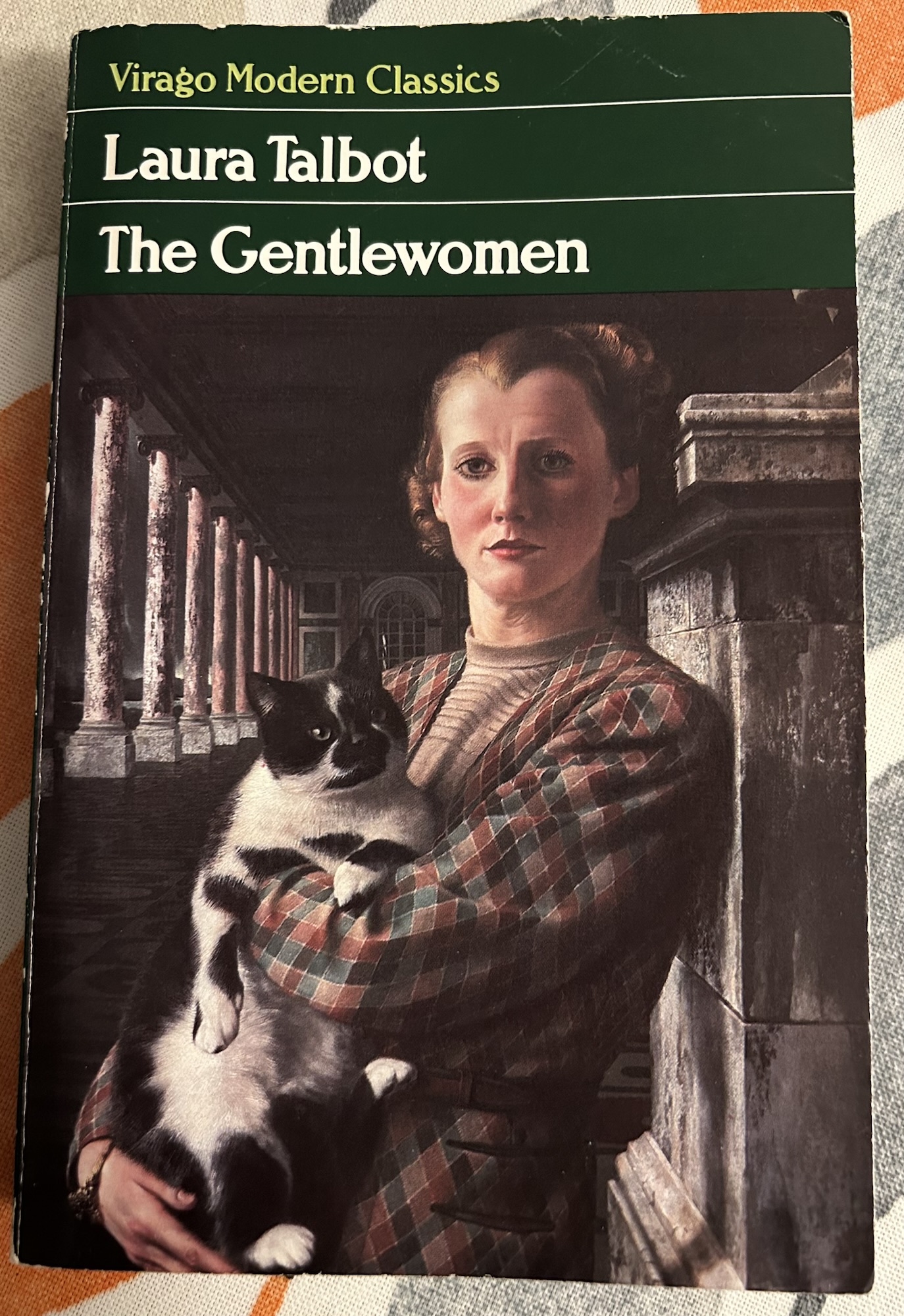
I must have forgotten to the check the VMC list for 1952, as I have wanted to read this one for ages (the cat!) and I think I remember it’s one that Ali really loved too. What would we do without events (and other completely made-up “reasons”) like this to make us finally take the time for good books that have been shelfsitters for far too long.
LikeLiked by 1 person
The cat is gorgeous! I hope you enjoy this one when you get to it 😊
LikeLike
It does sound a rather sad book despite the flashes of humour, and even that cat on the cover seems to be looking at her a bit disdainfully…
LikeLiked by 1 person
Absolutely, it is sad book. It’s a portrait of an unhappy life which could have easily been so different if she’d only shaken off her ridiculous snobberies.
LikeLiked by 1 person
Great review Madame B! I’m aware of this book, and may even have (or have had) it in my Virago collection – unread of course. I had no idea what it was about though, and it sounds as if it has a lot to it. I can see how the main character could be simultaneously annoying and yet a figure for sympathy – so many women had their lives and aspirations crushed by parents and circumstances!
LikeLiked by 1 person
That’s it exactly Kaggsy – she is annoying and not very likeable at all, yet you do feel for her. Her inability to move past all her pretensions makes her life so much worse that it needs to be.
LikeLiked by 1 person
Skimming your review for now, Madame Bibi, as I have a copy of this in my TBR – its link to 1952 had completely escaped me, otherwise I would read it for the club! That said, I can see from your opening comments that you enjoyed it, which is very reassuring to hear. 🙂
LikeLiked by 1 person
I did! I hope you enjoy this one when you get to it Jacqui.
LikeLike
A great review! I read it 15 years ago and did a shorter one, but I did enjoy it, too https://librofulltime.wordpress.com/2010/06/07/laura-talbot-the-gentlewomen-virago/ I particularly like that cover as the cat is very like my long-gone Dot!
LikeLiked by 1 person
Thanks Liz! Great to hear you enjoyed this too.
Dot must have been a beautiful girl – the cat is lovely 😻
LikeLiked by 1 person