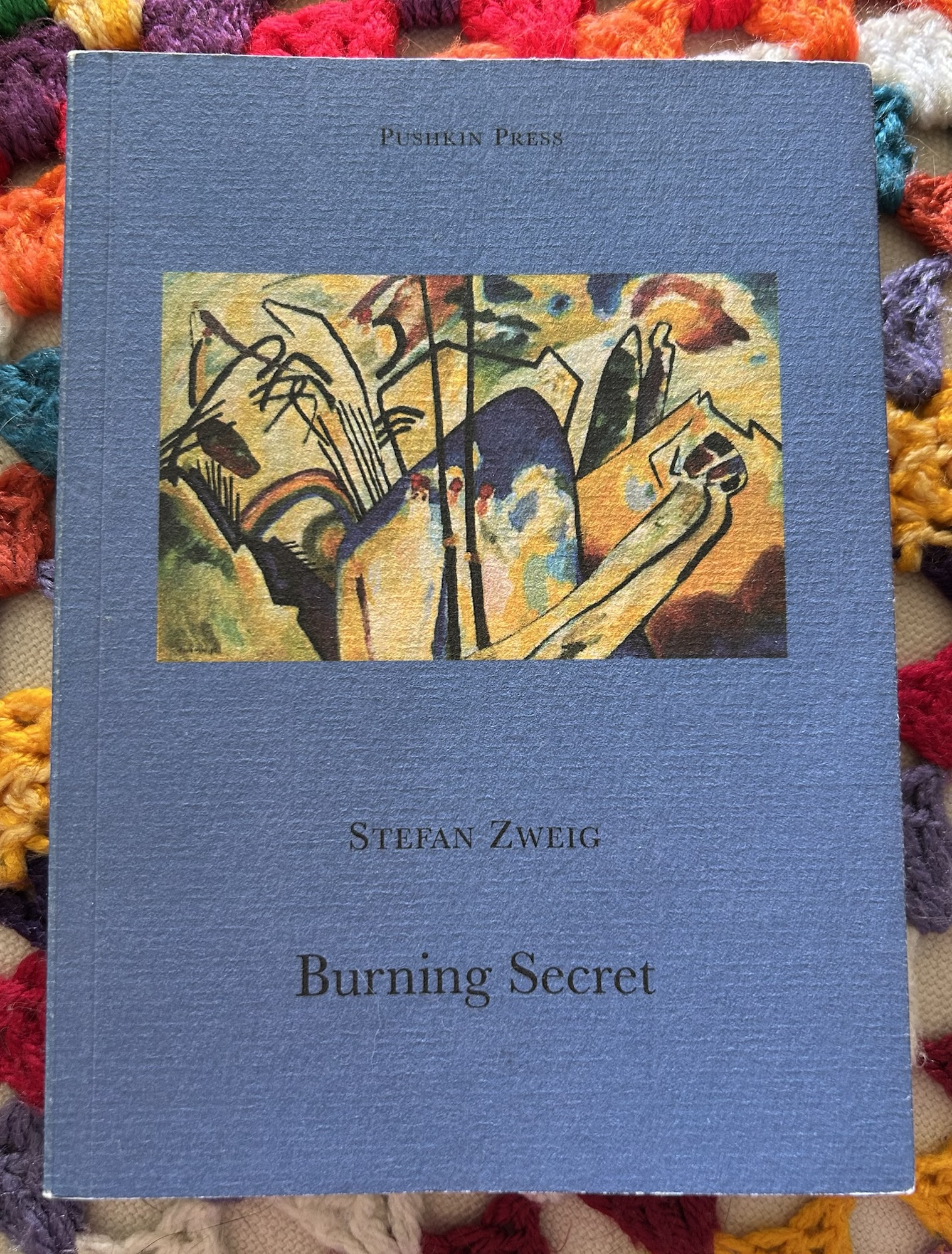
Burning Secret – Stefan Zweig (1913, transl. Anthea Bell 2008) 117 pages
Stefan Zweig is such an exquisitely tender writer. His precise, compassionate observations are deep with humane understanding. It makes him a perfect novella writer.
Burning Secret has a very simple structure. Edgar is twelve years old and recuperating from an illness in the spa town of Semmering. He is lonely and disregarded, bored and unnurtured.
“His face was not unattractive, but still unformed; The struggle between man and boy seemed only just about to begin, and his features were not yet kneaded into shape, no distinct lines had emerged, it was merely a face of mingled pallor and uncertainty.”
Unfortunately for Edgar, the Baron, an irredeemable cad and bounder, arrives in Semmering.
“He felt no inclination to be alone and avoided it as far as possible; he didn’t really want to become any better acquainted with himself. He knew that, if he was to show his talents to best advantage, he needed to strike sparks off other people to fan the flames of warmth and exuberance in his heart. On his own he was frosty, no use to himself at all, like a match left lying in its box.”
This vacuous young man plans on whiling away his time in a meaningless love affair, and his sights soon settle on Edgar’s mother. As she is initially resistant to his charms, he callously decides to leverage Edgar in order to win favour.
“The Baron easily won his confidence. Just half-an-hour, and he had that hot and restless heart in his hands. It is so extraordinarily easy to deceive children, unsuspecting creatures whose affections are so seldom sought.”
Poor Edgar. He falls hook, line and sinker.
“A great, unused capacity for emotion had been lying in wait, and now it raced with outstretched arms towards the first person who seemed to deserve it. Edgar lay in the dark, happy and bewildered, he wanted to laugh and couldn’t help crying.”
For the Baron it is all a game. He has no feelings for Edgar or his mother, the latter only prey with which to amuse himself. He views her ruthlessly, identifying her snobbery and pretentions and knowing how to exploit these by emphasising his nobility. He gives no consideration to her marriage or vulnerabilities as a woman who will be judged much more harshly than he if they have an affair.
What he doesn’t reckon on is Edgar’s dawning, imperfect realisation, and the fury of a hurt child. What follows is a coming-of-age story where the lessons are learned through emotional brutality.
And yet, the resolution is hopeful, and without bitterness. It feels realistic and reflective, not undermining what has gone before but demonstrating human endurance too.
In less subtle hands Burning Secret could be sentimental and mawkish. With Stefan Zweig, it is emotionally devastating.
“He didn’t understand anything at all about life, not now he knew that the words which he thought had reality behind them were just bright bubbles, swelling with air and then bursting, leaving nothing behind.”
 madame bibi lophile recommends
I haven’t read this one yet, but I love his work.
If only he had lived longer.
LikeLiked by 1 person
If you like Zweig I think you’ll enjoy this Lisa. It’s so finely observed.
His death was absolutely tragic, so very sad.
LikeLiked by 1 person
Adding this one to my list. Zweig lived in Bath in 1939 for just under a year. I pass his house on one of my regular walks which now has a plaque commemorating his stay there.
LikeLiked by 1 person
So glad this appeals Susan. It’s lovely to hear he’s commemorated in Bath.
LikeLiked by 1 person
Hmm, you make a compelling case for this one…
LikeLiked by 1 person
I think you might like this one FF 😊
LikeLiked by 1 person
Lovely review Madame B. This was one of the first Zweigs I read, iirc, and pre blog I think. You’re so right about how something which could be soppy in the hands of a lesser writer is far from it with him.
LikeLiked by 1 person
Thanks Kaggsy. His skill is supreme isn’t it? Such a subtle writer.
LikeLiked by 1 person
Another one that sounds so good: You’re going to have me adding a lot to my TBR this month! Edgar sounds really well done–and so indeed does the despicable Baron!
LikeLiked by 1 person
It’s so well done and so insightful. I hope you enjoy it Mallika!
LikeLike
Zweig is a writer who’s been on my list for ages and ages, I think this would be a good one to start with, thanks!
LikeLiked by 1 person
It would Jane – it would give you a good sense of his style and approach. I hope you enjoy him!
LikeLiked by 1 person
I’ve really enjoyed the couple of Zweig that I have read, This sounds good/.
LikeLiked by 1 person
If you like Zweig I think you’ll like this one, it’s so finely observed.
LikeLiked by 1 person
Yes, emotionally devastating is the phrase! I recall feeling crushed by this novella when I read it some years ago, and your review brings that sensation rushing right back. The loss of innocence in childhood is one of my favourite themes in literature, and this is a great exploration of the brutal nature of that transition. I’m so glad to see how much you got out of it!
LikeLiked by 1 person
It’s so impactful isn’t it? Remarkable for such a short book.
Good to hear you rate this one Jacqui.
LikeLike
“He felt no inclination to be alone and avoided it as far as possible; he didn’t really want to become any better acquainted with himself.'”
This immediately summons up a clear idea of his character. And it feels timeless!
Also, what a lovely little copy of this.
LikeLiked by 1 person
Absolutely – such clever writing! It was a lovely edition, one of the smaller Pushkins with textured covers and French flaps.
LikeLike