Novella a Day in May 2026 – No.3

I hadn’t heard of Rock Crystal by Adalbert Stifter (1945, transl. Elizabeth Mayer, Marianne Moore 1945) before, despite the fact that according to the back cover, Thomas Mann called Stifter “one of the most extraordinary, the most enigmatic, the most secretly daring and the most strangely gripping narrators in world literature”.  I picked it up because NYRB Classics always prove interesting, and this was no exception.
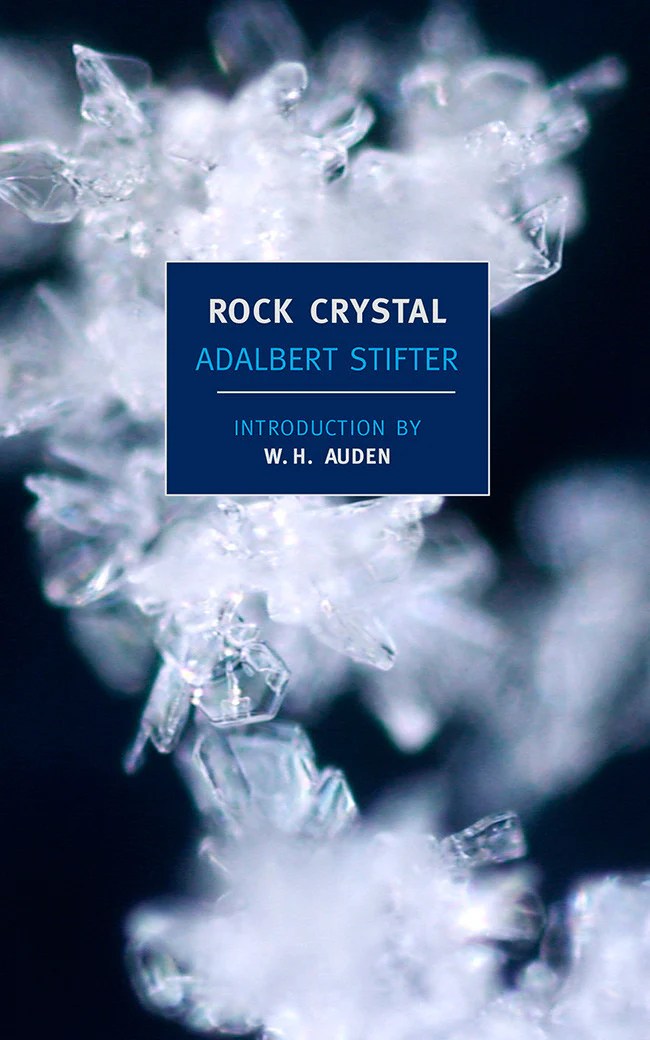
It opens with beautiful descriptions of its alpine setting:

“Among the high mountains of our country there is a little village with a small but needle-fine church-spire. Conspicuous above the green of abundant fruit trees, this spire—because the slates are painted vermilion—can be seen far and wide against the faint blue of the mountains.”

Rock Crystal is a Christmas story, and so the weather is very different:

“On the mountain, in winter, the two pinnacles called ‘horns’ are snow white and on clear days stand out in the dusky atmosphere with blinding brilliance; all the alpine meadows at the base of the summits are white then, as well as their sloping shoulders; even the precipitous rock faces or walls as the people call them, are coated with a white velvet nap of hoar-frost and glazed with ice tissue.”

And so the scene is exquisitely set for a fable, almost a fairytale. Certainly Rock Crystal’s central premise is a fairytale trope: two young children Conrad and Sanna, live in a village high in the Alps and walk through the forest to visit their grandparents in the valley.

They visit, collect their presents, and their grandmother warns them not to dawdle as they head back home. On the way home, the clear bright day changes rapidly with snow fall.

“There had descended upon everything a pervading sense of peace. Not the sound of a bird, although a few birds usually flit about in the woods even in winter, and the children on their way to Millsdorf that morning had heard them twitter.”

I thought the detail of the birds was so clever, horribly foreboding even as the children enjoy the snow.

Gradually the snow obliterates everything, so they lose their markers and without realising it walk onto a glacier.

“It was entirely dry, and they had smooth ice to walk on. But the whole cavern was blue, bluer than anything on earth, a blue deeper and finer than the vault of heaven itself, blue as azure glass with a faint light inside. There were massive ribs overhead, and more delicate ones, with pendant icicles, point lace, and tassels, the way leading further still—they knew not how far but they did not go on.”

Stifter places the reader alongside the children as they find some shelter as night falls and struggle not to fall asleep, knowing the dangers of doing so. I really couldn’t determine how this would work out.  

And so the story, beautifully told, becomes unbearably tense. The complete disorientation is vividly conveyed, and these two small children against the immensity of the environment seem utterly lost.

In the introduction, WH Auden amusingly observes that Stifter takes “breathtaking risks of appalling banalities” yet somehow avoids them all. Who am I to disagree?

Rock Crystal quietly evokes the power of love of family, of community, and of place. A truly memorable read.
Novella a Day in May 2025: No.23

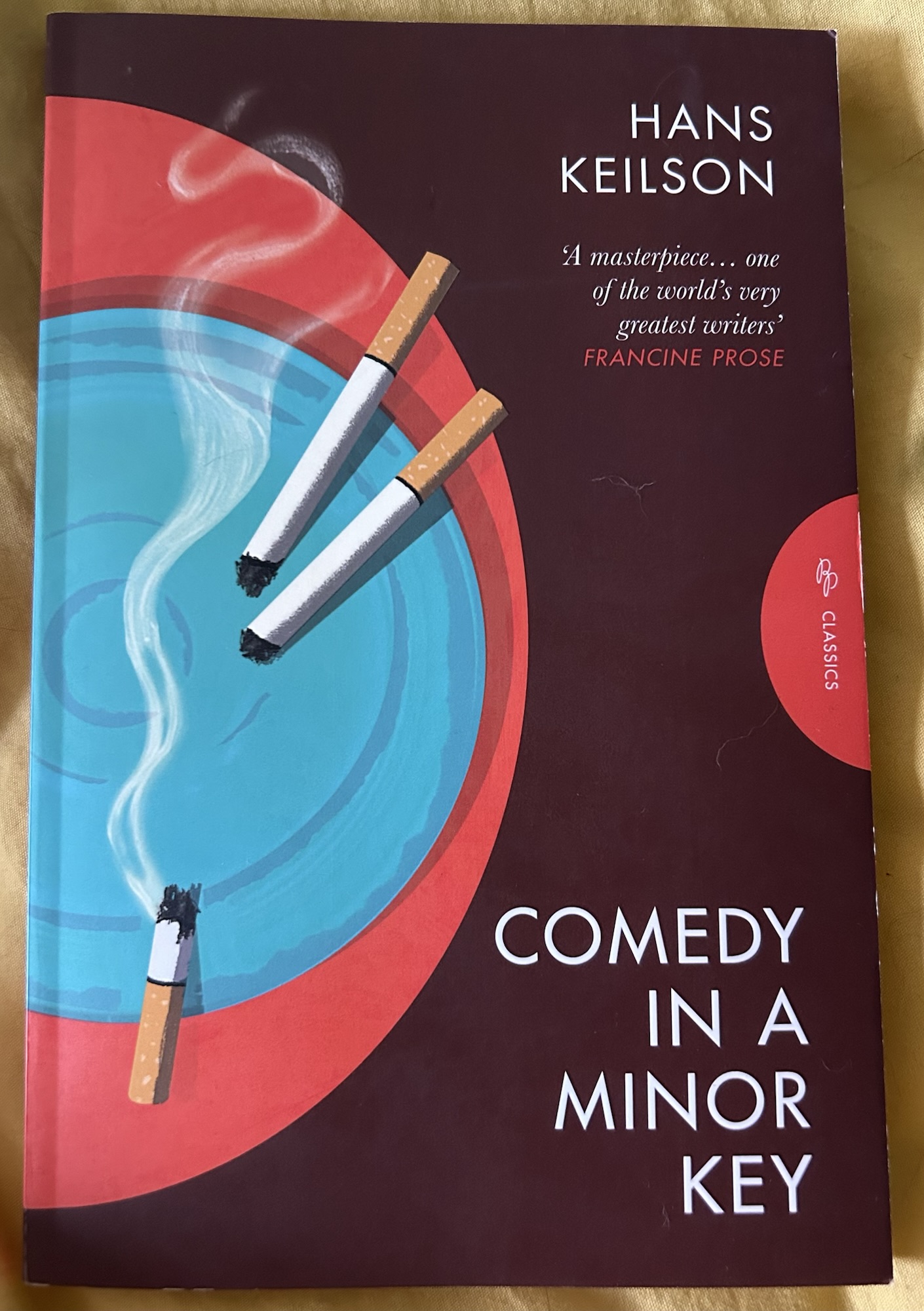
Comedy in a Minor Key – Hans Keilson (1947, transl. Damion Searls, 2024) 108 pages

Yesterday I posted on a German novella written just before the war, and today I’m looking a novella written just after the war but set during those years.

Hans Keilson was a remarkable man. His wiki page opens:

“German-Dutch novelist, poet, psychoanalyst and child psychologist. He was best known for his novels set during the Second World War, during which he was an active member of the Dutch resistance.

Keilson, having worked with traumatized orphans, mainly wrote about traumas induced by the war.”

Both his parents died in Auschwitz and Keilson had to go into hiding with a married couple for part of the war. In Comedy in a Minor Key, he explores this set-up, albeit primarily from the point of view of the couple.

Wim and Marie are a young Dutch couple who are approached to take someone into hiding in their house. Nico is older than them and the three of them live in restricted secrecy.

“The beginning was always exciting, no matter how many times a person had already lived through it.”

Wim and Marie are determined that no-one else will know about Nico. This doesn’t last long as they tell people, and others know already. For almost a year, the three of them live together in awkward domesticity.

What Keilson captures so well is the complexity of feelings around this living arrangement. So Nico isn’t unreservedly grateful; he’s also angry and scared and frustrated:

“Safe? Protected? Since they had taken him in? No, no, he was being unfair. But their house, their home, there things – their world – how it all had attracted him and soothed him at first. And now: how vain, how inflated, how worthless! For he measured things now with the cosmic measure, which gripped him tight and shook him back and forth. What trust in each other? What danger? And what a gulf between people! Consolation! Consolation?… was there any such thing?”

And for Wim and Marie there is bravery and kindness and also some vanity:

“You don’t get the chance to save someone every day. This unacknowledged thought had often helped them carry on when, a little depressed and full of doubt, they thought they couldn’t bear this complicated situation any longer and their courage failed them.”

The three of them muddle along together, and I found this description of their nightly snack and coffee very touching:

“There was gratitude in this habit, and a little tiredness, from the night to come that they were about to enter alone or as a pair, and a furtive, sad happiness in the smiling, incomprehensible futility.

But these scenes occur in flashback, as the novella opens with Nico having died of pneumonia, and Wim and Marie faced with what on earth to do now.

“How the neighbours and everyone on the street would look when he suddenly walked out of their house and strolled up and down the street with them. It would give them a little sense of satisfaction, and everyone who makes a sacrifice needs a little sense of satisfaction. And then you’d feel that you, you personally, even only just a little bit, had won the war.

It had all gone up in smoke. It wasn’t even a dream anymore. None of the three of them had any luck. But really, him least of all.

Poor Nico!”

Keilson never laughs at Nico’s death. What Comedy in a Minor Key shows is the enormity wartime in a domestic setting and how the mundane and silly can endure in the worst of circumstances. It shows how ordinary people can be so brave and also a little bit self-serving. It shows how the inbuilt hopes of a large gesture towards saving a life are entirely undermined when the person dies anyway.

I didn’t find this novella laugh-out-loud funny and I don’t think that’s what the title refers to. Rather I think the comedy refers to the ultimately comedic undermining of best intentions being a resistance in itself, as the war fails to destroy the ridiculous.

“Behind her curiosity there was a burning pain that cried out for more consolation than it was possible to give.”

Novella a Day in May 2025: No.4

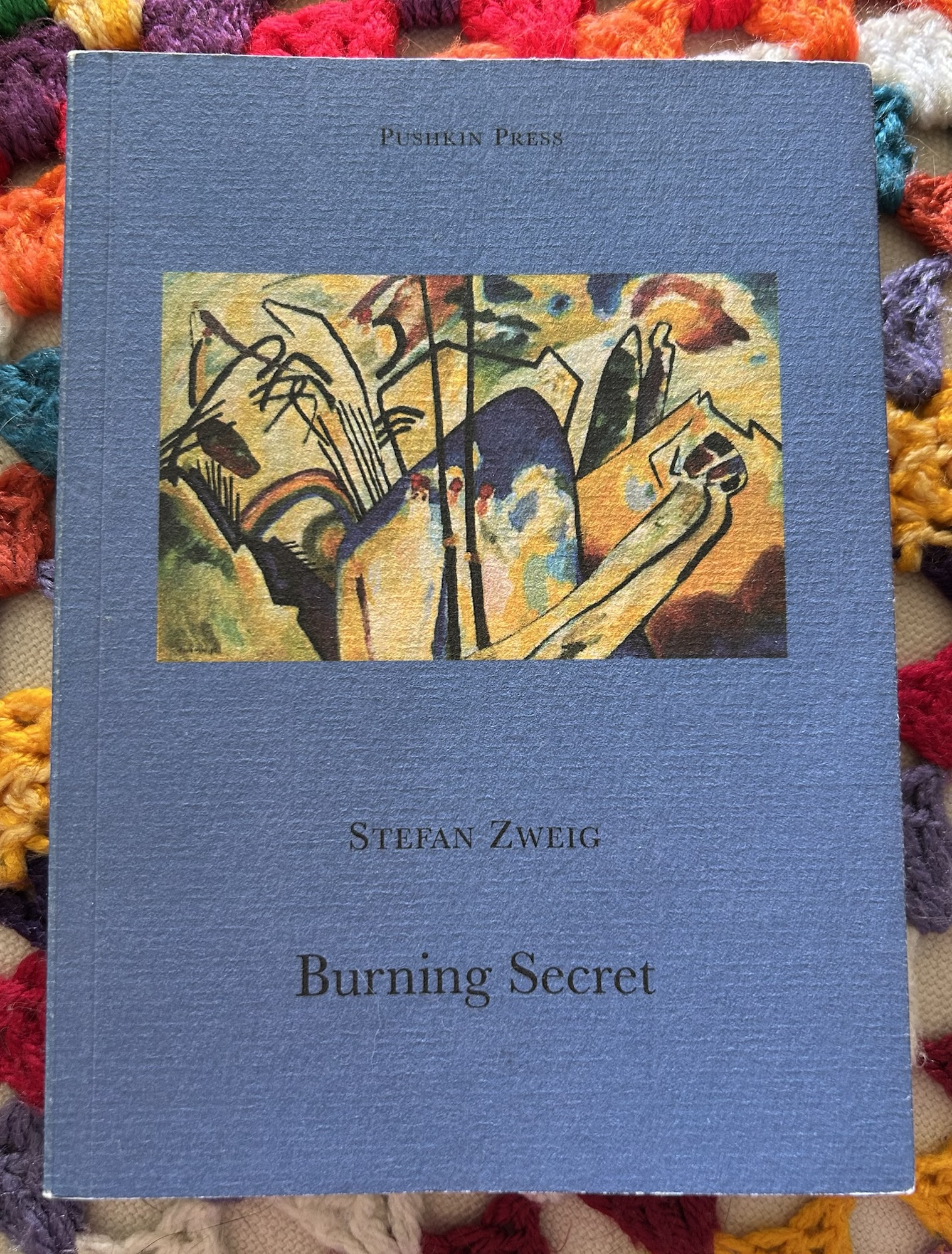
Burning Secret – Stefan Zweig (1913, transl. Anthea Bell 2008) 117 pages

Stefan Zweig is such an exquisitely tender writer. His precise, compassionate observations are deep with humane understanding. It makes him a perfect novella writer.

Burning Secret has a very simple structure. Edgar is twelve years old and recuperating from an illness in the spa town of Semmering. He is lonely and disregarded, bored and unnurtured.

“His face was not unattractive, but still unformed; The struggle between man and boy seemed only just about to begin, and his features were not yet kneaded into shape, no distinct lines had emerged, it was merely a face of mingled pallor and uncertainty.”

Unfortunately for Edgar, the Baron, an irredeemable cad and bounder, arrives in Semmering.

 “He felt no inclination to be alone and avoided it as far as possible; he didn’t really want to become any better acquainted with himself. He knew that, if he was to show his talents to best advantage, he needed to strike sparks off other people to fan the flames of warmth and exuberance in his heart. On his own he was frosty, no use to himself at all, like a match left lying in its box.”

This vacuous young man plans on whiling away his time in a meaningless love affair, and his sights soon settle on Edgar’s mother. As she is initially resistant to his charms, he callously decides to leverage Edgar in order to win favour.

“The Baron easily won his confidence. Just half-an-hour, and he had that hot and restless heart in his hands. It is so extraordinarily easy to deceive children, unsuspecting creatures whose affections are so seldom sought.”

Poor Edgar. He falls hook, line and sinker.

“A great, unused capacity for emotion had been lying in wait, and now it raced with outstretched arms towards the first person who seemed to deserve it. Edgar lay in the dark, happy and bewildered, he wanted to laugh and couldn’t help crying.”

For the Baron it is all a game. He has no feelings for Edgar or his mother, the latter only prey with which to amuse himself. He views her ruthlessly, identifying her snobbery and pretentions and knowing how to exploit these by emphasising his nobility. He gives no consideration to her marriage or vulnerabilities as a woman who will be judged much more harshly than he if they have an affair.

What he doesn’t reckon on is Edgar’s dawning, imperfect realisation, and the fury of a hurt child. What follows is a coming-of-age story where the lessons are learned through emotional brutality.

And yet, the resolution is hopeful, and without bitterness. It feels realistic and reflective, not undermining what has gone before but demonstrating human endurance too.

In less subtle hands Burning Secret could be sentimental and mawkish. With Stefan Zweig, it is emotionally devastating.

“He didn’t understand anything at all about life, not now he knew that the words which he thought had reality behind them were just bright bubbles, swelling with air and then bursting, leaving nothing behind.”