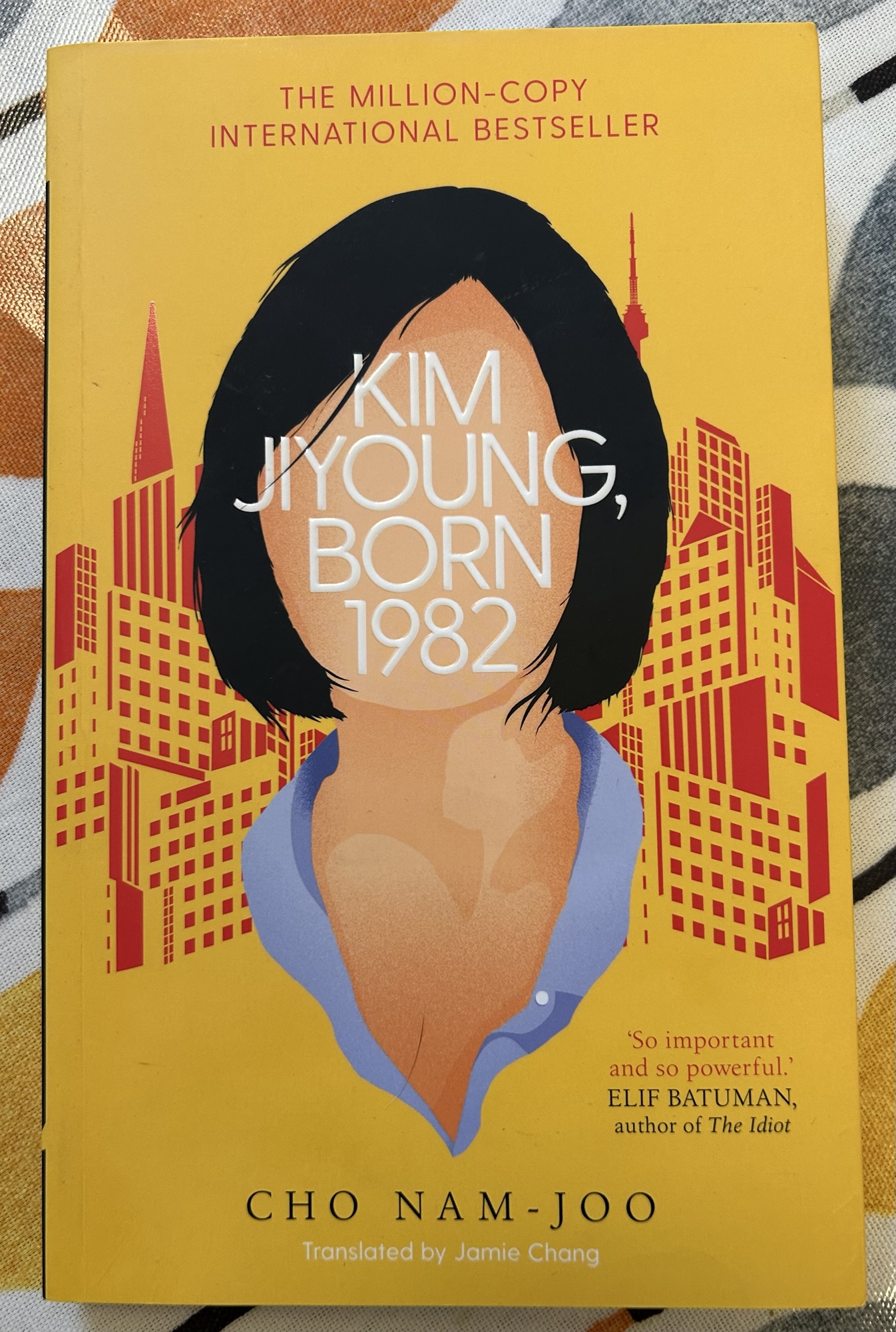
Kim Jiyoung, Born 1982 – Cho Nam-Joo (2016, transl. Jamie Chang 2018) 163 pages
I’m hard to please with issue-driven novels. Often I find them clunky and unconvincing, which leaves me wondering why the authors didn’t write an essay or long-form article instead.
And yet, Kim Jiyoung, Born 1982, which was very clear on the issues driving the novella to the extent of providing footnotes at various points, worked for me. Possibly because, as the title suggests, it almost presents like a piece of reportage or a case study.
The book opens in Autumn 2015, where young married mother Kim Jiyoung has started behaving oddly. At times she speaks like someone else, such as her mother. Her husband Daehyun is worried:
“Her odd behaviour continued sporadically. She’d send him a text message riddled with cute emoticons she never normally used, or make dishes like ox-bone soup or glass noodles that she neither enjoyed nor was good at.”
We are then taken back through Kim Jiyoung’s life in chronological order: Childhood 1982-1994; Adolescence 1995-2000; Early Adulthood 2001-2011; Marriage 2012-2015; before being brought up to date in 2016.
Jiyoung’s upbringing is fairly traditional. Her mother is bright and capable, and worked low-paid jobs which helped send her brother to medical school. Similarly, Kim Jiyoung’s brother is favoured:
“The brother had chopsticks, socks, long underwear, and school and lunch bags that matched, while the girls made do with whatever was available. If there were two umbrellas, the girls shared. If there were two blankets, the girls shared. If there were two treats, the girls shared. It didn’t occur to the child Jiyoung that her brother was receiving special treatment, and so she wasn’t even jealous. That’s how it had always been.”
And yet, in many ways her parents are progressive:
“Growing up, the sisters were never once told by their parents to meet a nice man and marry well, to grow up to be a good mother or and good cook. They’d done quite a lot of chores around the house since they were young, but they thought of it as helping out their busy parents and taking care of themselves, not learning how to be good women.”
Yet as she grows older, Jiyoung has to manage a different type of male entitlement, for which she is blamed:
“Entering high school meant a sudden expansion of her geographical and social world, which taught her that it was a wide world out there filled with perverts.”
One of the most challenging periods in Kim Jiyoung’s life is trying to find a job. It proves practically impossible:
“Jiyoung went to countless interviews after that, where interviewers made references to her physical appearance or lewd remarks about her outfit, stared lecherously at certain body parts and touched a gratuitously. None of these interviews led to a job.”
So the issue driving Kim Jiyoung, Born 1982 is pretty clear: the socio-cultural pressures exerted on women – and more specifically, South Korean women – from birth (or even before, as her grandparents wanted her to be a boy) and throughout their lives.
The footnotes actually work really well, demonstrating the wider context of Kim Jiyoung’s life, and also how those wider forces can impact the individual.
The bestselling nature of Kim Jiyoung, Born 1982 and its translation into 18 languages (according to my edition, it may be more now) is indicative of the relevance and reality of Kim Jiyoung’s life. Somehow it isn’t depressing or bleak, possibly given the matter-of-fact style, but it does demonstrate the ongoing need for change.
 madame bibi lophile recommends
This sounds depressing but enlightening.
LikeLiked by 1 person
There’s something in the style that stops it feeling too depressing, but the picture it paints is pretty sobering for sure.
LikeLiked by 1 person
I have to confess my rather shameful ignorance because I have not even heard of this one! But now I have and I feel I must read it! Thank you for bringing it to my attention. It does sound rather bleak but important and I do like the prose.
LikeLiked by 1 person
There are so many books I come across where I wonder how they passed me by entirely until that point!
This has an unusual style, especially with the footnotes, but I thought it worked well. I hope you enjoy it when you get to it 🙂
LikeLike
I have just finished this and popped back to reread your review. Thank you for bringing this one to my attention; I read it in two days (and I can see that it would really lend itself to reading in a day) and both enjoyed it, and found it very interesting and thought provoking. I thought the foot notes did help, in the same way as the introductions to the decade featured in BLWW publications. Sadly, I was also reminded of my own lonely experience of being a stay-at-home mother of a young child in 21st century South-East England. The barbed judgements of others, often based upon thoughtless and wrong assumptions really hurt, especially when made by other women.
If I could find a negative, it would be that this book does seem to suggest that the solution may be as simple as equal rights for fathers and mothers; unfortunately, I think it is more complicated and would involve a more radical whole societal transformation.
LikeLiked by 1 person
Thanks for letting me know how you found it! I’m glad you enjoyed it but very sorry to hear about your personal experience which meant it resonated with you. I completely agree that there needs to be a complete societal shift. As well as embedding rights, hopefully it would also mean there wouldn’t be so many unthinking, hurtful judgments like you experienced.
LikeLike
I’ve had this on my radar for so long yet I didn’t know whether to read it or not. I feel like I can’t deal with books focused on trauma and negative things. The fact you said it isn’t depressing or bleak helps a bit
LikeLiked by 1 person
It’s definitely focussed on negative things though, so I wouldn’t recommend it if you’re trying to avoid those themes. It’s presented in a very matter of fact style, but there’s no positive resolution to the sexism and misogyny.
LikeLiked by 1 person
I know exactly what you mean – it takes a particular skill to bring off a polemic novel of any kind, but when it works well it can be so powerful. This sounds like it does just that!
LikeLiked by 1 person
Absolutely, when it’s done well it’s astonishing! I thought this carried it off 😊
LikeLiked by 1 person
It is depressing that women still face that kind of stuff in a society that seems so modern in other ways. But I suppose it’s not so many decades ago that the same book could have been written here.
LikeLiked by 1 person
And I think how widely it’s been translated and the millions sold show how far it resonates.
LikeLiked by 1 person
I thought this was really well done.
LikeLiked by 1 person
Yes, it was very clever.
LikeLiked by 1 person
I was so excited to see this one come up! My local library branch is very small, and they don’t tend to keep books for very long (even classics) because space is such a concern, so imagine my puzzlement at there being not one but two copies of this novel on the shelves (one hardcover, one paperback)! Your post doesn’t answer that weirdness for me at all… hehehe… but it does make me want to read one of them!
LikeLiked by 1 person
How odd! Maybe because its sold so many copies? But I’m baffled too! I hope you enjoy reading one of the copies Marcie 🙂
LikeLike