Siblings – Brigitte Reimann (1963, transl. Lucy Jones 2023) 129 pages
Summarising Siblings makes it sound incredibly clunky. A brother and sister living in the GDR find themselves separated ideologically as one of them wants to leave for the West. However, Brigitte Reimann’s writing is so skilled that the relationship between the siblings is rounded. The novella never feels like a construct in order to explore two forms of government in opposition to one another.
We know from the start that there has been some sort of significant betrayal. It opens:
“As I walked to the door, everything in me was spinning.
He said, ‘I won’t forget this.’ He was standing very straight and not moving in the middle of the room. He said in a cold, dry voice, ‘I’ll never forgive you.’”
The story is told from the point of view of Elisabeth (Betsy/Lise) and each chapter opens with the current situation (1960, prior to the Berlin Wall being built) before looking back in time. We learn of her close relationship with her brother Uli.
“I trusted him in every way and was vain enough to think I knew everything or almost everything he thought and planned. But in truth, back then, which was only the day before yesterday, I didn’t have a clue about the person closest to me.”
They are young people from a previously privileged family (who voted for Hitler), although they no longer have access to their industrialist family’s assets or wealth. Elisabeth is an artist and has a job working in an industrial plant painting the workers and teaching, which she enjoys despite the frustrations of dealing with colleagues and pressures from the Stasi.
“As soon as I’ve warmed myself in the lap of my family for a few days, I feel homesick for its adventurous, daring atmosphere; and for the sight of the huge, white and yellow excavators; for the mountains of sand blown haphazardly by the wind, under which lies the dark brown, damp coal seam; and for the drivers up in their peaceful cabins, shields lowered, patiently shovelling tonnes of earth…”
Uli is an engineer but he is unable to get a job due to being blacklisted by association with a professor who defected, despite him knowing nothing about the defection. Unlike Elisabeth and her boyfriend Joachim who works for the Party, Uli struggles with the immense bureaucracy and lack of choices he has in the GDR.
The siblings’ brother Konrad went to the West with his wife, and Elisabeth sees this as a huge betrayal, despising the materialism she feels drove the decision. He was part of Hitler Youth, while Elisabeth and Uli were both small children during the war. Hence her feelings about the West and her immediate family are bound up with and complicated by Germany’s recent past.
A further complication is that Elisabeth and Uli have stayed close throughout their lives and she describes Uli romantically, dwelling on his handsomeness and appealing qualities more than on those of Joachim. I found her response in this way to her brother odd and unnerving, but I don’t know if that is a cultural difference or a deliberate decision by Reimann to make the siblings’ bond overly intense.
Uli tries to explain to Elisabeth the difference between him and Konrad; why he needs to leave, despite still believing in socialism:
“‘Before I’m ground to pieces here,’ he added, not quite as loudly, not quite as confidently. ‘I’ll always stand up for the public ownership of industry over there.’
‘Even in your shipyard?’
‘Even in my shipyard.’ He paused then smiled uncertainly.
‘How come your shipyard?’ I said quickly. ‘You’ll have to stop using communist phrases, you know.’”
Having Uli still believe in the system of government but finding himself unable to live under it complicates the opposing views of the siblings and exposes the layers of experiences which can lead to vastly different life decisions.
Another clever decision is to not paint the GDR as a bleak wasteland. As well as Elisabeth’s romantic view of the plant, the natural environment is beautifully evoked:
“The morning sun had moved on, and the sky stood flat and pale blue above the trees lining the avenue; from the kitchen window, above the cottages, I could see stables and small courtyards nestling closely together in this bucolic area of town. Raindrops sparkled on the walnut tree branches and the tips of its leaves in the slanting sunshine.”
The narrative circles back to end where it began, perhaps indicating the circular nature of the political arguments that neither Uli or Elisabeth will win. By the time we return, the reader is fully aware of the various ambivalent, contradictory bonds which tie Elisabeth and Uli. Siblings is a heartbreaking portrait of how wider political pressures can fracture the closest of relationships, irretrievably.
“‘I can’t explain anything to you,’ he said after a while. ‘Because our views on freedom, among other things, are too far apart.’”
 madame bibi lophile recommends
Another great one! I love literature about East Germany.
LikeLiked by 1 person
It’s a fascinating era isn’t it? I found this one so interesting in its portrayal.
LikeLiked by 1 person
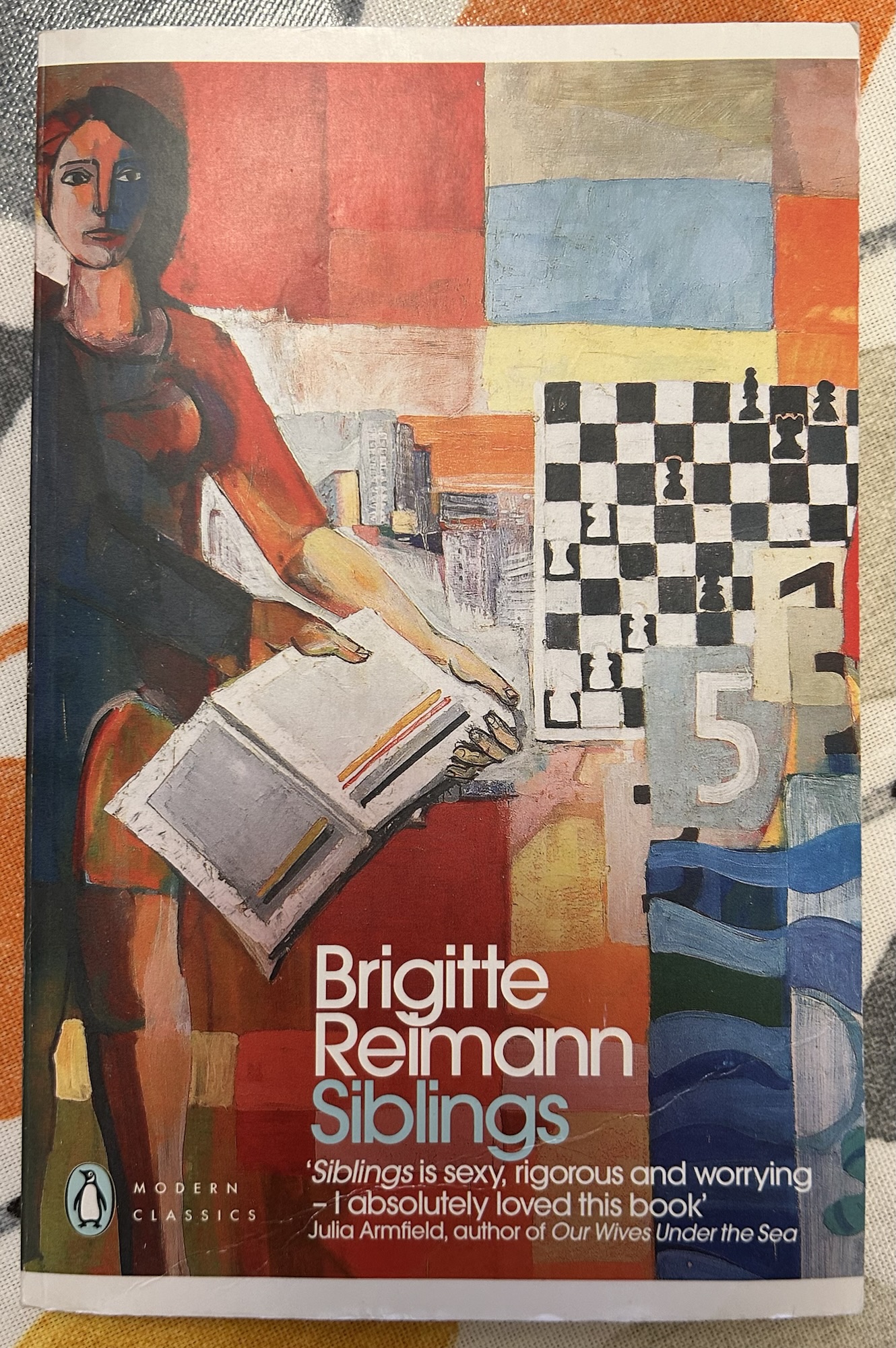
Quite disturbing that the puff quote on the cover says ‘sexy’ for a book about siblings 😀
Sounds like a very interesting one, and glad it was subtle enough to work. I’m embarrassed to say I had to google what GDR is – I’ve always just called it East Germany.
LikeLiked by 1 person
I have to admit to being a bit baffled by that adjective! I wouldn’t describe it as a sexy book myself, but maybe I’m missing something 😁
It was really interesting. Sadly I’m getting ancient so I remember the GDR and USSR on the news (though I was a child at the time!)
LikeLike
But weren’t you just saying, Simon, that one of your tutors at school had commented on how often your papers pointed out just this kind of relationship? Surely you should be rushing for a copy of this one and not turning up your nose at the s*xy bits? hee hee
LikeLiked by 1 person
Again, this sounds a great read although quite complicated in the feelings and beliefs of the characters, which is a good thing as that time can’t have just been black and white for a lot of German families. I agree with Simon about using the word sexy on the cover, yuk!
LikeLiked by 1 person
Yes, for a short novel I thought it explored those complexities quite well. It avoided becoming polemical.
I really don’t know why they put ‘sexy’ on the cover…!
LikeLiked by 1 person
I was put off a book I would have otherwise been drawn to by that ‘sexy’ because, having read the blurb, I assumed there was an incestuous relationship! I am assuming there is not so I shall definitely put this one back on the list; the subject matter is definitely one that interests me. And I am even more ancient than you so I do remember the days before the wall came down!
LikeLiked by 1 person
No, she does describe her brother in oddly romantic terms at times, but no incest! I’m sure they put a ‘sexy’ quote on the front to draw people in, it just goes to show it can backfire! I hope you enjoy this when you get to it 😊
LikeLike
Thank you for disabusing my wrong headed notion about incestuous relationships! Interestingly, the Penguin Books edition I borrowed from the library did not have that misleading sexy quote; the cover had no text simply the artwork.
I am pleased that I did read this. I found the historical setting very interesting and the descriptions were evocative and atmospheric. Thankfully, I did not even find the way Betsy/Lise referred to Uli to be off putting but accepted that it represented a sort of hero worship and the close emotional bond she had with her older brother. I admired the way Reimann managed to convey the political and ideological issues successfully without it seeming as if the story was just a convenient device.
LikeLiked by 1 person
I’m really pleased to hear you found this worthwhile. It is clever how she presents the ideals while still making the characters believable.
LikeLike
I have this one in my TBR. The ‘sexy’ quote does seem odd, and I can see why it might be off-putting.
LikeLiked by 1 person
It didn’t put me off but I tend into ignore them a lot of the time anyway! But it’s definitely an odd choice. I hope you enjoy this when you get to it Susan.
LikeLiked by 1 person
Ha – even though I have this edition, I missed the “sexy” quote! I loved this when I read it for WIT the other year – my review here https://librofulltime.wordpress.com/2023/08/31/book-reviews-three-women-in-translation-for-witmonth-and-one-all-virago-all-august/ – it’s led me to take a deeper look into East German lives.
LikeLiked by 1 person
I missed it too Liz! Great to hear you loved this and thank you for the link, I will stop by 🙂
LikeLiked by 1 person
LOL, I hadn’t seen that quote either but how ridiculous! I am quite drawn to this one, and have been for some time – I do find East Germany fascinating, as I had a pen-friend from there once! Will have to track this down!
LikeLiked by 1 person
It is ridiculous, I’m glad it’s not put you off Kaggsy! East Germany is fascinating.
LikeLiked by 1 person