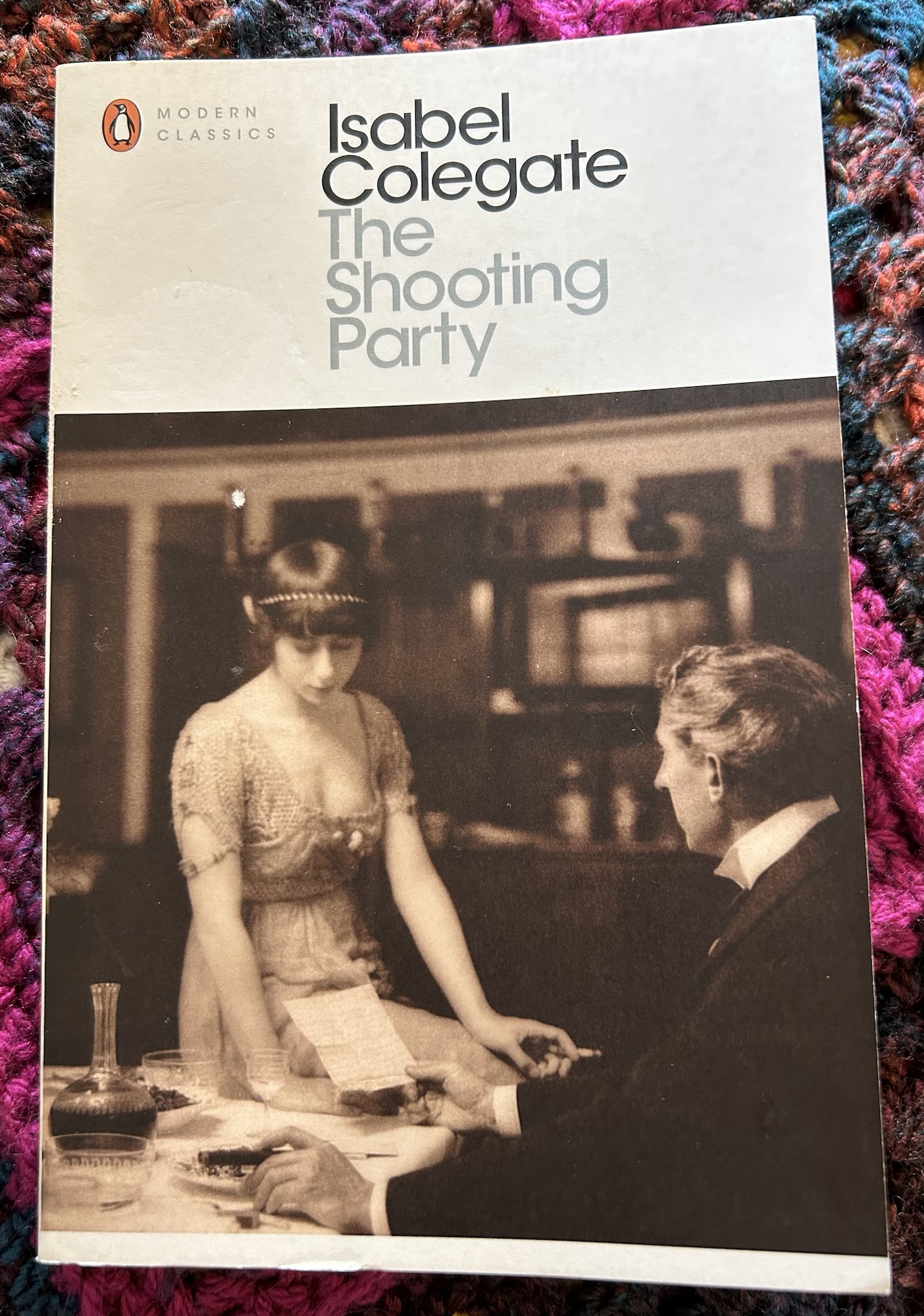
The Shooting Party – Isabel Colegate (1980) 191 pages
I’ll get my complaint about The Shooting Party out of the way first: there were about eleventy-million characters, far too many for a novella, and trying to keep them straight made my brain hurt. If ever a book needed a family tree/character list at the beginning it was this one. But other than that I really enjoyed it, so on with the post!
The Shooting Party was written in the latter part of the twentieth century but captures a bygone age just before the outbreak of World War I. Colegate relies on our knowledge as readers that the lives she presents are on the brink of being changed irrevocably.
“I can’t say I positively want a war; and yet one gets the feeling sometimes – life is so extraordinarily pleasant for those of us who are fortunate enough to have been born in the right place – ought it to be so extraordinarily pleasant? – and for so few of us? And isn’t there sometimes a kind of satiety about it all – and at the same time greed?”
The titular event is taking place at Sir Randolph Nettleby’s Oxfordshire estate. Over the course of three days a group of privileged people will convene in the slaughter of hundreds of birds. It is absolutely grotesque, but thankfully Colegate spends very little time on the details of bloodsports, being more interested in the relationships between the characters. There were a few passages I skipped but it remained very readable.
Sir Randolph is aware that the world is changing. He despairs at the falling away of the old order as the world becomes increasingly mechanised and industrialised. The country estates are losing workers and he worries at the decline of the countryside.
He is quite a gentle patriarch in many ways, despite being so much a man of his time. Colegate doesn’t laugh at her characters, but there is humour throughout and I don’t think we’re supposed to take them entirely seriously all the time:
“Sir Randolph, unlike Minnie who aspired to it, considered cosmopolitanism a vice. It was alright to know your way around Paris, Sir Randolph thought, and to visit Italian picture galleries or the relics of the classical world, but generally speaking a man should stick to one country and be proud of it. If one wanted to travel there was always the Empire.”
His grandson Osbert doesn’t do well at school and the family are despairing at getting him ready for Eton, yet it is Sir Randolph who sticks up for him:
“Sir Randolph said, ‘Leave him alone. There’s no malice in him. Give him time and he’ll come along all right.’ He spoke as he might have spoken of one of his black, curly-coated retrievers, and like the retrievers Osbert in due course came along.”
Osbert has a pet duck named Elfrida Beetle and a source of tension throughout the novel is whether she will survive or get caught up with the wild ducks that the party are determined to shoot to pieces. There is also an impending sense of doom, beyond the war, as we know from the start of the novel that there is “an error of judgement, which resulted in a death”. Yet the final day of the shoot starts peaceably enough, as Sir Randolph reflects in his study:
“Freed from time, he felt influenced towards the familiar state of watchful calm, from which he was aroused by the slow crescendo and then rapid diminuendo of the breakfast gone being sounded by Rogers, an acknowledged master on the instrument.”
His wife Minnie was a favourite of the now-dead King, (another character reflects: “A pity English royalty was always so philistine.”) and like her husband she has a strong sense of duty and decorum. Unlike her husband she’s also quite a frivolous character, but this suits her role as hostess and she sees more than she says. She gets on well with her granddaughter Cicely, who shares her silliness, if not her circumspection.
“Olivia did not find Cecily boring. She liked her liveliness and suspected her of having more courage than she herself had ever had. Cecily might well choose to be unconventional; something to which Olivia had never aspired, in her actions at least. Her thoughts, generally speaking, she kept to herself.”
Olivia is Lady Lilburn married to Bob, a man so dull that even as I’ve just finished the reading the novella I can’t remember anything about him except a funny scene with him fussing over cufflinks. Another couple are Lord and Lady Hartlip, long married and quite prepared to indulge each other’s extra-marital dalliances. Where Lord Hartlip draws the line is Lady Hartlip’s compulsive gambling, which she has learnt to hide from him. Thus Colegate shows that privilege and comfort don’t equal happiness for all. In fact, happiness seems elusive to so many of these characters.
Apparently one of criticisms of The Shooting Party on publication was that it tried to shoehorn in all the Edwardian political issues and the characters were ciphers in service of these. I think this is a little unfair. As I mentioned at the start, there are soooo many characters that I can see where this criticism came from: a rich Jewish businessman subject to Anti-Semitism; a member of European aristocracy; bored wives; flighty debs; gamekeepers entrenched in the social order; a new generation coming up of self-made men… but I found them all believable and Colegate is interested in the person behind the type.
Colegate evokes the daily routines of life in a large country estate so well, and balances the inevitable elegiac quality with the practicalities of living; the sad desperation of some of the characters with humour. As the day moves on personalities are exposed and relationships change forever.
 madame bibi lophile recommends
This sounds a wonderful portrait of changing times, and I do like the sound the characters you’ve described too; I’m glad there’s not too much focus on the hunting which I would not have been able to handle–I hope Elfrida comes through ok.
LikeLiked by 1 person
Yes, I couldn’t manage extended hunting scenes at all so I was thankful for that! It does work really well in portraying that particular place and time.
LikeLiked by 1 person
Lovely review, Madame B – I’ve been aware of this for a while but somehow never came across a copy. It does sound worth seeking out, despite the overload of characters!!
LikeLiked by 1 person
It is a great read Kaggsy! Usually character lists/family trees put me off a bit, but I definitely would have welcomed one here! Absolutely worth seeking out though, I found it really evocative.
LikeLiked by 1 person
It certainly sounds ambitious for a novella! Even in a novel all those characters could easily have felt like too much. I do hope Elfrida was not the subject of the error of judgement…
LikeLiked by 1 person
Yes, I think a novel would have even struggled with so many! I felt very tense about Elfrida…
LikeLiked by 1 person
I’ve seen the film but I didn’t realise it was written so recently; I wish more writers would include a dramatis personae like Jilly Cooper!
LikeLiked by 1 person
Hooray for Jilly! 😁
LikeLiked by 1 person
You’ve made this sound so interesting, and if I hadn’t already read it and been a bit disappointed by it, I’d race to it 😀 I think my problem was that I’ve read so many books written at this time that I don’t love historical novels set then.
LikeLiked by 1 person
Haha! I did wonder how I’d find it given it was historical fiction and like you, I’ve read a lot from the period (although a fraction of what you’ve read!) It worked for me but I can see why it wouldn’t when you have so much knowledge of the period.
LikeLike
I’ve heard good things, but the title/underlying theme worried me; I’m glad to know that you managed it as well as you did, and I’ll be less inclined to instinctively turn away from it now. (It’s not as though I never read about hunting–and often those books are making the very point that troubles me so–but it shows up in quite a lot of my reading, so when it’s advertised right there in the title, I ricochet away.)
LikeLiked by 1 person
I was a bit uncertain too, but the focus is definitely not on the activity and any bloodshed easily skipped. The title is off-putting! I wonder if it was chosen to draw attention to the ‘party’ around gunfire, when very soon the war was about to wipe out a generation.
LikeLike