Novella a Day in May 2026 – No.13

Last year for this project I read The Shooting Party by Isabel Colegate, and enjoyed it enough to pick up her debut novel, The Blackmailer (1958), this year.

I must admit my expectations were moderate – I liked The Shooting Party but thought it had far too many characters, and I expected a first novel written 22 years earlier to be less skilled. The author’s Foreword says “I look back on The Blackmailer with a certain affection” which to me hints at an unconditional fondness for something you know is flawed. But in fact found it tightly focussed and complex.

It has a distinctly unlikable titular protagonist in Baldwin Reeves. He is a barrister, resentful of those he feels were born with social and financial advantages, and determined to do whatever it takes to be a QC (as it was in the 1950s) and a politician.

“His ‘rivals’ were of course everyone else in the world.”

One of those he resents most severely is Anthony Lane: landed gentry, charming and charmed, war hero, seemingly universally adored. But Baldwin served with Anthony in Korea, and he knows he was dangerously inept, cowardly, and despised by his comrades.

Baldwin needs money, and so he decides to blackmail Anthony’s widow Judith to preserve the dead man’s posthumous reputation. She knows her husband wasn’t the same as the revered memory:

“Later she had come to believe what had at first seemed to her odd and rather degrading, that love was not always based on a similarity of principles, and that it was possible genuinely to love and even at times to admire someone whom one could seldom, if ever, respect.”

The degradation alongside love is important. Although initially Baldwin and Judith see each other as agonists, they quite quickly develop a warped rapport, feeling drawn to one another. For Baldwin, this is wrapped up in his feelings for Anthony:

“As if anything he might have thought about her late husband was a matter of indifference to her. This was not quite what he had expected, but after all there was a sort of familiarity about it: with Anthony too one’s opinions had not mattered because he had been so sure of his own.”

More than once it is mentioned that Baldwin loved Anthony, although it is not stated whether this included sexual attraction. So two people who both despised and were drawn to Anthony find he is bound up in their relationship after his death.

It’s not entirely clear why Judith should care if her dead husband’s name is tarnished, but it is partly due to loyalty towards her spiky, snobbish mother-in-law who adored her flawed son, and also Anthony’s sweet grandfather who saw Anthony as he was.

The story follows Baldwin and Judith’s odd kinship/courtship of sorts, as two somewhat unhappy people struggle against their circumstances in various ways.

‘I completely fail to understand how you can write anything so appalling,’ she said.

‘Yes, it’s nasty isn’t it?’ he said. ‘I shall try to keep my own name out of it if possible, but I may not be able to.’

Those of you who enjoy the writing of Diana Athill may enjoy the scenes of Julia at work in a publishing house. One publisher was utterly convinced that Colegate knew Andre Deutsch, so close was the portrait of Judith’s boss Felix Hanescu to the great man:

“That was what he had wanted to be, a genius: having just missed it, he had become a personality instead.”

The Blackmailer is almost a comedy of manners, but a bit too spiky. It could be very dark, but steps back from being so, such as when Baldwin insists Judith fire her beloved housekeeper (a man of shorter height who is consistently referred to by what is an offensive term now, although not necessarily intended to be so in the book). This piece of attempted psychological warfare is comedically undermined in a scene of absolute farce, rendering Baldwin ridiculous.

Similarly, The Blackmailer is a psychological study of a distorted relationship and the effects of fantasy, jealousy and lies, but it also doesn’t seek to explain the psychology of anyone. Rather it presents the relationships and leaves it to the reader to draw conclusions.

I can imagine this could be a frustrating read for some, but I enjoyed it and the lack of explanations, the wavering between genres. While this kept me at a bit of a distance for much of the novel, Colegate creates two scenes that pack a punch towards the end – one dramatically, one quietly, both devastating in their different ways.

Lately, for the first time, the points system on which he conducted his relations with other people had been beginning to show its failings.

Novella a Day in May 2025: No.20

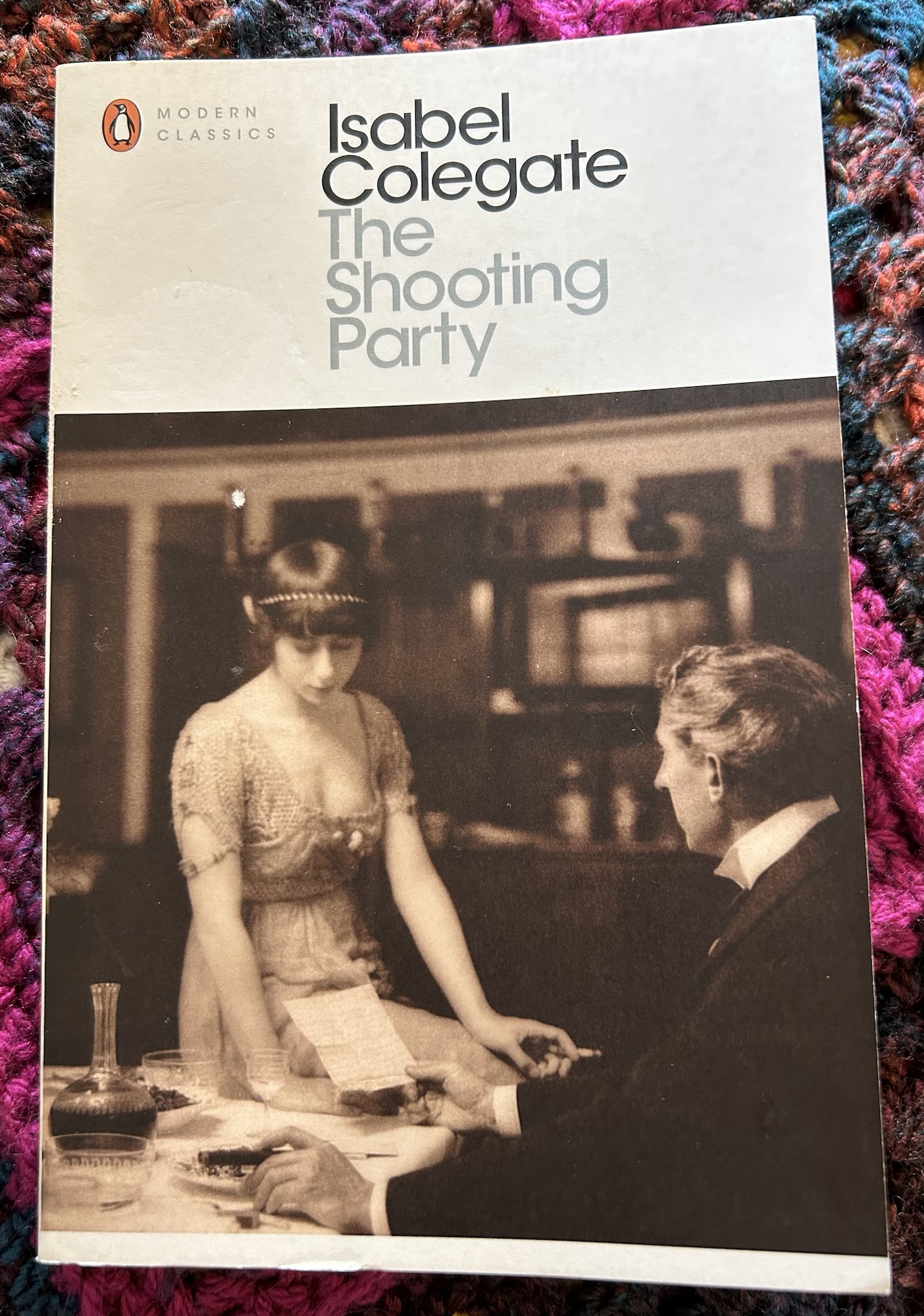
The Shooting Party – Isabel Colegate (1980) 191 pages

I’ll get my complaint about The Shooting Party out of the way first: there were about eleventy-million characters, far too many for a novella, and trying to keep them straight made my brain hurt. If ever a book needed a family tree/character list at the beginning it was this one. But other than that I really enjoyed it, so on with the post!

The Shooting Party was written in the latter part of the twentieth century but captures a bygone age just before the outbreak of World War I.  Colegate relies on our knowledge as readers that the lives she presents are on the brink of being changed irrevocably.

“I can’t say I positively want a war; and yet one gets the feeling sometimes – life is so extraordinarily pleasant for those of us who are fortunate enough to have been born in the right place – ought it to be so extraordinarily pleasant? – and for so few of us? And isn’t there sometimes a kind of satiety about it all – and at the same time greed?”

The titular event is taking place at Sir Randolph Nettleby’s Oxfordshire estate. Over the course of three days a group of privileged people will convene in the slaughter of hundreds of birds. It is absolutely grotesque, but thankfully Colegate spends very little time on the details of bloodsports, being more interested in the relationships between the characters. There were a few passages I skipped but it remained very readable.

Sir Randolph is aware that the world is changing. He despairs at the falling away of the old order as the world becomes increasingly mechanised and industrialised. The country estates are losing workers and he worries at the decline of the countryside.

He is quite a gentle patriarch in many ways, despite being so much a man of his time. Colegate doesn’t laugh at her characters, but there is humour throughout and I don’t think we’re supposed to take them entirely seriously all the time:

“Sir Randolph, unlike Minnie who aspired to it, considered cosmopolitanism a vice. It was alright to know your way around Paris, Sir Randolph thought, and to visit Italian picture galleries or the relics of the classical world, but generally speaking a man should stick to one country and be proud of it. If one wanted to travel there was always the Empire.”

His grandson Osbert doesn’t do well at school and the family are despairing at getting him ready for Eton, yet it is Sir Randolph who sticks up for him:

“Sir Randolph said, ‘Leave him alone. There’s no malice in him. Give him time and he’ll come along all right.’ He spoke as he might have spoken of one of his black, curly-coated retrievers, and like the retrievers Osbert in due course came along.”

Osbert has a pet duck named Elfrida Beetle and a source of tension throughout the novel is whether she will survive or get caught up with the wild ducks that the party are determined to shoot to pieces. There is also an impending sense of doom, beyond the war, as we know from the start of the novel that there is “an error of judgement, which resulted in a death”. Yet the final day of the shoot starts peaceably enough, as Sir Randolph reflects in his study:

“Freed from time, he felt influenced towards the familiar state of watchful calm, from which he was aroused by the slow crescendo and then rapid diminuendo of the breakfast gone being sounded by Rogers, an acknowledged master on the instrument.”

His wife Minnie was a favourite of the now-dead King, (another character reflects: “A pity English royalty was always so philistine.”) and like her husband she has a strong sense of duty and decorum. Unlike her husband she’s also quite a frivolous character, but this suits her role as hostess and she sees more than she says. She gets on well with her granddaughter Cicely, who shares her silliness, if not her circumspection.

“Olivia did not find Cecily boring. She liked her liveliness and suspected her of having more courage than she herself had ever had. Cecily might well choose to be unconventional; something to which Olivia had never aspired, in her actions at least. Her thoughts, generally speaking, she kept to herself.”

Olivia is Lady Lilburn married to Bob, a man so dull that even as I’ve just finished the reading the novella I can’t remember anything about him except a funny scene with him fussing over cufflinks. Another couple are Lord and Lady Hartlip, long married and quite prepared to indulge each other’s extra-marital dalliances. Where Lord Hartlip draws the line is Lady Hartlip’s compulsive gambling, which she has learnt to hide from him. Thus Colegate shows that privilege and comfort don’t equal happiness for all. In fact, happiness seems elusive to so many of these characters.

Apparently one of criticisms of The Shooting Party on publication was that it tried to shoehorn in all the Edwardian political issues and the characters were ciphers in service of these. I think this is a little unfair. As I mentioned at the start, there are soooo many characters that I can see where this criticism came from: a rich Jewish businessman subject to Anti-Semitism; a member of European aristocracy; bored wives; flighty debs; gamekeepers entrenched in the social order; a new generation coming up of self-made men… but I found them all believable and Colegate is interested in the person behind the type.

Colegate evokes the daily routines of life in a large country estate so well, and balances the inevitable elegiac quality with the practicalities of living; the sad desperation of some of the characters with humour. As the day moves on personalities are exposed and relationships change forever.