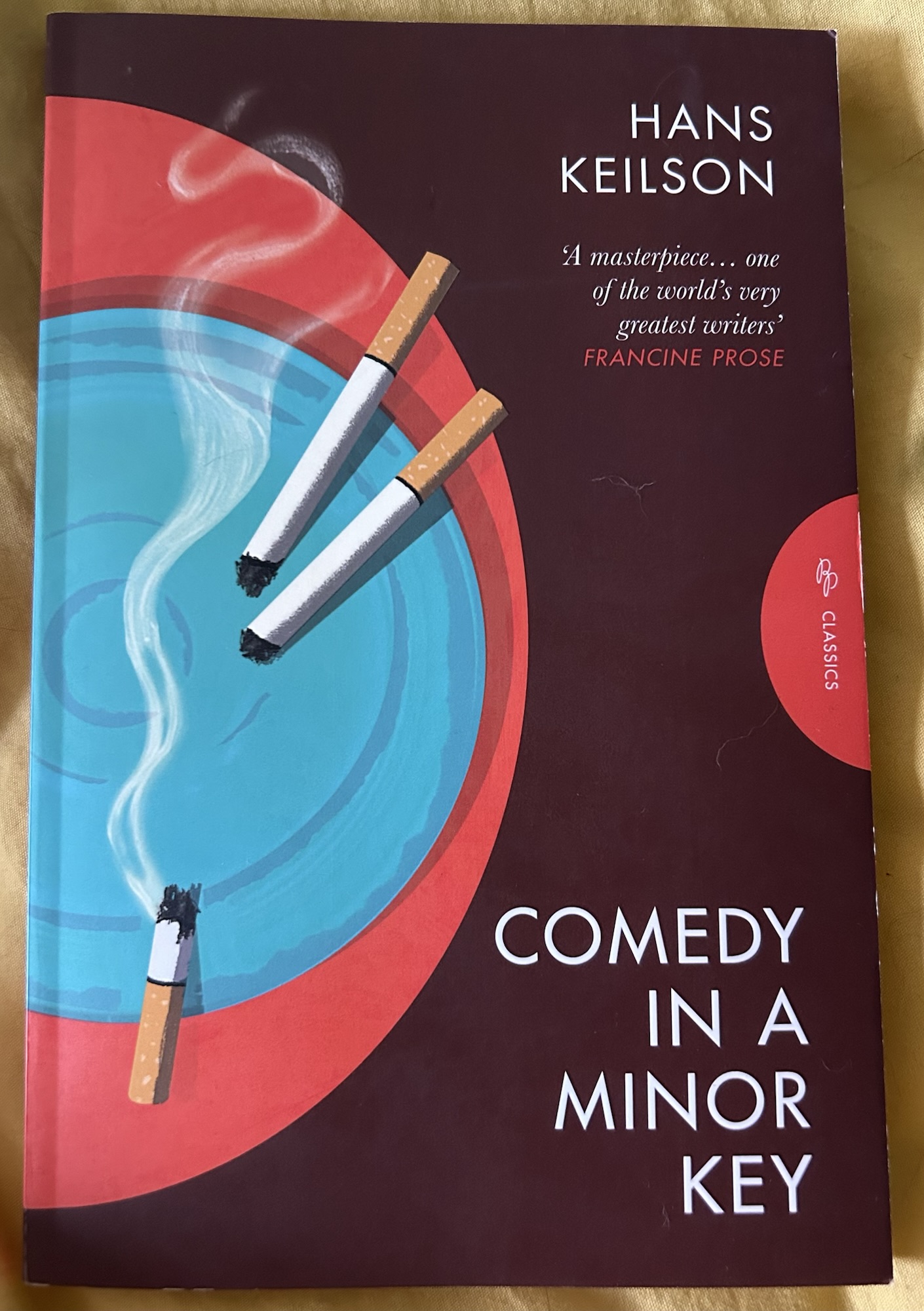
Comedy in a Minor Key – Hans Keilson (1947, transl. Damion Searls, 2024) 108 pages
Yesterday I posted on a German novella written just before the war, and today I’m looking a novella written just after the war but set during those years.
Hans Keilson was a remarkable man. His wiki page opens:
“German-Dutch novelist, poet, psychoanalyst and child psychologist. He was best known for his novels set during the Second World War, during which he was an active member of the Dutch resistance.
Keilson, having worked with traumatized orphans, mainly wrote about traumas induced by the war.”
Both his parents died in Auschwitz and Keilson had to go into hiding with a married couple for part of the war. In Comedy in a Minor Key, he explores this set-up, albeit primarily from the point of view of the couple.
Wim and Marie are a young Dutch couple who are approached to take someone into hiding in their house. Nico is older than them and the three of them live in restricted secrecy.
“The beginning was always exciting, no matter how many times a person had already lived through it.”
Wim and Marie are determined that no-one else will know about Nico. This doesn’t last long as they tell people, and others know already. For almost a year, the three of them live together in awkward domesticity.
What Keilson captures so well is the complexity of feelings around this living arrangement. So Nico isn’t unreservedly grateful; he’s also angry and scared and frustrated:
“Safe? Protected? Since they had taken him in? No, no, he was being unfair. But their house, their home, there things – their world – how it all had attracted him and soothed him at first. And now: how vain, how inflated, how worthless! For he measured things now with the cosmic measure, which gripped him tight and shook him back and forth. What trust in each other? What danger? And what a gulf between people! Consolation! Consolation?… was there any such thing?”
And for Wim and Marie there is bravery and kindness and also some vanity:
“You don’t get the chance to save someone every day. This unacknowledged thought had often helped them carry on when, a little depressed and full of doubt, they thought they couldn’t bear this complicated situation any longer and their courage failed them.”
The three of them muddle along together, and I found this description of their nightly snack and coffee very touching:
“There was gratitude in this habit, and a little tiredness, from the night to come that they were about to enter alone or as a pair, and a furtive, sad happiness in the smiling, incomprehensible futility.
But these scenes occur in flashback, as the novella opens with Nico having died of pneumonia, and Wim and Marie faced with what on earth to do now.
“How the neighbours and everyone on the street would look when he suddenly walked out of their house and strolled up and down the street with them. It would give them a little sense of satisfaction, and everyone who makes a sacrifice needs a little sense of satisfaction. And then you’d feel that you, you personally, even only just a little bit, had won the war.
It had all gone up in smoke. It wasn’t even a dream anymore. None of the three of them had any luck. But really, him least of all.
Poor Nico!”
Keilson never laughs at Nico’s death. What Comedy in a Minor Key shows is the enormity wartime in a domestic setting and how the mundane and silly can endure in the worst of circumstances. It shows how ordinary people can be so brave and also a little bit self-serving. It shows how the inbuilt hopes of a large gesture towards saving a life are entirely undermined when the person dies anyway.
I didn’t find this novella laugh-out-loud funny and I don’t think that’s what the title refers to. Rather I think the comedy refers to the ultimately comedic undermining of best intentions being a resistance in itself, as the war fails to destroy the ridiculous.
“Behind her curiosity there was a burning pain that cried out for more consolation than it was possible to give.”
 madame bibi lophile recommends
I read this a few years back and was really impressed by it.
LikeLiked by 1 person
It’s so impressive isn’t it? Really sensitively done.
LikeLiked by 1 person
A difficult situation explored in a very humane way, by the sound of it. I wonder how much of himself he put into it, given his experience.
LikeLiked by 1 person
Yes, so humane. It felt very real.
LikeLiked by 1 person
Lovely review Madame B. I thought this was a remarkable novel, with some real tension in it, and it explored the effects of the conflict on everyone. I’m keen to read more of his work now.
LikeLiked by 1 person
Yes, I’d be keen to read more by him too. I don’t remember reading anything quite like this before.
LikeLiked by 1 person
I had not heard of this author Madame Bibi. This sounds a very powerful, intense novel. Your excellent review certainly seems to capture some of that. This is another one I feel I must read for myself now!
LikeLiked by 1 person
It is really powerful, and so believable. I hope you enjoy this when you get to it!
LikeLike
Francine Prose has made some excellent reading recommendations; even though a lot of her own books are almost page-tuner-y, she is rooted in the classics and her suggestions have never steered me wrong.
LikeLiked by 1 person
Good to know, thank you!
LikeLike
Another interesting-sounding one, and a bit different from the plethora of WW2 stories we’re used to.
LikeLiked by 1 person
Yes, definitely. I couldn’t think of another portrayal really like this one.
LikeLiked by 1 person