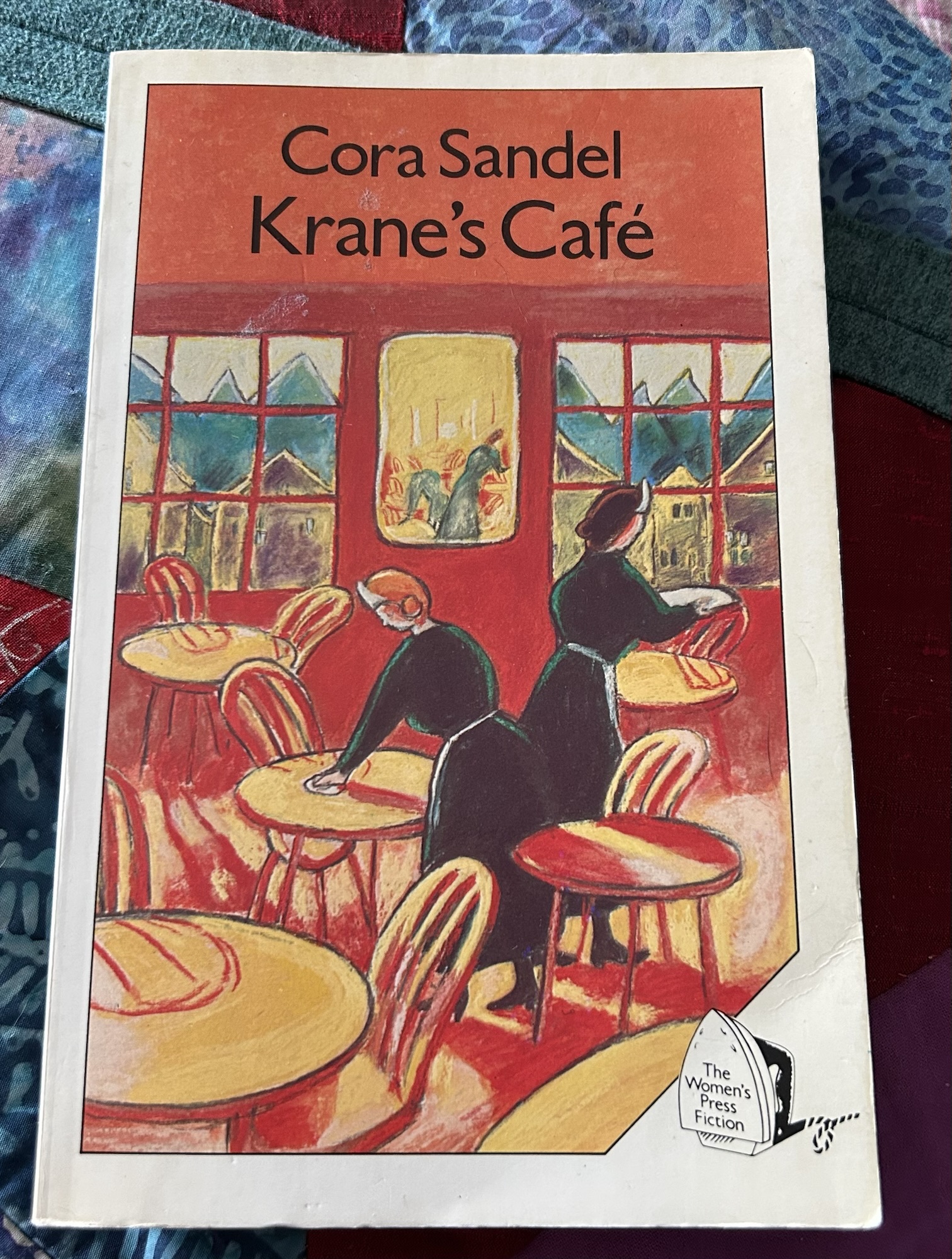
Krane’s Café – Cora Sandel (1946, transl. Elizabeth Rokkan 1968) 173 pages
Back in November Kaggsy reviewed some of Cora Sandel’s shorter writings and reminded me that I had Krane’s Café languishing in the TBR. I’m really pleased to have finally got to it, with its sly humour and incisive characterisation.
“There’s a lot to be heard before your ears drop off.”
Set just after the First World War, it opens with Katinka Stordal sitting in the titular café. She is the dressmaker in a small coastal town in northern Norway, and there is a big event coming up. Her orders are piling up, and Mrs Krane, the owner of the café with her husband, is trying to move Katinka on.
“’I’m going, I’m going,’ said Mrs Stordal. She looked up listlessly for a moment, and stayed where she was. It was one of those days when she looks much older than she really is.”
The narrative voice has this slightly bitchy, judgemental tone, which works so well. In implicitly proclaiming an alliance with the attitudes of the townsfolk, she draws attention to their pettiness and their lack of humane understanding.
People come in to try and chivvy Katinka along, with absolutely no interest as to why she is unable to move from the café or has her head in her hands. Their only concern is getting her back to work.
“As usual Mrs Brien was magnificently equal to the situation. ‘Now then, we mustn’t get hysterical, you know. We mustn’t give up. Everyone has worries. I don’t know anyone without worries. This really is naughty of you, Katinka.”
Then a man called Bowler Hat arrives…
“And he went over to Mrs Stordal and said in that low, one might almost be tempted to say melodious voice, if it were not so ridiculous, and offensive and bold into the bargain, ‘May I offer you something? Something you’d fancy? What about a little wine? The wine you’ve just been drinking? And then you can go on listening to me for a while? You mustn’t stop listening yet, you understand so well. I expect you know too how it feels to be lonely?’”
So the situation becomes scandalous. Katinka is in the back room of the café, drinking with a male stranger. She is complaining about her selfish family, her enduring fatigue with life, her lack of choices. Bowler Hat is an unnerving figure and I did wonder at times if he was a representation of the devil.
Mrs Krane feels overwhelmed without her husband to help her manage the situation, and her staff, Larsen and Sønstegård, are thoroughly enjoying the drama while pretending not to.
“Children and drunkards will tell you the truth. Both Larsen and Sønstegård admitted later that at that point they were almost afraid of more customers coming. For it was exciting to listen to Mrs Katinka, who scarcely ever gave you an answer in the normal run of affairs, sitting there giving rein to her tongue. Even though it was so dreadful to hear her gossiping like that about her own children. Throwing them to the wolves, you might almost call it.
And even though it was all a lot of nonsense.
What else could you call it?”
What emerges is a picture of real sadness. Katinka is lonely and disregarded by her family and by the town, while expected to fulfil their expectations of her. She is teased by the town’s children for her drinking, and in this small community no-one really truly acknowledges anyone else’s pain, despite how closely they all live together.
“And surely she couldn’t have thought of going and drowning herself, with all those orders, she the mother of two children besides? Nobody did that sort of thing in this town.
Suddenly it struck Mrs Krane that that sort of thing was just not written up in the paper about people in other places. Grieve the chemist had taken prussic acid in the cellar of his shop, though that had happened a long time ago and he was even scolded at his graveside by Mr Pio the curate […. ] and Iverson the tailor, who had such a spiteful wife, had walked out into the sea until it went over his head, and he never came up again, even though it was ebb tide and the sea was far out.”
In this way Sandel satirises society and its unthinking complacency towards others; the hypocrisy; and the self-interest. Yet unlike some satire, it doesn’t have a bitter edge. The characterisation is compassionate towards Katinka and Mrs Krane; and even Katinka’s daughter. The narrative voice is humorous and by aligning itself with the attitudes of the town, it avoids the superior tone of some satire.
I felt the ending was compassionate, though the town and its inhabitants remain largely unchanged…
“And all of a sudden Katinka shouted at the top of her voice, ‘Here comes the madness, the great, wonderful madness. The liberator from everything, who opens the gates and makes all spacious about you.’”
 madame bibi lophile recommends
Ooooh I have this one! So I’m skimming your review for the moment but I’m glad to hear you enjoyed it!!
LikeLiked by 1 person
Oh great! I really hope you enjoy it!
LikeLiked by 1 person
This sounds as if it captures the unthinking cruelty that can exist in small communities. I’m glad it ends with compassion.
LikeLiked by 1 person
Absolutely, it does capture that cruelty. She’s very humane towards her characters though.
LikeLiked by 1 person
That brings to mind some of the feeling in Penelope Fitzgerald’s The Bookshop, although that might be a little more tender and this Cora Sandel might be a little more cutting (due to reflecting those aspects of human nature all the more clearly, I mean)? Also, three cheers for those lovely WP editions!
LikeLiked by 1 person
Yes The Bookshop is gentler I think. But definitely similar in themes.
I do love the WP editions! I find I have to be really careful with them now, the glue is crumbling.
LikeLike
I love that cover! And your review has prompted me to shuffle the Cora Sandel (The Leech) I bought after reading Kaggsy’s review onto one (!) of my current tbr piles. I think I would like Krane’s Cafe too.
Less than a week of a novella a day to go; it feels as if you may have got a second wind; I am cheering you on to the finishing line!
LikeLiked by 2 people
Wonderful! I hope you enjoy her.
I think I have got a second wind, just about… 😁
LikeLike