“I always write with the Caribbean in mind.” (Merle Collins)

It feels somewhat inevitable that having been searching for my final read for Around the World in 80 Books, it turned out not to be tricky to source at all, but a book that had been languishing in the TBR  for a while. Angel by Merle Collins (1987) explores politically turbulent years in Grenada through the life of the young titular character.

It opens with Angel in her mother Doodsie’s arms, as workers strike and set fire to the plantations.

“The men held their cutlasses firmly. Held up on Doodsie’s shoulder, Angel clung round her mother’s neck. Mother and child kept their eyes riveted on the fire, Angel wide-eyed, Doodsie suddenly very afraid as she saw the De Lisle plantation houses enveloped in flames, a burning glow in the red and sky.

Just under the hill from the crowd, Ma Ettie sat down in her house and secured the folds of her headtie.”

The strikers follow union boss Leader (based on Eric Gairy). Angel’s father Allan has great faith, but Doodsie is more sceptical. She was my favourite character – some attitudes of her generation but a fiercely intelligent, independent- spirited, hard-working woman, who does not have an easy life. Allan comes and goes, providing little money as it is spread between his children with other women. Meanwhile Doodsie raises her family and tries to enable the choices she has been denied.

“Doodsie looked across at her daughter as she combed her fingers through the doll’s blonde hair. She wondered what Angel would grow up to be. One thing if I have anything to do with it, she not going to have my kind of life. She thought of Simon, sleeping quietly inside. He looked so hurt if you ever shouted at him, you just had to shut up after a while. Angel, on the other hand, looked as though she wanted to find out how long you could go on shouting for. She wouldn’t take no for an answer when she decided she wanted something.”

As Angel grows up she is intelligent but somewhat unmotivated, passing her exams except for West Indian history, which she finds dull and not as interesting as British history. It is at university in Jamaica where she starts to think politically, both on an international level and a personal level when she stops ironing her hair.

“She remembered always that day during her first year at school, when one of the nuns who took a deep interesting her welfare told her she should ask her mother to have her hair ironed or straightened so that it would look decent. Angel had held her head down, her hands had fingered her tie, she had muttered some answer of assent, then slithered along the wall of the corridor around the corner to the notice board. She stood staring up at it through her tears, feeling untidy and stupid, rolling and unrolling the grey tie around her neck.”

Angel heads back to Grenada after she gets her degree, to teach. Grenada achieves independence from Britain, and the family are still divided over Leader, whose portrait Allan has on the wall, before Angel smashes it. Her younger brother Rupert is part of the revolution which overthrows Leader (based on the New Jewel Movement).

“‘Civil war is blood, Rupert.’

‘Which side you on, Angel?’

‘I not on no blasted side. Side talk is war talk.’

‘That is rubbish. That opportunist nonsense could only mean you not on the side of the people. Why you don take a stan? The ting that frighten me about you is dat you able to support everybody. You always balancin! That is pure opportunism! Dammit to hell, Angel! Follow you mind! Come down on one side!’”

Much of the novel is written in patois and I found this evocative and powerful, and straightforward to follow although there is also a useful glossary at the end for non-speakers.

The story finishes with the dramatic events of the US invasion, before shifting to symbolic scenes in Doodsie’s backyard, and with Angel at the Delicia river. It is a fitting end to a book that expertly balances the story of a Grenadian family alongside major national events, never losing sight of either but showing how they are completely interwoven.

To end, a song quoted several times in the novel:

Title quote from an interview on Caribbean Literary Heritage.
“I am capable of whim only within order” (Colette, The Evening Star)

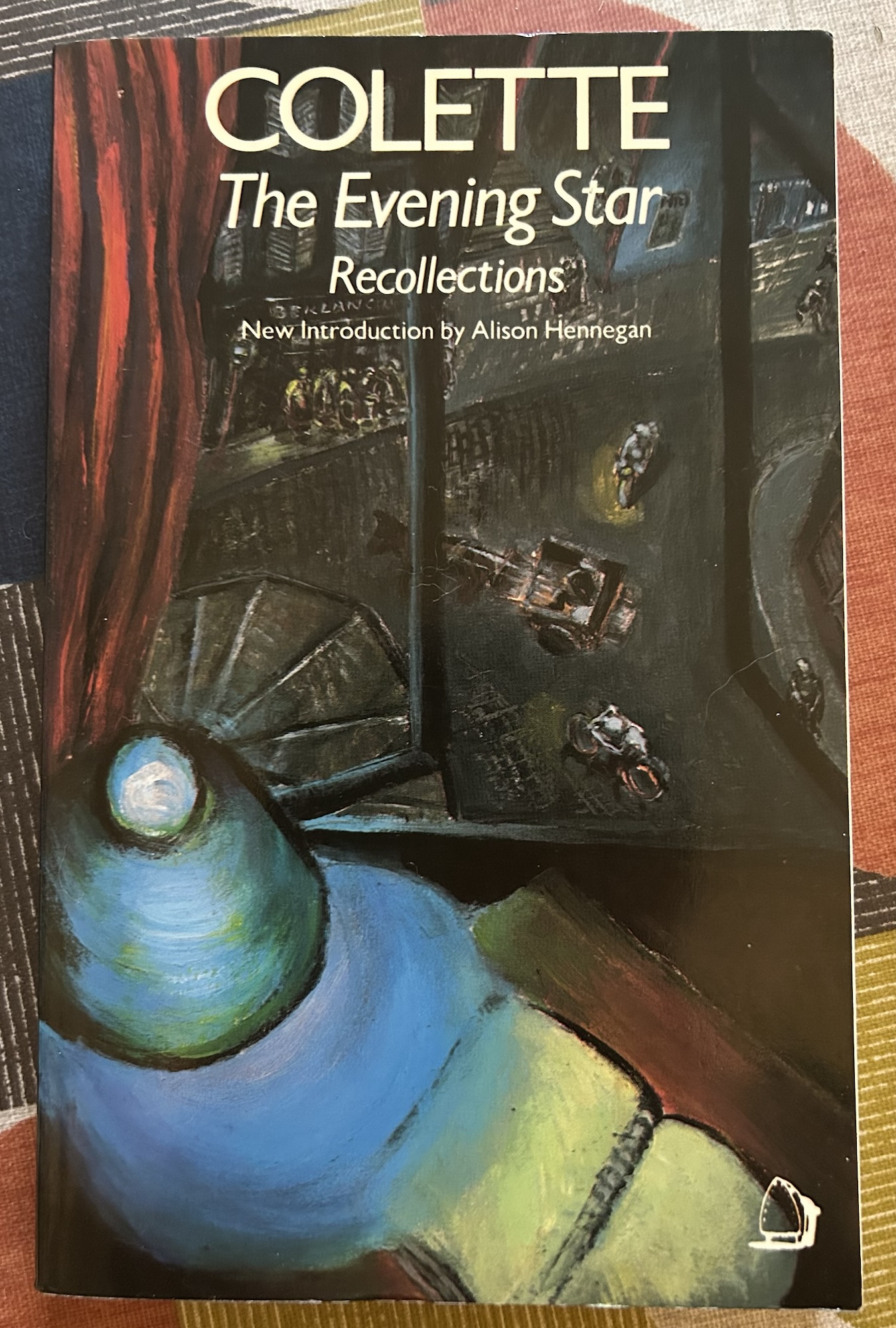
Happy Colette’s birthday! I love her writing, and so I somewhat erratically try and post on her birthday. This year I decided it was a perfect impetus to finally get to her memoir The Evening Star (1946 transl. Peter Owen 1973) which has been languishing in the TBR for too long…

Image from here

This memoir was written when Colette was in her seventies and experiencing significantly reduced mobility, due to arthritis. She remains sanguine:

“If we are to be shaped by misfortune, it’s as well to accept it. We do well to adapt misfortune to our requirements and even to our convenience. This is a mode of exploitation to which the young and robust are ill-suited, and I can well understand the difficulty of making them appreciate, for instance, that near-immobility is a gift.”

She is at home in the Palais-Royal:

“When I am alone, my apartment relaxes. It stretches itself and cracks its old joints. In fine dry weather it contracts, retracts, becomes immaterial, the daylight shows under all its doors, between its every hinge and joint. It invites the wind from outside and entrusts my papers to it, they go skimming off to the other end of the room. I shan’t unwind my cocoon of bed clothes for their sake. Greedy for air, I am a coward when it comes to cold.”

Her humour remains undimmed, such as after a long, poetic contemplation on pink in nature, she concludes:

“Enough of this blandness. I could enjoy a pickled herring.”

And I also enjoyed this reflection on her process:

On the strength of those writers who do make notes, I had made notes on a sheet of paper, and lost the paper. So I bought a notebook, American style, and lost the notebook, after which I felt free, forgetful, and willing to answer for my forgetfulness.

Written in 1946, Colette considers her home and city in the immediate aftermath of Nazi occupation:

“In its urbane, sly, stubborn fashion, the Palais-Royal began its resistance and prepared to sustain it. What resistance, what war can I speak about other than those I have witnessed?”

(Colette’s husband was Jewish and had been taken by the Gestapo, but subsequently released. He remained in a degree of hiding with the help of her Palais-Royal neighbours).

“All that offered itself insidiously, or made use of violence, Paris rejected equally. Let us caress with a happy hand it’s still-open wounds, it’s upset pillars, it subsided pavements: its wounds apart, it emerges from all this intact.”

Memories ebb and flow, and Colette reflects this in her writing. This is not an ordered – either chronologically or thematically – memoir. It is more a series of reflections and reminiscences, the past and present layered upon each other. There were times when I lost the thread of exactly what she was saying but just let her hypnotic prose wash over me. This felt an appropriate way to experience her memories and a clever way for Colette to align the reader with her experience as she reflects and writes from her bed.

I find some of Colette’s views problematic but these passages are short-lived. My favourite part of Colette’s writing is always how she captures her love of nature, and even from within her Parisian apartment she engages with the natural world. (Her husband occasionally intervenes in the narrative and is referred to as “my best friend”):

“My best friend, how can you think that I might have been bored? Why, the sky alone is distraction enough.”

There’s plenty here I haven’t mentioned and Colette’s discussion of friends and colleagues would also be of interest to anyone who enjoys early twentieth century French literature. It’s a short work, just over 140 pages in my edition, but such a joy to spend time with Colette.

I’ll leave you with this short quote, helpful for those of us in the Northern hemisphere currently enduring a January at least 84 days long…

“What should I wait for, if not the spring?”

Novella a Day in May 2025: No.25

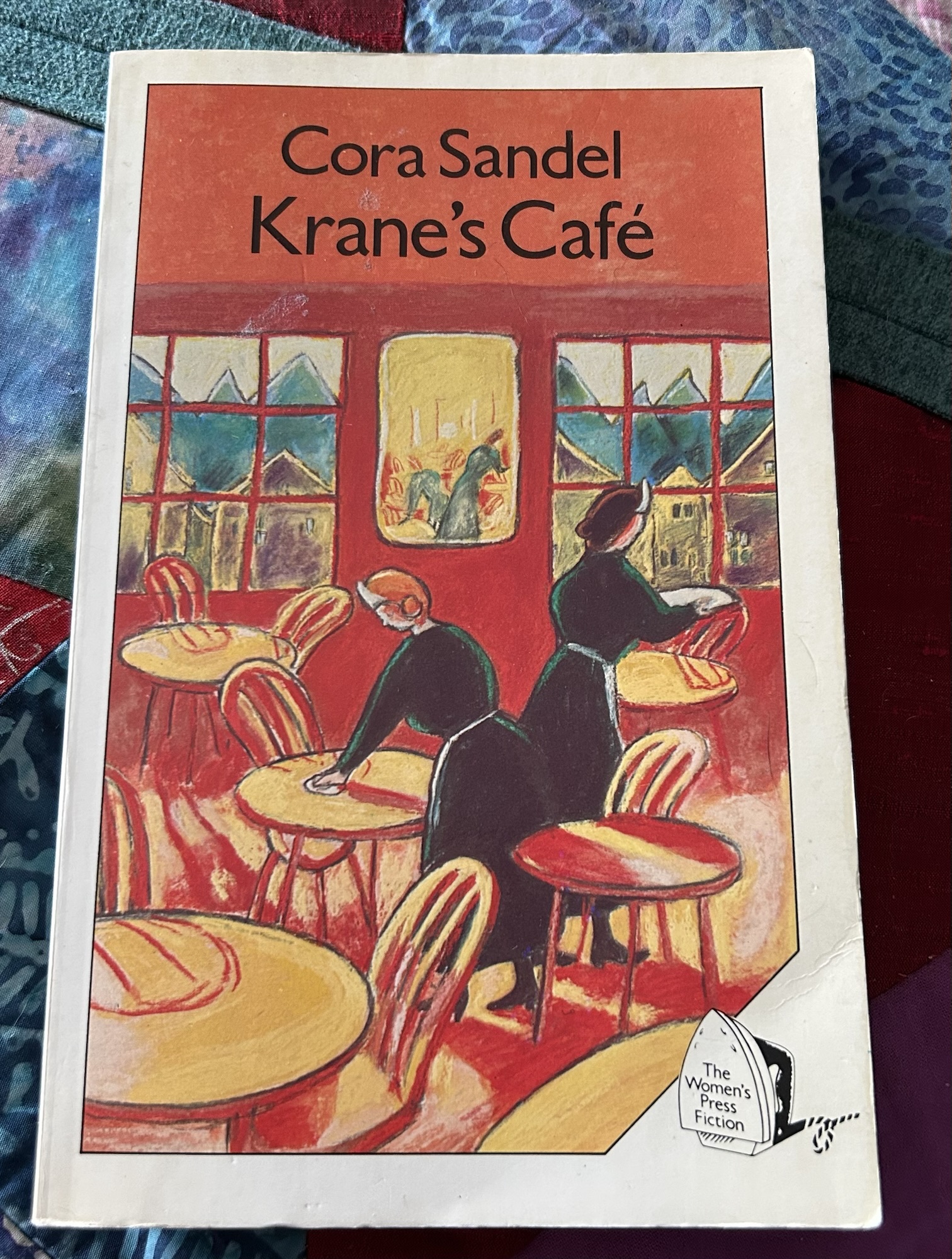
Krane’s Café – Cora Sandel (1946, transl. Elizabeth Rokkan 1968) 173 pages

Back in November Kaggsy reviewed some of Cora Sandel’s shorter writings and reminded me that I had Krane’s Café languishing in the TBR. I’m really pleased to have finally got to it, with its sly humour and incisive characterisation.

“There’s a lot to be heard before your ears drop off.”

Set just after the First World War, it opens with Katinka Stordal sitting in the titular café. She is the dressmaker in a small coastal town in northern Norway, and there is a big event coming up. Her orders are piling up, and Mrs Krane, the owner of the café with her husband, is trying to move Katinka on.

“’I’m going, I’m going,’ said Mrs Stordal. She looked up listlessly for a moment, and stayed where she was. It was one of those days when she looks much older than she really is.”

The narrative voice has this slightly bitchy, judgemental tone, which works so well. In implicitly proclaiming an alliance with the attitudes of the townsfolk, she draws attention to their pettiness and their lack of humane understanding.

People come in to try and chivvy Katinka along, with absolutely no interest as to why she is unable to move from the café or has her head in her hands. Their only concern is getting her back to work.

“As usual Mrs Brien was magnificently equal to the situation. ‘Now then, we mustn’t get hysterical, you know. We mustn’t give up. Everyone has worries. I don’t know anyone without worries. This really is naughty of you, Katinka.”

Then a man called Bowler Hat arrives…

“And he went over to Mrs Stordal and said in that low, one might almost be tempted to say melodious voice, if it were not so ridiculous, and offensive and bold into the bargain, ‘May I offer you something? Something you’d fancy? What about a little wine? The wine you’ve just been drinking? And then you can go on listening to me for a while? You mustn’t stop listening yet, you understand so well. I expect you know too how it feels to be lonely?’”

So the situation becomes scandalous. Katinka is in the back room of the café, drinking with a male stranger. She is complaining about her selfish family, her enduring fatigue with life, her lack of choices. Bowler Hat is an unnerving figure and I did wonder at times if he was a representation of the devil.

Mrs Krane feels overwhelmed without her husband to help her manage the situation, and her staff, Larsen and Sønstegård, are thoroughly enjoying the drama while pretending not to.

“Children and drunkards will tell you the truth. Both Larsen and Sønstegård admitted later that at that point they were almost afraid of more customers coming. For it was exciting to listen to Mrs Katinka, who scarcely ever gave you an answer in the normal run of affairs, sitting there giving rein to her tongue. Even though it was so dreadful to hear her gossiping like that about her own children. Throwing them to the wolves, you might almost call it.

And even though it was all a lot of nonsense.

What else could you call it?”

What emerges is a picture of real sadness. Katinka is lonely and disregarded by her family and by the town, while expected to fulfil their expectations of her. She is teased by the town’s children for her drinking, and in this small community no-one really truly acknowledges anyone else’s pain, despite how closely they all live together.

“And surely she couldn’t have thought of going and drowning herself, with all those orders, she the mother of two children besides? Nobody did that sort of thing in this town.

Suddenly it struck Mrs Krane that that sort of thing was just not written up in the paper about people in other places. Grieve the chemist had taken prussic acid in the cellar of his shop, though that had happened a long time ago and he was even scolded at his graveside by Mr Pio the curate […. ] and Iverson the tailor, who had such a spiteful wife, had walked out into the sea until it went over his head, and he never came up again, even though it was ebb tide and the sea was far out.”

In this way Sandel satirises society and its unthinking complacency towards others; the hypocrisy; and the self-interest. Yet unlike some satire, it doesn’t have a bitter edge. The characterisation is compassionate towards Katinka and Mrs Krane; and even Katinka’s daughter. The narrative voice is humorous and by aligning itself with the attitudes of the town, it avoids the superior tone of some satire.

I felt the ending was compassionate, though the town and its inhabitants remain largely unchanged…

“And all of a sudden Katinka shouted at the top of her voice, ‘Here comes the madness, the great, wonderful madness. The liberator from everything, who opens the gates and makes all spacious about you.’”

“Some things I cannot see until I write about them.” (Yuko Tsushima)

I wasn’t planning on joining in Japanese Literature challenge 17 hosted by Meredith at Dolce Bellezza other than enjoying other bloggers wonderful posts. However this enthusiastic post by Marina Sofia on Tsushima Yūko’s Territory of Light meant I immediately started rooting through the TBR to find Child of Fortune (1978, transl. Geraldine Harcourt 1983), which I knew I had buried somewhere…

This is the first of her novels I’ve read and on the strength of this I definitely want to read more. Novella length, it tells the story of Kōko, a 36-year-old single mother to eleven-year-old Kayako. Told in the third person from Kōko’s perspective, it is a compelling examination of one woman’s inner world and her barely articulated resistance to the expectations placed on her.

Early in the novel, Kōko suspects she is pregnant. She is ambivalent about Osada, the father, as she is about most things. But gradually she realises that she wants to keep the child:

“Maybe she was reaching an age when it was senseless to want a fatherless child; but, precisely because of her age, she didn’t want to make a choice that she would regret till the day she died. Lately she was more convinced than ever that there was no point in worrying about what people thought. She would soon be thirty-seven. The only person watching Kōko at thirty-seven was Kōko. When this obvious fact finally came home to her it was still a surprise – what a very lonely fact it was!”

Geraldine Harcourt’s informative introduction explains that pregnancy at that age in Japan around this time could still be viewed as shameful even within marriage, so Kōko’s decision is doubly transgressive.

Kōko is an intriguing character, as she lives an unconventional life which places her in opposition to so many, by barely doing anything. Her lack of decision-making is an act of quiet but determined resistance.

Her sister Shoko is much more conventional and doesn’t approve; Kōko’s daughter Kayako much prefers to spend time with her more affluent, conformist aunt. Kōko tries to explain to Shoko:

“No, that’s not it – don’t think I’ve liked using choosing a different world from other people. I know I’ve been stubborn – but not about Kayako alone. All my life, though I often haven’t known which way to turn, I have managed to make choices of my own. I don’t know if they were right or wrong. I don’t think anyone can say that.”

But really she hasn’t made that many choices. She married because of pregnancy; husband Hatanaka organised the divorce years later, unsurprisingly as Kōko didn’t love him, still holding a candle for her lover Doi. She doesn’t enjoy her job teaching piano, but she also takes no steps to do anything else. She doesn’t take great care of herself and she doesn’t have many friends or interests.

Two driving forces in her life are her love for her brother, who died many years earlier, and sexual desire. The latter has led to her current predicament, the former suggests one reason that may be contributing to her lack of attachments.

“A little over a year ago, Kōko had understood something for the first time: the in the end she had let everything slip away from her, that in reality she hadn’t a single resource. It was an alarming discovery.”

Her lack of attachment includes reality – we are taken into Kōko’s dreams and daydreams, woven in seamlessly but disconcertingly.  As we move back and forth in time, learning about Kōko’s childhood, marriage, griefs and pains, Tsushima builds a picture of a woman who may not be completely likable but who is recognisably human and flawed, and muddling through the best way she knows how.

I was really rooting for Kōko to find a more articulate agency, and the penultimate scene was unbearably tense in this regard. Child of Fortune is never didactic yet absolutely achieves a compelling portrait of a woman fighting for her life, against immense societal pressure.   

“Kōko was shaken by the realisation that even now, more than twenty years later, she still lacked any compelling reason to go on living. And by the fact that the will to live was still there.”

To end, Kōko has fond memories of a visit to Karuizawa, which does look lovely:

PS When I was looking for a title quote for this post, I found this great conversation between Tsushima and Annie Ernaux.