Continuing my cosy mystery reads for Christmas, it was Kaggsy’s tempting review at the start of the month which alerted me to Death in Ambush by Susan Gilruth (1952), republished by the British Library Crime Classics imprint.
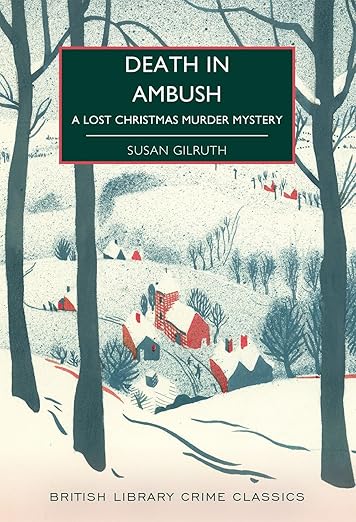
It opens with Liane – Lee – Crauford reflecting on what happened when she accepted her friend Betty’s invitation to stay at Christmas:
“As far as the murder went, we all disliked the victim so heartily that nobody could screw up much actual grief on that score; but all the same it was an upsetting thing to happen and caused a good deal of distress one way and another in the village.”
Betty is the doctor’s wife and has two small children. Lee is married but her husband will be joining her later, so she heads to the small village of Staple Green alone. It’s the sort of place where everyone knows everyone else’s business, and Lee soon meets several of the neighbours when Betty throws a drinks party.
Sir Henry Metcalfe is the local retired hanging judge and landowner who is given to pronouncements like:
“No wonder the Empire’s going to the dogs when people of our standing—the very ones who should know better and set an example to the working classes—behave like a set of hedonistic escapists.”
As well as smaller scale observations:
“Once a week, not to mention Sundays, we are left stranded and servantless while they frivol away their time and my money in the vulgar and overheated precincts of some neighbouring picture palace.”
In other words, his staff go to the cinema at Tunbridge Wells.
His wife Diana is universally acknowledged to be entirely lovely, not least by the land agent John Wickham – rumours abound but no-one can quite believe it of the irreproachable lady of the manor.
His tenants are the Qualnoughs, Lewis and his bright young daughter Ann, a slightly affected actress who calls everyone Darling. Sir Henry is threatening to turn them out of their home, and Ann is deemed an unsuitable match for Sir Henry’s son Michael, who also wants to pursue a career on the stage, against his father’s wishes. So it’s hardly surprising that when Sir Henry is found dead at home, Ann speaks for many when she pronounces it:
“The best bit of news we’ve had in Staple Green since they put in the main electricity cable”
While her father refuses to be hypocrite and freely admits, most entertainingly, that he found the deceased to be “a fraudulent nincompoop” and “a pedantic popinjay”.
It soon emerges that Sir Henry was poisoned, and given that Betty’s husband Howard leaves his surgery unlocked with all manner of medications freely available, any of the neighbours could have wandered in and helped themselves, including the mysterious and glamorous newcomer Sonia Phillips…
Scotland Yard arrive in the form of Detective Inspector Hugh Gordon and Sergeant Spragg. Hugh and Lee know each other and there are clear references to a previous mystery, although I didn’t feel I needed to have read that one to enjoy this. Hugh stays at the Blue Boar in the village with its “depressing air of frowst and aspidistras” and he and Lee are soon charging about in his flashy new Lancia to find the murderer.
I thought it was entirely obvious from some heavy clues at the start who the murderer was, and mostly how they’d done it too, apart from some logistics a twenty-first century reader is unlikely to pick up. But this didn’t detract from my enjoyment at all. These types of stories are comfort reads for me, and the detectives working everything out and tying it all up neatly is soothing escapism.
Lee is an entertaining narrator, clear sighted and witty. She is grumpy at not being a full confidante of Scotland Yard which seemed a bit presumptuous to me, while she lets being called “a good girl” by men who want her to be convenient slide by (no doubt a sign of the times). She and Hugh have a flirtatious relationship which provides an additional frisson to proceedings while never becoming anything more.
The story is well paced, believable and entertaining. There are also some lovely details to convey the Christmas setting:
“It was only a short distance to the village green, and we strolled up the lane admiring the wonderful patterns of filigree lace made by the spiders webs which hung festooned all over the high hedges, sparkling in the chilly sunshine, and the way each blade of grass on the verge stood out stiff and encrusted with thick frost.”
I hope this is the start of more Gilruth issues from BLCC – fingers crossed!
To end, mine is a secular Christmas, but I still have a favourite carol:
 madame bibi lophile recommends
That last quote is the perfect description of what we’d all like to see on Christmas Day! Here’s hoping for a brilliant reading year in 2026.
LikeLiked by 1 person
Yes absolutely! I love a frosty walk. Wishing you wonderful reads too Susan!
LikeLiked by 1 person
I am very pleased and relieved that you liked this one as I gave a copy of it to a friend for Christmas without having read the book myself.
I love that description of a frosty walk too.
Wishing you a very Happy New Year for 2026 (reading and otherwise!).
LikeLiked by 1 person
Oh great! I hope they enjoy it as much as I did.
There are some great descriptions, but not too many to slow down the story at all.
Wishing you a very happy 2026 too!
LikeLike
This sounds good thanks for sharing your thoughts and ‘In The Bleak Midwinter’ is an excellent carol. Hope you had an enjoyable festive season and wishing you a Happy – including plenty of reading – Healthy and Peaceful New Year.
LikeLiked by 1 person
Thank you very much! Hope you had a lovely Christmas with plenty of books to enjoy into the new year!
LikeLiked by 1 person
We had a quiet Christmas but enjoyable, thank you. One book as a gift and book tokens some of which I think will be used to purchase this book as I do like the sound of it. As for current reading happily I’ve books to hand on my shelves.
LikeLike
I think this one just arrived. Unfortunately, about four stacks of books are ahead of it, so my review may not appear until NEXT Christmas! (probably before that, though)
LikeLiked by 1 person
Haha! I hope you enjoy it whenever you get to it ☺️
LikeLiked by 1 person
It’s an entertaining one, isn’t it Madame B? And very atmospheric – I loved the way she conjured the location!
LikeLiked by 1 person
I really enjoyed it Kaggsy – thank you for alerting me to it!
She does capture the village so well – a perfect Christmas setting.
LikeLiked by 1 person
This does sound fun, and I do enjoy a small village setting, the type of place where everyone seems to be preoccupied with everyone else’s business. I’ll look out for it, once I’ve read the BLCC’s currently sitting on my shelves!
LikeLiked by 1 person
It is good fun Jacqui. I’ve never lived in a village but I do enjoy a village setting!
LikeLike
Sounds like great fun – I’ll stick it on the list for next Christmas! I don’t know that I’d like to be called a “fraudulent nincompoop” but I quite aspire to the title of “pedantic popinjay”…
LikeLiked by 1 person
Great! I really hope you enjoy it. I loved those insults 🤣
LikeLiked by 1 person
A Lost Christmas Mystery? That’s like…a double mystery? You know I envy your British Crime Classics, especially winter ones.
LikeLiked by 1 person
It’s incredible how they keep funding more to publish! They are great and I especially enjoy them in the colder months.
LikeLike