I’d planned to read Barbara Comyns’ A Touch of Mistletoe (1967) in December for obvious reasons, but I fell behind with my plans as always. Despite the title it’s not a Christmas book at all, and instead it’s got my 2026 reading off to a great start.
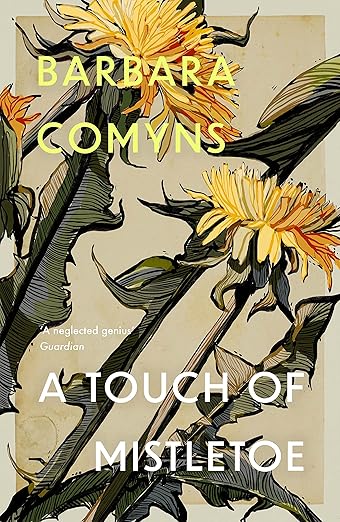
A Touch of Mistletoe is thought to be semi-autobiographical, as it follows sisters Vicky and Blanche Green from teenagers in the 1920s, to extreme poverty in the 1930s, through to marriage and motherhood in wartime, ending in the 1950s. Certainly a semi-feral childhood is something Comyns has explored before:
“Our mother rather lost interest in us after the thirst got hold of her and, although our grandfather was vaguely fond of us, he certainly wasn’t interested.”
While their brother Edward seems fairly content in a disengaged way, the sisters are desperate to leave their Warwickshire home. Vicky wants to go to art school, but the solicitor who controls her inheritance from her father does not think this is an appropriate use of funds. Blanche is yet to come of age:
“Blanche could not draw, but she had the very special gift of romantic beauty. She was extremely tall and willowy, with a flowing mass of almost black hair, classical features and a pale moon face, her skin as fine as the skin inside egg shells.”
Comyns is so adept with those arresting similes. Another that struck me later was:
“He looked like an ugly bird who had been given beautiful dogs eyes by mistake”
And:
“He was a great admirer of Cézanne and I did not say that he usually left me feeling rather cold and I thought his paintings looked as if he lived on sour apples.”
Vicky escapes to Amsterdam but finds herself an unpaid housekeeper for a filthy home, looking after bull terriers. (I must admit I skim-read some of the passages to do with the dogs, it was pretty awful.) She escapes, and after briefly returning home where her mother has swopped alcohol for incessant cleaning, the sisters finally get to London.
“It took us months to get used to the insidiousness of London grime and the hard water.”
They live in poverty, sharing a bed in boarding house, along with cockroaches and rats. They very nearly starve entirely, and the descriptions of hunger, inadequate clothing and squalid rooms put me somewhat in mind of Jean Rhys. Unlike Rhys the sisters are less dependant on men for money favours, and Comyns retains a cheeriness all of her own:
“Our bed sitting room was in a large Victorian house in quite a pleasant square with a garden in the centre where lime trees grew. Our room was on the hall floor and was painted a brilliant orange and blue, even the cheap china was orange and blue. The divan cover was a large damask table cloth dyed black. We thought it a wonderful room with its gas fire and ring with a little tin kettle on it.”
A striking detail of this time was their meagre meals: “To avoid spending shillings we used candles; but it was a slow way to cook—about twenty minutes to get an egg to boil.”
The situation doesn’t last forever, as Blanche finds work as a lady’s companion and Vicky falls in love with an art student. The description of married life here is very similar to Our Spoons Came from Woolworths. While Vicky’s husband Gene initially seems just as selfish as Charles in Spoons:
“Our marriage was such a happy one, perhaps partly due to the fact that Gene always had his own way over everything”
It gradually emerges that in fact he is very unwell. I thought the portrayal of serious mental illness – along with their mother’s alcoholism previously – was dealt with without judgement. There are parts of A Touch Of Mistletoe which are of their time and while I don’t think intended to be derogatory, are not language we use now. But the descriptions of Gene are sympathetic, and the outdated treatment he has sounds horrific but is never sensationalised.
Vicky worries about providing for their son Paul:
“He needed so much—good food, fresh air, clothes, education—there was no end to it and all I had to offer was love.”
Yet somehow they muddle through, with the help of kindly friends and neighbours, as well as Marcella, the family’s housekeeper of many years. Throughout it all Comyns retains her signature tone of unnerving guilelessness.
Later, Vicky remarries but her husband Tony also struggles with alcohol. Blanche has also had marriage troubles, and both feel they are entering old age as 40 looms (!)
The experience of London during the war is brilliantly evoked, as it was in Mr Fox, with enormous terrors sitting alongside the surprising smaller details:
“One evening, I think it was our wedding anniversary, we went to a famous restaurant where they had pheasant on the menu, but, when the waiter brought it to our table, it was only Spam pressed into the shape of a bird’s wing.”
A Touch of Mistletoe is longer than other Comyns I’ve read (336 pages) as she usually tends towards novella length, and I wondered if her beguiling, eccentric tone could sustain a longer novel. I needn’t have doubted. It was an absolute joy to spend longer than usual with a captivating writer whose voice is entirely her own.
To end, I can’t think of an appropriate 80s tune, so instead here’s the trailer for a film I saw twice last year, once at my local Odeon and then again with a Q&A with the writers/lead actors and director at the wonderful Prince Charles in December. It’s a gentle, beautifully observed film about grief and regret, friendship and kindness, and it’s got some silly jokes in it too. If you’ve not caught The Ballad of Wallis Island yet I do recommend it:
 madame bibi lophile recommends
I’m glad you enjoyed this one, although it sounds quite sobering in places. I loved The Ballad of Wallis Island. Last year’s low-key hit.
LikeLiked by 1 person
It is sobering but never depressing, because the narration is so equanimous. So pleased to hear you loved The Ballad of Wallis Island too!
LikeLiked by 1 person
“Her signature tone of unnerving guilelessness” – that’s exactly it! I can’t manage her any more as the horror is too much, and I gave all my copies away except for Our Spoons Come from Woolworths, which I can still read (even then there’s a horror dog bit!).
LikeLiked by 1 person
There are bits I skip for sure – the dogs in this one was grim. Our Spoons is still my favourite and it was the first of hers I read.
LikeLiked by 1 person
Gosh, this does sound dark in places, Madame B, but then Comyns does do darkness. I think I would have skimmed the dog bits too…
LikeLiked by 1 person
It is dark but her tone means that while she doesn’t shy away from things it’s somehow manageable. Definitely worth skipping the dog bits though!
LikeLiked by 1 person
I read my first Comyns last year (Our Spoons) and I thought she was a wonderful writer. I wonder why she’s not translated into French.
This one sounds grim, though.
LikeLiked by 1 person
There’s a lot that is grim – as there is in Spoons – but it’s not depressing. The narrator is so resilient, she sort of carries you along.
LikeLiked by 1 person
I like Comyns, but I haven’t read this one yet.
LikeLiked by 1 person
I hope you enjoy this one when you get to it!
LikeLiked by 1 person
I am so cross with myself: The Ballad of Wallis Island was screening here last year and I missed it. Fortunately I can get it on DVD, I just love the trailer:)
LikeLiked by 1 person
I hope you enjoy it Lisa! The trailer is pretty representative so if you liked that I think you’ll like the film 🙂
LikeLiked by 1 person
Since my off-blog resolution is to update my film-watching (i.e., something later than Hitchcock 😉 ), I shall take your recommendation and add The Ballad of Wallis Island to my TBW list.
LikeLiked by 1 person
Hooray! I hope you enjoy it FF.
LikeLiked by 1 person
I loved Wallis Island, a real highlight in the film year I thought; and I will get to Comyns this year, I’ll make it an absolute resolution!
LikeLiked by 1 person
Great to hear you loved Wallis Island too Jane! I hope you enjoy Comyns when you get to her. I’ll look forward to hearing how you find her.
LikeLiked by 1 person
This sounds really good. I’ve liked the Comyns I’ve read so far
LikeLiked by 1 person
Great to hear! I hope you enjoy this one if you get to it Cathy.
LikeLiked by 1 person
Phew, I’m glad to know there’s no Christmas tie after all. And glad of the warnings of the dark bits. /winces This year I’ve got Comyns scribbled down on the project page, although I’m not sure how far I’ll get with writing about them, just reading maybe.
LikeLiked by 1 person
I hope you enjoy her if you get to her. She is dark but her voice is so unique, I really like her (even if I have to skip certain animal sections)
LikeLike