Well, it’s only February but I already think that I’ve read one of the most extraordinary books of my year: The Glass Pearls by Emeric Pressburger (1966). Most pleasingly, it was a twofer for reading events this month, #ReadIndies hosted by Kaggsy as it is published by Faber as one of their Faber Editions series; and Hungarian Literature Month hosted by Winston’s Dad as Emeric Pressburger was born in Miskolc, Hungary.


Pressburger studied in Prague, moving to Weimar-era Berlin and then escaping the Nazis by moving first to Paris then London. It was there he met Michael Powell, and the powerhouse filmmaking duo was formed. I’m a big fan of Powell and Pressburger films, and it was this that led me to read The Glass Pearls (and a nice chat with the bookseller who is also a P&P fan.) But it absolutely stands on its own terms, not simply as curio for cinephiles.
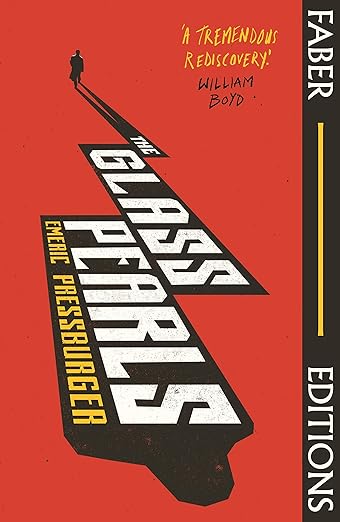
At the start of the novel, Karl Braun is moving into a lodging house in Pimlico, unloading a few items from a piano tuner’s van. His neighbours are curious, but mild-mannered Karl soon fits in. His fellow lodgers, Strohmayer who always has a deal on the go, and Kolm, a concert-loving chemist, are also European émigrés who escaped Hitler’s regime and assume Braun is the same. But the reader soon knows something the characters don’t: Braun is a Nazi escaping justice from the trials.
“I have lived for twenty years according to self-imposed rules; it wasn’t easy and I’m not going to change my ways now. I denied myself everything I used to enjoy most.”
Pressburger’s mother died at Auschwitz, as did many members of his extended family. In this astonishing novel he writes from the point of view of a Nazi doctor who carried out atrocities at Wittau concentration camp. It is so brilliantly done. The third-person narrative means it is presented as this is the man, this is what he did and how he now lives, which means as a reader you can stick with it where a first-person narrative would be too much to ask. But in writing from Braun’s point of view, it is also made personal, and you are asked to spend time alongside someone who has repeatedly taken unforgivable actions, for which he feels no remorse.
Braun frequently has nightmares about pursuit and capture, and justifies himself at imagined trials thusly:
“He would never do anything to serve only his own purpose unless it served the common purpose as well. He would go to any length to help others, disregarding his own interest. He loved his work; he was a good family man; adored his wife and child; he was religious, prayed to God and respected his laws. He was a romantic and romantics were the salt of this earth.”
And in this way Pressburger consistently shows us the man, his complete and utter delusion, his cruelty and vanity, and also makes him recognisable.
Braun leads an ordinary life in post-war London. He has a love interest who he takes to concerts in a sedate courtship; he has to navigate his workplace politics; he chats to his fellow lodgers. No-one knows he is Dr Otto Reitmüller.
“He made enough money for his needs, he even had a little in the bank. He enjoyed a good book, a good play, a good concert, a good talk. What else does a man want from life?”
We know one thing he wants: his wife and child back, killed in Hamburg bombings. Braun wasn’t with them, called back to camp to continue his horrors, which are portrayed clearly, sickeningly, but not sensationally.
Braun isn’t pretending to be cultured, or bereaved. He is both those things and an unrepentant torturer. It is powerful portrait that demands responsibility from those who enact war crimes, but also from those who witness, to acknowledge how it could happen again when the people who did it were ordinary – friends and neighbours.
His paranoia steadily grows as the newspapers report on the trials, the deadlines are extended, and a fellow fugitive urges him to get the money they stashed in Swiss bank account and join ‘the Brotherhood’ to live out their days in Argentina.
“He knew he could never have stuck it out in prison. His strong sense of justice would have reared up against petty persecutions by his warders.”
Braun becomes more fearful and restless. Two men seem to be watching him, the tension mounts, and while I didn’t want him to escape, The Glass Pearls absolutely worked on the level of a thriller where you are speeding through it to know the outcome.
“One had to be careful about the deductive powers of a fertile brain. Once trained for critical examination and to present the fullest picture of possible dangers to its master, the brain tended to overdo things were not watched too closely.”
It felt Hitchcockian in many ways, but a reversal of the innocent man pursued by shady forces.
“Suddenly he knew that all he was yearning for was peace.”
There’s a very interesting Afterword in this edition from filmmaker Kevin Macdonald, who is also Pressburger’s grandson. He movingly describes Pressburger’s survivors guilt and how when he developed dementia, he had delusions of being chased by Nazis. Astonishingly, he also says:
“Emeric went so far as to imbue the Braun character with certain traits of his own; such that, to some degree, Braun is a self-portrait.”
To end, a trailer for a delightful Powell and Pressburger film that is slightly less well-known than some of their big hitters. I’m not the biggest fan of romance but it would take a heart of stone to resist the charm of I Know Where I’m Going!
 madame bibi lophile recommends
An amazing man, writer and filmmaker.
LikeLiked by 1 person
Absolutely!
LikeLike
This is such a good review of a book that sounds almost unreadable. But that the author wrote it under the conditions which you describe is even more astounding. Thank you.
LikeLiked by 1 person
Thank you so much! It really is astounding, and very readable – Pressburger has a light-touch, flowing style that means you whizz through it. It’s an incredible feat.
LikeLiked by 1 person
I knew about this but did not think I would cope with the dark subject matter. However, as you very often tend to do, you have persuaded me otherwise and I have reserved a copy!
LikeLiked by 1 person
So glad I’ve persuaded you! I hope you find it OK. Pressburger writes very cleverly, whereby we know the horror of what Braun did, but it’s not graphic. He doesn’t let Braun or the reader off the hook but he doesn’t dwell on the actions either.
LikeLike
Just popping back and rereading your excellent review. I remained persuaded and have just finished The Glass Pearls (thrilled it qualifies for Read Indies and Hungarian Literature month too!).
Thank you for giving me the incentive and the courage to read this extremely clever, exciting and thought-provoking book. Pressburger’s personal history and the additional information in the afterword by his grandson made it all the more poignant and powerful.
LikeLiked by 1 person
Oh wonderful! I’m delighted to hear how much you got from reading this. Thanks so much for letting me know!
LikeLike
This sounds absolutely extraordinary. I noticed in bookshops when it was reissued but never picked it up. I will next time.
LikeLiked by 1 person
It really is Susan – I’m still not sure how he did it! Such a complex subject matter and cleverly written in such a readable style. So pleased you’ll take a look – this might be one that appeals to your partner too?
LikeLiked by 1 person
Spot on! He’s a fervent P & P fan
LikeLiked by 1 person
Great review Madame B – it’s a remarkable book, isn’t it? It’s really nuanced and though you’re never in any doubt about the horrors the man has participated in, it still works on the level of a thriller. Definitely one which stayed with me.
LikeLiked by 1 person
That’s exactly it Kaggsy. I’m sure it will stay with me too.
LikeLiked by 1 person
This sounds magnificent, a much better choice than mine for HLM.
LikeLiked by 1 person
My first choice for HLM was a DNF, I couldn’t get on with it at all! But this was much more successful. Hope you have better reads ahead too Lisa!
LikeLiked by 1 person
LOL The moral is, if in doubt, follow the blogs’ advice, especially Stu’s!
LikeLiked by 1 person
A great review of a truly excellent book! I’m so glad you were impressed with this, Madame Bibi. It’s remarkably gripping because we sense that Braun’s past is finally catching up with him. I’d love to see a film adaptation at some point, preferably with Kevin Macdonald in the director’s chair.
LikeLiked by 1 person
That would be amazing Jacqui! I really hope that happens, it would be a must-watch!
LikeLike
I feel as if I must read this, what an individual way to write about such horrors
LikeLiked by 1 person
I think you might rate this one highly Jane. It really is extraordinary.
LikeLiked by 1 person
This sounds so very good. And I’m sure I could count the Hungarian writers I’ve read on one hand. Of course you are better situated to have more European writers on your store shelves, but I should make a point of looking for them too. How very sad (but understandable) that the trauma of having been hunted would remain in the throes of dementia even though so many memories are lost/inaccessible.
LikeLiked by 1 person
It is really good, so well done. The number of translated works is improving, but its still pretty woeful, especially as you say, we are so close to mainland Europe.
I thought that was really sad about the dementia too – he couldn’t find peace. I believe he felt extremely guilty about not taking his mother with him when he left for France then England.
LikeLike
Pingback: “The simpler the words, the more significant their meaning.” (Narine Abgaryan, Three Apples Fell From the Sky) | madame bibi lophile recommends
i have this on my shelves. I’ve only skimmed your review so I can come back to it.the Faber finds series is full of gems, isn’t it.
LikeLiked by 1 person
It really is! I hope you enjoy this when you get to it Annabel.
LikeLike