Skin Deep – Antonia Lassa (transl. Jacky Collins) Blog Tour

After eleven years of blogging, it’s finally happening: I’m taking part in a blog tour 😀

And most delightfully, it coincides perfectly with my month of daily novellas. Skin Deep by Antonia Lassa (2023 transl. Jacky Collins 2023) comes in at 114 pages, making this Novella a Day in May 2023 – No.24.

One reason I don’t do blog tours usually is because I only blog about books I enjoy, so I can’t guarantee to take part. However, I trusted wonderful indie Corylus Books to see me right, and they did 😊 I thought Skin Deep was a great read.

It’s a challenge to have a detective story in so few words but the story didn’t feel diminished in any way by this. Yes, the solution is straightforward but I would much rather that than an overly convoluted, protracted story where I lose all sight of what’s happening and why on earth the person was killed in the first place.

Here is the blurb from Corylus Books:

“When police arrest eccentric loner Émile Gassiat for the murder of a wealthy woman in a shabby seaside apartment in Biarritz, Inspector Canonne is certain he has put the killer behind bars. Now he just needs to prove it. But he has not reckoned with the young man’s friends, who bring in lawyer-turned-investigator Larten to head for the desolate out-of-season south-west of France to dig deep into what really happened.

Larten’s hunt for the truth takes him back to the bustle of Paris as he seeks to demonstrate that the man in prison is innocent, despite all the evidence – and to uncover the true killer behind a series of bizarre murders.

Skin Deep is Antonia Lassa’s first novel to appear in English.”

All three protagonists are very believable and well-drawn. Although Canonne leaps to a lazy conclusion regarding the killer, he doesn’t doggedly stick to it. There is a lightness of touch in his portrait, including his contemplations of life and relationships, triggered by his missing tooth.

“The moment they went into the apartment, Canonne said to himself that they had got their man. The reason being that the place was impeccably tidy, more like the methodically kept home of a cold blooded serial-killer rather than a young man of twenty-six.”

This othering of Émile Gassiat because his lifestyle and sexual preferences don’t fit the stereotype of those of a good-looking young man is part of the wider themes in the book around difference and acceptance.

Larten is the perfect detective for the job in this regard, as he is comfortable with being viewed as Other and uses it to his advantage:

“Just as a small question-mark can alter the course and meaning of an entire sentence, no matter how complex and articulate it might be, Larten wanted those feminine touches that he included in his appearance or in his clothing, to act as a question mark at the end of each of the ‘sentences’ that constituted his identity. Something that would trouble others, getting them to question their own identity or fall for his charms. An invitation to dive into the unknown.”

He’s also a competent and driven detective who balances detailed investigation with an acute understanding of people.

“Larten could only add his own intuition, an argument that was not worth much in court but to which he clung. His intuition had failed him on very few occasions in his life, perhaps because he was a good wine taster.”

Skin Deep is such an accomplished crime novella. It balances poetic passages and societal commentary alongside characterization and plot with ease. Both the seedy seaside and cosmopolitan city were clearly evoked. I’m not a huge reader of contemporary crime and when I do read it, it is usually in translation – I would love to read a series of Larten novels as this camper-van dwelling wine enthusiast completely won me over.

Here are the stops from the rest of the tour, do check out the reviews for this great read:

Novella a Day in May 2023 – No.23

Marie – Madeleine Bourdouxhe (1943 trans. Faith Evans 1997) 141 pages

The striking cover of Marie and the fact that it is published by Daunt Books was enough to convince me to pick up this novella, and I’m so glad I did. I’m not familiar with Belgian writer Madeleine Bourdouxhe’s work but the afterword explained she was a friend of Simone de Beauvoir and Victor Serge, among others, and she was part of the resistance during the war, so I’m glad to have finally discovered her.

Marie was published in 1943 and details the sexual awakening of a young married housewife (the original title was A La Recherche de Marie, maybe it was felt Anglophone readers wouldn’t get the reference to Proust?) It has an elegiac tone at times – not only for Marie but for everyone she encounters and for the city of Paris – and I felt the spectre of war was certainly present.

It begins with Marie and her husband Jean on holiday in the south of France, away from their Parisian home:

“It wasn’t as hot as earlier on, but as the afternoon came to an end, everything remained steeped in torpor, retaining the heat of the whole day. There is something ineffable around Marie that was making her happy. Jean was next to her, serving her coffee, giving her a cigarette: and intimate little scene, on the balcony of a hotel, overlooking the sea.”

Marie seems very devoted to her husband, but the authorial voice – which shifts between tenses –  suggests he not entirely worthy:

“There was definitely strength in his character – or rather, there were bouts of strength. Jean had a way of claiming his due, or more than his due: a somewhat egotistical way of deciding, of drinking, of eating, of sitting, of occupying his place.”

During this holiday Marie finds herself strongly sexually attracted to a man around ten years younger than her. Their affair continues beyond the holiday season and Bourdouxhe is wonderful at minutely analysing unspoken moments between people:

“They mutually accept this great silence, and the richness, the sincerity that lies within it. They also know that in that moment they are seeing everything from the same point of view and that, for both of them, that red sail on the sea stands out as clearly, as harshly, as cruelly, as the thing that is deep inside them.”

There is a lot to this seemingly straightforward tale. The lover remains nameless and none of the characters are as fully drawn as Marie. She is absolutely Bourdouxhe’s focus, through which she explores the roles of women, sexuality, agency, choice.

The war also creates a sense of foreboding for everyone the story touches. Having googled, I know the town that Marie and Jean find themselves in at one point was 90% destroyed in 1940.

Marie is a woman with a rich inner life and a sensual response to her surroundings. As she starts to externalise some of this, Bourdouxhe shows how unknown people can be even to those closest to them, the pressure of societal forces for women, and the challenge in making an inner and outer life congruous with one another.

Marie is a powerful novella and I’m looking forward to exploring this author further.

“She weeps the strange, bitter tears of an exhausted woman who is gradually letting herself be worn out by a symbol.”

Novella a Day in May 2023 – No.22

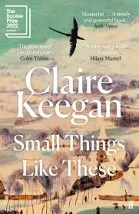
Small Things Like These  – Claire Keegan (2021) 110 pages

Claire Keegan’s short story collection Antarctica was the only work of hers I had read, but I remembered being really impressed by it. When Small Things Like These got so much love in blogosphere I knew I needed to pick her up again. Thankfully the planets aligned and I found a copy of it in a charity shop the very month I was focussing on novellas 😊

Bill Furlong is a coal merchant who lives a quiet life with his wife and young daughters in a 1980s Irish town. However, there is something in his past that means Bill has a sense of being an outsider. Perhaps it is this that means his compassion for people who are finding life harder and are homeless or struggling to make ends meet, or may be self-medicating with alcohol, is in contrast to those around him.

“Some nights, Furlong lay there with Eileen going over small things like these. Other times, after a day of heavy lifting or being delayed by a puncture and getting soaked out on the road, he’d come home and eat his fill and fall into bed early, then wake in the night sensing Eileen, heavy in sleep, at his side – and there he’d lie with his mind going round in circles, agitating, before finally he’d have to go down and put the kettle on, for tea.”

There is a Magdalene laundry in the town, and events conspire so that Bill becomes aware of the horrors that are taking place, sanctioned by state and church. His wife voices the general attitude when she says:

“‘If you want to get on in life, there’s things you have to ignore, so you can keep on.’”

However for Bill it is not so easy. The revelation comes at a time when he is questioning the purpose of his life, the daily toils and the wider meaning. So it is understandable that he is the one to break out from the conspiracy of wilful ignorance and silence that allows the abuse to continue.

“What would life be like, he wondered, if they were given time to think and reflect over things? Might their lives be different or much the same – or would they just lose the run of themselves?”

There is no way that the physical and psychological torture of the laundries can be captured in a 110 page novella, if ever, although there a couple of very distressing scenes. But I don’t think this is Keegan’s point. Instead she uses our pre-existing knowledge of the laundries to focus on putting us in the position of an ordinary person at that time. She demonstrates why he might take action, and what he could lose by doing so. The ambiguous ending, not without hope but not suggesting that Bill will avoid devastation, doesn’t allow for easy resolution.

Keegan is asking the reader to consider: what would you do? How much will you stand for, and how much are you prepared to lose? Knowing that throughout history atrocities have taken place while societies looked away, it is a powerful and enduring challenge.

“It would be the easiest thing in the world to lose everything, Furlong knew.”

Novella a Day in May 2023 – No.21

“I feel I’m only going to write short stories and novellas from now on. Chekhov said, toward the end of his life, “Everything I read strikes me as not short enough.” And I agree.” Martin Amis

A Pelican at Blandings – PG Wodehouse (1969) 192 pages

After the destabilised plots, shifting characterisation and unanswered questions of Untold Night and Day yesterday, a very silly, plot-driven novella today, where everything is tied up neatly at the end.

PG Wodehouse needs no introduction and while I would say A Pelican at Blandings is not him on top form, spending a few hours with a middling Wodehouse is still an absolute joy and time well spent.

Poor Lord Emsworth just wants to be left alone with his pig, the Empress. She has refused a potato which is causing her doting owner a great deal of distress. Unfortunately people always seem to be insisting on joining him at Blandings Castle.

“She left the room, and Lord Emsworth sank back in his chair looking like the good old man in some melodrama of Victorian days whose mortgage the villain has just foreclosed. He felt none of the gentle glow he was accustomed to feel when one of his sisters removed herself from his presence.”

Lady Constance is back at Blandings Castle with a woman named Vanessa Polk in tow. What’s more, she has invited horrible Lord Alaric and his niece Linda Gilpin to stay there too. She has plans to marry Vanessa to Alaric. Lord Emsworth decides this is a bridge too far, and this is before he knows Alaric has invited Wilbur Trout to stay. He calls on his aptly named brother Galahad, the Pelican Club member of the title, to rescue him.

Galahad wastes no time in telling Constance what he thinks of avaricious Alaric:

“’Are you telling me that that human walrus has fallen in love at first sight with Vanessa Polk?’

‘Alaric is not a human walrus.’

‘You criticise my use of the word human?’

Lady Constance swallowed twice, and was thus able to overcome a momentary urge to hit her brother over the head with the glass vase containing gladioli. It is one of the tragedies of advancing age that the simple reactions of childhood have to be curbed.”

Meanwhile one of Galahad’s numerous godsons, bestowed on him by Pelican Club members, Johnny Halliday, is in love with Linda Gilpin but they are currently estranged.

There are also some shenanigans with a plan to steal a picture:

“It’s a thing that must be done at dead of night, the deader the better. We must arrange a rendezvous. Where can we meet? Not in the ruined chapel, because there isn’t a ruined chapel.”

Lacking a Jeeves (although I’m very fond of the butler Beach), thank goodness Lord Emsworth has Galahad! Will he stop Constance’s terrible matchmaking, sort out the picture theft, reunite his godson with his betrothed, and bring some peace to his benighted brother’s life?

Of course he will.

“’Clarence has an amazing story to relate. Relate your amazing story, Clarence.’

‘Er,’ said Lord Emsworth.

‘That’s not all there is of it.’ Gally assured the Duke. ‘There’s a lot more, and the dramatic interest mounts steadily as it goes on.’

Novella a Day in May 2023 – No.20

Untold Night and Day – Bae Suah (2013 trans. Deborah Smith 2020) 152 pages

When I see writing described as dreamlike, I often think of highly metaphorical language, perhaps with a heavy emphasis on sensory experience, and with an unreal quality. Untold Night and Day is definitely dreamlike, but not quite in the ways I’ve described.

It initially seems very much grounded in everyday experiences. Where it becomes dreamlike is that it follows its own logic, jumping about with recurring motifs, in a way that makes sense within itself but becomes more disconcerting the more you consider it.

“A man carrying a kitten in a birdcage pressed himself against the opposite wall of the alley to avoid her car. He was a preacher, a well-known figure in this alley; he went around surreptitiously stuffing pieces of paper bearing Bible verses into people’s pockets, so he’d been mistaken for a pickpocket and arrested more than once. While she waited for the lights to change at the end of the alley, the woman driving the green car took her hand off the wheel and raised a bottle of water to her lips. Still with the phone to her ear. Against the regular growl of the engine, the hum of the air conditioning.”

These images and characters recur throughout the novella, each time with their context slightly shifted. There are other repeated motifs, including to The Blind Owl, a deeply disturbing novella which I read back in 2019. The shifting repetitions unsettle the story but also ground it in its own world.

Ayami is a former actor who works at an audio theatre. We join her at the end of her last shift, in the oppressive heat of Seoul, where through the night she and her boss search for their missing friend Yeoni. The following day, she shows round a German writer who never wanted to be in Korea in the first place.

The two times echo each other and almost merge, but whenever the narrative almost seems on the verge of entirely disintegrating, it holds on to that interior logic and somehow pulls you along, trying to work out what is happening and where Yeoni could be.

“That was the secret of night and day existing simultaneously. Ayami discovered this through a single movement, bending down to pick up the pebble. And, remembering this simultaneous existence more vividly than she remembered herself, became unable to remember anything else.”

I realise this may be an entirely unhelpful review as I’ve not really said very much! But hopefully I’ve given a sense of why this novella is hard to describe and hard to review. I enjoyed it, but definitely not one to read when you’re in the mood for a linear plot and all questions answered at the end…

“I have to record whatever comes into my head in the same place it happens. Things occur to me as images, and as forms, not as words arranged into sentences. The images quickly dissipate after the moment’s passed, and once that happens there’s no way for me to capture them in language.”

Novella a Day in May 2023 – No.19

Operation Heartbreak – Duff Cooper (1950) 155 pages

Operation Heartbreak is one of the few Persephone Books reprints written by a man, Duff Cooper, who served in Churchill’s government during the war and was married to socialite Diana Cooper. It is Persephone No.51 and I would say the title is entirely apt.

It follows the story of Willie Maryngton, born on the first day of the last century, which makes him too young to fight in World War I and too old in World War II. This is the great tragedy of his life, as Willie is devoted to the army and longs more than anything to see active service.

Willie is nice, pleasant, popular, but he never quite grasps anything, whether it is other people’s motives, the wider political situation, or any sort of life for himself beyond the armed forces. He witnesses others do so, and has a vague idea of world affairs, but everything drifts by him.

“It seemed to be his fate, he sometimes thought, to be a soldier who never went to war, and a lover who never lay with his mistress.”

He is a man out of his time, with both wars and with his love of the cavalry. He remains stubbornly committed to his horses despite being told that warfare is becoming mechanised. There is nothing he can do, and so he does nothing.

“Willie minded little how heavy [casualties] were if he was in it, but how could he bear to sit at home, hoping that his brother officers would be killed so that he could take their place?”

It’s a very sad tale as a pleasant, decent man really has no agency in his life. He places all meaning external to himself, and as such finds that he is dependent on indifferent forces to validate his existence. As a result, he holds that existence lightly.

“’I’m alone in the world, hale and hearty, just the sort of cannon-fodder they ought to be looking for – and, and, oh Hamilton, for God’s sake tell me – have I got a chance?’

Hamilton replied, ‘Not an earthly.’”

Now, SPOILERS. I wouldn’t normally discuss the ending of a book but I’m going to here because it’s really hard to explain my experience of reading this without doing so. I’ll be as vague as I can, but skip the rest of this post if you don’t want to know and just please believe me that Operation Heartbreak is truly worth reading.

The end of the novel is based on the true story of Operation Mincemeat. It is a well-known event in World War II, adapted into the film The Man Who Never Was, among others. Willie finds himself playing a pivotal role in the affair, and his real-life counterpart remains unnamed to this day.

I find it really intriguing that Duff Cooper – intelligent, sociable, successful; a hard-drinking womaniser and gambler, at the centre of so much – chose to write the story of Willie Marynton, a man seemingly very different from himself. In doing so, he shows real compassion for Willie, and for the real-life person whose identity remains unknown. The ending he gives Willie is an act of great kindness, and of commemoration. This makes Operation Heartbreak immensely moving, both in the story it tells and in what the novella represents as an act of respectful remembrance.

To end, a trailer for the latest adaptation of the true story:

Novella a Day in May 2023 – No.18

In Love – Alfred Hayes (1953) 120 pages

This is the third novella in as many days that I approached with some reservations, so at least I can feel smug that I’m not letting my biases get in the way of exploring some interesting books 😀

The reason for my trepidation in approaching In Love was that I thought it could be a misogynistic self-indulgent justification of how upset a man is when the woman he objectifies in some way demands to be seen as an actual person. And it definitely did have moments of misogyny and self-justification, but these were recognised by the narrator so while I didn’t like him or his behaviour, I didn’t feel he was asking me to.

(There is domestic violence and sexual assault within the story – neither are portrayed in extended length and I don’t cover it here but I wanted to mention it so readers would know to avoid the novella if these are triggers for you.)

The novella is a monologue by a man almost forty, sitting in a bar talking to a pretty girl in her mid-twenties. He recounts the tale of his break-up with another woman, while she remains a silent interlocutor. (She’s clearly much more patient than I am. Or not listening.) There’s really not much more to In Love, but I found it pulled me along through its pacey, readable style and evocation of a particular time.

It’s a story between two nameless people who seem quite lost. They are both searching for something more, and for a while cling to one another despite knowing that it will not bring happiness.

“What have I done, he said, to be so unhappy, and yet not to be convinced that this unhappiness, which invests me like an atmosphere, is quite real or quite justified?”

He is a writer, quite successful but seemingly distanced and adrift from other people. She is younger than him, divorced from a man she married very young, and in New York having left her daughter at home with her parents. She lives in an area that scares her, in a flat she doesn’t tidy, and answers the door in an unwashed towelling robe:

“This house, the way she lived, was only a hasty arrangement, thrown together to cover a time in her life which she did not consider to important, and in which she did not feel any necessity for putting things into any sort of final order. The final order had not yet arrived; she was waiting for it to arrive.”

There is a strong materialist theme running through In Love whereby money is given great importance, but also recognised as not really bringing you what you most need. It’s a time of societal change: post-war, with gender roles shifting but before the contraceptive pill and the liberations of the 1960s. This compounds their uncertainty – both are searching or waiting for something without being able to name what it is. There is a yearning in both of them, that she at least believes might be filled by money.

She leaves the writer for someone much richer. He takes it badly, the break-up becomes truly destructive.

“I knew that she had wanted what I was not prepared to give her: the illusion that she was safe, the idea that she was protected. She had expected, being beautiful, the rewards of being beautiful; at least some of them; one wasn’t beautiful for nothing in a world which insisted that the most important thing for a girl to be was beautiful. Perhaps now, I thought, she would have some other things she imagined she wanted: the cocker spaniel, the nursery with the wallpaper that had little sailing boats on it and flying fish, the lawn with an automatic sprinkler, and somebody else to do the dishes.”

In Love definitely had the feel of Mad Men to it with the New York setting, the era, the attitudes and the somewhat nihilistic view. If you liked that series, then this novella is definitely worth your time.

“It was all like something in a bad movie, if they still did things like that even in the movies; but mostly it was like something in a bad life.”

Novella a Day in May 2023 – No.17

Count d’Orgel’s Ball – Raymond Radiguet (1924, trans. 1989 Annapaola Cancogni) 160 pages

Raymond Radiguet was only twenty when he died, having published two novels, of which Count d’Orgel’s Ball was the second, some poetry and a play. He had led a life that brought him into contact with the foremost artists of the day, including Picasso and his lover Jean Cocteau, who wrote the foreword to the NYRB Classics edition I read.

This made me a bit trepidatious in approaching this novella, wondering if it was a piece of juvenilia that wouldn’t have otherwise garnered much attention. But I shouldn’t be so ageist, because I really found a lot to enjoy in Count d’Orgel’s Ball.

It tells the story of a love triangle amongst the beautiful and privileged in the 1920s. Mahaut is from an old family, and desperate for love when she marries young:

“She recovered some of the freshness of her early childhood when, at eighteen, she married Count Anne d’Orgel, one of our country’s best names. She fell madly in love with her husband who, in return showed her much gratitude and the warmest friendship, which he himself took for love.”

She adores her sociable and brilliant husband, who is fairly harmless but entirely vacuous:

“Nobody knew the reason for his prestige or, at least, for his brilliant reputation. His name had little to do with it since talent comes first even amongst those who worship names.”

Into their world comes François de Séryeuse, a young man not entirely enthralled by the Count’s charm and prestige. This works in his favour and the three spend more and more time together.

“He [the Count] adopted people more than he made friends with them. In return, he demanded a lot. He wanted to lead the way, to be in control.”

The Count doesn’t sustain control though, as François and Mahaut fall in love. For me this was the weakest point of the novella. Radiguet is excellent at observing people and social situations; he is incisive regarding pretention and social mores. Where the story falters for me is in creating fully rounded characters and the emotional ties between them. But perhaps I’m being unfair, as Radiguet is describing a world filled with shallow and/or naïve people. He doesn’t view them as having great emotional depth:

“It would be safe to say that François’ ideas on love were ready made. But since he had made them himself, he believed they were cut to size. He did not realise he had cut them out of limp feelings.”

The writing style is fluid and often scathing. It’s so readable and entirely unflinching in its view of a particular part of society at a particular time.

I thought there were a few rough edges at points in Count D’Orgel’s Ball; a tendency to tell rather than show, and characters as vehicles for social satire rather than fully recognisable people. But these are little quibbles and having written this novella at nineteen, I can only wonder what Radiguet would have achieved had he lived longer.

“Happiness is like good health: one is not aware of it.”

Novella a Day in May 2023 – No.16

The War of the Worlds – HG Wells (1898) 180 pages

I hardly ever read sci-fi and if we discount dystopian fiction then I basically never read it at all. However, I enjoyed HG Wells’ Ann Veronica when I read it back in 2019, and said it had encouraged me to try his science fiction.  I then promptly ignored this impetus for four years 😀

One of the benefits of novellas is that you can dip your reading toe into stories you might not otherwise try, and probably if The War of the Worlds was 500 pages I would never have come to it, despite it being part of my Le Monde’s 100 Books of the Century Reading Challenge. At 180 pages it was much less intimidating, and I really enjoyed it.

It opens:

“No one would have believed in the last years of the nineteenth century that this world was being watched keenly and closely by intelligences greater than man’s and yet as mortal as his own; that as men busied themselves about their various concerns they were scrutinised and studied, perhaps almost as narrowly as a man with a microscope might scrutinise the transient creatures that swarm and multiply in a drop of water. With infinite complacency men went to and fro over this globe about their little affairs, serene in their assurance of their empire over matter.”

I thought that was a brilliant piece of scene-setting, balancing a huge unknown menace alongside the determinedly everyday. This is something Wells does throughout, firstly in the initial reactions to the invasion:

“I saw my neighbour gardening, chatted with him for a time, and then strolled in to breakfast. It was a most unexceptional morning. My neighbour was of opinion that the troops would be able to capture or to destroy the Martians during the day.”

And secondly in the geography of the novel. It particularly resonated with me as it was places I knew well, having been part of where I grew up. He chooses central and south London, but also a big focus on suburbs like Leatherhead, Chobham, Walton-on-Thames (which aren’t where I grew up but I know them well, being nearby). It seems they haven’t changed massively in 125 years and were still recognisable, the main difference seeming to be cars rather than horse and carts. He couldn’t have picked places any more settled, to throw the extraordinary Martian invasion into the sharpest relief. I thought it was a masterstroke.

He also manages to make the Martians truly terrifying without demonising them, which I wasn’t expecting at all. Despite knowing Wells’ progressive views, as a Victorian novel I expected some sense of moral superiority to be asserted, rather than a challenge to imperialism:

“And before we judge of them too harshly we must remember what ruthless and utter destruction our own species has wrought […] Are we such apostles of mercy as to complain if the Martians warred in the same spirit?”

If I’ve made this sound a very heavy read, it really isn’t. Wells manages to create a tense narrative while driving his political points home, but at the same time he has a fairly light touch and even some moments of levity:

“At the sight of the sea, Mrs. Elphinstone, in spite of the assurances of her sister-in-law, gave way to panic. She had never been out of England before, she would rather die than trust herself friendless in a foreign country, and so forth. She seemed, poor woman, to imagine that the French and the Martians might prove very similar.”

The War of the Worlds was a ripping yarn, succinctly told, with a social conscience. A great read.

Novella a Day in May 2023 – No.15

Nightwood – Djuna Barnes (1936) 153 pages

Nightwood was not at all what I was expecting. Having never read Djuna Barnes before I had no preconceptions, and the blurb on the back described it as ‘the lives of Americans and Europeans in Paris in the decadent Roaring Twenties’. Yes please! But that was not the novel I got.

What I did get was very striking, and an intriguing piece of writing. I would describe it as a series of interconnected portraits and musings, very much in the modernist style. The characters are barely more than sketches, the plot is there but almost needn’t be. Instead we have glimpses, shattered shards that belong together but are as much about the gaps between them as trying to piece them all together.

Baron Felix has a background of secrets and lies. He falls in love with Robin and they have a child together, but she is constantly abstracted, given to disappearing for days on end:

“Felix found her presence painful, and yet a happiness. Thinking of her, visualizing her, was an extreme act of the will to recall her after she had gone, however, was as easy as the recollection of a sensation of beauty, without its details.”

Robin begins a long relationship with Nora Flood, an American who holds a salon, apparently based on the author:

“To ‘confess’ to her was an act even more secret than the communication provided by a priest. There was no ignominy in her; she recorded without reproach or accusation, being shorn of self reproach or self-accusation. This drew people to her and frightened them; they could neither insult nor hold anything against her, though it embittered them to have to take back injustice that in her found no foothold. In court she would have been impossible; no one would have been hanged, reproached or forgiven, because no one would have been ‘accused’. The world and its history were to Nora like a ship in a bottle; she herself was outside and unidentified, endlessly embroiled in a preoccupation without a problem.”

They are split up through Robin’s involvement with Jenny Petherbridge:

“She had a fancy for tiny ivory or jade elephants; she said they were luck; she left a trail of tiny elephants wherever she went; and she went hurriedly and gasping.”

Nora becomes the interlocutor for Dr Matthew-Mighty-grain-of-salt-Dante-O’Connor, who likes a drink and to lecture. There are long passages of discourse and the tone, voices and style reminded me at various points of Joyce, Eliot and Brecht. But Nightwood is definitely its own world too, and Barnes voice is strong and individual, and not trying to be anyone else.

I would definitely re-read Nightwood now I feel more prepared for it rather than expecting a more traditional prose novella. It’s one of those pieces with striking images or phrases that stay with you, independent of the story. I have a collection of Barnes short stories in the TBR somewhere and I’m definitely encouraged to dig them out, as I think her style will suit that form really well.

“None of us suffers as much as we should, or loves as much as we say. Love is the first lie; wisdom the last.”