Novella a Day in May 2023 – No.14

Moonstone: the boy who never was – Sjón (2013 trans. Vicotoria Cribb 2016) 144 pages

I really loved Sjón’s novella The Blue Fox when I read it back in 2016, and since then I’ve failed to pick up anything by him at all. Moonstone was good choice for a return as I found this novella lyrical and involving.  

(I should warn anyone picking up this novella that it opens with a very explicit scene, and given that one of the characters is referred to as ‘the boy’ I thought I’d been plunged straight into the details of a sexual assault. Thankfully that was not the case.)

Máni Steinn Karlsson is living in Iceland in 1918, a time of profound change. The Katla volcano erupts:

The volcano is painting the night sky every shade of red, from scarlet through violet to crimson, before exploding the canvas with flares of bonfire yellow and gaseous blue.

The influenza epidemic takes hold:

“The young people glance around, and only now does it dawn on them how many members of the audience have been taken ill: every other face is chalk-white; lips are blue, foreheads glazed with sweat, nostrils red, eyes sunken and wet. Silence falls on the gathering.”

and Iceland votes to be independent from Denmark.

Máni is an outsider, raised by a foster mother, isolated at school and gay at a time when this was illegal in Iceland. He escapes to the cinema, and through this new medium become fixated with Sóla G, a young girl around his own age:

“It was when the girl stood up to leave that it happened. The instant her shadow fell on the screen they merged – she and the character in the film. She looked around and the beam of light projected Musidora’s features onto her own.

The boy froze in his seat. They were identical.”

As Máni carries on with his life through these extraordinary circumstances, he is brought closer to Sóla G and to the dangers of living in ways that society deems unacceptable, the least of which is his love of cinema.

Sjón’s writing is crystal clear and beautifully evocative. He balances reality and fantasy with delicate precision, each blending into the other, without ever losing his characters or the impact of his story. [Slight spoiler in the next sentence, please skip if you prefer!] The metaphysical ending may not be to everyone’s taste but I thought it worked perfectly and found it truly moving.

“He’d had no inkling that when the pestilence took hold Reykjavík would empty and convey the impression that nothing was happening at all; that the town would become an abandoned set that he Máni Steinn could envisage as the backdrop for whatever sensational plot he cared to devise, or, more accurately, for the kind of sinister events that in a film would be staged in this sort of village of the damned – for these days the real stories of being acted out behind closed doors. And they are darker than a youthful mind can begin to imagine.”

Novella a Day in May 2023 – No.13

Lost Profile – Françoise Sagan (1974 trans. Joanna Kilmartin 1976) 142 pages

This novella follows a young woman, Josée, as she leaves her abusive husband Alan and is drawn into the orbit of the controlling Julius A.Cram, all within the social sphere of incredibly rich Parisian socialites.  

Sagan has very little time for this echelon of society:

“We talked of this and that, in other words nothing, with the tact that characterises well-bred people once they are at table. It seems that it only takes a knife, a fork, a plate and the appearance of the first course to induce a kind of discretion.”

Josée does very little at the start of the novel and seems to drift around, content to be entirely idle, which makes her vulnerable. She blames herself for her husband’s abuse and then in leaving him finds herself controlled by another man, albeit in a very different way. Julius is an enigmatic character who also seems to operate on the periphery of their social set. Both are lonely in their way, and the people they pass time with are entirely self-involved, so with the exception of her friend Didier, there is no-one to warn Josée of the danger she is in.

“It was an idiosyncrasy common to each individual member of that little set to refer to all the rest as ‘the others’, as though he or she were a paragon of virtue and a superior intelligence who had strayed into a bunch of contemptible socialites.”

As Josée tries to get her life together, the reader has greater awareness than she does herself. We can what is happening in her circumstances that she remains blissfully unaware of, and we can see how these circumstances will play out. She is incisive and clearsighted regarding others, but not remotely self-reflective:

“They were an amiable couple, great friends of Irène Debout, who, having exiled themselves far from Paris out of a grotesque affectation for the simple life, spent their time when they came to the capital, roughly 100 times a year, extolling the charms of solitude. They lived for their weekend house parties.”

Lost Profile is a slight tale, but I always enjoy Sagan’s writing. This was mainly enjoyable for the bitchy portraits of the rich and idle – a quick read, just the right length for the subject matter.

“Perhaps, one day, I too would reach the point of being able to tolerate only a sort of carbon copy of myself, black and white, colourless and spineless. Ah yes, the time would come when I would bicycle without ever leaving my bathroom, chewing pills the while to send my feelings to sleep. Muscled legs and flabby heart, a serene face and a dead soul.”

I’ve mentioned before the terrible 1970s/early 80s Penguin covers for Sagan’s work, and this one is no exception:

Novella a Day in May 2023 – No.12

A Simple Tale – Claire Messud (2001) 92 pages

A Simple Tale is the first of two novellas collected under the title The Hunters. It’s my first experience of Claire Messud’s writing and it has definitely made me keen to explore her further.

The tale is that of Maria, a Ukrainian refugee who was taken to the labour camps during the Second World War, before escaping to Canada. Once there, she worked for various people as domestic help, and in her old age there is only one client left:

“The old woman, her fluffed hair pressed flat at the side of her head, her ravaged hands fumbling with the blankets, hauled herself up and swung her feet to the floor. The bed was high – it was Mrs Ellington’s marriage bed – and Mrs Ellington was small: her feet dangled a few inches above the carpet, sweeping, like divining rods, in search of her slippers. Maria bent and slid the pink mules one at a time over Mrs Ellington’s scaly insteps.”

We learn of how Maria and her husband Lev built a new life with their son Radek, who wants to be known as Rod. It is a reminder that no-one’s tale is simple and you never know what someone carried with them:

“She marvelled, too, that no visible mark of her own life was apparent upon her (excepting, perhaps, her silver incisors; but she did not, at such events, have any call to reveal them), that these men and women could not smell, from her olive skin, the stink of the camps (of camp upon camp) nor detect the ache of nights spent in German ditches.”

It’s also a tale of the silences and misunderstandings between generations, compounded by the traumas of war. Maria cannot understand her son’s choice of wife and he cannot understand her relentless drive to be busy, and for domestic order and cleanliness:

“It delighted her to think that she passed through the house with as little disturbance as Lev’s ghost. It was a complex satisfaction: that of not wasting, to be sure, the satisfaction bred into her in her parents cabbage-scented cottage in far away Gulyaypole; but also that of keeping safe, untainted, the life, the permanence, that she and Lev had built together over their Canadian years.”

A Simple Tale is not a sad one despite the realities it portrays. It is a tale of resilience and endurance and of indomitability, particularly of women. It is about aging and acceptance, and of sisterhood – unasked for, unexpected, but there all the same. I really loved it.  

“In their different ways, Maria realised, both she and Mrs Ellington will becoming invisible. And perhaps, then, she decided, although not without a grim sense of resignation, they would doomed to each other, perhaps that was the truth: bound, in spite of themselves, to illuminate one another and to help each other to cast some semblance of a shadow.”

Novella a Day in May 2023 – No.11

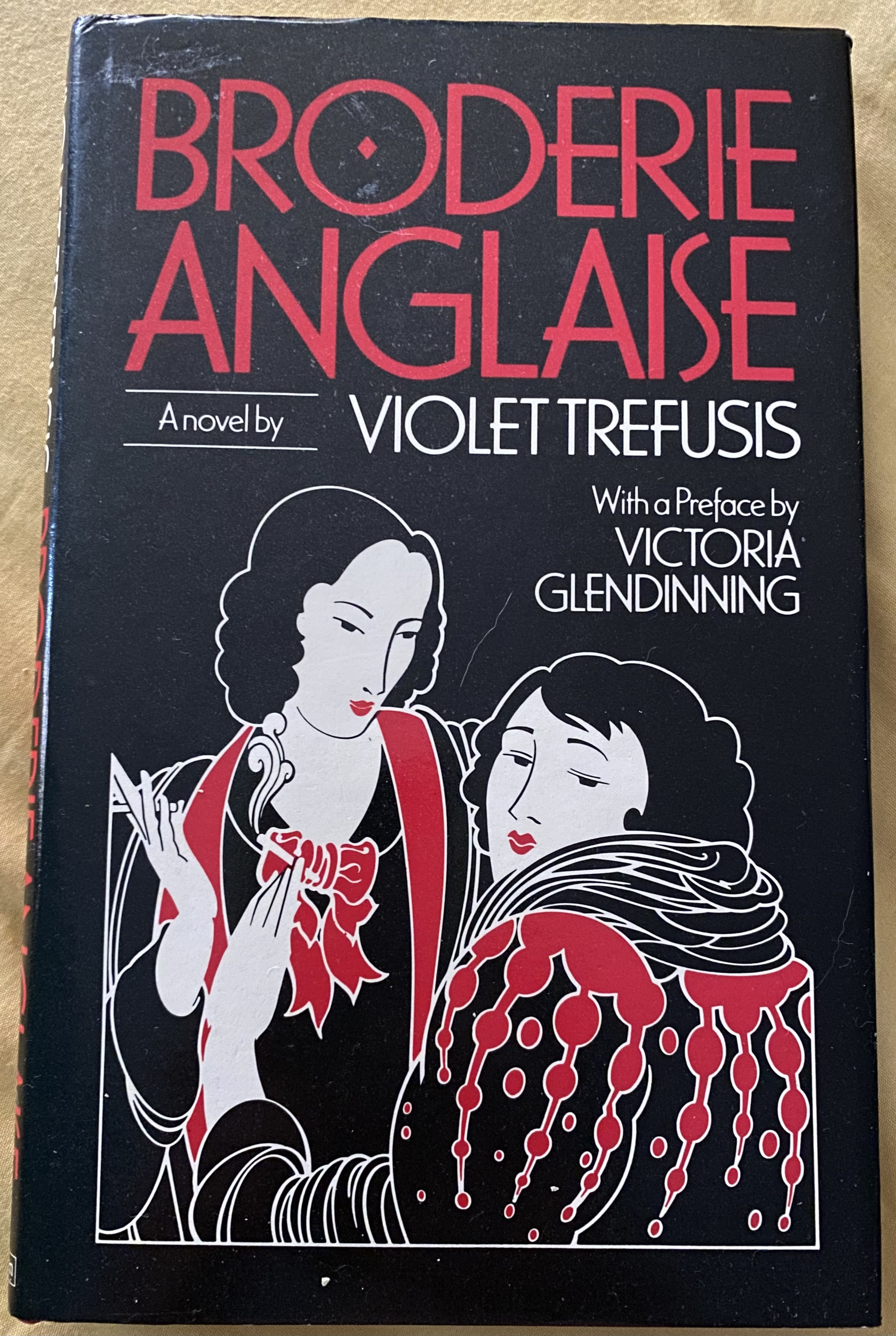
Broderie Anglaise – Violet Trefusis (1935 trans. Harcourt Brace Jovanovich Inc. 1985) 120 pages

My main reason for picking up Broderie Anglaise was an interest in Violet Trefusis because of her links to Vita Sackville-West, and through her, Virginia Woolf, rather than the novella itself. Although I did enjoy Hunt the Slipper when I read it a few years ago, I was primarily interested to see the characters of Vita and Virginia as conjured in this novella, and the portrait of Knole, Vita’s ancestral home.

Alexa is a celebrated English writer (no prizes for guessing who she represents) who is having an affair with Lord Shorne (Vita). Casting a long shadow over their liaison is his broken heart from a relationship with Anne, a distant cousin (Violet).

“He said to himself that this was exactly the companion he needed – humane and sympathetic and at the same time rather sexless.”

It’s worth noting that Broderie Anglaise was published in French and only translated for the Anglophone market in 1985. Victoria Glendinning says in her preface to this edition that she doesn’t think Vita or Virginia were aware of the novella’s existence. So although the portraits can be quite acidic at times, it’s definitely an easier read knowing that no-one they represented ever read them.

It’s difficult to convey the mind of a genius when you are not a genius. Trefusis wisely glosses over Alexa’s writing and sticks to her anxieties around her affair, and more mundane concerns:

“Alexa went and sat by the window, at the mercy of the light, now no one else was there. A sluggish drizzle was falling. She looked up at the sky. Its full, baroque clouds were like a gathering of Marlborough’s contemporaries – all scrolls and whorls, from their wigs to their shoes. The sky’s not very imaginative, she thought, it always reminds me of something.”

The first part of the novella is Alexa’s anticipation of meeting Anne, when a mutual (oblivious) friend arranges a meeting. She reflects on her affair with John and what little she knows of Anne. The affair is not romanticised; it’s treated with some degree of irony and humour.

“Arm in arm they went up the slippery staircase that led to the state apartments. Alexa supported him. He was the Lord, the ravisher. She was about to become his mistress. They had to go through eight drawing rooms in all – a long way for a couple who had been drinking.”

Violet definitely doesn’t idolise either Vita or herself in the character of Anne. I felt she treated all three as flawed people, struggling to understand the circumstances they found themselves in.

Where she did portray a monstrous person was in the character of Lady Shorne (Lady Sackville). Controlling, intrusive, inappropriate, surrounding herself with trappings – she was truly malevolent.

“The tiny room, cluttered with carefully illuminated pieces of amber, each one lit up from within by its own mocking flame; her hostess, sitting motionless like a big spider in the middle of her web – all combined to make Alexa ill at ease.”

Broderie Anglaise is slight, but it’s definitely worth a read, particularly for those with an interest in Woolf/VSW. The portrait of Lord Shorne’s home Otterways has echoes of Orlando’s estate, being as they are both portraits of Knole. It’s also interesting to see how the Russian Princess of Orlando (Violet) chose to portray herself given a chance. She can be a witty and precise observer:

“‘I use up all my vital force in my books. There’s nothing left over for life,’ she suggested, with the famous touching smile which was so admired in the literary world but which John found exasperating because it was to be seen in all her photographs.”

Ultimately I felt Violet wasn’t overly settling scores here, but rather making a plea for not idolising lovers, even when they are from glamorous families, or are the foremost writer of their generation. She suggests that truly seeing people and situations may be painful, but it is really the only way towards enduring and authentic relationships.

Although she does use a play on words at the end to give herself the final say. And why not, it’s her novella after all 😀

“This was just the sort of thing that irritated him most. She was sentimental when she should have been satirical, obstinate when she should have been amenable.”

Novella a Day in May 2023 – No.10

Strange Hotel  – Eimear McBride (2020) 149 pages

Another day, another novella about hotels 😊

This is slightly odd review, because what I think works about this novella is also why I have reservations about recommending it. But it absolutely worked for me, so I decided to include it when I only write about books I recommend.

Eimear McBride writes stream of consciousness novels. I’m fine with this style but I know it’s really off-putting for lots of people. If you are one of those but were thinking of giving McBride a try, I would say this is not the place to start. Strange Hotel doesn’t have the verve of A Girl is a Half-Formed Thing or The Lesser Bohemians. But these disclaimers aside, here is why I think it worked.

I would say Strange Hotel is a novel about grief. We follow an unnamed woman as she checks into hotels in Avignon, Prague, Oslo, Auckland and Austin. We never know why she is in any of these places. She drinks too easily and she sleeps with men she does not want to see again.

“Times have changed, she notes, as is her wont on those occasions of which, of late, there have been more than a few. Another unzipped bag, in another uninteresting hotel room, upon which she stares indifferently down at the folded clothes, or the shampoo congealing into them if she’s been unlucky which, on this occasion, she has not.”

She has a list of places she is working through, possibly as some sort of pilgrimage, possibly not.

She is both articulate and inarticulate, and the reader has to try and piece together what is going on for her. It’s not easy, and in that sense we are very much in the place she finds herself:

“Why is the world always such work? It’s harder to let the words into her body now or, maybe, out. They used to form and reform themselves in order to dole out whatever she had in mind, whatever meanings her body inclined to make them make. Now, they barely carry meaning beyond the literal wattle and daub. This does, occasionally, make her wistful for the savagery of before when, beholden to no one, the words did whatever they pleased. She wouldn’t mind going back to that.”

A lot of my job is concerned with grief and bereavement and I’ve recently experienced a personal bereavement. I think Strange Hotel brilliantly captures the disorientation, the unreality, the betweenness, the holding pattern of grief.

Hotels are a perfect setting for this theme, and stream of consciousness is the perfect style. The formality in tone that wasn’t apparent in McBride’s previous novels also captures the detachment and default behaviour the bereaved can find themselves experiencing.

I read Strange Hotel at exactly the right time, there was a lot that resonated. McBride is brilliant at what she does and she uses a difficult style expertly.

“The solitary purpose of keeping the world at the far end of a very long sentence.”

Novella a Day in May 2023 – No.9

The Hotel – Elizabeth Bowen (1927) 175 pages

The Hotel ticks a lot of boxes for me: interwar setting, repressed Brits abroad, characters thrown together through transient living arrangements, and of course novella length. My concern was that it’s Elizabeth Bowen’s debut novel and her prose can be pretty impenetrable at the best of times, let alone when she’s still honing her craft. However that proved unfounded as I found this an easier read by Bowen standards – I really enjoyed it.

The titular institution is located on the Italian riviera and is filled with genteel Brits, mainly women. The novel opens with the fallout from a row between two perfect examples of such: the companions Miss Pym and Miss Fitzgerald. The former ends up walking to tennis courts with Mrs Kerr, quite a coup as Mrs Kerr holds all the power among the hotel residents. The reasons for her occupying this elevated position are never quite clear, but her absolute self-assurance and manipulativeness surely contribute.

Mrs Kerr is looking for Sydney Warren, a beautiful, studious young woman whose family are worried about her. Sydney has come away with her cousin Tessa Bellamy, who has a vague malady:  

“She was distressed by any suggestion of impermanence; she was a lonely woman. One had to have Something in one’s life. She lay on a velvet sofa in her bedroom with the head pulled round away from the window and wished that she were religious woman and that it would be time for lunch and that Sydney would soon come in.”

The start of the novel is full of these pithy sketches of the residents. I especially enjoyed the elderly sisters-in-law Mrs and Miss Pinkerton:

“They were more closely allied to one another in the memory of Edward’s than they had either of them been to Edward himself…. Cherished little animosities reinforced their ties to one another; Rosina maintained to herself implacably that if she had been Edward’s wife she would have borne him children; Louisa was aware enough of this to be a little markedly generous to Rosina, who was not in a position to refuse anything that might be offered.”

They are hugely affronted by the arrival of an Anglican clergyman, James Milton, who unwittingly uses their reserved bathroom. Bowen is a brilliant observer of the manners and social customs of the hotel, treating it all with a wry affection:

“Beyond, down the long perspective to the foot of the stairs, one could see visitors take form with blank faces, then compose themselves for an entrance. Some who thought punctuality rather suburban would gaze into the unfilled immensity of the room for a moment, then vanish repelled. Others would advance swimmingly and talk from table to table across the emptiness, familiarly, like a party of pioneers. Men came in without their wives and did not always look up when these entered. Women appearing before their husbands remained alert, gazed into an opposite space resentfully, and ate with an air of temporising off the tips of their forks.”

Romantic relationships are treated with a great deal of scepticism in the novel: the pretty Lawrence sisters look to make pragmatic marriages; Mrs Lee-Mitterson panders to her ridiculous self-centred husband; it’s mentioned more than once how incompatible men and women are. It wouldn’t be a stretch at all to take a queer theory reading to many of the relationships in The Hotel, and it could also be read as demonstrating the value and endurance of platonic friendship.

The early character sketches and scene setting of The Hotel were completely wonderful, but for me the novella didn’t quite live up to this initial promise.  I was drawn into the various relationships and shifting allegiances, and the disarray caused by the arrival of Mrs Kerr’s much anticipated, determinedly aloof son Ronald was very enjoyable.  I think what stopped me unreservedly loving this was that I did find the characters ultimately quite distancing – Sydney Warren is meant to be reserved and a bit cold but I felt this distance as a reader too.

But still there was so much to enjoy and I found it a real treat.

“Notwithstanding the slight sense of degeneracy induced by reading novels before luncheon she had been enjoying Jude the Obscure.”

Novella a Day in May 2023 – No.8

August is a Wicked Month  – Edna O’Brien (1965) 

Many, many years ago, decades even, when I was a sixth-former (that’s Year 12, kids) my English teacher gave out a list of suggested reading for A levels. Somewhat surprisingly, I didn’t finish it entirely (although just in case that seems worryingly off-brand, I should say my name still went round to the teachers on a list as the pupil who borrowed most library books that year) and I can remember the few that escaped me. One was August is a Wicked Month, and having read it now I’m a bit surprised it was on a sixth-form reading list. Because it is explicit. But it’s also very realistic so maybe my teachers thought it was responsible reading 😀

Ellen is in her late twenties and her ex-husband has taken their son camping. Ellen is not good at being alone and managing feelings:

‘I’ll just be,’ she said. A rare thing for her, racked as she was with anxiety, wondering always what would happen next, if an affair would be eternal, or if she loved her son over much, or if the wheels of a car they sat in would fly off and leave them half dead on the roadside.

So she decides to go to the south of France for sun and anonymous sex:

“She had been brought up to believe in punishment; sin in a field and the long awful spell in the Magdalen laundry scrubbing it out, down on her knees getting cleansed. She longed to be free and young and naked with all the men in the world making love to her, all at once. Was that why he ran?”

Written in 1965, this is not a tale of the joys of sexual liberation and freedom. Despite the setting, the tale is not glamorous. Ellen falls in with a crowd that includes a film star, but its all lonely and sad and isolating. She may as well have stayed away,

“She wanted to go home, not to London to the pipes of light but home to the race to which she belonged: and then she shivered uncontrollably, knowing that their thoughts were no longer hers. She had vanished back into childhood and the dark springs of her terrors.”

Everything Ellen does seems a misstep but not comically so. Her confused interactions with people, failed flirtations and disappointing sex just serve to highlight the inadequacy of human communication and the tendency to look for solace in precisely the wrong places.

This was the first Edna O’Brien I’ve read and I thought her writing was wonderful. She has a way of building images in a way that is so startling and disconcerting, but recognisable:

“Yellow all around, the lemons in the trees like lobes of light, the odd lit bulb, and his face yellow like parchment, from age. His blue eyes were not dead but were something worse. They had the sick look of eyes that will wounded and for whom death would be a relief.”

She can also be incredibly spiky and unforgiving:

“Her hands were long and white and soft. Hands into which cream and money had been poured and unlike the face they were able to be beautiful without showing the umbrage of the unloved.”

The only misstep for me was an event towards the end that seemed unnecessarily dramatic and as if there wasn’t enough faith in Ellen’s story as it stood to carry the novella. But a minor quibble overall – I’ll definitely be seeking out the Country Girls trilogy after this.

Novella a Day in May 2023 – No.7

A Sunday in Ville-d’Avray – Dominique Barbéris (2019, trans. John Cullen 2021) 152 pages

For the first Sunday of this month of novella reading, a novella set on a Sunday! I was alerted to A Sunday in Ville-d’Avray by Jacqui’s excellent review and so I was delighted when I came across a copy in my local marvellous charity bookshop.

“On Sundays, you think about life.”

The narrator (referred to as Jane on the French flap blurb although I don’t remember her being named in the text) goes to visit her sister in the Parisian suburb of Ville d’Avray for the afternoon. The sisters have intermittent contact and Jane’s urbanite boyfriend Luc seems to have an ambiguous relationship with both his in-laws and the suburbs. For this visit she is alone:

“And so I was full of memories, I was in the melancholy state of mind that often comes over me when I go to see my sister, and I think I started by getting a little lost in Ville d’Avray, by driving through the provincial, peaceful streets of my sister’s neighbourhood, past private houses their gleaming bay windows, their porches, their phony airs (Art Deco villa, Norman country house), their gardens planted with rosebushes and cedars.”

Nothing really happens, and yet the afternoon is full of significance. The sisters sit out in the autumn afternoon and Claire Marie recounts a chaste affair with a man called Marc Hermann. He has both a mysterious past and present:

“She was almost sure that he was lying to her about a great many things, but she felt certain that he was alone and that his solitude was complete, so dense that she could perceive the space it occupied around him, and that solitude touched her heart.”

It is the atmosphere rather than the plot that gives this novella its power. It captures perfectly that quiet, subdued feeling of a Sunday afternoon, anticipating the activity of the week ahead. There is also an unsettling quality to it: the fading light as the sisters sit, the repeated references to the forests that surround the suburb where Claire Marie and Marc would walk; the fear of burglars and invasion.

Jane is at once the first-person narrator and the silent interlocutor. This is a novella of liminal spaces: temporal, geographical and psychological. Barbéris expertly holds the reader between these spaces in the story, destabilising the narrative.  Nothing overt is said or done, but gradually there is a sense of not trusting what we are being told. But should Jane not trust Claire Marie or should the reader not trust the narrator?

I’m sure the atmosphere of this novella will stay with me. A perfect Sunday afternoon read.

“Ever since the neighbour had mowed his lawn, the whole street smelled of cut grass. I don’t know why the smell of cut grass can give you such a feeling of sadness, and also such a violent desire to keep on living.”

Novella a Day in May 2023 – No.6

The White Bird Passes  – Jessie Kesson (1958) 159 pages

Last year I read a short story by Jessie Kesson and I was so impressed I really wanted to try more of her work. Luckily I saw her novella The White Bird Passes in my local charity shop and swooped in. I wasn’t disappointed.

Eight year-old Janie lives with her mother in Our Lady’s Lane, aptly named because this side street is full of matriarchs, including Poll Pyke, Battleaxe and The Duchess. They live in absolute poverty, hand to mouth, and yet the story isn’t depressing because Janie isn’t depressed. She loves living where she lives.

The novella is based on Jessie Kesson’s early life and it is beautifully balanced portrayal. It doesn’t shy away from the realities (suicide, sex work, disease and infestations) but these sit alongside love, humour, enjoyment.

“The Green was as much part of the Lane as the communal pump in the causeway. If you weren’t in the Lane you were ‘down at the Green’. There is no third alternative. Even if there had been, you would have been out of your mind to have chosen it in preference to the Green.

The summer through, the Greens chair-o-planes, whirling high, blistered with colour and blared with music. The Devil’s Own Din was how the sedate residents of Hill Terrace described it in protest to the Lord Provost and the Town Council, but to the Laners who were the true lovers of the Green it was music.”

It authentically captures characters and dialogue, without ever descending into caricature. At no point is there any authorial judgement on the way the characters are living, it is simply as it is.

“Janie never had to beg for her own needs. There were better ways of satisfying them. The surest way to get a penny was to scour the football grounds for empty beer bottles and sell them back to the beer shops at half rate. A fair bargain, since the bottles hadn’t belonged to you in the first place. More remunerating but less infallible, was to stand outside The Hole in the Wall on Saturday night, bump into the first drunk man you saw, weep loudly, pretending he had bumped into you. That was usually a sure threepence forced into your palm. Sometimes it was sixpence if the man was drunk enough. For her other needs, Janie confined herself to the dustbins in High Street.”

Janie’s mother Liza comes from a reasonably well-off family who view her as a disgrace. When Liza takes her for a visit, we get a glimpse of a life away from urban poverty.

“Janie wondered at her mother’s easy intimacy with this country; her quick recognition of the flowers in the woodworkers’ gardens, with names unheard of in the Lane; Snow in Summer, Dead Man’s Bells, Love in a Mist, Thyme, yellow St. John’s wort, pink star bramble-blossom. ‘There’s going to be a good crop of brambles the year.’ Liza cast an experienced eye over them. ‘We’ll need to come for a day in autumn for the bramble picking.’ They wouldn’t of course. But Janie had learned to enjoy the prospect more than the reality.”

Eventually the Cruelty Man catches up with Janie and enacts the local opinion that “the bairn would be better in a home.”

This part of the story is not given the same consideration by Kesson. Again, there is no judgement. You can see why Janie was taken away and how it can be both the right and wrong decision. But the state orphanage is not Kesson’s consideration in The White Bird Passes. The story belongs to the Lane and the women of the Lane, especially to Janie and Liza.

“But Liza had been beautiful, Janie remembered. Almost like Shelley said. Her beauty made the bright world dim. Not quite the same though. All the other women of the Lane had been grey. Prisoners clamped firmly into the dour pattern of its walls and cobblestones. But Liza had always leapt burnished, out of her surroundings. And in the leaping had made the dim world bright.”

Novella a Day in May 2023 – No.5

The Life and Death of Harriett Frean – May Sinclair (1922) 184 pages

I am very fond of Victorian novels. Those huge, sprawling tales of domestic realism suit me very well in the right mood. However, the heroines do have a tendency towards pious self-sacrificing virgins, whose superhuman goodness is rewarded in the end by a rich husband and/or massive legacy. So even while they profess a dedication to heavenly rewards, they can do so from the comfort of being hugely loaded in the earthly realm, alongside a hottie in a big white shirt (which admittedly does sound pretty appealing).

It is this premise that May Sinclair takes issue with in The Life and Death of Harriett Frean.

Early in the novel there is an example of how the child Harriett behaves in the way expected of little Victorian girls, and as a result does not get her needs met. The only reward is a sense of self-satisfaction:

“Being naughty was just that. Doing ugly things. Being good was being beautiful like Mamma. She wanted to be like her mother. Sitting up there and being good felt delicious.”

Sinclair shows how this conditioning is reinforced through insidious guilt-trips:

“Understand, Hatty, nothing is forbidden. We don’t forbid, because we trust you to do what we wish. To behave beautifully…”

And so Harriett grows up idolising her parents and never questioning whether this mode of behaviour is more about convenience for others than actually what is right.

Harriett’s biggest sacrifice is refusing to enter a relationship with the man engaged to her friend. It is this she consistently returns to, through a life that never truly sees or allows for others. Sinclair shows the vanity and self-centredness wrapped up in supposed self-effacement:

“When she thought of Robin and how she had given him up, she felt a thrill of pleasure in her beautiful behaviour, and a thrill of pride in remembering that he had loved her more than Priscilla.”

The Life and Death of Harriet Frean explores how this type of behaviour – inauthentic, fundamentally dishonest – can lead to unhappiness in big and small ways, from never having cutlets served how you prefer to destitution for some. But Harriett never really learns, sticking stubbornly to her frame of reference even as life repeatedly demonstrates the inadequacy of doing so and the damage that can be done.

For me the novella remained just the right side of didactic, but I think had it been longer it may have drifted into preachiness. As it was, it remained an interesting counterpoint to all those fictional Victorian heroines who may not have found things quite so clear-cut in real life.