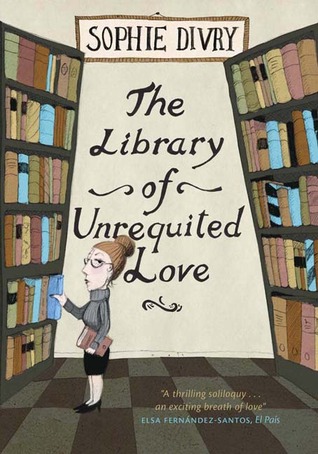
The Library of Unrequited Love – Sophie Divry (2010, trans. Sian Reynolds 2013) 92 pages
The Library of Unrequited Love by Sophie Divry is a monologue delivered by a librarian to a reader who she discovers has been locked in the library overnight, when she opens up in the morning. The librarian is middle-aged and frustrated about a plethora of things, including her job:
“Being a librarian isn’t an especially high-level job I can tell you. Pretty close to being in a factory. I’m a cultural assembly line worker.”
She is committed to librarianship however, and throughout the novella her love of books emerges, as does her appreciation of the Dewey decimal system:
“they didn’t just classify by author, they sometimes put books on the shelf by size, or date of acquisition. Now I think of it, the confusion it must have caused. Glad I didn’t live then, I couldn’t have put up with that kind of anarchy.”
The reader remains a silent interlocutor as the librarian spills out all her feelings. Although she claims she has given up on love, you get the sense this isn’t quite true:
“One of my favourite authors, you’ve already gathered that, is Guy de Maupassant. Now there’s a man for you. Just imagine, he wrote two hundred and ninety short stories and seven novels in ten years. And then on Sundays, he went rowing on the Seine. A real force of nature, eh? He must have had terrific biceps and been fantastically intelligent.”
There are also her unrequited feelings for a regular library reader:
“With that lovely neck of his. It would disappoint me if a man as clever as Martin were to be in love. But you have to be prepared for anything.”
The librarian is a funny and acerbic narrator:
“That’s another reason I don’t go travelling. Napoleon’s always been there first. I can’t stand it.”
She is slightly self-deceiving but she is also wise, sad, honest and above all, entertaining. I enjoyed my short time in her company, mostly because The Library of Unrequited Love is actually about a love that is always fulfilled, over and over: the love of books.
“Book and reader, if they meet up at the right moment in a person’s life, it can make sparks fly, set you alight, change your life.”
The Final Solution – Michael Chabon (2005, 127 pages)
An elderly once-famous detective has retired to Sussex to keep bees. Sound familiar? The detective is never identified by name, but it’s reasonable to assume he’s Sherlock Holmes.
“Even on a sultry afternoon lie this one, when cold and damp did not trouble the hinges of his skeleton, it could be a lengthy undertaking, done properly, to rise from his chair, negotiate the shifting piles of ancient-bachelor clutter – newspapers both cheap and of quality, trousers, bottles of salve and liver pills, learned annals and quarterlies, plates of crumbs – that made treacherous the crossing of his parlour, and open his front door to the world.”
Chabon is brilliant at capturing the frailties and fears of old age and fading faculties:
“The memory of the taste of scotch was in his mouth lie the smell of burning leaves lingering on a woollen scarf. But the cords that held him together were so few and threadbare that he feared to loosen them.”
“Over his bearing, his speech, the tweed suit and tatterdemalion Inverness there hung, like the odour of Turkish shag, all the vanished vigour and rectitude of the Empire.”
It is 1944, and the old man is asked to investigate the disappearance of a parrot, which has been reeling off lists of numbers of great interest to various shady persons. The parrot is the only friend of a mute Jewish boy, and shortly after it disappears a lodger at the same premises of the boy is found murdered.
The old man relishes the opportunity to use his much-lauded skills again. Yet while it is a mystery novella, this is not the main point of the story. Rather it is about how some things are so huge – wars, the Holocaust – they defy reason and straightforward explanation. Answers can be comforting, but sometimes they are not there to be found.
“A delicate, inexorable lattice of inferences began to assemble themselves, like a crystal, in the old man’s mind, shivering, catching in the glints and surmises. It was the deepest pleasure life could afford, this deductive crystallisation, the paroxysm of guesswork, and one that he had lived without for a terribly long time.”
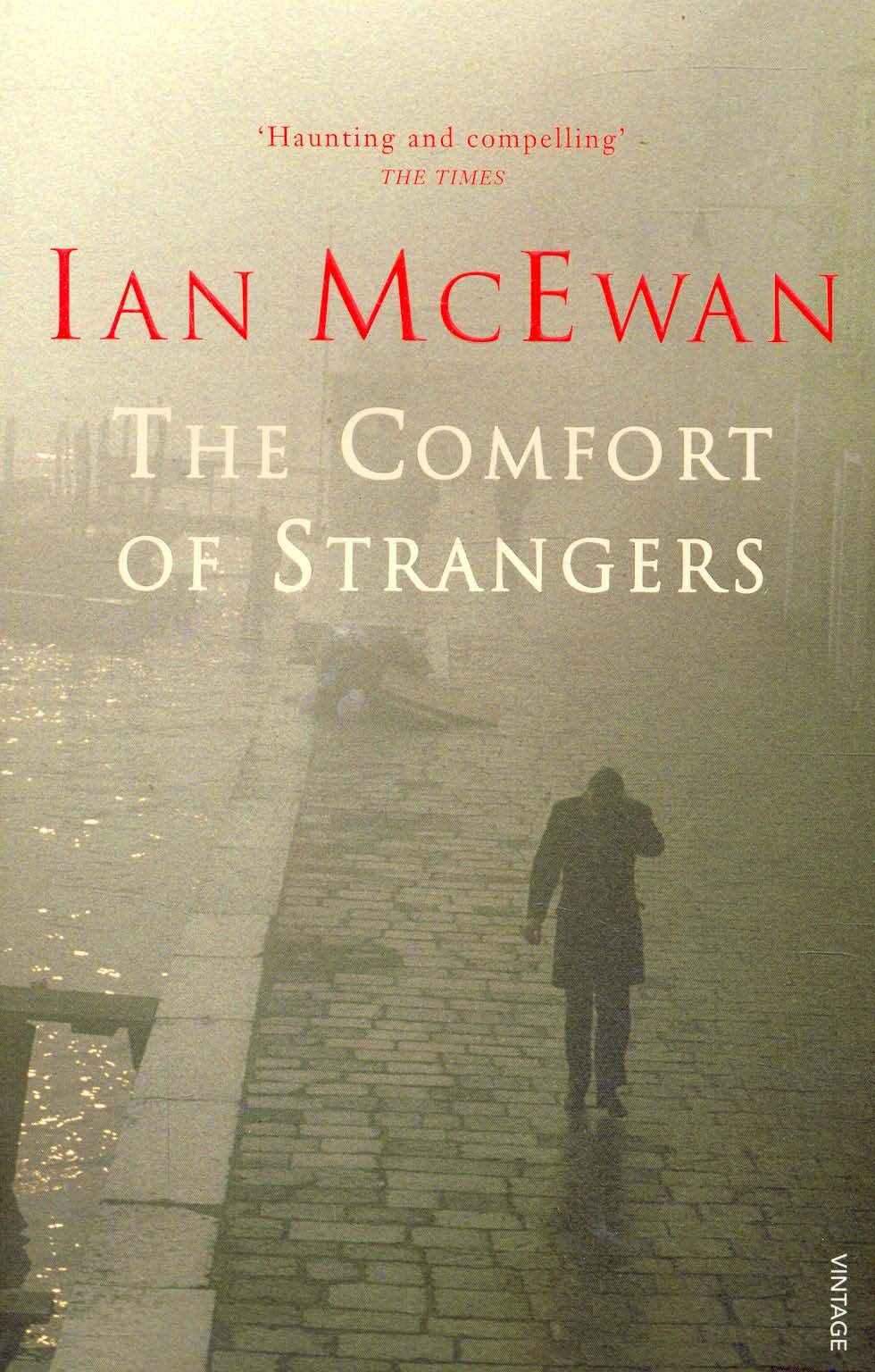
The Comfort of Strangers – Ian McEwan (1981, 100 pages)
The Comfort of Strangers was Ian McEwan’s second novel, and details a holiday taken by Colin and Mary in an unnamed European city (probably Venice).
They have been together for many years but do not live together. McEwan expertly establishes a couple who share a certain co-dependency and claustrophobia – at least during this holiday – but seem to lack intimacy.
“Colin stood in front of the mirror, listening, and for no particular reason began to shave for the second time that day. Since their arrival, they had established a well-ordered ritual of sleep, preceded on only one occasion by sex, and now the calm, self-obsessed interlude during which they carefully groomed themselves before their dinner-time stroll through the city. In this time of preparation, they moved slowly and rarely spoke. They used expensive, duty-free colognes and powders on their bodies, they chose their clothes meticulously and without consulting the other, as though somewhere among the thousands they were soon to join, there waited someone who cared how they appeared.”
They get lost that evening and are rescued by Robert, a forceful man who tells them a tale from his past. They end up staying with Robert and his wife Caroline in their villa, and the other couple’s relationship emerges as complex and disturbed.
“Caroline spoke cautiously, her face tensed as though she expected at any moment a loud explosion. ‘I hope you don’t mind, there’s something I should tell you. It’s only fair. You see, I came in and looked at you while you were sleeping. I sat on the trunk about half an hour. I hope you’re not angry.’
Mary swallowed and said, uncertainly, ‘No.’”
I can’t say more for fear of spoilers, but will say that McEwan’s considered, cool style lends itself well to a tense, dark tale.
The Comfort of Strangers was adapted into a film in 1990. Having viewed this trailer I’m not sure I’ll be watching it, but I do recommend the trailer itself which is hilarious, enjoy!
The Bookshop – Penelope Fitzgerald (1978) 123 pages
The Bookshop was Penelope Fitzgerald’s second novel (I reviewed her first here) and her first to be nominated for the Booker, which she later won with Offshore. It’s set in 1959 in the small Suffolk coastal town of Hardborough. This is not a picturesque seaside resort but a damp, isolated place:
“The town itself was an island between sea and river, muttering and drawing into itself as soon as it felt the cold.”
Florence Green decides to open a bookshop in Hardborough and buys The Old House, a 500 year old derelict property:
“The Old House was not haunted in a touching manner. It was infested with a poltergeist which, together with the damp and an unsolved question about the drains, partly accounted for the difficulty in selling the property. The house agent was in no way legally bound to mention the poltergeist, though perhaps he alluded to it in the phrase unusual period atmosphere.”
Florence is a lonely widow, but she is not a pushover. As the forces of the town (mainly Mrs Gamart who wants The Old House for an arts centre for no other reason it seems than she is bored and used to getting what she wants) conspire against her, she doesn’t give up. Astutely, she acquires several copies of a book she has never read by an author she has never heard of, Lolita by Vladimir Nabokov, and it causes quite the stir, raising much-needed profits for the shop.
She also has her allies. The reclusive Mr Brundish, proudly from an old Suffolk family, is on her side. Christine Gipping, an eleven year old with 2 broken front teeth, proves a tenacious keeper of Florence’s lending library and not easily put off by supernatural elements:
“Florence did not expect her assistant to return; but she came back the next afternoon, with the suggestion that if they had any more trouble they could both of them kneel down and say the Lord’s prayer. Her mother had advised that it would be a waste of time consulting the Vicar.”
The Bookshop is an absolute gem. The portraits of the inhabitants of Hardborough fully realised and idiosyncratic yet believable. The plot is simple but taut, the writing witty. Fitzgerald achieves a perfect balance of compassion without sentimentality.
“She had a kind heart, though that is not of much use when it comes to matters of self-preservation.”
The Panda Theory – Pascal Garnier (2008, trans. Gallic Books 2012, 143 pages)
This is the first Pascal Garnier I’ve read, and while I’ve heard he can be a bit read-one-read-them-all, I enjoyed this quick, noir read.
Gabriel arrives in a Breton town and begins to get to know the locals, without revealing very much about himself or why he is there.
“a completely nondescript town…the sea was far away, its presence unimaginable. There was nothing picturesque here.”
Jose owns the local bar and is struggling while his wife Marie is in hospital. Gabriel can cook and so takes on this domestic duty while Jose flounders.
“With his elbows on the table, Jose hoovered up his meal. The tomato sauce ran from the corners of his mouth, to his chin and down his neck. Like an ogre.”
Gabriel wins the titular stuffed toy on the shooting range at the fair, and gives it to Jose for his children, but it stays in the bar, its impassive gaze surveying the customers, arms outstretched.
Gabriel attracts the interest of lonely, cat-obsessed Madeleine, and befriends lonely drug-addict Rita.
“ ‘I love you, Gabriel. It’s stupid but it’s true.’
The blind man turned a corner. The sound of his stick gradually faded away before disappearing completely. The town lay still, bathing in dreams in which everybody was a hero. He had to sleep. Sleep.
‘I’m going back to the hotel, Madeleine. It’s late.’
She’d never been as beautiful as she was then. Much more beautiful than her geranium.”
Gradually we learn about Gabriel’s family and why his wife and children are no longer with him. It also emerges why he is in the town and what his purpose is. The Panda Theory doesn’t hold any great surprises but it’s a well-paced, atmospheric tale that builds effectively to its conclusion. I would happily read more by Garnier, even if it is more of the same.
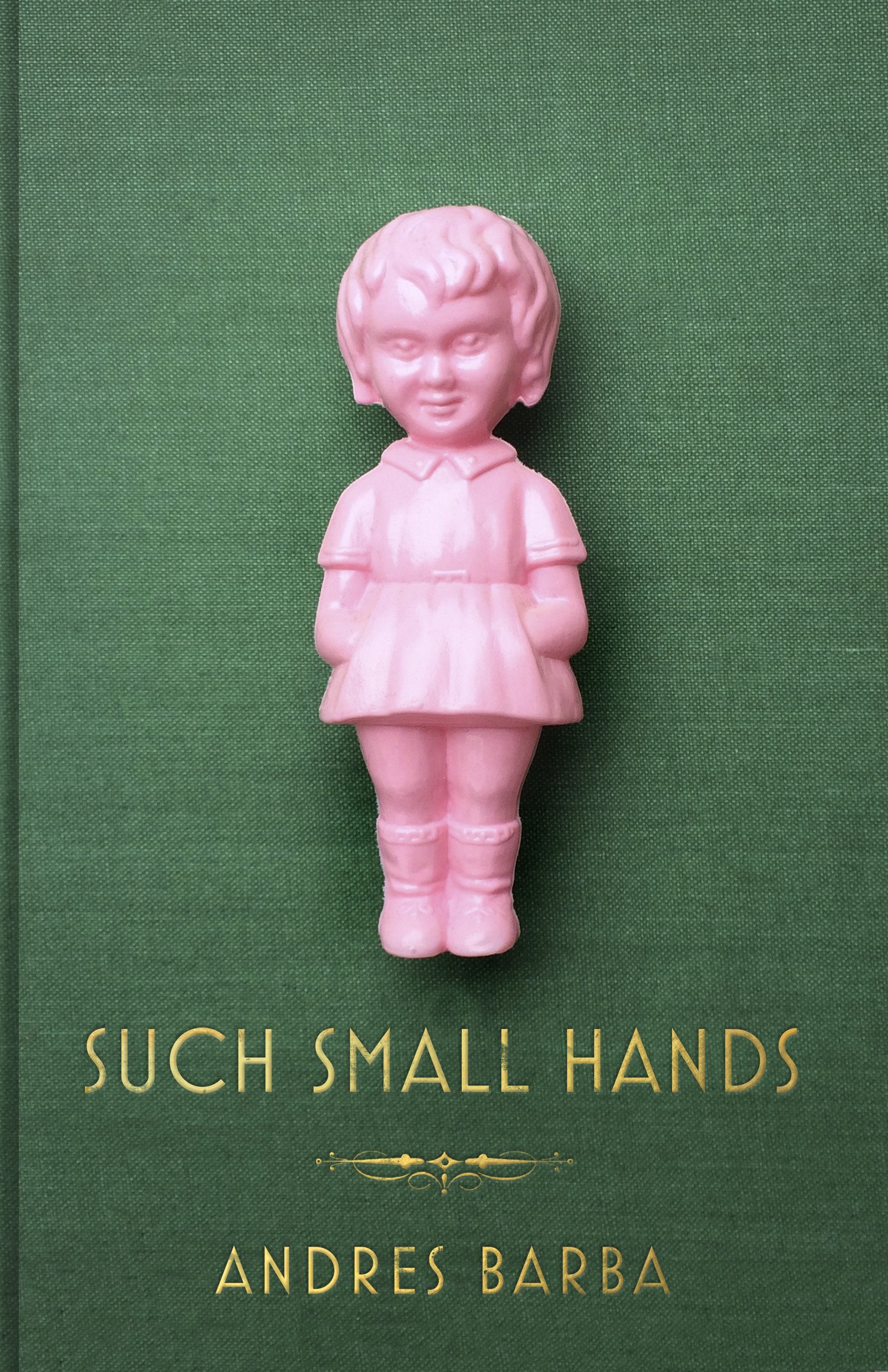
Such Small Hands – Andres Barba (trans. Lisa Dillman 2017) 101 pages
Well, this was super creepy. Institutionalised children *shudder*
Seven year old Marina is in a car accident.
“’Your father died instantly, your mother is in a coma.’ Lips pronounce them without stopping. Quick, dry words. They come in thousands of different, unpredictable ways, sometimes unbidden. Suddenly they just fall, as if onto a field. Marina’s learned to say them without sadness, like a name recited for strangers, like my name is Marina and I’m seven years old. ‘My father died instantly, my mother is in the hospital.’”
After her mother dies, Marina is sent to an orphanage, taking a doll given to her by the psychologist, which she has also called Marina. The other girls are both mesmerised and wary of Marina.
“Marina shrank and we grew. She stood alone, with her doll, by the statue of Saint Anne, watching us. Or was it the doll who was watching? We didn’t know who the doll really was. Because sometimes she looked like Marina, and she, too, seemed to have a hungry heart, and clenched fists close to her body, and she, too, was silent even when invited to join in; and she nodded her head back and forth, something we’d never seen a doll do before. And she seemed persecuted and excluded, too.”
Neither Marina or the girls understand the relationships they forge. There is fear and eroticism mixed in with tentative gestures towards friendship. Marina’s scar from the accident is a source of wonder.
“‘You can’t feel it?’
‘No. Well, only a little.’
Desire passed through the girl, too. Like stagnant water that suddenly begins to drain, imperceptibly.
And devotion mixed in with the desire.
‘Do you want to touch it?’
‘Yes.’
But the girl didn’t react right away.”
Barba gradually builds the tension and develops the girls’ games into something deeply disturbing and sinister, but wholly believable (there is an afterword which explains the real-life inspiration for the story). This tale will haunt me for a long time.
Despite being so short, this is a heartbreakingly beautiful tale. Its focus is one day – Mothering Sunday in 1924 – when the orphaned Jane Fairchild has the day off like all housemaids, but no home to go to.
“All over the country, maids and cooks and nannies had been ‘freed’ for the day, but was any of them – was even Paul Sheringham – as untethered as she?”
Paul Sheringham is her aristocratic lover at a neighbouring house, and they take advantage of the staff absence to meet, possibly for the last time as he is soon to be married.
“In any case she was getting ready to lose him. Was he getting ready to lose her? She had no right to expect him to see it that way. Did she have any right to think she was losing him? She had never exactly had him. But oh yes she had.”
The romance between the two is brilliantly evoked, as there is a real sense, although nothing is said, of how deeply they feel for one another while under no illusion that their relationship will endure.
“As if he wished her to know, she would think later, that on this special upside-down day he had placed himself, lordliest of the lordly as he could be, in the deferring role. He had … offered her his house, opened its door for her obediently on her arrival, then undressed her as if he were slave”
There is much foreshadowing of the events of the day and we know that something hugely significant occurred, something which changes Jane’s life forever.
“As if the day had turned inside out, as if what she was leaving behind was not enclosed, lost, entombed in a house. It had merged somehow – pouring itself outwards – with the air she was breathing. She would never be able to explain it, and she would not feel it any the less even when she discovered, as she would do, how this day had turned really inside out.”
Mothering Sunday is more plot-heavy than a lot of novellas, and it is incredible how much Swift packs into such a short space without the story ever feeling constrained or curtailed in any way. At the same time, he is brave enough to leave a huge part of the story unanswered, as things sometimes are unanswered in life.
“We are all fuel. We are born, and we burn, some of us more quickly than others. There are different kinds of combustion. But not to burn, never to catch fire at all, that would be the sad life, wouldn’t it?”
Captivating and brilliant.
However, you may not find it so – I urge you to read Lucy’s very funny review of Mothering Sunday here.
Journey into the Past – Stefan Zweig (1976 German publication; trans. Anthea Bell, 2009) 84 pages
Although I’ve since read and blogged about The Post Office Girl, this was the first Stefan Zweig I’d read and at first I wondered why everyone rated him so highly as a writer. Then I realised what he was doing in Journey into the Past was immensely clever.
It tells the story of a love affair between a student, Ludwig, and the wife of his employer, who is not named. The story begins with them on a train in the 1920s, and with Ludwig’s thoughts travelling back into the past to remember how they first met before the First World War separated them.
At first, I thought the description of the affair overblown and naïve.
“From that first meeting he had loved this woman, but passionately as his feeling surged over him, following him even into his dreams, the crucial factor that would shake him to the core was still lacking – his conscious realisation that what, denying his true feelings, he still called admiration,respect and devotion was in fact love – a burning, unbounded, absolute and passionate love.”
At this point I was thinking Zweig perhaps wasn’t for me 😉
But as the story developed – they admit their love but it remains unconsummated, he goes abroad and then war breaks out, separating them for longer than they ever anticipated – it dawned on me that this style choice was entirely deliberate and conscious. What Zweig shows us is a world before modern technological warfare, a world that was brutally torn apart. These naïve young lovers are part of a society, a life, that was utterly destroyed.
So although we know they are reunited, it is not with the same youthful self-obsession or indulgent love that they had previously.
“‘Everything is just as it used to be, don’t you think?’ she began, determined to say something innocent and casual, although her voice was husky and shook a little. However he did not echo her friendly, conversational tone, but gritted his teeth.
‘Oh yes, everything.’ Sudden inner rage forced the words abruptly and bitterly out of his mouth. ‘Everything is as it used to be except for us, except for us!’”
Journey into the Past is not a depressing book despite portraying losses that are glimpsed and barely articulated. It is about the impact of international conflict on the lives of individuals in the smallest, most profound ways. Zweig questions whether those loses can be overcome, and I still don’t know what I think.
I feel foolish for my initial impression of this novella: I hadn’t realised I was in the hands of a master.
Today is Monica Dickens Day in Jane at Beyond Eden Rock’s Birthday Book of Underappreciated Lady Authors. I’d planned for May to be only novellas over here, but I couldn’t resist the chance to dig out 2 Persephone editions from the TBR and join in with Jane’s celebration. I’m glad I did, because I really enjoyed my first encounter with Monica Dickens.
Firstly Mariana (1940) which is part of the Persephone Classics range. On the Persephone website they say:
“We chose this book because we wanted to publish a novel like Dusty Answer, I Capture the Castle or The Pursuit of Love, about a girl encountering life and love, which is also funny, readable and perceptive; it is a ‘hot-water bottle’ novel, one to curl up with on the sofa on a wet Sunday afternoon. But it is more than this.”
That just about sums it up. On the one hand Mariana is a very simple novel, about a young girl called Mary growing up and reaching adulthood just as World War II breaks out. She has various infatuations and gets her heart bruised, if not quite broken, before she meets the love of her life. What raises it above this very ordinary premise is the fond characterisation and Dickens’ wit.
Mary herself is a determinedly independent soul:
“People were kind and friendly and amusing, but they thought that companionship and conversation were synonymous and some of them had voices that jarred in your head. There was a lot to be said for dogs.”
She has been this way her whole life, as her school report testifies:
“Mary is a dear little girl…but we find a tendency in her to resent authority to the point of resistance. Although she is popular with her fellow pupils, I am afraid she is a bad mixer, being at the same time intolerant and unconfident of others and disinclined to enter into the heart of the community.”
She lives with her mother who works in a dress shop, as her father died in the previous war. There is also her reprehensible, indulgent Uncle Geoffrey who leaves her aged 8 to catch the Tube home by herself. He subsequently goes off to Hollywood to make his name in the movies. What stops this being entirely whimsical is the first chapter: we know the adult Mary is waiting for news of her husband whose ship has been sunk in the conflict. So alongside the fun characters and the wit is the background of potential tragedy; things do not seem to bode well for Mary, given the titular reference to Tennyson’s poem.
But in the meantime there is gentle fun to be poked at the trials and tribulations of young love:
“She told herself that she had been through a searing experience which had left her as a woman set apart from love – a tragic figure. This sustaining vision had tided her over the misery of the end of last summer, until the excitement and newness of Dramatic College had given her something else to think about.”
Dickens is a wise writer though, and so while she presents her characters with a slightly askance view, she shows how their feelings make them who they are, and who they will be:
“She had thought that [he]was the answer to everything, and when she had found out that he wasn’t she had been left alone with no one on whom to pin her burden of romantic devotion.”
I really enjoyed Mariana, which I wouldn’t have assumed would be the case given the subject matter. Dickens is very readable and I whizzed through the novel. I enjoyed spending time with all the characters (apart from an awful arrogant Bullingdon club type who seemed to have future-Prime-Minister written all over him) and I enjoyed Dickens unpretentious, thoughtful style.
“A corner of the jigsaw of Mary’s life had been made into the right pattern, by unknown means. It seemed that one had little control over one’s own destiny. All one could do was to get on with the one job nobody else could do, the job of being oneself.”
Secondly, The Winds of Heaven (1955), which had far fewer likeable characters and was almost bleak at times, but just saved from being so by the gentle endurance of the main character, Louise, who is widowed and destitute.
“She reached for the ashtray, for she wanted to tap off the ash frequently, as she had seen highly-strung, busy people do. Louise was neither highly-strung, nor busy, but when she was in London, among people who all seemed to be doing something important in a hurry, she liked to try and keep pace.”
The reason Louise is destitute is because her husband, Dudley, who seems to have had absolutely no redeeming qualities, died and left her with all his worldly debts.
“Everyone said Louise was ‘wonderful’ about Dudley’s death, but she could not be anything else, because, shocking though it was to her, she hardly cared.”
“there was nothing for it but that Louise should stay with her daughters in turn to pass the summer months. It was all arranged at an embarrassing family conclave, where no-one could say what they were thinking, and each tried to outdo the other in unselfishness.”
And so The Winds of Heaven follows Louise as she moves from one daughter to another. Miriam lives in a suburb in the Home Counties and is an absolute snob; Anne is the laziest person on earth who has somehow managed to marry a lovely man who runs a smallholding and genuinely cares for Louise; Eva is an actor in London and having an affair with a married man. They clearly all take after their father as they are selfish and self-absorbed. They are also, in different ways, all quite unhappy, and Louise has no idea how to help.
“she had wanted the futile thing she had made of her marriage with Dudley to be justified at least by the emergence of three happy lives.”
The novel is episodic in nature and through it we learn about Louise and her daughters. It’s a very mid-20th century English family, full of unspoken truths, supressed conflicts, and love. The somewhat depressing state of Louise’s familial relations is lightened by two beacons of light in her life: a friend, and her granddaughter. Gordon Disher is a bed salesman and pulp-fiction author who becomes: “The oddest, but most comforting friend she had ever made”. Ellen is Miriam’s daughter who like Louise, is a misfit in the family (a good thing, seeing as how appalling they all are) and who provides genuine kinship.
“how delightful to be a grandmother with a responsive grandchild, who opened her heart to you without embarrassment, because she had no-one to talk to at home”
The Winds of Heaven captures a particular moment in time, where women had only just begun to stop being exclusively homemakers and enter the workplace. Louise feels she can’t support herself, because she doesn’t believe she has any skills. This leaves her in genteel middle-class poverty, dependent on her daughters. She is part of a vanished world, and is not treated kindly by those who are finding their way in a new one. Dickens handles this social commentary with an incredibly light touch though, and so The Winds of Heaven often reads more like a series of acerbic character studies than a commentary on mid-twentieth century gender roles. It’s always highly readable, quietly building to a dramatic, tragic denouement, where hope survives.
To end, Monica had a rather famous great-grandfather. To tell you all about him, here are the incomparable Horrible Histories, channelling The Smiths:
Grief is the Thing with Feathers – Max Porter (2015, 114 pages)
Max Porter’s first novel Grief is the Thing with Feathers was published to much fanfare in 2015,which is encouraging in today’s increasingly conservative publishing industry, as this novella is a true original. In fact, it’s difficult to call it a novella, as its more like a patchwork of prose, poetry, monologue, fantasy and the commonplace.
A woman has died suddenly, leaving behind a husband and two young boys, reeling with grief. Into their shattered lives comes Crow:
“I find humans dull except in grief. There are very few in health, disaster, famine, atrocity. Splendour or normality that interest me (interest ME!) but the motherless children do. Motherless children are pure crow. For a sentimental bird it is ripe, rich and delicious to raid such a nest.”
Crow is far from sentimental: he is foul-mouthed, aggressive and terrifying. He is also exactly what the family need; particularly a family headed by a Ted Hughes scholar.
“In the middle, yours truly. A smack of black plumage and a stench of death. Ta-daa!”
The voices alternate between Crow, Dad and Boys. The mixed narrative, compiled of short passages and lots of white space on the page effectively captures the disorientation and incoherence of grief. We never know exactly what Crow is: metaphor, collective fantasy, actual manifestation. The oversized bird, the madness and uncontrollable force of grief, exists alongside Dad trying to keep a hold on the everyday concerns of raising two boys:
“There was very little division between their imaginary and real worlds, and people talked of coping mechanisms and childhood and time. Many people said ‘You need time’, when what we needed was washing powder, nit shampoo, football stickers, batteries, bows, arrows, bows, arrows.”
The Boys are not distinguished from each other. They play and pretend, they are violent and angry and thoughtful and decent. Their passages are the most poem-like:
“Dad has gone. Crow is in the bathroom
where he often is because he likes the
acoustics. We are crowded by the closed
door listening. He is speaking very slowly,
very clearly. He sounds old-fashioned, like
Dad’s vinyl recording of Dylan Thomas.”
Grief is the Thing with Feathers deserves all its plaudits and then some. It is a taut, beautifully written, experimental exploration of grief which effectively captures the fallout of a death on a family. It is brave, tender, unsentimental and deeply moving. Cathy over at 746 Books wrote recently of the theatrical adaptation which looks amazing. I’m sure this tale will transfer powerfully to stage.
“They offer me a space on the sofa next to them and the pain of them being so naturally kind is like appendicitis. I need to double over and hold myself because they are so kind and keep regenerating and recharging their kindness without any input from me.”





 madame bibi lophile recommends