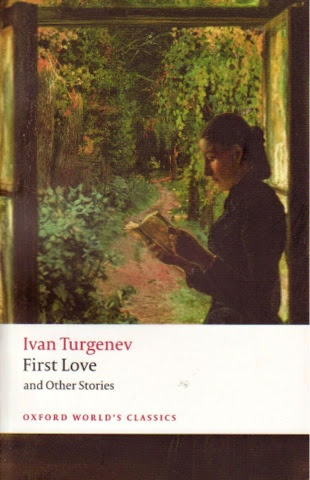
First Love – Ivan Turgenev (1860, trans. Isiah Berlin, 1950) 106 pages
This short tale of thwarted first love, told by a man, Vladimir Petrovich, looking back on the summer of 1833 when he was 16, manages to be both moving and funny. I felt for the pain of the young boy, whilst simultaneously rolling my eyes at the self-importance of teenagers (a bit how I feel watching Romeo and Juliet these days – kids!)
A young man is on the brink of adulthood, having just said goodbye to is tutor, when Princess Zasyekin moves in next door. The princess is uncouth and her house shabby:
“She took snuff as noisily as ever, and fidgeted and turned about on her chair as much as before. It never seemed to have entered her head that she was a princess.”
However, her daughter Zinaida is beautiful and poised, and has suitors in abundance. She teases them all, keeping them in a state of anticipation whilst remaining just out of reach. The young Petrovich is no different:
“But through the tears and the melancholy, inspired by the music of the verse or the beauty of the evening, there always rose upwards, like the grasses of early spring, shoots of happy feeling, of young and surging life.”
Yet there is always the sense that things are happening with Zinaida that our protagonist is too green to recognise. She seems genuinely fond of him and at one point even tells him so after he nearly breaks his neck jumping from a high wall (told you – kids!) yet there is something worldly and slightly damaged about her which Petrovich cannot begin to understand.
“My arms were smarting from the nettles, my back ached, my head swam, but at that moment I experienced a sense of bliss such as I never again felt in the whole of my life. It flowed like a delicious pain through all my limbs and finally resolved itself in rapturous leaps and cries. Yes, indeed, I was still a child.”
First Love reminded me of The Go-Between and Great Expectations whilst being resolutely its own tale. In a short space it conveys a detailed, effective portrait of the awakening of a young person to both the love and corruption that the adult world has to offer.
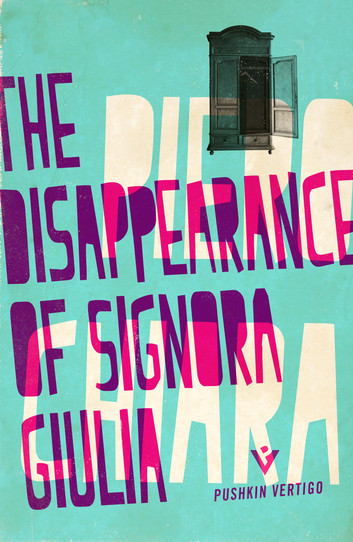
The Disappearance of Signora Giulia – Piero Chiara (1970, trans. Jill Foulston 2015) 122 pages
The Disappearance of Signora Giulia was initially published in an Italian newspaper as a serial and is now available in English translation thanks to Pushkin, as part of their Vertigo imprint. It is a quick, snappy crime thriller that does not aim for trite resolution but rather an exploration beneath the surface of a life to the murky depths.
Corrado Sciancalelpre is “blessed with a special form of intuition, that peculiar mental agility that enables great policemen to delve into the minds of criminals.”
Thankfully, he is also happy married and liked in the town in northern Lombardy where he works – no tortured alcoholic with a secret past here.
A powerful lawyer, Esengrini, asks Sciancalelpre to investigate the titular vanishing of his wife. Every Thursday, Guilia has been going to Milan to visit their daughter at boarding school, but now she has failed to return and two bags of her things are missing too. Sciancalelpre agrees and what follows is essentially a police procedural, but the short length of the story ensures the pacing remains tight.
Sciancalelpre is resolutely unsentimental but not without sympathy. The more he investigates, the more he feels for the missing woman:
“He didn’t say ‘Poor Signora Giulia to Esengrini when he visited him in his office every few days towards evening. With Esengrini, he spoke only of the undeniably disappointing results of a search conducted throughout the whole of Italy with Signora Giulia’s photo.”
It’s impossible to say much more about a crime novella without including spoilers. Suffice to say there are plenty of red herrings, people and relationships who are not what they seem. The Disappearance of Signora Giulia is a diverting read, when you’re in the mood for a crime novel you’ll finish quickly. It is not a simple tale though, and the resolution is a complex one that leaves questions unanswered. This wasn’t a source of frustration but rather felt realistic.
I really enjoyed this, Chiara’s first novel to be translated into English despite his huge popularity in Italy, and I hope there will be many more translations to follow.
After Claude – Iris Owens (1973) 206 pages (cheating my own criteria by 6 pages)
Trigger warning: mentions rape
I bought this one day when I finished the book I was reading more quickly than expected and I was waiting for a friend, who was late. I don’t like being without a book to read on my person and I found a late-opening charity shop. Amongst the Da Vinci Codes and James Patterson’s entire back catalogue I was thankful to spy a New York Review of Books logo. They’re a reliable, interesting publisher and so I found myself launched into the acerbic wit of Iris Owens, totally unprepared.
After Claude is funny, but it also features a despicable heroine. Kudos to Owens for not feeling it is necessary to write an attractive, likeable female for her lead, but really, Harriet Daimler is one of the most infuriating, obnoxious and unpleasant people ever committed to paper. She moves from friend to friend, sponging off them until her unrelenting selfishness alienates them and they chuck her out. She may be depressed: she sleeps all day, watches trashy quiz shows and eats, that’s it. But any sympathy the reader may feel is limited by her rudeness, prejudice and manipulations towards all who cross her path. She frequently uses homophobic language; she is racist; she denies her own Jewishness without realising that her denials illuminate that which she is trying to hide:
“ ‘Mazeltov,’ he congratulated me in an unfamiliar tongue.”
Who doesn’t know what Mazeltov means? Harriet is also completely delusional. The story begins “I left Claude, the French rat.” What quickly emerges is that Claude has thrown her out, sick of her utter selfishness and bitterness.
“Claude, who had learned his English in England, spoke with one of those snotty, superior accents, stuffed into a slimy French accent, the whole mess flavoured with an occasional American hipsterism, making him sound like an extremely rich, self-employed spy.”
What Claude quickly learns is that trying to throw someone out who won’t listen and is totally self-interested, is no mean feat.
“ ‘Me a bore?’ I laughed, amazed that the rat would resort to such a bizarre accusation. I have since learned never to be amazed at what men will resort to when cornered by a woman’s intelligence.”
Over the course of the story we learn how Harriet and Claude met, when she was thrown out of her friend Rhoda’s house, for something horrific which I won’t include for fear of spoilers, but would you live with someone who treated you thus?
“Had I been insensitive when I told her ‘Rhoda, I have nothing per se against your karate classes but rather than pin all your hopes on a rapist, wouldn’t a cruise make more sense?’”
What kept me reading was partly wanting to see what would happen to someone so extremely selfish and self-serving that normal rules don’t apply: Harriet could do anything. Also, amongst the rancour are some bitingly funny observations, such as this regarding a friend’s marriage:
“It goes without saying that though ideally suited and ecstatically happy, Jerry and Maxine had flown directly from their wedding ceremony to group therapy, paying top prices for the privilege of insulting each other in front of an audience.”
What happens to Harriet after Claude is bizarre. She meets a guru-type and ends up begging to be allowed to join their cult, even after suffering sexual humiliation at their hands. Ultimately then, Harriet is both horrible and pitiful, extremely vulnerable but bent on destroying anyone who might want to help.
Like a pratfall in which someone ends up genuinely hurt, After Claude is funny but you feel you shouldn’t laugh; it’s painful and you want to tear your eyes away. Owens is an accomplished writer but I’m not sure I could have stood a much longer novel.
We Have Always Lived in the Castle – Shirley Jackson (1962, 146 pages)
Well, this was a deeply creepy read. Shirley Jackson’s final novel tells the story of eighteen year-old Merricat, living with her older sister Constance and Uncle Julian in self-imposed isolation, ever since Constance was found not guilty of murdering the rest of the family with arsenic. The townspeople don’t trust the verdict, and the family are shunned. Merricat’s days are filled with ritual, both domestic and talismanic of her own devising, with a threat of violence never far away [skip the first sentence if cruelty to animals is a trigger]:
“I found a nest of baby snakes near the creek and killed them all; I dislike snakes and Constance had never asked me not to. I was on the way back to the house when I found a very bad omen, one of the worst. My book nailed to a tree in the pine woods had fallen down. I decided that the nail had rusted away and the book – it was a little notebook of our father’s, where he used to record the names of people who owed him money, and people who ought, he thought, to do favours for him – was useless now as protection. I had wrapped it very thoroughly in heavy brown paper before nailing it to the tree, but the nail had rusted and it had fallen, I thought I had better destroy it, in case it was now actively bad, and bring something else out to the tree, perhaps a scarf of our mothers, or a glove. It was really too late, although I did not know it then; he was already on his way to the house.”
‘He’ is Cousin Charles, whose arrival disturbs the fragile balance within the house. Constance and Merricat have a close relationship, but not a healthy one. They are both somewhat infantilised, and are co-dependent in complex ways. Charles is interested in getting Constance out and about, and his hands on the family money. Jackson superbly racks up the tension without ever resorting to clichés. There are also moments of levity, mainly around Uncle Julian’s eccentricities and non-sequiturs.
“ ‘Jonas is asleep in the lettuce,’ I said.
‘There is nothing I like more than cat fur in my salad,’ Constance said amiably.
‘It is time I had a box,’ Uncle Julian announced. He sat back and looked angrily at his papers. ‘They must all be put in a box this very minute. Constance?’
…
‘He is dishonest. His father was dishonest. Both my brothers were dishonest. If he tries to take my papers you must stop him; I cannot permit tampering with my papers and I will not tolerate intrusion. You must tell him this Constance. He is a bastard.’
‘Uncle Julian –‘
‘In a purely metaphorical sense, I assure you. Both my brothers married women of very strong will. That is merely a word used – among men my dear; I apologize for submitting you to such a word – to categorise an undesirable fellow.”
We Have Always Lived in the Castle is a powerful read and an astonishing one. With its atmosphere of unspoken threat and insidious menace, all set within a ritualised domesticity, it is deeply disturbing. Undoubtedly a gothic masterpiece.
Cliffs – Olivier Adam (2005, trans. Sue Rose, 2009) 147 pages
Set over the course of a single night, Cliffs shows the enduring damage caused to the child – now a grown man – of a parent who dies by suicide.
The narrator is sitting on a balcony on the Normandy coast in the middle of the night, gazing at the cliffs where his mother died, while his partner and child lie sleeping in the room behind him. As he sits and smokes, he reflects on his life with his abusive father and his traumatised brother:
“We weren’t supposed to breathe move speak feel. We weren’t supposed to need anything, pocket money or comfort or affection or smiles or advice, we weren’t supposed to expect anything except the slaps, smacks or wallops he dealt out”
Later he meets other damaged souls, drawn together by a mutual recognition:
“We’ve grown up in fear of our fathers, the troubled silence of our mothers, the empty space formed by abstract, imaginary places, without edge or centre.”
Cliffs isn’t a depressing book; it is a story of survival, of endurance even when we are irrevocably damaged by experience.
“This way of life didn’t cure me of anything, it was merely possible when I couldn’t cope with any other kind of life, particularly the one I’d just left behind. It was a life of silence, space and absence, of maintaining an acute presence within objects, the shifting play of light, the still motion of water, the perfumes, the texture of the air. It was a life in which I finally found a niche, quiet but peaceful, a body filled with air and fog, a mind completely given over to the noise of the sea and the wind, the company of birds.”
Cliffs is beautifully written, but the beauty in no way detracts from the raw hurt experienced by narrator. It is an intense read, haunting and memorable.
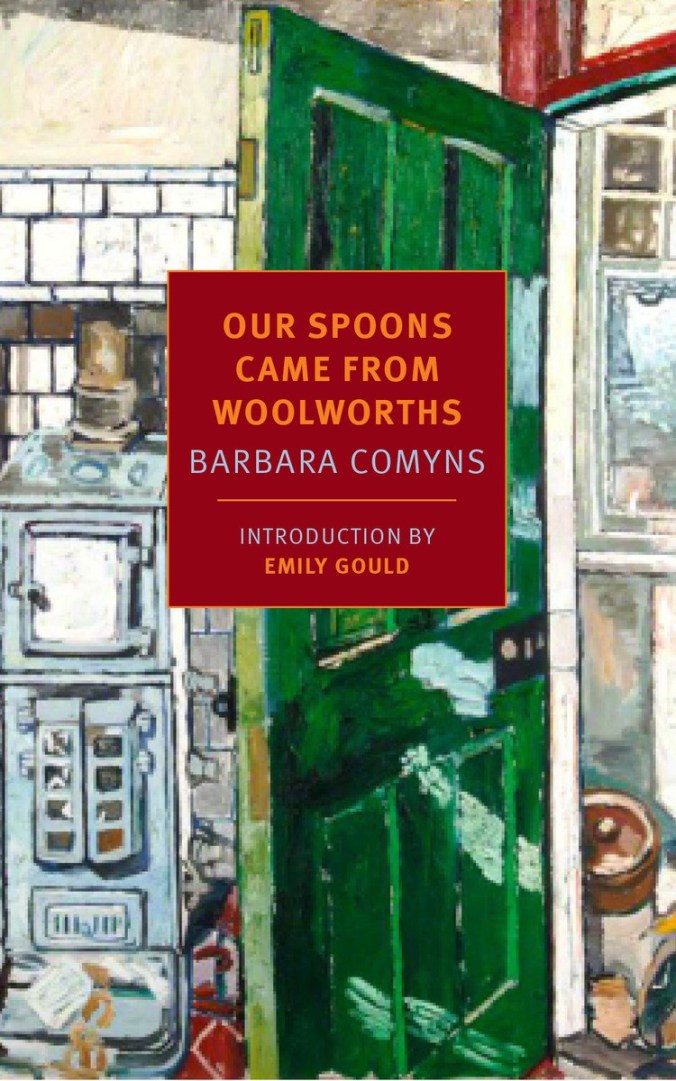
Our Spoons Came From Woolworths – Barbara Comyns (1950, 195 pages)
Our Spoons Came From Woolworths is the first Barbara Comyns I’ve read, attracted by the whimsical title and it being a Virago. I’m so glad I picked this up. Our Spoons Came From Woolworths was a compelling read, and not nearly as whimsical as I had assumed.
The NYRB edition
It tells the story of Sophia’s marriage at a young age to Charles, an artist, in the 1930s. They are painfully naïve, and Charles especially has no idea about money:
“He said Eva had told all her relations about the coming baby, and they had asked him masses of questions about how he was going to support a wife and family. They had given him some money, though, four pounds in all. I was glad to hear this as we only had one golden guinea left in the dresser drawer, but my gladness did not last long, because it turned out he had already spent the money on some paints, brushes, books and an enormous walnut cake from Fullers.”
With the arrival of the baby, the poverty becomes even more pressing. Charles is monumentally selfish and self-absorbed, but not quite despicable. He’s just clueless and self-centred, and this means his actions are inadvertently cruel. Although the situation is quite desperate, Comyns’ voice is matter-of-fact and never asks for sympathy. There is a light, almost surreal humour present:
“Charles said he had borrowed some money to send telegrams to his relations saying we had a boy of six ounces. I told him it was six pounds not ounces, but he said a few pounds either way wouldn’t make any difference. But Charles’ telegrams caused a huge sensation, and his family was most disappointed when in due course they discovered we had quite a normal baby.”
But the humour always highlights the bigger picture, such as Charles’ disregard and disinterest in his children. While Comyns is unsentimental, this does not mean she is unaware of the power of her story. She has plenty to say about the role of women in interwar Britain and the hypocrisies that meant they were expected to marry and then make the best of it, with little means of support beyond their husbands. She also shows how this is bound up in sexual politics, with male infidelity so much more accepted than female, yet women deserving an equal right to happiness:
“Some time later, when I realised I had been unfaithful, I didn’t feel guilty or sad, I just felt awfully happy I had had this experience, which if I had remained ‘a good wife’ I would have missed, although, of course, I wouldn’t have known what I was missing. I felt quite bewildered. I had …been a kind of virgin all the time. I wondered if there were other women like this, but I knew so few women intimately it was difficult to tell.”
The story is also an indirect plea for a welfare state. What Sophia and her children endure would not be life-threatening after the end of the Second World War, with a social safety net established to protect them from absolute destitution and starvation.
But I worry now I’ve made Our Spoons Came From Woolworths sound very heavy, which it isn’t. Comyns knows how to say serious things with a lightness of touch that is quite remarkable. You’re not left in any doubt as to Sophia’s desperation, but it remains a hopeful novel about human resilience. It’s generally thought to be thinly-disguised biography (Comyns was married to the painter John Pemberton between 1931-5 and had two children with him) and Comyns makes her point about these types of stories – concerning women and poverty – desperately needing to be heard at a time when no-one really wanted to listen, in deadpan comic style:
“This book does not seem to be growing very large although I have got to Chapter Nine. I think this is partly because there isn’t any conversation. I could just fill pages like this:
‘I am sure it is true,’ said Phyllida.
‘I cannot agree with you,’ answered Norman.
‘Oh, but I know I am right,’ she replied.
‘I beg to differ,’ said Norman sternly. That is the kind of stuff that appears in real people’s books. I know this will never be a real book that business men in trains will read, the kind of business men that wear stiff hats with curly brims and little breathing holes in the side. I wish I knew more about words.”
Although I understand from other bloggers that Comyns’ other novels are very different, I am now officially an ardent fan.
Jamilia – Chingiz Aitmatov 96 pages (1957, tr. 2007 James Riordan although the publishers don’t say if this was from Kyrgyz or Russian – Aitmatov wrote in both)
Narrated by Seit, the brother-in-law of the beautiful titular protagonist, Jamilia is reminiscent of The Go-Between, in that it is told from the point of view of the young observer of an older person’s love affair, from a time in his life when he is looking back on his past.
Set during the war, Jamilia’s husband is away fighting. An injured soldier, Daniyar, returns to the village where he was born:
“ ‘We are content and so are the spirits of our ancestors. And now, God willing, we’ll finish off the Germans and live in peace and Daniyar will raise a family like the rest of us, his own smoke will rise from the hearth.’
By invoking Daniyar’s ancestors they were saying he was one of us. And that is how a new kinsman appeared in our village.”
Daniyar, Seit and Jamilia travel regularly by cart to take the grain from the harvest to the train station. Aitmatov writes with economy yet is able to evoke a vivid scene with few words. He captures the land of Kyrgyzstan with true sensitivity and the land is an integral part of the story:
“Eager to reach home, the horses trotted briskly, the stones scraping beneath their feet. The cool wind brought with it the bitter pollen of flowering wormwood, and the faint aroma of ripening wheat. Mingling with the smell of tar and horse sweat, it all made us faintly dizzy.”
During the journeys back and forth, the quiet, unassuming Daniyar is teased by the vivacious Jamilia and Seit. Then Daniyar starts to sing, and everything changes:
“If only I could recreate his song. It contained few words, yet even without words it revealed a great human soul. I have never heard such singing before or since. The tune was like Kirgiz or Kazakh, yet in it was something of both. His music combined the very best melodies of the two related peoples and had woven them into a single, unrepeatable song. It was a song of the mountains and the steppe, first soaring into the sky like the Kirgiz mountains, then rolling freely like the Kazakh steppe.”
What lifts this tale above the ordinary is Aitmatov’s beautiful writing, but also how the story expands a simple, almost fable-like, narrative into something broader. Jamilia is about romantic love, but told at a step removed by a man who grew up to become a painter; it also becomes about art, and the transcendental nature of love and art. Jamilia falls for Daniyar because of his voice. Seit becomes seized with a desire to create, and takes his first tentative steps towards his life’s vocation. Jamilia is about how love, in all its variety of forms and circumstance, unites us all:
“I felt it was not simply a love for another person, it was somehow an uncommon, expansive love for life and earth.”
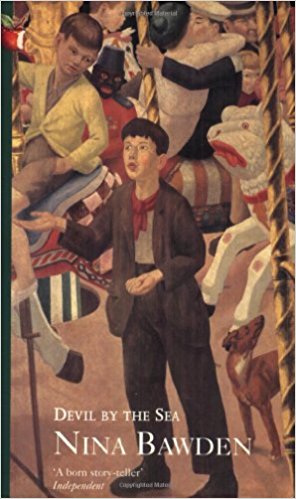
When I was a child I loved Nina Bawden’s books, particularly The Peppermint Pig and Carrie’s War, which a read and re-read. For some reason though, I never picked up her novels for adults. Ali has been championing her writing over on her blog Heavenali, and this prompted me to dig Devil by the Sea out of the Virago TBR (yes, the TBR is so humungous now there are TBR sub-piles) and give it a read.
I’m happy to say that Bawden is just as wonderful writing for adults as she is for children. This creepy, tightly plotted tale is a compulsive read with plenty to say about human relationships – particularly those between adults and children – and the nature of feeling Other. It begins:
“The first time the children saw the Devil, he was sitting next to them in the second row of deckchairs in the bandstand. He was biting his nails.”
The children are Hilary and Peregrine. They are not happy, carefree children; Bawden would never be that patronising in her portrayal of young people. Instead, Hilary is jealous and angry, and can be petty. Peregrine is religious and anxious. They live in a seaside town all year round and it is holiday season. Their half-sister is having an affair with a vain married man who does not love her. Their father and step-mother are under-involved in the children’s lives. Their Auntie beachcombs and keeps the rotting fish she finds. Into all this comes a man they believe is the devil.
“The man turned and looked at them. A shadow crossed his face: like an animal, he seemed to shrink and cringe before the mockery Hilary had made of him […] He continued to watch her with a steady, careful stare. She fumbled in the pocket of her cotton dress. Her voice croaked with embarrassment.
‘Would you like a toffee?’
The man looked beyond her to Peregrine. Briefly, their eyes met. Peregrine could not look away, he was transfixed. The man’s eyes were dark and dull, dead eyes without any shine in them. They reflected nothing.”
A child with the unfortunate moniker of Poppet goes missing, and Hilary saw the man lead her away.
“Poppet’s picture was in the middle of the front page and Hilary looked at it with interest….She read the first few lines beneath the picture and a dark veil came down over her eyes. Her heart beat wildly in her throat. Something cold and evil menaced her from the shadowed corners and for a while she crouched quite still, as if afraid to wake a sleeping beast.”
The fact that this evidence is not easily voiced for the situation resolved is due to the misunderstanding and myth-making of children; the obliviousness and myopia of adults; the fear of everyone.
Despite being a gothic tale in many ways, Devil by the Sea is wholly believable. This is not least because Bawden is not interested in making her characters likable, but rather real, complex, flawed and fascinating. It is creepy and captivating and deeply unsettling. On the strength of this, I will definitely be reading more of Bawden’s adult fiction, not least because I was lucky enough to win The Birds on the Trees in Ali’s giveaway last year 🙂
For a while now I’ve been enamoured of the novella. I enjoy sparse writing styles (not so good at this myself 😉) and at its best a novella gives us a narrative distilled to its essence for maximum impact. To spread novella love I’ve decided to post about a novella each day for the whole month. There’s no fixed definition of a novella so for my purposes I’ve decided its longer than 70 pages and shorter than 200. This will definitely work! It won’t peter out and die in a heap by 5 May at all! Onwards…
The Game of Cards – Adolf Schroder (trans. Andrew Brown, 2008) 143 pages
The Game of Cards is not ostensibly gothic or a thriller, and yet it is both these things. The story of how student Markus Hauser is employed by Selma Bruhns for a week to put several trunks worth of letters into chronological order is truly creepy and suspense-filled.
Selma is a terse, uncommunicative employer, who lives in an old house with a vast number of cats at varying stages of disease. Markus is constantly at the point of leaving, unable to stomach the “stench” of the house, the feral occupants, his awkward employer and the seemingly pointless nature of his repetitive task:
“He squatted down between the piles of letters lying on the floor, but when her resumed his work…looking for the pile in which he was putting the letters from 1943, laying the pages of the letter on it and reaching out for the next one, he paused, as if he’d only just realised that he had absolutely no idea what he was doing”
Gradually however, Markus is drawn into the letters, all written to a woman named Almut. Very little is given away, but Markus finds himself compelled to continue, without really understanding why.
“Words from the letters that he had read came alive. He found himself in streets where he had never been, heard the shrieking and whistling of creatures that he could not see but whose presence he surmised, felt on his skin the burning sun whose strength he had never yet felt, saw a woman coming up to him who spoke in a language that he did not understand.”
This chronology is interspersed with the investigation being conducted by Superintendent Berger, who suspects Markus of having strangled Selma with her own scarf on his last day of work. Thus we are drawn into not only the mystery of who Almut is and why Selma is obsessively writing to her, but also who killed Selma and why. Schroder jumps between the two timelines without preamble and so the reader is drawn into the disorienting, imperfectly understood situation of the all the characters.
“With a sudden move that took Markus by surprise, she threw the animal towards him, it crashed into his chest, and only because Markus reacted quickly and caught the animal could he prevent I from falling onto the ground.
‘You are working slowly and without much concentration,’ said Selma Bruhns, turning round and stepping into the house.”
There is also the question of what happened – and what the stake was – in the titular match between Markus and Selma…
The Game of Cards is a deeply disturbing read, and a powerful portrait of enduring psychological trauma. It will stay with me for a long time.
This week’s theme stems from a very boring reason. But I try to pick themes that relate to my life or what’s happening in the world in some way, and my life is very boring. In fact, the most remarkable thing about it is just how dull it is. So brace yourself reader, and try & stay awake while I tell you that I am a leasehold flat owner.
I’ve always hated this because my managing agents are inept slimebags truly reprehensible human beings, but I spent an evening last week consoling a friend who is a share-of-freeholder and is engaged in a long dispute with her one of her neighbours/fellow freehold sharers, which has now turned vaguely medieval and who she refers to by a most unsavoury nickname.
If you’re still with me, you deserve a little treat. Here’s a trailer for one of my favourite ever films which is rather apt:
So as I spent a long time thinking about flats recently, the theme is novels set in apartment blocks. Firstly, Paradises by Iosi Havilio (2012, trans. Beth Fowler 2013). Apparently this is a sequel to the author’s previous novel Open Door, which I haven’t read, but it didn’t seem to restrict my understanding of Paradises, which I found compelling. Following the death of her partner, an unnamed woman leaves her country home with her small child, Simon, and moves to Buenos Aires. She gets a job at the local zoo:
“Something about the gloomy light, the small of the enclosure, the watchfulness of the snakes in captivity produces a hole in my stomach, an anguish that forces me to increase my pace. I skirt the large tank of water turtles, ignore the lizards walk past the door saying nursery and go outside.”
The janitor, Canetti, takes a shine to her. He used to be a bank treasurer before losing his job through fraud and is filled with bitterness. He shows the woman the el Buti squat, presided over by the obese, immobile, morphine-addicted Tosca. She moves in:
“And yet despite the filth, the heat, those intestinal noises, and the smell of shit that rises in waves, at some point in the early hours Canetti’s words from the first time he brought me here come to mind: We’re safe here. I even babble them to myself to confirm it. And so I relax and rest a bit, although still without sleeping. On the third day I cover the windows with black bin bags to prolong the night.”
The voice of the young woman is matter-of-fact and she presents her extreme circumstances almost indifferently (Paradises has been compared to L’Etranger). This, combined with the present-tense, captured the numbness of grief and the sense of just getting through each moment. Yet according to the introduction by Alex Clark, the narrator’s passivity and weird equanimity was present in Open Door too, so maybe it’s just her character. Either way, I found her voice distinct and engaging. We follow her through her life as she juggles motherhood, work, relationships with idiodyncratic but wholly believable characters: seemingly spiky Iris who cares for Simon; the unpredictable Eloisa who seems to have no boundaries at all and drags the narrator along with her; the various residents of el Buti.
“each of us has to devise our truth in relation to the other”
The squat is surrounded by paradise trees, whose berries are poisonous and whose bark holds the cure. This duality is repeated throughout the novel: alienation sits alongside connection, love and grief are side by side. Paradises is an unsettling novel but at no point did I feel alienated from the unusual, detached woman telling the story. A remarkable achievement.
Let’s take a Vincent Cassel break (that’s definitely a thing, isn’t it?)
Secondly, A Far Cry from Kensington by Muriel Spark (1988) is set at “14 Church End Villas, South Kensington, that rooming house, shabby but clean, that today is a smart and expensive set of flats, gutted and restructured, far beyond the means of medical students, nurses, and the likes of us as we were.”
Narrated by the young widow Mrs Hawkins, she describes her time at the rooming house in the 1950s. She moves between jobs in publishing with little respect for her employers:
“Sir Alec was thin and grey and his voice matched his looks. It sounded like a wisp of smoke wafting from some burning leaves hidden by a clump of lavender.”
“I had a sense he was offering things abominable to me, like decaffeinated coffee or coitus interruptus”
Spark’s satire of publishing and writers is a joy, but A Far Cry From Kensington is also about capturing a moment in time when society is on the cusp of change. Relationships between the sexes are changing, and Mrs Hawkins pushes against societal expectations of women in the mid-20th century. She is resentful of being characterised as a capable widow (she feels this is partly due to her size and begins determinedly losing weight).
Meanwhile, there is tension in the house as someone is sending threatening anonymous letters to Wanda, a European seamstress who rooms there. The different residents begin to suspect each other while landlady Milly is certain it’s an outsider:
“Milly was upset at the suggestion that it was someone in the house, to the point of being almost mesmerized by the idea. She also feared further letters. ‘These things happen in threes’ said Milly in her way of uttering bits of folk-wisdom; she was spooning tea into the heated teapot. She always mixed tea with maxims.”
Mrs Hawkins is a great narrator: matter-of-fact, funny, uncompromising.
“I enjoy a puritanical and moralistic nature; it is my happy element to judge between right and wrong, regardless of what I might actually do.”
The plot around the victimisation of Wanda is frankly a bit bonkers and easily the weakest point in the novel, but despite a weak plot A Far Cry From Kensington is full of Spark’s wit and razor-sharp observation. Not a word in this short novel is wasted.
To end, a video putting the brutalist architecture of the Thamesmead flats to good use:






 madame bibi lophile recommends