“Live fully, live passionately, live disastrously. Let’s live, you and I, as none have ever lived before.” (Violet Trefusis to Vita Sackville-West, 1918)

Happy Valentine’s Day! And for those who are single (such as myself), console yourself that we don’t have to go to an overpriced, overcrowded restaurant to have our meal interrupted by tired-looking pushers of sad hothouse roses in buckets whilst couples around us try and hide their mutual disdain for one another as their relationships teeter on the brink of collapse under the pressure of meeting the impossible standards of commercially appropriated romantic love 😉

As I said, Happy Valentine’s Day everyone!

*fans self*

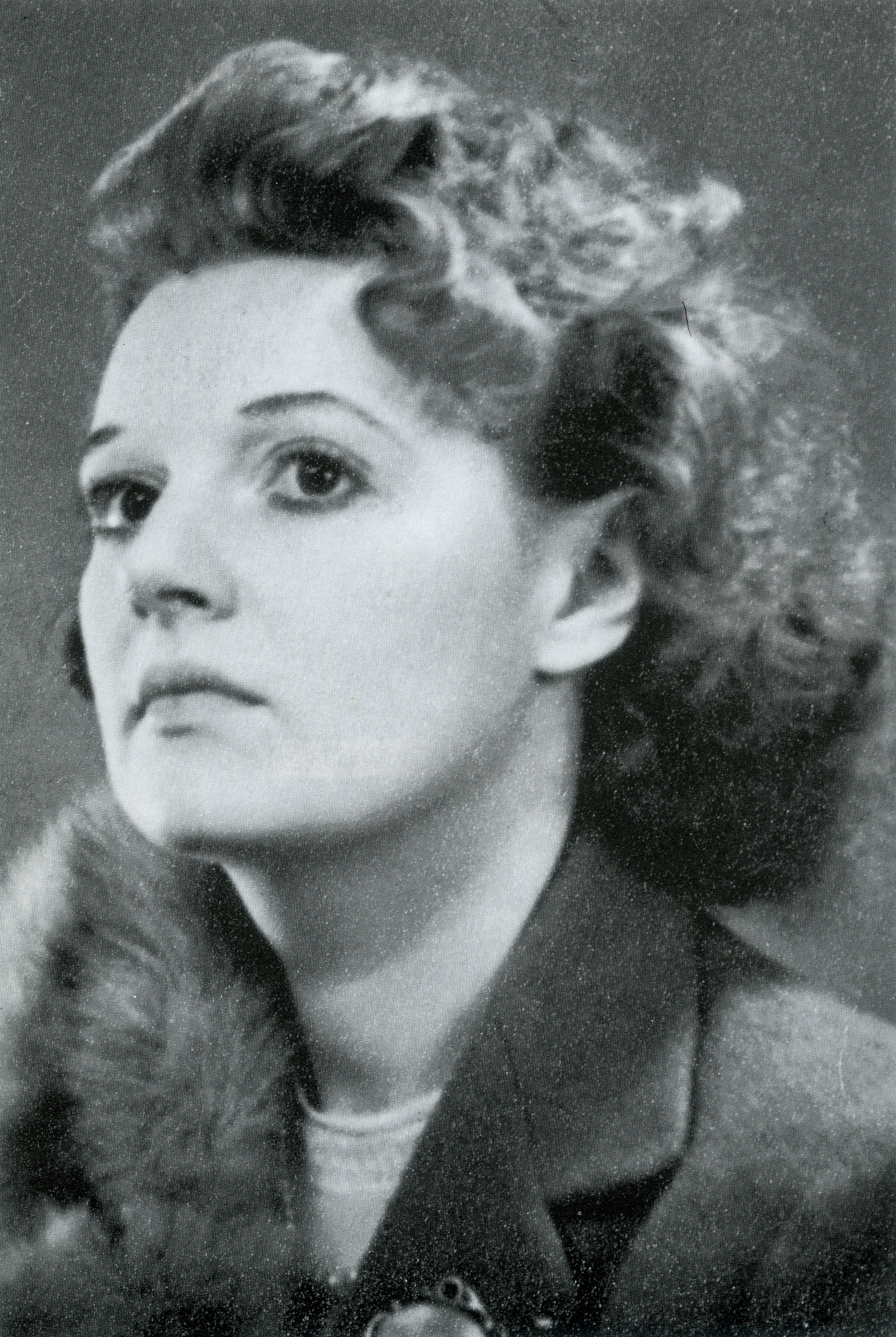
For Valentine’s Day I thought I’d look at two novels concerned with romantic love. A brief foray through my TBR and I struggled to find anything that showed it in a positive light, which says much about my reading tastes. I quickly abandoned that idea and instead I’ve picked 2 novels written by a famous couple, Violet Trefusis and Vita Sackville-West. They met when Violet was ten and Vita was twelve; four years later Violet confessed her love, but life events separated them. They both went on to marry men but continued their relationship, although they did eventually split up. They stayed in touch and remained warm towards each other. Violet is ‘Sasha’ in Orlando, Woolf’s love letter to Vita.


Firstly, Hunt the Slipper by Violet Trefusis (1937).

Nigel lives with his sensible horticulturist sister Molly in their lovely home in Bath. He likes the finer things in life and prides himself on his good taste. Trying to get out of a visit to meet Caroline, the new wife of a neighbour, he gives Molly the following reason regarding Caroline’s family:

“You can’t imagine what they’ve done to their Elizabethan home. I once lunched there years ago; it looked as if Christabel Pankhurst and d’Annunzio had set up house together. Tea-cups and tracts battled for supremacy with peacocks feathers and leopard skins. It was so alarming that I fled.”

However, he goes, and the meeting is not a success. Caroline is miserable in her marriage to Anthony, a man who:

“never tired of dressing her up in the family jewels, of draping her in old-fashioned stuffs. She was his favourite recreation, his most valued asset. He did not particularly care about women, except as part of a decorative scheme.”

She is offhand to Nigel, who is used to women falling for his middle-aged charms, and he is distinctly unimpressed.  However, when they meet in Paris, Caroline has changed. She is in love with someone nearer her own age, Melo. Her taste in men is pretty questionable:

“Melo was a martyr to snobbishness, as a nursemaid is martyr to corns. Apart from physical attraction, Caroline led to the Royal Enclosure, stalking in Scotland, Noel Coward first-nights. In short, to the negligently luxurious life of the British aristocracy.”

Needless to say, this cad breaks her heart, and she turns to Nigel for solace. At this point he falls in love with her, but Caroline remains indifferent.

“He did not suspect that by one of Love’s infallible ricochets she was behaving to him as Melo had behaved to her. Her cruelty was Melo’s legacy, her indifference to him was out of revenge for Melo’s indifference to her. Love passed from one to the other, furtive, unseizable, like the slipper in ‘Hunt the Slipper.’”

There follows a period whereby they both travel, narrowly missing each other in various European destinations, Nigel writing effusive, desperate letters and Caroline sending intermittent, controlled replies. However, slowly, Caroline’s feeling change.

“You’re a terrible hoarder, aren’t you? Is possessiveness quite the same thing as jealousy, I wonder? Funny I should have fallen prey to two ‘collectors’. A[nthony] respects his possessions, whereas you love and tyrannize yours.”

Hunt the Slipper is a slim novel (180 pages) and the short length works well – Caroline and Nigel are both quite selfish. I didn’t wholly dislike them, but nor did I have a great deal of sympathy for them beyond that of realising we’re all flawed human beings and we all need love. Also the hunting of the slipper – love being always just out of reach – could have got tedious but as it is the plotting remains tight. Hunt the Slipper is a witty, sparky novel which gently mocks British insularity, snobbery in all forms, and self-delusion. Trefusis doesn’t judge her characters harshly and so neither do we. She dramatizes in the most ordinary way the conflicts of a cosy routine life against one of passion and unpredictability and doesn’t offer any trite answers as to which will bring most happiness.

Secondly, Family History by Vita Sackville-West (1932).

Beautiful widow Evelyn Jarrold lives an undemanding life, financially well-off with her own flat in London and her son heir to her late husband’s industrial family fortune.

“Evelyn Jarrold was not a woman who questioned the established order of the civilised world. She was not stupid, but, in such matters, simply acquiescent.”

However, she meets Miles Vane-Merrick – also rich, part of the landowning classes, but (shock!) left-leaning – and he turns everything upside down.

“The total absence of ideas amongst the younger Jarrolds, their perpetual heavy banter which passed for wit, the limitations of their interests, their intolerance, their narrow-mindedness, all appeared insufferable to her now in contrast with Miles’ alertness and gaiety.”

He is fifteen years younger than she, and Sackville-West uses their passionate affair to highlight the enormous changes happening in interwar Britain. Evelyn is only 39 but compared to 25 year old Miles she is from a different era. Her friends dress for dinner, the women don’t work, the men snooze through Lords debates before supporting the Tories. Miles and his friends are concerned with new world order, welfare of workers, the women earn money and they talk late into the night.

“Would she ever turn round on the whole of her acquaintance, and in a moment of harshness send them all packing? She knew that the necessary harshness lurked somewhere within her; in fact, she was rather frightened of it.”

The difficulty is, then what would she do? Evelyn is jealous and possessive, but this may not just be temperament, it may be because she has little else to occupy her mind. Miles carries on at his work (politics, running his estate, writing his book) and loves her around this. She does nothing but wait for him to find time for her.

“Love and the woman were insufficient for an active mind, Love and the man, however, were all-too-sufficient for a starved heart and unoccupied mind, Miles learnt it, to his cost; Evelyn never learnt it, to hers.”

Sackville-West does not shy away from the weakness in her characters. Evelyn can be controlling, vain, and overly concerned regarding middle-class mores. While Miles may protest “Instinct makes me reactionary, reason makes me progressive.”, the fact that he’s also given to statements such as “I like women to be idle and decorative.” means he’s not that progressive. He’s self-centred and doesn’t ever seem to take an action that doesn’t suit him entirely. Despite the fact that people constantly refer to him as brilliant and the great hope for the country, I found him weak. One of Evelyn’s relatives is pithily described by Sackville-West thus:

 “She had not preserved her virginity for forty-five years without revealing the fact in every phrase and gesture. A practising Christian, she was packed with a virtuous complaisance and not one ounce of charity.”

However, by the time Miles announces that the best thing that could happen to this woman was for her to be raped, he’d lost me entirely.  Misogynistic pig.

So it says something for Sackville-West’s writing that the fact that I really couldn’t stand one of the characters did not put me off the novel at all. Family History is an intriguing way to explore and make personal the upheavals of the first part of the twentieth-century in Britain. Apparently it didn’t do well on release and was considered one of her lesser works, but I found it thought-provoking and entertaining. The ending genuinely moved me. But most of all, Sackville-West’s wit is an absolute delight. For this reason, I’ll finish with a few choice bon mots:

[On the British upper classes] “The standard of looks was amazing; they had the distinction and beauty of thoroughbred animals. The young men were as elegant as greyhounds, the young women coloured as a herbaceous border. What did it matter […]that those sleek heads contained no more brains than a greyhound’s?”

“Who ever went to Eton to be educated?”

“The icy wind, whipping, biting, brought a certain exhilaration. Discomforts that one need not necessarily endure, always do induce a certain exhilaration. Hence the perennial charm of picnics.”

To end, just to prove I’m not really an embittered cynic, here’s a sweet duet between a pioneering new wave icon and a banjo-playing frog:

“Courage calls to courage everywhere, and its voice cannot be denied.” (Millicent Fawcett)

Today is the 100th anniversary of the 1918 Representation of the People Act in Britain receiving Royal Assent, which enabled all men and some women over the age of 30 to vote for the first time (it would be another 10 years before women got equal voting rights). There are lots of events going on this year to commemorate the centenary, but it’s also worth noting that the suffragettes argued for equal pay for equal work, and yet 100 years later (last week) Carrie Gracie has been giving evidence to MPs over pay discrimination at the BBC. This is just one example. The fight for equal rights worldwide is ongoing.

Suffragettes,_England,_1908

For this post I’ve picked one novel written by a suffragette and a short story from the twentieth-first century portraying suffragettes.

Firstly, No Surrender by Constance Maud (1911), who was a member of the Women Writers Suffrage League. I read a crusty copy from the library which had that pleasing old book smell, but Persephone have published it as one of their beautiful editions too, and if you’re on a book-buying ban like me, they also offer it as a free e-book.

Maud looks at suffrage primarily through the story of young cotton mill worker Jenny Clegg. Jenny Clegg’s father has all the power in their home while her mother does all the work:

“Her voice took on its usual apologetic tone with her lord and master. For Mrs Clegg was imbued with a spirit of such humility that she apologised not only for rising early and late taking rest, while fulfilling her manifold obligations towards her mate, such as bearing and raising his ten children, cooking, washing, mending, cleaning for the family, but even for her very existence up to the age of fifty-five in this strenuous service without pay.”

Mr Clegg squanders the money earned by the women in his family such as Jenny. He is selfish but supported by law and society in his behaviour:

“Mr Clegg regarded his daughter sternly, but without wrath. He answered her in measured tones, strong in his sense of his impregnable position, backed as he felt himself to be, not only by the law of the land, the tradition of generations, his own physical force and intrinsic superiority of sex, but by the innermost conviction and consent of all right-thinking womankind.”

Jenny’s political awareness is given direction when she encounters Mary O’Neil, a moneyed society girl who rebels against her class’ expectations of her and supports the suffragettes. There is humour in her mother’s friend Lady Walker’s attitudes towards her own gender:

“ ‘Can you suppose for one moment that a man like Horace Boulder, or even Penhaven, would have been attracted, had Helen or Cicely shown a tendency to independent interests and original thought?’ “

There were plenty of women against the suffragettes, and Lady Walker’s dismissal of them as “ ‘hysterical, unsexed creatures, with a mania against men.’” was not unusual. The character provides some much needed levity, but is never presented as ridiculous, as this internalised misogyny had a major impact on the lives of women at the time, helping maintain the limitations of their rights and freedoms.

Maud covers the main events of the movement up until that time, and uses various scenarios to get across the arguments of women’s suffrage: speeches from carriages, dinner party conversations, arguments between lovers. This is both the strength and weakness of the novel. No Surrender is an issue-lead novel, despite Maud placing a romance between Jenny and Joe Hopton, Labour party candidate, as the driving plot. As such, it sometimes falters under the weight of its intentions. Much as I dislike Dickens, he is an absolute master at dramatising his social commentary. Maud is not so gifted and sometimes No Surrender is overly didactic, with poorly realised characters and a sentimental tone. But I must stress that this is not all it is. It is also able to dramatise how:

“Courage, self-abnegation, forethought, invention, and a keen sense of humour marked the tactics of the militant movement.”

bringing a unique, personal perspective to balance the reportage (and lack thereof) regarding the movement. While at times I found the characterisation of the working classes a bit ‘gor blimey guv’nor’ (or perhaps I should say ‘ee by gum’ as its northern stereotypes) it’s still commendable that Maud roots the story in the working classes, and shifts the focus from the middle class suffragettes.

 “’there’s a good many ladies who’d be doin’ far more good in the world if they thought more about their womanhood and less about their ladyhood’”

So all in all, a flawed novel but a fascinating one, written contemporaneous to the movement by someone who was directly involved.


Secondly, A Mighty Horde of Women in Very Big Hats, Advancing, the final and longest story in the short story collection The Apple by Michel Faber (2006), in which he revisits the characters and setting of his hugely successful novel The Crimson Petal and the White. I’m going to ignore the links to TCPATW to avoid spoilers for those who haven’t read it (it’s great – you should definitely read it!)

The story is narrated by an elderly man in a nursing home in the 1990s, recalling his life when he was very young, with his artist father, bohemian mother, and Aunt Primrose (who dresses in men’s clothes and shares a bed with his mother, but the menage a tois arrangement is never explicitly stated).

“You know, because I was a child in what’s now called the Edwardian era, and because I was born the day Queen Victoria died, I always think of the Edwardians as children. Children who lost their mother, but were too young to realise she was gone, and therefore played on as before, only gradually noticing, out of the corners of their eyes, the flickering shadows outside their sunny nursery. Shadows of commotion, of unrest. Sounds of argument, of protest, of Mother’s things being tossed into boxes, of fixtures being forcibly unscrewed, of the whole house being dismantled.”

Amongst this change, there is a conflict between old and new which is obvious to the small child on a daily basis:

“Bureaucrats, tradesmen, doctors, postmen, parsons, waiters, porters, the whole pack of them; they ignored my mother and Aunt Primrose, and directed their remarks to my father.”

But he is a preoccupied artist and it is the women who drive the lives of the household, with energy, fun, and strong political convictions:

“She an Aunt Primrose worked as a kind of music hall duo, Mama getting by on charm and disarming honesty, while Aunt Primrose supplied the sardonic touch. My father was – if you’ll excuse what’s definitely not meant as a pun – the straight man.”

The story culminates on Women’s Sunday, the Hyde Park rally of 21 June 1908 which was the first major meeting organised by the WSPU. A Mighty Horde of Women in Very Big Hats, Advancing covers a great many themes in its 60-plus pages: being part of stories we can’t fully comprehend, the flawed nature of memory, how history is made, the need to attach a narrative to our lives looking back. Faber is a brilliant storyteller, able to cover all this within a driving plot, authentic voice and lightness of touch. He’s said he won’t write any more since publishing Undying in 2016 following the death of his wife, and I sincerely hope he changes his mind. All the stories in The Apple were highly readable, they worked individually, as a whole, and as a sort-of sequel to TCPATW. He’s a great writer.

To end, a silly portrait of a suffragette but not one I can dismiss because it was probably the first time I learnt what a suffragette was:


“The true novelist is one who understands the work as a continuous poem, is a myth-maker, and the wonder of the art resides in the endless different ways of telling a story.” (Muriel Spark)

Today would have been Muriel Spark’s 100th birthday, and there are celebrations and events taking place throughout the year, which you can read about here. Ali over at Heavenali is also doing a year long reading event #ReadingMuriel2018 so do join in exploring this wonderful novelist.

Image from here

2017 was the year of the novella for me. I don’t know why, but I repeatedly found myself drawn to short, tightly written, impactful stories. So it was inevitable that 2017 also became a year when I read Muriel Spark. She is absolutely masterful at the short novel. Her writing is sharp and concise, which suits her wit, but you never come away feeling short-changed; they are absolutely complete in themselves.  Here are 3 quick(ish) reviews of some Spark novellas that I read last year.

The Driver’s Seat (1970) 103 pages

This is a deeply unsettling tale, which leaves the reader with as many questions as answers by the end of it. It tells the story of the last few days of Lise’s life; this isn’t a spoiler as we know early on she will be found tied up and stabbed. Foreshadowing occurs throughout:

“She is neither good-looking nor bad-looking. Her nose is short and wider than it will look in the likeness constructed partly by the method of identikit, partly by actual photography, soon to be published in the newspapers of four languages.”

Spark does not ask that we feel sorry for Lise. The present tense and the characterisation are deliberately distancing. Lise is unlikeable – spiky and rude. She is also behaving somewhat eccentrically, dressing in vivid clashing colours  (“a lemon-yellow top with a skirt patterned in bright V’s of orange, mauve and blue… a summer coat with narrow stripes, red and white, with a white collar”) which she then screams justification for at a shop assistant:

“ ‘These colours go together perfectly. People here in the North are ignorant of colours. Conservative; old-fashioned. If only you knew! These colours are a natural blend for me. Absolutely natural.’ She does not wait for a reply”

We follow Lise as she catches a flight to an unnamed holiday destination, and goes in search of a man who represents “my type” although she does not specify exactly what this is, and we know it is not sexual. It gradually emerges that Lise has motivations that are not articulated, and yet they drive her on relentlessly:

 “ ‘It’s getting late,’ says Lise. Her lips are slightly parted and her nostrils and eyes, too, are a fragment more open than usual; she is a stag scenting the breeze, moving step by step…she seems at the same time to search for a certain air-current, a glimpse and an intimation.”

It’s almost impossible to say anymore without spoilers. There are some funny moments in this dark tale, a particular conversation filled with non-sequiturs made me laugh. But overall the feeling created is one of deep unease. It has been described as a ‘metaphysical shocker’, and is definitely not one for readers who like clear answers and loose ends all neatly tied up.

Image from here

The Ballad of Peckham Rye (1960) 143 pages

When I was reading this, one of my colleagues, who is a big Muriel Spark fan, described her as ‘a scamp’. This is a perfect description of the authorial tone in this funny, odd novella.

It opens with Humphrey Place declining to marry Dixie at the altar, and the blame for such behaviour being laid by onlookers at the door of Dougal Douglas, who is no longer around. We then head back in time to see Dougal’s arrival in Peckham and the havoc he wreaks before his departure.

Dougal acquires a position at the firm of Meadows, Meade and Grindley:

“Dougal turned sideways in his chair and gazed out of the window at the bridge; he was now a man of vision with a deformed shoulder. ‘The world of industry,’ said Dougal, ‘throbs with human life. It will be my job to take the pulse of the people and plumb the Industrial depths of Peckham.’”

Instead of doing anything near what he has been employed to do, he skives off work, gets another job at a rival firm under the name Douglas Dougal, for which he also does no work, and sets about unsettling the lives of everyone with whom he comes into contact. There is a weird, almost surreal tone to events and we are never told why Dougal is there or what his motivations are for anything.

“Mr Weedin laid his head in his hands and burst into tears.

Dougal said, ‘You’re a sick man, Mr Weedin. I can’t abide sickness. It’s my fatal flaw. But I’ve brought a comb with me. Would you like me to comb your hair?’

‘You’re unnatural,’ said Mr Weedin.

‘All human beings who breathe are a bit unnatural,’ Dougal said. ‘If you try to be too natural, see where it gets you.’”

Sharp was Catholic, and so it’s tempting to read this as an allegory. Dougal does have lumps on his head which he claims are where the horns were removed. I’m not sure we’re meant to read him as a devil, though he is devilishly beguiling. The Ballad of Peckham Rye is a quick, wonderful read, showing how easily the most ordinary of lives and events therein can tip into the extraordinary, and how little we know anyone, least of all ourselves.

Image from here

The Public Image (1968) 125 pages

The Public Image is a wonderfully pithy satire on fame, celebrity and how women are forced into certain roles. Annabel Christopher is an English actress living in Rome with her husband Frederick and baby Carl. Frederick despises his wife, she is partly aware and partly indifferent to this.

“Her husband, when she was in his company with his men friends…tolerantly and quite affectionately insinuated the fact of her stupidity, and she accepted this without resentment for as long as did not convey to her any sense of contempt. The fact that she was earning more and more money than her husband seemed to her at that time a simple proof that he did not want to work.”

While Frederick is weak and thwarted by his wife’s success, Annabel is superficial and self-obsessed, intent on cultivating her images as the “English Lady-Tiger” with her adoring Italian public. Frederick takes a drastic revenge on Annabel to try and destroy her public image, and thereby destroy her.

“She was as unaware of his secret life as she was of her own, for hers was not articulate. She probably never formed a sentence in her mind that she would hesitate to reveal to open air.”

However, while Annabel is vacuous, she is also sharp as a pin, with an astute understanding of how to cultivate and maintain her public relations. Everyone has underestimated her, and her campaign to maintain her public power will reveal a side to her previously unimagined.

It’s astonishing how little this novel has aged. In this era of dead-eyed celebrities maintaining an iron-grip on their image through incessant selfies on their Instagram accounts, Annabel looks positively self-effacing. Spark’s satire sparkles and illuminates the ugly side of glamour with incisive wit.

I’m yet to read any Spark where she seems off her tremendous game. Thankfully in this year of not buying books I still have The Mandelbaum Gate in the TBR, so I’ll definitely be reading that before her centenary is out.

Retro pop video to end as usual, but I do apologise, I couldn’t resist….


“There is nothing so intractable as a calendar.” (Margery Sharp)

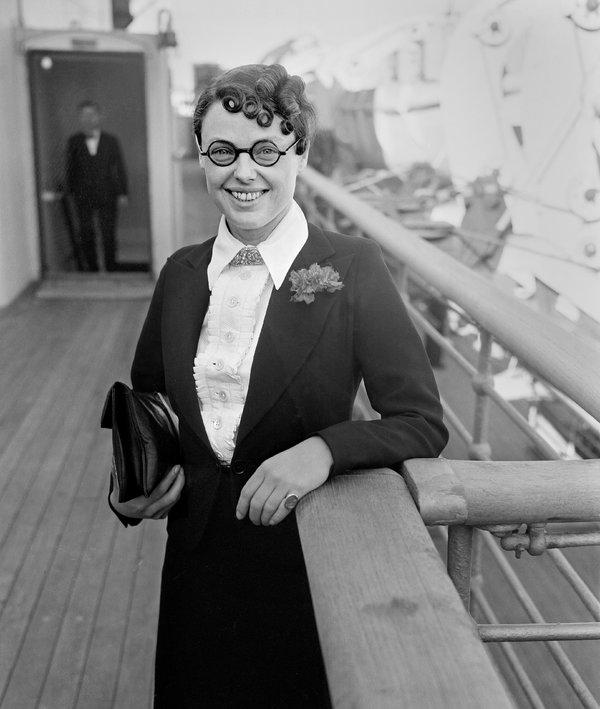
I thought the title quote rather apt, as I’m late to Margery Sharp Day this year, but I couldn’t let it pass after falling for the author since reading two of her novels for Margery Sharp day 2017. She’s so witty, she writes with such brio, and also with such humanity and warmth that I’m a confirmed fan.

13Enthusiast--articleLarge-v2

Image from here

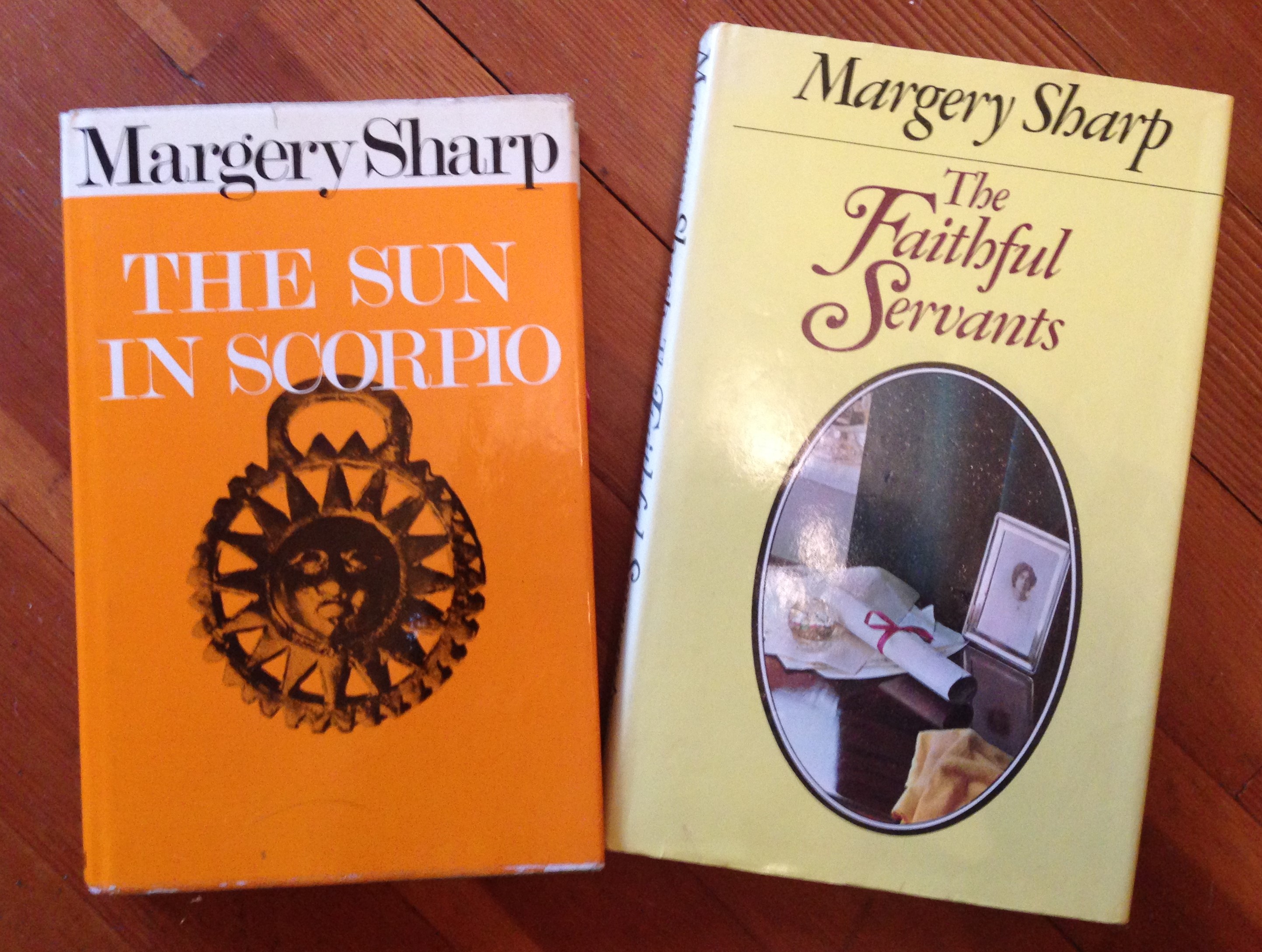
And yet, when reading The Faithful Servants (1975), these wonders of Sharp’s writing were not quite so evident. Jane from Beyond Eden Rock, who organises Margery Sharp Day and is a great champion of her writing, had said that her later novels were not quite as good, and how right she was. The Faithful Servants is absolutely still worth reading, but Sharp’s penultimate novel is not as sparkling as her earlier work.

It’s a great idea: a trust is established at the end of the nineteenth century by dissolute Jacob Arbuthnot for aged servants down on their luck. In portraying the requests to the trust, Sharp is able to track the huge societal changes that took place between the start of the trust and well into the twentieth century, by which time the welfare state has been established and the servant class almost entirely disappeared. The various visitors to the trust’s offices are colourful and the staff only slightly less so. But…. it doesn’t quite work. The characters are all well-observed as I would expect from Sharp, and there are are some lovely touches, such as the gentle relationship established between two beneficiaries, Miss Xavier and Miss Quartermaine, of whom “neither had the least idea that they were Lesbians.”  Sharp’s wit is also in evidence:

“ ‘Lady P. simply meant that the children should drop whatever they were doing to make up the rosettes for a Tory party candidate, or sew bean bags for a Tory fete. As you know by now dear, I’ve always been a convinced Liberal; but I can assure you I didn’t object from party politics. What I objected to was the assumption that absolutely any activity took precedence over Moliere.’ ”

But it just doesn’t have the verve of her other novels. It reads more like a series of sketches, which in a sense is exactly what it is. Of course, this is a series of sketches by Margery Sharp, and so they are entertaining, sly and funny, with strong women in evidence:

“Mr Blackburn thought of her as a field flower plucked from its native heath; Mr McIntyre, as some shy little creature of the woods. Of course neither mentioned the fancy.

Then in 1874 she was arrested on a charge of murder, To be explicit, of having introduced arsenic into her employer’s night cap of tea.”

The Faithful Servants did not diminish my love for this author, but if Margery Sharp is new to you, this would not be the best place to start. A clever idea, not entirely fulfilled, but with moments of witty brilliance which act as a reminder that Sharp off her game is still better than many at their peak.

Secondly, back to 1965 and The Sun in Scorpio, which sees Sharp very much on form. The Pennon family live on a small outpost of the fading British empire, “The Next-Door Island” to Malta.

“They weren’t Army, and they weren’t Navy, they were irretrievably civilian; it was a measure of Mrs Pennon’s social insecurity that she always felt nervous before giving a dinner-party in case no-one came. At least they weren’t Trade however, and she always made a point of explaining her husband’s chest was weak.”

Sharp writes about the warm climate wonderfully and casts a similarly acute eye towards the familial relationships. The children Muriel, Cathy and Alan don’t particularly get on, and neither do their parents. Cathy especially loves the island and its warmth, and she has a formative moment with the governor, a bachelor the ex-pat ladies flutter around. However, the start of the Second World War sees Cathy wrenched away as the Pennons return to England, where their shortcomings are made even more apparent.

“Indeed, their new, heavier clothing swamped them all, diminishing individuality, and as it were underlining the fact that whereas on the Island (among some few hundred of the Ruling Race), they’d been at least petty someones, at Home (amongst some fifty millions) they were nobodies.”

Cathy in particular struggles under the grey skies of Britain. Muriel thrives as a hockey-playing school leader and Alan finds girls to fall in love with, but Cathy doesn’t excel at anything.

“In general they were a sulky lot, and Cathy was amongst the sulkiest. It was very hard on Mrs Pennon, but she had developed such a technique of losing herself in a novel, a daughter’s obvious misery disturbed her no more than a husband’s equally obvious lack of any will to live.”

Sharp follows them through the years, and while Alan is able to move away for work and Muriel turns into a unbearably smug married suburban mother, Cathy remains somewhat adrift. Once her parents are dead, she is financially bereft and has to live with Muriel. This situation depresses all involved, and when the opportunity arrives for Cathy to become a nanny to the daughter of landed gentry she gratefully escapes to Devon.

The mother of her charge is very beautiful, and very much younger than her husband.

“ ‘Alas!’ sighed Lady Jean (probably the only woman of her generation who could sigh alas and get away with it.)”

She is also manipulative and unfaithful, and her charm in referring to Cathy as her “attendant sprite” is not entirely successful. Cathy has no great affection for her small charge, but she also has no real choices in life. Sharp’s depiction of Cathy’s domestic situation is highly entertaining as she is wholly unsuited to being a nanny and has little in common with the media and image-obsessed small girl she is nannying:

“ ‘Poor gwandpa!’ lisped Elspet – out of flannel and into frills again. ‘Mummy says he’s tewwibly pwessed for money.’

‘Nonsense, he must be worth a million,’ said Cathy bracingly.

‘But all in land,’ pointed out Elspet. (It occurred to Cathy to wonder whether besides reading Vogue and Tatler her charge ever dipped into the Financial Times…..)

‘You don’t own entailed land, it owns you,’ explained Elspet. ‘Poor grandpa! I can’t go to sleep for worrying about him. You must read to me out of Peter Pan.’ “

The years pass and we see what happens to Muriel and Alan, and also Jacko, an islander who was friends with Cathy and taught her poker, who similarly finds himself in London. The main focus remains mainly on Cathy however, and Sharp doesn’t trouble to make her likable. Cathy has nothing particularly to recommend her and she isn’t very nice, but she is also unhappy, and as a woman in the early part of the twentieth-century she doesn’t have enough control over her life to try and remedy the situation.  It doesn’t matter one bit that Cathy is so unlike a heroine though. It’s actually refreshing, and realistic, and told with Sharp’s wit, economy, and verve it’s a hugely enjoyable journey towards a perfectly realised ending. The Sun in Scorpio is an absolute joy.

To end, the wonderful Harry Belafonte singing a song Cathy would appreciate:

“I think Isambard Kingdom Brunel would be a good chap to have supper with. Anyone who builds a railway and then builds a steamship when he gets to Bristol and can’t go any further must be a good chap.” (Fergus Henderson)

This week I’ll be briefly visiting the beautiful city of Bristol for work, so in preparation I’ve read 2 books by EH Young, who fictionalised Bristol as Radstowe throughout her novels.


bristol-2312860_960_720

EH Young’s world is one of genteel middle-class, and at first I wasn’t sure The Misses Mallett (1922) was for me. The descriptions of the beauty of Radstowe were somewhat overblown, and I wondered if it was going to be clumsy Austen-lite. I’m pleased to say I was completely wrong. The Misses Mallet is acutely observed and Young’s characterisation is excellent. Those who people her world are complex, not always likable but always so believable.

Caroline and Sophia are elderly unmarried Mallet sisters who spend their days reliving past glories, which may not be exactly as Caroline remembers:

“ ‘And men like what they fear,’ Caroline added.

‘Yes dear,’ Sophia said, A natural flush appeared round the delicate dabs of rouge. She hoped she might be forgiven for her tender deceits. Those young men in white waistcoats had often laughed at Caroline rather than her wit; she was, as Sophia had shrinkingly divined, as often as not their butt, and dear Caroline had never known it; she must never know it, never know it.”

The elderly Miss Malletts are comically but fondly drawn, with their frills and lace, their make-up which doesn’t hide their age, Caroline’s mistaken belief that she is wordly, and their constant self-mythologising. Rose, their younger step-sister, is different:

“restraint and a love of danger lived together in her nature and these two qualities were fed by the position in which she found herself, nor would she have had the position changed. It supplied her with the emotion she had wanted. She had the privilege of feeling deeply and dangerously yet of preserving her pride.”

She is in love with Francis Sales, but realised it too late and he married another. As Young details above, this arrested love affair quite suits her. Sales’ wife is housebound in constant pain since a fall from a horse that she believes Rose engineered. They are locked in a co-dependent, vindictive relationship bound up in what has not been said, in blame and in guilt.

Yet overall the lives of the Misses Malletts are calm and routine.

“the Mallets did not criticise their actions or analyse their minds”

This all changes with the arrival of Henrietta, their young orphaned niece.

“the Mallets don’t marry, Henrietta. Look at us, as happy as the day is long, with all the fun and none of the trouble. We’re terrible flirts, Sophia and I. Rose is different, but at least she isn’t married. The three Miss Malletts of Nelson Lodge! Now there are four of us, and you must keep up our reputation.”

But Henrietta may not be quite so ready to adopt the Miss Mallett way of life. She also falls for Francis Sales, whilst being courted by the socially awkward Charles Batty:

“He was plain; he was getting bald; his trousers bagged; his socks wrinkled like concertinas; his comparative self-assurance was quite unjustified.”

What follows is a novel written with great lightness of touch, but it is the excellent characterisation that stops it being cosy or sentimental. It is a world that has passed, but it is a world that is fully realised and Young shows that it, and the people in it, can still be recognised and understood. The Misses Mallett, and those who surround them, will stay with me a long time.


Secondly, William which came 3 years after The Misses Mallett. I found the descriptive writing in this a lot more restrained and so I wonder if either 3 years saw the maturing of EH Young’s writing style, or if she was actually having a sly dig at purple prose romances in The Misses Mallett and I missed the pastiche. Either way, William is brilliantly written and was her most successful novel. It is primarily a character study of the titular man, a self-made shipping magnate.

“William Nesbitt had no yearnings for the sea: he had had enough of it in his youth, but the thought of it was always with him and would have been with him even if his business had not compelled him to constant communication with it; and the fact that it lay down there beyond the river and out of sight, was like the presence of a woman, still beautiful, whom he loved no longer with desire, but with knowledge, understanding and satisfaction.”

William is someone who life has treated well, and he has an affection for it:

“Life was interesting, a great adventure, enlivened by countless minor episodes. It was difficult to believe anybody could find it dull. Every personality was more or less of an excitement to him – Kate, Janet, Lydia, the captains of his ships, the clerks in his office, the ships themselves, the very gulls swooping for garbage in the river, cutting the air with wings like swords.”

However, although he has worked hard and continues to do so, he has never really been tested. This is about to change. One of his five children, his daughter Lydia, leaves her husband to live with her lover. The post-war times are a-changing, and William finds himself in opposition to his wife as they cope with the fallout. William finds he is able to love his children unconditionally. His affection for life is undiminished and expanded.

“ ‘I’ve told you Kate, we can’t have them as we want them. We’re lucky to have them as they are.’”

His wife on the other hand, is outraged at Lydia’s unconventional choice and becomes embittered as she realises she holds absolutely no power to change the situation.

“He had lived with her for nearly forty years, not deceiving himself into the belief of perfect union, but in accord, with humour, with much happiness, and now, in the face of first trouble, he had lost touch with her, as though his consort were only for smooth waters.”

William is a rich novel despite not being overly long (a good thing to my way of thinking). Once again, EH Young displays excellent characterisation and psychological insight, not only towards her main protagonist but also the characters of his wife and their children. There is sadness in the novel, with Kate’s moral rigidity causing her deep pain and William’s realisation that although his marriage is basically happy “He had missed ecstasy”. However, it is not a sad novel. Rather it captures the human impact of societal change and it does so without preaching, showing how both human beings and love endure. EH Young challenges the institution of marriage (she lived in a ménage a trois for many years) whilst also showing its advantages:

“‘There’s a great deal of humbug about marriage… and a forced loyalty is the devil. And if Oliver couldn’t hold Lydia by love, why should he hold her by law?’”

It is a testament to EH Young’s writing that while society has moved on to an extent that the central dilemma no longer exists, William remains a deeply moving and compelling novel.

These were my first two novels by EH Young and I’m already a huge fan. In this year of my book buying ban, I’m pleased to find I have 4 more of her novels in the TBR mountain (it’s this kind of excess which has led to the aforementioned ban); I’ll definitely be reading them soon.

To end, a band that named themselves after their home town near Bristol:

“Insanity – a perfectly rational adjustment to an insane world.” (R. D. Laing)

Some friends of mine recently got married in a beautiful venue, which used to be a mental health hospital. A lovely time was had by all. People were struck at how nice it was, and it got me wondering: why? Were they expecting the institution to be grim in itself, or was it the thought that somehow all that pain remains and would be felt? It seemed to be a bit of both. Clearly the idea of a place where mental health is treated is a powerful one. It’s no surprise then, that it’s proved a tempting choice for writers, so it’s led me to this week’s theme of novels set in mental health units. Rest assured Reader: although powerful, neither of my choices are depressing. At this time of year it can feel like everyone’s mental health is under siege and we just don’t need it. In fact, here’s a little pick-me-up for us all:

On with books! Firstly, All Dogs Are Blue by Rodrigo de Souza Leao (2008, trans.Zoe Perry and Stefan Tobler 2013). This novella is only 107 pages long but it is one of the most affecting and powerful pieces I have ever read. Rodrigo de Souza Leao died in a psychiatric clinic in Rio de Janeiro in 2009, shortly after this was published. All Dogs Are Blue takes the reader into life inside such an institution, and does so with an unblinking gaze, humour, warmth and blistering truth.

The narrator is 36-year-old man who has swallowed ‘a chip’ which alters his behaviour. This has led to his incarceration. There isn’t a plot, it wouldn’t make sense if there was. Instead, the narrator takes us through his daily experiences and reminiscences about his past.

“The Christian says hallelujah. She takes my hand. I take out my dick and can’t play snooker. I go back to my nine-by-twelve cubicle, where they put me to smile bayoneting my veins. Grab the flesh, stretch the flesh, shove another injection in.”

The narrator never tries to convince us of his sanity. Rather, we are given his world view, one which is sometimes shocking in its clarity amongst flights from reality:

“If it could bark and eat, what would a blue dog eat? Blue food? And if it got ill. Would it take blue medicine? A lot of medicines are blue, including Haldol. I take Haldol to be under no illusions that I’ll die mad one day, somewhere dirty, without any food.”

Despite detailing an individual in dire circumstances, All Dogs Are Blue is not a depressing book. This is because the narrator is resilient and self-aware, even as he experiences psychotic delusions. There is humour found in his hallucinatory companions, nineteenth century French writers:

“Rimbaud wasn’t used to modern stuff, He was a guy from another time. He had to learn everything. He’d never written another poem. But he was a good companion for wasting away the hours and for poker.”

Whereas Baudelaire can be a bit more moody.

De Souza Leao also writes with great beauty and poetry:

“Everything went green like the colour of my brother Bruno’s eyes and the colour of the sea. Rimbaud was happy and decided not to kill himself.

Everything went Van Gogh. The light of things changed.”

But the humour and the poetry do not detract from the pain. Rather, they capture it in the most effective way to draw you in to begin to understand an extreme experience that thankfully, most of us will not endure.

“I break everything because I’m made of shards and when the shards invite me to, I wreak havoc.”

Through an individual experience, the wider issue of how we treat the mentally ill is addressed. De Souza Leao doesn’t offer answers but he poses uncomfortable questions about institutionalised mental healthcare:

“Mostly, they only wanted you to keep your mouth shut all the time, like no-one deserved to hear you say anything noble or important.”

All Dogs Are Blue is a stunning, heartbreaking novella. It is also yet another example of the brilliant work being done by not-for-profit publishers And Other Stories bringing translated fiction to a wider audience.

Secondly, a novel which examines the impact on family when a member has enduring mental ill health, The Gravity of Love by Sara Stridsberg (2014, trans. Deborah Bragan-Turner 2016). I was inspired to pick this up after reading Kate’s wonderful review. It’s also another stop on my Around the World in 80 Books Reading challenge, hosted by Hard Book Habit. Narrated by Jackie, it tells of her relationship with her alcoholic father Jim, who is an inpatient at Beckomberga Hospital in Stockholm. This was one of the largest mental health hospitals in Europe, but was closed in 1995 as the focus on care shifted to the community.

Image from here

Jackie finds herself drawn to her father and to the hospital, visiting repeatedly throughout her young life, despite the pain it causes.

“The light that has always been in his eyes is there no longer. The beautiful, terrifying desolate light that spilled over, illuminating the night around him and betraying a special kind of intensity and recklessness, something unstoppable, a raging fire, the sheerest drop.”

Stridsberg is excellent at capturing the complexities of loving someone who is hell-bent on self-destruction; the contradictory state whereby the person and what they seem to promise constantly shifts and hope of a better future never quite dies.

“All at once he sounds like the Jim I find so hard to remember, the way he was before the alcohol, before the devastation; if there really is such a thing as before.”

Jim is treated with compassion but the selfishness of his behaviour is not shied away from. He is the alcoholic but the disease that affects far more than just him:

“Every morning, a great despondency in his chest that stretches out like a wasteland. A blazing sun within him, his blood screaming for the warmed brandy running through his veins.”

Jackie makes highly questionable decisions herself and while this is clearly due to Jim’s impact on her life, Stridsberg is wise enough to present these decisions as they stand and not pull them apart in trite pseudo-psychological interpretations. We never entirely understand what draws Jackie relentlessly back to Beckomberga, because she doesn’t entirely understand it herself.

“Each time I walk through the hospital gates the rest of the world slides away, like the tide that recedes to lay bare another shoreline”

The Gravity of Love is about families, about how they make us who we are and how we make us who we are. Stridsberg explores a variety of familial relationships with great subtlety, but it is also a story of individuals’ relationships with institutions. Jackie’s relationship with Beckomberga is complex, and similarly, the inpatients’ relationship with the hospital is shown to be ambivalent, both supportive and restrictive:

“People say that former patients keep returning to Clock-House Park at Beckomberga, that they stand under the trees with their hands pressed on the sun-bleached walls, as if the institution’s heart were still beating within – a weak human pulse against my hand when I touch the faint blood-red colour of the façade.”

The fate of the last patient of the hospital, Olaf, is a sad one and this description of his experience just absolutely floored me:

 “He has always walked alone with the stamp of illness imprinted under his skin, visible to all apart from himself. Whenever he has approached a girl she has shied away. Every time he has offered his hand to someone it has been construed as hostile and he has been banished back to the hospital.”

Although very different from All Dogs Are Blue, Stridsberg is similarly challenging in her questions around how we treat mental illness: institutionally, societally, politically and individually. A beautifully written, poetic novel that never lets the style detract from the substance.

To end, I promised a return to 80s pop videos this week, and so I thought I’d pick an artist who has been very open about his experience with bipolar disorder. The fact that I’ve been in love with him for 37 years did not influence my choice in the slightest 😉

“Adventure is just bad planning.” (Roald Amundsen)

Happy New Year! My 2018 is rubbish so far but I’m hopeful of improvement – I’ve caught the horrible virus everyone is down with at the moment. According to fellow sufferer Rev. Richard Coles on twitter, it’s God’s way of telling you to watch a boxset.  My virus-addled brain can’t focus on the plot of a single episode of something at the moment, never mind a whole boxset (so this post may be even less coherent than usual). I’m fed up and bored and so I thought I’d look at people pushing themselves to physical extremes when I can’t even get off my sofa at the moment without a 5-point plan.  It will also be another stop on my Around the World in 80 Books Reading challenge, hosted by Hard Book Habit. Off to Antarctica!

Firstly, The Birthday Boys by Beryl Bainbridge (1991) which tells the story of Scott’s disastrous attempt to reach the South Pole. Five sections are narrated by different members of the party with Scott in the middle. It’s an effective approach, building a picture of the different personalities involved and the disintegration of their hopes.

Petty Officer Evans begins the tale, full of military loyalty to their leader.

“Being down a crevasse together is no excuse for stepping out of line. All I know is I’d die with the man, and for him, God help me, if the necessity arose.”

However, through Dr Wilson, Bainbridge articulates the changes taking place in society at the time of the expedition, just into the second decade of the twentieth century.

“All the things we were taught to believe in, love of country, of Empire, of devotion to duty, are being held up to ridicule. The validity of the class system, the motives of respectable, educated men are now as much under scrutiny of the magnifying glass as the parasites feeding off the Scottish grouse.”

The men are clinging onto ideas in the face of unstoppable forces, both societally at home, and environmentally in the Antarctic. They are doomed to failure.

Scott takes up the middle portion of the book and Bainbridge brilliantly captures all his contradictions. He is arrogant yet doubtful, single-minded yet insightful.

“justifying my actions would have been simply no good for morale. Like it or not, and God knows, half the time I don’t, someone has to take the decisions – along with the consequences.”

His motivations are mixed. He claims it as a scientific expedition for Empire, yet is furious when he is beaten to the Pole.

“I came to sanity under Bill’s tuition. He wisely said I must continue as if nothing happened, as if Amundsen didn’t exist. It was unthinkable that our scientific projects should be sacrificed in a vulgar scramble to reach the Pole.”

Yet Bainbridge never allows us to despise his hubris. To do so would mean we lose our empathy with the men who he led to their deaths, and the novel would lose its enormous emotional power. As Lieutenant Bowers observes:

“I think I know what ails the Owner. He’s absolutely sound as regards what’s right, but he lacks conviction. He simply isn’t stupid enough to be convinced his is the only way. In the circumstances, it’s a dangerous trait.”

That’s not say that by the time we get to sceptical, reticent Oates, I wasn’t pleased to hear someone expressing their anger and frustration at their leader.

“I’ve never known such a man for making mistakes and shifting the blame onto others.”

However, as the nearness of death, their body parts rotting, the tedium of days desperately clinging to life in an inhospitable landscape starts to send them all insane with desperation, even Oates admits:

“Truth to tell, I think he was the only one among us capable of making any decisions.”

Bainbridge is a wonderful writer and even though we know what happened, she still manages to create tension and drama from the men’s horrific situation. She is also able to capture the landscape as beautifully and evocatively as she does the men’s psychology.

“Those who envisage this place as nothing more than a godforsaken plateau of ice and snow are mistaken. For one there are outcrops of jet-black rock about which the wind blows so fiercely the snow can never settle; and for another, the ice, being subject to reflections of sun and sea, is never purely white but tinged with rose and cobalt-blue and every shade of violet, the whole set against skies, days or night, that run through all the colours of the spectrum.”

The Birthday Boys is a short novel (181 pages) but none the less for it. It is Bainbridge at the height of her powers and as such, it is immense.

Secondly, a quick foray into Antarctica by Claire Keegan (1999) because I’ve got quite carried away with Beryl. This is Keegan’s first collection of short stories and it’s remarkably assured with a strong narrative voice. I actually found the titular story the weakest, but I suspect maybe it’s dated a wee bit. My favourite stories in the collection were those set in rural Ireland. The Ginger Rogers Sermon was devastating. The narrator is a young girl on the cusp of adulthood, living on her parents farm in a place where there’s not much to do.

Don’t ask me why we called him Slapper Jim. My mother stamped his image in my head, and I was at an age when pictures of a man precede the man himself. The posters verify: Thin Lizzie with a V of chest exposed, Pat Spillane’s legs racing across my bedroom wall…I was the girl with the sweet tooth and a taste for men.”

The taste for men is problematic when you have feelings and knowledge, but not a great deal of understanding. Adulthood is approaching rapidly but childhood also lingers:

“Now that I am thirteen I am sectioned off from men. It happens in school too, in gym class. I play basketball and jump over hurdles and come back all red-faced and sweaty and talk non-stop in class. Nobody sits beside me because I smell like an afterbirth. I wear the pads and Lily of the Valley and go dancing down the pub. Slapper Jim is always there with the bantam. I waltz around in the cigarette smoke with old men my father knows.”

This is the tone of The Ginger Rogers Sermon exactly: matter-of-fact, unsentimental, funny and sad. A tragedy occurs, arising from disturbing circumstances, yet the ending contains some hope. As in many of Keegan’s stories, things are unresolved and the story is stronger for it.

Keegan has spent time in the States and some of her stories are set there. The final one, Passport Soup, is one of these, a sad tale of the parents of a missing child. Keegan is brilliant at capturing deep feeling without melodrama, in beautiful but sparse prose:

“Frank Corso has lost his appetite. He pushes his plate aside and gets up and puts the milk carton with his daughter’s photograph back in the refrigerator and goes to bed. The sheets are cold. He hears a wedge of snow fall from the eaves of the roof onto the drift beneath the window. Snow falling, compounding cold. Daylight bleaches the walls before he finally sleeps.”

This is a powerful collection of stories, and if you’re not keen on short stories but want to give them a go, it’s a good place to start. Keegan absolutely understands the form, she doesn’t waste a word. Unfortunately, she seems to publish rarely: her second collection came 8 years later, followed after another 3 years by a stand-alone ‘long short story’. That’s not a criticism though – quality like this is worth waiting for.

To end, a tasteful video for once (clearly I really am ill), narrated by the unsurpassable Sir David & full of arresting images (normal cheesy service will resume next week):

“Happiness is having a large, loving, caring, close-knit family in another city.” (George Burns)

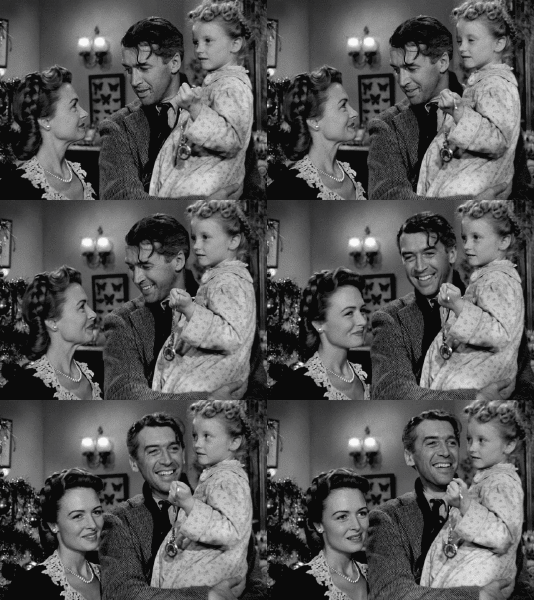
I hope you all had a wonderful Christmas! From my twitter feed, I know for some that means being as far away from relatives as possible 😉 If Christmas advertising were to be believed, we should all have families like this:

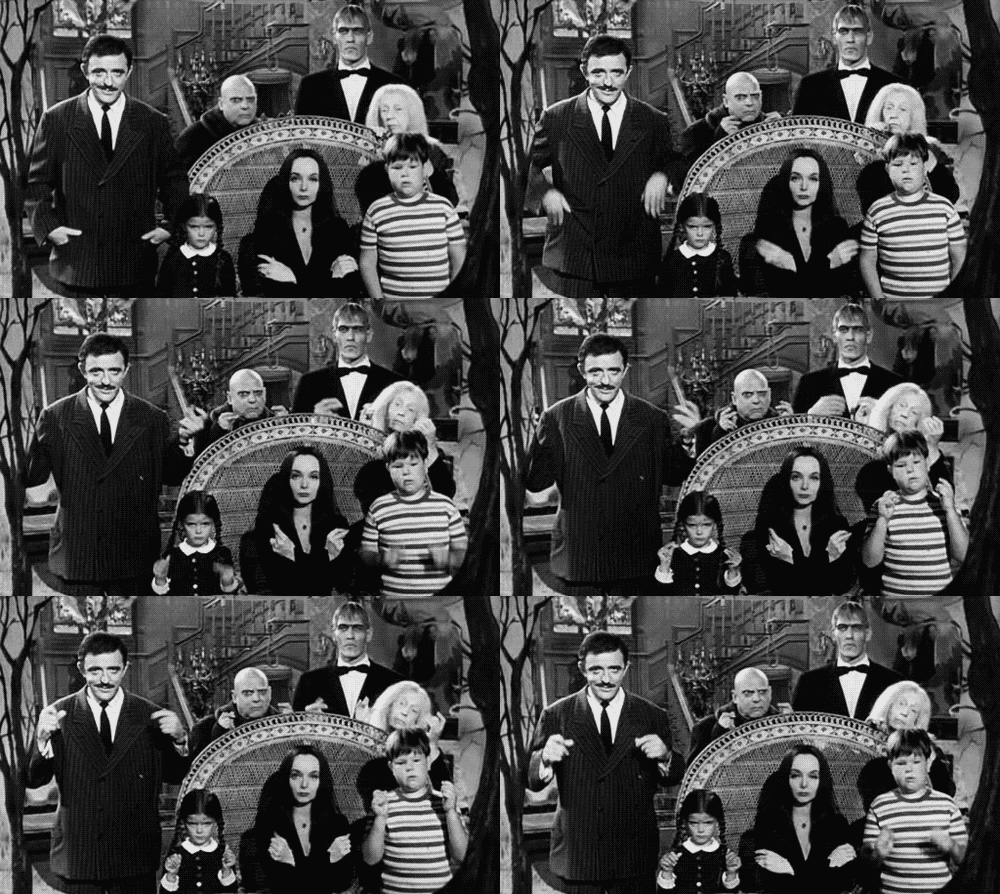
Whereas in fact the reality may be closer to this:

In which case I would say well done you, because I’m the only person alive who doesn’t like It’s a Wonderful Life *ducks for cover* whereas the Addams Family are awesome.  Whether you spent Christmas with George Bailey or Uncle Fester,  I thought this week might be a good time to look at families that are found in unexpected places.

Firstly, Plainsong by Kent Haruf (1999) which I picked up after loving Our Souls at Night so much and many bloggers recommended I start the Plainsong trilogy. All the things I enjoyed about Our Souls at Night were here: a gentle, unshowy voice, believable idiosyncratic characters, ordinary lives shown to have a delicate beauty.

Set in the fictional prairie community of Holt, Colorado, Plainsong focusses on a pregnant schoolgirl, Victoria Roubideaux, and one of her teachers, Tom Guthrie, who is splitting up with his wife. After Victoria is thrown out by her mother, another teacher, Maggie Jones, suggests to a pair of elderly brothers, Harold and Raymond McPheron, that they take her in.

“ You’re getting goddamn stubborn and hard to live with. That’s all I’ll say. Raymond, you’re my brother. But you’re getting flat unruly and difficult to abide. And I’ll say one thing more.

What?

This ain’t going to be no goddamn Sunday school picnic.

No it ain’t, Raymond said. But I don’t recall you ever attending Sunday school either.”

They offer Victoria a home, and the portrayal of their developing relationship with the young woman is just lovely. The brothers are set in their ways and unused to female company. Victoria is shy and unsure. The tentative gestures they make towards one another pay off and a tender, mutually nurturing affection develops.

“The brothers were watching her closely, a little desperately, sitting at the table, their faces sober and weathered but still kindly, still well meaning, with their smooth white foreheads shining like polished marble under the dining room light. I wouldn’t know, she said. I couldn’t say about that. I don’t know anything about it. Maybe you could explain it to me.

Well sure, Harold said. I reckon we could try.”

Meanwhile, Tom’s sons Ike and Bobby are struggling to come to terms with their mother’s depression and subsequent leave-taking. A similarly unexpected yet gentle cross-generational relationship develops between the boys and elderly, isolated Mrs Stearns who they know from their paper round.

“The timer dinged on the stove. They took the first oatmeal cookies out of the oven and now there was the smell of cinnamon and fresh baking in the dark little room. The boys sat at the table and ate the cookies together with the milk Mrs Stearns had poured out into blue glasses. She stood at the counter watching them  and sipped a cup of hot tea and ate a small piece of cookie, but she wasn’t hungry. After a while she smoked a cigarette and tapped ashes in the sink.

You boys don’t say very much, she said. I wonder what you’re thinking all the time.

About what?

About anything. About the cookies you made.

They’re good, Ike said.”

Plainsong is a gentle tale about all that human beings can give and be to one another, but it is not remotely sentimental or rose-tinted. Haruf shows, he doesn’t tell, with a restraint and subtlety that is easy to underestimate but is absolutely masterful. I find his writing incredibly moving. It’s going to be a real strain on my 2018 book buying ban not to rush out and buy the novels of his I don’t yet own.

Secondly, Sweet Bean Paste by Durian Sukegawa (2013, trans. Alison Watts, 2017). Again, this is a simply told tale of ordinary people, and it is truly heartwarming. The main protagonist is the decidedly unheroic Sentaro. He has a criminal record and is employed by people he owes money to. He sells dorayaki – pancakes filled with the titular paste – with no pride in or commitment to his work. One day Tokue, an elderly lady with a visible disability in her hands and face arrives in the shop:

“ ‘I had one of your dorayaki the other day. The pancake wasn’t too bad, I thought, but the bean paste, well…’

‘The bean paste?’

‘Yes. I couldn’t tell anything about the feelings of the person who made it.’

‘You couldn’t? That’s strange.’ Sentaro made a face as if to show how regrettable that was, though he knew full well his bean paste could to reveal no such thing.”

Sentaro employs Tokue on the understanding that she will not interact with the customers who he thinks will be put-off by her disability. Tokue’s delicious bean paste brings more customers to the shop and business begins to boom. As Sentaro and Tokue’s relationship develops, he begins to understand that she has survived Hansen’s disease (leprosy) but is still subject to significant stigma around the disease. One of the schoolgirl customers, Wakana, becomes very attached to Tokue, and they visit her at the asylum she continues to live in although the government has passed an act which means those with Hansen’s disease are no longer kept in isolation.

“Nevertheless human lives had been swallowed up by this place and for a hundred years, continually spurned. It felt to Sentaro as if the singular silence rose from the very earth beneath their feet, steeped as it was in sighs and regrets.”

Sweet Bean Paste is about living life to the full even when society is circumscribing it in cruel ways. It is about friendship’s power to heal and to empower. It is also about opening ourselves to experience the world in new and surprising ways, no matter our age. Tokue has an almost mystical relationship with her cooking, which enriches both her and those who consume her food.

“When I make sweet bean paste I observe closely the colour of the adzuki beans faces. I take in their voices. That might mean imagining a rainy day or the beautiful fine weather they have witnessed. I listen to their stories of the winds that blew on their journey to me.”

And so in the end, I think Sweet Bean Paste is about nourishment in all its forms; it is there for the taking if we have the wisdom to see it and the open hearts to embrace it.

To end, never let it be said that I shy away from the obvious:

“Merry Christmas, I don’t want to fight tonight” (The Ramones)

Happy Christmas everyone! I’ve picked 2 undemanding festive reads this week, as I for one am already finding my brain overtaxed – I blame all the twinkling lights.


To start, the irresistably titled Christmas With Dull People by Edwardian satirist Saki (republished this year by Daunt Books). This is a perfect stocking filler: 4 stories amounting to 48 pages, little bite-sized witticisms for when your brain is dribbling out of your ears trying to comprehend the inanities of Christmas telly as your stomach tries to digest a week’s worth of calories in one sitting.

The stories are so short I just want to give you a wee taster of what to expect, I can’t really say more or it will amount to paraphrasing the whole thing. Saki is wonderfully witty and contained but it does make the stories hard to review!

In the first story ‘Reginald’s Christmas Revel’ the titular man is trying to get through Christmas games with his relations.

“On Christmas evening we were supposed to be specially festive in the Old English Fashion. The hall was horribly draughty, but it seemed to be the proper place to revel in, and it was decorated with Japanese fans and Chinese lanterns, which gave it a very Old English effect.”

In the following story ‘Reginald on Christmas Presents’ he treats us to his opinions on the difficulty of festive gift-receiving:

“Then there are aunts. They are always a difficult class to deal with in the matter of presents. The trouble is that one never catches them really long enough. By the time one has educated them to an appreciation of the fact that one does not wear red woollen mittens in the West End, they die, or quarrel with the family, or do something equally inconsiderate. That is why the supply of trained aunts is always so precarious.”

We leave Reginald for ‘Bertie’s Christmas Eve’ in which Bertie, who “had in early life adopted the profession of n’er do well” treats his whole family appallingly in a farcical fashion.

Finally in ‘Down Pens’ a couple struggle with the thank you letter writing that inevitably follows the revelries:

 “I’ve come to the end of my capacity for expressing servile amiability. Eleven letters today and nine yesterday, all couched in the same strain of ecstatic thankfulness”

I hope this has given you enough of an idea of Saki’s wit and humour to convince you. A real treat, and calorie-free to boot!

Creepy snowmen break:

Secondly, Arrest the Bishop? By Winifred Peck (1949) which I picked up after reading Ali’s review. This is a lovely golden age mystery set in 1920, at Christmas time, although the festivities are not lingered over.

Dr Broome, the Bishop of Evelake, has various people arriving at his Palace where he lives with his second wife, their staff (minus Moira the housekeeper who is in hospital) and Bobs, his secretary. Joining them are Judith, his flighty, adulterous daughter from his first marriage; Sue, his sensible daughter from his second; Dick,  ex-military police and now a deacon; a Chancellor; a canon; and a group of young clerics. It is snowing heavily as you’d expect in a country house murder mystery, when the despicable Reverend Ulder arrives:

“when he focussed those eyes on you, with the secretive state of all creeping, slimy things and when his too oily manner stiffened into threats… the sensitive shuddered as if turning over a stone which conceals maggots”

This charmer is corrupt in just about every way you can imagine and having added blackmail to his repertoire, there is no shortage of suspects when he is poisoned. Dick helps out Chief Constable Mack with the investigation, but everyone seems so unlikely a murderer:

“Motive and opportunity alike seemed to point skeleton fingers at such preposterous figures – Judith – the Chancellor – Canon Wye – the Bishop himself!”

“Dick…was aware by now that his activities in the war would always seem to outsiders that of a sort of glorified policeman. Nor could he very well explain that til this day he had no experience whatever of suspecting Church dignitaries of murder.”

Mack seems determined to arrest the Bishop, while for Dick, the chief suspect is obsequious butler Soames:

“Had this chap been reading Wodehouse as a guide to butlers? For occasionally he would throw out such Jeeves-like sentiments with oily rectitude, in startling contrast to his usual sulky, aggressive manner.”

Despite their biases and their motley crew of suspects, of course they get there in the end. To be honest, the murderer is completely obvious, but this was part of the fun. I could just watch the investigation play out and enjoy this good-natured golden age mystery as a perfect comfort read for this time of year.

I contributed greatly to our team win at my work’s Christmas quiz this year, due to my specialist subject coming up: questionable late-20th century Christmas tunes. The clincher was knowing that this wasn’t Elvis Presley (trigger warning – creepy puppet):

“Just try new things. Don’t be afraid. Step out of your comfort zones and soar, all right?” (Michelle Obama)

A little while ago I went to see Edward St Aubyn interviewed and he was every bit as witty and compelling as I’d hoped. He mentioned that he finds dialogue the easiest part of writing, and an audience member asked him if he’d consider writing a play. St Aubyn said he didn’t really enjoy theatre (something along the lines of “I always seem to be in the middle of row M”) but that playwriting might be a bit of a holiday from novel writing, which I’m sure must have pissed off any playwrights in the audience sweating blood and ink over their drama.

Also, for any fellow Patrick Melrose series fans, and I know we are a precious bunch who don’t want to see TV mess up such novelistic perfection, he said he’d been on set to see the production that’s being made with Benedict Cumberbatch and he was very happy with it.

So, a long preamble to say that this is why I decided to look at playwrights writing prose this week.

Firstly, Samuel Beckett’s First Love and Other Novellas (1954-73, trans. Samuel Beckett and Richard Seaver) which I would argue aren’t novellas at all, they are all short stories (there are 4 stories in the collection and the 2 longest are only just over 20 pages). Pedantry aside, I would say if you like Beckett’s dramas you’ll like his short stories. It’s all here: existential crisis, bleak absurdism, humour and despair.

In The End, the first-person narrator is down on his luck, clothed in badly fitting clothes that ‘they’ have given him from a dead man, having burnt his (presumably to avoid disease). He eventually finds lodgings, but is turfed out and returns to an itinerant life:

“One day I witnessed a strange scene. Normally I didn’t see a great deal. I didn’t hear a great deal either. I didn’t pay attention. Strictly speaking I wasn’t there. Strictly speaking I believe I’ve never been anywhere. But that day I must have come back.”

Pretty Beckettian, no? I know he’s not for everyone, but what I like about Beckett is that all the absurdism and word-play is not an intellectual exercise only, but is underpinned by a great humanity and acute awareness of suffering which makes his work bleakly beautiful:

“The memory came faint and cold of the story I might have told, a story in the likeness of my life, I mean without the courage to end or the strength to go on.”

The idea of choosing the story we tell is continued in the next two stories, The Expelled where the narrator, having taken us through a day in his life concludes:

“I don’t know why I told this story. I could just as well have told another. Perhaps some other time I’ll be able to tell another. Living souls, you will see how alike they are.”

And also in The Calmative, where the narrator tells himself a story to assuage the fear of death:

“So I’ll tell myself a story. I’ll try and tell myself another story, to try and calm myself, and its there I feel I’ll be old, old, even older than the day I fell, calling for help and it came. Or is it possible that in this story I have come back to life, after my death? No, it’s not like me to come back to life, after my death.”

The final, titular story is needless to say, not a rose-tinted view of innocence and longing.

“I didn’t understand women at that period. I still don’t for that matter. Nor men either. Nor animals either. What I understand best, which is not saying much, are my pains. I think them through daily, it doesn’t take long, thought  moves so fast, but they are not only in my thought, not all.”

So, business as usual for Beckett despite the change in the form from drama 😀 If you’re not sure about Beckett but want to give him a go, you could do worse than start here; you’ll get a good flavour without having to pay extortionate theatre ticket prices only to find yourself stuck in the middle of row M.

Obligatory picture of Beckett’s amazing face:

Samuel_Beckett,_Pic,_1

Secondly, About Love and Other Stories by Anton Chekhov (trans. Rosamund Bartlett, OUP 2004). I’m being a bit cheeky claiming Chekhov primarily as a playwright for the purposes of this blog post, given that the back of my edition of these stories has a quote from Raymond Carver proclaiming Chekhov “the greatest short story writer who has ever lived”.

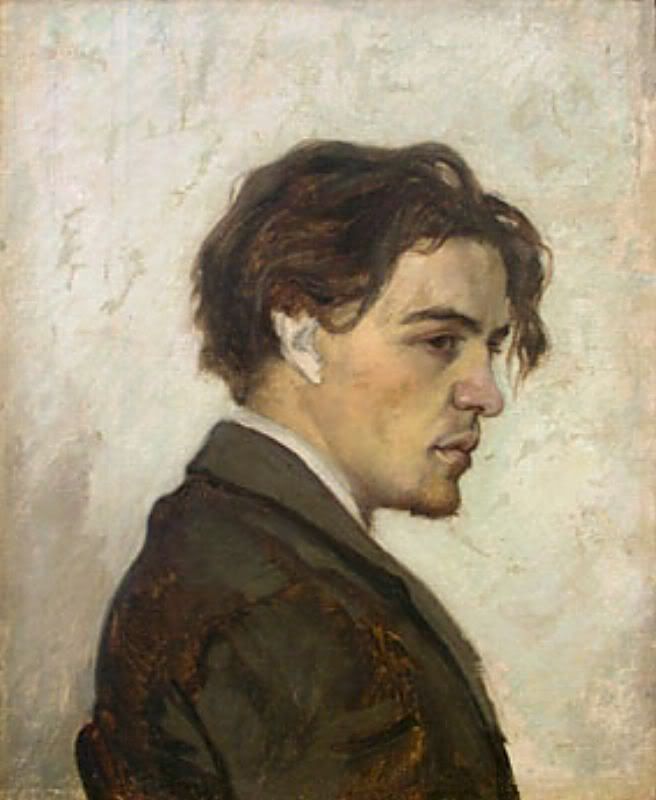
Anton Chekhov, who took up writing after One Direction split up

Having read this collection, I would say he really is a master. Beautiful writing, not a word out of place (as you’d expect given the famous ‘gun’ instruction regarding not having any superfluous detail) and he is able to take the miniature and make it epic. In The Lady with the Little Dog, Chekhov takes a well-worn story of a bounder seducing an unhappy woman and turns it into a tragedy, without it ever becoming sentimental or overblown.

“She pressed his hand and started walking down the stairs, looking back at him  all the time, and you could see from her eyes that she really was not happy. Gurov stood for a while, listening, and then when everything had gone quiet he looked for his coat-peg and left the theatre.”

It is the story not of a great love affair, but a love that sneaks up on two people who were not looking for it and how it seems to bring nothing but misery, but with an ever-present promise of unrealised happiness.

The stories are ambitious in theme and they are truly profound, but that doesn’t mean they are without humour. Rothschild’s Violin begins:

The town was very small – worse than a village really – and the people who lived in it were mostly old folk who died so rarely it was quite annoying.”

Yakov is the unfortunate coffin maker in this healthy town and he is grumpy and horrible to his wife. When his wife dies, he expresses his unexpected feelings through his violin playing, to great effect:

“Rothschild listened intently, standing to one side, his arms folded on his chest. The frightened, confused expression on his face gradually changed to one of grief and suffering. He rolled his eyes, as if experiencing exquisite pain”

A story about the universality of pain and the expression of feeling beyond words is explored with a lightness of touch that almost borders magic realism. Chekhov writes with such subtlety and never patronises the reader.

It’s really hard to write about Chekhov’s short stories. They are so rich, so full of telling detail and so beautifully evoked that I have not done any justice to them here. I only hope that I’ve convinced you to pick up one of his short story collections and read the treasures for yourself.

To end, following my last post’s comment by Lucy, a festive video of 2 men stepping out of their comfort zones and looking slightly baffled about it all (“I’m David Bowie, I live down the road” 😀 ):