Temperatures have dropped in the UK and I’m writing this after coming in from a surprise snow flurry, while Scotland’s had proper snow, so I think now it’s December & officially winter. My choices this week are suitably wintry in theme, but they’re not a big tome to curl up with on a winter’s day. I’m going through a prolonged novella phase at the moment and these are excellent examples of how much can be achieved in a short space. They’re small, but powerful.
Firstly, A Life’s Music by Andre Makine (2001, trans. Geoffrey Strachan) which comes in at 106 pages. The narrator is stuck in a snowbound railway station awaiting the Moscow train:
“Suddenly everything is illuminated by a truth that has no need of words: this night lost in a void of snow; a good hundred travellers huddled here; each seems as if he were breathing gently upon the fragile spark of his own life; this station with its vanished platforms; and these notes stealing in like moments from an utterly different life.”
The notes come from a piano being played by an elderly gentleman, tears streaming down his face. When they finally board the train, he tells the narrator his story, and why the music makes him cry. It is a tale of war and persecution, and of shifting identities in order to survive:
“As a result of this fear, and the assiduity with which he copied the actions of others during those first few weeks, he did not feel as if he were engaged in combat. And when he was finally able to relax the constantly taut string within him, he found himself in the sin of a veteran soldier”
Makine is interested in human endurance, in cruelty, in love and in moments of transcendence. He is brilliant at using small moments to illuminate big themes.
“To his surprise he felt himself growing increasingly separate from the wind, the earth, the cold, into which he had almost merged. But more surprising still was this simple bliss: the warm line where the woman’s body touched his own at night. Just this line, a gentle, living frontier, more substantial than any other truth in the world.”
A Life’s Music is a haunting tale written by a master. Makine proves that you don’t need to write at length to create something substantial. Stunning.
Secondly, A Meal in Winter by Hubert Mingarelli (2012 trans. Sam Taylor 2013) which is only 138 pages long. The premise of A Meal in Winter is incredibly simple, and the themes it explores incredibly complex. Three German soldiers find a Jewish man when they are on patrol in Poland. They do not share a common language with the young man and they take him prisoner with ease . They then retreat to an abandoned cottage to cook their meagre rations on a freezing winter’s day before taking him back to their barracks to be shot.
“everything would be better once it was warmer. Smoking and eating in front of the stove! What could be better? We would smoke while we waited for the bread to thaw and for the cornmeal to cook.”
The focus on essential human need for food, warmth and shelter is a master stroke by Mingarelli. The men are human first, soldiers second. Will they recognise their common humanity with their terrified prisoner and what will it mean if they do?
Mingarelli is excellent at building characters, scenes and atmosphere in a few words, and the desperate situation for all concerned is brilliantly evoked, within a harsh, freezing landscape:
“Sky and earth had blurred into one, and there was no comfort to be found in either. While I packed the snow into our mugs, I wondered again how it was possible that we had once seen so many sunflowers here, and not so long ago either. The landscape had been so full of them, so completely covered, that it seemed their oil must have been flowing like a river somewhere.”
A Meal in Winter is a powerful and moving novella that does not offer simple answers; it has really stayed with me.
To end, I know it’s a wee bit early for Christmas tunes, but I’ve chosen it because of the excellent snowy outfits. Remember kids: real fur is cruel, and spandex leggings are not suitable winter attire.
I’m managing to squeeze in one final post for German Literature month, hosted by Caroline and Lizzy. Hopefully next year I’ll be better organised and able to participate some more, but for now I’m off to Austria, which is also another stop on my Around the World in 80 Books Reading Challenge, hosted by Hard Book Habit. Do join in with GLM next year or AW80Books, they’re great ways to read some wonderful books 😊
Firstly, The Post Office Girl by Stefan Zweig (trans. Joel Rotenberg 2008) which was found amongst his papers after he killed himself in 1942. This is a melancholy tale of the impact of war on individuals, in this instance the First World War. Christine is a titular provincial civil servant, who finds herself in her late twenties having only known penny-pinching and drudgery.
“The war stole her decade of youth. She has no courage, no strength left even for happiness.”
Christine is plucked out of her ordinary life by her aunt who is visiting the Swiss Alps. She invites Christine to stay and the naïve woman is enraptured by the whirlwind of new clothes, fine dining and bright young things of which she is suddenly in the midst.
“All the world’s sweetness might be in this one thin straw of scalding ice. Heart thumping, fingers trembling avidly, she looks about for someone or something to receive her overflowing gratitude.”
Christine is transformed from a drudge into a beautiful young woman that people want to be with.
“In this instant, shaken to her very depths, this ecstatic human being has a first inkling that the soul is made of stuff so mysteriously elastic that a single event can make it big enough to contain the infinite.”
Then, just as suddenly, it is all taken away. Back in her small Austrian town she finds herself unable to cope with the poverty of the people, her home and her job. She meets Ferdinand, a soldier whose war wound means he is unable to continue his work as an architect. He is cynical of governments and bitter regarding his experience:
“In our Tartar village we didn’t know if Vienna was part of Bohemia, or maybe Italy. And we didn’t give a damn. All we cared about was stuffing a crust of bread down our throats and getting the lice out of our hair and finding some matches or tobacco sometime in the next five hours.”
For Christine, this man is soulmate, but these two souls are so damaged, so hurt and isolated, that they can only offer one another the bleakest kind of companionship.
“Christine was taken aback. The man beside her had said just what she’d been thinking all this time; he’d expressed clearly what she’d dully felt – the wish to be given one’s due, not to take anything from anyone, but to have some kind of life, not to be left out in the cold forever while others were warm inside.”
Zweig is unblinking in his portrayals of people, showing them with all their flaws, vanities and foibles, but still with great compassion. You feel for the characters precisely because they are so believably imperfect. The tyranny they face from the ruling class – either elected or via money – is presented as inescapable. The Post Office Girl is a novel about desperation, and how financial poverty can wear people down to a poverty of spirit. It is beautifully written and absolutely devastating.
In the Afterword of my edition William Deresiewicz suggests the novel is unfinished. I’m not sure I agree. I don’t know enough about Zweig’s style to argue my point forcefully, but to me, the ending occurs exactly where it should. It is perfect: sad but defiant, with so much unknown.
Secondly, The Piano Teacher by Elfriede Jelinek (1983, trans. Joachim Neugroschel 1988). Marina Sofia reviewed Jelinek’s volume of 3 plays In den Alpen for German Lit Month, do read her fascinating post which explains how controversial the author is in Austria due to her critique of Austrian society. The Piano Teacher was the first of her novels to be translated into English and it was also adapted into a film in 2001, starring the wonderful Isabel Huppert and directed by Michael Haneke. I haven’t seen it but it looks a faithful adaptation:
I found The Piano Teacher an incredibly tough read. Jelinek does not pull her punches in any way. This tale of Erika, a woman living in a claustrophobic, abusive relationship with her mother, and her masochistic sexual desires seeking expression with one of her pupils is really hard going.
“They are enclosed together in a bell jar: Erika, her fine protective hulls, her mama.”
Jelinek creates the cruel, affectionate relationship between mother and daughter brilliantly. They are bound together in bitterness and a warped love.
“The daughter is the mother’s idol, and Mother demands only a tiny tribute: Erika’s life.”
Erika’s relationship with her mother and the abuse she suffers, and enacts, feeds into her sexual preferences, reminding me of The Blue Room. She is repressed (she shares a bed with her mother), and this expresses itself through the violence she metes out to her unsuspecting fellow commuters, and in one horrible instance, a pupil she is jealous of. She is a voyeur and attends peepshows and stalks couples in the park, but is incapable of becoming sexually aroused by what she witnesses. When a student, Klemmer, expresses an interest in her, the two begin a clumsy, stunted affair. It is no great love story:
“Klemmer is still concerned about that damned aged difference. However, he is a man, and that easily makes up for the ten years Erika has over him. Furthermore, female value decreases with increasing years and increasing intelligence. The technician in Klemmer computes all this data, and the bottom line of calculations reveals that Erika still has a wee bit of time before wandering into the tomb.”
The Piano Teacher is brutal. Jelinek’s imagery is disturbing, particularly around the sexual or body parts [the next quote is an example of this, don’t read if you think it will upset you, but I wanted to give a clear idea of a recurring theme in the novel]:
“Rot between her legs, an unfeeling soft mass. Decay, putrescent lumps of organic material. No spring breezes awaken anything. It is a dull pile of petty wishes and mediocre desires, afraid of coming true. Her two chosen mates will encompass her by crab claws: Mother and Klemmer.”
I was relieved to get to the end of The Piano Teacher, I don’t think I could have taken much more. Jelinek is a brilliant writer: her pacing and plotting are perfect and she has powerful things to say about the psychological warfare we wage on ourselves and others. But now I have to go and find a nice Golden Age crime novel with which to recover….
Regular readers will know that I do like to end on an 80s pop video and will shoehorn them into a post wherever possible. I’m delighted that my trip to Austria means I can end on this:
Well, I’m off to an unbelievably slow start with German Literature Month, hosted by Caroline and Lizzy, given that we’re more than halfway through the month and this is my first post. I’m hoping I’ll get some more posts in before the month is out, but clearly myself and productivity are not friends right now.
A picture of sloths in a pathetic and failed attempt to make my laziness more endearing
Firstly, The Glass Bees (Gläserne Bienen, 1957) by Ernst Junger (trans. Louise Bogan & Elizabeth Mayer, NYRB, 2000), which was frankly, completely terrifying. Generally I’m not one for sci-fi/speculative fiction and now I know why, because they scare me silly. Written in the 1950s, the story is set in an undisclosed time and place sometime in future. At the time of publication, my edition tells me it was dismissed as irrelevant. To which I can only respond:
And commend those critics for their optimism. See if you can find any contemporary parallels: a powerful and ruthless business man has developed advanced technology and uses this to assert control of society through media and entertainment. Now I think about it, a more appropriate David Tennant gif would have been:
The tale is narrated by Richard, a war veteran and ambiguous character, who is considering being employed by the Donald Trump/Rupert Murdoch hybrid business man Zapparoni as a security chief/spy on his workers:
“The people employed by Zapparoni were an extremely difficult lot. Engaged in a most peculiar kind of work – the handling of minute and often extremely intricate objects – they gradually developed an eccentric, over-scrupulous behaviour, and they developed personalities which took offense at motes in a sunbeam.”
Zapparoni uses microtechnology but he has also developed automatons who are more than human. There are those that look like him and enable him to be in more than one place at once, and those who are used to promote an idealised form through film and media:
“Thus one might say that these figures did not simply imitate the human form but carried it beyond its possibilities and dimensions…the movements and expressions indicated that nature had been studied and surpassed.”
Likewise, the titular bees are micro-robots much more efficient at collecting nectar than actual bees. This unstable reality is part of the novel’s overall feel of not being able to trust what you see and struggling to understand feelings that are evoked by such odd circumstances. Richard is a cavalry soldier, and as such is an anachronism, harking back to days of animal and human power when the world has moved on. He is virtually unemployable, which is what leads him to Zapparoni in the first place, wholly aware that if he takes the job, at some point he is likely to meet with an ‘accident’.
Events at his job interview are equally discombobulating, with the elderly Zapparoni living in surprisingly old-fashioned surroundings and sending Richard into the garden for a gruesome test. I won’t say much more for fear of spoilers as The Glass Bees is a short (209 pages in my edition), tightly written novel set over 2 days. It packs a lot into such a short space though, as Richard’s immediate experiences and reminiscences give much food for thought on the nature of human beings, their relationship with technology, how power is wielded, where morality lies… big questions which mean The Glass Bees certainly leads itself to re-reading.
It is not a bleak novel; there is an enduring faith in humankind:
“I came to recognise that one single human being, comprehended in his depth, who gives generously from the treasures of his heart, bestows on us more riches than Caesar or Alexander could ever conquer. Here is our kingdom, the best of monarchies, the best republic. Here is our garden, our happiness.”
However, this faith is constantly under assault and The Glass Bees acts as a stark warning on the human price of technological progress:
“Human perfection and technical perfection are incompatible. If we strive for one, we must sacrifice the other; there is, in any case, a parting of the ways. .. Technical perfection strives towards the calculable, human perfection towards the incalculable.”
I’m not sure we’ve really learnt the lessons The Glass Bees presents. As I said at the start, terrifying.
From a speculative future to a novel that shows the fallout of the recent past, The Emigrants (Die Ausgewanderten, 1992) by WG Sebald (trans. Michael Hulse, Harvill Press, 1996). The Emigrants is familiar territory for readers of Sebald, dealing with displacement, memory and loss with a deceptively simple voice and a narrative that blurs the lines between fiction and autobiography, complete with illustrative photographs. Narrated by an emigrant who comes to England and settles in Manchester, its four sections tell the stories of different emigrants with whom he comes into contact. The first section, ‘Dr Henry Selwyn’ tells of his eccentric landlord.
“Dr Selwyn liked to be out of doors, and especially in a flint-built hermitage in a remote corner of the garden, which he called his folly and which he had furnished with the essentials. But one morning just a week or so after we had moved in, I saw him standing at an open window of one of his rooms on the west side of the house. He had his spectacles on and was wearing a tartan dressing gown and a white neckerchief. He was aiming a gun with two inordinately long barrels up into the blue.”
As this passage captures, the short section (around 20 pages) is both whimsical and yet with an underlying sense of something much more serious. It shows how, following the second world war, what we see on the surface belies the enduring damage and pain that persists.
The second section ‘Paul Bereytyer’ begins with a suicide. The narrator’s childhood teacher has lain on the train tracks and the narrator pieces together his past in an attempt to understand why. Paul is a quarter Jewish and during the war “out of blind rage or even a sort of perversion” he returns to Berlin and gets called up into the artillery. What is truly haunting in this section is that the clues to his end are there all along for those who knew him:
“Railways had always meant a great deal to him – perhaps he felt they were headed for death. Timetables and directories, all the logistics of the railways, had at times been an obsession with him… I thought of the stations, tracks, goods depots and signal boxes that Paul had so often drawn on the blackboard and which we had to copy into our exercise books as carefully as we could.”
The third section tells the story of the narrator’s Great-Uncle Adelwarth who travels around the world but ultimately ends up in an institution. In the final section, ‘Max Ferber’, an artist tells the narrator the story of his mother and the impact of the holocaust on his family.
“Memory…makes ones head heavy and giddy, as if one were not looking back down the receding perspectives of time but rather down on the earth from a great height, from one of those towers whose tops are lost to view in the clouds.”
The Emigrants is an incredible novel. Sebald writes with simplicity yet great beauty, building a picture of enduring war wounds. He demonstrates how the legacy of conflict is still to be felt, if only we open our eyes to see it.
“I now sometimes feel that at that moment I beheld an image of death [it] lasted only a very short time, and passed over me like the shadow of a bird in flight.”
To end, the trailer for the most expensive German TV series ever made, apparently. It’s set during the Weimar Republic, I’m 4 episodes in and enjoying it so far (contains scenes of drug taking and sauciness):
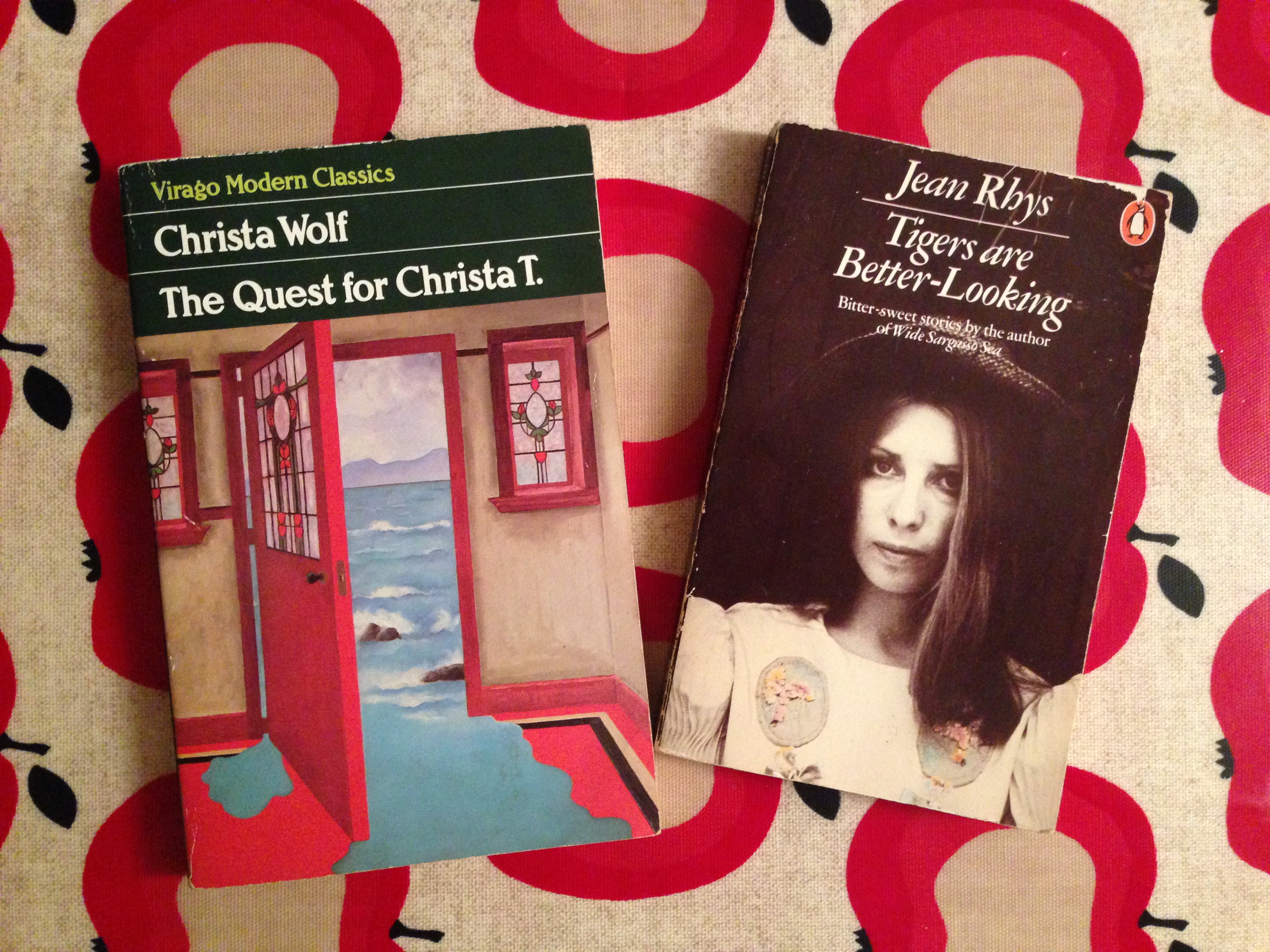
Firstly, The Quest for Christa T by Christa Wolf (trans. Christopher Middleton). This is the story of Christa’s life, told from the point of view of a schoolfriend who becomes reacquainted with Christa before leukaemia cuts her life short. The opening paragraph captures the concerns of the novel- the impossibility of ever truly knowing another person, and the fallacy of ever trying to capture them in order to portray them to others:
“The quest for her: in the thought of her. And of the attempt to be oneself. She speaks of this in her diaries, which we have, on the loose manuscript pages that have been found, and between the lines of those letters of hers that are known to me. I must forget my memory of Christa T – that is what these documents have taught me. Memory puts a deceptive colour on things.”
Christa is an enigma. She is self-contained but within that is a resistance; having survived Hitler’s Germany she doesn’t readily conform to East Germany’s strictures:
“she was always tall, and thin, until the last years, after she’d had children. So there she was, walking along in front, stalking head-in-the-air along the curb, and suddenly she put a rolled newspaper in her mouth and let go with a shout: HOOOHAAHOOO – something like that. She blew her trumpet and the off-duty sergeants and corporals of the local defense corps stopped and stared and shook their heads at her.”
This is a watershed moment for the narrator, the point at which she notices Christa and begins to acknowledge her wonder at her friend. However, while Christa is compelling, she also lives a life that is completely ordinary. She grows up, gets married, has children, and works as a teacher.
“Christa T lived strenuously even when she seemed lackadaisical; that ought to be attested, though the point here cannot be attested, though the point here cannot be to justify her…she didn’t attempt to escape from it all, as many people were starting to do in those years. When her name was called: “Christa T!” – she stood up and went and did what was expected of her.”
Despite this, the quest is not one that can be fulfilled – at the end we are in the position of the narrator in that we don’t know who Christa T is either. This is Christa’s final resistance: she conformed exactly how she was supposed to under Nazism and communism, and yet the state, her friends, and the readers of her story cannot box her in.
“There it is again, the language of her sketches, there her voice is heard again. Yet it will eventually have to stop; the moment is coming where the voice fails, and it can’t be interrupted. Some details pass me by, while I anticipate the end.”
The Quest for Christa T is fragmentary and non-linear, yet it still manages to be a satisfying whole. It is a subtle, beautifully written novel which allows for the reader’s intelligence to find their own meaning. But don’t just take my word for it, take David Bowie’s: The Quest for Christa T was one of his 100 must-read books.
Secondly, the short story collection Tigers are Better-Looking by Jean Rhys, which features two collections, the first 8 stores collected under the titular tale, the last 9 printed from The Left Bank, originally published in 1927. The rest of The Left Bank stories were judged by Rhys to be too weak to merit republication. Surprisingly though, these were my favourite part of Tigers are Better-Looking. While I enjoyed the first selection of stories, I felt they weren’t as strong as Sleep It Off Lady, her final collection of short stories published 8 years after this, which I had greatly enjoyed. While The Left Bank stories are essentially sketches, I thought they had real verve so I’ll concentrate on this section. When read all together they give a wonderful sense of a particular city at a particular time. Rhys captures people with artful description:
Illusion“Miss Bruce was quite an old inhabitant of the Quarter […] one thought of her as a shining example of what character and training – British character and training – can do. After seven years in Paris she appeared utterly untouched, utterly unaffected, by anything hectic, slightly exotic or unwholesome. Going on all the time all round her were the cult of beauty and the worship of physical love: she just looked at her surroundings in her healthy, sensible way, and then dismissed them from her thoughts”
And she is equally adept at capturing relationships, such as that between a painter and ex-prostitute in Tea with an Artist:
“And then I remembered the way in which she had touched his cheek with her big hands. There was in that movement knowledge, and a certain sureness: as it were the ghost of a time when her business in life had been the consoling of men.”
Rhys often drew on her own life and there are certainly stories here that will be familiar to anyone who has read her work: depression and poverty in Hunger, the life she knew as a shop model in Mannequin, but she also broadens her gaze. There is a touching portrait of an old man and child in From a French Prison, a tragic love affair in La Grosse Fifi quite different from the dinginess and malaise that characterises the affairs she normally writes about.The longest story is Vienne, and here is where the shadow of war begins to loom over the Europe she has been portraying. A young couple, too sad to be Bright Young Things, desperately traverse the continent without quite understanding the danger, but knowing they must reach safety.
“We drank a still wine, sweetish, at dinner. It went to my head and again I could tell myself that my existence was a dream. After all it mattered very little where we went. Warsaw, London…London, Warsaw…..Words! Quite without the tremendous significance I had given them.”
I don’t think Tigers Are Better Looking is Rhys at her best, but there is still so much to enjoy in this collection, flashes of brilliance even when the stories aren’t as strong. She’s a wonderful writer and reading this has encouraged me to dig out the remaining novels of hers that I have yet to read.
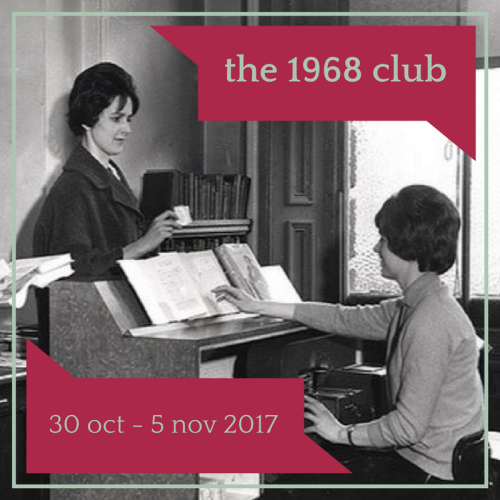
To end, the UK number one this week in 1968. All together now: la, la, la, la, la, laaaaaaaaaa….
October is Black History Month in the UK, so here is a little contribution, two wonderful novels that I want to gush about 😊
Firstly, Under the Udala Trees by Chinelo Okparanta (2015), a remarkably accomplished debut novel, set in the years during & immediately after the Biafran civil war.
Ijeoma loses her beloved father in the war:
“Uzo. It was the kind of name I’d have liked to fold up and hold in the palm of my hand, if names could be folded and held that way. So that if I were ever lost, all I’d have to do would be to open up my palm and allow the name, like a torchlight, to show me the way.”
Her mother struggles to cope with her grief and so Ijeoma is sent away, and it is then that she meets Amina. The young women’s mutual attraction is problematic within their highly religious society (not only are they gay, but Ijeoma is a Christian Igbo while Amina is a Muslim Hausa), and so their secret romance is always tempered with the knowledge that they could be torn apart at any moment:
“When our lips finally met, she kissed me hungrily, as if she’d been waiting for this all along. I breathed in the scent of her, deeply, as if to take in an excess of it, as if to build a reserve for that one day when she would be gone.”
Ijeoma’s sexuality forces her to question much that forms the foundation of her life in Nigeria, not least the religion she has been brought up to and educated within.
“Just because the Bible recorded one specific thread of events, one specific history, why did that have to invalidate or discredit all other threads, all other histories? Woman was created for man, yes. But why did that mean woman could not also have been created for another woman? Or man for another man? Infinite possibilities, and each one of them perfectly viable.”
Being gay is a dangerous thing for Ijeoma and the threat is very real; at one point a club she is in is raided. The women hide in a bunker left over from the war, but one who doesn’t make it is brutally murdered. Okparanta captures the fallout from the war and the ongoing violence faced by gay Nigerians in a dramatic but never sensationalist way. Under these pressures, Ijeoma tries to lead a conventional life but it unsurprisingly leads to true misery for all those involved:
“I acknowledge to myself that sometimes I am a snail. I move myself by gliding. I contract my muscles and produce a slime of tears. Sometimes you see the tears and sometimes you don’t. It is my tears that allow me to glide. I glide slowly. But, slowly, I glide. It is a while before I am gone.”
Under the Udala Trees is very much rooted in a particular country at a particular time, but it has something to say as well that is beyond the specific. It is most definitely about the continued criminalisation of gay people in Nigeria, and it is also about how all of us have to question the beliefs and structures we are raised within, and find our own way to be free:
“That tethering way in which the familiar manages to grab ahold of us and pin us down.”
This is an accomplished first novel, and Okparanta is a wise writer. She creates beautiful prose, compelling characters and a well-paced story, and she has important things to say about the world and those of us in it.
“Sometimes it is hard to know to whom the tragedy really belongs.”
I’m excited to see what she does next.
Secondly, The Bridge of Beyond by Simone Schwarz-Bart (1972, trans. Barbara Bray 2015), and one more stop on my Around the World in 80 Books Reading Challenge, hosted by Hard Book Habit.
I wanted to read this after seeing Claire’s wonderful review at Word by Word (over a year ago – I get there in the end…) My copy is the New York Review of Books edition, which I recommend for a sensitive, enthusiastic introduction by Jamaica Kincaid.
Narrated by Telumee, it tells the story of her life on the island of Guadeloupe, and the women she is descended from. The opening paragraph is just beautiful:
“A man’s country may be cramped or vast according to the size of his heart. I’ve never found my country too small, though that isn’t to say my heart is great. And if I could choose it’s here in Guadeloupe that I’d be born again, suffer and die. Yet not long back my ancestors were slaves on this volcanic, hurricane-swept, mosquito-ridden island. But I didn’t come into the world to weigh the world’s woe. I prefer to dream, on and on, standing in my garden, just like any other old woman of my age, til death comes and takes me as I dream. Me and all my joy.”
Part One tells the story of her mother Victory, and her grandmother, Queen With No Name, who raises Telumee. Her great-grandmother was a freed slave and her descendants have lives which are hard and with more than their fair share of grief, but also with moments of love and joy. After her father is stabbed, Telumee’s mother is swamped in grief, until she falls in love again. She doesn’t want her young daughter living with them, and so Telumee goes to live with Queen Without Name:
“Grandmother was past the age for bending over the white man’s earth binding canes, weeding and hoeing, withstanding the wind, and pickling her body in the sun as she had done all her life. It was her turn to be an elder; the level of her life had fallen; it was now a thin trickle flowing slowly among the rocks, just a little stirring every day, a little effort and a little reward.”
Telumee grows up in the loving home of her grandmother but Queen Without Name cannot protect her from making a disastrous marriage. Telumee survives though, and The Bridge of Beyond is a tale of overcoming adversity, of finding strength within yourself that you didn’t know you had, and of drawing on the strength of other women to help you endure.
“Through all her last days Grandmother was whistling up a wind for me, to fill my sails so that I could resume my voyage.”
Schwarz-Bart is a beautiful writer who captures an individual voice compassionately without descending into cliché. I’ll definitely be looking to read more of her work.
You’re telling me Jane. I travel every weekday from south to east London and I’ve become increasingly aware that my lungs are taking a right battering. Still, I do love the east of the city, as I think it’s the best place to get a sense of the layers of history of London. The street names give subtle clues to their past lives by being called things along the lines of Ale Draper’s Alley and Jellied Eel Pass (OK, I may have made those up) and everywhere you go there is something to learn. I eat my lunch next to William Blake and Daniel Defoe’s graves and an adjacent road is the last in London to have preserved the Victorian wooden block paving. If you’re a massive geek like me, you can watch a little 1 minute video about it here, and because it’s the East End, of course there’s some stuff about the Krays in there too.
This nerdy preamble is to say that this week I’ve chosen the theme of historically-set London novels, stories based in the Victorian era and 1960s, despite both being written in the 1990s.
Firstly, Dan Leno and the Limehouse Golem by Peter Ackroyd (1994). This short novel weaves together the story of Elizabeth Cree, sentenced at the start of the novel to death by hanging for murdering her husband, with that of Dan Leno, music hall star, and the Limehouse Golem, insane mass murderer preying on the East End poor. Ackroyd has great fun evoking the gothic atmosphere of Victorian London:
“The early autumn of 1880, in the weeks before the emergence of the Limehouse Golem, was exceptionally cold and damp. The notorious pea-soupers of the period…were quite as dark as their literary reputation would suggest; but it was the smell and the taste of the fog which most affected Londoners. Their lungs seemed to be filled with the quintessence of coal dust, while their tongues and nostrils were caked with a substance known colloquially as ‘miners’ phlegm’”
This fetid atmosphere carries off Elizabeth’s mother, and so she packs her bags and gets a job at the music halls. She adores Dan Leno, who takes her under his wing but remains unknowable:
“He was still very young but he could already draw upon an infinite fund of pathos and comic sorrow. I often wondered where it came from, not finding it in myself but I presume that there was some little piece of darkness in his past.”
The narrative is focussed on Elizabeth and so Dan remains somewhat unknown to the reader, but there is a sense that everyone in the novel is unknowable to an extent. As the narrative cuts back and forth in time, between Elizabeth’s story, court transcripts, and the Golem’s diary, the reader is piecing together the story from fragments. In that way it places us in the position of detectives, who obviously don’t arrive at crime scenes to then work a linear story backwards to determine what happened.
Ackroyd’s brain is roughly the size of Russia and his historical knowledge is formidable but never overtakes the story. He has fun with it – there are cameos from famous people: Oscar Wilde, Karl Marx and George Gissing all make appearances. He also has fun with the irreverent, insane, entertaining voice of the Golem:
“What a work is man, how subtle in faculties and how infinite in entrails!”
The film of Limehouse Golem came out earlier this year. From the trailer it looks as if changes were made, notably to focus much more on the investigating detective. If you’ve seen it, I’d love to hear your thoughts on whether I should watch it in the comments:
Secondly, forward to the 1960s and The Long Firm by Jake Arnott (1999). Gangster novels aren’t really my thing, but Susan from A Life in Books convinced me in one of her Blasts from the Past that as I’d enjoyed the TV series I should give it a try. She was absolutely right; it may open with Harry Starks warming a poker in order to insert it into someone, but The Long Firm is an intelligent study of the effects of violence and the damage wreaked on the people who inhabit shady netherworlds of crime.
“Breaking a person’s will, that’s what it was all about. He’d explained it to me once. Harry didn’t like to do business with anybody he couldn’t tie to a chair. He liked to break people. Sometimes it was a warning, sometimes a punishment. Always to make one thing very clear. That he was the guvnor.”
The story is told from five viewpoints in chronological order: Harry’s lover, a peer of the realm business partner, a small time gangster, a showgirl/beard and sociology lecturer all give us their view of Harry but ultimately he remains obscure. This is entirely appropriate: like the Krays and the Richardsons, legend builds up around the life and the crimes and the people themselves become lost.
The Long Firm’s historical detail and accuracy seems entirely authentic, and as in Golem, real life characters – this time the Krays, Judy Garland, and Jack the Hat who narrates one section – make appearances. Harry himself is reminiscent of Ronnie Kray but is still a believable individual character.
The Long Firm doesn’t shy away from the realities of Harry’s profession in any way but it also doesn’t dwell on it or glamorise it; Arnott is more intelligent and interesting than that. There are doses of bone-dry humour:
“He is fascinated by the world of privilege. A patriotic desire to be part of a really big racket, I suppose.”
The interest in The Long Firm is in the people that revolve around this world: what they gain and what they lose by their involvement, the prices that are paid and why they are there in first place:
“I relied on Harry. And his ruthlessness at least had a certainty to it. He was on to a sure thing. It didn’t seem that I’d have to do very much. But I felt myself being drawn into something. A gravity that governed me. As if I’d always really belonged to seediness and the bad side of things.”
Ultimately, I think The Long Firm is about stories. Why there are so many stories that emerge from this time and section of society, what is truth, what is fable, whether the difference matters, and why these stories are still being told.
The Long Firm was adapted into a 4-part series by the BBC in 2004 and my memory of it is that it was excellent. Certainly Mark Strong is never anything less than compelling:
Hey freshers! If you’re reading this, it means only one thing: you survived Fresher’s Week! Congratulations! Now get yourself dosed up on alka seltzer and down to the GUM clinic, pronto.
If there’s one thing I’m expert on, other than TV detectives and cheese, its being a student. I’m ridiculously overqualified and not studying anything for the past 2 years is the longest I’ve ever gone without sitting a course of some kind, probably ever. I’m feeling decidedly twitchy and trying to decide what I want to educate myself in next (current contenders: whisky tasting/dry stone walling (not a huge demand in London, admittedly)/ French language) but until that time I’ve gone back to college via 2 wonderful novels. And for all those students out there, pay attention to your older, wiser Madame B, and remember:
Firstly, Stoner by John Williams (1963), which is something of a rediscovered classic in recent years, with effusive praise heaped on it from all quarters. In this instance I thought the hype was absolutely deserved. Stoner is a beautifully written, acutely observed portrait of an ordinary life which is deeply moving.
William Stoner grows up on a farm without books, until his father takes the remarkable decision that Stoner should study agriculture at the University of Missouri, which he joins in 1910. What no-one foresees, least of all Stoner himself, is that he will fall in love, with literature:
“As his mind engaged itself with its subject, as it grappled with the power of the literature he studied and tried to understand its nature, he was aware of a constant change within himself”
And so we follow Stoner as he becomes a student of literature, then a teacher, and never leaves the university.
“Sometimes he stood in the centre of the quad, looking at the five huge columns in front of Jesse Hall that thrust upward into the night out of the cool grass… Grayish in the moonlight, bare and pure, they seemed to him to represent the way of life he had embraced, as a temple represents a god.”
The life Stoner leads is very ordinary: he makes a disastrous marriage but they stick it out, he becomes an OK teacher, he makes friends and enemies, he has a loving but complex relationship with his daughter… nothing happens and everything happens. The writing is so good that you are pulled along through this everyday story just as much as you would be through a heavily plot-driven thriller.
Stoner is undeniably a sad novel. Stoner has a lot of loneliness in his life and he is victim to circumstances which he cannot control and which are grossly unfair, engineered by people who vent their pain on him. Yet it is not depressing, because he endures and he finds joy. For the bibliophile, there are some beautifully realised passages describing why we love literature:
“the epiphany of knowing something through words that could not be put into words”
More generally, there is peace to be found in accepting the things we cannot change, and there is plenty Stoner cannot change:
“As he walked slowly through the evening, breathing the fragrance and tasting upon his tongue the sharp night-time air, it seemed to him that the moment he walked in was enough and he might not need a great deal more.”
I highly recommend this quietly heart-breaking novel.
Secondly, The Art of Fielding by Chad Harbach (2012), which I never would have picked up, thinking it was a sports novel, if it wasn’t for Kate at Books are My Favourite and Best reassuring me that it definitely was about more than baseball (she’s right); you can read her review here.
The Art of Fielding follows Henry Skrimshader’s career at Westish College, where he is accepted due to his prowess on the baseball field. He is recruited there by Mike Schwartz, an ambitious jock whose knees are giving out; he rooms with Owen Dunne, a beautiful clean-freak who is also a highly talented player and who begins a problematic affair; and President Affenlight discovers a new love of baseball alongside other more surprising things, just as his troubled daughter Pella returns home.
“If Affenlight were to list the things he loved, he wouldn’t include Westish – that would seem silly, like saying you loved yourself. He spent half his time frustrated with, ambivalent about, annoyed at the place. But anything that happened to alter the fortunes of Westish College, Affenlight took more seriously than if it were happening to himself.”
Henry’s career at Westish does not go smoothly and his crisis affects all those around him. There is quite a lot about baseball in the novel and it all went over my head seeing as how I’ve never watched a game in my life and don’t really plan to change this, but it didn’t affect my enjoyment of the novel in the slightest. Harbach’s writing reminded me a bit of Richard Russo, in that it captures a slightly old-fashioned, all-American life, but is involving and affecting because of this, rather than nostalgic and distancing. The focus is very much on well-drawn, idiosyncratic characters and their relationships, so that you feel absolutely drawn into their lives.
I may not know much about baseball, but what Harbach taught me is what I’ve always suspected, that for people who get it, sports and life are one and the same:
“What would he say to her, if he was going to speak truly? He didn’t know. Talking was like throwing a baseball. You couldn’t plan it out beforehand. You just had to let go and see what happened. You had to throw out words without knowing anyone would catch them – you had to throw out words you knew no one would catch. You had to send your words out where they weren’t yours anymore.”
Really, The Art of Fielding is about love. Love between friends, parents and children, siblings, lovers, team mates, teacher and student, platonic, romantic, familial… in all its guises. And in that it is deeply moving. The ending isn’t sad but it still made me cry on the bus, dammit.
To end, a song I heard last week for the first time in years, and which took me straight back to my first foray into further education:
August is Women in Translation month, hosted by Meytal at Biblibio. I’ve been faithfully reading translated fiction throughout the month but I have failed miserably at blogging about any of it. Usually when bloggers disappear for a bit they’ve gone on holiday/fallen in love/started a new job. I have no such exciting excuses – I’m at the same job, feeling bitter about a lack of holiday & the nearest I’ve got to romance is shamelessly objectifying Tom Burke in the new Cormoran Strike adaptations on the BBC:
In a bid to catch up, here is a quick summary of the 6 novels I’ve read in translation, all quite short but all punching well above their weight in terms of powerful, affecting stories. They also include 2 more stops (France & Greece) on my much neglected Around the World in 80 Books Reading Challenge hosted by Hard Book Habit.
Colette – The Other One (1929, trans. from French by Elizabeth Tait & Roger Senhouse 1960)
Given I’m such a Francophile, it came as a great surprise to me that I hadn’t yet visited France as part of #AW80Books so I’ve rectified the situation with Colette’s tale of infidelity and complex family dynamics over the course of a summer in a villa in France.
Fanny is married to Farou, and awaits his return in a villa where she lives with her stepson Jean and companion Jane, with whom Jean is in love. Fanny subsequently comes to realise that Jane is one of Farou’s many extra-marital dalliances.
It’s a slim novel (157 pages in my edition) and in a sense very little happens. What The Other One offers is a beautifully written, subtle exploration of the psychological complexities that exist between people who are inextricably bound up in one another’s lives, with all the love and pain that can entail.
“Fanny turned on Jane her Paris smile, well made-up and full-lipped, and Jane, whose fair hair lit up a corner of the room, was instantly extinguished.”
Marguerite Duras – La Douleur (1985, trans. from French by Barbara Bray 1986)
I’m overcompensating now by staying France, with Duras’ typical mix of autobiography and fiction, regarding her war experiences. At the start of La Douleur she writes that the work is based on diaries she discovered which she doesn’t remember writing. The six stories/diaries move back and forth across the period of the war and create the sense of a fragmented narrative which explores the desolation and destruction of war and the impossibility of telling a tale of such insurmountable human loss in only one way. I found it incredibly powerful.
“Suddenly freedom is bitter. I’ve just come to know the total loss of hope and the emptiness that follows; you don’t remember, it creates no memory. I think I feel a slight regret at having failed to die while still living. But go on walking, I move from the street to the sidewalk, then back into the street. I walk, my feet walk.”
Sun-Mi Hwang – The Hen Who Dreamed She Could Fly (2000, trans. from Korean Chi-Young Kim 2013)
This is the story of a hen named Sprout. She decides she wants more from life than laying eggs to be taken away: she wants to live in the wild and raise a chick.
This fable is incredibly clever, in that you can read it to a child but there is plenty for adults here too. It’s a story written with great lightness of touch, and as such the lessons it teaches are various, depending on what you find in it. It could be about (for starters): going your own way in life, questioning authority, facing fears, attitudes to immigrants, the value of empathy, adoptive families, familial love, finding freedom…
“Sprout was the best name in the world. A sprout grew into a leaf and embraced the wind and the sun before falling and rotting and turning into mulch for bringing fragrant flowers into bloom. Sprout wanted to do something with her life, just like the sprouts on the acacia tree. That was why she’d named herself after them. Nobody called her Sprout, and she knew her life wasn’t like a sprout’s, but still the name made her feel good. It was her secret.”
The edition by Oneworld books also features lovely illustrations by Nomoco, worth seeking out.
Penelope S Delta – A Tale Without a Name (1911, trans. from Greek by Mika Provata-Carlone 2013)
Another fable, and another lovely edition from Pushkin Press whose description explains that this is ‘one of Greece’s best loved stories.’ It tells of an indulgent arrogant king who takes his nation into ruin and the son and daughter who bring it back to prosperity under a policy of meaningful employment for the greater good.
“Time always passes. But if you consume yourself in idle things you waste it; whereas if you do work that has a purpose, you make good use of time.”
It’s also a militaristic tale – much emphasis on vanquishing enemies and building armies – but ultimately it is about social responsibility. I don’t think it’s a stretch to see it as deeply political: Delta’s father was a mayor who narrowly avoided execution, her diplomat lover was assassinated and she killed herself the day the Nazis reached Athens. A Tale Without a Name presents complex political ideas in a deceptively simple style.
Han Kang – Human Acts (2014, trans. Deborah Smith 2016)
This novel caused me to deviate from a wholly WITMonth August, as I was so upset by it that I had to read a British Library Crime Classic to recover. I approached it wholly ignorant of the political turmoil that South Korea had experienced in the 1980s. Kang pitches us into the student uprising in Gwangju in 1980. It begins with a boy searching for the body of his friend amongst the piles of corpses that a brutal regime creates.
“Why would you sing the national anthem for people who’d been killed by soldiers? Why cover the coffin in the Taegukgi? As though it wasn’t the nation itself that murdered them.”
Human Acts follows various people all connected to the uprising, and Kang absolutely does not pull her punches. What the piles of bodies mean in human terms is explored fully both in terms of the emotional ramifications and the hard reality of how to deal with so many bodies. It’s a novel that deals with extreme brutality in sensitive, subtle prose.
“Their faces had been covered in white paint, erased. I swiftly shrank back. Necks tipped back, those dazzling white faces were angled towards the thicket. Staring out into the empty air, their features a perfect blank.”
The novel contains scenes of torture that are hard to bear, but never gratuitous. In the final part of the novel, Kang explains her own links to the story, and how this is not quite fiction. It’s astonishing that someone personally affected by the tragedy can write something so carefully constructed, but this is what she has achieved. The story is crafted but absolutely unflinching in looking at atrocities inflicted by governments and their devastating fallout.
“She had no faith in humanity. The look in someone’s eyes, the beliefs they espoused, the eloquence with which they did so, were, she knew, no guarantee of anything. She knew the only life left to her was one hemmed in by niggling doubts and cold questions.”
Elena Ferrante – The Lost Daughter (2006, trans. from Italian Ann Goldstein 2007)
Finally, I’m a bit undecided about the Neapolitan quartet and feel slightly baffled as to why its garnered quite so much praise, but I did enjoy this novella from Ferrante and those who love the quartet will find much that is familiar here: a flawed female narrator, conflicts with loved ones, a sense of violence close to the surface.
Leda takes a holiday alone in southern Italy. She is disturbed by a loud extended Neapolitan family and a certain event draws her into their sphere. During the course of the holiday she reflects on her life and the repercussions of the choices she has taken, on herself, her marriage and her daughters.
“My daughters make a constant effort to be the reverse of me. They are clever, they are competent, their father is starting them out on his path. Determined and terrified, they advance like whirlwinds through the world, they will manage better than us, their parents.”
Leda isn’t likeable but the narrative is compelling and pulls you along to deliver a short sharp shock.
As regular readers will know, I need no encouragement to indulge in an 80s pop video. Here’s one that was a massive hit in the original German and in English translation. It’s about nuclear war; of course we have no worries about such an event now…
This is part of a series of occasional posts where I look at works from Le Monde’s 100 Books of the Century. Please see the separate page (link at the top) for the full list of books and an explanation of why I would do such a thing.
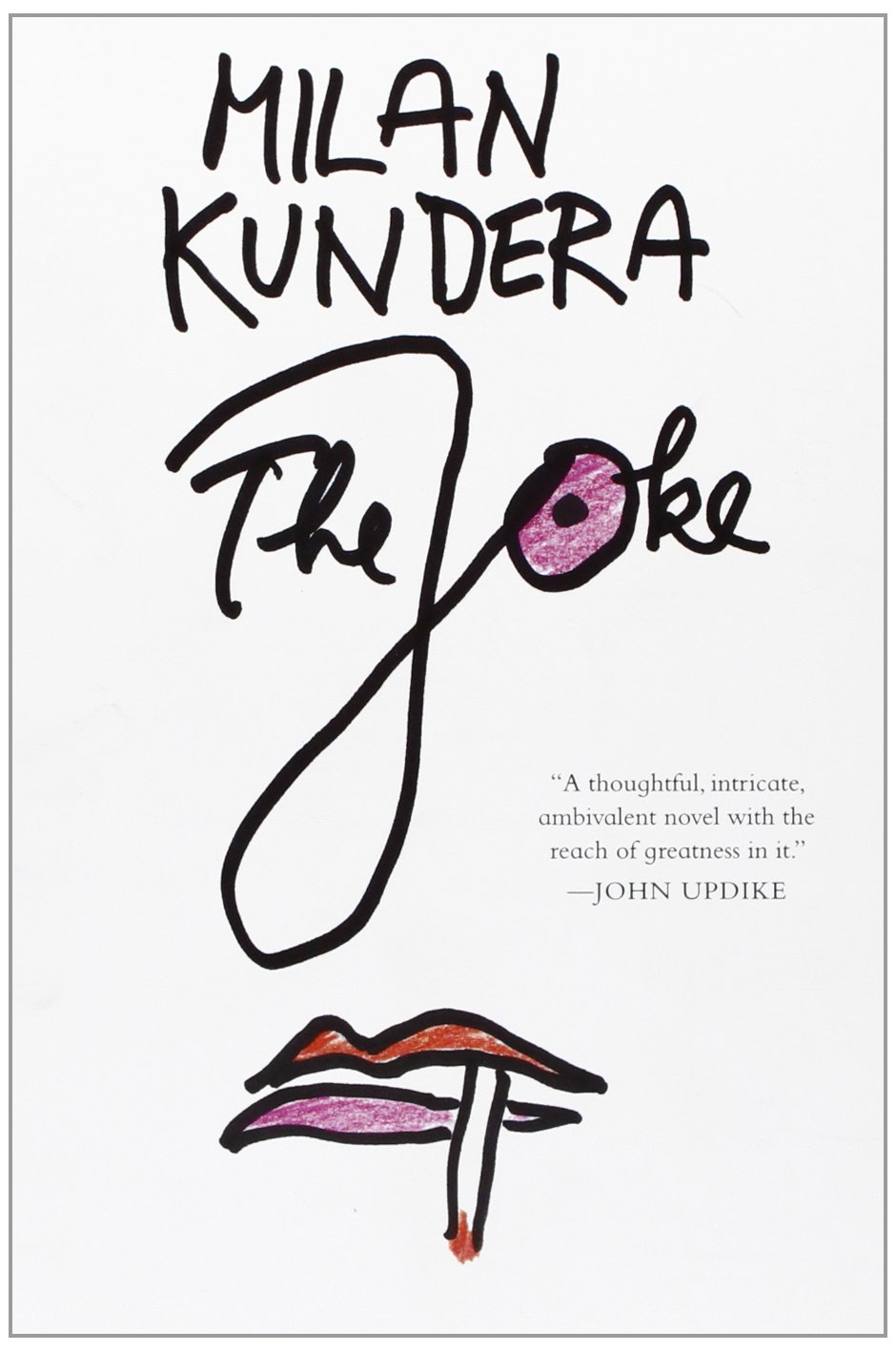
The Joke (1967; trans. Michael Henry Heim 1982*) is the first Milan Kundera I’ve read, as I found his massive intellectual-philosopher reputation intimidating to my tiny brain. However, I found this, his first novel, very readable so who knows, maybe I will tackle the cumbersomely-titled The Unbearable Lightness of Being at some point?
Ludvik lives in 1950s communist Czechoslovakia (as it then was) and is sulking when he sends his girlfriend, Marketa a facetious postcard:
“Optimism is the opium of the people! A healthy atmosphere stinks of stupidity! Long live Trotsky!”
Unfortunately, as we who live in the age of twitter know, irony is not always apparent in the written word and the authorities do not appreciate his sentiments. He is thrown out of the Party and sent to a labour camp with other political dissidents. The story is told from the viewpoint of Ludvik, his friend Jaroslav who is interested in Moravian culture, lecturer Kostka who is Christian in the face of Ludvik’s atheism, and journalist Helena who is used cruelly to facilitate a revenge act.
As Ludvik looks back on his interrupted career and the injustice he has suffered, Kundera offers an incisive commentary on the effect of repressive regimes, but also questions how far all of us can lose sight of ourselves in the face of societal pressures:
“When the Comrades branded my conduct and my smile as intellectual (another notorious pejorative of the times) I actually believed them. I couldn’t imagine (I wasn’t bold enough to imagine) that everyone else might be wrong, and that the Revolution itself, the spirit of the times, might be wrong, and I, an individual, might be right. I began keeping tabs on my smiles, and soon I felt a tiny crack opening up between the person I’d been and the person I should be (according to the spirit of the times) and tried to be.”
Ludvik attempts to enact a revenge for his treatment, but it does not go as planned. He realises that the man who has become the focus of his anger is only a man, and that the issues are larger than a single person.
“How would I explain I used my hatred to balance out the weight of evil I bore as a youth? How would I explain I considered him the embodiment of all the evil I had ever known? How would I explain I needed to hate him?”
Overall, the sense is of an almost Beckettian absurdity. There isn’t the surrealism of Beckett, but certainly the sense of futility and powerlessness of the individual in the face of an indifferent world. Kundera evokes this lightly, so The Joke is not a heavy read, although it considers huge themes. While the politics are particularly relevant to Europe in the last century, the story moves beyond the specific to challenge the role of the individual within structures in which we live, how much agency we have, and what responsibility that brings with it.
“what if history plays jokes? And all at once I realise how powerless I was to revoke my own joke: I myself and my life as a whole had been involved in a joke much more vast (all-embracing) and absolutely irrevocable.”
Kundera has been exiled in France since 1975 after criticising the repressive nature of the then Czech government. The Joke is not self-righteous or overly polemical: it portrays, Kundera writes in the introduction, a man “condemned to triviality”. While this ironical awareness distanced me from Ludvik somewhat and stopped me totally loving this novel, it also prevents The Joke being pompous, and instead funny, sad, tragic and wise.
To end, an apt song which I hope a book blogger who likes singers called Barry will enjoy even though it’snot Barry singing, and a video that is most definitely of a certain era (it wasn’t all repressive politics in the 1960s kids, there were psychotropic drugs too!):
*It’s worth seeking out a later translation of the novel, as Kundera was unhappy with the first English translations but has authorised the later ones
Unfortunately due to the weird summer we’re having (unseasonably hot/unseasonably cold on repeat) the scourge of my life, the devil’s seed, aka grass pollen, is still in abundance and I am refusing to go anywhere that isn’t made of concrete/steel/brick, or some combination thereof.
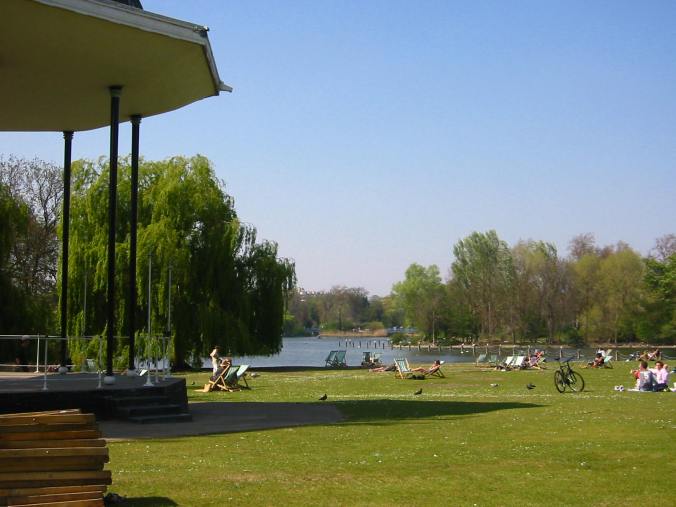
Well, I’ll tell you, Leo. You live through books of course, same as always. So this week I’m visiting my favourite London park, Regent’s, via two wonderful novels.
Firstly, The Heat of the Day by Elizabeth Bowen (1948), where protagonist Stella lives near Regent’s Park and where the opening scene sees counterspy Harrison flirting with Louie, an ordinary young woman who is open to affairs while her husband is away fighting the war.
“The very soil of the city at this time seemed to generate more strength: in parks outsize dahlias, velvet and wine, and the trees on which each vein in each yellow leaf stretched out perfect against the sun blazoned out the idea of the finest hour. Parks suddenly closed because of time-bombs – drifts of leaves in the empty deckchairs, birds afloat on the dazzlingly silent lakes – presented, between the railings which still girt them, mirages of repose.”
This eerie quality pervades the whole novel. While there is a plot – Harrison wants Stella to spy on her lover Robert, who is spying for the Germans – I felt this was not the driving force of what Bowen is writing about. Instead I think what she is considering is a very specific generation of people at an extraordinary moment in time.
“Younger by a year or two than the century, [Stella] had grown up just after the First World War with the generation which, as a generation, was come to be made to feel it had muffed the catch. The times, she had in her youth been told on all sides, were without precedent – but then so was her own experience: she had not lived before.”
There is a sense throughout the book of things left unsaid, sentences unfinished, and yet a deep understanding that exists between everyone living through the war.
“So among the crowds still eating, drinking, working, travelling, halting, there began to be an instinctive movement to break down indifference while there was still time. The wall between the living and the living became as solid as the wall between the living and the dead thinned. In that September transparency people became transparent, only to be located by the just dark flicker of their hearts.”
People behave in ways that they wouldn’t normally, but they can barely remember what normal is, or why they would behave that way in the first place. Bowen tends to overwrite, but as with the other novels of hers that I’ve read, this quality didn’t bother me as much as it does usually, and I felt it particularly apt here. I just let the writing and the atmosphere wash over me. Thankfully, I’ve not lived through that type of war, but to me Bowen seemed to have done an incredible job at capturing the heightened yet oddly detached experiences that would have occurred:
“But they were not alone, nor had they been from the start, from the start of love. Their time sat in the third place at their table. They were the creatures of history, whose coming together was of a nature possible in no other day”
The Heat of the Day is about the tragedy of war in the widest sense, where no guns go off and people carry on whilst feeling torn apart. Sad, desperate, quiet, and beautifully evoked.
Next, Mrs Dalloway by Virginia Woolf (1925) and my shortest review ever. Here it is: Virginia Woolf is a genius and Mrs Dalloway is pretty much a perfect novel. That is all.
I really don’t think I can review Mrs Dalloway. I find Woolf’s writing so rich, multi-layered and complex I feel I can’t possibly do it any kind of justice. Woolf’s treatment of a day in the life of society hostess Clarissa Dalloway and shell-shocked Septimus Smith is so sensitive and sophisticated, I feel like a gibbering idiot. Instead here are some passages:
Clarissa: “She could see what she lacked. It was not beauty; it was not mind. It was something central which permeated; something warm which broke up surfaces and rippled the cold contact of man and woman, or of women together.”
Septimus in the park with his wife: “Happily Rezia put her hand with a tremendous weight on his knee so that he was weighted down, transfixed, or the excitement of the elm trees rising and falling, rising and falling with all their leaves alight and the colour thinning and thickening from blue to the green of a hollow wave, like plumes on horses’ heads, feathers on ladies’, so proudly they rose and fell, so superbly, would have sent him mad. But he would not go mad. He would shut his eyes; he would see no more.”
The recurring motif of the chiming of Big Ben: “The leaden circles dissolved in the air.”
Finally: “It was a splendid morning too. Like the pulse of a perfect heart, life struck straight through the streets.”
*Sigh* Even if you’ve already done so, please read Mrs Dalloway. And then read it again.
To end, the most wonderful cinematic ending: Withnail and I, and the wolves of London Zoo viewed from Regent’s Park.















 madame bibi lophile recommends