“He that loves reading has everything within his reach.” (William Godwin)

Let’s ignore the sexism of the title quote and focus on the sentiment (especially as Godwin was married to Mary Wollstonecraft who I like to think told him off for any gender assumptions) 🙂  I was prompted to think along these lines a few weeks ago when I watched the moving and joyous BBC4 documentary B is for Book.

I don’t generally write about children’s or YA fiction, but I felt quite inspired by the documentary showing the jubilant discovery and magic of the written word.  My Le Monde’s 100 Books of the Century Reading Challenge has some kids books on it, so this week I’m channelling my inner child (not that difficult, tbh)

You-hear-screaming-crying-next-room-brace-yourself-whats-come

Firstly, The Little Prince by Antoine de Saint-Exupéry (1943), ranked number 4 on Le Monde’s list; it is the most translated French book and the fourth most translated book worldwide. And how is this for a CV: Wiki describes Antoine de Saint-Exupéry  as “writer, poet, aristocrat, journalist, and pioneering aviator”. I feel so inadequate.

The Little Prince is narrated by an aviator who crashes in the desert, where he meets a visiting alien prince. The prince is from a planet where he lives alone, and which is so small that the sun is always setting:

“For as everyone knows, when it is noon in the United States the sun is setting over France. If you could get to France in a twinkling, you could watch the sunset right now. Unfortunately France is rather too far away. But on your tiny planet, little prince, you only had to move your chair a few steps. You could watch night fall whenever you liked.

‘One day,’ you said, ‘I watched the sunset forty-three times!’

And a little later you added:

‘You know, when one is that sad, one can get to love the sunset.’

‘Were you that sad, then, on the day of forty-three sunsets?’

But the prince made no answer.”

This melancholy tinge continues throughout the tale. The prince is a sad character and remains mysterious to the aviator.  It is a children’s book though, and has some lovely touches to stir the imagination:

“On the morning of his departure he set his planet in good order. He carefully swept out his active volcanoes. He had two active volcanoes – which were very useful for heating up breakfast in the morning.”

The prince describes his travels, in which he has met six adults, also living alone on isolated tiny planets: a king (who rules over no-one), a vain man, an alcoholic, a businessman (who wants to own the stars), a lamplighter (who constantly lights a lamp for no purpose) and a cartographer (who has never been anywhere). Thus the story is a critique of adults placing meaning in acquisition and status rather than in emotional connection and adventure. The aviator is an adult himself but does not hold adults in high regard:

“Grownups love figures. When you describe a new friend to them, they never ask about important things. They never say: ‘What’s his voice like? What are his favourite games? Does he collect butterflies?’ Instead they demand ‘How old is he? How many brothers has he? How much does he weigh? How much does his father earn?’ Only then do they feel he know him.”

The Little Prince is a sweet, sad tale, one which will appeal to children for the  adventure and imaginative leaps, but also has a great deal to offer adults, as a fable regarding a search for meaning in the world.

“You can only see things clearly with your heart. What is essential is invisible to the eye.”

It is also illustrated with gorgeous watercolours by the author (yet another string to his bow):

the-little-prince-best-quotes-cover-800x469

Image from here

Secondly, The Wonderful Adventures of Nils by Selma Lagerlöf (1906–1907), number 68 on Le Monde’s list. This classic of Swedish literature has been immortalised on stamps, on currency, and Lagerlöf won the Nobel Prize for Literature.
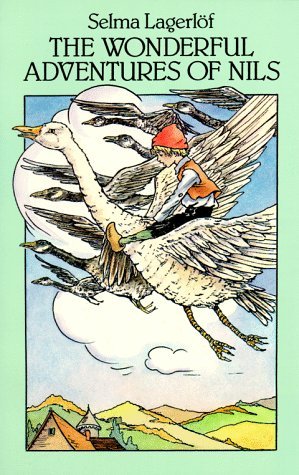
771287

Nils is a self-centred, lazy, cruel ungrateful boy. Bunking off church to stay at home, he gets on the wrong side of an elf. Everyone knows you don’t mess with elves, Nils.  Of course the elf wreaks his revenge:

“For in the glass he saw plainly a little, little creature who was dressed in a hood and leather breeches.

“Why, that one is dressed exactly like me!” said the boy, clasping his hands in astonishment. And then he saw that the thing in the mirror did the same thing. Thereupon he began to pull his hair and pinch his arms and swing round; and instantly he did the same thing after him; he, who was seen in the mirror.

The boy ran around the glass several times, to see if there wasn’t a little man hidden behind it, but he found no one there, and then he began to shake with terror. For now he understood that the elf had bewitched him, and that the creature whose image he saw in the glass was – himself.”

Nils’ family goose, who has the excellent appellation of Morten Goosey-Gander, decides to follow a flock of wild geese on their migration to Lapland and Nils tags along, riding on Goosey-Gander’s back. As an elf, Nils finds he can understand animals’ speech, and learns to be kind rather than torture them.

“The wild geese challenged the white goosey-gander to take part in all kinds of sports. They had swimming races, running races, and flying races with him. The big tame one did his level best to hold his own, but the clever wild geese beat him every time. All the while, the boy sat on the goosey-gander’s back and encouraged him, and he had as much fun as the rest.”

Lagerlöf was commissioned to write this by the National Teachers Association, so in the course of reading about Nils’ journey, you learn about wildlife and Swedish geography: win/win.

“Just as the first spring showers pattered against the ground, there arose such shouts of joy from all the small birds in groves and pastures that the whole air rang with them, and the boy leaped high where he sat. ‘Now we’ll have rain. Rain gives us spring; spring gives us flowers and green leaves; green leaves and flowers give us worms and insects; worms and insects give us food; and plentiful, and good food is the best thing there is,’ sang the birds.”

He didn’t know exactly where on earth he was: if he was in Skåne, in Småland, or in Blekinge. But just before reaching the swamp, he had glimpsed a large village, and thither he directed his steps. Nor was it long before he discovered a road. Soon he was in the village street, which was long, and had trees on both sides, and was bordered with garden after garden. The boy had come to one of the big cathedral towns, which are so common on the uplands, but can hardly be seen at all down in the plain.”

Nils’ wonderful adventures also include seeing off his arch-nemesis Smirre Fox and learning to think of others rather than being such a deeply unpleasant person.  For a book with such a didactic purpose, it really doesn’t read as instructive and moralistic. The Wonderful Adventures of Nils is written with a real lightness of touch and is great fun.

To end, a taster of my favourite book from when I was a child:

“One fine day.” (Carole King)

Last week I mentioned that 2016 has been a terrible year so far. I don’t follow sport in any shape or form, but even I know Andy Murray has done his best to cheer up a post-Brexit UK by winning the men’s singles final at Wimbledon. Congratulations to all the winners!

andy-murray-wimbledon-tennis_3741489

Image from here

Obviously these wins are the result of years of dedicated training, but we all experience things that culminate in one day now and again. So to celebrate I’ve picked two novels that deal with the events of one day.

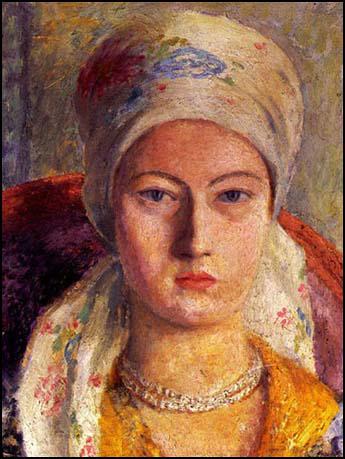
Firstly, Cheerful Weather for the Wedding by Julia Strachey (1932), who was one of the Bloomsbury group; this novel was originally published by Leonard and Virginia Woolf’s Hogarth Press, she was a niece of Lytton Strachey and was painted by Dora Carrington:

ARTstracheyJ2

This novella details the morning of a wedding: the preparations, the arrival of guests, the bustling of servants. The bride doesn’t make an entrance for a while, instead we are treated to her mother, Mrs Thatcham, giving contradictory instructions to all and not seeing that this why things are not organised as she expects:

“with a look of sharp anxiety on her face as usual – as though she had inadvertently swallowed a packet of live bumble-bees and was now beginning to feel them stirring about inside her. She stopped and looked at the clock.

‘I simply fail to understand it!’ burst from her lips.

She trotted briskly out of the drawing-room in the direction of the kitchen.”

Apparently this woman, who veers between being frustratingly tedious and a downright bully, was based on Strachey’s mother-in-law…

Meanwhile, the guests start to arrive. There are some lovely character sketches of family members and assorted hangers-on, told with gentle – in the main – humour.

“a tall, grey-haired man, in black clerical clothes, with a gaunt white face reminiscent of a Pre-Raphaelite painting of Dante. It was Canon Dakin, or Cousin Bob of Hadley Hill as the family called him.”

There is a hilarious description of a lampshade wedding gift and Aunt Katie’s verdurous wedding hat. My favourite little scene was between deluded Aunt Bella, who is busy boring her nephew Lob with tales of how her servants “simply cherish me”, and is met with the following non-sequitur:

“‘My dear lady,’ replied the cheerful Lob, speaking unexpectedly loudly, and holding his glass of wine up to the light for a moment, “I don’t care two pins about all that! No! The question, as I see it, is quite a different one. The whole thing is simply this: Is it possible to be a Reckless Libertine without spending a great deal of money?’”

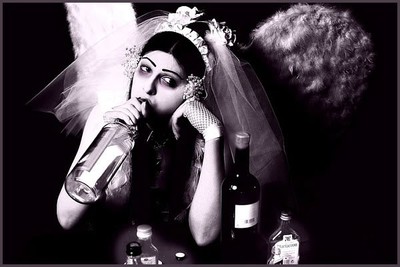
When we finally meet the bride, Dolly, it is clear all is not well. For starters, she has put away most of a bottle of rum to enable her to stagger down the aisle:

“At this moment Dolly was trailing slowly down the back staircase (which was nearer to her part of the house than the main one), her lace train wound round and round her arm. From out of the voluminous folds of this there peeped a cork and the top of the neck of the bottle. In her other hand was her large bunch of carnations and lillies.” 

As Dolly is unsure of what she is doing and why, simultaneously there is an admirer of hers, Joseph, who may at any minute stop the wedding, though he is not sure of his motivations for doing so. Apparently Strachey was a fan of Chekov, and Cheerful Weather for the Wedding shows this influence in domestic subject matter and conflicted characters unable to take action. The humour is bittersweet: while the preparations and family members are portrayed with a light irreverence, the drunk bride and her inert friend? lover? – we are never told – bring a genuine sadness to proceedings. I couldn’t help feeling they were both on the brink of disaster.

“Dolly knew, as she looked around at the long wedding-veil stretching away forever, and at the women too, so busy all around her, that something remarkable and upsetting in her life was going steadily forward.”

Virginia Woolf’s opinion of Cheerful Weather for the Wedding was high: ‘I think it astonishingly good – complete and sharp and individual.’ Strachey doesn’t explain everything and leaves many questions in the reader’s mind as to what is going unsaid and undone on this nuptial morning (looking at the trailer for the 2012 film it looks as if everything is spelled out, so I will not be watching the film version – why? WHY??)  While it is short, Cheerful Weather for the Wedding is not slight – witty, sardonic, sad and wise – it is a fully realised portrait of everyday tragedy.

400x400_1335564193597-drunkbride

Image from here

Secondly, A Single Man by Christopher Isherwood (1964) tells a day in the life of George Falconer, an ex-pat English professor living alone in California just after the Cuban missile crisis, and grieving the loss of his partner Jim, killed suddenly in road traffic collision.

“And it is here, nearly every morning, that George, having reached the bottom of the stairs, has this sensation of suddenly finding himself on an abrupt, brutally broken off, jagged edge – as though the track had disappeared down a landslide. It is here that he stops short and knows, with a sick newness, almost as though it were for the first time: Jim is dead. Is dead.”

In the midst of this enormous pain, George carries on with his life: teaching a class, shopping, going to the gym, getting drunk with a friend.

“In ten minutes, George will have to be George; the George they have named and will recognise. So now he consciously applies himself to thinking their thoughts, getting into their mood. With the skill of a veteran, he rapidly puts on the psychological makeup for this role he must play.”

A Single Man is perfectly paced, capturing George’s numb putting-on-foot-in-front-of-the-other coping without losing narrative drive. The tone is gentle, treating George kindly, but without sentimentality – he is not always kind himself, and his views on those he encounters are unblinking. However, as we spend the day with George, we start to get glimmers of his desire to keep living, a sense that he will find meaning in carrying on. But then his grief completely side-swipes him:

“He pictures the evening he might have spent, snugly at home…only after a few instants does George notice the omission which makes it meaningless. What is left out of the picture is Jim, lying opposite him at the other end of the couch, also reading; the two of them absorbed in their books yet so completely aware of the other’s presence.”

There is sadness in A Single Man but it is not depressing. Rather it shows how life goes on in all its messy imperfection, and that can be OK, even when you are feeling far from fine.

 A Single Man was made into a film in 2009, the directorial debut of fashion designer Tom Ford. It certainly looked amazing and had some wonderful performances by Colin Firth and Julianne Moore, but the screenplay made some significant changes and unsurprisingly, I prefer the book for its subtlety and nuance. Kudos to Ford though, for filming a book that takes place almost entirely within one man’s head.

I hope you all have a great day ahead 🙂

“But what first, Debbie, attracted you to the millionaire Paul Daniels?” (Mrs Merton/Caroline Aherne)

Caroline Aherne, actor and writer, creator of the comedic brilliance that was The Royle Family, died on Saturday.  And so 2016 continues as forerunner for the most rubbish year in recent memory. If the political situation and the death of a yet another great person this year is getting you down, I would prescribe YouTubing  Caroline’s career for some solace.

If you enjoy someone’s work, there is a consolation that they leave this behind when they are no longer around, so I thought I would look at two novelists last works which were published in their lifetimes.

Firstly, The Old Man and the Sea by Ernest Hemingway (1952), fulfilling the sea-based tale requirement of the Around the World in 80 Books reading challenge hosted by Hard Book Habit. And so my inexplicable love affair with Hemingway continues. I’ve written before about how much I want to dislike Hemingway, but I just adore his writing. Like all great love affairs, we are wholly incompatible, and yet I find myself drawn back time and time again, whilst knowing I cannot change him. The Old Man and the Sea did not succeed in breaking the spell.

Hemingway, rocking a chunky knit to give his best salty old sea dog impression

Hemingway, rocking a chunky knit to give his best salty old sea dog impression

The titular old man is Santiago, a Cuban fisherman who sails in the Gulf Stream and has gone 84 days without catching a fish.

“Everything about him was old except his eyes and they were the same colour as the sea and were cheerful and undefeated.”

Manolin, a young boy, has known the fisherman his whole life and loves him, and it is through his eyes that we first see Santiago:

“His shirt had been patched so many times that it was like the sail and the patches were faded to many different shades by the sun. The old man’s head was very old though and with his eyes closed there was no life in his face. The newspaper lay across his knees and the weight of his arm held it there in the evening breeze. He was barefooted.

The boy left him there and when he came back the old man was still asleep.

“Wake up old man,” the boy said and put his hand on one of the old man’s knees.

The old man opened his eyes and for a moment he was coming back from a long way away. Then he smiled.”

They head out to fish separately – Manolin is banned from accompanying Santiago due to his salao bad luck – and what follows is the story of Santiago’s lone sea journey. The descriptions have Hemingway’s trademark pinpoint accuracy but this exists alongside metaphorical beauty, which absolutely captures the water and the isolation of the sailor.

“The old man knew he was going far out and he left the smell of the land behind and rowed out into the clean early morning smell of the ocean. He saw the phosphorescence of the Gulf weed in the water as he rowed over the part of the ocean that the fishermen called the great well because there was a sudden deep of seven hundred fathoms where all sorts of fish congregated because of the swirl the current made against the steep walls of the floor of the ocean.”

“The sea was very dark and the light made prisms in the water. The myriad flecks of the plankton were annulled now by the high sun and it was only the great deep prisms in the blue water that the old man saw now with his lines going straight down into the water that was a mile deep.”

The fisherman succeeds in hooking a “great fish” but is unable to bring it aboard, and so is towed by the marlin farther and farther out to sea, as he waits for the fish to die. I can’t say much more as it is only novella length (you can read the full text here) so I’ll just say that The Old Man and the Sea is extraordinary: fable, allegory, elegy, a meditative page-turner which I found truly moving.

“He looked across the sea and knew how alone he was now. But he could see the prisms in the deep dark water and the line stretching ahead and the strange undulation of the calm. The clouds were building up now for the trade wind and he looked ahead and saw a flight of wild ducks etching themselves against the sky over the water, then blurring, then etching again and he knew no man was ever alone on the sea.”

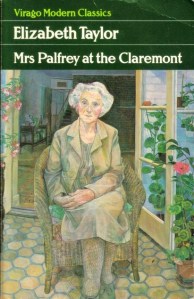
Secondly, Mrs Palfrey at the Claremont by Elizabeth Taylor.

Image from here

Following the death of her beloved husband, Mrs Palfrey moves to the Claremont Hotel on the Cromwell Road “The porch pillars had been recently painted; there were spotted laurels in the window boxes; clean curtains – a front of emphatic respectability.” to see out her days.

“She was a tall woman with big bones and a noble face, dark eyebrows and a neatly folded jowl. She would have made a distinguished-looking man and, sometimes, wearing evening dress, looked like some famous general in drag.”

Mrs Palfrey and her fellow permanent residents at the hotel are desperately trying to avoid a nursing home and rub along together in a mix of boredom, gossip and barely suppressed disdain. Although Taylor is interested in aging and how to find meaning in a world that considers you finished, this isn’t a depressing novel , but rather a gentle comedy with a melancholic tinge.

“Soon, there was a soft, slapping sound as Mr Osmond shuffled a pack of cards for a game of patience: against this, the knitting sounds, and sighs, and stomach gurglings (quickly coughed over).

‘Well, another Sunday nearly gone,’ Mrs Post said quickly, to cover a little fart. She had presence of mind.”

Mrs Palfrey is a resolute soul, who refuses to feel sorry for herself. Part of the generation who lived through both World Wars, she gets on with things.

 “She felt a determination about the lilac trees. They were to be a part of her rules, her code of behaviour. Be independent; never give way to melancholy; never touch capital. And she had abided by the rules.”

On a walk around London, she has a fall and is rescued by a young man, Ludo. He is shaggy-haired, scruffily dressed, good-looking and a wannabe writer. They end up forming an unlikely friendship and the nuances, contradictions, tensions and tenderness between the two are beautifully observed. Taylor is a wonderful writer: sharp, observant, funny and real. She put me in mind of Barbara Pym, and the blurb on the back of my copy of this novel compares her to Jane Austen.  Certainly if you like those, you’ll find a lot to love here.

 “She could glimpse bed-sitting rooms – like Ludo’s some of them – where once cooks had attended ranges, rattling dampers, hooking off hot-plates, skimming stock pots, while listening to housemaids’ gossip bought from above stairs. Mrs Palfrey went slowly by, imagining those days, which were almost clearer to her than this present structure of honeycomb housing and the isolation of each cell, because they were the days that belonged to her being young, and so were the clearest of all to her.”

To end, if you think Ernest Hemingway and Elizabeth Taylor are an unlikely pairing, here’s a heavy metal band and an orchestra performing a song named after a Hemingway novel:

“If you were gay, I’d shout hooray” (Avenue Q)

London Pride, the LGBT+ festival which runs for 3 weeks in June, culminated with a parade this weekend. The Orlando shootings had already given this year’s festival an added poignancy, and after the week we’ve had in Britain, a joyful parade celebrating diversity warmed my battered heart. My favourite thing at this year’s festival is undoubtedly this – we should keep it all year round.

download (1)

Image from here

In this post I’m going to look at two classic novels which explore an experience of being gay at the start of the twentieth century. They are both set in Britain, where at the time being a gay man was illegal (repealed in 1967). Lesbians weren’t acknowledged in law, but being gay of gender was broadly speaking, socially taboo.

Firstly, Maurice by EM Forster, which was written in 1914 but not published until after Forster’s death in 1970. Maurice grows up in an England where sex education involves conversations like this:

“To love a noble woman, to protect and serve her – this, he told the little boy, was the crown of life. ‘You can’t understand now, you will some day, and when you do understand it, remember the poor old pedagogue who put you on the track. It all hang together – all – and God’s in his heaven, All’s right with the world. Male and female! Ah wonderful!”

Good grief. Maurice blindly follows the path laid out for him: prep school, public school, Cambridge. Forster is rather scathing towards his protagonist, emphasising his lack of intellect and inability to question his life in any way. Events force him out of this spiritual somnambulism when his best friend makes a confession:

“Durham could not wait. People were all around them, but with eyes that had gone intensely blue, he whispered ‘I love you.’

Maurice was scandalized, horrified. He was shocked to the bottom of his suburban soul, and exclaimed, ‘Oh, rot!’”

Gradually however, Maurice realises what the reader already knows, that he is sexually attracted to men and loves his friend. This is the start of him living consciously and becoming generally more pleasant:

“After this crisis, Maurice became a man. Hitherto – if human beings can be estimated – he had not been worth anyone’s affection, but conventional, petty, treacherous to others, because to himself. Now he had the highest gift to offer.”

Maurice isn’t totally redeemed: he can still be selfish and a terrible snob. This is one of the novel’s strengths – he isn’t idealised, he isn’t better or worse than most people, he is just an ordinary person with the need to love and be loved, but because “England will always be disinclined to accept human nature” Maurice suffers greatly, because he is forced to try and supress such basic human needs.

“He lived on, miserable and misunderstood, as before, and increasingly lonely. One cannot write these words too often: Maurice’s loneliness: it increased.”

Meanwhile, heterosexual couples are welcomed and celebrated, able to live openly.

“They loved each other tenderly. Beautiful conventions received them – while beyond the barrier Maurice wandered, the wrong words on his lips and the wrong desires in his heart, and his arms full of air.”

However, this isn’t a sad novel – apparently Forster was determined it would not be so as he didn’t want a gay protagonist to appear to be punished. It is about how accepting who we are enables us to live better lives not only for ourselves but for those around us, and it is about the damage that can be done when society attempts to force a predetermined conventional ‘norm’ upon people. Maurice is also beautifully written and highly readable; never preachy and emotionally affecting.

There was a Merchant Ivory adaptation of Maurice in 1987, which I’ve never seen, but looks like a faithful adaptation, starring many of the Merchant Ivory regulars:

Secondly, The Well of Loneliness by Radclyffe Hall (1928). Unlike Forster, she published at the time, but given the novel was subject to an indecency trial, it seems Forster judged correctly that Maurice would cause outrage. The Well of Loneliness tells the story of Stephen Gordon, a daughter to landed gentry who were so convinced she’d be a boy that they give her a masculine name. As Stephen grows up, she struggles against the gender expectations placed on her.

“And Stephen must slink upstairs thoroughly deflated, strangely unhappy and exceedingly humble, and must tear off the clothes she so clearly loved donning, to replace them with the garments she hated. How she hated soft dresses and sashes, and ribbons, and small coral beads, and openwork stockings! Her legs felt so free and comfortable in breeches; she adored pockets, too, and these were forbidden”

The novel follows Stephen through her young life, isolated from her peers, distanced from her mother who is revolted by a difference in her daughter she cannot name. Stephen’s solace is her kind father and her horses. She gradually realises that she is attracted to women, and that this is unacceptable to the society in which she lives.

“What remained? Loneliness, or worse still, far worse because it so deeply degraded the spirit, a life of perpetual subterfuge, of guarded opinions and guarded actions, of lies of omission if not of speech, of becoming an accomplice in the world’s injustice by maintaining at all times a judicious silence”

The wiki page about this novel tells me it’s been criticised by people who see the difficulties experienced by Stephen as encouraging shame, but I think this is a bit unfair. Written in 1928, I suspect living in a society where you had to hide a fundamental part of who you are, where “Love is only permissible to those who are cut in every respect to life’s pattern” could be a bit bloody at times. Stephen is never portrayed as needing to be anything other than she is: the fault is society’s not hers, and she remains defiant to the end.

“She must show that being the thing she was, she could climb to success over all opposition, could climb to success in spite of a world that was trying its best to get her under…Yes, it was trying to get her under, this world with its smug rules of conduct, all made to be broken by those who strutted and preened themselves on being what they considered normal.”

The Well of Loneliness could do with being about 100 pages shorter (Sarah Waters judges The Unlit Lamp as a much stronger novel) but I still found it very readable and whizzed through it. It’s somewhat depressing stance may mean it’s controversial amongst critics, but love it or hate it, it remains a highly significant novel of the time.

To end, a chance to indulge my slightly baffling but most enduring Danny Dyer obsession. Often cast as the stereotypical uber-straight macho man, here he is getting an opportunity to perform gender in a much broader way:

“It’s the final countdown.” (Europe (the band))

This isn’t a political blog, but it is one where I try and relate books to what’s going on in my life/the wider world, and this is the week when Britain votes on whether to stay in or leave the EU. So in this post I’m looking at two books by European writers, and in order to maintain the blog’s thin veneer of impartiality, I’ve picked one by a writer from a country inside the EU, and one from outside.  Between them they are two more stops on my Around the World in 80 Books reading challenge hosted by Hard Book Habit– with none of the attendant worries of which passport queue to join, should major changes ensue…

Firstly, The Blue Fox by Icelandic by poet/novelist/songwriter for Bjork/all round Renaissance man Sjon (trans.Victoria Cribb).  This short novel (112 pages in my edition) is stunning: lyrical, sparse and truly magical. I can’t remember whose blog first introduced me to this, so if it was you please leave a comment 🙂

The story begins in 1883, with the priest Baldur Skuggason hunting a rare blue vixen:

“Snow covered the land up to the roots of the glacier, not a bare patch of earth to be seen; the vixen would write the tale of her travels on the blank sheet as soon as she embarked on them.

Grasping the weapon in both hands, he set off.”

Not a word is wasted, as Sjon creates characters and atmosphere with the minimum needed. This style is highly effective as it evokes the quiet focus of the hunt and the frozen expanse of the winter landscape.

“The sun warms the man’s white body, and the snow, melting with a diffident creaking, passes for birdsong.”

The second part of the novel goes back 16 years to explore the relationship between naturalist Fridrik B Fridriksson and his ward Abba, who has Down’s Syndrome. This section is more densely written but still beautifully constrained.

“Ghost-sun is a name given by poets to their friend the moon, and it is fitting tonight when its ashen light bathes the grove of trees that stand in the dip above the farmhouse at Brekka. This little copse was the loving creation of Abba and Fridrik, and few things made them more of a laughing stock in the Dale than its cultivation, though most of their endevours met with ridicule.”

Back in 1883, the stories intertwine and move towards an eerie, unsettling conclusion. The Blue Fox occupies a space between poetry, prose, myth, mystery and fable. Highly recommended.

Secondly, Berlin Stories by Robert Walser (tr. Susan Bernofsky), which also occupies a space between genres, this time autobiography and fiction. Walser moved to Berlin in 1905 as a young man, and Berlin Stories collects together his impressions of the city, the people he meets, the experiences he has.

I had no idea what to expect, not having read any Walser before. Picture the scene, reader: It is early morning. You hate your job. You are on a crowded platform waiting for a delayed train. You are surrounded by other commuters, who by their disregard for even the most basic social niceties are telling you that they too hate their job, and they hate you only marginally less.  Then you read this:

“Onward, onward.  That blue-eyed marvel, the early morning, has no time to waste on drunkards. It has a thousand shimmering threads with which it draws you on; it pushes you from behind and smiles coaxingly from the front. You glance up to where a whitish, veiled sky is letting a few scraps of blue peek out; behind you, to gaze after a person who interests you; beside you, at an opulent portal behind which a regal palace morosely, elegantly towers up. Statues beckon you from gardens and parks; still you keep on walking, giving everything a passing glance: things in motion and things fixed in place”

Needless to say, by page 4 of Berlin Stories, where that passage appears, I knew I was in for a beautiful journey around Berlin in Walser’s company. His style is brilliantly evocative of a city: short sketches of whatever interests him creates a series of impressions of Berlin, rather than a fixed, focused depiction. He is funny and sad, he has an eye for the minutiae and the broader picture. It is a love letter to the city, and you are left in no doubt as to why Berlin has such a culturally rich history.

“Berlin by comparison – how splendid! A city like Berlin is an ill-mannered, impertinent, intelligent scoundrel, constantly affirming the things that suit him and tossing aside everything he tires of. Here in the big city you can definitely feel the waves of intellect washing over the life of Berlin society like a sort of bath. An artist here has no choice but to pay attention.”

Like The Blue Fox, this is a short volume (139 pages) and therein lies its power. Walser creates concise, delicate yet richly vivid portraits of Berlin. Just gorgeous.

To end, I want a badge. A badge to commend my enormous self-restraint in not going on a 1980s cheese-fest (which is something I rarely restrain from) by capturing either the titular song or the band Berlin in embedded video form. Instead I’m going for a guaranteed earworm clip from a musical inspired by the Berlin stories of another writer, Christopher Isherwood.  Take it away, Liza:

“I’m the greatest thing that ever lived! I’m the king of the world! I’m a bad man. I’m the prettiest thing that ever lived.” (Muhammad Ali)

As usual, I’m a bit behind the times: here is my post to commemorate the death of Olympian/activist/philanthropist/iconic legend Muhammad Ali on 3 June, whose memorial was last Friday.

c8c7ccdd-25ee-454b-bd57-8cd8566212a8-1630x2040

Image from here

I thought I would therefore theme this post around ‘greatest’.  Just over a week ago Lisa McInerney won this year’s Bailey’s Prize for her debut novel The Glorious Heresies, so I’ve decided to look at Half of a Yellow Sun by Chimamanda Ngozi Adichie which won the Baileys (then the Orange) in 1997 and was chosen as the prize’s Best of the Best in 2015. I’ve paired it with Midnight’s Children by Salman Rushdie which won the 1981 Booker, and then in 1993 (25 years of the Booker) and 2008 (40 years of the Booker),  it won the Best of the Bookers (the latter by public vote). They are also two more stops on my Around the World in 80 Books Reading Challenge, hosted by Hard Book Habit– away we go!

Half of a Yellow Sun is set in Nigeria during the civil war of the 1960s, when there was an attempt to establish Biafra as an independent nation. Focusing on two sisters, Olanna and Kainene, their partners Odenigbo and Richard, and Olanna and Odenigbo’s houseboy Ugwu, the war is explored through its varied but monumental impact on all their lives.

Before the war, Olanna and Odenigbo live a privileged middle class life in the university town of Nsukka, entertaining in the evenings with friends who debate issues of post-colonial identity:

“‘I am Nigerian because a white man created Nigeria and gave me that identity. I am black because the white man constructed black to be as different from as possible from his white. But I was Igbo before the white man came.’”

Ugwu joins them and is mesmerised by their sophistication, and the worlds they open for him through the books they provide. However, Adichie shows that the legacy of colonialism is deep-rooted:

“Master’s English was music, but what Ugwu was hearing now, from this woman, was magic. Hers was a superior language, a luminous language, the kind her heard on Master’s radio, rolling out with clipped precision. It reminded him of slicing a yam with a newly sharpened knife, the easy perfection in every slice.”

As the Igbo people try to establish Biafra and civil war escalates, Olanna, Odenigbo and Ugwu’s lives are ripped apart and Adichie does not pull her punches. There is forced conscription, rape as a weapon, starvation and mutilation. However, there is also reconciliation between the estranged sisters, and Adichie’s focus is not on horrors but on how the human spirit survives against overwhelming odds:

“The war would continue without them. Olanna exhaled, filled with frothy rage. It was the very sense of being inconsequential that pushed her from extreme fear to extreme fury. She had to matter. She would no longer exist limply, waiting to die.”

Adichie is a hugely popular and successful author, and I feel the hype is fully deserved: she’s a brilliant writer. I whizzed through this book – she manages to write a compelling, political, angry, compassionate and highly moving page-turner. What a feat.

Half of a Yellow Sun was adapted into a film in 2013, apparently not that successfully despite a seemingly perfect cast including smoking hot eye candy hugely talented actor Chiwetel Ejiofor:

On to Midnight’s Children by Salman Rushdie (1981) which like Half of a Yellow Sun was the author’s second novel: so much for the ‘difficult second novel’ theory. It’s taken me about twenty years to read Midnight’s Children, which works out as 6% of a page per day. It’s been quite a ride.

rhpsf

I jest of course, but it did take me 3 goes spread over 20 years to get into this novel.  Normally I would have resigned it to the DNF pile (which is tiny, my TBR aspires to be that size one day – never going to happen) but I kept persevering because people who loved it really loved it and it always cropped up on various book lists (including Le Monde’s , which forms one of my reading challenges).

Now that I’ve read it, I can’t say I loved it – something about Rushdie’s style meant this was always a tough read for me – but I did find it impressive. Midnight’s Children is hugely ambitious, tackling themes around nation-making, history writing, colonialism and culture. Seemingly impossible within one novel, but Rushdie and his massive brain are clearly equal to the task. The story is narrated by Saleem Sinai who is born on the stroke of midnight on 15 August 1947, the exact moment that India gained independence from Britain.

“Thanks to the occult tyrannies if those blandly saluting clocks I had been mysteriously handcuffed to history, my destinies indissolubly chained to those of my country. For the next three decades, there was to be no escape.”

Saleem’s story, and that of his family, becomes the story of the nation of India. The novel makes heavy use of magical realism, and I think this is Rushdie’s masterstroke. It would be impossible to explore such enormous themes and multiple events if the novel were entirely grounded in a recognisable reality. By allowing for magic realism, Rushdie can take the story in any direction he needs to.

Saleem discovers that all the children born into India between midnight and 1am on the day of Independence have special powers – his own being telepathy, powered by his enormous nose and blocked sinuses (told you there was magic realism).

“the children of midnight were also the children of the time: fathered, you understand, by history. It can happen. Especially in a country which is itself a sort of dream.”

“Midnight has many children; the offspring of Independence were not all human, Violence, corruption, poverty, generals, chaos, greed and pepperpots…I had to go into exile to learn that the children of midnight were more varied than I – even I – had dreamed.”

Saleem is a self-acknowledged unreliable narrator. His memory fails him at times, regarding both events in his own life and those in the wider political history of India. What Rushdie is questioning is the narratives we are all within – family, nation, history, culture – and how there is no one reality for any of us.

“Family history, of course, has its proper dietary laws. One is supposed to swallow and digest only the permitted parts of it, the halal portions of the past, drained of their redness, their blood. Unfortunately this makes the story less juicy, so I am about to become the first and only member of my family to flout the laws of halal. Letting no blood escape from the body of the tale, I arrive at the unspeakable part; and, undaunted, press on.”

I realise I may have made Midnight’s Children sound like a heavy read, and in some ways it is, but it also has a gentle humour running through it to lighten the tone.  I’ve certainly never read anything else like it.

“One day, perhaps, the world may taste the pickles of history. They may be too strong for some palates, their smell is overpowering, tears may rise to eyes; I hope nevertheless that it will be possible to say of them that they possess the authentic taste of truth”

To end, I can’t help wishing the dress code for book award ceremonies was monochrome cat suits and that winners collected their awards by emerging from a fog of dry ice:

“Honeymoon, keep a-shining in June” (By the Light of the Silvery Moon)

As a companion piece to my last post about marriage, I thought I would look this week at portrayals of honeymoons. Originally I planned to include On Chesil Beach by Ian McEwan but I ran out of time & wanted to re-read it in order to do it justice, as I remember it being very moving. So please don’t let my inadequacy prevent you from checking it out if you haven’t read it 😉 Onwards to honeymoon stories I’ve read more recently!

weimaraner-1381186_960_720

All the ‘honeymoon’ pictures I googled made me want to vomit, so here’s a Weimaraner puppy instead

Firstly, Orkney by Amy Sackville (2013), which is an eerie, claustrophobic tale of a honeymoon taken on a remote Scottish island. Richard is a professor of English literature who is entranced by literary sirens and by his silver-haired wife, forty years younger than he, strange and unknowable:

“She is a tiny, perfect, whittled trinket found bedded in the sand, carved patiently, for comfort; she is a spined and spiky urchin with an inside smooth as polished stone, as marble; she is frond of pallid wrack, a coral swaying in the current, anchored to the sea-bed; she is an oyster, choking on grit, clutching her pearl to her.”

The unnamed wife is obsessed with the sea, taking long, lone walks by day and having water-filled nightmares by night:

And as she dreams her submarine dreams I lie beside her, a whale’s carcass, a wrecked ship, a vast ribcage in the dark blue deep; and she is a tiny luminescent silver fish, picking me clean, in and out of all that’s left of me, bare bones long since freed of flesh and rigging.”

Each chapter covers a day of their honeymoon, told from Richard’s perspective. This is not a plot-driven story as very little happens, in some ways it is quite a slight tale, but I found Sackville’s beautiful writing made it compelling and carried me along. The atmosphere gradually becomes more uncanny, with a sense that is not just Richard’s wife who is unknown, but that there are no certainties at all:

“An overcast, lowering sky this morning; the clouds have clotted through the night. Something gathering, brooding, out on the sea. A darkness spreading. The edges of my wife blur against the sky.”

Orkney is short novel about the stories we tell ourselves and each other, how we understand the world, and how what is real and unreal is not always clearly delineated:

“He tells her tales of the finfolk and selkies. Nothing can replace those first tales, which have coloured the cast of her thought, which have filled her nights with the sea, which are at least as real to her as anything she’s learned of the world since.”

5726963_8e14c7f0

Secondly, the short story Here We Are by Dorothy Parker (1931). A young couple are on a train, having been married “exactly two hours and twenty-six minutes”.  Most of the story is dialogue, and they come across as so terribly young and naïve.

“He sat down, leaning back against the bristled green plush, in the seat opposite the girl in beige. She looked as new as a peeled egg. Her hat, her fur, her frock, her gloves were glossy and stiff with novelty.”

They sit and talk about the day, the wedding, those they know, and bicker about silly things: hats, mainly.

“‘Hell, honey lamb, this is our honeymoon. What’s the matter?’

‘I don’t know,’ she said. ‘We used to squabble a lot when we were going out together and then engaged and everything, but I thought everything would be so different as soon as you were married. And now I feel sort of strange and everything. I feel so sort of alone.’”

Of course, what they are not saying is that the train is speeding them towards a hotel room, and they are terrified about what is going to happen once they are alone together.  The story is a masterclass in ‘show, don’t tell’ writing. Parker’s trademark acerbic wit is not to the fore – the story is gently funny, and I felt sorry for this unknowing couple marrying in such a different age, and desperately hoped it would work out for them.

Speaking of virgins:

“My most brilliant achievement was my ability to be able to persuade my wife to marry me.” (Winston Churchill)

A friend of mine got married last weekend, and most lovely it was too. But enough about them; it gives me an excuse for indulgence of an enduring crush (who I planned to marry when I was six –  with hindsight I suspect the age gap was insurmountable):

To celebrate I’ve picked two novels which explore the theme of marriage. Firstly, The Marriage Plot by Jeffrey Eugenides (2011). Set at Brown University in the early 1980s, it tells the story of three undergraduates, Leonard, Madeleine and Mitchell, as they try and find their way through life, while realising that their academic and intellectual achievements have not prepared them in any way. As an English graduate, I particularly enjoyed Eugenides’ evocation and gentle ribbing of this area of study:

“That left a large contingent of people majoring in English by default. Because they weren’t left-brained enough for science, because history was too dry, philosophy too difficult, geology too petroleum-oriented, and math too mathematical- because they weren’t musical, financially motivated, or really all that smart, these people were pursuing university degrees doing something no different from what they’d done in first grade: reading stories. English was what people who didn’t know what to major in majored in.”

Of course I disagree 🙂 Eugenides is very good a skewering the intellectual trends in academia, which at this time was semiotics, while not undermining idealistic Madeleine’s belief in ideas and search for meaning. Unfortunately “Madeleine’s love troubles had begun at a time when the French theory she was reading deconstructed the very notion of love.” and she finds the theories don’t really account for the messiness of real world relationships. In one pivotal scene, the writing of Roland Barthes is used to break her heart:

I Love You je-t’aime/I-love-you. As she read these words, Madeleine was flooded with happiness. She glanced up at Leonard, smiling. With his finger he motioned for her to keep going. The figure refers not to the declaration of love, to the avowal, but to the repeated utterance of the love cry. Suddenly Madeleine’s happiness diminished, usurped by the feeling of peril. She wished she weren’t naked.”

The Marriage Plot is comic but remains grounded in the three vulnerable characters trying to become the best versions of themselves. Once they leave university, the novel shifts from satirising academia to focus on the characters’ relationships with one another. Eugenides uses a typical romantic plot (no-one is in love with anyone who can love them back) to create a metafictional commentary on how romance and marriage have been presented throughout the ages, particularly in novels. If this sounds truly dreadful, rest assured the novel stops short of being too smug about its own cleverness, and what emerges in the second half is a truly sensitive portrait of mental illness.

 “That was when Leonard realised something crucial about depression. The smarter you were, the worse it was. The sharper your brain, the more it cut you up.”

Whether or not this is true, Leonard is both brilliant and extremely unwell, and the exploration of his bipolar disorder is non-sensationalist and balanced, showing the effect on Leonard and those around him; the price paid for something devastating which is no-one’s fault.

“it was as if her own heart had been surgically removed from her body and was being kept at a remote location, still connected to her and pumping blood through her veins, but exposed to dangers she couldn’t see: her heart was in a box somewhere, in the open air, unprotected.”

I didn’t find The Marriage Plot quite as effective as Eugenides’ debut The Virgin Suicides, and although I haven’t read Middlesex, his lauded second novel (it’s buried in a TBR stack somewhere…), I doubt this novel concerned the Pulitzer judges to the same extent. However, it is a novel with much to offer, and I recognised and cared about all the characters in it. The Marriage Plot plays with ideas and even destabilises itself with metafictional nods towards novels and novel writing, but never at the expense of a recognisable humanity.

“the novel had reached its apogee with the marriage plot and had never recovered from its disappearance, In the days when success in life had depended marriage, and marriage had depended on money, novelists had a subject to write about. The great epics sung of war, the novel of marriage. Sexual equality, good for women, had been bad for the novel. And divorce had undone it completely. What would it matter whom Emma married if she could file for separation later?”

12909527393_b0c336c399_z

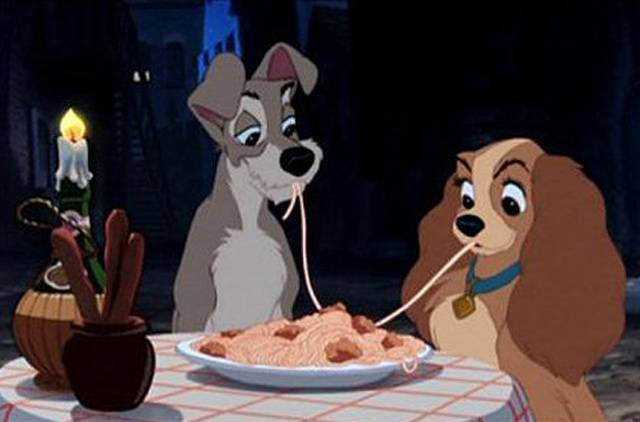
Pasta eating dogs melt even this non-romantic’s heart

Secondly, The Amateur Marriage by Anne Tyler (2004), which portrays the marriage between Michael and Pauline, from their courtship under the shadow of World War II through to old age. Their fledgling relationship is shown through the eyes of the small town where Michael has grown up:

“She had her read coat on, which is how they could all spot her from such a distance. They said ‘Michael! Look!’ and Michael turned at once in the right direction, although Pauline herself had not called out. When she came nearer they could see why. She had no breath left, poor thing. She was gasping and tousle-haired and flushed – really not her prettiest, but who in the world cared? She was holding out her arms, and Michael dropped his belongings and started running too, and when they collided he swooped her up so her feet completely left the ground, Everybody said ‘Ah’ in one long satisfied sigh – everyone except his mother, but even she watched with something close to sympathy.”

Once the war – and its accompanying heightened experience, drama and uncertainty is over, the marriage is shown through the eyes of the couple, who realise they are entirely mismatched:

“by nature, Pauline tumbled through life helter-skelter, while Michael proceeded deliberately. By nature, Pauline felt entitled to spill anything that came into her head while Michael measured out every word. She was brimming with energy – a floor pacer, a foot jiggler, a finger drummer – while he was slow and plodding and secretly somewhat lazy. Everything to her was all or nothing…while to him the world was calibrated more incrementally and more fuzzily.”

This being Anne Tyler, it is not a huge tragedy, but rather a psychologically astute portrait of two people and their family with the attendant hurt, frustration, disappointment, love and affection:

“Another time, Michael might have felt annoyed by this rouged and lipsticked version of the truth. Such concern for the looks of things even within the family! But today he was touched. It occurred to him that his wife had amazing reserves of strength, that women like Pauline were the ones who kept the planet spinning. Or at least, they made it appear to keep spinning, however it might in fact be wobbling on its axis.”

If you’ve read any of Anne Tyler’s 20 novels before, you’ll know what to expect in The Amateur Marriage: set in Baltimore, concerned with ordinary people leading ordinary lives, with no huge dramas. This is not a criticism, however. She is brilliant at well-observed detail, of the meaning found in small moments, of what we learn to live with and the solace imperfect human beings can give one another.

“He believed that all of them, all those young marrieds of the war years, had started out in equal ignorance…Then two by two they fell away, having grown wise and seasoned and comfortable in their roles, until only he and Pauline remained, as inexperienced as ever – the last couple left in the amateurs’ parade.”

To end, a little something for another friend who was also at the wedding, and who I think will be the next bride I see. She has an agreement with her partner for a certain man to be her celebrity allowance:

“Trains, like time and tide, stop for no one” (Jules Verne)

Despite not thinking of myself as a remotely patriotic person, there was a 3 part programme on TV recently that was probably the most British thing ever, and I am so sorry it’s ended. Paul Merton travelling around the island by train (is it me or is he turning into Ian Hislop?), only getting off at request stops and chatting to those he meets. That’s it. Result: pure brilliance.

I share Mr Merton’s love of trains, and so this week I thought I would look at novels where they feature heavily.  This also enables me to fulfil the requirement of the Around the World in 80 Books reading challenge hosted by Hard Book Habit, to include a book about travel.

Firstly, Compartment No.6 by Rosa Liksom (2011, tr. Lola Rogers) which I was alerted to by Sarah’s review at Hard Book Habit and also by bookarino, where I was sure I had read a review but now I can’t find it on her blog – bookarino, if you reviewed please leave a link below!

The novel details the journey on the Trans-Siberian railway from Moscow to Mongolia undertaken by the two inhabitants of the titular compartment. Liksom describes the landscapes they pass through simply but evocatively, and succeeds in capturing a sense of place and of travel:

“An unknown Russia frozen in ice opens up ahead, the train speeds onward, shining stars etched against a tired sky, the train plunging into nature, into oppressive darkness lit by a cloudy, starless sky. Everything is in motion: snow, water, air, trees, clouds, wind, cities, villages, people, thoughts. The train throbs across the snowy land.”

The atmosphere in the compartment is intimate and oppressive:

“All of Siberia slowly brightened. The man in his blue tracksuit bottoms and white shirt did push-ups between the bunks, sleep in his eyes, his mouth dry and smelly, the mucousy smell of sleep in the compartment, no breath from the window, tea glasses quietly on the table, crumbs silent on the floor.”

The man Vadim is repugnant: misogynistic, violent, anti-semitic, anti anyone who isn’t him. His attitudes and behaviour are repellent. Yet as they are forced together, a comradeship builds between him and the female traveller. She is presented a step removed: we never know her name, her direct speech is given only once and then she is quoting. Yet this works brilliantly at evoking the girl’s slightly numb, detached state as she runs away from her troubles and works her way back to facing them, with the help of the dreadful Vadim.

 “The girl looked out of the window at an entirely new landscape…she thought of that July day when she came back from her summer vacation in Finland and Mitka was at the station to meet her. She thought about how they had gone to the boarding house, run up the nine flights of stairs hand in hand, how the hallway had been filled knee-high with the fluffy heads of dandelions, how they’d run up and down the hallway like children, the dandelion fluff drifting in and out of the windows.”

Compartment No.6 is a short but haunting novel which will undoubtedly linger long in my memory.

Secondly, Strangers on a Train by Patricia Highsmith (1950), which was adapted only a year later into the famous Alfred Hitchcock film of the same name, albeit with several changes.

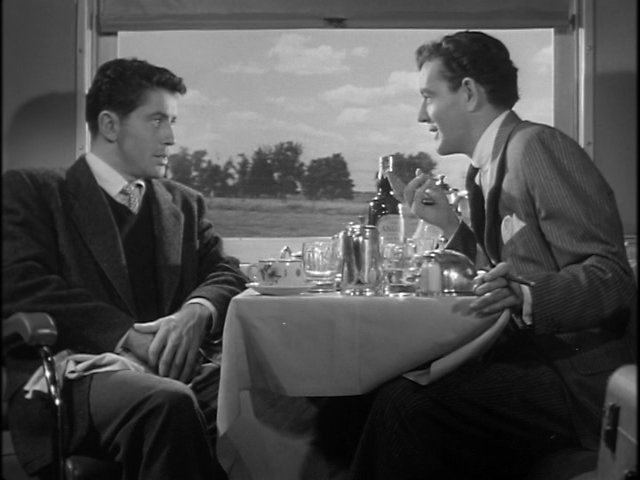
Strangers_on_a_Train_-_In_the_dining_car

Sadly my commuter train doesn’t look like this, despite being full of people hatching murderous plots

Successful architect Guy Haines meets bored, spoilt alcoholic Charley Bruno on a long haul train journey. He is reluctant to engage in chat, but Bruno is insistent, and Guy ends up telling him that he is travelling to meet his wife to ask for a divorce. Bruno meanwhile, hates his father and wants his inheritance.

“Bruno could be violent. He could be insane, too. Despair, Guy thought, not insanity. The desperate boredom of the wealthy…it tended to destroy rather than create. And it could lead to crime as easily as privation.”

It is Bruno who comes up with the idea that they swop murders, Bruno killing Guy’s estranged wife for Guy killing his father. Guy doesn’t agree, but Bruno goes ahead anyway. Needless to say, he is a sociopath:

“whether Guy came through with his part of the deal or not, if he was successful with Miriam he would have proved a point. A perfect murder.”

“So long had he been frustrated in his hunger for a meaning of his life, and in his amorphous desire to perform an act that would give it meaning, that he had come to prefer frustration, like some habitually unrequited lovers.”

Bruno ends up stalking Guy, entirely obsessed with him, and it is this, rather than the murders or closing net of the investigation that provides the thriller element of the novel. Bruno is completely unstable and there is no telling what he might do as he exerts increasing pressure on Guy. Yet Bruno is vulnerable too, childlike and confused, and never admitting that it is sexual desire which draws him to Guy.

“Guy! Guy and himself! Who else was like them? Who else was their equal? He longed for Guy to be with him now. He would clasp Guy’s hand and to hell with the rest of the world! Their feats were unparalleled! Like a sweep across the sky! Like two streaks of red fire that came and disappeared so fast, everybody stood wondering if they had really seen them.”

There are definite overlaps with Tom Ripley, the sociopathic protagonist of several Highsmith novels. Bruno is a much less attractive character than Ripley, but there is the desperation and loneliness of the sociopath, the thwarted gay desire, and the doubling between characters, which Guy realises, much as he is reluctant to admit it:

“And Bruno, he and Bruno. Each was what the other had not chosen to be, the cast-off self, what he thought he hated but perhaps in reality loved.”

Strangers on a Train worked well for me as a thriller, but without any glorification of murder or murderers.  Like The Talented Mr Ripley, what I was mainly left with was a sense of sadness at the destruction that desperate human beings can wreak on one another.

To end, a quick clip to shamelessly indulge my love of Buster Keaton:

“Outside of a dog, a book is man’s best friend. Inside of a dog it’s too dark to read.” (Groucho Marx)

Last week I mentioned the indulgence of good friends, so this week I thought I would look at novels capturing female friendships. I’ll try and redress the balance at some point by looking at male friendships, but this week, in the words of Lesley Knope, its ovaries before brovaries 😀

Fox-News

My future – I sincerely hope

Image from here

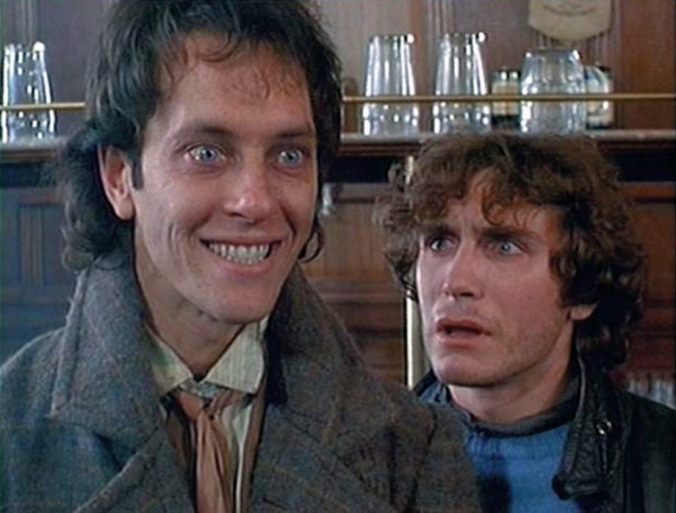
Firstly, Animals, the second novel from Emma Jane Unsworth, described on the cover by Caitlin Moran as “Withnail with girls”, which pretty much sums it up. Laura lives with her friend Tyler, a one-woman tornado:

“She didn’t just change the temperature of rooms, she changed their entire chemical make-up so that anyone in the room would only be aware that the room was an extension of her and she was the thrumming nucleus.”

Tyler is indulgent, defensive, funny, clever – a total nightmare with whom Laura feels an immediate bond:

“Someone who sees right to your backbone and simultaneously feels their backbone acknowledged.”

But Laura is in love with Jim and is planning to get married, introducing a tension into the women’s friendship.  Tyler wants life to continue as it is, Laura is not so sure. It’s not plot-heavy, as Tyler and Laura ricochet from one substance-fuelled experience to another, it’s funny and sad and so very believable:

“And there it was, as always, swinging my way: The Night. With its deals, promises and gauntlets, by turns many things: nemesis, ally, co-conspirator, master of persuasion. It tosses its promises before you like scraps on the road, crumbs leading into the forest: pubs, parties, booze, drugs, dancing, karaoke…”

Amongst all this eventful partying, there is an elegiac quality to Animals: both the women are in their thirties and there’s a sense that their life together cannot continue for much longer, and that it might not be so entertaining if it did:

“Next to the sink, two folded banknotes balanced on a rung of the towel rail, drying. I stood and looked into the bowl before I flushed, recalling the adage of a girl I’d once worked with: White piss good; amber piss bad. Orwellian in its visceral simplicity. Meanwhile the liquid I had dispatched into the toilet bowl was almost ochre.”

1987WithnailandIArrow-920x699

A great film, but not a wise lifestyle choice, kids

Image from here

The bawdy chaos of Animals is presented through considered, inventive storytelling; Unsworth’s voice is compelling and like Laura on a night out with Tyler, I found myself carried along for the ride.

Secondly, the publishing phenomenon that is Elena’s Ferrante’s My Brilliant Friend (tr. Ann Goldstein, Europa editions 2012) and one more stop on my Around the World in 80 Books reading challenge, hosted by Hard Book Habit. This is the first in a quartet known as the Neapolitan novels which have sold millions worldwide, no doubt to the chagrin of authors everywhere stuck on a PR treadmill, as Ferrante remains determinedly anonymous. The novels detail the friendship between Elena and Lila from the 1950s onwards.

“She stopped to wait for me, and when I reached her she gave me her hand. This gesture changed everything between us forever.”

I’m grateful to Kate’s recent review which tempered my expectations somewhat. While I did like the novel, I think had I gone in with the astronomical expectations created by all the hype I would have been disappointed. As it was, I went in with moderate expectations and enjoyed being pulled into the poor Neapolitan neighbourhood Ferrante so vividly evokes. Elena summarises: “I feel no nostalgia for our childhood: it was full of violence.” She’s not wrong. Violence between strangers, friends and families seems to be constant. The poverty and accompanying lack of horizons takes its toll:

“At the Bar Solara, in the heat, between gambling losses and troublesome drunkenness, people often reached the point of disperazione – a word that in dialect meant having lost all hope but also being broke – and hence of fights.”

Within this environment, Lila and Elena form a friendship that is full of the unspoken. Elena is mesmerised by Lila, who is tough, independent, and highly intelligent. Despite the time they spend together, the core of Lila – what she really wants, her hopes and dreams – remain mysterious to Elena.

“Would she always do the things I was supposed to do, before and better than me? She eluded me when I followed her and meanwhile stayed close on my heels in order to pass me by?”

It is this competitiveness, this desire to be like Lila, which spurs Elena on, to the point where this motivation becomes indistinguishable from her own preferences. She continues at school long after Lila leaves, her academic commitment a mixture of wanting to outstrip Lila, wanting to do well because it is what Lila wants, and wanting to do well for herself. Ferrante has an excellent understanding of how these early friendships are so vitally important, how they form us in ways we barely understand and how quickly it is impossible to say what feels intrinsic to us and what is the influence of others. She captures the ambivalence of friendships that are formed out of deep love and conflict:

“When school started again, on the one hand I suffered because I knew I wouldn’t have time for Lila anymore, on the other I hoped to detach myself from the sum of the misdeeds and compliances and cowardly acts of the people we knew, whom we loved, whom we carried – she, Pasquale, Rino, I, all of us – in or blood.”

While I’m not quite ready to proclaim myself a fully paid-up Ferrante acolyte, the quartet supposedly gets better as it goes along, so by book four I could well be (Marina Sofia has written a really interesting review of the quartet here).

To end, two celebrities (one of whom plays the aforementioned Lesley Knope) who claim to be BFFs and I actually believe them: