Novella a Day in May 2025: No.4

Burning Secret – Stefan Zweig (1913, transl. Anthea Bell 2008) 117 pages

Stefan Zweig is such an exquisitely tender writer. His precise, compassionate observations are deep with humane understanding. It makes him a perfect novella writer.

Burning Secret has a very simple structure. Edgar is twelve years old and recuperating from an illness in the spa town of Semmering. He is lonely and disregarded, bored and unnurtured.

“His face was not unattractive, but still unformed; The struggle between man and boy seemed only just about to begin, and his features were not yet kneaded into shape, no distinct lines had emerged, it was merely a face of mingled pallor and uncertainty.”

Unfortunately for Edgar, the Baron, an irredeemable cad and bounder, arrives in Semmering.

 “He felt no inclination to be alone and avoided it as far as possible; he didn’t really want to become any better acquainted with himself. He knew that, if he was to show his talents to best advantage, he needed to strike sparks off other people to fan the flames of warmth and exuberance in his heart. On his own he was frosty, no use to himself at all, like a match left lying in its box.”

This vacuous young man plans on whiling away his time in a meaningless love affair, and his sights soon settle on Edgar’s mother. As she is initially resistant to his charms, he callously decides to leverage Edgar in order to win favour.

“The Baron easily won his confidence. Just half-an-hour, and he had that hot and restless heart in his hands. It is so extraordinarily easy to deceive children, unsuspecting creatures whose affections are so seldom sought.”

Poor Edgar. He falls hook, line and sinker.

“A great, unused capacity for emotion had been lying in wait, and now it raced with outstretched arms towards the first person who seemed to deserve it. Edgar lay in the dark, happy and bewildered, he wanted to laugh and couldn’t help crying.”

For the Baron it is all a game. He has no feelings for Edgar or his mother, the latter only prey with which to amuse himself. He views her ruthlessly, identifying her snobbery and pretentions and knowing how to exploit these by emphasising his nobility. He gives no consideration to her marriage or vulnerabilities as a woman who will be judged much more harshly than he if they have an affair.

What he doesn’t reckon on is Edgar’s dawning, imperfect realisation, and the fury of a hurt child. What follows is a coming-of-age story where the lessons are learned through emotional brutality.

And yet, the resolution is hopeful, and without bitterness. It feels realistic and reflective, not undermining what has gone before but demonstrating human endurance too.

In less subtle hands Burning Secret could be sentimental and mawkish. With Stefan Zweig, it is emotionally devastating.

“He didn’t understand anything at all about life, not now he knew that the words which he thought had reality behind them were just bright bubbles, swelling with air and then bursting, leaving nothing behind.”

Novella a Day in May 2025: No.3

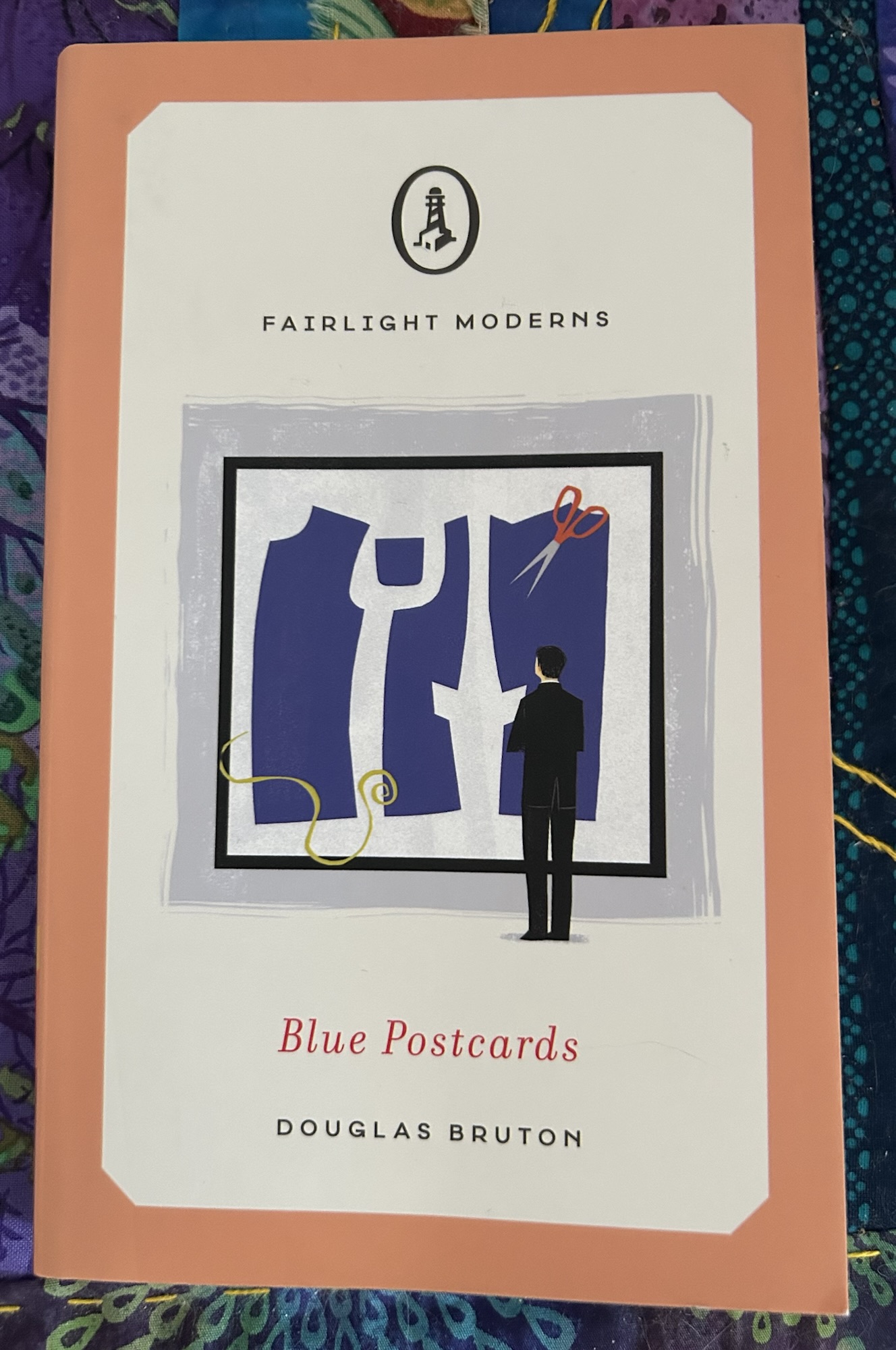
With or Without Angels – Douglas Bruton (2023) 107 pages

Having loved Hope Never Knew Horizon by Douglas Bruton when I read it in February for #ReadIndies, I was keen to try more by him. With or Without Angels is an intriguing novella, attempting to capture the process of creating art at the end of life.

Written in the third person but mainly from the point of view of “the old artist”, Bruton portrays Alan Smith’s memories and thoughts as he works on his final piece, The New World, which was a response to Giandomenico Tieplo’s Il Mondo Nuovo. (In the Afterword Bruton explains that Alan’s widow had read the novella and she encouraged publication, with permission for the art to be reproduced.)

The New World is a series of images and they are reproduced in the book, after the fictional prose passages which evoke the creation of them. So for the first one, a photograph taken on a trip to Tate Modern:

“Out on the street the air was wet and chill and shifting. It smelled of bus exhausts and damp wool and faintly of cigarettes. And his wife it smelled of, too. Something with flowers in her perfume. Patchouli maybe – a shrub of the mint family – something of wet soil or apples that are past ripe, the smell of a cork pulled from a bottle of strong red wine. It’s the last of the senses to go, smell. He had heard that somewhere and was comforted that when all else failed he would know his wife was at his side by her smell.”

The smell of patchouli is something that is returned to at different sections along with other recurring motifs. This was so clever; it evoked the layering of memory and movement back and forth in time as someone contemplates the past from a present where they know their future is limited. (Also, a special thank you to the woman who stood next to me on the tube and was wearing patchouli as I read this 😊)

Time collapses in on itself at various points for the artist, disorienting but without him losing sight of his work.

“Some things are so familiar that you expect them to be there even when they are not and cannot be. The blue hat had been eaten into holes by moths. But he is sure that he has seen it hanging on the last hook in the hall as recently as a week ago.”

Bruton never attempts to interpret the work or lay claim to an absolute meaning in The New World. He is too subtle for that, and part of what With or Without Angels explores is that there are no final answers to be gleaned from a work of art.

“It’s not that he fears the questions. He wants them to be asked. That’s part of the point. It’s the answers that he frets over. He has come to a time in his life where the answers are like Brighton’s running pebbles under his feet.”

There’s also no sentimentality in the artist nearing the end of his life. Instead it is a gentle, tender, compassionate portrait.

“The thing she did with her hair […] and how he felt when he saw her do that, somehow there was meaning and hope and love in that. The old artist does not tell anyone this, not even his wife, but maybe she knows.”

With or Without Angels captures so much in so few pages. It is a remarkable work which manages to explore enormous themes with such a light touch, without ever seeming superficial.

The New World link at the start of this post will take you to Alan Smith talking about the work.

Novella a Day in May 2025: No.2

Day two of NADIM and I’m delighted that Simon at Stuck in a Book will be reading a book a day for the month too!

The Victorian Chaise-Longue – Marghanita Laski (1953) 99 pages

It’s been years since I read the very powerful Little Boy Lost by Marghanita Laski, and I kept meaning to get back to her. The Victorian Chaise-Longue is a short tale of domestic terror, and would appeal to anyone who is a fan of Daphne du Maurier’s short stories, or The Yellow Wallpaper.

It opens with Melanie who has recently given birth, and is now recovering from tuberculosis, being patronised by her doctor and her husband.

“‘Now listen to me,’ he said. ‘Because you’ve managed to be a good obedient girl so far, we’ve been able to conquer what might have been a very nasty little flare up, and if you let yourself get perfectly well and we keep a steady eye on you, there’s no reason why anything of the sort should ever occur again.’”

And…

“‘How clever you are, darling,’ said Melanie adoringly. ‘You make me feel so silly compared with you.’

‘But I like you silly,’ said Guy, and so he does, thought Dr. Gregory, watching them. But Melanie isn’t the fool he thinks her, not by a long chalk, she’s simply the purely feminine creature who makes herself into anything her man wants her to be.”

So as you can see, the horror is there from page one 😀

They decide that Melanie could do with a change of view, and so she lies down on the titular furniture, which she had found in a junk shop before she became unwell. It’s heavy and ugly, but she had been taken by it; she had also experienced a memory which wasn’t hers when looking at it, which she quickly brushed aside.

When she wakes up, she is still on the chaise-longue, but in a different room and a different era, with a harsh woman who calls her Milly not Melly. At first she believes herself to be dreaming, but:

“It was real, that touch of flesh. There was no conceivable atmosphere of dream of which that touch of rough dry flesh could be a part.”

Melanie is trapped there, feeling even more unwell, cared for by the woman who turns out to be Milly’s sister Adelaide, and a stereotyped housemaid.

Milly is in some sort of disgrace, incurring her sister’s barely concealed wrath. As she tries to piece together what has happened, Melanie recognises parallels with her own life:

“Sin changes, you know, like fashion.”

I mentioned at the beginning Daphne du Maurier and the feminist classic by Charlotte Perkins Gilman. The Victorian Chaise Longue perhaps suffers by these comparisons. It’s not quite as horrifyingly unnerving as du Maurier’s stories, or as overt in its wider themes as The Yellow Wallpaper. But it is an engaging, quick read, which doesn’t offer trite answers to Melanie’s predicament or the wider issue of women’s bodies so often being constrained by forces more powerful than they are.

Novella a Day in May 2025: No.1

After a break last year, I’ve decided to return to my novella a day project in May. I always try and give myself a head start of a few posts and I’ve not managed as many as I would have liked this year, so we’ll see how it goes… My TBR is ridiculous so if I can stick to this, it will hopefully help!

The Fell – Sarah Moss (2021) 180 pages

I wasn’t really in the market for a pandemic novel, but I was so impressed by the previous novellas I’d read by Sarah Moss, Ghost Wall and Summerwater (particularly the former) that I decided to give The Fell a try.

This novella is reminiscent of Summerwater, written just a year earlier, in its use of multiple viewpoints. There is no direct speech but the story progresses from the points of view of Kate, a furloughed waitress; her teenage son Matt; their elderly neighbour Alice; and local volunteer Rob.

Kate and Matt have been told to self-isolate in their cottage in the Peak District, having been exposed to someone with Covid-19 infection. Kate is really struggling, while her son is more stoical:

“I know, she said, I’m making a fuss, I just find this really hard, I knew I would. Not, he thought, as hard as getting sick, not as hard as Deepak’s dad who was in Intensive Care for three weeks or the grandparents of kids in his class who’ve died this year or his maths teacher who’s back at work but can’t get enough breath for sentence half of the time, compared to that doing the garden instead of going up the fells is actually quite manageable, so how about he games and she does yoga the garden and they hope neither of them starts with the fever and loss of taste and smell.”

But Kate breaks the isolation, risking spreading the disease, a £10,000 fine or imprisonment, in order to go for a walk on the fell. She doesn’t take her phone with her and she reasons she won’t see anyone up there anyway.

“Damp, not quite raining. Keep moving, get warm. The relief of it, being out, being alone, starting to warm up from her own effort, wind and sky in her lungs, raindrops on her face, weather.”

Alice, her neighbour who is classed as extremely vulnerable due to her cancer diagnosis, sees Kate go.

 “Self-isolating, one of those horrible new nonsensical phrases. Social distancing, whoever came up with that […] medical distance, they should call it, or why not just safe distance, and when did ‘distance’ become a verb? Language is also infected. Return, George Orwell, England has need of thee.”

Alice was my favourite character, baking biscuits and worrying about her weight, blasting out tunes to cheer herself up, and refusing any self-pity:

“More Springsteen, there’s a reason they don’t write protest anthems about well-off retired people feeling a bit sad.”

The pandemic means that as well as isolation and frailty, she also has to contend with Zoom calls with her daughter’s family:

“Sometimes Alice thinks she’d rather have a Radio 4 podcast than Susie with her dinner.”

Kate’s walk doesn’t go according to plan, and she ends up stranded with one, possibly two broken limbs. Rob and his team of volunteer Mountain Rescue therefore have to risk themselves coming together to try and find her, and Matt is old enough and astute enough to pick up the police’s hinting questions as they try and ascertain whether Kate is a suicide risk.

All this means Kate is not a sympathetic character, but her harsh self-judgement and realisation of the impact of what she has done portrays her as a flawed human who took a really bad decision. And now she is being haunted by a raven:

“Go away, Kate thinks, bugger off. Are you a spirit guide or my mother? Oh God what if it’s both.”

Five years on from the time portrayed, and surely written very close to it for a publication date of 2021, The Fell has aged well. It captures a lot from the pandemic, and certainly reminded me about elements of daily life then which I had largely forgotten. However, it is not beholden to its pandemic setting. The characterisation is strong enough that it is a story of four people bound together psychologically by an extreme situation, while remaining entirely physically separated. It explores what survival means for different people, and the prices paid for endurance.

“You’d just sometimes rather have dark conviction than the appalling uncertainty of hope.”

“The Riviera isn’t just a sunny place for shady people” (W. Somerset Maugham)

This is my final contribution to Kaggsy and Simon’s1952 Club which has been running all week. So far I’ve read two golden age mysteries for the club and I’m finishing with one too: Death on the Riviera by John Bude, in a pleasing British Library Crime Classics edition.

I read The Cheltenham Square Murder for the 1937 Club last year, and while I had enjoyed it, I didn’t think it was the strongest of Bude’s novels or a particularly perplexing mystery. This, I’m happy to report, was much stronger.

The story centres around the rich and privileged Nesta Hedderwick and her various assorted guests at her villa in the south of France.

“But for the nagging accusations of her weighing-machine life might have been perfect. She’d money; one of the loveliest villas in Menton; A large … collection of friends; splendid health; a sense of humour; and a virile capacity for enjoyment. Her husband, a successful but dyspeptic stockbroker, had died between the wars of ptomaine poisoning.”

Staying with Nesta are her niece Dilys; “smooth-faced bounder” Tony Shenton; Nesta’s companion Miss Pilligrew; beautiful Kitty; and a decidedly shifty artist:

“When Nesta had an artist living in the house she expected him to behave like one. Paul Latour certainly did his best to live up to the fin de siècle Bohemianism on which Nesta had directed her romantic ideas of the genre.”

Bude clearly has a lot of fun with Paul’s artistic swizz:

“A cod’s head capping the naked torso of a woman, balanced onto cactus leaves and garnished with the motif of lemons and spaghetti… Paul shrugged hopelessly.”

Although Dilys’ attitude to where she has found herself suggests Paul isn’t alone in his pretence:

“Just paste and cardboard and tinsel, like most of my aunt’s insufferable friends. Actually I find it rather boring. It gets that way after a time.”

So it seems the French Riviera is the perfect place for a counterfeiting operation, which is what brings DI Meredith and Acting-Sergeant Freddy Strang across La Manche, searching for Tony ‘Chalky’ Cobbett.

They work closely with Inspector Blampignon and refreshingly, the local police are shown to be entirely competent and pleasant to work with.

As the British and French police investigate the local forgers, Freddy runs into Dilys and they begin a very sweet romance, which brings the two threads smoothly together. When an acquaintance of the villa coterie goes missing, the police investigation widens.

One of my complaints with The Cheltenham Square Murder was that something completely and utterly obvious takes forever to be recognised by Meredith and I thought the same had happened here. Fortunately it turned out I’d fallen into exactly the assumption Bude had set up for the reader: at one point he has Meredith explain that when such an occurrence happens in mystery novels it always means the following…. a nice little meta joke with the reader which I appreciated 😊

Oddly, given the novel’s title, no-one is murdered until around page 160 of a 223 page novel. For my tastes, too long was spent on the counterfeiting and too little on people getting bumped off, but the investigation worked well and it was a steady police procedural without being plodding:

“He was visited by one of those revealing flashes of deduction that spring, not from any inspirational source, but from a clearly realised and logical appreciation of the facts.”

Death on the Riviera is well-paced and enjoyable, with enough characters for plenty of suspects without being completely baffling. The humour is gentle and light, and the setting beautifully evoked:

“It wouldn’t be easy, he realised, to take leave of this sunlit, sparkling coast with its terraced vineyards and olive groves, it palms and oleanders, it’s fantastic cacti, it’s mimosa-scented streets and impossibly blue seas. He thought of the Old Kent Road on a wet February night and shuddered.”

“Good authors don’t seem to do much good these days. Books have got so psychological.” (Laura Talbot, The Gentlewomen)

This is a contribution to Kaggsy and Simon’s1952 Club, running all week. One of the many great things about the Club weeks is that they encourage me to raid the TBR and get to books which could have languished there forever. Today’s book is a perfect example: an author and a novel I knew nothing about but which I greatly enjoyed.

Laura Talbot was the pen-name of Lady Ursula Chetwynd-Talbot, and her knowledge of the land-owning classes informs The Gentlewomen throughout. It tells the story of Miss Roona Bolby, a single woman growing older who has to earn her living as a governess. She clings desperately to her family’s genteel background and colonialism while around her the world changes irrevocably.

“When she had been sent back to England she had been seven. She had been told so much since that memories which had been sharp had become blurred by that which she had been told. It was difficult now to sort her own from Sita’s and Mavis’s. India had not faded with the journey home; from then on it had grown, it had become as much a part of her own life as of her Mother’s and Sita’s and Mavis’s.”

Thus she will tell anyone – repeatedly and incessantly – that she was born in India, as she wears gold Indian bangles and uses an Indian silver brush set. She remains oblivious to the fact that her background is a matter of utter indifference to everybody.

At the beginning of the novel she leaves her shabby boarding house Hillstone in Birmingham, (filled with characters which could have made a great novel in itself!) and heads to the country seat of the Rushford family.

The Second World War is ongoing, and so the house is not as it once was. Lord Rushford is overseas, there are two Italian POWs and Land Girls have working on the estate, and my favourite character, straight-talking Reenie, has never been a kitchen maid before.

Miss Bolby has been employed to tutor to the various children from both parents’ first marriages, while Nanny Becca cares for the younger toddler Bella. Jessy, Barby, Louisa and Ruth dislike their tutor, and why wouldn’t they? She is completely devoid of any warmth towards them, won’t call them by the names they use, and seems a pretty dull teacher.

In Miss Bolby, Laura Talbot has not created a likable protagonist. She is so bound up in outdated societal structures, she entirely fails to respond to people as people. Her snobbery infects all her thoughts and actions:

“I always think it helpful to know from what milieu people come, especially in these days when one so frequently find the unexpected.”

The Introduction to my edition suggests that the portrait of Miss Bolby is without compassion, but I disagree. While she is petty, silly and resentful, we see how thwarted she is through her memories. Her mother used phrases like “rather deuxième” about those she deemed socially inferior, failing to recognise the crassness of such a phrase – one which Miss Bolby echoes later in the novel. She also wished to be a singer, which her mother prevented.

And so while she declined suitors in her youth as never good enough, it is really only she who suffered, and continues to do so. She was beautiful, but rejected the chances that this gave her, and now when roles and opportunities for women are still so circumscribed, she is losing her looks too. Her world is getting smaller and smaller, and she exacerbates this.

“Drawing-rooms and dining-rooms were as passages, her presence in them transitory: she had been forced to grope as a moth gropes before flying out into the night.”

When Miss Pickford arrives at Rushford, the reader is shown another way for someone in similar circumstances to live. The other gentlewoman of the title, Miss Pickford has little advantages in her favour, but she enjoys people and is interested in them, is entirely without Miss Bolby’s pettiness and relentless judgements, and has genuine skill in her work as secretary. The children warm to her and call her Picksie, and no-one seems to consider her an “old bag” – an epithet frequently associated with Miss Bolby.

As this disparate group rub along together, there is a threat to Miss Bolby’s fragile sense of worth, grounded as it is on meaningless external attributes rather than who she is as a person. Her sister Sita made a marriage to Arthur Atherton-Broadleigh and lives abroad, so Miss Bolby puts great store by the connection (and by constantly referring to it) despite little knowledge of the actual realities of the relationship. Unfortunately for her, there is someone who knows Arthur’s past very well…

At the same time her Indian bracelets go missing, and this additional pressure on her psyche means she starts to behave quite viciously. While there is never quite the psychological disintegration that occurs in William’s Wife or Wish Her Safe at Home, The Gentlewomen did remind me of these novels, with the portrayal of societal pressure and delusion for women who wanted so much more from life.

The war is far away physically, but the drudge of various privations and the frequent noise of aeroplanes bearing down to the local airbase add an atmosphere of bleak strain, which becomes almost Gothic as it turns out Rushford has been burned out from fire in many places, and sits in overgrown, unmanageable grounds.

“War was a lonely battle for the lonely, for those not urgently connected with it, and in her case a lonely battle for what?”

In case this sounds very heavy, I should say I disagree with the Introduction in another way, when it says Talbot had no humour.  I think she is easy to underestimate because she is not interested in drawing attention to her writing at all; there is no strong authorial voice. Her style is to present the characters, and leave judgement to the reader. Often Miss Bolby’s pretentious assertions go ignored by her interlocutors which speaks volumes.

And so I found there were various moments of humour, from the wonderful Reenie, to the neighbour Lady Archie who consistently baffles her devoted husband by acquiring modern slang from the Squadron-Leader at the RAF base. Needless to say, this doesn’t fit in Miss Bolby’s schema at all:

“She had wondered all evening about Lady Archie, and who Lady Archie was and why she used such phrases as ‘It seems to ring a bell’ and ‘Same here’, which one expected from a Mr Billings, but not from a woman such as Lady Archie.”

“ ‘Wizard!’ said Lady Archie. ‘But I’ll have to consult Hughie about the car.’”

The tension builds in The Gentlewoman towards a somewhat melodramatic climax, but while I felt this came close to clumsy, it was also a real page-turner. On the strength of this novel, I would definitely be interested in reading more by Laura Talbot. (And although I’m not usually bothered by writer’s biographies particularly, I’m also intrigued by her third marriage, which took place two years after she published this novel, to Patrick Hamilton. How on earth did that come about?!)

Sadly, ultimately Miss Bolby’s harshest judgements are in the fleeting ones she puts upon herself:

“A failure, who had not lived fully in any sphere – who had always lived up on the fringe.”

“Nothing puts things in perspective as quickly as a mountain.” (Josephine Tey)

Today for the 1952 Club hosted by Kaggsy and Simon I’m looking at another golden age mystery. The Singing Sands by Josephine Tey features her regular detective, Inspector Alan Grant. It was found in her papers after she died and published posthumously, which usually makes my heart sink, but the novel seems pretty complete so I hope it was as she planned.

You can come across all sorts prejudices and snobberies in golden age crime and The Singing Sands has a strong one running throughout, which admittedly I’ve not encountered before in the genre: Tey is a total snob about Scotland. As far as I can work out her rules are:

  1. Be Scottish
  2. But speak with an English accent (by which I assume she means RP – I doubt my south London tones would cut the mustard)
  3. Don’t be from the city
  4. Especially don’t be from Glasgow
  5. Be from the Highlands
  6. Don’t be a nationalist
  7. Really don’t be from Glasgow

I take great exception to her attitude to Glasgow – it’s a beautiful city full of friendly people. Every time I go I’m knocked out and I’m still giving serious consideration to moving there. In the end when I came across these attitudes I just rolled my eyes and skipped on, and it didn’t affect my enjoyment of the novel. But as a counterbalance I urge everyone to (re)visit wonderful Glasgow!

On with the novel! It opens with Grant struggling with his mental health and deciding to visit his cousin Laura (Lalla) and her family in the Highlands to recuperate. The background of what led to Grant reaching this point is never quite specified but he seems to be experiencing burnout/PTSD.

As he disembarks the train, the grumpy attendant is trying to rouse the passenger in berth B Seven. Grant realises he is dead, and his interest in faces (detailed extensively in The Daughter of Time which is where the title quote comes from but would have worked very well in this novel too) is piqued:

“What would bring a dark, thin young man with reckless eyebrows and a passion for alcohol to the Highlands at the beginning of March?”

He also picks up B Seven’s newspaper, which has some cryptic verse scribbled on it. Much as Grant tries to focus on his family and the fishing expeditions he had planned, his mind keeps being drawn back to B Seven. The verse leads him to visit some of the islands to identify the landmarks mentioned:

“There was nothing else in all the world but the green torn sea and the sands. He stood there looking at it, and remembering that the nearest land was America. Not since he had stood in the North African desert had he known that uncanny feeling that is born of unlimited space. That feeling of human diminution.”

Although his colleagues in London have identified the body and ruled accidental death, Grant thinks both these conclusions are questionable. Despite trying to recover from his work, he can’t let it go. He is aware that keeping his mind occupied can be useful, but it is a fine balance:

“Grant was very conscious that his obsession with B Seven was an unreasonable thing; abnormal; that it was part of his illness. That in his sober mind he would not have thought a second time about B Seven. He resented his obsession and clung to it. It was at once his bane and his refuge.”

We follow Grant as he heals, with the help of his beautiful environment, the understanding of his family, and his pursuit of the truth.

“But for B Seven he would not be sitting above this sodden world feeling like a king. New born and self-owning. He was something more than B Seven’s champion now: he was his debtor. His servant.”

The Singing Sands is not heavily plot-driven and the mystery is slight, but it is still an enjoyable read, if a slightly unusual approach to the genre. Grant’s dogged pursuit of the truth of a death which others seem quick to disregard makes him endearing, and there are lovely descriptions of the Highlands. It’s a quick read that doesn’t outstay its welcome, and it is compassionate in its portrayal of mental health.

“In matters where A was at spot X at 5:30pm on the umpteenth inst, Grant’s mind worked with the tidiness of a calculating machine. But in an affair where motive was all, he sat back and let his mind loose on the problem. Presently, if he left it alone, it would throw up the pattern that he needed.”

“London is too full of fogs and serious people.” (Oscar Wilde)

This is a contribution to Kaggsy and Simon’s 1952 Club, running all week. I found a few contenders in the TBR including several golden age mysteries, so I’m starting today with a pretty famous one, Tiger in the Smoke by Margery Allingham.

The titular smoke is a London pea-souper, a thick smog that chokes the airways and severely limits visibility – perfect for dastardly crimes to be committed!

“The fog was like a saffron blanket soaked in ice-water. It had hung over London all day and at last was beginning to descend. The sky was yellow as a duster and the rest was a granular black, overprinted in grey and lightened by occasional slivers of bright fish colour as a policeman turned in his wet cape.”

The story opens with Geoffrey Levett and Meg Elginbrodde crawling through the fog-bound traffic in a taxi. They are one of those wonderful postwar stiff-upper-lipped couples whose romantic chit-chat takes place along the following lines:

“Look, we’ll get out of this somehow and we’ll go through with the whole programme. We’ll have everything we planned, the kids and the house and the happiness, even the damned great wedding. It’ll be alright, I swear it, Meg.”

Love it!

The blight on their nuptials is that someone has been sending blurry photos to Meg of someone who could be her first husband Martin, presumed dead in the war. So she meets friend of the family  – and Allingham’s regular detective  – Albert Campion, along with Inspector Charlie Luke, at a train station.

It quickly emerges that the man is not her husband but a criminal named Duds Morrison. As the group begin to unravel what is going on and why, there is less mystery and more of a character study of a truly sinister criminal named Havoc. Inspector Luke is unnerved:

“Just then he had a presentiment, a warning from some experienced-born six sense, that he was about to encounter something rare and dangerous. The whiff of tiger crept to him through the fog.”

A gang of criminals appear and my heart sank a bit, as they all had various physical differences and I was braced for ableism. But while that is certainly present, the real menace in the book lies with Havoc, and Allingham labours over how physically perfect he is:

“His beauty, and he possessed a great deal […]

His face was remarkable, in feature it was excellent, conventionally handsome […]

Jail pallor, which of all complexions is the most hideous, could not destroy the firmness of his skin […]

He was a man who must have been a pretty boy, yet his face could never have been pleasant to look at. Its ruin lay in something quite peculiar, not in expression only but in something integral to the very structure. The man looked like a design for tragedy. Grief and torture and the furies were all there naked, and the eye was repelled even while it was violently attracted. He looked exactly what he was, unsafe.”

In other words, as beautiful and deadly as a tiger.

In comparison there is my favourite character, Canon Avril, Meg’s father:

“he asked so little of life that its frugal bounty amazed and delighted him. The older he grew and the poorer he became, the calmer and more contented appeared his fine gentle face.”

In fact, Tiger in the Smoke had an increasing amount of religious references and imagery as it went along (though it isn’t didactic at all) and I found myself reminded of Muriel Spark. I ended up googling Margery Allingham to see if she had a strong faith like Spark but couldn’t find it referenced. Tiger in the Smoke isn’t like Spark tonally, but it is certainly concerned with notions of good and evil in a similar way to her novels.

Although this is a Campion mystery, he barely features. Apparently the 1956 film cut him out entirely, and this wouldn’t be difficult at all. His sarcastic retainer Lugg also appears, and his wife Amanda along with Oates from Scotland Yard “a drooping figure in a disgraceful old mackintosh” but this could just as easily be a standalone novel.

While there isn’t a mystery as such, the plot is satisfyingly complex and the novel is expertly paced. The foggy atmosphere is used to full effect and Allingham creates a real page-turner. I was whizzing through Tiger in the Smoke to find out what happened.

It leads to a tense denouement, underpinned by a real sadness. A hugely satisfying start to my 1952 Club reading!

“Havoc was ‘police work’. There was no mystery surrounding his guilt. He was something to be trapped and killed, and Campion was no great man for blood sports.”

“Admit that you deserve forgiveness.” (Niamh Mulvey, The Amendments)

This is my final post for Reading Ireland Month, hosted by Cathy at 746 Books. I’ve really enjoyed my reading for the event with so many strong, memorable voices, and this choice was no exception.

I heard about The Amendments by Niamh Mulvey (2024) through Susan’s review.  It was so appealing I decided it would be my indie bookshop purchase of the month (I need to stop saying I have a resolution to buy one book a month from an indie bookshop or publisher, because it’s never just one 😀 ) and it was a great choice.

There are three main timelines throughout the novel. In London, 2018 Nell’s partner Adrienne is pregnant with their first child and Nell is spiralling with anxiety and ambivalence.

“Adrienne, unfortunately, was not just an object, not just a saviour, not just a happy ending. Adrienne, it turned out, was a person with her own dreams and needs and desires. And those were: more life, more love, which was to say, which is to say – a baby.”

In Ireland, 1982 Nell’s mother Dolores has left home and moved to Dublin, where she becomes involved in a feminist group campaigning for pro-choice reproduction rights (one of the amendments of the title, the other taking place in 2018).

“‘The biggest problem in this country is that people are so scared of asking questions. I don’t know why we’re all so afraid of each other.’

Mary laughed suddenly as if she had only just realised this. She looked at Dolores, as if they were both sharing in this joke, this realisation, together, and Dolores laughed too, though she was uncertain, she felt there was so much she did not yet see.”

In Ireland 2001, studious Nell is struggling with her sexuality and has joined an all-female religious organisation hoping for answers:

“She returned to school that September feeling as if the things she used to count on were all changing in ways she did not at all approve of and this disapproval extended to include her own feelings.”

It is the escalation of events at this time which drive the novel. Nell is so confused, so full of feelings she doesn’t know what to do with, and this builds to a tragedy truly awful and very believable.

Loving Adrienne and recognising that her unresolved feelings from this time threaten her present, Nell agrees to couples therapy. But in order to be entirely honest with both herself and Adrienne, Nell needs to return home to Dolores.

Dolores has deep regrets from her past too, as well as her contemporary worries about Nell. What Mulvey demonstrates so clearly is how much can go unsaid even in relationships grounded in a deep love, and how damaging this can be.

“Dolores wakes up every day of her life with a feeling of worry around Nell, the pain is like a muscle that aches with overuse.”

In exploring the characters’ past and moving them towards a more hopeful future, Mulvey juggles the timelines and the themes with great subtlety. Multiple timelines are always tricky but these were finely balanced throughout and each enhanced the understanding of the other.

The healing that occurs felt hopeful without being sentimental. Nell achieves self-acceptance, if not quite self-forgiveness; resolution if not redemption.

I thought The Amendments was hugely accomplished and very readable. The various female characters were all well-realised and the plotting tight. Mulvey treats her characters with such humane compassion and I was rooting for them to be able to do the same.

“She looks at herself in the mirror and she reflects that all living things want to survive. And it is such a relief to include herself in that humble category of all living things.”

To end, an interesting interview with the author expanding on the societal context of The Amendments:

“People were capable of being many things at once.” (Sarah Gilmartin, Service)

I was a bit wary approaching Service by Sarah Gilmartin (2023) as I’d not long finished an issue-driven novel which I thought never quite managed to create characters who existed believably beyond the issue itself. Service has been described as a #MeToo novel, looking as it does at sexual assault and the structures that enable predators to not only get away with it, but thrive. However, when I saw it in my much-beloved charity bookshop during Cathy’s Reading Ireland Month it seemed perfect timing, and I also remembered that Susan had rated it.

The story is told from the point of view of three characters in alternating chapters.

Hannah, now in her thirties and selling her home as she and her husband divorce, looking back on time when she was a student and a waitress at T, a swanky restaurant reaping the rewards of boomtime Dublin;

“And there was Daniel, of course, we all loved Daniel. The skill, the swagger, the hair, even the naff red bandana that he sometimes wore during prep. We were in awe of him, of the fact that he didn’t seem to care about anything except the food. Serious cooking and good times, that was the dream we sold at T, over and over again.”

Daniel, the celebrity chef who oversaw T, now accused on Facebook of rape by an employee and facing criminal trial;

“Tomorrow the farce begins in earnest. Tomorrow I’ll see that ungrateful wench in person for the first time since she sat at her computer and pressed destroy.”

And his wife Julie, there throughout it all and trying to keep a home running for their teenage sons.

“I knew that you were not the kind of man who would come in the door of an evening and ask about your family. You were too full of your own stories, your voice set to megaphone inside your head, while the rest of us whispered asides. I knew this and I still said yes.”

This isn’t a he said/she said thriller – the way the stories and voices are presented it’s clear that Daniel did it. I thought this was a clever decision, as it frees Gilmartin instead to really focus on the characters’ lives within the various systems of enablement surrounding Daniel. He doesn’t see himself as a predator: why would he, when he is venerated – his toxic, controlling behaviour lauded?

“In that long, hot room that was fuelled by aggression and banter and occasional lines of speed, everything was sexualized.”

Daniel’s narrative is unreliable of course, and Gilmartin cleverly presents it in a way that the reader isn’t sure if he believes it himself. Is he consciously lying, or does he not recognise his actions as rape? He’s deluded enough to think all women want him really, and whether they say ‘no’ to him is a matter of indifference – like everything else they say. In a misogynistic culture where women are commodified and discardable the minute they reach thirty, their careers in front-of-house dependent not on skills or talent but on the approval of the straight-male gaze, where his own wife refers to ‘sluts’, he probably sees what he does as his entitlement.

I’ve seen some readers saying they vacillated with regard to the characters, but this wasn’t my experience with Hannah or Daniel. Where I did change somewhat was with Julie. I found her internalised misogyny infuriating, along with her astounding naivete that somehow a man who has plenty of women willing to sleep with him would therefore not assault anyone.

“How did I not know my husband was a predator? Somehow, I have no answer, beyond some ferocious thought, that all these years have meant nothing, marriage to mirage.”

“How do you weigh up the infinite exhibits of a decades-long marriage?”

But ultimately I saw her as a victim in the situation too, and it is Julie who pinpoints a fundamental societal attitude, so long ingrained, which silences women:

“I always had that ability, learned at such a young age – not to make a scene, not to dramatise, not to look for attention. Only the wrong kind of girls looked for attention.”

There is real tension in Hannah’s narrative as you know what is going to happen while desperately wishing it wouldn’t, and I thought the scene was handled sensitively and entirely non-gratuitously. The immediate fallout and enduring trauma are both believably portrayed.

When I initially read Service, I wondered if a limitation was the voices not being overly distinct from one another, but now, a few days on, I find Daniel’s voice has really stayed with me, the insidious toad (except I quite like toads). So unfortunately through not being able to shake him off I’ve realised my mini-criticism was mistaken!

The ending offered some hope while not being entirely unrealistic which I appreciated, not needing unrelenting bleak narratives right now. In an Author’s Note, Gilmartin explains that the barriers in the current legal system mean that the trial in the book would be unlikely to even occur in real life.

A girl like you.

It could be said in many different ways.”