“All of my close friends are emotional train wrecks.” (Patrick de Witt)

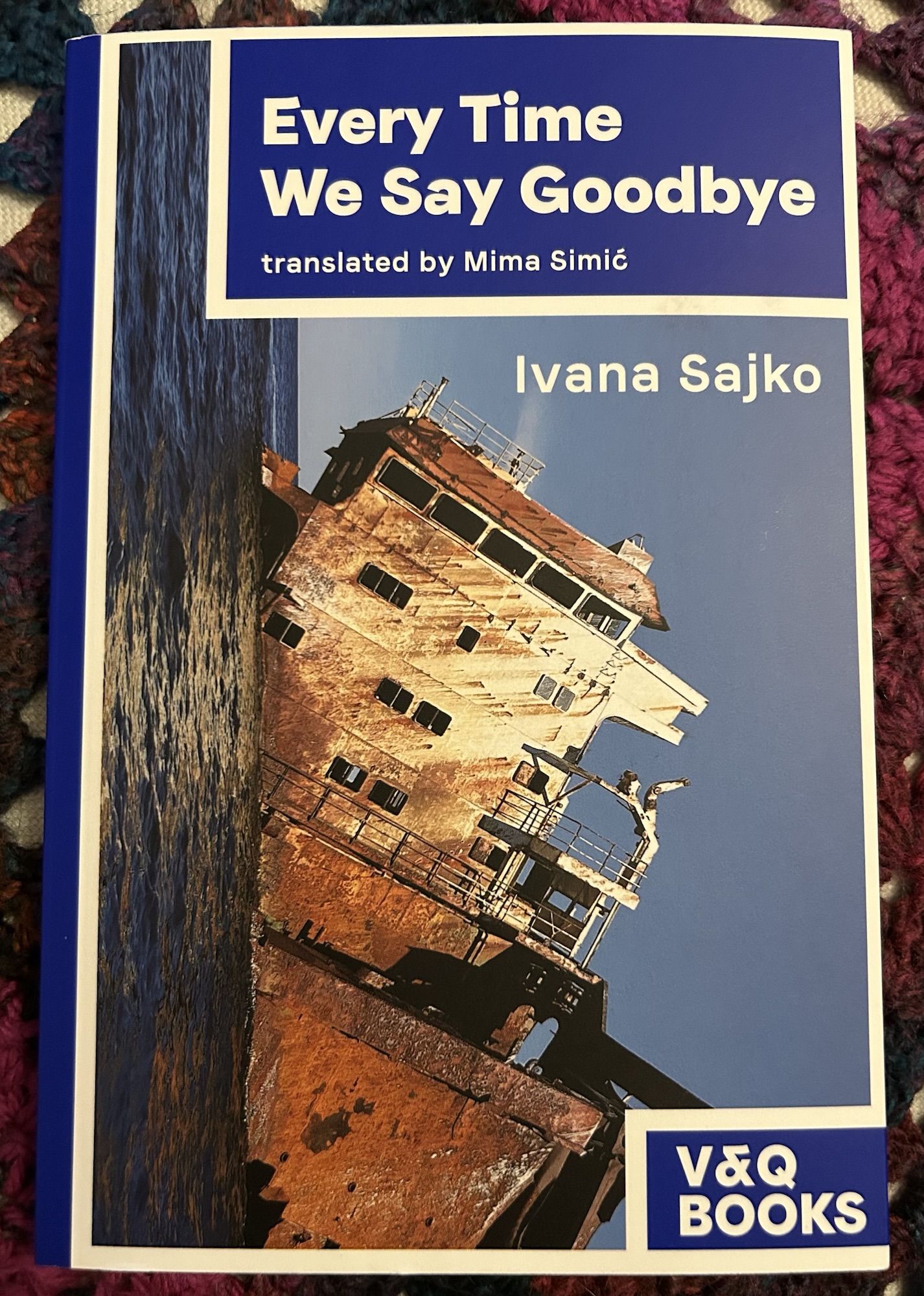
I don’t get many books sent to me by publishers, but I was really pleased to be offered Every Time We Say Goodbye from V&Q Books who specialise in writing from Germany. Ivana Sajko was born in Zagreb and her translator Mima Simić is Croatian, they both now live in Berlin. Back in 2023 I read Love Story from the same author, translator and publisher and found it powerful and unflinching.

With everything that’s been going on for me with work it’s taken me some time to get to it, but at 118 pages it’s a perfect Novellas in November read, hosted by Cathy and Bookish Beck.

A writer leaves his partner to catch a train from south-east Europe through to Berlin.

“Leaving nothing behind but the story of a man travelling through Europe hit by another crisis, boarding a train convinced that it doesn’t really matter why he’s leaving, as he has no reason to stay, the story of a man sinking into his notebook, grasping mid-descent at his messy notes, each of them opening a new abyss beckoning another fall, a man who still cannot bring himself to open the flat box of photographs from his mother’s drawer,”

Each short chapter is a single sentence, and while I know this sounds off-putting, I thought it worked brilliantly. The long, weaving sentences broken by commas perfectly captured the sense of memories surfacing back and forth against the physical rhythm of the train journey.

The narrator is not particularly likable but he is recognisable and believable. As he considers how his relationship failed and looks back on his life so far, his experiences are inextricably bound to the time and geography he lives within.

“Everyone left because they had to: my mother, my father, my brother, and all these goodbyes weren’t dramatic gestures but quiet moments of stepping onto a train or a bus, followed by long rides in uncomfortable seats with stiff legs, full bladders, a restless heart and the anticipation of the final stop, which meant a new beginning and facing expectations”

Twenty-first century Europe is shown as a place of dislocation, whether through wars, socio-economic pressures, or pandemics. The impossibility of the personal and political being distinct from one another is variously explored. The writer’s depression is at least partly due to what he witnessed as a journalist:

“I lay on the ground at Tovarnik station amid garbage and people now grown in distinguishable, on the filthy platform strewn with large stones, under the European Union flag that flapped ironically next to a border crossing sign that read ‘Croatia’ and ‘EU’”

And I particularly liked this observation about how international covid restrictions made explicit the shortcomings in his and his mother’s relationship:

“The plague was our internal standard, and now that it had also driven the rest of the world apart, our few metres gap became the global standard, the plague revealed the fatality of the smallest gestures and the significance of shortest distances, a single step towards or away from a person could help or harm them; gestures we’d used to hurt each other suddenly became protective, so we didn’t really need to make an effort to adopt the new regulations”

Grounded as it is the events and establishments of the day, Every Time We Say Goodbye still remains a slippery narrative, questioning the subjectivity and reliability of memory and how we understand our experiences:

“I’d like to write about him making faces and winking at me across the table, but none of that is true, I remember none of it, my brother has no face at all, he has no smile, no voice, no drops of sweat glisten on his skin, no scabs on his knees, he has no clear outline, there are no concrete details to him, every time I look in his direction, all I can see is a murky silhouette of a boy, he’s too far away”

There is a lot packed into this slim novella. It is undoubtedly a commentary on contemporary Europe; but it also portrays the inadequacy of human communication and understanding, and how this can wreak damage in our closest and most intimate relationships. Trauma is visited on large and small scales.

Not an easy read, but one I am glad to have read for its brave choices in style and subject matter. If, like me, you enjoy a Translator’s Note, there is a really interesting one from Mima Simić included.

To end, of course I was going to go with the obvious choice, an absolute classic:

“Small and growing businesses are the beating heart of our economy and the soul of our communities.” (Mary Portas)

I’ve finished at work now and my leaving gift was bookshop.org vouchers (to quote my colleague: “Tell me what you want so you don’t get some rubbish you’ll never use” 😀 ) which of course I started spending the same day! My first purchase was two novellas because it is #NovNov after all, hosted by hosted by Cathy and Bookish Beck.

It was Susan’s review of A Room Above a Shop by Anthony Shapland (2025) which made it a must-read for me, and my astronomical expectations were met entirely. It’s a beautifully written, carefully observed and deeply moving novel.

M has inherited a hardware shop from his father. Part of the place for years and providing a community service, everyone knows who he is without knowing him at all.

“Keeping shop hours, he is the ear of the village, the listener. They never register his life at all, upstairs in that one room.”

He meets B, somewhat younger than him, in the pub, and invites him to meet on Carn Bugail on New Year’s Eve.

“He’s not quite sure what he’s walking towards. A pulling and pushing – his instinct says go; his anxiety says stay. Either choice feels wrong. He can’t not act.”

They know it is the start of something, they know there is attraction between them, but they live in a small community, still reeling from miners’ strikes and with increasing homophobia driven by a fear of a new illness, HIV.

“Paid work is fragile, rare. Divisions still run deep; picket-angry graffiti still visible, disloyal homes shunned. Pockets are empty, borrowing and mending and patching. Everything feels temporary. Desperate.”

When B takes a job at M’s shop and moves into the spare space upstairs, little more than a cupboard but useful for appearances’ sake, they build a life together. But it is a hidden life which takes place behind closed doors, and runs beneath the performance they undertake each day as colleagues in the shop. It is both familiar and filled with tension.

“This hill is a bright map of his childhood. A play track for stunt bikes, a den, a place to be lost, to disappear with siblings. Or away from them. A place to loiter and mitch dull school days out until the bell. The place to be alone with this feeling that he’s different to the others.”

Shapland achieves something remarkable in just 145 pages, with plenty of space on the page. He crafts a fully realised portrait of two people and their relationship within a clearly evoked setting. The historical details are light touches, just enough to give a flavour of the time and certainly enough to build the pressure that M and B are living under.

His writing is incredibly precise, so although the story is short, it is not a quick read. Every single word carries its full weight to create beautiful sentences. I found myself double-checking the author bio to see if he was poet as he writes with such sparse care, but apparently not.

A Room Above a Shop is so moving. Witnessing the silences that surround M and B, the way they are unable to make the most everyday, harmless expressions of love and care towards one another, or to have their relationship acknowledged by anyone other than themselves, is quietly devastating.

“No word or deed reaches the ground from this floating platform, on this mattress, this raft, on this ocean adrift in the afternoon sun. This room lightly tethered by stairs.”

To end, a scene of coming out in a 1980s Welsh mining village from Pride, and apparently pretty accurate of the real-life person’s experience:

“Money, like vodka, turns a person into an eccentric.” (Anton Chekhov)

Thank you to everyone who left such kind and encouraging comments on my last post, I really do appreciate it. My brain is feeling less fried from anxiety at impending unemployment, but the slog of job applications means I still didn’t manage as much reading or as many posts for September as I would have liked!

Still, this is one final contribution to Short Story September hosted by Lisa at ANZ Lit Lovers. It’s been such a great event and good encouragement to take some of the short story volumes off my shelf, which always seem to languish in favour of novels.

This one is a perfect example, as I’ve really enjoyed the novels by Deborah Levy that I’ve read (Hot Milk, Swimming Home and The Man Who Saw Everything) and also her volumes of autobiography. She is so precise and incisive, but never cold, and has a way with startling imagery. All of which are definite strengths in short story form, and I was not disappointed by the ten stories in Black Vodka (2013), published by the ever-wonderful AndOtherStories.

Lisa wisely asked us to focus on one story in a collection, which is a great approach as writing about short story collections can be a real challenge. However, for this collection my tired brain struggled to formulate a post on just one, due to Levy’s precise way of writing. It’s very difficult to go into any detail with the stories in this collection, so I’ll just attempt to give a flavour of a few.

The collection is thematically linked through explorations of love in many guises. It opens with the titular story of an advertising executive falling for his colleague’s archaeologist girlfriend.

“There is nothing that feels as good as breathing near someone you desire. The past of my youth was not a good place to be. Is it strange then, that I am attracted to a woman who is obsessed with digging up the past?”

The man is vulnerable and the story describes the delicate moves towards one another made by two people unsure of each other and themselves. The fragility of the self is another recurring theme, as people struggle to sustain identities.

In Vienna, again there is a vulnerable man, unsure of where he lives or who he is after the disintegration of his marriage. His lover, the married Magret, is business-like and forthright. There is a sad humour in the contrast between his fragility and her determination not to be involved beyond the physical act.

“He nods, as if he is a secretary taking notes from an inscrutable Executive Director who wears purple lipstick to frighten the more timid of her staff. She rips the silver foil from a carton of langoustines and slides them into the microwave that still has the price taped to the side. He watches her bend her long neck to check the minutes and seconds and then fold her arms against the pearl-grey cashmere that hugs her small breasts. While she waits she tells him she has no idea why her husband has bought her a microwave.”

While most of the stories are grounded in the everyday – however unsettling that is, especially when feelings are overwhelming – Cave Girl has a slight magical realism edge as a brother tries to cope with his sister changed beyond all recognition.

“My sister Cass thinks that ice cubes in the shape of hearts will change her life.”

A highly readable collection, inventive and moving, sad and funny, where nothing is tied up neatly.  

To end, a surprisingly fully-clothed performance from Eugene Hütz and Gogol Bordello 😀

“You cannot beat a roulette table unless you steal money from it.” (Albert Einstein)

It’s been hugely stressful few weeks, which meant my reading has fallen off a cliff. I didn’t get to my final read for #WITMonth but I hope to at some point (Magda Szabo’s The Door, where the bookmark has sat at page 50 for four weeks, despite my really enjoying it), and we’re two-thirds through September where I’ve failed to take part in SpinsterSeptember or ShortStorySeptember, both of which I was really looking forward to.

However… I have handed in my notice at work now, with no job to go to…

And while this is incredibly anxiety-provoking I think it speaks to it being the right decision that my reading has resumed (imperfectly, but resumed!) and I’m catching up on the blogosphere too 😊

So, this is a contribution to Short Story September hosted by Lisa at ANZ Lit Lovers. Hopefully I’ll get to some more of the short stories languishing in the TBR, even if it will be fewer than I planned. Do head over to Lisa’s blog to find out more, and join in!

The Casino by Margaret Bonham (1948), a collection of short stories which is Persephone No.48 and features an enlightening forward by Bonham’s daughter, Cary Bazalgette. Lisa has asked us to focus on one story, so I’m just going to focus on the titular one, but the whole collection is really a strong one.

A group of teenage girls are excited and trepidatious at the thought of going unaccompanied to the casino in the French seaside town in which they are holidaying. Bonham captures perfectly that time of life when you are not quite an adult and are impatient to experience the adult world, while finding the whole prospect terrifying and wishing you could be at home in your pyjamas.

“In the dusk, Giselle waited outside the iron gates. Her frock was pink and stuck out like a cake-frill, she undulated and giggled. In a line of four they went down the street towards the sea, past Sainte Claire where Giselle waved and Valentine looked sideways at seeing M. Chabouillard’s face a round whiskered disapproving moon at the window. Between Kitty’s steel confidence and Valentine’s detachment, Rhys walked with her eyes on the heaving channel, thinking of ruin.”

In a short space Bonham draws fully recognisable portraits of the girls. Kitty is determined to get on with adult life, Rhys is scared by the whole thing, Giselle naïve and child-like, Valentine somewhat indifferent and preoccupied with her painting.

The evening is one of anticipation, and of course it is an anti-climax:

“The restaurant was half-full, stuck with pink paper roses in white and gilt trellis. At the far end a damp, pink band played, the floor was cleared for dancing, the tables crowded round the walls. Kitty looked sulky, and ordered coffee without asking if anyone wanted something else, and at this Rhys was very much relieved, for her anxious fears had drawn a table covered with bottles of brandy, the bill paid by a leering stranger and Kitty the receipt. In her dark-red dress that gave her no pleasure she sat breathing carefully with her back to the wall.”

My comparable teenage experiences were of south London pubs and horrible West End nightclubs 😀 Yet this description of a provincial French casino really evoked for me the disappointment of the banal detail found in something you’ve been simultaneously dreading and enticed by when you’re a young adult.

It’s the perfect story with which to start the collection. Margaret Bonham really understands the art of the short story. Not a word is wasted in her sharply observed tales, and she writes with a light touch that belies her acute psychological observations.

To end, regular readers will be familiar with who I turn to in times of stress (although I must say I’ve been really touched by the unwavering support of my friends. There were some I put off telling because I thought they’d say “What the hell are you thinking???” They didn’t, and I feel quite teary about it all. Almost worth handing in my notice for!) Now back to David:

“The cup of tea on arrival at a country house is a thing which, as a rule, I particularly enjoy.” (PG Wodehouse)

I feel like it wasn’t so long ago I read and enjoyed Old Baggage by Lissa Evans (2018), but as I blogged about it I can see it was six years ago! Where does the time go…? Anyway, it was Susan’s enticing review of Small Bomb at Dimperley (2024) which reminded me that I really should pick up Evans again, and as it turned out, now was exactly the right time.

Set immediately after World War II, the titular country pile is falling down around its much-reduced inhabitants’ ears. Home of the “lesser nobility” Vere-Thissets, their wastrel heir Felix has died in the war and they are awaiting the return of his diffident brother Valentine to take up the reins.

Dowager Lady Irene Vere-Thisset is struggling with post-war societal changes, including:

“A farmer named Jeffries who habitually spoke to Irene with familiarity which suggested they’d first met when queuing at a whelk stall and who had actually clapped her on the back last year when she had been presenting the trophy for best heifer at the county fair.”

During the war the house had been a maternity hospital, and Mrs Zena Baxter has stayed on, with her now two-year-old daughter Allison:

“It was quite galling to be forced to admire a piece of shrapnel that had somehow landed in Addenham churchyard and which was kept in a velvet-lined box as if it were a saint’s jawbone, when she herself had been dug out of the basement shelter of Hackney Young Women’s Hostel five hours after the building had suffered a direct hit.”

Zena is organised and capable, which is just what Dimperley needs, the only other remaining staff being Hersey who arrived at age fifteen and is now fighting off retirement. Zena has ended up as secretary to Alaric Vere-Thisset, as he writes an interminable history of the family despite the fact that:

“no Vere-Thisset had ever raised an army, or invented anything, or written a proper book, or endowed an institution, or even become a Member of Parliament.”

Meanwhile, Felix’s widow Barbara is struggling to get to know her daughters after they have been in the US for several years, escaping the conflict. Poor Barbara is physically defeated by much of everyday life, and has been left to undertake many of the noblesse oblige responsibilities without acknowledgement or thanks.

No-one thinks Valentine can make a go of running this money-pit, including Valentine:

“Lacking in either personal magnetism or the sort of skills that were needed for the forging and maintenance of useful connections. He was, as his father had noted, a poor rider, a below-average shot, an indifferent golfer and rather unfortunately ‘the image of my Uncle Fenwick’, though Irene had been unable to confirm the latter since every picture of Uncle Fenwick had been removed from the family album after the incident”

But what has been overlooked is that none of these attributes actually matter. Personal magnetism and charm are vastly overrated qualities, and what Valentine lacks in these he makes up for in decency, hard work and humility. He’s also likely dyslexic, and this alongside being forced to write with his non-dominant right hand at school means he is consistently underestimated.

We follow the family as Valentine and Zena try to take Dimperley by the scruff of the neck, and all of them attempt to work out a place for themselves in the ever-shifting new world of Labour governments, working women and – horror of horrors – an expanding National Trust (!)  

Small Bomb at Dimperley wears its research lightly, so you never get an info-dump but rather a believably evoked sense of the immediate postwar period. What is foregrounded is the characters, and they are all wonderful. The more eccentrically comic Alaric and Barbara are never condescended to – their behaviour is laughed at but never they themselves. They are treated with insight and compassion, as is Lady Irene despite her clinging to archaic attitudes. The depth of characterisation creates flawed, believable people who I really invested in.

Small Bomb at Dimperley demonstrates how everyone deserves to find their place of repose – somewhere to be cared for, to love and to be loved. It shows how this occurs in a variety of ways and is not the preserve of the glamorous or the charismatic. Evans is so good at creating engaging circumstances and people who she treats with such humanity, humour and warmth.

“You couldn’t give half the population a gun and send them away for five years and then expect their slippers still to fit when they came home.”

It’s been a while since I ended with an 80s tune, so here’s a song about a more modest abode than Dimperley:

“Keep the circus going inside you.” (David Niven)

I really enjoyed Elisa Shua Dusapin’s debut novel Winter in Sokcho so I was looking forward to picking up Vladivostok Circus (2022, transl. Aneesa Abbas Higgins 2024) for Women in Translation Month this year. The two novels share the setting of tourist attractions out of season, and of carefully evoked relationships defined as much by distances as by intimacies.

Nathalie is twenty-two and has graduated in costume design in Belgium. She arrives in Vladisvostok – a place she knows from childhood – to spend time with an acrobat trio who are working on their Russian bar performance. They will be performing at Ulan-Ude, seeking to perform a triple jump four times in a row.

“They communicate in Russian, constantly interrupting each other. Anton gives directions, demonstrates a move to Nino, who listens, hands on hips, visibly impatient. Anna climbs back onto the bar. Their movements synchronise. Anna sets the beat, a rhythmic pulse, rising and falling, like a breath being pushed out and sucked back into the lungs, a beating heart at the centre of the ring.”

Ukrainian trampoline champion Anna is their new ‘flyer’ after the previous acrobat, Igor, was injured in an accident five years previously. Nino is from a German circus family and has worked with Anton since he was eight years old. They are both haunted by what happened with Igor.

The four of them are left in the empty winter circus with manager Leon, and Dusapin expertly portrays the barren environment absent of tourists and glitter, smelling of the departed animals.

Nathalie feels awkward from the start, when she arrives before she is expected. She is unsure of her designs and she talks too much, straining the polite interest of the men. Anna is openly hostile and there is a shaved cat called Buck wandering around, adored by Leon. The atmosphere is unsettling and uneasy.

“By the end of the evening, they all have their headphones on. They each go back to their own room listening to music. I put my headphones on too, but without any music. I sit there, focusing on the sounds inside my own head. It makes me feel closer to the others somehow.”

Gradually however, the relationships deepen. This occurs in a believable way, by increments and without sentimentality.

“‘Aren’t you ever scared?’ I ask after a while.

‘All the time,’ he says. ‘I’m terrified with every new jump. Scared of getting hurt. Scared of hurting Anna. I’m scared of the audience too; I get stage fright.’”

Physical forms are flawed in this novel: Anna worries she is too heavy, Anton is nearing retirement, both men nurse injuries and Nathalie has psoriasis. This emphasises human frailty, building tension throughout this short novel as the group strive for their bodies to achieve this dangerous spectacle.

I think Winter in Sokcho is the stronger novel and if you’ve not read this author before then I would recommend that as the place to start. But there is still plenty to enjoy in Vladivostok Circus; Dusapin is so good at creating an unnerving quality to her settings and characterisation which somehow still manages to be entirely believable and warm.

“It occurs to me that my materials can have an impact on their act too. Smoothing out the skin, tapering the body, enabling it to rise more quickly and to a greater height. And at the same time, accelerating the fall.”

“I am merely the canvas on which women paint their dreams.” (Rudolph Valentino)

I’m going through a bit of a reading slump at the moment, not a terrible one as I’m finding I can focus on my comfort reads, but I’m struggling with anything that needs more concentration. It’s very frustrating.

I wanted to take part in August’s Women in Translation Month, so I was hoping to recover my reading mojo in time. Having enjoyed All Our Yesterdays and The Dry Heart by Natalia Ginzburg previously, I thought her direct style would suit my addled brain well. Valentino (1957 transl. Avril Bardoni 1987)) is essentially a short story, just 62 pages in my edition (a Daunt Books reissue) and I whizzed through it on a short train journey to visit a friend in Sussex.

The story is narrated by Caterina, sister of the titular character:

“My father believed that [Valentino] was destined to become a man of consequence. There was little enough reason to believe this, but he believed it all the same and had done ever since Valentino was a small boy and perhaps found it difficult to break the habit.”

Valentino is vain and feckless, entirely undeserving of the faith his parents put in him and the sacrifices the whole family have made to finance his medical studies. He fritters away his time and routinely gets engaged to ‘teenagers wearing jaunty little berets’.

So when he announces his latest engagement, no-one takes it particularly seriously:

“It had happened so often already that when he announced he was getting married within the month nobody believed him, and my mother cleaned the dining room wearily and put on the grey silk reserved for her pupils’ examinations at the Conservatory and for meeting Valentino’s perspective brides.”

However, this engagement to Maddelena sticks. She is older, unattractive and incredibly rich. Valentino’s parents are heartbroken at his avariciousness being made so apparent. Caterina is more equanimous and she soon realises that Maddelena is caring and hard-working. Valentino is not worthy of his bride.

“It was not easy to explain to my sister Clara the turn that events had taken. That a woman had appeared with lashings of money and a moustache who was willing to pay for the privilege of marrying Valentino and that he had agreed.”

What follows is a carefully realised study of the family members and their dynamics, particularly around Valentino’s marriage. Caterina’s direct voice conveys the hurt Valentino inflicts, not through cruelty but through utter obliviousness and self-focus, without demonising him.

In such a short space, Ginzburg achieves a really moving portrait of familial relationships and how these exist under the pressures exerted by society.  There is sadness in the tale but also a deadpan humour. Caterina presents the situation without judgement, enabling a real depth to the characterisation.

Ginzburg is such an intelligent, insightful writer who never seeks to alienate readers with her cleverness. She presents knotty complexity with a deceptive simplicity of style. If you’ve never read her, Valentino is a good place to start.

“My emotions at that time were neither profound nor melancholic and I was confident that sooner or later things would improve for me.”

To end, Rudolph Valentino playing ‘a youthful libertine’ and dancing a tango, over 100 years ago:

“It was not a bad life, while things happened fast. And they usually did.” (Ursula Parrott, The Ex-Wife)

When I saw The Ex-Wife by Ursula Parrott (1929) in my local charity bookshop I snapped it up, remembering JacquiWine’s review. Faber Editions are always reliable too, and it’s great that they’ve brought this back into print (as have McNally in the US.) It evokes a young woman navigating independence during Jazz Age New York so vividly.

Pat is twenty-four when her marriage to Pete falls apart, with extra-marital dalliances on both sides, aided by alcohol and parties.

“In the three weeks we had been to six parties, three first nights, five speakeasies, four night clubs, two operas, and a concert”

These young people are so inexperienced and naïve, and the collapse of their marriage seems inevitable as neither have the first clue how to save it:

“I thought: “I will try to make it up to Pete by being good tempered always, and looking as pretty as possible, and following all his stories, and not being extravagant anymore.” I felt very grown up.”

From my twenty-first century view I wouldn’t want to save a marriage to someone who pushed me through a plate-glass door because he wasn’t happy about the pregnancy he was equally responsible for, but Pat is very attached to her husband and wants him back.

She moves in with her friend Lucia, five years older and also divorced, who tries to persuade Pat of the advantages of their situation:

“‘We are free. Applesauce! Free to pay our own rent, and buy our own clothes, and put up with the eccentricities of three to eight men who have authority over us in business, instead of having to please just one husband.’”

We follow Pat as she navigates single life as woman in the Roaring Twenties: working, socialising, happy and unhappy. She is attractive and young, and men are interested in her. Parrott has some wonderful turns of phrase and a way of crafting sentences that is so arresting.

“Hoping sometime to wake and find I had slept beside a lover and friend, I slept to wake beside a stranger exigent, triumphant, or exasperated, or perhaps as bored and polite as I.”

Pat enjoys parties and manages a successful career. She also has genuine friends both male and female, but there is an undercurrent of sadness with some of her male friends who are older than she is, and so fought in the war.

“Kenneth looked as if he would understand about Peter, and the men one kissed cure one of the memory of Peter, and the little hope one cherished about Peter, in spite of judgement and the common sense and the well-meant advice of one’s friends.”

Pat is a fashion copywriter who enjoys spending money and there are some gorgeous descriptions of clothes throughout The Ex-Wife. New York is obviously another love, and this passage made me wonder if it inspired the opening scene of Woody Allen’s Manhattan:

“Sam gave Lucia an Orthophonic Phonograph for a birthday present. Gershwin’s ‘Rhapsody in Blue’ was almost the only record we ever played on it. We turned that on, about once an hour when we were at home.

‘That tune matches New York,’ Lucia said. ‘The New York we know. It has gaiety and colour and irrelevancy and futility and glamour as beautifully blended as the ingredients in crepes suzette.’

I said, ‘It makes me think of skyscrapers and Harlem and liners sailing and newsboys calling extras.’

‘It makes me think I’m twenty years old and on the way to owning the city,’ Lucia said. ‘Start it over again, will you?’”

Apparently the novel was a scandalous sensation on first appearance and had to be published anonymously. There is much in it that feels very modern and I was surprised that a 1929 novel was so open in discussions of sex, domestic violence and abortions. The difference in grief responses from Pat and Pete regarding their young child felt very real and heartbreaking, despite Parrott not overly exploring it.

There are also some pithy observations about what increased freedom for women at this time really means:

“The principal thing that relieving women from the dullness of domesticity did, was to relieve men from any necessity of offering stability in return for love, fidelity and so on.”

Yet really what makes The Ex-Wife still so readable after nearly a century is the closely-observed characterisation of Pat. She is so endearing: young in many ways, older in others. She is frank about her loneliness and vulnerabilities; unapologetic about her enjoyment of bars, dancing and shopping. She is wise and naïve and she really grows throughout The Ex-Wife.

“Enclose with that decree a complete assortment of young illusions, a beatific confidence, an entertaining lack of common sense, and an innocent expression—and I shall be—just as if I had never married.”

To end, a scene from the film adaptation made just a year later, which won Norma Shearer an Oscar:

Murder Tide – Stella Blómkvist (transl. Quentin Bates) Blog Tour

Today I’m taking part in a blog tour for Corylus Books, a lovely indie publisher with a focus on translated crime fiction.

Murder Tide (2017, transl. Quentin Bates 2024) is the third Stella Blómkvist mystery I’ve read as part of Corylus’ blog tours and I enjoyed reacquainting myself with her world: her daughter Sóley Árdís; the deepening relationship with Rannveig; her cousin Sissi; newshound Máki; and of course her antagonistic relationship with the local police.

Here is the blurb from Corylus Books:

“Left to drown by the rising tide at the dock by Reykjavík’s Grótta lighthouse, the ruthless businessman with a murky history of his own had always had a talent for making enemies.

The police have their suspect – who calls in Stella Blómkvist to fight his corner as he furiously protests his innocence. Yet this angry fisherman had every reason to bear the dead man a grudge.

It’s a busy summer for razor-tongued, no-nonsense lawyer Stella. A young woman looking for a long-lost parent finds more than she bargained for. An old adversary calls from prison, looking for Stella to   broker a dangerous deal with the police to put one of the city’s untouchable crime lords behind bars at long last.

Is the mysterious medium right, warning that deep waters are waiting to drag Stella into the depths?”

Murder Tide is grounded in the realities of Iceland in 2011. Grímúlfur, the murdered man, was nicknamed the ‘Quota King’ and made a lot of money out of Iceland’s financial crash in 2008. People who took out enormous foreign currency loans had to hand over their businesses to the banks, who then sold on the loans to their cronies who had the loans written off. Grímúlfur was one of the cronies and he bought fishing quota rights too.

“‘The quota system has split the country for the last two decades, as it has provided a chosen few with great wealth just as it has wrecked many rural communities and added to the inequality and injustice in Icelandic society,’ Máki writes.”

Stella’s client is a fisherman who suffered under this system, and she soon finds out that as well as the many who Grímúlfur ripped off, his family bear him some pretty significant grudges too.

At the same time she is helping a young woman called Úlfhildur find her birth father, who unfortunately for Úlfhildur seems to be a truly sinister man married to a threatening woman, who together run a cult.

Her third client is the decidedly dodgy Sævar whose case highlights police corruption and reinforces Stella’s cynical world view:

“Bitter experience has taught me that there’s nobody in this world who can be trusted. It’s all about uncertainty and coincidence.”

The three strands in Murder Tide are woven together well and even my poor brain managed to keep track of what was happening. The societal commentary felt intrinsic to the plot rather than slowing it down, and I whizzed through this pacy story.

Stella felt more likable in this book and the habit she has of referring to brand names and labouring over material possessions has eased off a bit. She’s leading a slightly more settled life as she and Rannveig continue the relationship which began in Murder Under the Midnight Sun. But Stella’s domestic life is generally in the background, as she tears around working just as hard as ever.

She really does need to stop sexually assaulting people though. This time it was for a different reason than her own gratification, but for a character who is supposed to follow her own moral compass in opposition to self-serving businessmen and corrupt police officers, I would really welcome her incorporating informed consent into her world view.

However, this isn’t a significant part of Murder Tide so please don’t be put off! What worked especially well was the menace of characters and genuine sense of danger, alongside humour. Chapters frequently end with a quote from Stella’s mother, a woman who seems to have had an aphorism for every occasion, ranging from the insightful to the clichéd, the incomprehensible to the remarkably plain-speaking. These really made me smile and kept the character of Stella grounded in a more recognisable reality, while she rode motorbikes at speed, visited career criminals in prisons and exposed corruption with the help of Sissi’s technical expertise.

The tone is also carefully balanced. There were some very dark aspects to Murder Tide, and Blómkvist is expert at conveying these clearly, without ever being gratuitous or voyeuristically gruesome.

As always with Stella’s stories, the pace and plotting worked seamlessly. But what I especially enjoyed in Murder Tide was the deepening characterisation of Stella, and I’m looking forward to seeing where she goes next.

Here are the stops from the rest of the tour, so do check out how other bloggers got on with Murder Tide:

Novella a Day in May 2025: No.31

The Catch – Mick Herron (2020) 105 pages

For the final post of this year’s Novella a Day in May project: a bit of a departure for me, as it’s a spy thriller.

I don’t read spy novels at all really, but a million years ago, Lady Fancifull who sadly no longer blogs, recommended the Mick Herron Slough House series to me, and she was absolutely right. They are evocative, pacy, politically engaged, and funny. They are gaining even more attention now due to the wonderful Slow Horses adaptation with Gary Oldman in the lead (a casting I wasn’t sure about until the first moment he appeared on screen and all doubts immediately dissipated.) I highly recommend the series both in book and television formats.

The Catch is a standalone novella, part of the world of Slow Horses but only featuring the formidable Diana ‘Lady Di’ Taverner from MI5 as a familiar character (“reaching Desk level required drive, ambition, contacts, dress sense and at least a glimmer of sociopathy”.)

John Bachelor may not be a Slow Horse but he’d fit right in – a washed-up spy, trying to keep his head down. “Squeezing his feet into socks produced the kind of hyperventilation that running upstairs once triggered.”

He’s employed by the service as “a milkman”, which means he does the rounds of other old spies, checking in on them and keeping track. Except he’s lost one of his charges: Benny Manors, who has a history of blackmail.

One day John wakes up to find two Service agents in the flat he’s been living in illegally, and – he thought – under the radar.

“It was all very alarming. If they’d been thugs, he’d have known he was in for a kicking. But they were suits, which suggested a more vicious outcome.”

For reasons they refuse to divulge, they want Benny found. John is inept, out of practice, and he has two days.

I can’t say much more except it is just so impressive how Herron manages to weave a pacy spy novella, complete in itself, in so few pages. All his usual commentary and humour was evident, as well as a plot that piled machination upon machination.

Somehow Herron always evokes a recognisable London too, which so few novelists seem to achieve. He does it while writing about a side of life I know nothing about (and never will, I’d be the world’s most useless spy):

“Seven Dials. He seemed to recall an Agatha Christie with that in the title, which suggested he might encounter the usual suspects in the usual places: spinsters in the kitchen, colonels in the bar. Maybe a vicar or two in the library. As it was, Monmouth Street was just another London thoroughfare, cheerful in the sunshine and grubby round the edges, and peopled by the usual young, the usual old, the former acting like they owned the place while the latter actually did.”

To end, the trailer for the first series of Slow Horses, an absolutely pitch-perfect adaptation: