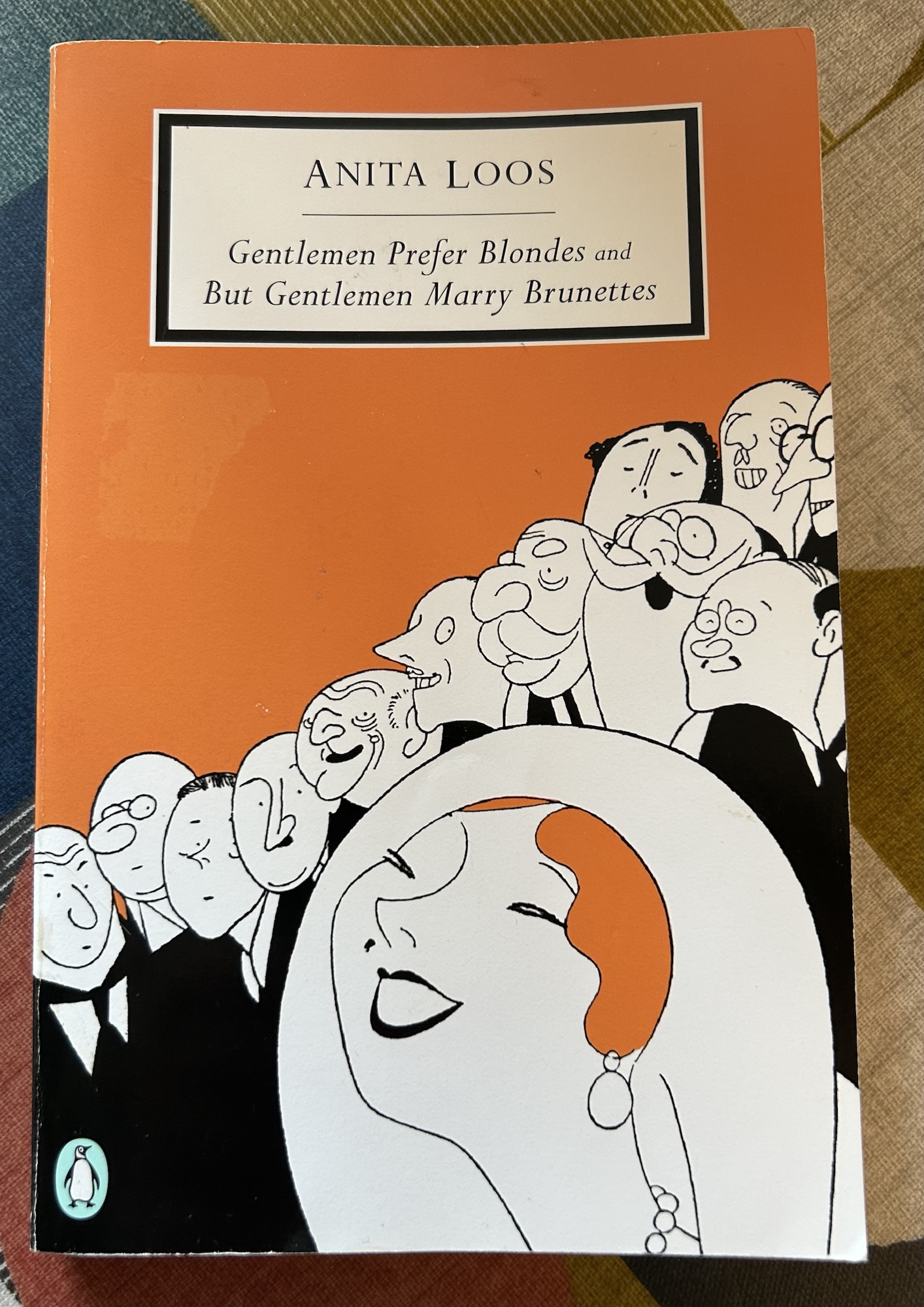
Following on from yesterday’s post on Gentleman Prefer Blondes, today I read the sequel But Gentlemen Marry Brunettes by Anita Loos (1927).
(Please note – some spoilers for Gentlemen Prefer Blondes!)
I’ll start with the negatives: I don’t think this quite has the sparkle of Gentlemen Prefer Blondes and it has less of the vignette style which suited Lorelei’s voice so well. I would hesitate to recommend it as a standalone novel, but as a short, diverting companion-piece to Blondes, there is still much to enjoy.
It opens with Lorelei expressing some quite modern views on marriage:
“I am full of ambitions and I think that practically every married girl ought to have a career if she is wealthy enough to have the home life carried on by the servants. Especially if a girl is married to a husband like Henry. Because Henry is quite a homebody and, if a girl was a homebody to, she would encounter him quite often.”
As Lorelei settles into married life and motherhood, Dorothy is still on hand with cynical commentary:
“And even Dorothy says that “a kid that looks like any rich father is as good as money in the bank.” I mean sometimes Dorothy becomes Philosophical, and says something that really makes a girl wonder how anyone who can make such a Philosophical remark can waste her time like Dorothy does.”
When Lorelei decides to follow a career as a writer, she heads to the Algonquin Round Table. I don’t know what Loos’ relationship was with this group, but she’s pretty biting about these literary wits:
“So then they all started to tell about a famous trip they took to Europe. And they had a marvelous time, because everywhere they went, they would sit in the hotel, and play cute games and tell reminisences about the Algonquin. And I think it is wonderful to have so many internal resources that you never have to bother to go outside of yourself to see anything.”
Lorelei decides to write about her friend Dorothy’s life, from travelling carnival, to school:
“Well, the Principal went down to Dorothy’s class and told all the girls that Dorothy had not had the advantage of a pure home, so they must form themselves into a little Committee, and help her not to stray. And after that, Dorothy really became the center of attraction, until one of the girls took a false step with a visiting football team and Dorothy lost her novelty.”
To joining the Ziegfeld Follies:
“Because hardly any broker seems to have enough Psychology to realize that the real ideal of his dreams is some small town village bell that he used to weave a romance around when he was age sixteen. But Mr. Ziegfield knows all about Psychology so that is the kind he picks out. And Dorothy says that about all Mr. Ziegfield does to “glorify” them, is to get them to comb the hay out of their hair, and give up starch in lingeray.”
For a story about Dorothy, there’s quite a lack of her biting observations, which was a shame. However, there are still some good lines:
“Gloria warned Dorothy that it would be fatal to marry a saxaphone player, without giving yourself an opertunity to get sick of him first.”
(Very reminiscent of Some Like It Hot!) And one that had a slightly Wodehouse turn of phrase:
“I mean, he could not take to drink, because he had already done that for years.”
So all in all, Loos’ wit means there is enough to enjoy if you enjoyed Blondes, and at novella-length Brunettes doesn’t outstay its welcome.
To end, we’ve had blondes and brunettes, now an extremely famous redhead, who like Dorothy was part of the Ziegfeld Follies:

