“I began to understand the world outside the shadows of the family tree.” (Zuheir el-Hetti, The Baghdad Villa)

I’m hoping to complete my Around the World in 80 Books reading challenge this year. I want each book to be written by someone from that country and so at this stage I need to actively seek the books rather than just see what comes into my path. However, The Baghdad Villa by Zuheir el-Hetti (2016, transl. Samira Kawar 2023) did turn up in my local charity bookshop, helping me to add Iraq to my list.
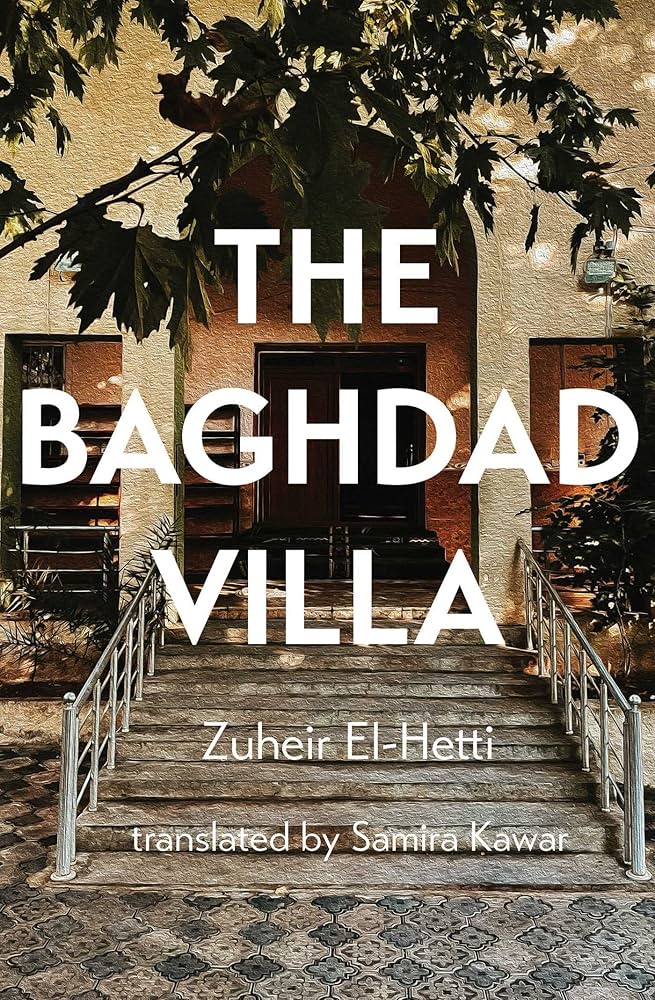
Set in 2003 after the American invasion and toppling of Saddam Hussein, the narrative is from the point of view of Ghosnelban, a young woman from an aristocratic family who is racketing around the titular building, remembering the glory days of her relatives as life outside the grounds changes beyond all recognition.

“We had been brought up according to strict rules of speech and behaviour. The use of words that breached the limits of politeness and respect was prohibited. We had carefully preserved that strict moral linguistic code, which we shared with our few gradually vanishing acquaintances and relatives, fearing that its demise would signal the loss of our identity.”

Ghosnelban’s only company is her one remaining member of staff, the housekeeper Mamluka, and her brother Silwan, who is very unwell.

“He had been a soldier in an army that had been epically crushed in the battle to free the oil-rich desert. He came back to us, but did not return, because he had left his mind there, on the road between Basra and Nasiriya. He came back filled with horrifying nightmares, leaving behind all that was human. Then he began to endlessly narrate what he had experienced and seen on that accursed road, like an endless black waterfall.”

Ghosnelban knows her situation is unsustainable. At the start of the novel she receives a bullet in the post – a warning to leave her home or be killed. She meditates on seven artworks on the walls, Masters collected by her grandfather, each painting giving its name to a chapter in the book.

Ghosnelban is not likable. She is an elitist who freely admits to othering people who are not like her “Truly, did the lives of such human beings have meaning?” At the same time, clinging onto her elitism in the face of overwhelming destruction of her way of life is an act of defiance and resistance.

“I was, after all, the descendant of a highborn family and had learned to sculpt hatred and to turn it into a lethal weapon that I threw everyone to confront the vulgarity prevailing around me.”

As much as I didn’t like Ghosnelban, her voice was so distinctive and strongly evoked from the start, I was quicky drawn into her story. And as this develops, of course she becomes more complex than the superior, condescending snob the reader is initially introduced to.

She finds freedom in a friendship with sex worker Regina:

“I wanted to escape my own skin into which I had been placed by my family and it’s ancient history. She didn’t know who I was, was completely ignorant of my family’s history… and was totally uninterested in lineage.”

We also learn of Ghosnelban’s experience of love and passion with someone whose position makes the match entirely unsuitable. Perhaps it is this that encourages her to try and find who is when not defined by her family:

“My grandparents seemed supremely elegant, but cheerless. Their gazes expressed a hauteur that seemed natural to them, two people who never allowed colourful emotions to draw close […. ] Tears were an absolutely forbidden weakness. Displays of yearning were cheap. Love was demonstrated through action, not mawkishness; smiling was a feeling, not a meaningless stretching of the lips. We had learned that list by heart, and I remembered it nostalgically.”

While Ghosnelban seems to retreat into inaction, gazing at her grandfather’s paintings and reflecting, el-Hetti brilliantly builds the sense of impending threat and violence from which she cannot escape. Ghosnelban is not stupid and she knows she has to take a decision or inaction becomes a decision. For such a reflective, interior narrative, The Baghdad Villa becomes unbearably tense.

The Baghdad Villa is a compelling, complex character study which widens to explore the impact on individuals during moments of rapid societal and political change.  It demonstrates how moments of great humanity can exist in the most extreme circumstances; as well as the extremes to which human beings can be driven.

Much to my surprise, it became a real page-turner as I hoped Ghosnelban wouldn’t be destroyed along with her family’s villa. On finishing, I knew I was really going to miss Ghosnelban’s snooty, fierce and vulnerable voice.
“Why don’t words come automatically with threads that we can yank to pull them back inside ourselves?” (Jokha Alharthi, Bitter Orange Tree)

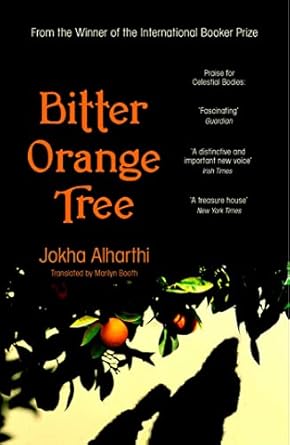
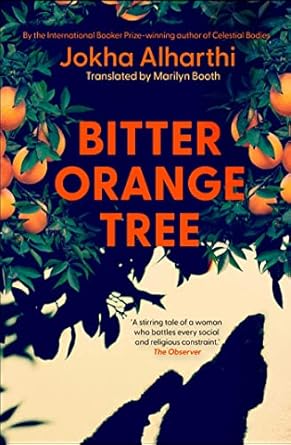
For this year’s Women in Translation Month I’m trying to focus on countries I’ve yet to visit on my Around the World in 80 Books reading challenge. This meant I was delighted to find a copy of Bitter Orange Tree by Jokha Alharthi (2016, transl. Marilyn Booth 2022) in my much-frequented local charity bookshop, as I’ve not read a book by an Omani author before.

I had completely missed Celestial Bodies for which Alharthi and Booth won the Man International Booker Prize in 2019. At that time Alharthi was the first Omani woman to be translated into English.

Bitter Orange Tree is a short novel, just 214 pages in my edition with quite large type, which I read entirely during a train journey back from Newcastle. (In fact, everyone around my table was reading a print book – it was like the olden days! For balance, I should say on the journey up I was sat next to someone who spent the whole time scrolling through TikTok and Insta, never watching any of the short content through to the end. I found it exhausting and had to mind my own business in the end 😀 )

The story is told from the point of view of Zuhour, a young woman who has left Oman to study in a nameless, cold, foreign city (most likely Edinburgh). She balances descriptions of her current life where a friend’s sister has fallen in love with a man her family wouldn’t approve of, with memories of Oman and particularly her grandmother-figure, Bint Aamir.

Zuhour harbours guilt regarding not staying with her grandmother, who has now died. A comment to a friend is the starting point for memories and reflections on Bint Aamir’s life:

“She always longed to own some land… just a tiny patch, with date palms growing on it, even if there was only space for five or so. And a few little fruit trees – lemon, papaya, banana, bitter orange. She would even plant those herself. She would water them and take care of them. And eat from them. And rest in their shade.”

Bint Aamir’s life is not easy, expelled along with her brother from her father’s house, she struggles for money. Gradually she finds a role in a relative’s home and while owning nothing, she provides almost everything.

“Bint Aamir’s feet were submerged in the soil that was the ground of our lives. She built the walls that made this household exist and thrive, mud brick by mud brick.”

Zuhour’s past and present conflate frequently, and I thought Alharthi conveyed so effectively the way memories underpin and inform the present. The conflation and the movement back and forwards between different times was seamless and never confusing.

“Tears run from my eyes, from both my eyes, from my two sound eyes. My tears spill over her one eye, which is damaged; over the herbal concoctions that were prescribed by ignorance; over the violence and harshness of childhood; over children orphaned by their mothers deaths and thrown out by their fathers, and over their brothers tragic ends; over a field she did not possess; over a companion she was never fortunate enough to have; over son who is not hers; over the grandchildren of a friend who died before she did.”

There’s also some humour, and I particularly liked this description of Zuhour’s friend Christine:

“Her cup of decaf coffee with soy milk was tall and skinny: it looked just like her. Here at this party, she was an exact scan of the figure I always saw at the university: T-shirt jeans running shoes ponytail nose ring tattoo long skinny cup.”

There were aspects of the story that were less successful for me though. Alongside the friends’ illicit relationship that Zahour has complex, unresolved feelings about, there is also a story of domestic violence involving her sister Sumayya. Both these sub-plots were too shallowly explored, before they petered-out. I felt that either Bitter Orange Tree needed to be longer, or one of these sub-plots needed to be cut and the other further developed.

While I liked the imaginative style, sometimes it became overly sentimental, particularly with regard to Bint Aamir. Although Zahour acknowledges “All her contentment was drawn from the happiness of the people for whom she cared.” she sometimes goes on flights of fancy regarding what her grandmother didn’t have in life, without knowing how her grandmother felt. These seemed clunky to me, although in fairness this may have been deliberate, to emphasise Zahour’s callow inexperience and inability to think beyond cliches at times.

But I only blog about books I like and I did like Bitter Orange Tree. The handling of past and present was so deft, and the style so readable. From looking online I think a lot of people preferred Celestial Bodies so I’d be keen to give that a try. If you’ve read Celestial Bodies I’d love to hear how you found it.

Novella a Day in May 2020 #18

Two Women in One – Nawal el-Saadawi (1975 trans. Osman Nusairi and Jana Gough, 1985) 124 pages

Nawal el-Saadawi is a ridiculously impressive individual; if you ever want to feel like a total underachiever, just read her wiki page. A big part of her work is as a campaigner for women’s rights, and this is very much the theme of Two Women in One.

The novella concerns Bahiah Shaheen, who is studying to be a doctor.

“She stood with her right foot on the edge of the marble table and her left foot on the floor, a posture unbecoming for a woman – but then in society’s eyes she was not yet a woman since she was only eighteen. In those days, girls dresses made it impossible to stand like that. Their skirts wound tightly around the thighs and narrowed at the knees, so that their legs remained bound together whether they were sitting, standing or walking, producing an unnatural movement.”

Bahiah doesn’t walk like other women, she strides. She isn’t interested in men. She isn’t interested in her studies. She struggles to connect with her family. She often thinks of herself as split in two: the outwardly obedient daughter and student, the inwardly restless and rebellious young woman.

Bahiah likes art and drawing, and she meets a young man Saleem at an exhibition. He begins to open her eyes to life beyond her home and studies and her internal reflections start to result in external actions.

“Bahiah Shaheen’s mind was not her own. But she had another mind. She could feel it in her head, a swelling thing that filled her skull, impishly and secretly telling her that all these things were worthless and that she wanted something else, something different, unknown but definite, specific yet undefined, something she could draw with the tip of her pen on the blank sheet of paper like an individual black line, But when she looked at it, it became a long line stretching far and wide as the horizon with no beginning and no end.”

This is what el-Saadawi captures so well in Two Women in One: not knowing what you want, except you want something different. Another writer would have Bahiah’s awakening coinciding with a sexual awakening with Saleem, or a driven ambition to be an artist. But el-Saadawi doesn’t fall into those clichés, although Bahiah experiences sexual pleasure and is motivated by her art. Rather Bahiah has that late adolescent feeling of restlessness and disconnect, without knowing enough about yourself or life to know what you want to fight for.

For Bahiah, this adolescent awakening has significant ramifications, because she lives in a society that circumscribes women’s choices and activities and under a government that clamps down forcibly on any dissent.

“Ever since she first became aware of life, she had wondered why all the things she loved were taboo.”

Two Women in One is simply plotted and told, but it is a story that asks big questions about the freedom of the individual, the role of women, societal responsibility and the price paid for living authentically.

“Bahiah now understood the tragedy. She knew why human beings hide their real desires: because they are strong enough to be destructive; and since people do not want to be destroyed, they opt for a passive life with no real desires.”

Novella a Day in May 2019 #9

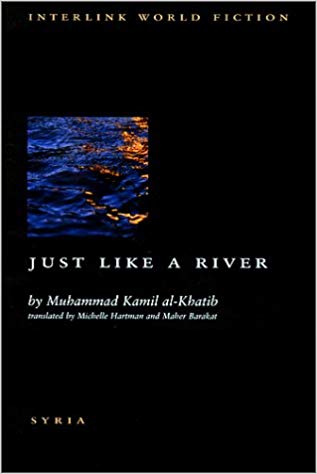
Just Like a River – Muhammad Kamil al-Khatib (1984, trans. Michelle Hartman and Maher Barakat, 2003) 110 pages

Just Like a River was Syrian writer Muhammad Kamil al-Khatib’s first novel, set in Damascus in the 1980s. It forms another stop on my much-neglected Around the World in 80 Books reading challenge, hosted by Hard Book Habit. The novella looks at the lives of a group of Syrians, with different chapters from different viewpoints. In this way, al-Khatib builds a picture of the individuals, Damascus, and the wider Syrian political situation.

Dallal is the young daughter of Yunis, a Chief Sergeant in the army. She struggles with the expectations placed on women where she lives and idealises life overseas:

“Young European women live alone. They rent rooms and come home at night when they like. Over there, men do not harass women in the streets but are polite like Doctor Morton White.”

Ha! Unfortunately we know she is sadly mistaken, in both this and in her assessment of her professor. He is self-centred and shallow, and exoticises Syrian women without really bothering to get to know a single one:

“He had illusions that he would discover Arab women through Dallal. He would explore this Middle East that was shrouded in secrets.”

By returning to characters over various chapters al-Khatib deepens the individual portraits. Yusuf is in love with Dallal and his friend Zuhayr at first seems a real misogynist. Then it becomes apparent that his flippancy hides a deeper hurt, and he is as cynical about men as he is women:

“What do we offer them other than a mirror image of our fathers’ backwardness? We act as if we are only thieves or guards of their hymens.”

The portrayal of women is sympathetic, so Dallal is seen as young and naïve rather than ignorant and prideful. Her friend Fawziya is hurt yet optimistic:

“Fawziya was a disappointed woman. Her tempestuous love affair with Sami caused her to have a general disrespect for men, coupled with a longing for some certain, but unknown, man… She and her mother dealt with things just as one might expect two destroyed women in solidarity with each other would. They were two women betrayed by both men and time, and who persevered, waiting for a certain something, a certain man, a certain incident. This is why they spent so much time reading coffee cups and interpreting dreams.”

As they all deal with the day-to-day concerns of family conflict and unspoken feelings, the political situation is building in the background. When he is called to the army, Yusuf is not particularly concerned. As it becomes clear that the conflict may be escalating, he meets it with grim humour:

“ ‘They don’t give us good weapons or enough of them. Look, can’t you see how the bombs fall down like paper?’

Yusuf laughed. ‘I fear that we, not the missiles, are paper,’ he said.”

Just Like a River is an evocative and memorable portrait of a group of people struggling against the forces directing their lives, and themselves. If that makes it sound heavy or depressing, it isn’t. It looks at huge themes straight on, but does so with compassion and understanding.

“Brevity is the soul of lingerie.” (Dorothy Parker)

Apparently you can have too much of a good thing.  This is not something I’ve experienced myself, but as it seems to be a truth universally acknowledged, I’ll go with it.  So even if you are an inveterate bibliophile there can be times when humungous, bicep-busting books can be off-putting, particularly if like me, you’re a non-Kindle using commuter.  You don’t want to be lugging The Count of Monte Cristo onto the train (or so my osteopath insists).  This week I thought I’d look at books that are small and perfectly formed: 1 novella and 1 short story collection that are little gems.

Firstly, Fair Play by Tove Jansson (1989 my edition trans. Thomas Teal 2007, 127 pages). Jansson is most famous for creating those weird hippo/mouse hybrid creatures the Moomins:

https://www.youtube.com/watch?v=CdyG97Zgguw

Recently I kept reading about how good her writing for adults is, so when I saw Fair Play in a bookshop I decided it was A Sign.  A Sign for me to spend money, which admittedly is what every bookshop says to me.  But Fair Play was worth every penny.  It is a beautifully observed, delicate portrait of two artistic women sharing a life together.  Jonna is a visual artist, Mari a writer:

“They never asked, “Were you able to work today?” Maybe they had, twenty or thirty years earlier, but they’d gradually learned not to.  There are empty spaces that must be respected  – those often long periods when a person can’t see the pictures or find the words and needs to be left alone.”

This is what Fair Play captures so well, the unspoken subtleties that exist in a long-term relationship, with the person you know better than anyone.  With a restrained lightness of touch, Jansson presents moments in time between the two women,  detailing events that seem simultaneously fleeting yet loaded with meaning.

“They hadn’t noticed the fog moving off….suddenly the sea was open and blue and they found themselves a long way out toward Estonia.  Jonna started the motor.  They came back to the island from a totally new direction, and it didn’t look the same.”

The novel has no ostensible plot, and there is no sense of time – each chapter could occur chronologically, or could be moving back and forth across the trajectory of their long relationship.  It doesn’t matter.  You finish the novel with the feeling of being allowed glimpses into two unique, intertwined lives, while understanding how we all essentially remain unknown.

“It’s gone so quiet,” Jonna said. “What did you think? Wasn’t that a good storm?”

“Very good,” Mari said. “The best we’ve had.”

Jansson’s writing is stark, yet beautiful. I will definitely be seeking out more by this writer.

Secondly, The Madman of Freedom Square by Hassan Blasim (2009, Comma Press, trans. Jonathan Wright, 90 pages). The cover of this collection includes a quote from The Guardian, proclaiming Blasim “perhaps the best writer of Arabic fiction alive”. Like Fair Play, this was the first time I’d read this author, and it seems like such an oversight as he has so much to say that is important.  Blasim is a deeply political writer, by which I mean not that he is polemical, but that he is engaged with how literature works within a wider society:

“Because literature in this country is literature that goes through phases. Since the fall of Saddam Hussein there have been incessant calls for writing to be intelligible, realistic, factual and pragmatic.  They are lamenting readers that don’t exist. They claim the writers of the past made the readers defect, whereas in fact for hundreds of years there were no readers in the broad sense of the word.  There were only hungry people, killers, illiterates, soldiers, villagers, people who prayed, people who were lost and people who were oppressed. Our writers seem to have grown tired of writing for each other.” (‘The Market of Stories’)

Blasim’s stories detail lives caught up in war: illegal immigrants, hostage experiences, propaganda- makers, asylum-seekers.  He is acutely aware of how stories are manipulated in this media-saturated world, and how there can be many truths held within the one story:

“This story took place in darkness and if I were destined to write it again, I would record only the cries of terror which rang out at the time and the other mysterious noises that accompanied the massacre. A major part of the story would make a good experimental radio piece.” (‘The Truck to Berlin’)

The short stories in The Madman of Freedom Square are all the more powerful for their brevity: there is a sense that in such unstable times, words are a luxury, and every one must count.  Certainly Blasim’s words count; his stories are powerful, extraordinary, bleakly funny on occasion, and deeply moving.

Back to frivolity: to end, a reminder that smaller is sometimes better (although frankly, when it comes to cookies, I’m still not entirely convinced…)