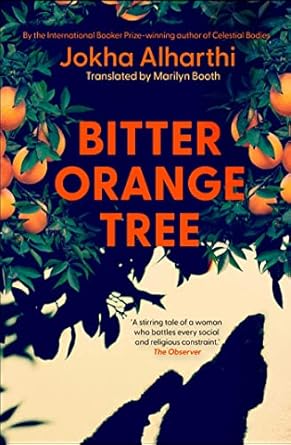
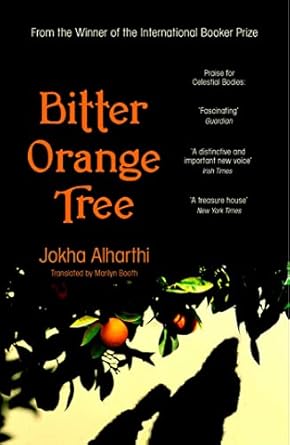
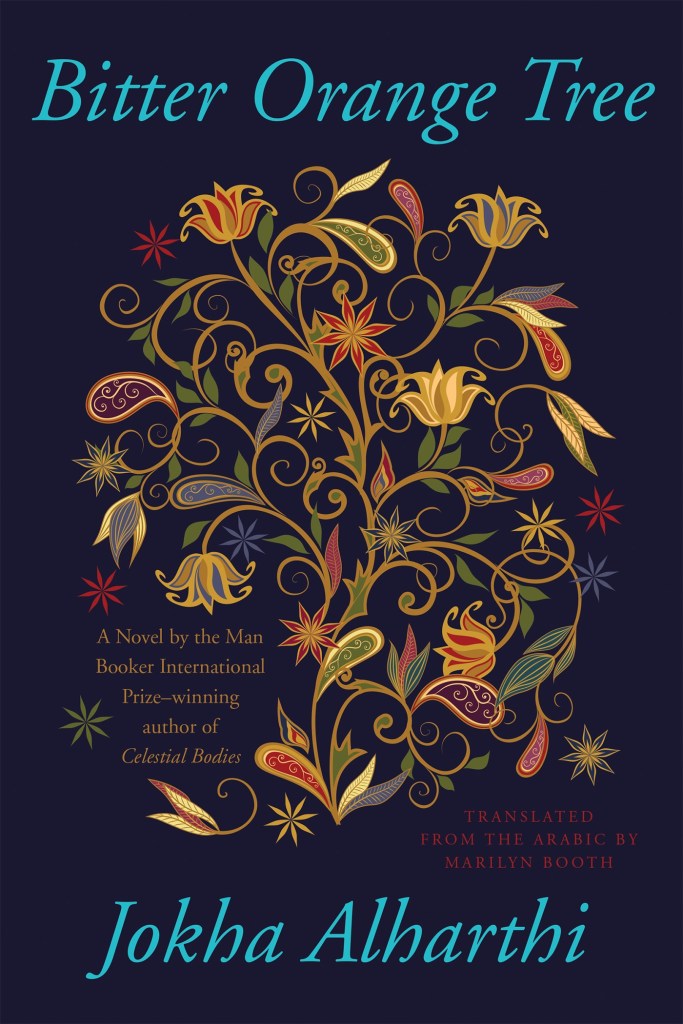
For this year’s Women in Translation Month I’m trying to focus on countries I’ve yet to visit on my Around the World in 80 Books reading challenge. This meant I was delighted to find a copy of Bitter Orange Tree by Jokha Alharthi (2016, transl. Marilyn Booth 2022) in my much-frequented local charity bookshop, as I’ve not read a book by an Omani author before.
I had completely missed Celestial Bodies for which Alharthi and Booth won the Man International Booker Prize in 2019. At that time Alharthi was the first Omani woman to be translated into English.
Bitter Orange Tree is a short novel, just 214 pages in my edition with quite large type, which I read entirely during a train journey back from Newcastle. (In fact, everyone around my table was reading a print book – it was like the olden days! For balance, I should say on the journey up I was sat next to someone who spent the whole time scrolling through TikTok and Insta, never watching any of the short content through to the end. I found it exhausting and had to mind my own business in the end 😀 )
The story is told from the point of view of Zuhour, a young woman who has left Oman to study in a nameless, cold, foreign city (most likely Edinburgh). She balances descriptions of her current life where a friend’s sister has fallen in love with a man her family wouldn’t approve of, with memories of Oman and particularly her grandmother-figure, Bint Aamir.
Zuhour harbours guilt regarding not staying with her grandmother, who has now died. A comment to a friend is the starting point for memories and reflections on Bint Aamir’s life:
“She always longed to own some land… just a tiny patch, with date palms growing on it, even if there was only space for five or so. And a few little fruit trees – lemon, papaya, banana, bitter orange. She would even plant those herself. She would water them and take care of them. And eat from them. And rest in their shade.”
Bint Aamir’s life is not easy, expelled along with her brother from her father’s house, she struggles for money. Gradually she finds a role in a relative’s home and while owning nothing, she provides almost everything.
“Bint Aamir’s feet were submerged in the soil that was the ground of our lives. She built the walls that made this household exist and thrive, mud brick by mud brick.”
Zuhour’s past and present conflate frequently, and I thought Alharthi conveyed so effectively the way memories underpin and inform the present. The conflation and the movement back and forwards between different times was seamless and never confusing.
“Tears run from my eyes, from both my eyes, from my two sound eyes. My tears spill over her one eye, which is damaged; over the herbal concoctions that were prescribed by ignorance; over the violence and harshness of childhood; over children orphaned by their mothers deaths and thrown out by their fathers, and over their brothers tragic ends; over a field she did not possess; over a companion she was never fortunate enough to have; over son who is not hers; over the grandchildren of a friend who died before she did.”
There’s also some humour, and I particularly liked this description of Zuhour’s friend Christine:
“Her cup of decaf coffee with soy milk was tall and skinny: it looked just like her. Here at this party, she was an exact scan of the figure I always saw at the university: T-shirt jeans running shoes ponytail nose ring tattoo long skinny cup.”
There were aspects of the story that were less successful for me though. Alongside the friends’ illicit relationship that Zahour has complex, unresolved feelings about, there is also a story of domestic violence involving her sister Sumayya. Both these sub-plots were too shallowly explored, before they petered-out. I felt that either Bitter Orange Tree needed to be longer, or one of these sub-plots needed to be cut and the other further developed.
While I liked the imaginative style, sometimes it became overly sentimental, particularly with regard to Bint Aamir. Although Zahour acknowledges “All her contentment was drawn from the happiness of the people for whom she cared.” she sometimes goes on flights of fancy regarding what her grandmother didn’t have in life, without knowing how her grandmother felt. These seemed clunky to me, although in fairness this may have been deliberate, to emphasise Zahour’s callow inexperience and inability to think beyond cliches at times.
But I only blog about books I like and I did like Bitter Orange Tree. The handling of past and present was so deft, and the style so readable. From looking online I think a lot of people preferred Celestial Bodies so I’d be keen to give that a try. If you’ve read Celestial Bodies I’d love to hear how you found it.


I like your decision to choose countries you have not read from before. I haven’t read Bitter Orange Tree but I did read Celestial Bodies, it’s not an easy one to recall because of the structure of the narrative, but looking back I recall it made quite an impression once I let of narrative expectations. There were numerous characters across time and the thing that connected them for me was The Big House where they resided or had some relation to. It feels like the kind of book that a second reading would reveal more, as first time around you are figuring out what it is about and it requires having to let go, to let that understanding arrive. I highlighted many passages though and appreciated its uniqueness, something the International Booker excels at.
LikeLiked by 1 person
That’s so interesting Claire, thank you for sharing your experience. I’ll remember what you say about letting go of expectations when I get to Celestial Bodies.
LikeLiked by 1 person
I’m not sure I’ve read anything by an Omani writer, either, but reading Claire’s comment perhaps Celestial Bodies might be a better place to start.
LikeLiked by 1 person
Yes, I think that’s right. From what Claire said and some comments I read online, Celestial Bodies sounds the stronger work. And it won the International Booker!
LikeLiked by 1 person
I haven’t read any books by an Omani before and I like your decision to find authors from countries to which you have not yet travelled (by book I mean of course!).
I enjoyed reading your thoughts, and the cited quotes, in this review. I then did a little research on this one and Celestial Bodies (how books lead one on trails in the mind!). I definitely would consider trying these and, should I do so, I will try to remember Claire’s comments about letting go of my expectations; it’s helpful to be warned/advised how best to approach a book that might be a bit different from the usual reading styles.
I love reading on a train, just as long as it is not too noisy. It combines two of my favourite activities – people and places watching and books. I love your comment about the person on Insta and Tiktok; when I was on a train recently, I did notice I was the only one with a ‘real’ book but it was very quiet because everyone was plugged into their devices with little personal headphones. I felt quite embarrassed when I had to speak on my mobile without any headphones!
LikeLiked by 1 person
Yes, Claire’s comments are really helpful aren’t they? It sounds like Celestial Bodies is a challenging but rewarding read. Let’s hope we enjoy it when we get to it!
I love reading on trains too 🙂 I agree about the quiet – when people are playing five different songs from their devices it’s awful! I’ve a train journey to Inverness next week and I really hope it’s a peaceful one…
LikeLike
Oman is a setting I’ve never visited in my reading either and this sounds a good place to do that. I love that quote about the grandma’s wish for a piece of land–immediately conjures up feelings of peace and contentment.
LikeLiked by 1 person
It was good, the Oman setting was really well evoked. I really liked that quote too, land and plants can mean so much.
LikeLiked by 1 person
This does sound interesting Madame B, even if some of the elements didn’t work for you. I’ve not read anything from Oman either as far as I know and I think it’s a great idea to incorporate new places in WIT!
LikeLiked by 1 person
Yes, even though it wasn’t totally successful I still found it really interesting. I’m enjoying visiting new places via WITMonth!
LikeLiked by 1 person
I’ve not read her prize-touched novel either, but I do have this one on my local library branch, tagged as “soonish” in my list. Glad to hear that you found it a worthwhile experience (I’ve not read an Omani woman’s writing yet, either).
LikeLiked by 1 person
I hope you enjoy this one when you get to it Marcie!
LikeLike