“The power of books, this marvellous invention of astute human intelligence.” (Mariama Bâ)

My Around the World in 80 Books reading challenge is much neglected, so I was pleased to find a novella from a Sengalese writer in my local charity bookshop/goldmine, in time for Novellas in November hosted by Cathy and Bookish Beck.

So Long a Letter by Mariama Bâ (1980, transl. Modupé Bodé-Thomas, 1981) is only 89 pages long but covers major themes, around choices available to women in 1970s Senegal; polygamous marriage; Sengalese society emerging from colonialism; and generational difference. It is framed as a letter from Ramatoulaye to her long-term friend Aissatou, but as one long letter with no reply, it doesn’t really feel like an epistolary novel.

At the start of the novel, Ramatoulaye’s husband Modou has just died. As she undertakes four months and ten days of mourning as part of her Islamic faith, she reflects on the pain caused when Modou took his second wife, Binetou, a friend of their eldest daughter.

“I have enough memories in me to ruminate upon. And these are what I am afraid of, for they smack of bitterness. May their evocation not soil the state of purity in which I must live.”

Ramatoulaye trained as a teacher and works at the university, but finds herself considering what she gave up for married life:

“How many dreams did we nourish hopelessly that could have been fulfilled as lasting happiness and that we abandoned to embrace others, those that have burst miserably like soap bubbles, leaving us empty handed?”

Having met her husband during training, she has been married for thirty years and raised twelve children. Now the children are older and with her husband gone, she finds herself caught between generations:

“It was the privilege of our generation to be the link between two periods in our history, one of domination, the other of independence. We remained young and efficient, for we were the messengers of a new design.”

Yet her daughters are the ones achieving a marriage of equal partners, and while Ramatoulaye welcomes this, she struggles with other behaviours such as wearing trousers and smoking:

“The unexpectedness of it gave me a shock. A woman’s mouth exhaling the acrid smell of tobacco instead of being fragrant.”

The full extent of Modou’s disregard of Ramatoulaye emerges later in the novel: he didn’t tell Ramatoulaye he was courting Binetou or considering marriage, but leaves one day not to return. His friends arrive at the house to explain he has married again and left the family.

A strength of the story is Ramatoulaye’s refusal to outright condemn the young second bride. She recognises that Binetou has been pushed by her mother to marry for financial gain.

“Binetou, like many others, was a lamb slaughtered on the altar of affluence.”

And when Binetou doesn’t behave kindly, Ramatoulaye frames it thus:

“A victim, she wanted to be the oppressor. Exiled in the world of adults, which was not her own, she wanted her prison gilded. Demanding, she tormented. Sold, she raised her price daily. What she renounced, those things which before used to be the sap of her life which she would bitterly enumerate, called for exorbitant compensations, which Modou exhausted himself trying to provide.”

There is a strong sense of sisterhood running through So Long a Letter. In writing to her recently divorced friend, the narrative remains between two women, creating an intimacy and a focus on unmediated female experience.

“I am not indifferent to the irreversible currents of women’s liberation that are lashing the world. This commotion that is shaking up every aspect of our lives reveals and illustrates our abilities.

My heart rejoices each time a woman emerges from the shadows.”

To end, a film adaptation was released this year. From the trailer, it looks faithful to the book:

“I began to understand the world outside the shadows of the family tree.” (Zuheir el-Hetti, The Baghdad Villa)

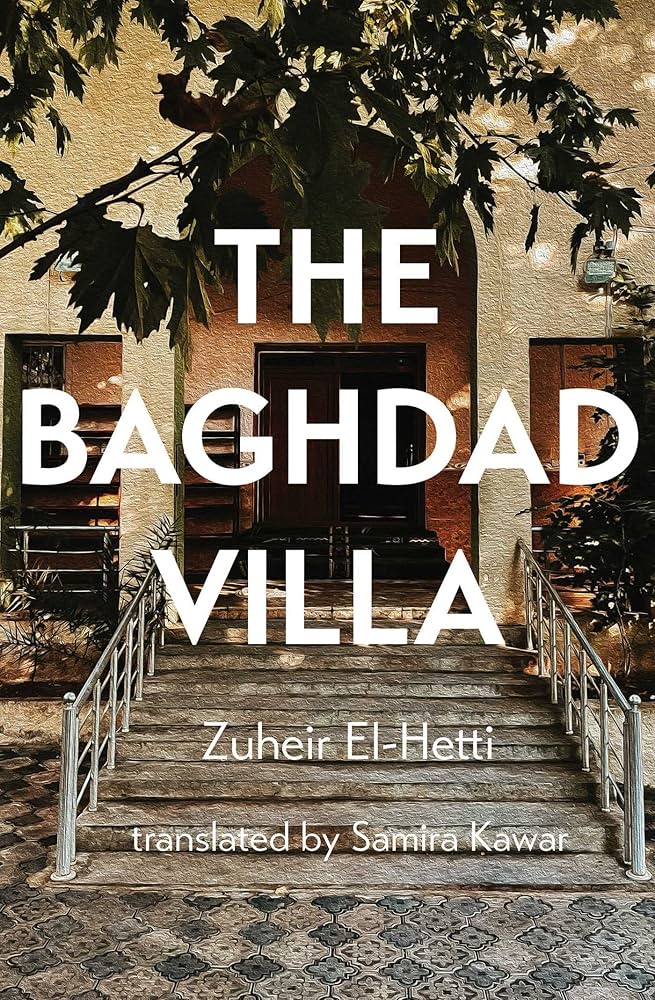
I’m hoping to complete my Around the World in 80 Books reading challenge this year. I want each book to be written by someone from that country and so at this stage I need to actively seek the books rather than just see what comes into my path. However, The Baghdad Villa by Zuheir el-Hetti (2016, transl. Samira Kawar 2023) did turn up in my local charity bookshop, helping me to add Iraq to my list.

Set in 2003 after the American invasion and toppling of Saddam Hussein, the narrative is from the point of view of Ghosnelban, a young woman from an aristocratic family who is racketing around the titular building, remembering the glory days of her relatives as life outside the grounds changes beyond all recognition.

“We had been brought up according to strict rules of speech and behaviour. The use of words that breached the limits of politeness and respect was prohibited. We had carefully preserved that strict moral linguistic code, which we shared with our few gradually vanishing acquaintances and relatives, fearing that its demise would signal the loss of our identity.”

Ghosnelban’s only company is her one remaining member of staff, the housekeeper Mamluka, and her brother Silwan, who is very unwell.

“He had been a soldier in an army that had been epically crushed in the battle to free the oil-rich desert. He came back to us, but did not return, because he had left his mind there, on the road between Basra and Nasiriya. He came back filled with horrifying nightmares, leaving behind all that was human. Then he began to endlessly narrate what he had experienced and seen on that accursed road, like an endless black waterfall.”

Ghosnelban knows her situation is unsustainable. At the start of the novel she receives a bullet in the post – a warning to leave her home or be killed. She meditates on seven artworks on the walls, Masters collected by her grandfather, each painting giving its name to a chapter in the book.

Ghosnelban is not likable. She is an elitist who freely admits to othering people who are not like her “Truly, did the lives of such human beings have meaning?” At the same time, clinging onto her elitism in the face of overwhelming destruction of her way of life is an act of defiance and resistance.

“I was, after all, the descendant of a highborn family and had learned to sculpt hatred and to turn it into a lethal weapon that I threw everyone to confront the vulgarity prevailing around me.”

As much as I didn’t like Ghosnelban, her voice was so distinctive and strongly evoked from the start, I was quicky drawn into her story. And as this develops, of course she becomes more complex than the superior, condescending snob the reader is initially introduced to.

She finds freedom in a friendship with sex worker Regina:

“I wanted to escape my own skin into which I had been placed by my family and it’s ancient history. She didn’t know who I was, was completely ignorant of my family’s history… and was totally uninterested in lineage.”

We also learn of Ghosnelban’s experience of love and passion with someone whose position makes the match entirely unsuitable. Perhaps it is this that encourages her to try and find who is when not defined by her family:

“My grandparents seemed supremely elegant, but cheerless. Their gazes expressed a hauteur that seemed natural to them, two people who never allowed colourful emotions to draw close […. ] Tears were an absolutely forbidden weakness. Displays of yearning were cheap. Love was demonstrated through action, not mawkishness; smiling was a feeling, not a meaningless stretching of the lips. We had learned that list by heart, and I remembered it nostalgically.”

While Ghosnelban seems to retreat into inaction, gazing at her grandfather’s paintings and reflecting, el-Hetti brilliantly builds the sense of impending threat and violence from which she cannot escape. Ghosnelban is not stupid and she knows she has to take a decision or inaction becomes a decision. For such a reflective, interior narrative, The Baghdad Villa becomes unbearably tense.

The Baghdad Villa is a compelling, complex character study which widens to explore the impact on individuals during moments of rapid societal and political change.  It demonstrates how moments of great humanity can exist in the most extreme circumstances; as well as the extremes to which human beings can be driven.

Much to my surprise, it became a real page-turner as I hoped Ghosnelban wouldn’t be destroyed along with her family’s villa. On finishing, I knew I was really going to miss Ghosnelban’s snooty, fierce and vulnerable voice.

#WITMonth: My Pen is the Wing of A Bird (Maclehose Press)

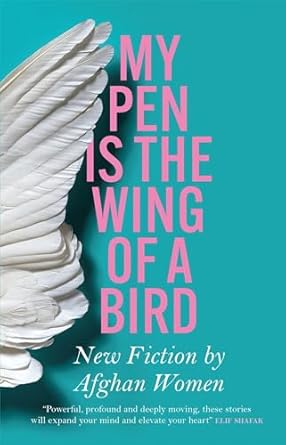
Continuing my plan to focus on countries I’ve yet to visit on my Around the World in 80 Books reading challenge for this year’s Women in Translation Month, I was pleased to find an anthology of short stories from Afghanistan in my oft-visited local charity bookshop. I later found out it was the first anthology of short fiction by Afghan women translated into English.

My Pen is the Wing of a Bird: New Fiction by Afghan Women (2022) brings together twenty-three stories by eighteen women (ten of whom have since left Afghanistan) as part of the UNTOLD Narratives project. The stories are translated by a variety of translators from the Pashto and Dari languages.

This will be a really short review (for me!) because if I find writing about short story collections by one author difficult, writing about an anthology by different writers is nearly impossible. So I’ll just say from the start that I found this collection powerful, evocative, moving. It was a compelling read and I’d urge anyone to get hold of a copy.

Often short story collections – even by the same author – can seem patchy but I thought this collection was remarkably consistent. The stories focus on the daily life for women and children in Afghanistan, some set in the past and evoking the country’s long history of conflict, but most with a contemporary setting. I’ll just pick out a few moments to hopefully give a sense of the collection.

There are several stories which are a tough read; domestic violence in particular features in a few. But a sense of hope and resilience pervades. In A Common Language by Fatema Haidari (transl. from Dari by Dr Zubair Popalzi), young female workers leave their hard-won jobs in support of a colleague who is sexually harassed, realistic but still hopeful about their chances of finding further employment. This is immediately followed by The Late Shift by Sharifa Pasun (transl. from Pashto by Zarghuna Kargar) where Sanga, a young working mother, continues to go to her work as a newsreader in 1985, despite the falling bombs all around her.

“Before she entered the studio, she took off her shoes and put on the special sandals that were kept in a metal cupboard. The people in charge of the studios didn’t want anyone bringing in dust that could harm the equipment […] The studios were soundproof; no sound from explosions could enter from outside.”

There are a couple of stories dedicated to those who have died. Blossom by Zainab Akhlaqi (transl. from Dari by Dr Negeen Kargar) is one, dedicated to Afghan schoolgirls and the students who died at Sayed ul-Shuhada high school on 8 May 2021. Through the story, the narrator comes to realise the importance of her friend’s question: “If a person never reads a book how can he change?”  This is carefully explored and never clunky.

I don’t think it’s a spoiler as such but do skip the next bit where I talk about the ending if you wish! The final lines of the story are simple yet intensely moving:

“I put on my black school uniform and white scarf and filled my bag with notebooks. I cut a fresh branch of blossom from our garden and went to school.”

My Pillow’s Journey of Eleven Thousand, Eight Hundred and Seventy-Six kilometres by Farangis Elyassi (transl. from Dari by Dr Zubair Popalzai) is one of the few stories set somewhere other than Afghanistan and shows that leaving your home country can be an ambivalent experience. The narrator moves to a life in the United States, but struggles for the first time in her life with insomnia. She is convinced it is linked to the loss of her comfortable pillow, made for her by her mother. Slowly she realises it is more complex (again, skip the next quote to avoid spoilers):

“my sleep was bound to the warm embrace of my country, it was bound to visiting my beloved mother, it was bound to the chatter I shared with my sisters, to the friendship and silliness so I shared with my brother, to the laughter I enjoyed with my friends. My peaceful sleep was because of the small service I used to do for my country, because of my streets, because of a sense of freedom one can feel only in one’s country.”

Looking at the UNTOLD Narratives website, I can see that this month they published My Dear Kabul, a collective diary from the women who wrote My Pen is the Wing of a Bird. It sounds unmissable.

“In the besieged city everything is unusual but everything is at the same time ordinary.” (Alma Lazarevska)

For this year’s Women in Translation Month I’m trying to focus on countries I’ve yet to visit on my Around the World in 80 Books reading challenge. Today I’m off to Bosnia and Herzegovina via Death in the Museum of Modern Art by Alma Lazarevska (1996 transl. Celia Hawkesworth 2014) published by Istros Books.

Death in the Museum of Modern Art is a collection of six stories set during the siege of Sarajevo, although Lazarevska never names the “besieged city” that features in all the tales. Lazarevska is a Bosnian writer and survivor of the siege.

I always find it really hard to write about short story collections, so I’ll just focus on the opening and closing tales.  In Dafna Pehfogl Crosses the Bridge between There and Here, the titular character reflects on her long. “unlucky”, “clumsy” life, starting when the maid burned the last coffee listening to her mother’s labour screams. Dafna is something of a scapegoat for her family and remained unmarried as her suitors weren’t smart enough for her family. Now in old age she finds herself alone in the war-torn city. Her family on “the other side” have arranged her passage to safety.

“She stepped boldly and decisively. Freed from other people’s gaze and lengthy sighs. Her feet were light on the deserted bridge between there and here.”

This is the only story in the collection written in the third person, but it didn’t distance Dafna in any way. I really hoped she’d make it to safety…

The final story, Death in the Museum of Modern Art has a dry humour to it. The narrator is answering questions that will form part of an exhibition at MoMA, including “How would you like to die?”

“I would have liked to tell him about that terrible feeling I have of being late… the feeling that I have being overtaken and I’m losing my sense of being present. Neither here, nor there.”

Without heavy judgement, Lazarevska demonstrates how the lived experience of war is being simplified and packaged up for art consumers. The impossibility of the questionnaires even beginning to capture anything meaningful from such a situation.

“But for an American, one ‘easy’ is the same as another. Hence a visitor to the Museum of Modern Art may read that my friend the writer wanted to die easily. He understands that, but the writer does not. That word introduces confusion into the writer’s answer. Can wishes of this kind be expressed in a foreign language, particularly one that does not distinguish one ‘easily’ from another?”

Lazarevska writes in a constrained style, both tonally and structurally. She doesn’t waste a word and has a real command of the short story form – I thought the six stories in this collection were all equally strong.

Lazarevska writes about the siege of Sarajevo in a way that is evocative but not overly emotive, trusting that the circumstances are extraordinary and shocking enough that they don’t need embellishment. Her focus is broadly domestic, looking at how ordinary lives find ways to carry on. The result is a compelling and memorable collection that places the reader alongside the characters as they hold onto their humanity through the most brutal experience.

“The hand I write with his healed. If any new questions should ever arrive, I shall write my answers myself. I’m writing all of this with my own hand.”

“Why don’t words come automatically with threads that we can yank to pull them back inside ourselves?” (Jokha Alharthi, Bitter Orange Tree)

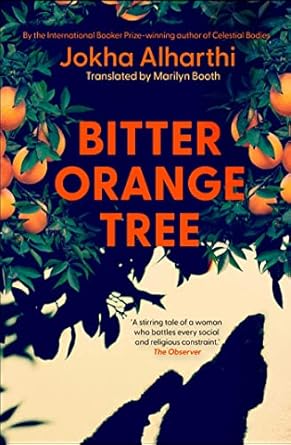
For this year’s Women in Translation Month I’m trying to focus on countries I’ve yet to visit on my Around the World in 80 Books reading challenge. This meant I was delighted to find a copy of Bitter Orange Tree by Jokha Alharthi (2016, transl. Marilyn Booth 2022) in my much-frequented local charity bookshop, as I’ve not read a book by an Omani author before.

I had completely missed Celestial Bodies for which Alharthi and Booth won the Man International Booker Prize in 2019. At that time Alharthi was the first Omani woman to be translated into English.

Bitter Orange Tree is a short novel, just 214 pages in my edition with quite large type, which I read entirely during a train journey back from Newcastle. (In fact, everyone around my table was reading a print book – it was like the olden days! For balance, I should say on the journey up I was sat next to someone who spent the whole time scrolling through TikTok and Insta, never watching any of the short content through to the end. I found it exhausting and had to mind my own business in the end 😀 )

The story is told from the point of view of Zuhour, a young woman who has left Oman to study in a nameless, cold, foreign city (most likely Edinburgh). She balances descriptions of her current life where a friend’s sister has fallen in love with a man her family wouldn’t approve of, with memories of Oman and particularly her grandmother-figure, Bint Aamir.

Zuhour harbours guilt regarding not staying with her grandmother, who has now died. A comment to a friend is the starting point for memories and reflections on Bint Aamir’s life:

“She always longed to own some land… just a tiny patch, with date palms growing on it, even if there was only space for five or so. And a few little fruit trees – lemon, papaya, banana, bitter orange. She would even plant those herself. She would water them and take care of them. And eat from them. And rest in their shade.”

Bint Aamir’s life is not easy, expelled along with her brother from her father’s house, she struggles for money. Gradually she finds a role in a relative’s home and while owning nothing, she provides almost everything.

“Bint Aamir’s feet were submerged in the soil that was the ground of our lives. She built the walls that made this household exist and thrive, mud brick by mud brick.”

Zuhour’s past and present conflate frequently, and I thought Alharthi conveyed so effectively the way memories underpin and inform the present. The conflation and the movement back and forwards between different times was seamless and never confusing.

“Tears run from my eyes, from both my eyes, from my two sound eyes. My tears spill over her one eye, which is damaged; over the herbal concoctions that were prescribed by ignorance; over the violence and harshness of childhood; over children orphaned by their mothers deaths and thrown out by their fathers, and over their brothers tragic ends; over a field she did not possess; over a companion she was never fortunate enough to have; over son who is not hers; over the grandchildren of a friend who died before she did.”

There’s also some humour, and I particularly liked this description of Zuhour’s friend Christine:

“Her cup of decaf coffee with soy milk was tall and skinny: it looked just like her. Here at this party, she was an exact scan of the figure I always saw at the university: T-shirt jeans running shoes ponytail nose ring tattoo long skinny cup.”

There were aspects of the story that were less successful for me though. Alongside the friends’ illicit relationship that Zahour has complex, unresolved feelings about, there is also a story of domestic violence involving her sister Sumayya. Both these sub-plots were too shallowly explored, before they petered-out. I felt that either Bitter Orange Tree needed to be longer, or one of these sub-plots needed to be cut and the other further developed.

While I liked the imaginative style, sometimes it became overly sentimental, particularly with regard to Bint Aamir. Although Zahour acknowledges “All her contentment was drawn from the happiness of the people for whom she cared.” she sometimes goes on flights of fancy regarding what her grandmother didn’t have in life, without knowing how her grandmother felt. These seemed clunky to me, although in fairness this may have been deliberate, to emphasise Zahour’s callow inexperience and inability to think beyond cliches at times.

But I only blog about books I like and I did like Bitter Orange Tree. The handling of past and present was so deft, and the style so readable. From looking online I think a lot of people preferred Celestial Bodies so I’d be keen to give that a try. If you’ve read Celestial Bodies I’d love to hear how you found it.

‘We look to Scotland for all of our ideas of civilization.’ (Voltaire)

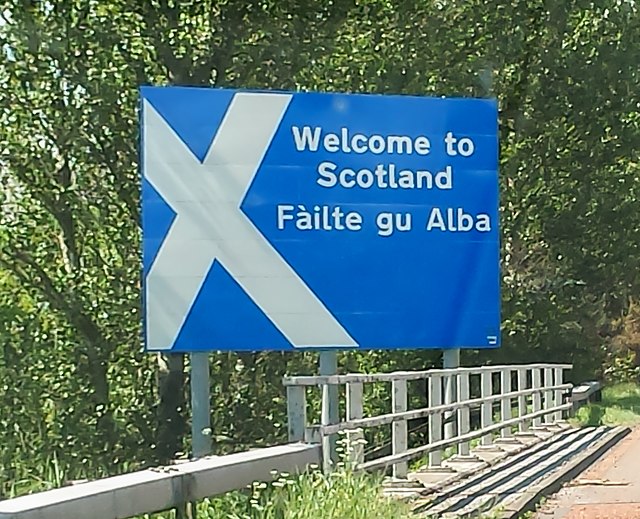
After bookish travels (sadly not actual travels) to Ireland and Wales in March, I thought I would start April with a visit to Scotland and a stop on my Around the World in 80 Books reading challenge. As with actual travels, things did not go entirely plan…

Image from Wikimedia Commons

I have piles of Scottish authors in the TBR but my initial choices did not work out. The first novel I chose was excellent but brutal, so I just wanted to leave it behind at the end and not blog about it. My second choice I thought was safe; an established and accomplished author. Unfortunately I chose a novel she wrote at age 21, before she realised that sentences need a coherent structure. I got so sick of re-reading to try and work out which pronoun referred to which character that it was a rare DNF for me.

Given my reading pace is so slow at the moment, I then panicked and chose a novella and a short story to try and get something read. Thankfully these turned out to be enjoyable reads 😊

Firstly, Edinburgh-born Muriel Spark’s final novel, The Finishing School (2005). The titular institution is College Sunrise, on the shores of Lake Geneva, run by Rowland and Nina Mahler, although by Rowland in name only:

“To conserve his literary strength, as he put it, he left nearly all the office work to Nina who spoke good French and was dealing with the bureaucratic side of the school and with the parents, employing a kind of impressive carelessness.”

Feckless Rowland is thrown of kilter by the arrival of Chris Wiley at the school:

“His own sense of security was so strong as to be unnoticeable. He knew himself. He felt his talent. It was all a question of time and exercise. Because he was himself unusual, Chris perceived everyone else to be so.”

Chris is writing a novel about Mary Queen of Scots, unhindered by the actual facts of what happened. Although Rowland is tutor to the young artistic students, Chris keeps his writing progress secret, fully aware that this stokes Rowland’s obsession with him.

In this short novel, the other pupils and staff at the school are sketched in lightly but enjoyably, such as Mary: “her ambition was to open a village shop and sell ceramics and transparent scarves”.

Not a great deal happens, but the tension builds as Rowland becomes more fixated on Chris, and the two end up in a co-dependent relationship, as Chris observes:

“I need his jealousy. His intense jealousy. I can’t work without it.”

This being Spark, I couldn’t guess which way the novel would end as she mixes the very dark with a lightness of touch:

“ ‘Too much individualism,’ thought Rowland. ‘He is impeding me. I wish he could peacefully die in his sleep.’”

I wouldn’t say The Finishing School was Spark at the height of her powers – I found it a diverting read and an enjoyable one, but for me, Spark at her best is breath-taking, almost shocking. If you’re already a fan, there’s still much to enjoy here though. The askance view of human relationships, the morbid alongside the comic, the skewering of pretentious writers, and the arresting non-sequiturs.

Secondly, Until Such Times by Inverness-born writer Jessie Kesson (1985), which I had as part of the anthology Infinite Riches: Virago Modern Classics Short Stories (ed. Lynn Knight, 1993). It was a pretty good match for Spark although I didn’t plan it as such, with some darkly comic characterisation and a very unnerving ending.

The bairn is taken to live with her Grandmother and Aunt Edith:

“But you weren’t here to stay forever! Your Aunt Ailsa had promised you that. You was only here to stay… ‘Until Such Times’, Aunt Ailsa had said on the day she took you to Grandmother’s house…”

We join her with the house in a vague state of uproar trying to prepare for a visit from Aunt Millie and Cousin Alice. There is a suggestion that the visitors are respectable and admirable, whereas the bairn and Aunt Ailsa are somehow disreputable.

The narrative moves back and forth, showing the reader more than the bairn understands about her family situation and expertly drawing the dynamics between Grandmother, Aunt and child. The tension for a child living in a strict household and the manipulations and judgements of the Aunt (who is somehow unwell but never quite clear how; she is referred to by an old-fashioned term no longer used) was so well evoked.

At only 11 pages long, Kesson shows all that can be achieved in a short story: well-drawn characters, social commentary, narrative tension and a recognisable world. The final sentence was a perfect ending. I thought Until Such Times was really impressive and I’ll definitely look out for more of Kesson’s work.

To end, a Scottish treat for my mother, who is a big fan:

“A journey is a person in itself; no two are alike.” (John Steinbeck)

This is my second post for Women in Translation Month (WITMonth) hosted by Meytal at Biblibio, and I’m hoping its also a sign that my blogging slump is coming to an end – fingers crossed! This week I’ve chosen two books linked by the theme of travel.

Firstly, Flights by Olga Tokarczuk (2007, trans. Jennifer Croft 2017) which won the International Man Booker Prize last year.

Flights is quite a hard book to review, as it’s aptly titled and resists being pinned down in any way. It’s fiction, non-fiction, essay, philosophical musing, travelogue, digression… yet this fragmentary style still holds together and works as a whole. The unity is found through the recurring themes of travel, movement, restless and flight; and also of the human body at its most visceral – the collection of bone, muscle, skin and blood that enables human locomotion.

“A thing in motion will always be better than a thing at rest; that change will always be a nobler thing than permanence; that which is static will degenerate and decay, turn to ash, while that which is in motion is able to last for all eternity.”

The fiction sections include a man whose wife and son disappear when they are on holiday in Croatia; the wife of an elderly professor who is taken ill on a cruise; a woman who leaves her young family to live on the streets… all in perpetual motion. There are also historical sections looking at the fate of Chopin’s heart; the first naming of the Achilles tendon; cadaver preservation techniques, among other bodily concerns. The focus on the organic reality of living stops Flights from becoming too flighty, grounding all the fragments in a corporeal existence.

The consistent voice also ties these different pieces together, the sense that we are being told these stories, historical fragments and observations by the same narrator, a female traveller. She sets the focus on travel as she describes the airports, planes, buses and terminals she finds herself waiting in, and her conversations with those who cross her path:

“She says that sedentary peoples, farmers, prefer the pleasures of circular time, in which every object and event must return to its own beginning, curl back up into an embryo and repeat the process of maturation and death. But nomads and merchants, as they set off on journeys, had to think up a different time for themselves, that would better respond to the needs of their travels. That time was linear time.”

Flights is a book you can dip into or read in a linear fashion. I did the latter and I’m glad I did as I could pick up the echoes across the different narratives that give a sense of unity to the book and to the world it evokes. However, it could work just as well by reading a section and focussing closely on it, as Tokarczuk’s writing is so rich. She has described her style as one of constellations, and the reason behind this individual approach is noted in Flights:

“Constellation, not sequencing, carries truth.”

Not a book for when you want a good meaty plot, but I still found it a compulsive read as well as a thought-provoking one.


Secondly, The Expedition to the Baobab Tree by Wilma Stockenstrom (1981, trans. JM Coetzee 1983) which is set in South Africa and so forms another stop on my Around the World in 80 Books reading challenge, hosted by Hard Book Habit.

I felt a bit conflicted when I started this: the story of a young slave girl told by a white South African was problematic for me. I looked on Goodreads and no-one else seemed to have this issue. Then I thought that at the time of writing, when black South African voices were so thoroughly suppressed, maybe writing this was a huge political statement.

(I once attended a debate about queer/transgender stories being staged. One side felt only those who identified as queer/trans should tell those stories. The other side felt it was fine for straight/cis artists to tell such stories so long as they did their research and the resulting art was sensitive. The wider issue is something I often come back to and think about, and something I’m still thinking through, as I did with this novella.)

The Expedition to the Baobab Tree is beautifully written and certainly a sensitive portrayal of a woman finding autonomy for the first time as she lives in the hollow of the titular tree on the southern African veld.

“I know the interior of my tree as a blind man knows his home, I know its flat surfaces and grooves and swellings and edges, its smell, its darknesses, its great crack of light […] I can say: this is mine. I can say: this is I. These are my footprints.”

The woman has ended up stranded in the veld as a doomed commercial expedition by her last owner has failed spectacularly. With no-one making demands on her for the first time, the woman is free to think and reflect:

“If I could write, I would take up a porcupine quill and scratch your enormous belly full from top to bottom. I would clamber up as far as your branches and carve notches in your armpits to make you laugh. Big letters. Small letters. In a script full of lobes and curls, in circumambient lines I write round and round you, for I have so much to tell of a trip to a new horizon that became an expedition to a tree.”

Like Flights, The Expedition to the Baobab Tree is not a straight narrative. It moves back and forth in time, with no named places or persons, It has an almost hallucinatory quality – and the narrator may be hallucinating at times, given her exposure and lack of food –  but this never detracts from the horrors she has experienced. There are times she was treated well, but she was also repeatedly assaulted, raped, and had all her children taken as babies. We are the witnesses to her experience, recounted poetically but unflinchingly.

“One time I fled from the tree. I ran aimlessly into the veld, trying to get out of its sight by hiding behind a high round rock, and I opened my mouth and I brought out a sound that must be the sound of a human being because I am a human being and not a wildebeest […] but a human being that talks and I brought out a sound and produced an accusation and hurled it up at the twilight air.”

This is a short, powerful read with a distinctive female narrator who demands to be heard.

To end, a tenuously-linked 80s video as usual 😉 Well, the title offers travel advice! I’ve chosen it especially for Kate as she’s seeing a-ha soon:

“A library is a place where you can lose your innocence without losing your virginity.” (Germaine Greer)

I really feel I’ve lost my blogging mojo over the last year. It started with the 2018 heatwave which killed off my reading for a few weeks; my reading recovered but my blogging never really did. I’m hoping Women in Translation Month (WITMonth) hosted by Meytal at Biblibio will help, but given we’re nearly halfway through, maybe not 😀 If any of you lovely bloggers have any tips on how to recover they would be gratefully received!

Anyway, here is what I hope will be the first of a few posts for WITMonth; starting with two novels loosely linked by themes of virginity, or lack thereof.

Firstly, Sworn Virgin by Elvira Dones (2007, trans. Clarissa Botsford 2014) published by the wonderful AndOtherStories. Set in Albania, its also another stop on my Around the World in 80 Books reading challenge, hosted by Hard Book Habit (Dones is Albanian but wrote this originally in Italian).

Sworn Virgin looks at the experience of Hana, who has taken on a mostly extinct northern Albanian Kanun tradition. The tradition is that a family without male heirs can nominate a female to become a sworn virgin; she will live as a man and fulfil male roles. Hana took on the role willingly to avoid a marriage she didn’t want.

“ ‘It’s not that hard to be a man, you know?’ she says. ‘I swore never to get married, it’s a tradition that exists only in the north of the country. Let me explain: when there are no boys in a family, one of the girls swears to behave like a man and to remain a man for the rest of her life. From that moment on, she has to play all the roles and take over the tasks of a man. That’s why I became the son my uncle never had. Uncle Gjergj was my father’s brother; he took me in and brought me up after my parents died.’”

At the start of the novel Hana is travelling to the US to live with her cousin Lila and begin the process of becoming Hana again. Lila is highly feminine and doesn’t quite understand that for Hana, who has been living as Mark for 15 years, the transition back is not straightforward.

“ ‘You need to take off these men’s clothes.’

‘There’s no hurry.’

‘The sooner you get rid of them the better.’

‘That’s not true.’

‘I thought that was the deal. That you were coming here to go back to what you were.’

‘Yes, but there’s no hurry.’”

Hana has to adjust to a new country as well as a new way of presenting herself to the world. Although a story of immigration, Sworn Virgin is also a story of homecoming – to oneself. Hana has to decide how her appearance will express who she is, but also look at her life and think about what she wants. She had loved books and wanted to go to college, but had to return home when her beloved uncle Gjergj was dying. When her studies became impossible and she was facing marriage she didn’t want, she chose to become Mark instead.

“She had men’s clothes and a flask of raki in her pocket, and these had been her mirrors. She had needed nothing else. Up there in the mountains, time and place had been equal partners.”

 Although the sworn virgin tradition may be seem extraordinary to those of us unused to it, Dones has made a documentary about sworn virgins before she wrote this novel and to me it never felt sensationalist or exoticised. There is much in Hana’s story that is relatable. Sworn Virgin is about reconciling yourself to the past, and how it is never too late to make changes when you find you’ve outgrown certain decisions.

“Hana tries to bring her attention back to her body. The man she thought would still be tenaciously inhabiting her is no longer there. That man was only a carapace. Lila was right: Mark Doda’s life had been no more than the sum total of the masculine gestures Hana had forced herself to imitate, in the skin worn leathery by bad food and lack of attention. Mark Doda had been a product of her iron will.”

The focus on virginity is given a wider scope too. Hana’s virginity has become a burden to her, something to discard to help her move forward. Losing it is about Hana acknowledging herself as a sexual being with desires, and prioritising her own needs  – both sexual and non-sexual – in a way she hasn’t been able to before. This is dealt with non-romantically but still sensitively.

Obviously there is a strong theme of gender roles in Sworn Virgin, but for me it was first and foremost a character study of Hana, and the many binaries she has to adjust to: home/new country, rural life/urban life, family/independence.

“She tries to penetrate the unique spirit of the individual, she analyses their face and eyes, she tries to imagine the thoughts hiding behind those eyes, but she tends to avoid thinking about the fact that the thoughts are inextricably linked to male or female ego…She’s only just realizing now that for a long time she has had to consider things from both points of view.”

Secondly, from one extreme to the other. If there’s a character in literature not remotely associated with virginity, its probably Emma Bovary. Although I can’t stand Emma, I still picked up Sophie Divry’s Madame Bovary of the Suburbs (2014, trans. Alison Anderson 2017) with anticipation because I  had really enjoyed The Library of Unrequited Love. This isn’t quite so sparky as her previous novel, but then I don’t think its supposed to be, given as its dealing with a pervasive sense of middle class ennui.

M.A. (geddit?) is born in the 1950s and dies around 2025. In between, she is bored.

“You could not voice your feelings of dissatisfaction, because – and images from all over the world came to remind you – everything had been programmed for you to be happy.”

As the quote above shows, the novel is written in the second person. Normally I would hate this technique, but here I thought it worked quite well. The reader is constantly being told ‘you’ are doing/feeling these things, but we’re not. Essentially we feel the same sense of disconnect as M.A. does to her comfortable middle class life, living in the titular area, in a house she owns with her husband Francois, raising their children.

“In those days it didn’t bother you, or not for very long, that you never had a break. Inventing a marinade, discussing your daughter’s progress, teasing your husband about his incompetence at household chores; you got the impression that at last you were enjoying a certain return on your investment, after so many years of movement, migration, studies, pregnancies.”

Of course, as we know, Madame Bovary found one way to alleviate her boredom, as does M.A. with the vacuous Phillipe. Inevitably the affair is doomed, but unlike Emma, M.A. carries on. In this way I actually found it more depressing than its namesake; Madame Bovary is quite melodramatic, whereas this novel suggests there are plenty of lives of quiet desperation being carried out across the land.

However, I don’t want to suggest this is a bleak read, it’s not. The things I enjoyed about The Library… are evident here: the light touch, the wry humour:

“The eldest among us aware of what awaits the newlyweds once everyone has left, once the tables have been cleared, the last goodbyes are said, and we find ourselves in front of a refrigerator.”

Flaubert famously said ‘Madame Bovary, c’est moi.’ Divry suggests ‘Vous êtes Madame Bovary’.

“Deep down no-one knows whether supreme happiness is attainable in one’s lifetime, physical pleasure remains one of its earthly traces, a trace we cling to, as long as we have the strength.”

To end, there’s an obvious 80s pop tune I could include on the theme of virginity, but for once I’m not going the obvious route 😊 I love the Pet Shop Boys and I don’t think I’ve ever managed to shoehorn them in so here they are singing about sinful urges:

Novella a Day in May 2019 #9

Just Like a River – Muhammad Kamil al-Khatib (1984, trans. Michelle Hartman and Maher Barakat, 2003) 110 pages

Just Like a River was Syrian writer Muhammad Kamil al-Khatib’s first novel, set in Damascus in the 1980s. It forms another stop on my much-neglected Around the World in 80 Books reading challenge, hosted by Hard Book Habit. The novella looks at the lives of a group of Syrians, with different chapters from different viewpoints. In this way, al-Khatib builds a picture of the individuals, Damascus, and the wider Syrian political situation.

Dallal is the young daughter of Yunis, a Chief Sergeant in the army. She struggles with the expectations placed on women where she lives and idealises life overseas:

“Young European women live alone. They rent rooms and come home at night when they like. Over there, men do not harass women in the streets but are polite like Doctor Morton White.”

Ha! Unfortunately we know she is sadly mistaken, in both this and in her assessment of her professor. He is self-centred and shallow, and exoticises Syrian women without really bothering to get to know a single one:

“He had illusions that he would discover Arab women through Dallal. He would explore this Middle East that was shrouded in secrets.”

By returning to characters over various chapters al-Khatib deepens the individual portraits. Yusuf is in love with Dallal and his friend Zuhayr at first seems a real misogynist. Then it becomes apparent that his flippancy hides a deeper hurt, and he is as cynical about men as he is women:

“What do we offer them other than a mirror image of our fathers’ backwardness? We act as if we are only thieves or guards of their hymens.”

The portrayal of women is sympathetic, so Dallal is seen as young and naïve rather than ignorant and prideful. Her friend Fawziya is hurt yet optimistic:

“Fawziya was a disappointed woman. Her tempestuous love affair with Sami caused her to have a general disrespect for men, coupled with a longing for some certain, but unknown, man… She and her mother dealt with things just as one might expect two destroyed women in solidarity with each other would. They were two women betrayed by both men and time, and who persevered, waiting for a certain something, a certain man, a certain incident. This is why they spent so much time reading coffee cups and interpreting dreams.”

As they all deal with the day-to-day concerns of family conflict and unspoken feelings, the political situation is building in the background. When he is called to the army, Yusuf is not particularly concerned. As it becomes clear that the conflict may be escalating, he meets it with grim humour:

“ ‘They don’t give us good weapons or enough of them. Look, can’t you see how the bombs fall down like paper?’

Yusuf laughed. ‘I fear that we, not the missiles, are paper,’ he said.”

Just Like a River is an evocative and memorable portrait of a group of people struggling against the forces directing their lives, and themselves. If that makes it sound heavy or depressing, it isn’t. It looks at huge themes straight on, but does so with compassion and understanding.

“At a dinner party one should eat wisely but not too well, and talk well but not too wisely.” (W. Somerset Maugham)

‘Tis the season of the works Christmas do, and this week I’ll be stuffing my face at not one but two dinners, as I’m going to both my old job and new job’s yuletide outing. I hate works outings, so I’d be tempted to proclaim that there is no God, but that’s not really in keeping with the season. So I’ll just say I’m not happy about the week’s forthcoming events.

robin-llorando

This week I’m looking at two stories that will help me stop being so ungrateful, as they feature horrific dinners with despicable people. Buon Natale!

Firstly, The Dinner by Herman Koch (2009, tr. 2012 Sam Garrett) and one more stop on my Around the World in 80 Books Reading Challenge, hosted by Hard Book Habit. Paul and his wife Claire are meeting his brother Serge and his wife Babette at a swish Amsterdam restaurant. Fairly quickly, it is apparent that Paul harbours a great deal of resentment towards his brother:

“Through and through, Serge remained a yokel, a boorish lout: the same boorish lout who used to get sent from the table for farting”

The dinner begins to unravel from the beginning. Babette arrives visibly upset:

 “Yet there was something else, something different about her this time, like a room where someone has thrown out all the flowers while you were gone: a change in the interior you don’t even notice at first, not until you see the stems sticking out of the garbage.”

As they work their way through the dinner (the different sections of the book are split into the consecutive sections of a menu), Paul reflects on why they are actually all meeting – to discuss a horrific crime which has taken place – and recent events in his life. The further we get into the novel, the more of Paul’s personality begins to emerge, from a slightly controversial take on memorial stones…

 “The injustice is found more in the fact that the assholes are also put on the list of innocent victims. That their names are also chiselled onto the war memorials.”

…escalating to an increasingly apparent violent nature and fascistic attitude to people.  A worrying combination:

“The little hairs on the back of my neck and my tingling fingers had not betrayed me: when the lower intelligences are about to lose an argument, they grasp at other straws in order to justify themselves.”

I won’t say too much more for fear spoilers, but The Dinner is a quick read, its light touch belying its serious concerns: should personal interest ever outweigh societal responsibility and what are the ramifications if it does?

Safe to say you’ll finish the novel mightily relieved that you never have to sit down to a meal with a single character portrayed within. And this is Koch’s master stroke. I desperately wanted the whole family to implode, for justice to be done. In doing so, I realised I wasn’t so very different to these repugnant people and their feeling of moral superiority towards others. It was not a comfortable place to be. The Dinner leaves a bad taste in the mouth, exactly as its creator intended.

Secondly, Festen (2004), the stage play by David Eldridge of the 1998 film by Thomas Vinterberg (trigger warning: mentions incest). I was a huge fan of the Dogme 95 films and I saw the play in 2004 where it translated well to the stage. It’s a simple plot but powerful: Christian’s twin sister Linda has killed herself and as the family meet to celebrate their father’s 60th birthday, Christian makes a speech about why Linda would do such thing – the sexual abuse she and Christian endured as children at the hands of their father.

“Christian: I apologise for interrupting again.

A slight pause.

I’m sorry, but I’ve forgotten the most important thing. We’re here today because it is my father’s birthday. We’re not here for any other reason.

A slight pause.

I’m sorry if I led you all up the garden path before. I am sorry. I’d like to make it all up to you all now by asking you to charge your glasses. To my father.

Helmut: Well done Christian.

Poul: Yes, well done.

Christian: If you would all like to stand with me. And raise your glasses.

Everyone stands.

To the man who killed my sister. To a murderer.”

Unsurprisingly, all hell breaks loose. Unlike The Dinner, there are people to care about and root for. Despite the horrific subject matter, there are moments of levity and the play is warm towards the majority of the characters.  Reading plays can be an odd business, because it’s not the primary form for the story. I found the playtext of Festen very readable and affecting, but if you don’t fancy it, do give the film a go, as the story is a moving one and brilliantly directed (contains swearing):

What a depressing post this has turned into! ‘Tis the season of being grumpy about enforced joviality 😉 I promise I’ve a much lighter-hearted Crimbo post planned for next week. For this week, I wish you all a lovely load of Christmas parties, may they be as adorable as this dinner:

tumblr_mgy6596y1n1rjmdrro1_500