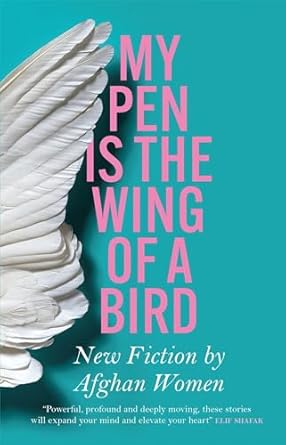
Continuing my plan to focus on countries I’ve yet to visit on my Around the World in 80 Books reading challenge for this year’s Women in Translation Month, I was pleased to find an anthology of short stories from Afghanistan in my oft-visited local charity bookshop. I later found out it was the first anthology of short fiction by Afghan women translated into English.
My Pen is the Wing of a Bird: New Fiction by Afghan Women (2022) brings together twenty-three stories by eighteen women (ten of whom have since left Afghanistan) as part of the UNTOLD Narratives project. The stories are translated by a variety of translators from the Pashto and Dari languages.
This will be a really short review (for me!) because if I find writing about short story collections by one author difficult, writing about an anthology by different writers is nearly impossible. So I’ll just say from the start that I found this collection powerful, evocative, moving. It was a compelling read and I’d urge anyone to get hold of a copy.
Often short story collections – even by the same author – can seem patchy but I thought this collection was remarkably consistent. The stories focus on the daily life for women and children in Afghanistan, some set in the past and evoking the country’s long history of conflict, but most with a contemporary setting. I’ll just pick out a few moments to hopefully give a sense of the collection.
There are several stories which are a tough read; domestic violence in particular features in a few. But a sense of hope and resilience pervades. In A Common Language by Fatema Haidari (transl. from Dari by Dr Zubair Popalzi), young female workers leave their hard-won jobs in support of a colleague who is sexually harassed, realistic but still hopeful about their chances of finding further employment. This is immediately followed by The Late Shift by Sharifa Pasun (transl. from Pashto by Zarghuna Kargar) where Sanga, a young working mother, continues to go to her work as a newsreader in 1985, despite the falling bombs all around her.
“Before she entered the studio, she took off her shoes and put on the special sandals that were kept in a metal cupboard. The people in charge of the studios didn’t want anyone bringing in dust that could harm the equipment […] The studios were soundproof; no sound from explosions could enter from outside.”
There are a couple of stories dedicated to those who have died. Blossom by Zainab Akhlaqi (transl. from Dari by Dr Negeen Kargar) is one, dedicated to Afghan schoolgirls and the students who died at Sayed ul-Shuhada high school on 8 May 2021. Through the story, the narrator comes to realise the importance of her friend’s question: “If a person never reads a book how can he change?” This is carefully explored and never clunky.
I don’t think it’s a spoiler as such but do skip the next bit where I talk about the ending if you wish! The final lines of the story are simple yet intensely moving:
“I put on my black school uniform and white scarf and filled my bag with notebooks. I cut a fresh branch of blossom from our garden and went to school.”
My Pillow’s Journey of Eleven Thousand, Eight Hundred and Seventy-Six kilometres by Farangis Elyassi (transl. from Dari by Dr Zubair Popalzai) is one of the few stories set somewhere other than Afghanistan and shows that leaving your home country can be an ambivalent experience. The narrator moves to a life in the United States, but struggles for the first time in her life with insomnia. She is convinced it is linked to the loss of her comfortable pillow, made for her by her mother. Slowly she realises it is more complex (again, skip the next quote to avoid spoilers):
“my sleep was bound to the warm embrace of my country, it was bound to visiting my beloved mother, it was bound to the chatter I shared with my sisters, to the friendship and silliness so I shared with my brother, to the laughter I enjoyed with my friends. My peaceful sleep was because of the small service I used to do for my country, because of my streets, because of a sense of freedom one can feel only in one’s country.”
Looking at the UNTOLD Narratives website, I can see that this month they published My Dear Kabul, a collective diary from the women who wrote My Pen is the Wing of a Bird. It sounds unmissable.
Death in the Museum of Modern Art is a collection of six stories set during the siege of Sarajevo, although Lazarevska never names the “besieged city” that features in all the tales. Lazarevska is a Bosnian writer and survivor of the siege.
I always find it really hard to write about short story collections, so I’ll just focus on the opening and closing tales. In Dafna Pehfogl Crosses the Bridge between There and Here, the titular character reflects on her long. “unlucky”, “clumsy” life, starting when the maid burned the last coffee listening to her mother’s labour screams. Dafna is something of a scapegoat for her family and remained unmarried as her suitors weren’t smart enough for her family. Now in old age she finds herself alone in the war-torn city. Her family on “the other side” have arranged her passage to safety.
“She stepped boldly and decisively. Freed from other people’s gaze and lengthy sighs. Her feet were light on the deserted bridge between there and here.”
This is the only story in the collection written in the third person, but it didn’t distance Dafna in any way. I really hoped she’d make it to safety…
The final story, Death in the Museum of Modern Art has a dry humour to it. The narrator is answering questions that will form part of an exhibition at MoMA, including “How would you like to die?”
“I would have liked to tell him about that terrible feeling I have of being late… the feeling that I have being overtaken and I’m losing my sense of being present. Neither here, nor there.”
Without heavy judgement, Lazarevska demonstrates how the lived experience of war is being simplified and packaged up for art consumers. The impossibility of the questionnaires even beginning to capture anything meaningful from such a situation.
“But for an American, one ‘easy’ is the same as another. Hence a visitor to the Museum of Modern Art may read that my friend the writer wanted to die easily. He understands that, but the writer does not. That word introduces confusion into the writer’s answer. Can wishes of this kind be expressed in a foreign language, particularly one that does not distinguish one ‘easily’ from another?”
Lazarevska writes in a constrained style, both tonally and structurally. She doesn’t waste a word and has a real command of the short story form – I thought the six stories in this collection were all equally strong.
Lazarevska writes about the siege of Sarajevo in a way that is evocative but not overly emotive, trusting that the circumstances are extraordinary and shocking enough that they don’t need embellishment. Her focus is broadly domestic, looking at how ordinary lives find ways to carry on. The result is a compelling and memorable collection that places the reader alongside the characters as they hold onto their humanity through the most brutal experience.
“The hand I write with his healed. If any new questions should ever arrive, I shall write my answers myself. I’m writing all of this with my own hand.”
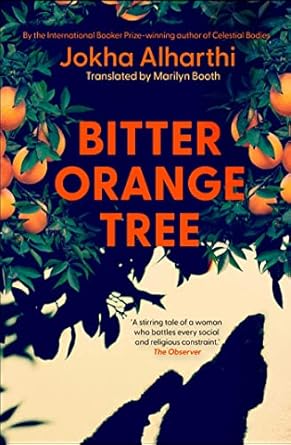
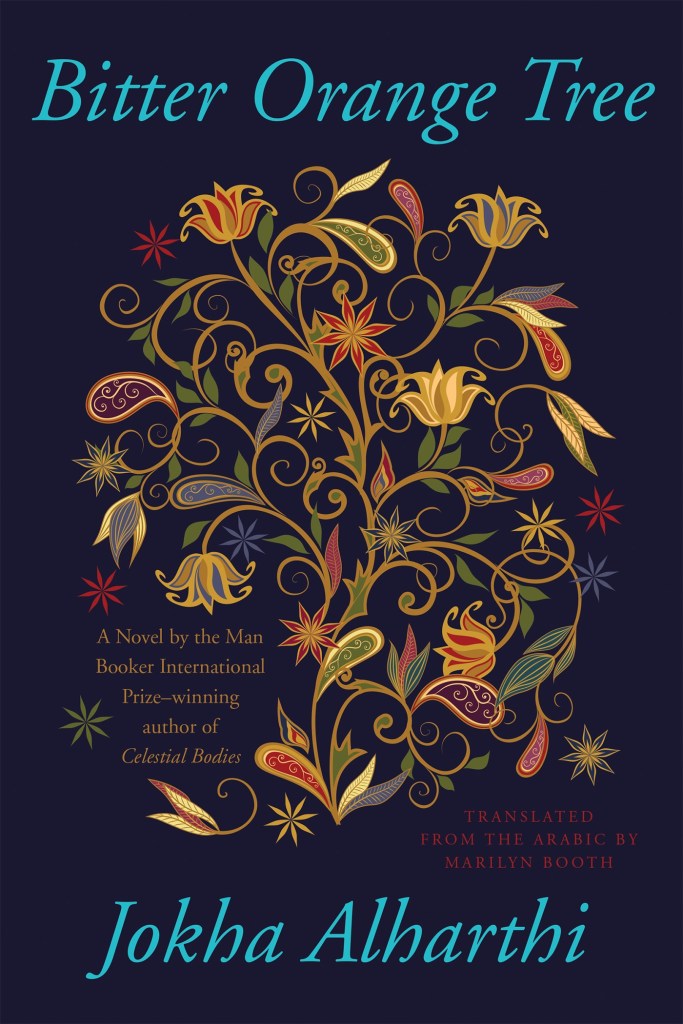
For this year’s Women in Translation Month I’m trying to focus on countries I’ve yet to visit on my Around the World in 80 Books reading challenge. This meant I was delighted to find a copy of Bitter Orange Tree by Jokha Alharthi (2016, transl. Marilyn Booth 2022) in my much-frequented local charity bookshop, as I’ve not read a book by an Omani author before.
I had completely missed Celestial Bodies for which Alharthi and Booth won the Man International Booker Prize in 2019. At that time Alharthi was the first Omani woman to be translated into English.
Bitter Orange Tree is a short novel, just 214 pages in my edition with quite large type, which I read entirely during a train journey back from Newcastle. (In fact, everyone around my table was reading a print book – it was like the olden days! For balance, I should say on the journey up I was sat next to someone who spent the whole time scrolling through TikTok and Insta, never watching any of the short content through to the end. I found it exhausting and had to mind my own business in the end 😀 )
The story is told from the point of view of Zuhour, a young woman who has left Oman to study in a nameless, cold, foreign city (most likely Edinburgh). She balances descriptions of her current life where a friend’s sister has fallen in love with a man her family wouldn’t approve of, with memories of Oman and particularly her grandmother-figure, Bint Aamir.
Zuhour harbours guilt regarding not staying with her grandmother, who has now died. A comment to a friend is the starting point for memories and reflections on Bint Aamir’s life:
“She always longed to own some land… just a tiny patch, with date palms growing on it, even if there was only space for five or so. And a few little fruit trees – lemon, papaya, banana, bitter orange. She would even plant those herself. She would water them and take care of them. And eat from them. And rest in their shade.”
Bint Aamir’s life is not easy, expelled along with her brother from her father’s house, she struggles for money. Gradually she finds a role in a relative’s home and while owning nothing, she provides almost everything.
“Bint Aamir’s feet were submerged in the soil that was the ground of our lives. She built the walls that made this household exist and thrive, mud brick by mud brick.”
Zuhour’s past and present conflate frequently, and I thought Alharthi conveyed so effectively the way memories underpin and inform the present. The conflation and the movement back and forwards between different times was seamless and never confusing.
“Tears run from my eyes, from both my eyes, from my two sound eyes. My tears spill over her one eye, which is damaged; over the herbal concoctions that were prescribed by ignorance; over the violence and harshness of childhood; over children orphaned by their mothers deaths and thrown out by their fathers, and over their brothers tragic ends; over a field she did not possess; over a companion she was never fortunate enough to have; over son who is not hers; over the grandchildren of a friend who died before she did.”
There’s also some humour, and I particularly liked this description of Zuhour’s friend Christine:
“Her cup of decaf coffee with soy milk was tall and skinny: it looked just like her. Here at this party, she was an exact scan of the figure I always saw at the university: T-shirt jeans running shoes ponytail nose ring tattoo long skinny cup.”
There were aspects of the story that were less successful for me though. Alongside the friends’ illicit relationship that Zahour has complex, unresolved feelings about, there is also a story of domestic violence involving her sister Sumayya. Both these sub-plots were too shallowly explored, before they petered-out. I felt that either Bitter Orange Tree needed to be longer, or one of these sub-plots needed to be cut and the other further developed.
While I liked the imaginative style, sometimes it became overly sentimental, particularly with regard to Bint Aamir. Although Zahour acknowledges “All her contentment was drawn from the happiness of the people for whom she cared.” she sometimes goes on flights of fancy regarding what her grandmother didn’t have in life, without knowing how her grandmother felt. These seemed clunky to me, although in fairness this may have been deliberate, to emphasise Zahour’s callow inexperience and inability to think beyond cliches at times.
But I only blog about books I like and I did like Bitter Orange Tree. The handling of past and present was so deft, and the style so readable. From looking online I think a lot of people preferred Celestial Bodies so I’d be keen to give that a try. If you’ve read Celestial Bodies I’d love to hear how you found it.
Hello bookish blogosphere! I’ve been away for what feels like a long time. June and July were a big pile of pants and I needed a step back from things. I want to say thank you to the lovely bloggers who contacted me to ask if I was OK, when I really wasn’t. Your kindness genuinely meant a lot.
I’ve only just started reading again after about six long weeks of being unable to digest a single written word. Some very strange things have happened to my reading; I couldn’t deal with fiction for a while so I finally got round to reading some of the biographies that have languished in my TBR for aeons. Then having got back to fiction I’ve started with a subject about as far from my usual fare as its possible to be: serial killers. Except neither novel is really about serial killers…
Firstly, My Sister the Serial Killer by Oyinkan Braithwaite (2017). This made quite a splash when it came out and I remember large, eye-catching posters on the tube, back when commuting was a thing. It’s a quick read and it was that reason that made me pick up this debut, thinking it was a good way to try and get back into reading.
My logic worked well, and I whizzed through this tale of a murderous sibling, narrated by Korede, a young successful nurse whose talent for cleaning comes in handy when helping her sister Ayoola cover up her deeds.
The novel starts in media res as Ayoola contacts Korede to ask for help having killed her third boyfriend in self-defence. Ayoola is completely oblivious to the seriousness of her crimes and seems to feel no remorse. Although Korede loyally helps her, she is beginning to have doubts as to the nature of Ayoola’s self-defence.
“ ‘Do you not realise the gravity of what you have done? Are you enjoying this?’ I grab a tissue and hand it to her, then take some for myself.
Her eyes go dark and she begins to twirl her dreadlocks.
‘These days you look at me like I’m a monster.’ Her voice is so low, I can barely hear her.
‘I don’t think you’re – ‘
‘This is victim shaming you know.’”
The novel isn’t graphic and the details of the killings are not dwelt on – thankfully, if you’re as squeamish as me. Instead what Braithwaite explores is a complex relationship between sisters and the impact of patriarchal systems on young women. It’s set in Nigeria but the themes certainly resonated with me as a UK reader.
Korede and Ayoola grew up with a violent father and it his weapon that Ayoola uses:
“ ‘The knife is important to me Korede. It is all I have left of him.’
Perhaps if it were someone else at the receiving end of this show of sentimentality, her words would hold some weight. But she cannot fool me.”
No-one questions Ayoola because she is beautiful, no-one pays attention to Korede because she is average looking. Both women suffer under a society that commodifies women, even though Korede is successful in her career as a nurse and Ayoola is a talented clothes designer.
A doctor where Korede works, Tade, seems to be decent but even he follows the predictable path of not noticing what Korede can offer and falling for Ayoola’s looks, projecting his fantasies onto her.
“ ‘She is beautiful and perfect. I never wanted to be with someone this much.’
I rub my forehead with my fingers. He fails to point out the fact that she laughs at the silliest things and never holds a grudge. He doesn’t mention how quick she is to cheat at games or that she can hemstitch a skirt without looking at her fingers. He doesn’t know her best features or her…darkest secrets. And he doesn’t seem to care.”
Ayoola dating Tade adds tension to the narrative – will she try to kill him? Will Korede try to save the man she has feelings for? Who will succeed?
Sometimes satire can leave a bitter taste, but MSTSK avoids this with it’s dry humour and lack of preachiness. It doesn’t attempt crass psychology as to why both women are as they are, it simply presents their lives and upbringing and leaves the reader to draw their own conclusions. This light touch means it raises serious issues about contemporary society without losing sight of characters or plot. An impressive debut.
Secondly, Sword by Bogdan Teodorescu (2008, trans. Marina Sofia 2020) which was sent to me by the lovely Marina Sofia who blogs over at Finding Time to Write. She has translated this novel under Corylus Books, the publishing house which she has founded with three others.
MSTSK used a serial killer to satirise patriarchal systems, and Sword uses it in a similar way to satirise political systems. Set in Romania, it forms another stop on my Around the World in 80 Books Reading Challenge, hosted by Hard Book Habit who sadly don’t seem to be blogging any more.
Someone is killing Roma people in Bucharest using the titular weapon. There is no apparent motive – except presumably a racist one – and the murders have a competence to them which means the police investigation has very little to go on. This isn’t a police procedural though, and very little of the story is given over to the murders themselves (again, thankfully…) aside from the first. Instead Teodorescu uses the murders to explore the power systems in place in Romania and how this exposes the weaknesses and motivations of those within.
If that sounds dry, it really isn’t. The story whips along and the portrayals of power players feel authentic (Teodorescu is a political analyst). Early on, the petty concerns of Istrate, Head of Comms and Press Relations at the Presidential Office, demonstrate the disregard that the deaths receive. He only likes the social side and travel associated with his job, and the President hates him and so has set up another press office.
“He was briefly tempted to write a report complaining about the lack of professionalism in his team. Instead of getting reports about major problems, the international situation, global crises that could destabilise the Balkan region, an in-depth political analysis, he had to put up with silly homicide stories! He gave up reading the press summary, but resolved to complain about it the next time he met the President.”
The government is concerned, but only in trying to balance appealing to those who might welcome vigilante justice represented by Sword (as the press have nicknamed the killer) because he only kills criminals, and how it will look internationally that they haven’t caught him. The advice given to the Minister of the Interior suggests how to manage the situation in a pre-election year:
“A few heads rolling at all levels in the police force should demonstrate the government is taking things seriously. Admittedly, it also demonstrates how incompetent the police are, but no-one worries about that too much.”
Despite such machinations, the murders continue to rack up and tensions in the country between various groups escalate. The context of Romania finding its place in international capitalist systems after the fall of communism is evoked well but it doesn’t take much imagination – if any – to see parallels across different political systems. I felt this could just as easily be Westminster. There’s something depressingly universal about someone with integrity being forced aside for political expediency:
“ ‘It’s not anger. It’s profound sadness. Because you’ve proven to me yet again that it’s not good enough to be qualified, professional, well-intentioned and to work your socks off… it still won’t get you the respect you deserve.’”
Sword is incisive and uncompromising in its portrayal of corruption and the powerless victims of such systems, but its not depressing. Instead I found it a compelling read and I’d definitely be interested to read more by this author.
Writing this post was difficult as I’m so out of practice, but to end it’s business as usual with an obvious late twentieth century pop choice 😀
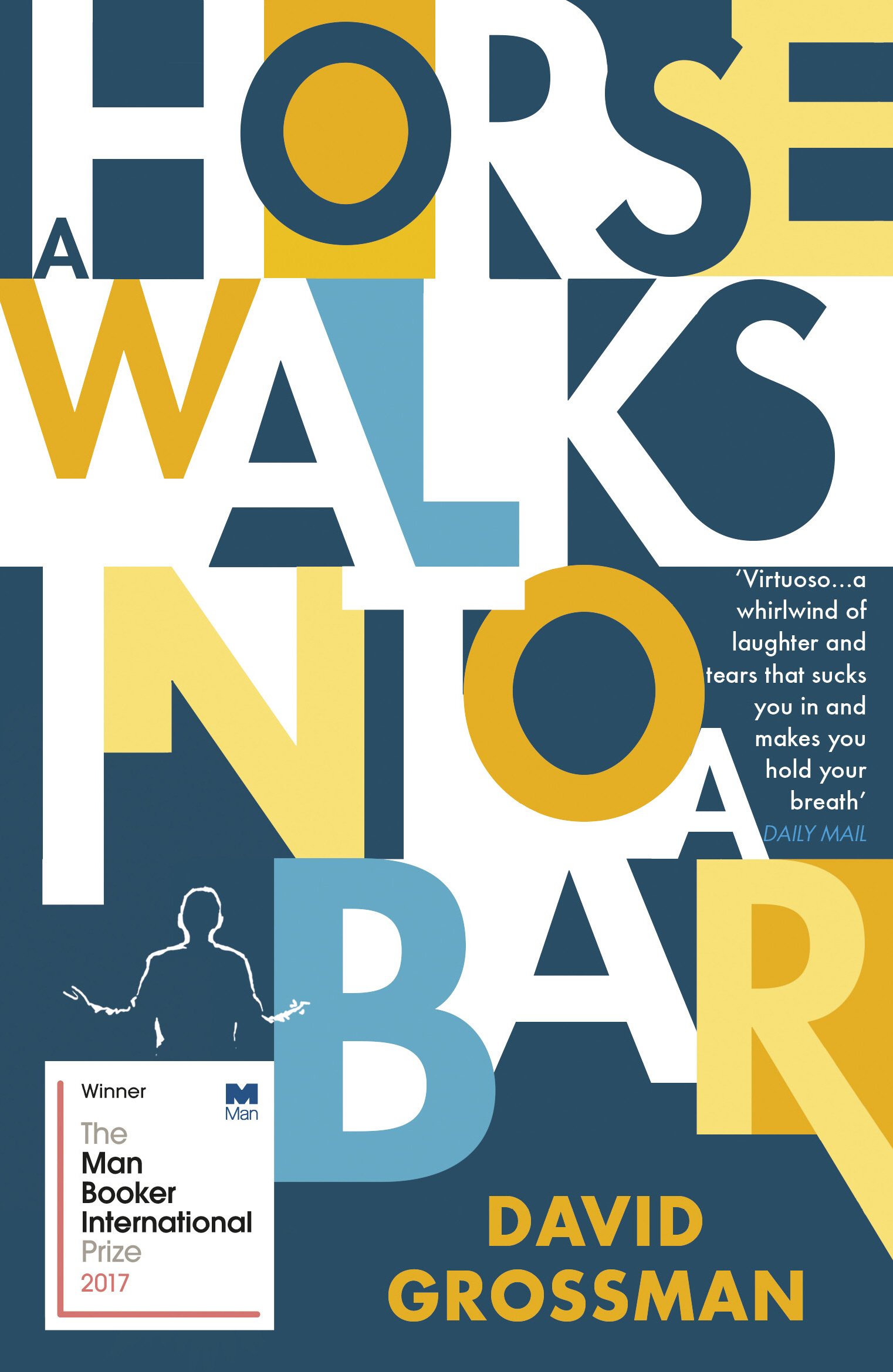
A Horse Walks into a Bar – David Grossman (2014, trans. Jessica Cohen 2016) 198 pages
A Horse Walks Into a Bar is a novel about a comedian, but the fact that it won the 2017 Man Booker International Prize (there’s an interesting interview with translator Jessica Cohen on the Asymptote blog) is an indication that it has serious things to say. Its takes place in Israel and so it also forms my last stop this novella month on my Around the World in 80 Books reading challenge, hosted by Hard Book Habit.
Dovaleh Greenstein is a stand-up comic known as Dovaleh G, and the novel follows his set in a Netanya comedy club over two hours, from the point of view of his childhood friend Avishai Lazar, now a retired district court judge in his late 50s who barely remembers Dovaleh.
“From the minute he got on stage he’s been seeking my eyes. But I can’t look straight at him. I dislike the air in here. I dislike the air he breathes.”
Dovaleh G is not a pleasant man. He berates the audience, he insults their town, he has the style of stand-up that mixes old-fashioned jokes with barely concealed aggression.
“I swear to God, standing before you tonight is the first man in history to get post-partum depression. Five times! Actually four, ‘cause two of them were twins. Actually five, if you count the bout of depression after my birth.”
He’s offensive and at various points audience members walk out. They complain he is not giving them what they paid for – a night of laughs. Instead, Dovaleh recounts his childhood memories: living with his mother who was traumatised from the camps, and his father who beat him. He walked on his hands to escape neighbourhood bullies.
Onstage, he verges on being a bully himself. Someone else is in the audience who remembers him as a child: Azulai, a small woman and spirit medium, to whom he is absolutely brutal. Yet his most vehement aggression is reserved for himself:
“Somehow, on the phone, there was something attractive about his offer, and I can’t deny that he does have his moments on stage, too. When he hit himself, there was something there, I’m not sure what, some sort of alluring abyss that opened up. And the guy is no idiot. He never was”
Grossman captures brilliantly that tension that can exist in stand-up where the audience don’t feel entirely safe, and don’t exactly know where their laughter is coming from. He also exploits fully that a lot of comedy is born out of pain. Dovaleh G is not likable, but throughout the course of the novella he does become understandable, and it is possible to feel compassion for him.
The audience (and readers) become witnesses for Dovaleh G; to his life, his trauma and his anger. What humour there is, is very, very dark. There was a riff on Dr Mengele that actually made me wince – I’m not sure I’ve winced at a book before.
A Horse Walks into a Bar is a devastating read but not a destructive one. At the end I felt there was some hope, which given Grossman is a highly political writer has wider significance than the life of Dovaleh G and Avishai Lazar. I’ve not discussed the politics of the novella because I felt I didn’t know enough about Israel and Palestine to do it justice, but if you know about this in more depth then I’m sure A Horse Walks Into a Bar will have an extra resonance for you.
“How, in such a short time, did he manage to turn the audience, even me to some extent, into household members of his soul?
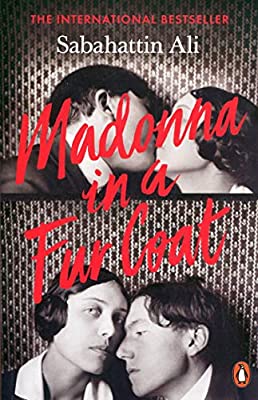
Madonna in a Fur Coat – Sabahattin Ali (1943, trans. Maureen Freely and Alexander Dawe 2016) 168 pages
Madonna in a Fur Coat is set mainly in Berlin, but is bookended by scenes in Ankara, so I’m counting it as another stop on my Around the World in 80 Books reading challenge, hosted by Hard Book Habit (who unfortunately don’t seem to be blogging any more). It feels a bit of a cheat to count it as Turkey but I’m so behind on the challenge that I’m taking a few liberties!
Continuing yesterday’s theme of an elegy for a young love affair, Madonna in a Fur Coat tells the romance of a Turkish man with a visual artist in 1920s Berlin. The novel begins in 1930s Ankara, where the narrator visits his unremarkable colleague at home, and is struck by the disregard his family show him.
“It seemed impossible that a man like Raif Efendi – what sort of man that might be, I had no idea, but I was sure he was not as he seemed – that a man like this would shrink away from those closest to him.”
He feels there must be more to his quiet colleague, who is fluent in German, than meets the eye.
“Why, when we are reluctant even to describe a wedge of cheese we are seeing for the first time, do we draw our final conclusions from our first encounters with people, and happily dismiss them?”
Raif knows he may die and so he asks the narrator to destroy a notebook, which of course the narrator reads. It was written ten years after the events it documents and describes how, as a young man, Raif stayed in Berlin to learn soap manufacturing, a career he is far from committed to. One day, visiting a gallery, he becomes mesmerised by a portrait of a woman in the titular garment:
“All I can say is that she wore a strange, formidable, haughty and almost wild expression, one that I had never seen before on a woman. But while that face was utterly new to me, I couldn’t help but feel I had seen her many times before.”
He visits daily to stare at the picture, and eventually meets Maria Puder, the woman who painted the self-portrait. They begin an intense, but largely platonic relationship. Raif is inexperienced and shy:
“If I ever met a woman I found attractive, my first thought was to run away.”
While Maria is determined and self-reliant:
“This all ends the moment you want something from me.”
My tolerance for young, earnest love affairs is pretty minimal, being old and sceptical myself 😀 Yet I was able to follow the relationship between Raif and Maria with interest because I wanted to see how it was that Raif ended up ill, poor and disregarded back in Ankara; and because Maria is a well-drawn woman rather than bland love object:
“I was only too aware that I still knew next to nothing about her. My judgements were formed of my own dreams and illusions. At the same time, I was absolutely sure they would not deceive me.”
Madonna in a Fur Coat is a sad tale of lives half-lived, of ill-advised restraint and missed opportunities. I didn’t find it depressing, but it’s certainly a melancholic and mournful read.
Kim from Reading Matters reviewed this novella back in January, you can read her excellent review here.
La Blanche is set largely in Casablanca, and so forms another stop on my much-neglected Around the World in 80 Books reading challenge, hosted by Hard Book Habit who sadly don’t seem to be blogging any more but it’s a great challenge so do join in if you can!
La Blanche is narrated by a young woman whose grandfather was murdered in their home in 1992. Along with her mother she flees Morocco to France, but following a painful break-up of a relationship finds herself heading back to the land of her birth.
“It rained heavily in the night. Torrential summer rain. I didn’t sleep a wink. Perhaps partly too, because I’m anxious about going back to Morocco. It’s as though I’d been bracketing off my childhood for years. Once I’d arrived in France I’d never thought about my childhood in Casablanca again. I’d left it all over there, apart from a little scrap of white paper, folded in four, that I always keep with me.”
The narrative moves back and forth across time, building a picture of her privileged childhood in Casablanca, the violence that shattered it, and the psychological fall-out from a disintegrating romantic relationship as an adult. This is handled expertly and is never confusing, blending together with ease to create a fully realised portrait of this young woman’s life.
The language is taut and every word placed carefully – hence this novella only comes in at 80 pages – but the story is in no way underwritten. Hamisultane has a startling and inventive way of writing, such as here, when the narrator awakes to realise her lover has left:
“It’s morning. The bed is empty. Light is flowing across the room. I close the shutters because I’m afraid it might flow straight though my body.”
It’s so impressive that La Blanche was a debut novel. The time shifts, language and characterisation are handled so deftly making for a satisfying and evocative read.
“My grandfather wakes me.
It is dawn.
He’s taking me out with him.
‘As quick as you can,’ he says to me. ‘While we can still see the morning dew beading the blooms on the rose bushes.’”
I’ve recently been watching Kathy Burke’s All Woman on Channel 4 and absolutely loved it, partly for Kathy’s habit of greeting any nonsense like vaginal steaming/vajazzling etc with an incredulous ‘Faaaaaaack off!’ but mainly because she is so warm, funny and non-judgemental. I highly recommend it, not only for women although she is a brilliant female role model:
“’The thing with me is that I’m quite arrogant. I’ve got faith in my own talent and I always have. And if anyone turned around and said to me, ‘You’re never going to work again’, I used to say, ‘I will’.”
Here’s another quote from Kathy which I enjoyed, included here especially for confirmed Darcy adorer Fiction Fan:
“‘Who wants to get up at five every morning? I did four days on Tinker, Tailor, Soldier, Spy and by the end of it, I was bored. I thought, ‘I’m over this now. Let’s go home. I’ve met Colin Firth, and he’s lovely. Now, where are the sandwiches?’”
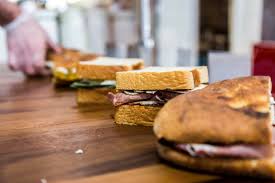
I tried to find a copyright-free picture of Kathy to include but of course there aren’t any, so in honour of her TTSS experience, here are some copyright-free sandwiches instead:
This post is rapidly in danger of becoming Reasons I Love Kathy Burke and thus rivalling War and Peace for brevity. On with books! In honour of the programme I have chosen two novels around the theme of women’s rights and female friendship.
Firstly, a book I probably wouldn’t have picked up if it wasn’t for the recommendations from so many bloggers I trust, Old Baggage by Lissa Evans (2018). Mattie Simpkin was a militant suffragette, but now its 1928 and she’s looking for something to channel all that energy into.
“She couldn’t remember a time when her path hadn’t been lined with startled faces; they were her reassurance that progress was being made.”
So Mattie decides to startle her well-to-do neighbours in Hampstead by setting up a club on the Heath for girls: to learn fitness, politics, history and self-defence, amongst anything else Mattie thinks will be useful for the modern woman.
Mattie is hugely likable but her drive means she can be a bit oblivious to those around her. Her sweet friend Florrie, known as The Flea, lives with her in Mattie’s house in Hampstead, utterly devoted. Mattie relies on her to keep the domestic side of things running smoothly, without realising that The Flea has feelings for her, until a repugnant Mosley-loving acquaintance, Jacqueline Simpkin, points it out to her. It is the fractious relationship with Jacqueline that leads to one of the pivotal moments of the novel, where Mattie’s group is pitted against the Hitler Youth-lite that Jaqueline is involved with.
“The battle is not yet over; ever day brings fresh skirmishes.”
Unfortunately Mattie makes a huge mistake in a matter moments, which has significant ramifications. Mattie has to reassess her understanding of some of the people she knows, and herself. This takes place without ever being worthy or moralistic. The situation evolves in such a way that I felt desperately sorry for Mattie, even though she was entirely in the wrong.
The historical detail is beautifully observed and presented almost incidentally. There is no nostalgia here: The Flea has worked as hard as Mattie for women’s suffrage, but doesn’t get the vote until the end of the novel, when women’s voting rights became equal to men’s (all over the age of 21). Until that point, only Mattie voted because she was over 30 and owned property. The victory of the suffragettes was, for 10 years, a middle-class victory.
For all the period detail, the central questions of the book remain relevant: what do you do when the thing that galvanized you no longer exists? How do you decide where meaning lies, and what if lies in difficult to reach places?
“ ‘We were a battering ram,’ Mattie was wont to say. ‘Together we broke down the door.’ But beyond that splintered door had been a dozen more doors and, scattered by their momentum, some women had tried one and some another, and some had given up and turned away, and it seemed to The Flea that all that unity and passion, all that wild energy, had dissipated. And she herself and her ilk, trudging soberly behind, had somehow ended up the vanguard…”
Old Baggage has a wonderful central character in flawed, individualistic Mattie and plenty to say without ever being heavy handed. The plot pulls you along and the ending is really moving without being sentimental. A treat.
Secondly, Nervous Conditions by Tsitsi Dangarembga (1988) which is set in Zimbabwe, and so forms another stop on my Around the World in 80 Books reading challenge, hosted by Hard Book Habit. I’m embarrassed to say I’d never heard of this, as since reading it I’ve discovered it’s considered a modern classic and was voted into the top 12 for Africa’s 100 Best Books of the 20th Century. It’s a powerful tale of postcolonial female experience, written beautifully and certainly deserving of its classic status.
The tale is narrated by Tambudzai, known as Tambu, who is unflinching in what she tells us, opening with “I was not sorry when my brother died.” The reasons for this lack of remorse are personal – her brother was arrogant and unpleasant; and societal – his death opens up opportunities to Tambu that she was denied as long as there was a male child older than her.
“I was quite sure at the time that Nhamo knew as well as I did that the things he had said were not reasonable, but in the years that have passed since then I have met so many men who consider themselves responsible adults and therefore ought to know better, who still subscribe to the fundamental principles of my brother’s budding elitism, that to be fair to him I must concede he was sincere in his bigotry.”
Ouch!
The opportunity Tambu has is to leave her rural home and be educated alongside her cousin Nyasha at the convent school her uncle and aunt run. This side of her family could not be more different to Tambu’s mother and father; they have travelled, are educated and her cousins have forgotten essential parts of their Zimbabwean childhood:
“I had not expected my cousins to have changed, certainly not so radically, simply because they had been away for a while. Besides, Shona was our language. What did people mean when they forgot it?”
Tambu and Nyasha still forge a deep bond despite the differences that have opened up between them, but Tambu sees the price her cousin pays for her international upbringing.
“I missed the bold, ebullient companion who had gone to England but not returned from there. Yet each time she came I could see that she had grown a little duller and dimmer, the expression in her eyes a little more complex, and though she were directing more and more of her energy inwards to commune with herself about the issues she alone had seen.”
As Tambu settles into city life and her schooling she begins to understand more not only about herself but her country, and there are some wonderfully pithy observations about colonialism:
“They had given up their comforts and security of their own homes to come and lighten our darkness. It was a big sacrifice that the missionaries made. It was a sacrifice that made us grateful to them, a sacrifice that made them superior not only to us but to those other Whites as well who were here for adventure and to help themselves to our emeralds…With the self-satisfied dignity that came naturally to white people in those days, they accepted this improving disguise.”
But really Dangarembga’s focus is human relationships, and how the patriarchy impacts on the most intimate of these. Her uncle, Babamukuru, enjoys enormous status at home and at work. Her aunt, Maiguru, is highly educated and capable, but only ever a second-class citizen. Their daughter Nyasha struggles with these constraints and her behaviour is loud and rebellious, and emphatically punished:
“Babamukuru condemning Nyasha to whoredom, making her a victim of her femaleness, just as I had felt victimised at home in the days when Nhamo went to school and I grew my maize. The victimisation, I saw, was universal. It didn’t depend on poverty on lack of education or on tradition. It didn’t depend on any of the things I thought it had depended on. Men took it everywhere with them.”
Ultimately though, Nervous Conditions is a hopeful novel. Tambu is resilient and this is her coming of age story: with who she is, fitting in with neither family easily; with her desires for education and independence; and with her country. I started this with the opening lines of the novel, and I’ll end it with the beautifully constrained, considered final words:
“Quietly, unobtrusively and extremely fitfully, something in my mind began to assert itself, to question things and refuse to be brainwashed, bringing me to this time when I can set down this story. It was a long process for me, that process of expansion.”
To end, Kathy as part of Lananeeneenoonoo with French & Saunders and Bananarama, for Comic Relief in 1989. Beatles fans may want to look away now:
This is my second post for Women in Translation Month (WITMonth) hosted by Meytal at Biblibio, and I’m hoping its also a sign that my blogging slump is coming to an end – fingers crossed! This week I’ve chosen two books linked by the theme of travel.
Firstly, Flights by Olga Tokarczuk (2007, trans. Jennifer Croft 2017) which won the International Man Booker Prize last year.
Flights is quite a hard book to review, as it’s aptly titled and resists being pinned down in any way. It’s fiction, non-fiction, essay, philosophical musing, travelogue, digression… yet this fragmentary style still holds together and works as a whole. The unity is found through the recurring themes of travel, movement, restless and flight; and also of the human body at its most visceral – the collection of bone, muscle, skin and blood that enables human locomotion.
“A thing in motion will always be better than a thing at rest; that change will always be a nobler thing than permanence; that which is static will degenerate and decay, turn to ash, while that which is in motion is able to last for all eternity.”
The fiction sections include a man whose wife and son disappear when they are on holiday in Croatia; the wife of an elderly professor who is taken ill on a cruise; a woman who leaves her young family to live on the streets… all in perpetual motion. There are also historical sections looking at the fate of Chopin’s heart; the first naming of the Achilles tendon; cadaver preservation techniques, among other bodily concerns. The focus on the organic reality of living stops Flights from becoming too flighty, grounding all the fragments in a corporeal existence.
The consistent voice also ties these different pieces together, the sense that we are being told these stories, historical fragments and observations by the same narrator, a female traveller. She sets the focus on travel as she describes the airports, planes, buses and terminals she finds herself waiting in, and her conversations with those who cross her path:
“She says that sedentary peoples, farmers, prefer the pleasures of circular time, in which every object and event must return to its own beginning, curl back up into an embryo and repeat the process of maturation and death. But nomads and merchants, as they set off on journeys, had to think up a different time for themselves, that would better respond to the needs of their travels. That time was linear time.”
Flights is a book you can dip into or read in a linear fashion. I did the latter and I’m glad I did as I could pick up the echoes across the different narratives that give a sense of unity to the book and to the world it evokes. However, it could work just as well by reading a section and focussing closely on it, as Tokarczuk’s writing is so rich. She has described her style as one of constellations, and the reason behind this individual approach is noted in Flights:
“Constellation, not sequencing, carries truth.”
Not a book for when you want a good meaty plot, but I still found it a compulsive read as well as a thought-provoking one.
I felt a bit conflicted when I started this: the story of a young slave girl told by a white South African was problematic for me. I looked on Goodreads and no-one else seemed to have this issue. Then I thought that at the time of writing, when black South African voices were so thoroughly suppressed, maybe writing this was a huge political statement.
(I once attended a debate about queer/transgender stories being staged. One side felt only those who identified as queer/trans should tell those stories. The other side felt it was fine for straight/cis artists to tell such stories so long as they did their research and the resulting art was sensitive. The wider issue is something I often come back to and think about, and something I’m still thinking through, as I did with this novella.)
The Expedition to the Baobab Tree is beautifully written and certainly a sensitive portrayal of a woman finding autonomy for the first time as she lives in the hollow of the titular tree on the southern African veld.
“I know the interior of my tree as a blind man knows his home, I know its flat surfaces and grooves and swellings and edges, its smell, its darknesses, its great crack of light […] I can say: this is mine. I can say: this is I. These are my footprints.”
The woman has ended up stranded in the veld as a doomed commercial expedition by her last owner has failed spectacularly. With no-one making demands on her for the first time, the woman is free to think and reflect:
“If I could write, I would take up a porcupine quill and scratch your enormous belly full from top to bottom. I would clamber up as far as your branches and carve notches in your armpits to make you laugh. Big letters. Small letters. In a script full of lobes and curls, in circumambient lines I write round and round you, for I have so much to tell of a trip to a new horizon that became an expedition to a tree.”
Like Flights, The Expedition to the Baobab Tree is not a straight narrative. It moves back and forth in time, with no named places or persons, It has an almost hallucinatory quality – and the narrator may be hallucinating at times, given her exposure and lack of food – but this never detracts from the horrors she has experienced. There are times she was treated well, but she was also repeatedly assaulted, raped, and had all her children taken as babies. We are the witnesses to her experience, recounted poetically but unflinchingly.
“One time I fled from the tree. I ran aimlessly into the veld, trying to get out of its sight by hiding behind a high round rock, and I opened my mouth and I brought out a sound that must be the sound of a human being because I am a human being and not a wildebeest […] but a human being that talks and I brought out a sound and produced an accusation and hurled it up at the twilight air.”
This is a short, powerful read with a distinctive female narrator who demands to be heard.
To end, a tenuously-linked 80s video as usual 😉 Well, the title offers travel advice! I’ve chosen it especially for Kate as she’s seeing a-ha soon:
I really feel I’ve lost my blogging mojo over the last year. It started with the 2018 heatwave which killed off my reading for a few weeks; my reading recovered but my blogging never really did. I’m hoping Women in Translation Month (WITMonth) hosted by Meytal at Biblibio will help, but given we’re nearly halfway through, maybe not 😀 If any of you lovely bloggers have any tips on how to recover they would be gratefully received!
Anyway, here is what I hope will be the first of a few posts for WITMonth; starting with two novels loosely linked by themes of virginity, or lack thereof.
Firstly, Sworn Virgin by Elvira Dones (2007, trans. Clarissa Botsford 2014) published by the wonderful AndOtherStories. Set in Albania, its also another stop on my Around the World in 80 Books reading challenge, hosted by Hard Book Habit (Dones is Albanian but wrote this originally in Italian).
Sworn Virgin looks at the experience of Hana, who has taken on a mostly extinct northern Albanian Kanun tradition. The tradition is that a family without male heirs can nominate a female to become a sworn virgin; she will live as a man and fulfil male roles. Hana took on the role willingly to avoid a marriage she didn’t want.
“ ‘It’s not that hard to be a man, you know?’ she says. ‘I swore never to get married, it’s a tradition that exists only in the north of the country. Let me explain: when there are no boys in a family, one of the girls swears to behave like a man and to remain a man for the rest of her life. From that moment on, she has to play all the roles and take over the tasks of a man. That’s why I became the son my uncle never had. Uncle Gjergj was my father’s brother; he took me in and brought me up after my parents died.’”
At the start of the novel Hana is travelling to the US to live with her cousin Lila and begin the process of becoming Hana again. Lila is highly feminine and doesn’t quite understand that for Hana, who has been living as Mark for 15 years, the transition back is not straightforward.
“ ‘You need to take off these men’s clothes.’
‘There’s no hurry.’
‘The sooner you get rid of them the better.’
‘That’s not true.’
‘I thought that was the deal. That you were coming here to go back to what you were.’
‘Yes, but there’s no hurry.’”
Hana has to adjust to a new country as well as a new way of presenting herself to the world. Although a story of immigration, Sworn Virgin is also a story of homecoming – to oneself. Hana has to decide how her appearance will express who she is, but also look at her life and think about what she wants. She had loved books and wanted to go to college, but had to return home when her beloved uncle Gjergj was dying. When her studies became impossible and she was facing marriage she didn’t want, she chose to become Mark instead.
“She had men’s clothes and a flask of raki in her pocket, and these had been her mirrors. She had needed nothing else. Up there in the mountains, time and place had been equal partners.”
Although the sworn virgin tradition may be seem extraordinary to those of us unused to it, Dones has made a documentary about sworn virgins before she wrote this novel and to me it never felt sensationalist or exoticised. There is much in Hana’s story that is relatable. Sworn Virgin is about reconciling yourself to the past, and how it is never too late to make changes when you find you’ve outgrown certain decisions.
“Hana tries to bring her attention back to her body. The man she thought would still be tenaciously inhabiting her is no longer there. That man was only a carapace. Lila was right: Mark Doda’s life had been no more than the sum total of the masculine gestures Hana had forced herself to imitate, in the skin worn leathery by bad food and lack of attention. Mark Doda had been a product of her iron will.”
The focus on virginity is given a wider scope too. Hana’s virginity has become a burden to her, something to discard to help her move forward. Losing it is about Hana acknowledging herself as a sexual being with desires, and prioritising her own needs – both sexual and non-sexual – in a way she hasn’t been able to before. This is dealt with non-romantically but still sensitively.
Obviously there is a strong theme of gender roles in Sworn Virgin, but for me it was first and foremost a character study of Hana, and the many binaries she has to adjust to: home/new country, rural life/urban life, family/independence.
“She tries to penetrate the unique spirit of the individual, she analyses their face and eyes, she tries to imagine the thoughts hiding behind those eyes, but she tends to avoid thinking about the fact that the thoughts are inextricably linked to male or female ego…She’s only just realizing now that for a long time she has had to consider things from both points of view.”
Secondly, from one extreme to the other. If there’s a character in literature not remotely associated with virginity, its probably Emma Bovary. Although I can’t stand Emma, I still picked up Sophie Divry’s Madame Bovary of the Suburbs (2014, trans. Alison Anderson 2017) with anticipation because I had really enjoyed The Library of Unrequited Love. This isn’t quite so sparky as her previous novel, but then I don’t think its supposed to be, given as its dealing with a pervasive sense of middle class ennui.
M.A. (geddit?) is born in the 1950s and dies around 2025. In between, she is bored.
“You could not voice your feelings of dissatisfaction, because – and images from all over the world came to remind you – everything had been programmed for you to be happy.”
As the quote above shows, the novel is written in the second person. Normally I would hate this technique, but here I thought it worked quite well. The reader is constantly being told ‘you’ are doing/feeling these things, but we’re not. Essentially we feel the same sense of disconnect as M.A. does to her comfortable middle class life, living in the titular area, in a house she owns with her husband Francois, raising their children.
“In those days it didn’t bother you, or not for very long, that you never had a break. Inventing a marinade, discussing your daughter’s progress, teasing your husband about his incompetence at household chores; you got the impression that at last you were enjoying a certain return on your investment, after so many years of movement, migration, studies, pregnancies.”
Of course, as we know, Madame Bovary found one way to alleviate her boredom, as does M.A. with the vacuous Phillipe. Inevitably the affair is doomed, but unlike Emma, M.A. carries on. In this way I actually found it more depressing than its namesake; Madame Bovary is quite melodramatic, whereas this novel suggests there are plenty of lives of quiet desperation being carried out across the land.
However, I don’t want to suggest this is a bleak read, it’s not. The things I enjoyed about The Library… are evident here: the light touch, the wry humour:
“The eldest among us aware of what awaits the newlyweds once everyone has left, once the tables have been cleared, the last goodbyes are said, and we find ourselves in front of a refrigerator.”
“Deep down no-one knows whether supreme happiness is attainable in one’s lifetime, physical pleasure remains one of its earthly traces, a trace we cling to, as long as we have the strength.”
To end, there’s an obvious 80s pop tune I could include on the theme of virginity, but for once I’m not going the obvious route 😊 I love the Pet Shop Boys and I don’t think I’ve ever managed to shoehorn them in so here they are singing about sinful urges:







 madame bibi lophile recommends