“Raindrops on roses and whiskers on kittens/Bright copper kettles and warm woollen mittens/Brown paper packages tied up with strings/These are a few of my favourite things” (Maria Rainer/Julie Andrews, The Sound of Music)

I write to you from within a fog of lemsip and cough syrup.  Yes, this week I’ve had a grotty cold.  Nothing major by any means, but just enough to make me feel grim and make the days a little greyer.  So I thought for this post I’d cheer myself up and be totally self-indulgent, by choosing two books that are thematically linked only in the fact that they are two of my favourites.

Firstly, If Nobody Speaks of Remarkable Things by Jon McGregor (Bloomsbury, 2002).  This was McGregor’s first novel, longlisted for the Booker, and written when he was only twenty-six.  Choking down my jealousy, I am able to tell you that the accolades are highly deserved.  I think this is such a beautifully written, confident debut.  It tells the story of an ordinary street and its ordinary inhabitants, over the course of a day.

“The short girl with the painted toenails, next door, she says oh but did you see that guy on the balcony, he was nice, no he was special and she savours the word like a strawberry, you know she says, the one on the balcony, the one who was speeding and kept leaning right over, and they all know exactly who she means, he’s in the same place most weeks, pounding out the rhythm like a panelbeater, fists crashing down into the air, sweat splashing from his polished head.”

“In his kitchen, the old man measures out the tea-leaves, drops them into the pot, fills it with boiling water.  He sets out a tray, two cups, two saucers, a small jug of milk, a small pot of sugar, two teaspoons.  He breathes heavily as his hands struggle up to the high cupboards, fluttering like the wings of a caged bird.”

“She opens her front door, just a little, just enough, and she hops down her front steps, the young girl from number nineteen, glad to be out of the house and away from the noise of her brothers.  The television was boring and strange anyway, it was all people talking and she didn’t understand.  She taps her feet on the pavement, listening to the sound her shiny black shoes make against the stone…”

I hope these three examples give a good idea of why I love this novel so much.  McGregor is so skilled at finding the poetry in ordinary lives and how the self is expressed through seemingly innocuous actions.  Gradually the inhabitants of the street emerge as fully realised characters from the details of this one day.  This narrative is intertwined with a first person narrative, and you begin to realise that something significant, and tragic, took place on this ordinary day.  If Nobody Speaks of Remarkable Things is a novel of startling sensitivity and lyricism.

If this has whetted your appetite for McGregor’s novels, I discuss his second novel, So Many Ways to Begin here.

Secondly, Death and the Penguin by Andrey Kurkov trans. George Bird (1996, English translation 2001, Harvill Press).  How to describe this novel?  It’s frankly a bit bonkers and one of those I think I understand, but maybe it’s about something else entirely.  It’s a great read though.  It tells the story of Viktor, an aspiring writer who gets a job writing obituaries, and his pet penguin Misha, who he took on when Kiev zoo gave all its animals away: “he had been feeling lonely. But Misha brought his own kind of loneliness, and the result was now two complimentary lonelinesses, creating an impression more of interdependence than amity.”

The character of this depressed penguin is as vividly realised as any of the human characters, and you really start to feel for this bird who symbolises the existential crisis of his owner and others caught up in a post-Soviet world that they do not understand: “Sleeping lightly that night, Viktor heard an insomniac Misha roaming the flat, leaving doors open, occasionally stopping and heaving a deep sigh, like an old man weary of both life and himself.”

The fragile relationship between Viktor and Misha is tested to its limit by a series of surreal events.  Viktor’s friend Misha-Non-Penguin leaves his daughter Sonya with Viktor, and so he drifts into a family unit with this self-contained little girl and her nanny.  But meanwhile, someone is using his obituaries as a hit-list, and he is being followed by a mysterious stranger known only as the fat man…

“The Chief considered him through narrowed eyes.

“Your interest lies in not asking questions,” he said quietly.  But bear in mind this: the minute you’re told what the point of your work is, you’re dead. […] He smiled a sad smile.  “Still, I do, in fact, wish you well.  Believe me.””

Death and the Penguin is a surreal adventure story, a post-Soviet satire, an examination of the individual spirit up against forces that seek to control.  It’s funny and it’s sad, it has something to say, and it says it in a truly unique and engaging way.

Here are the novels with another of my favourite things, my psychotic cat (he looks calm in this photo, but trust me, he is hell-bent on world domination):

Image

“Never in the field of human conflict was so much owed by so many to so few.” (Winston Churchill)

10 November was Remembrance Sunday, and so for this post I thought I would look at two novels dealing with the theme of war.

Firstly, Regeneration by Pat Barker (Penguin, 1991).  This was the first novel Barker wrote in the Regeneration trilogy, the other two being The Eye in the Door and The Ghost Road.  I actually think The Ghost Road is the strongest of the three, but Regeneration is still an expertly crafted novel, and although each novel in the trilogy stands alone, I think it’s preferable to start at the beginning.  Regeneration tells the story of Dr WHR Rivers, a psychiatrist at Craiglockhart hospital during the First World War, and his shell-shocked soldier patients, including the poets Siegfried Sassoon and Wilfred Owen.  Although fiction, the novel is based on true events and Dr Rivers is a real-life character as well as the poets.  Barker said she chose the character of Rivers as, not being a soldier herself, she had to find a voice with some distance from the trenches.  Although this is the case, the way Barker looks at the horrors of war is unflinching.  I’m about to quote something truly atrocious, brace yourselves or scan past it:

“Burns arms were goose-pimpled, though the room was not cold.  The smell of vomit lingered on his breath.  Rivers sat down beside him.  He didn’t know what to say, and thought it better to say nothing.  After a while he felt the bed begin to shake and put his arm round Burns’ shoulders.  “It doesn’t get any better, does it?” […]

Burns. Rivers had become adept at finding bearable aspects to unbearable experiences, but Burns defeated him.  What had happened to him was so vile, so disgusting, that Rivers could find no redeeming feature.  He’d been thrown into the air by the explosion of a shell and had landed, head-first, on a German corpse, whose gas-filled belly and had ruptured on impact.  Before Burns lost consciousness, he’d had time to realise that what filled his nose and mouth was decomposing human flesh.  Now, whenever he tried to eat, that taste and smell recurred.  Nightly he relived the experience, and from every nightmare he awoke vomiting.”

Horrors like this are almost impossible to contemplate, and even more upsetting when you realise things like this actually happened.  Within this context, amongst their traumatised and screaming comrades, Sassoon and Owen try to express their disgust and anger through verse:

““What draft is this?”

“Lost count,” said Owen. “You did tell me to sweat my guts out.”

“Did I really? What an inelegant expression. “What passing-bells for these who die as cattle?” I see we got to the slaughterhouse in the end.” Sassoon read through the poem. When he’d finished, he didn’t immediately comment.

“It’s better isn’t it?”

“Better.  It’s transformed.” […]  He thought for a moment, crossed one word out, substituted another.  “There you are,” he said, handing the page back, smiling. “Anthem for Doomed Youth.””

Regeneration is not a long novel, 249 pages in my edition, but Barker crams so much in and I’ve barely scratched the surface here.  Alongside the issues of war, she considers themes of madness, what society expects from men, and what it expects from women.  How the state can betray its citizens, and what we can give to each other in times of crisis.

Here is a clip from Gilles MacKinnon’s excellent 1995 adaptation of Regeneration (released as Behind the Lines in some countries), including some lines from one of Wilfred Owen’s greatest poems, Dulce et Decorum Est:

Secondly, further back in time to the Crimean War, Master Georgie by Beryl Bainbridge (Abacus, 1998).  This was the novel for which Bainbridge was posthumously awarded a Booker Prize in 2011, with a special prize, the Best of Beryl.  I haven’t read all of Bainbridge’s books, so I can’t vouch for whether it’s her best, but it’s certainly highly accomplished.  It tells the story of George Hardy, a surgeon and photographer who, after a family tragedy, decides to leave Liverpool for the Crimea.  His adoptive sister Myrtle and geologist brother-in-law Dr Potter accompany him, alongside fire-eater and sometime lover of George, Pompey Jones.  These three voices narrate the story, and learning about the eponymous character from others is entirely appropriate, as George is an enigmatic and conflicted man, as obscure as one of his blackened and fading photographic images .  As Myrtle observes:

“There’s a sameness about death that makes the emotions stiffen – which is for the best, else one would be uselessly crying all day long.  It’s why Georgie often seems insensitive to other people’s feelings.  Dealing with the dying, one must either blunt the senses or go mad.”

Amongst the filth and squalor of the Crimean battlefields, all see death more often than not.  Bainbridge presents it in a determinedly low-key way; the Charge of Light Brigade happens outside the story, and Dr Potter’s pragmatic response speaks volumes about the dehumanising effects of war:

“I am in two minds as to whether I should bother to pack my tent, it being in a wretched state, perfectly sodden and much holed.  It would be better for my health if I slept in the hospital tent, though that too is in a deplorable condition.  I am at least better off as far as transport is concerned; three days ago over two hundred cavalry horses of the Light Brigade stampeded into camp, their riders having perished in a charge along the north valley.”

It may not be “Half a league, half a league, half a league onward…” but while Bainbridge shuns Tennyson’s pomp, her use of small detail says more than enough about the futility of the combat and the waste of human lives.  Master Georgie is a haunting novel that stayed with me long after I finished it.

Here are the novels with the symbol of Remembrance Sunday, a poppy:

Image

“For last year’s words belong to last year’s language /And next year’s words await another voice.” (TS Eliot)

Today marks a year since my first blog post.  During the year I’ve got so much more out of blogging than I ever thought possible, and that is due in no small part to my fellow bloggers, you gorgeous bunch.  So I thought it would be apt to commemorate my first year by looking at a piece of writing by another WordPress blogger.

First birthday

(Image from http://www.juicyoccasions.co.uk/2012_02_01_archive.html)

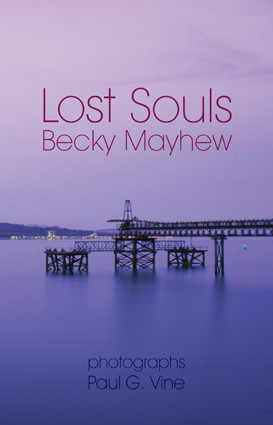
Becky Mayhew blogs at Becky Says Things.  Her blog is funny, insightful and truly original.  Do check it out, I promise you will be better for it as Becky points and laughs at the absurdities of life, and has something interesting to say about it all too. In 2011, Becky had a collection of short stories published by the lovely Treehouse Press, Lost Souls.   It is collection of three stories, “Shelves”, “Ramona” and “Roses”.

“Shelves” is told to us by a librarian, whose sexual encounters are intertwined with her job and the reading matter of her partners.  So she sleeps with the “insipid, vole-like” Geoffrey when he takes on board her suggestion to abandon John Grisham for Jane Austen, and later, after Wuthering Heights:

“I think the dynamic impression of hot-blooded Heathcliff had gone to his head a little, as he had the audacity to suggest we go back to mine. I conceded, and took him round the corner along the twelve houses to my flat, almost entirely for my own personal interest in what a week of Heathcliff does to a man; as it turned out, less than I hoped.”

As the passage above shows, there’s a wry, dry humour running through the tale, and the librarian’s voice is strong and distinctive.  There are some beautiful images and Becky has an original turn of phrase:

“His eyes slid like oil over titles, one black eyebrow raised; occasionally he paused to finger a book spine or to bend to a lower shelf, and then he moved on, disappearing and reappearing in and out of bookcases like a thief.”

Fellow bibliophiles, didn’t we always know that libraries are hotbeds of sexual tension?

The narrator of “Ramona” is a middle-aged teacher, struggling to assert herself in all aspects of her life.  I know enough teachers to know the description of how “it is depressing trying to teach a class of idiots who are far more interested in their social and sexual status than in how Margaret Atwood develops her characters” rings true.  The narrator’s interest in one of her pupils, Ramona Manson, is slightly baffling to her, as Ramona “is not charming, she is not beautiful, she is not even particularly threatening”, and yet, she goes through life with an ease the narrator cannot achieve, and with a sense of authority that continually evades the older woman.  The plot of “Ramona” is a simple one, and yet through this largely unremarkable time the fracture lines in the teacher’s life become fully exposed.  The story is an artfully constructed portrait of an ordinary life teetering on the edge.

I loved the first line of the final story, “Roses”: “There he is, inside a flaming scarlet halo.” It’s a perfect example of what is to come – a beautifully written, unnerving, and insidiously violent tale. Unlike the other two stories, “Roses” is told in the third person, from the point of view of Elizabeth, a florist and fantasist, for whom the flowers are people:

“The bamboo chuckles raspingly under its breath.  The lilies poke out their tongues; the sunflowers nod on their aching necks, shoulders shaking with weary laughter…”

Elizabeth spends her day obsessed with a man who uses the coffee shop opposite her florists:

“Sometimes she can feel him, in the long stretches when she is alone with her flowers; she can feel a presence, a warmth about her, as though he is sitting right there beside her, breathing her perfumed air.  Their worlds beautifully interlaced like the coiling infinity of an open rose.”

That last sentence is such perfectly balanced writing: an image of originality and meaning without any pretension or heavy-handedness. I don’t want to say too much more about “Roses” as it would give the plot away, but the final page of this book, containing the last four short paragraphs of this story, was breathtakingly well-written.  The images are startling and evocative, and I absolutely loved this story.  Becky has blogged in the past about her tendency to procrastinate.  I can only hope she is more successful than me at beating this behaviour, because I want to read more of her work very soon…

On their website, Treehouse Press say “we want our books to be unique and beautiful objects, a thing you’d want to hold in your hand, and also for the writing and the artwork to engage you”.   Hopefully I’ve convinced you of the engaging quality of Becky’s writing.  In the book the stories are alongside the haunting images of Paul G. Vine’s photographs, certainly making it a lovely object. You can buy Lost Souls direct from the publisher at http://www.treehousepress.co.uk/products/lost-souls , so if you’d like to get Becky’s book can I enter a plea that you buy it there and not from a certain tax-avoiding multi-national company?

Image

(Image from http://www.treehousepress.co.uk/products/lost-souls )

Thanks to everyone who’s looked at the blog/followed/commented/re-blogged etc and made the last year such a joy!

“When I was a teenager, I read a lot of Poe.” (Dario Argento)

It’s Hallowe’en!  OK, it was Hallowe’en.  I delayed this post slightly to make it a joint one for my friend D’s birthday, as she is a massive fan of Gothic. Happy Birthday D!

While the cooler kids are no doubt watching films by Dario Argento last Thursday, (who I’ve quoted above) there are some for whom nothing says horror like Hammer.  Hammer Films are a British production company whose classic output you can see clips from here:

http://www.youtube.com/watch?v=MyltXEDiXKM

Some insight into my upbringing there: as a teenager my mother fell in love with Christopher Lee in those roles; it’s a wonder I’m so normal (I always brush my fangs every night before bed).  Also, one of my long-standing girl crushes, Valerie Leon, makes an appearance in the Blood From the Mummy’s Tomb.  She’s the one the narrator describes as “smoking hot”, and indeed she is.  Oh Valerie, how I wish I looked like you, even a little bit would do…  If you think To the Devil a Daughter looks amusing, well, you are probably right.  I’ve never seen it, but a few years back I took my mother to a talk by Richard Widmark.  Christopher Lee made an impromptu appearance in the audience (my mother is still recovering, as am I, to be honest) and the two of them reminiscing about that film was the funniest part of the night.  Definitely worth a look, I’d say.

But this is supposed to be about books, right?  Well, I’m getting there.  Hammer have produced some pretty high-profile films in recent years, including The Woman in Black.  As part of their raised profile, they’ve gone into partnership with Arrow books, and asked contemporary authors (Helen Dunmore, Julie Myerson, Sophie Hannah, Melvin Burgess) to write some creepy stories.  I thought it was the perfect marriage for a Hallowe’en book blog post, so my first choice is The Daylight Gate by Jeanette Winterson (Arrow Books in association with Hammer, 2012). The novel tells the story of the Lancashire Witch trials of 1612.   Winterson has taken this real-life story and woven it with her own fiction to brilliantly evoke a nation caught up in paranoia around the power of women, of ritual, and of a new Protestant faith trying hard to establish itself over the old Catholic one.  Lancashire was a Catholic stronghold, and it’s where the conspirators of the 1605 Gunpowder Plot sought refuge:

“The north of England is untamed.  It can be subdued but it cannot be tamed.  Lancashire is the wild part of the untamed.  The Forest of Pendle used to be a hunting ground, but some say that the hill is the hunter – alive in its black-and-green coat cropped like an animal pelt.”

Alice Nutter is a rich woman who lives alone, rides astride, engages in falconry, and rescues witches from a ducking.  Given these unwomanly ways, she naturally raises suspicions.  She studied under the occultist John Dee, and invented a deep magenta dye “like looking into a mirror made of mercury” which made her fortune. Alice struggles to remain apart from the society she is surrounded by, and eventually gets drawn into the town politics that have seen several women arrested on witchcraft.  The Daylight Gate is a short novel and I don’t want to give too much away, but what I will say is that amongst the witchcraft (severed heads talking with other people’s blackened tongues, people transforming into hares, familiars, elixirs of youth and the like) what is truly shocking is the state-sanctioned capture and torture, based entirely in reality.  Brace yourselves:

“In the cell was a rack, a winch, a furnace, a set of branding irons, a pot for melting wax, nails of different lengths.  A thumbscrew, a pair of flesh tongs, heavy tweezers, a set of surgical instruments, a series of small metal trays, ropes, wire, preparations of quicklime, a hood and a blindfold […] They made a small neat cut in his side and drained a quart of blood to weaken him.  Then they forced him to drink a pint of salt water.  They did not break his fingers joint by joint or pull out his teeth one by one.  They were relaxed. They drew pictures on his chest with delicate knives…they pinned back his eyelids with metal clips and dropped hot wax into his eyeballs. When he screamed they debated whether or not to take out his tongue.  But they wanted his tongue for confession.”

Eek.  I’m not a big fan of horror, but I imagine part of the appeal is that it’s a safe way to scare yourself, secure in the knowledge that Freddy Kruger et al are entirely removed from your life.  In The Daylight Gate, Winterson shows us the horrors that really aren’t so far removed, and as such offers very little comfort.  A truly chilling read for Hallowe’en.

Secondly, The Monk by Matthew Lewis (1796, my copy Oxford University Press 1995).  The Monk was written by Lewis in 10 weeks, shortly before he turned 20.  I decided to read it as at least 3 people, including my friend D, told me it was the most barking mad novel they’d ever come across.  How could I resist?  They were so right, I had no idea how right they were.  The Monk is so insane, to try and review it is near impossible.  Its plot is so convoluted, I can’t give you a summary in a single blog post. Instead, let’s make a list of typical Gothic tropes:

  • Virginal, beautiful young maidens who struggle to remain so
  • Old crones, often in caretaking capacity to the young maiden
  • People with obscure origins inc. family members pretending to be other than they are, to get close to family who for some reason have spurned them
  • Large buildings, many rooms/corridors/secret passageways
  • Large building probably also crumbling
  • Large building has garden where weather ably reflects psychological states of characters
  • Curses – which are ignored at peril also, oaths of vengence
  • Transgressions – religious/sexual (forbidden desires)/moral/societal (leading to or caused by isolation from society)
  • Supernatural – ghosts/spontaneous bleeding inc. signs in blood/resurrections
  • Magic – inc. witches/objects that provide user with all they desire/potions
  • Death and feigned death, murders
  • Dungeons
  • Torture
  • And, of course – Satan

Yep, The Monk has them all.  I can’t believe Lewis forgot to include vampires.  Maybe he thought that was going too far…

Here is a trailer for the most recent adaptation of the novel; the makers should be commended for even attempting it.  No-one does insanity-induced eye-rolls like Vincent Cassell:

http://www.youtube.com/watch?v=WJ5lDIOV_pI

“From the end spring new beginnings.” (Pliny the Elder)

This week I thought I’d look at the endings of novels, as a companion piece to my last blog post, which looked at beginnings.  Doing this without giving away huge spoilers may be a bit of a challenge but I’ll do my best!

Firstly, Brokeback Mountain by Annie Proulx (4th Estate, 1999). I’m going to assume a certain amount of knowledge here as there was a hugely successful film made of this short story, but I’ll still try not to tell you exactly what happens.  The ending is this:

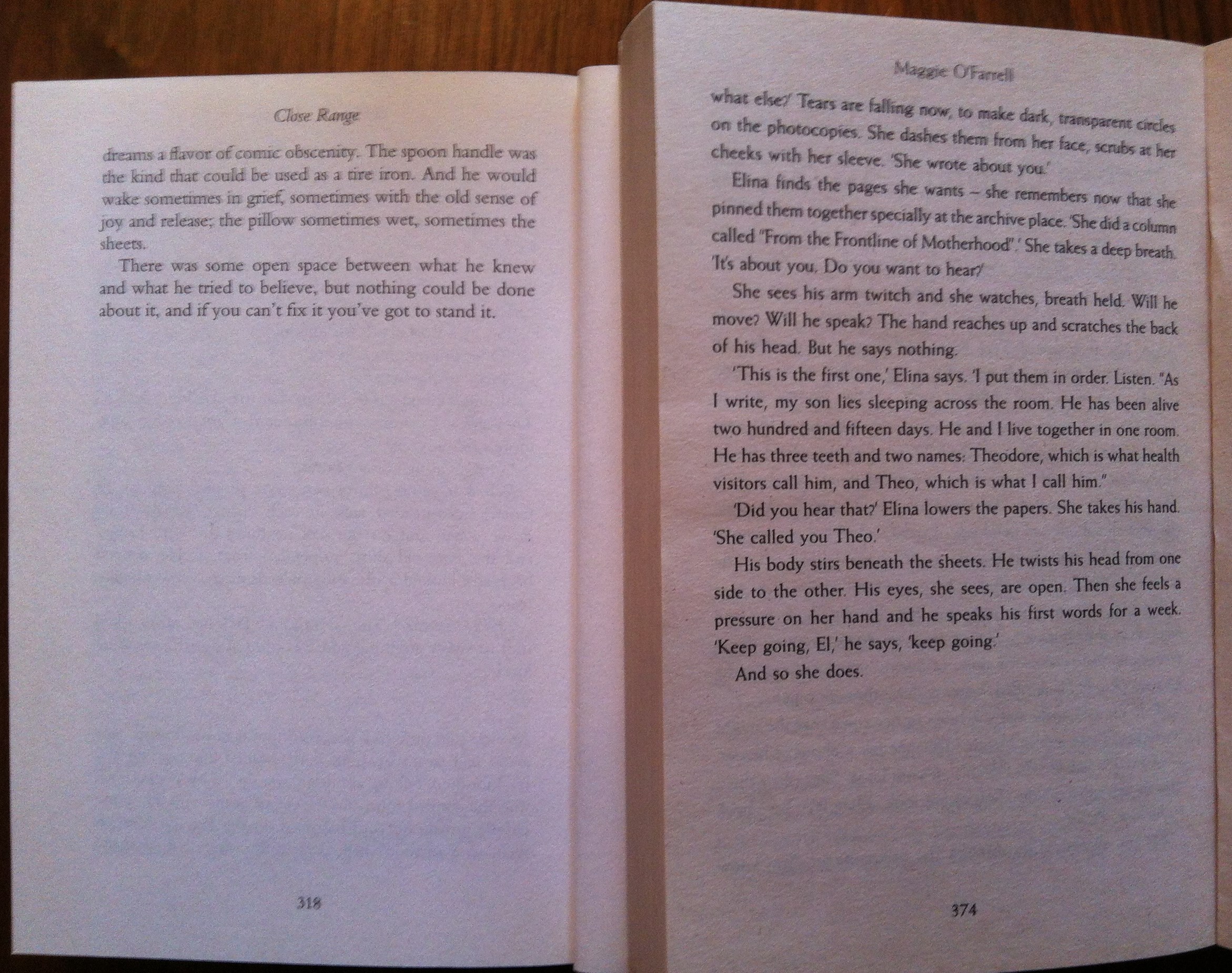
“There was some open space between what he knew and what he tried to believe, but nothing could be done about it, and if you can’t fix it you’ve just got to stand it.”

This is from the point of view of Ennis, a cowboy in 1960s America, who falls in love with his co-worker, Jack, when they are ranchers on the titular mountain.  The two of them are emotionally illiterate, they have no words with which to try and understand their experience.  This end line is just perfect for their story; Proulx’s sparse writing style with simple imagery like “open space” portrays their terse love affair (conducted mainly outdoors)and Ennis’ contained character exactly.  The language is all the more powerful for its simplicity “you’ve just got to stand it” capturing the heart-breaking stoicism of someone who ultimately feels powerless to lead an authentic life, to close that gap between what he knows and what he tries to believe.

It’s a story of a romance, but it’s determinedly unromantic:

“The room stank of semen and smoke and sweat and whiskey, of old carpet and sour hay, saddle leather, shit and cheap soap.  Ennis lay spread-eagled, spent and wet, breathing deep, still half tumescent, Jack blowing forceful cigarette clouds like whale spouts…”

Reading Proulx is often like this, a multi-sensory, unflinching experience. She also has a great ear for dialogue, adding to the sense of her stories’ authenticity.  Proulx has spoken about how highly she values the short story form, and so what you get in Brokeback Mountain is a perfectly crafted gem, where not one word is wasted.

Proulx has spoken warmly of the film adaptation of the story, particularly Heath Ledger’s portrayal of Ennis. Here is how that ending was interpreted in Ang Lee’s sensitive 2005 film version of the story:

Secondly, The Hand that First Held Mine by Maggie O’Farrell.  I read this fairly recently, and I found the last lines quite moving, so I thought I’d include them here.  They are:

“ “Keep going, El,” he says, “keep going.”

And so she does.”

These simple phrases capture a lot.  The story is one of families, the secrets and lies that can make up the relationships people hold with their nearest and dearest.  It’s a dual narrative, telling the story of Lexie Sinclair who leaves home to be with the worldly Innes Kent in London in the 1950s, and Elina, living in contemporary London, trying to hold on to a sense of self in the disorienting aftermath of having a baby:

“Elina jerks awake.  She is puzzled by the darkness, by the way her heart is fluttering in her chest.  She seems to be standing, leaning against a wall of surprising softness.  Her feet feel a long way away from her.  Her mouth is dry, her tongue stuck to her palate.  She has no memory at all of what she is doing here , standing in the dark, dozing like this against a wall.  Her mind is blank, like a ream of unmarked paper.  She turns her head suddenly, with a great heaving, everything swerves on its axis because she sees the window, she sees Ted next to her, she sees that she is not in fact standing.  She is lying.  On her back, hands clasped over her chest, a stone lady on a tomb.”

Elina’s partner is Ted, and as Elina finds her way back into the world it gradually emerges that Ted’s parents have not told him the whole truth about his life.  As Elina and Ted attempt to unravel the mystery, the two narratives converge.

I don’t want to say too much more for fear of spoilers, but what I will say is that THTFHM is a highly readable examination of the absolute havoc families can wreak on each other; of how powerful the truth can be, and its forceful drive towards exposure no matter what.  All the pain and turmoil often sits alongside love, and in the end all we can do is keep going.  The last few lines are an understated, realistic and hopeful ending.  The novel details the complexities of the ties that bind within a well-paced plot that ensures the reader keeps going until the last line.

Image

“Beginnings are always messy.” (John Galsworthy)

This week I started my final year at uni.  Things could get a little patchy on the blog front from here on in, but I really want to try and keep it going on a regular basis, so hopefully service will be uninterrupted by essays, tutorials, presentations, deadlines, exams….eek.  In honour of the new term, I thought I’d look at beginnings in books.  Not that this is a great new beginning for me – as a mature student I’ve been here many, many times before, so much more than is necessary.  But a beginning it is, and so on we go!

Firstly, Behind the Scenes at the Museum by Kate Atkinson (Black Swan, 1995).  This was Kate Atkinson’s first novel; nowadays she is well-known as the author of the Jackson Brodie novels (Case Histories, One Good Turn, When Will There Be Good News, Started Early Took My Dog) but this was before she turned her hand to detective fiction.  Let us just pause for a minute to consider the BBC trailer for their excellent adaptation of the Brodie novels:

Was that just an opportunity to gratuitously observe the craggily gorgeous and highly talented Jason Isaacs without his top on?  Yes it was.  (But I do recommend both the books and the TV series). Now back to books.  BTSATM is told from the point of view of Ruby, from the moment of her conception.  The novel begins:

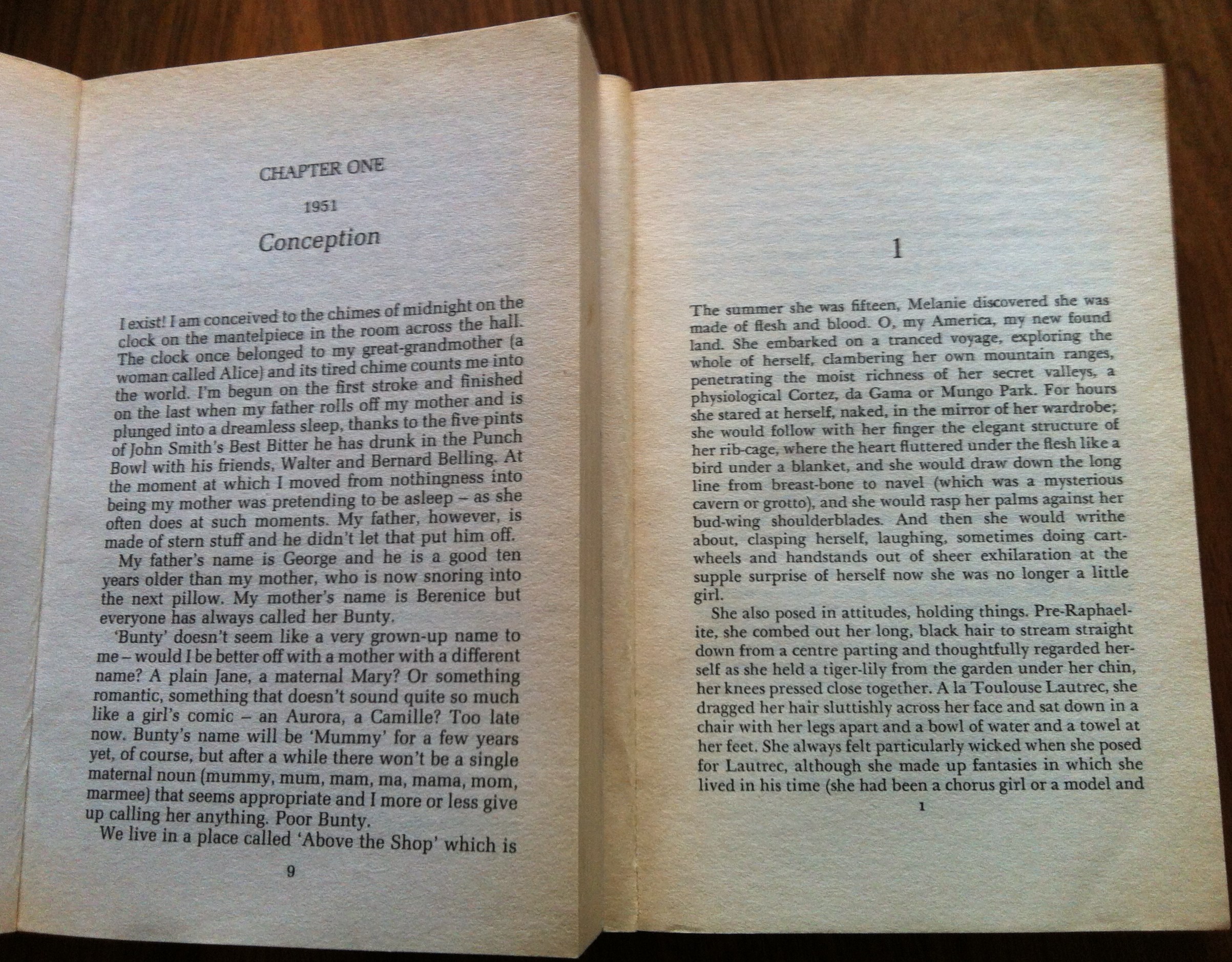
“I exist!  I am conceived to the chimes of midnight on the clock on the mantelpiece in the room across the hall.  The clock once belonged to my great-grandmother (a woman called Alice) and its tired chime counts me into the world.  I’m begun on the first stroke and finished on the last when my father rolls off my mother and is plunged into dreamless sleep, thanks to the five pints of John Smith’s Best Bitter he has drunk in the punchbowl with his friends, Walter and Bernard Belling.  At the moment at which I moved from nothingness into being my mother was pretending to be asleep – as she often does as such moments.  My father, however, is made of stern stuff and he didn’t let that put him off.”

When I was thinking of books to write about for this theme, this is the passage that immediately sprung to mind.  I think it’s just brilliant, and such a confident debut.  The two word opening sentence is really bold and creates a lively, engaging voice for Ruby.   The rest of the paragraph introduces so much about the rest of the story; it’s an enormously skilled piece of writing.  Firstly, the fact that it’s narrated from conception, that the foetal Ruby will be able to hear her mother’s thoughts, tells you that the story is not conventional.  Secondly, two of the women from Ruby’s family are already introduced, and the story will tell Ruby’s life but also be interwoven with the stories of other women in her family: her mother, grandmother and great-grandmother will all feature in third-person narratives alongside Ruby’s first person tale.  Thirdly, although the tale is highly inventive, it is not whimsical, and instead grounded in an earthy realism, as evidenced by Ruby’s unromantic beginnings.  And finally, as the end sentence shows, there’s a good dose of humour in there too.

BTSATM won the Whitbread book of the year in 1995, and I hope this beginning has given you a taste of why.  As Ruby takes you through the story of her life up to present day (around 1993), her unique voice creates vivid portraits of her family, and why and how things got to be the way they are.  All of Kate Atkinson’s novels are highly readable and expertly plotted, I urge you to give her a go.

Secondly, Angela Carter’s second novel, The Magic Toyshop (1967, my copy Virago 1994). Carter was a truly unique, arresting voice in fiction and I don’t always find her writing comfortable, but then I don’t think I’m supposed to.  The novel begins:

“The summer she was fifteen, Melanie discovered she was made of flesh and blood.  O, my America, my new found land.  She embarked on a tranced voyage, exploring the whole of herself, clambering her mountain ranges, penetrating the moist richness of her secret valleys, a physiological Cortez, da Gama or Mungo Park.  For hours she stared at herself, naked, in the mirror of her wardrobe; she would follow with her finger the elegant structure of her ribcage, where the heart fluttered under the flesh like a bird under a blanket…”

While the opening to BTSATM told you a lot about the novel, I think this opening tells you more about Carter as a writer.  She had a skill for making the everyday somewhat disconcerting, and I think the opening line shows this.  It states a truism, but you know there’s more happening than is immediately apparent.  Carter was concerned with women’s sexuality, but in a way that her characters are not necessarily sexual in response to other people – when others become involved, things become complicated and the sexual response less clear (her novel Love brutally details this type of experience). She often wrote in a magic realist style, and while this isn’t evident in this paragraph, the simile “like a bird under a blanket” demonstrates her odd approach to images, and how unsettling she can be.  Although the paragraph appears celebratory, a bird under a blanket is a horrible image of unnatural surroundings, containment and probably death.  To put this alongside a 15 year old girl who goes on in the paragraph to laugh “out of sheer exhilaration” at herself is disturbing, and hints at the violence that often lurks in Carter’s worlds.

Needless to say, this adolescent idyll doesn’t last long.  That night, Melanie finds out her parents have died in a plane crash, and she and her brother and sister have to move to London to live with her uncle Philip and her aunt Margaret, the latter of whom never speaks. Philip is a tyrant, and owns the toyshop of the title, where he works on puppet shows.  Despite the title, this is not a fairytale: “She turned over some of the stock.  Repelled yet attracted by the ferocious masks, she finally tried on one or two, but there was no mirror where she could see herself, although she felt peculiarly feline or vulpine according to the mask she wore.  They even seemed to smell of wild animals.” Creepy.  Carter is not an easy writer, but her inventiveness and intelligence make the challenge worthwhile.  If you fancy giving her a go but want something less intense, I recommend her picaresque later novels, Nights at the Circus and Wise Children.  There’s no-one like her.

003 (2)


“Autumn is a second spring when every leaf is a flower.” (Albert Camus)

Despite it being unseasonably warm here in London right now, the nights are drawing in and today I stepped on a conker, so I’ve decided officially that autumn is here.  I love autumn: the colours of the trees, the crispness of the air, the crispness of the apples…

Usually I try and make my choices not too obvious, but I’m going totally obvious with my first choice this week, Keats’ Ode to Autumn (1819).  You can read the whole poem here.  It begins with one of the most famous lines in English literature:

Season of mists and mellow fruitfulness, 
        [… ]to load and bless
        With fruit the vines that round the thatch-eves run;
    To bend with apples the moss’d cottage-trees,
        And fill all fruit with ripeness to the core;
          To swell the gourd, and plump the hazel shells
        With a sweet kernel…

I’ve mentioned before that I’m not a really a fan of the Romantics, and while this is an idealised, bucolic portrait of autumn, the beauty of the writing is undeniable. I love the fecund imagery: loading, bending, filling, swelling, plumping.  It gives a dynamism to the imagery but also a heady sense of autumnal bounty.  Keats builds on this headiness in the next stanza, personifying autumn as a soporific state:

 Thy hair soft-lifted by the winnowing wind;
  Or on a half-reap’d furrow sound asleep,
      Drows’d with the fume of poppies,

[…]by a cyder-press, with patient look,
          Thou watchest the last oozings hours by hours.

This is such a brilliant piece of writing, I feel quite sleepy just reading it.  “soft-lifted”, “drows’d” and “oozing” layer dreamy, slow motion action to great effect.  In the next stanza this motion is slowed down further, as autumn moves into winter, effectively dying:
   

Hedge-crickets sing; and now with treble soft

      The red-breast whistles from a garden-croft;
          And gathering swallows twitter in the skies.

The sound of the grasshoppers (“hedge-crickets”), robins and swallows heralding the coming winter is in keeping with the gentle imagery that has gone before, and creates an effective sense of how the death of a season is a slow fade, not a sudden change.  Keats takes us through the whole season, and while he may present an autumn that doesn’t really exist, it is still immediately recogniseable.  And it makes me want to drink scrumpy…

For my second choice I thought I’d choose a book based around academia, as for lots of people this is what the change in season at this time of year symbolises.  On Beauty by Zadie Smith (Penguin, 2005) is set in a fictional New England university town, Wellington. It follows two families, the Belsey’s and the Kipps, and their impact on each other’s lives, in a loose reworking of Howard’s End by EM Forster. Howard Belsey is a liberal art history professor, his nemesis the conservative Sir Monty Kipps.  When Sir Monty is given a visiting post at Wellington, the two families collide; the wives becoming friends, the children already romantically intertwined.  I’ll be honest, I didn’t much rate Smith’s first novel, the much-hyped White Teeth, but by On Beauty (despite the verging-on-pretentious title) she’s really getting into her stride.  She captures perfectly the pragmatism that constantly invades the high-minded idealism of academia:

“by next Tuesday these kids would have already sifted through the academic wares on display in the form of courses across the Humanities Faculty, and performed a comparative assessment in their own minds, drawing on multiple variables including the relative academic fame of the professor; his previous publications up to that point; his intellectual kudos; the uses of his class; whether his class really meant anything to their permanent records or their grad school potential; the likelihood of the professor in question having any real-world power that might translate into an actual capacity to write that letter that would effectively place them – three years from now – on an internship at the New Yorker or in the Pentagon or in Clinton’s Harlem offices or at French Vogue…”

However, the novel is not just a satire on academia.  Smith uses the setting to consider themes of identity, race, art, aging, love, all bound together by a strong intellect and comic sensibility:

“At this distance, walking past them all, thus itemizing them, not having to talk to any of them, flaneur Howard was able to the love them and, more than this, to feel himself, in his own romantic fashion, to be one of them.  We scum, we happy scum! From people like this he had come. To people like this he would always belong.  It was an ancestry he referred to proudly at Marxist conferences and in print; it was a communion he occasionally felt on the streets of New York and in the urban outskirts of Paris.  For the most part, however, Howard liked to keep his ‘working class roots’ where they flourished best: in his imagination.”

As Howard’s life unravels around him, the various members of the two families are each going on their own journeys towards realising who they are and who they will become. On Beauty is a big novel that considers big themes, I hope Smith’s observation of “a sprinkle of mirthless intellectual laughter, the kind one hears at bookshop readings” is not a proleptic reference to the reception the novel received – I somehow doubt it.

Just a little footnote point of interest: On Beauty is a family affair, with Smith’s husband, Nick Laird, providing the poetry, her brother Doc Brown, MCing a spoken word night some characters attend, and Smith herself appearing briefly as a “feckless novelist on a visiting fellowship”. For intelligent rap/comedy with something to say, I highly recommend Doc Brown’s YouTube channel.

To end, here is a photo that ties the two together, New England in autumn:

Image

(Photo credit: http://www.boston.com/travel/explorene/specials/foliage/galleries/reader_fall_photos/ )


“My books are like water; those of the great geniuses are wine. Fortunately everybody drinks water.” (Mark Twain)

Today is National Poetry Day, and the theme is Water.  I’ve chosen two contemporary poets who wrote on this theme (one poem and one collection of poems).  Mainly because I really like both the poets and they were who immediately sprang to mind, and also because I felt a bit bad about getting all Renaissance on your asses in my previous post.  Twentieth/twenty-first century language only this week, I promise!

Firstly, “Swimming to the Water Table”, from Neil Rollinson’s first collection A Spillage of Mercury (Cape Poetry, 1996).  Rollinson is famed for his unashamedly sexual poetry, but the theme of this poem couldn’t be more different.  “Swimming to the Water Table” deals with the modern day echoes of the Moors Murders.  I’m not sure how well-known these brutal, tragic events are outside Britain, so if you don’t know, there’s a link to the Wikipedia page here.  This is not a pleasant subject matter, but I think Rollinson treats it with sensitivity.  If you’d rather not approach such things, do give it a miss and scroll down to my second choice of poems.  The poem begins:

“After hours of silence and the velvet

of peat cloughs, the road

from Manchester cuts the moor

like an act of violence.”

I think this is hugely clever.  Rollinson is not going to write about the murders themselves – that would be hideous and entirely inappropriate.  Instead he creates the bleak, eerie atmosphere on the moor where the children are buried, and a sense of attack.  The noise of the main road, the assault on the person and senses, the sudden impact of it, manages to evoke the violence without in any way glamorising it.  The sound of the language, with the hard ‘c’ of “cuts” and “acts” creates for the reader the same sense of jolting into harshness that the speaker has experienced with the road, as we are forced away from the softness of “velvet” and “peat”.

The speaker is told where he is and reminded of what has taken place there:

“…I can picture

the gaunt, blonde murderess, smoking

a cigarette, watching the road,

Brady unrolling the carpets, cracking

puns with every strike of the spade.”

Again, I think Rollinson is so skilled here at evoking without explicitly detailing:  the shocking indifference of Hindley as she smokes and watches elsewhere,  the “cracking” and “striking” of Brady, enactor of the most sickening violence imaginable.  Rollinson is not shying away from what they did, and the verbs in this passage do not allow the reader to shy away either.  At the same time, we’re not in the midst of the brutal acts themselves; this is all we need, gory details would be sensationalist and intrusive. 

So where is the water?  In these final lines:

“…The bleached

rib of an animal curls from the ground

like the heart of a flayed orchid.

Under my feet, the bodies of children

swim to the clear, sweet water table.”

I find this ending incredibly powerful.  The animal rib shows the death that surrounds the moor, and a strange beauty that exists in the place – a flayed orchid is such an oddly violent, unsettling image.  The idea of the bodies in the water table is both haunting and deeply upsetting, but at the same time, by having them swimming, not floating, the children are granted an independent agency. I think Rollinson uses the water imagery to reclaim for the children something they were denied in life: a final peace and tranquillity.

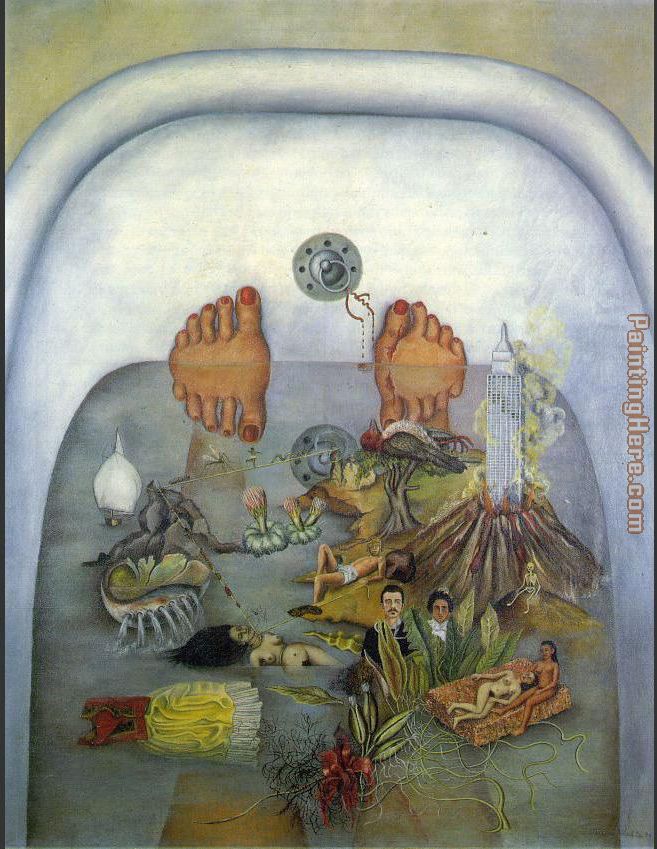
Secondly, a whole collection with a recurring theme of water, What the Water Gave Me: Poems After Frida Kahlo by Pascale Petit (Seren Books, 2010).  For this collection, Petit took on the voice of the artist Frida Kahlo, and created poems around her paintings.  There are six poems throughout the collection named “What the Water Gave Me”. The painting by Kahlo of this title looks like this:

Image

(Image from:  http://www.paintinghere.org/painting/what_the_water_gave_me-7293.html)

In “What the Water Gave Me IV” Petit layers image upon image to capture the multitude of scenes in the picture; it is 34 lines long but only one sentence.  It begins:

“The bath I lie in like a sarcophagus,

the water that’s about to become kerosene

the surface I have to keep absolutely still

so my body can slip through it

like a reflection passing out of a mirror”

You can have a look at the picture and see what you think Petit is doing here, I don’t want to kill the poem by insisting the meaning I see is absolute.  But I will say I think she captures the surrealism of Kahlo’s pictures with the notion of kerosene and the escaping reflection, and the odd, visceral yet detached relationship Kahlo has with her body.  The kerosene also moves towards the underlying violence in Kahlo’s work.  When she was 18 Kahlo had a severe accident when she was travelling on a bus.  The severity of her injuries left her in agonising pain her entire life:

“the ulcers and craters, the giant

one- legged quetzal pierced by a tree,

my toes and their doubles, their blood-red nails,

the ex-votos to give thanks for surviving

twenty-two fractures, the miniature parents

on their atoll far off as my thigh,

the Empire State Building spewing gangrene

over my shin, that no perfume can mask

so no-one will visit

the life led dying”

I think Petit does a great job of capturing one form in another here, giving words to visual art.  The shortening of the last two lines creates an emphasis to demonstrate the impact on the person of all the extreme imagery, and I think they are lines of real pathos.  The layering of image upon image without a break creates a momentum that drives towards the final line:

“a steel handrail breaks off and hurtles towards me.”

This effectively evokes how for Kahlo, the accident is lived over and over, forever in the present tense.  Its repercussions sent ripples through her entire life, and the impact of that steel handrail was devastating: it pierced through her abdomen and womb, meaning that although she wanted children, she could never carry one full term.  As she lies in the bath, as she lives her life, she lives the accident.

You can read some more examples of the poetry in the collection on Petit’s website, here.

Well, this wasn’t the most cheery subject matter, but I think both the poets are huge talents and their poetry is really powerful, so I hope this post wasn’t too depressing!  Do check out their other poems/collections, they’re well worth a look.

Here are the poems with a glass of water (sorry to be so prosaic, but hey, it represents the theme, right?)

Image

“I must have wanton Poets” (Edward II/Christopher Marlowe)

Oh dear, I’ve been very slack with regard to writing this blog lately.  I’ve been beavering away trying to prepare for my final year at uni, and have not managed my time properly – this does not bode well for the mania of finals.  Anyway, my pending exam failures aside,  I was wracking my brains trying to think of a theme for this post, when all I’ve been doing is studying.  Very dull, and does not make for lots of choices for a theme that relates to my life in any way.  But then I thought of something that happened recently and I want you stick with me when I tell you the theme of this post: its Renaissance theatre.  Wait!  For those of you groaning and having flashbacks to sweating over Shakespeare at school, let me say this: you were taught badly.  Renaissance drama can be the best drama there is, from a golden age of theatre when some of the greatest minds were so engaged with the art form they produced lively, innovative, downright entertaining plays.  Then generations of schoolchildren were tortured into trying to unpick it all bit by bit, whilst being told it was good for them.  I hope if that was your experience you’ll finish reading this post, and let me try and persuade you back into the theatre, because I love it.  The reason I’ve made it the theme of this post is because I went and saw Edward II at the National, and it was fantastic.  For those of you with ease of access to the South Bank, I highly recommend you try and catch it.  The production was so innovative and fresh (actors in the audience, multimedia approach, ad-libbing) but it still didn’t lose sight of Marlowe’s brilliant language.  Its iconoclastic approach may not be everyone’s cup of tea, but for me it was one of the best adaptations I’ve seen.

So I thought I’d look at two more Renaissance plays, neither by Shakespeare, because there’s an abundance of stuff on him, no?  (This doesn’t mean I won’t opt to write a post on him at another time, he was a genius after all).  Firstly, Dr Faustus by Christopher Marlowe.  I last saw this performed in 2011 at The Globe, and it was a great production.  I’m not always so keen on The Globe’s approach to things, but this worked well, and Arthur Darvill (Rory in Dr Who according to the excited audience members that surrounded me) was a perfect Mephistopheles.  Here’s the final scene from that production (filmed theatre is always a bit odd I think, and often does the production no justice, but hey ho):

Dr Faustus is about an academic who sells his soul to the devil, asking him to “Resolve me of all ambiguities”.  Ultimately however, Faustus does not use his devilish power to find the answers to anything, but instead uses his time to enjoy prestige and wealth.  This is the first time he and Mephistopheles (Lucifer’s servant) speak:

MEPH. Now, Faustus, what wouldst thou have me do?

FAUSTUS. I charge thee wait upon me whilst I live,

To do whatever Faustus shall command,

Be it to make the moon drop from her sphere,

Or the ocean to overwhelm the world.

 MEPH. I am a servant to great Lucifer,

 And may not follow thee without his leave:

 No more than he commands must we perform.

 FAUSTUS. Did not he charge thee to appear to me?

 MEPH. No, I came hither of mine own accord.

FAUSTUS. Did not my conjuring speeches raise thee? speak.

MEPH. That was the cause, but yet per accidens;

For, when we hear one rack the name of God,

 Abjure the Scriptures and his Saviour Christ,

 We fly, in hope to get his glorious soul…

This first conversation shows so much about the rest of the play.  Firstly, Faustus is a pompous idiot.  He’s just muttered all these complex Latinate incantations, entirely unnecessarily.  When Mephistopheles arrives it’s because he was hanging around, and dropped in “of his own accord”.  Faustus has not conjured  Lucifer, who would not concern himself with such a weasel.  Faustus asks for silly things, the moon to drop, a servant to obey his commands. Secondly, he has no real understanding of what he’s done, it is Mephistopheles who knows the true price paid with his “glorious soul”.  This devil explains:

MEPH. Unhappy spirits that fell with Lucifer,

Conspir’d against our God with Lucifer,

And are for ever damn’d with Lucifer.

FAUSTUS. Where are you damn’d?

MEPH. In hell.

FAUSTUS. How comes it, then, that thou art out of hell?

MEPH. Why, this is hell, nor am I out of it:

Think’st thou that I, who saw the face of God,

And tasted the eternal joys of heaven,

Am not tormented with ten thousand hells,

In being depriv’d of everlasting bliss?

 O, Faustus, leave these frivolous demands,

 Which strike a terror to my fainting soul!

That line: Why, this is hell, nor am I out of it, to me is the killer line of the whole play.  It shows just how little Faustus understands of what he has forfeited, and makes Mephistopheles the most complex character in the play.  He is both malevolent, and deeply, tragically sad, a fallen angel.  It shows how the person you are enables the power you have, to create a heaven or hell of your own making.  Marlowe was a controversial figure in his time; a government informer claimed the playwright was an atheist, an extreme and dangerous view to hold in the late sixteenth century.  (The informer also claimed Marlowe said “All they that love not tobacco and boys are fools”, a slightly less contentious view at the time).  Atheism was equated with immorality at the time, but I would argue Dr Faustus is a highly moral play whether or not you believe in God.  It asks the questions: what do you worship? and what price are you paying for that worship?  In this way, I would argue it still has plenty to say today, whether you are religious or not.  And if that all sounds a bit heavy, well, the full title is The Tragical History of Dr Faustus, but there are plenty of comic scenes and the play is so artfully written that you never feel like you’re being preached at.

Secondly, a comedy after all that tragedy, by Shakespeare’s frenemy, Ben Jonson: The Alchemist.  Jonson is rarely performed compared to his peers, and I think that’s a real shame.  This play is fast, frenetic, has plenty of physical and verbal comedy and is hugely entertaining.  It’s set in London during the plague, when all those who can afford it have fled to the country.  A servant, Face, takes advantage of his master’s absence to team up with an alchemist, Subtle, and a prostitute, Doll Common, to con people out of their money.  Cue lots of scenes with the three in various disguises, spinning ridiculous stories and scenarios to a succession of gullible idiots.  One of the most colourful of these is Sir Epicure Mammon, who desires the Philosopher’s Stone, for the following dubious reasons:

MAM. For I do mean

To have a list of wives and concubines,

Equal with Solomon, who had the stone

Alike with me; and I will make me a back

With the elixir, that shall be as tough

 As Hercules, to encounter fifty a night.—

 Thou’rt sure thou saw’st it blood?

 FACE. Both blood and spirit, sir.

 MAM. I will have all my beds blown up, not stuft;

Down is too hard: and then, mine oval room

Fill’d with such pictures as Tiberius took

From Elephantis, and dull Aretine

But coldly imitated. Then, my glasses

Cut in more subtle angles, to disperse

And multiply the figures, as I walk

 Naked between my succubae. My mists

 I’ll have of perfume, vapour’d ’bout the room,

 To lose ourselves in; and my baths, like pits

 To fall into; from whence we will come forth,

 And roll us dry in gossamer and roses.—

 Is it arrived at ruby?—Where I spy

 A wealthy citizen, or [a] rich lawyer,

 Have a sublimed pure wife, unto that fellow

 I’ll send a thousand pound to be my cuckold.

Jonson was scathing of those who practiced alchemy (attempting to turn base material into gold) and the greed of both the tricksters and their tricks is scathingly skewered.  However, it is a comedy, and (SPOILER) no-one is severely punished.  Of course, nowadays we’re far too savvy to believe in such things as alchemy – now, where did I put that lottery ticket…..?

Here’s an example of sixteenth-century alchemical experiments in action:

“Procrastinate now, don’t put it off.” (Ellen DeGeneres)

The Guardian newspaper has a series it runs on Saturdays, called The Q&A, short interviews with celebrities.  One of the regular questions is: “What is the trait you most deplore in yourself?”  I don’t even have to pause for thought to answer this one.  Having lived with myself all these years there are plenty of things I deplore in myself, but far and away is my enormous capacity for procrastination.  Since I’ve started this blog, my procrastination has developed two-fold: I use the blog to procrastinate from whatever else I’m meant to be doing, and the blog also provides something else I procrastinate over.  Let’s just say there’s some reading for next term not getting done right now, and certain members of my household facilitate my procrastination by indulging their favourite pastime of sitting on my laptop – how can I possibly work in these conditions?

Image

If you are fellow procrastinator, take heart from the fact that you are in great company.  Famous procrastinators include Leonardo da Vinci, Douglas Adams, Franz Kafka and Samuel Taylor Coleridge. The last of these is who I turn to now, with The Rime of the Ancient Mariner.  You can read the full poem here. This famous long poem tells the story of a mariner cursed after he shoots an albatross that had brought a warm wind to his ship:

And I had done a hellish thing,

And it would work ’em woe:

For all averred, I had killed the bird

That made the breeze to blow.

Ah wretch! said they, the bird to slay,

That made the breeze to blow!

As a result of his actions, he has to wear the albatross around his neck (hence the phrase for a guilty burden) and the ship is taken into new waters by vengeful spirits where the crew begin to die.

Day after day, day after day,

We stuck, nor breath nor motion;

As idle as a painted ship

Upon a painted ocean.


Water, water, every where,

And all the boards did shrink;

Water, water, every where,

Nor any drop to drink.


The very deep did rot: O Christ!

That ever this should be!

Yea, slimy things did crawl with legs

Upon the slimy sea.


About, about, in reel and rout

The death-fires danced at night;

The water, like a witch’s oils,

Burnt green, and blue and white.

As these lines show, there is an eerie, hallucinatory quality to the imagery that really evokes a feeling of desolation and disquiet on a vast expanse of ocean. The atmosphere of the poem is deeply unsettling.

When the mariner begins to appreciate the natural life around him, he prays, and the albatross falls from his neck, lifting the curse.

Beyond the shadow of the ship,

I watched the water-snakes:

They moved in tracks of shining white,

And when they reared, the elfish light

Fell off in hoary flakes.


Within the shadow of the ship

I watched their rich attire:

Blue, glossy green, and velvet black,

They coiled and swam; and every track

Was a flash of golden fire.


O happy living things! no tongue

Their beauty might declare:

A spring of love gushed from my heart,

And I blessèd them unaware:

Sure my kind saint took pity on me,

And I blessed them unaware.


The self-same moment I could pray;

And from my neck so free

The Albatross fell off, and sank

Like lead into the sea.

However, the Mariner is left to wander the earth, telling his story. It is not a comfortable resolution, and apparently Coleridge was in some sort of spiritual crisis when he wrote this poem.  But although it’s an uncomfortable read, it’s also Coleridge at his best, and the imagery is beautiful and arresting.  Definitely worth a read, and as a procrastination tool it should use up about an hour.

Secondly, back to the twenty-first century with Where’d You Go, Bernadette by Maria Semple. Semple used to write for various television shows, including one of my all-time favourites, Arrested Development, so I approached this novel with high hopes.  I wasn’t let down.   The novel is funny, but not at the expense of the characters.  Semple manages to create people you really care about, even as you laugh at their foibles and delusions.  I chose it for this post because Bernadette is an architect who hasn’t created anything in years.  The novel is told from the point of view of her adoring 15-year-old daughter Bee, but also multiple viewpoints as we read letters, emails, notes and even a transcript of a TED talk.  Bernadette lives with her husband and daughter in a crumbling building:

“All day and night it cracks and groans, like it’s trying to get comfortable but can’t, which I’m sure has everything to do with the huge amount of water it absorbs any time it rains.  It’s happened before that a door all of a sudden won’t open because the house has settled around it.”

“I knew our blackberry vines were buckling the library floor and causing weird lumps in the carpet and shattering basement windows. But I had a smile on my face, because while I slept, there was a force protecting me.”

Bernadette hates living in Seattle, “this Canada-close sinkhole they call the Emerald city”.  She responds with antagonism bordering on aggression to the parents at Bee’s school who try and get her involved in the “community”.  Then one day she disappears.  As Bee tries to put together what’s happened and find her idiosyncratic, forceful mother, the various characters emerge through Bee’s impression of them and their own words in the various transcripts that make up the novel. They are all flawed, funny, recognisable and likeable.  Even the character I most wanted to throttle redeemed herself in the end.

Although it’s Bee looking for her mother, the title is Where’d You Go, Bernadette, not Where’d You Go, Mom.  Ultimately the novel is about Bernadette’s search for herself, because, as a friend of hers points out: “If you don’t create, Bernadette, you will become a menace to society”.  And funny though Bernadette’s menace is, you’re rooting for this eccentric and engaging character to find her way back to working again. Where’d You Go, Bernadette is a reassuring, feel-good novel about how we’re all trying to get through life and not lose ourselves along the way.

Normally I end with a photo of the books, but I thought it was apt to the theme of procrastination not to get round to it.  Instead here is Tim from The Office exploring his favourite way to procrastinate, by torturing Gareth: