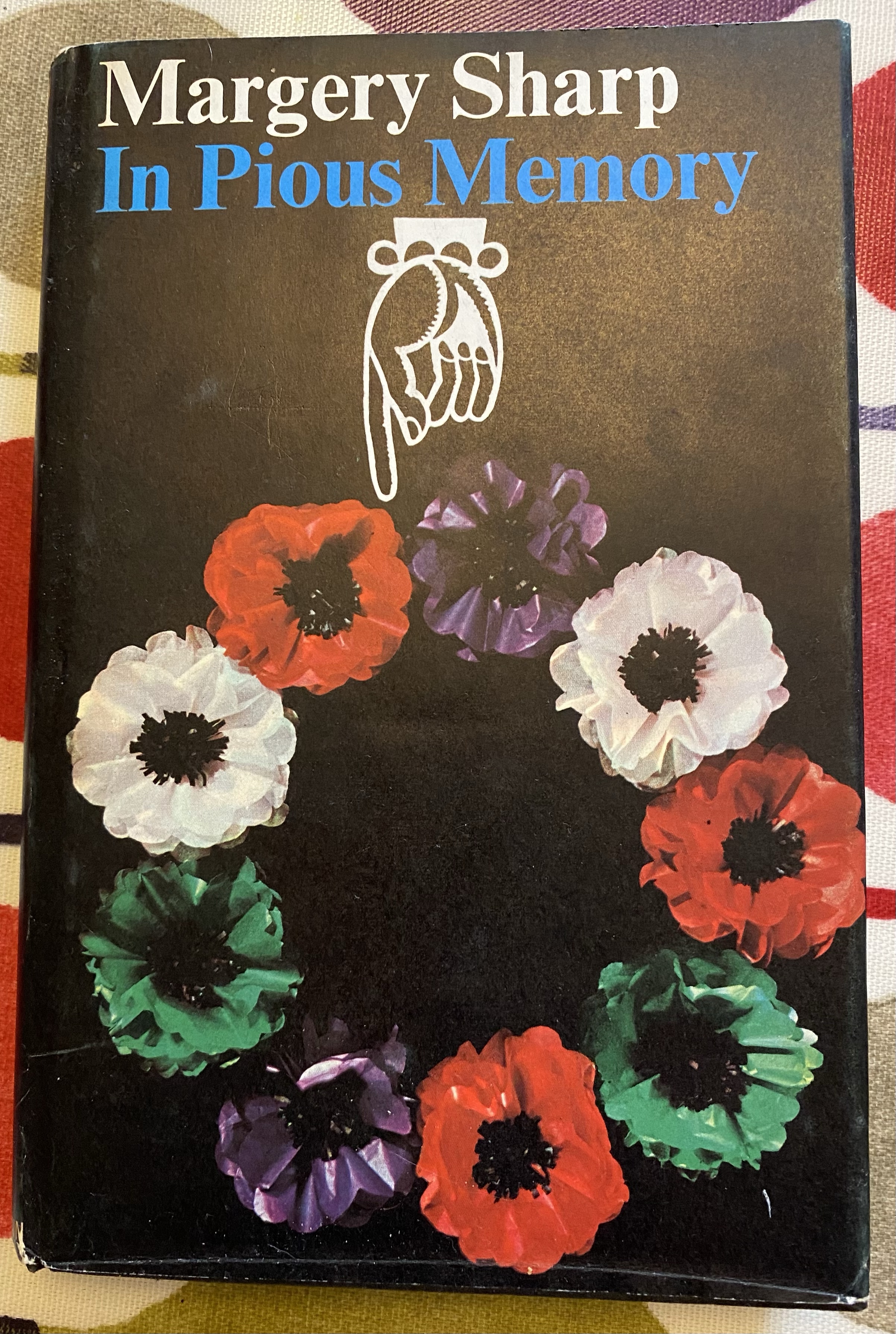
I’m a big fan of Margery Sharp and I enjoyed In Pious Memory a lot. It has her gentle sense of the ridiculous and her fond acceptance of human foibles to the fore, making it a solid comfort read.
It opens with the death of Arthur Prelude, a man who, while inoffensive, seems to have been a monumental bore to all who knew him personally, giving all his energies to his professional life.
“His giant intellect was housed in but an average body – indeed rather below average; average only in the sense of being unremarkable: all the more startling therefore was the effect when on rostrum or at banquet board he suddenly rose to his feet and let his intellect loose like a line from a mouse-trap. Mrs Prelude naturally never witnessed this transformation herself, she was always at home in the hotel bedroom sterilising his inhaling-apparatus with water boiled over a portable methylated-spirit stove; but other wives told her about it.”
His wife was utterly devoted, his adult children a lot more clear-sighted:
“‘Well. of course,’ said Elizabeth. ‘Mother’s of her generation. She behaved quite marvellously, after the crash, and if she’s been crying ever since, it’s only natural.’
‘As it’s natural for us to remain dry eyed?’
‘I suppose so,’ said Elizabeth. ‘After all we didn’t know father very well.’”
Despite Elizabeth and William’s resolution that “‘We must all be very kind to mother, and find her that flat in Hove at once.’”, their younger sister Lydia – determinedly romantic, and set for a career on the stage – decides her father is wandering around the Alps and needs to be found. In this endeavour, she enlists the help of her cousin Toby, and they go biking off across mainland Europe.
Meanwhile, Arthur Prelude is becoming a lot more likable in death than in life, as fictitious memories of his warmth and affection grow and take on a life of their own:
‘We should have lied to mother sooner,’ said Elizabeth.
‘How could we, while father was still alive?’ countered William.
Will Mrs Prelude be able to see past the false memories of her crashing bore husband towards new romantic opportunities? Will Lydia and Toby find Arthur wandering round the mountains in amnesiac shock? Will William get married and will Elizabeth avoid marriage? Absolutely nothing of serious consequence occurs, thank goodness.
In Pious Memory gently ribs questionable veneration of the dead and reminds us all to appreciate the now, imperfect as it may be.
You can read Simon’s thoughts on this novella here.
I’ve chosen two short novels that feature pretty unsympathetic protagonists. In both instances the writing was so good it kept me right alongside them, and maybe it’s the after-effects of covid (it probably is) but they both made me cry.
Night Boat to Tangier (2019) is only 214 pages in my edition, with lots of dialogue and spaces on the page, yet it still manages to be a fully realised portrait of two men in middle age, coming to terms with regret.
Charlie and Maurice sit in the port of Algeciras looking for a young woman they expect to turn up there at some point:
“Two Irishmen sombre in the dark light of the terminal make gestures of long sufferance and woe – they are born to such gestures, and offer them easily.”
Quite quickly we realise that Charlie and Maurice are not to be messed with. They accost a young man named Benny and the threat they pose is both insidious and comic:
“The stories we could tell, Benny. Did you ever try and buy 350 goats off a fella in Marrakesh, did you?
On credit.
In a Cork accent.”
The narrative moves back and forth in time, and we learn how it is that these two men have ended up bound together, why one has a limp and the other a damaged eye, who the girl is they are looking for and how they made their money.
What I enjoyed was the affection the two men had for each other, as easily expressed as their violence.
“Is it me or was I something like a Matt Dillon-type in my younger days?
You were the bulb off him, Charlie. But come here. Have you seen Mickey Rourke lately?
Think I saw him on the number eight going up MacCurtain Street. Top-right-hand seat, overhead the driver.
He’s after leaving himself go something shockin’.
He is, yeah. They nearly had to turf him off the number eight.”
That interaction reminded me of the easy, bordering surreal, dialogue in Roddy Doyle’s Two Pints novellas, but overall it was of Samuel Beckett that Night Boat put me in mind. The two males waiting for someone without knowing when they will arrive, the nihilism and humour, a sense of despair and endurance of hope…
But Night Boat is absolutely its own story. Barry brilliantly evokes the two men as they are in 2018 and as they were in the late 90s/early 00s, showing how their life choices caused such pressure that it took all their strength not to fracture irrevocably. Charlie and Maurice are not very commendable but neither are they one-dimensional baddies. They are deeply flawed and also deeply vulnerable.
Barry writes simply but also has some startling turns of phrase:
“Charlie’s smile is, of its own right, an enlivened thing. It travels the terminal as though disembodied from him. It leaves a woven lace of hysterical menace in its wake.”
“A troubled silence descends – the old times are shifting again; they are rearranging like faultlines.”
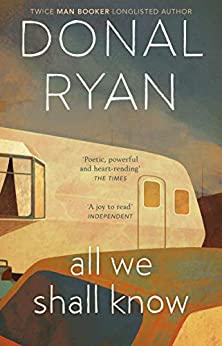
Secondly, All We Shall Know by Donal Ryan (2016). I only started reading Ryan a few years ago but he’s quickly become one of my favourite authors. He writes beautifully, but with a pared-back style, and he always demonstrates such compassionate understanding. I thought his quote about this quality was a suitable title for this post about questionable characters.
Melody Shee narrates the story, and she is not a sympathetic character, as she tells us from the off:
‘Martin Toppy is the son of a famous Traveller and the father of my unborn child. He’s seventeen, I’m thirty-three. I was his teacher. I’d have killed myself by now if I was brave enough.”
The novel follows Melody from twelve weeks of pregnancy through to giving birth, as she reflects on her adolescence and early marriage, her relationship with her parents and her history of appalling decision-making.
Her mother was probably depressed, although this is never said, and had a difficult relationship with Melody’s father, which Melody emulated to try and please her mother. She feels guilty about this now, as her father is possibly the nicest man ever:
“There’s no kindness in me. I can feel it, and think about it, but I can never act it, or be it, the way my father is, the way he’s selfless without effort, a man who has kindness in the marrow of his bones, a soul with barely a blemish.”
She married Pat, her childhood sweetheart, and they seem to have spent most of their time verbally destroying one another:
“The boy who’d grown to adulthood beside me, curled around me, stunting himself, stunting me, a twisted tangle of boughs, hunched and bowed and facing inwards.”
“We merged over time into one person, I think, and it’s easy to be cruel to oneself.”
The pregnancy due to another man is the final straw, and they break up, leaving Melody alone in the house, in a town where everyone knows each other’s business. She finds herself strongly drawn to Mary Crothery, a Traveller woman who, although she lives with her family, is somewhat ostracised from her community. As Melody teaches Mary to read, the two form a close bond, and it’s this that pushes the narrative forward as they both anticipate and cope with life-changing events.
Alongside the current day pregnancy and this relationship with Mary, Melody recalls the heart-breaking story of her childhood best friend, Breedie Flynn. While as a reader it is possible to see the cruelty of young adults who don’t comprehend the damage they are doing as unthinking, it is still an all too believable tragedy, and Melody’s intense guilt and grief don’t seem at all misplaced.
Ryan has made a brave choice in centring a woman who has wreaked so much damage on other people’s lives. But Melody isn’t remotely self-pitying or self-justifying, and in a wholly misguided way, she tries to do better. What I haven’t captured here is that she and Mary are both very funny. Melody literally screaming her frustrations at small town judgement and gossip, and Mary’s snarky asides lift the story and stop it being bleak. It’s not depressing, it’s human and messy and there’s sadness and cruelty and love.
I adore Donal Ryan’s writing and even if this story doesn’t appeal, I’d urge you to seek out his work. His writing is so sensitive and precise, and so readable.
“I’m frightened about what will reach my father’s ears, and how his heart will speed and slow in worry and fear, and how he’ll want to help but won’t know how, so will stand at the window, and watch the weather, and wait.”
To end, Cathy’s post about her favourite Irish films reminded me how much I love The Commitments and hadn’t watched it in years – something being stuck on the sofa with covid gave me a chance to remedy. Robert Arkins, who played Jimmy Rabbitte, sang a few songs on the soundtrack, but wasn’t shown singing in the film. I thought he did a great version of Slip Away, but I couldn’t find decent footage of that, so here he is singing Treat Her Right:
Today is the longest day of the year for those of us in the Northern hemisphere, so I thought I’d celebrate with a couple of light reads (haha – sorry.) It’s also my beloved and much-missed great aunt’s birthday, so I’ve chosen two novels I think she would have approved of – she wasn’t a great reader but I hope she’d enjoy these.
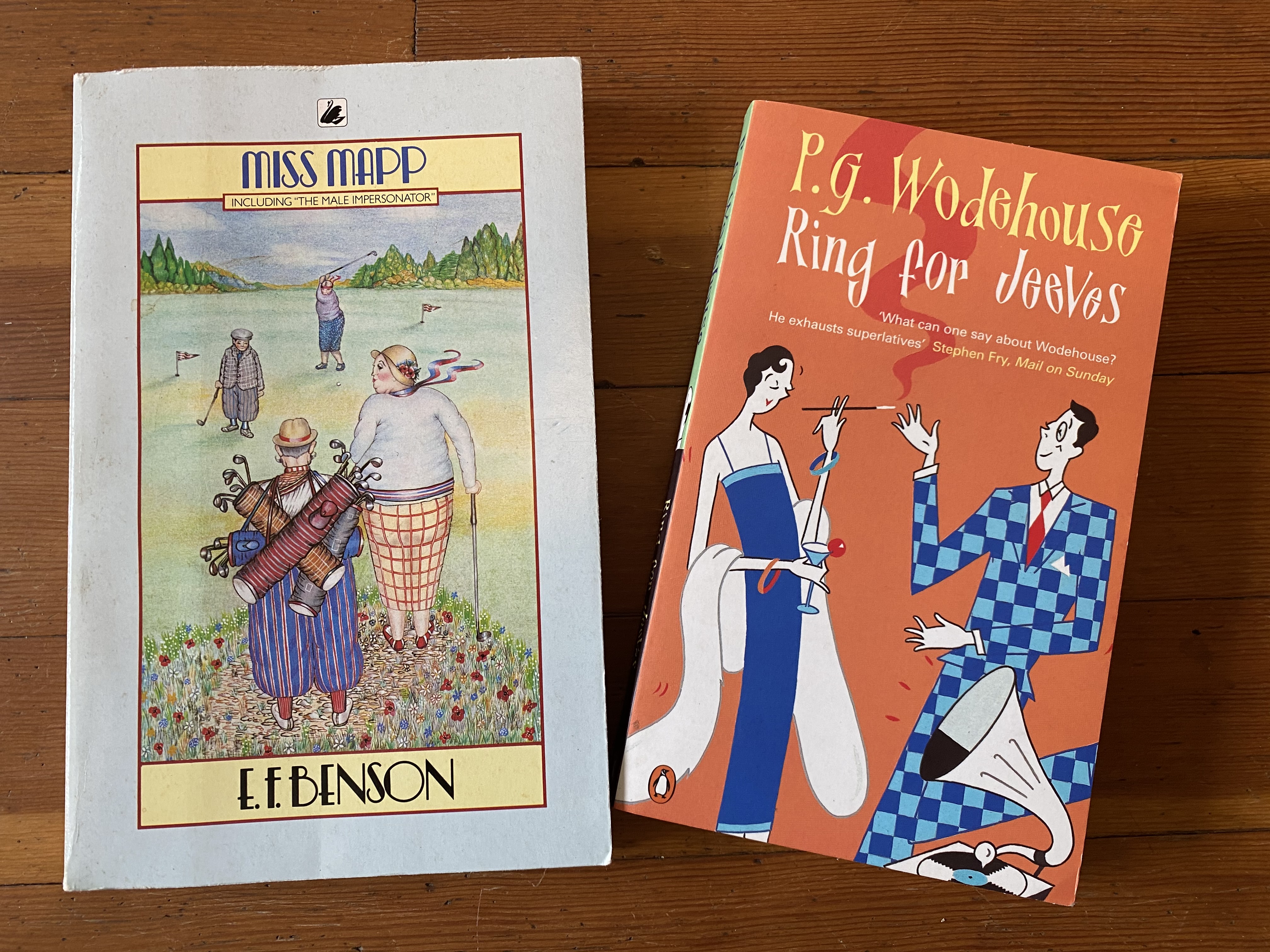
Firstly, Miss Mapp by EF Benson (1922). This is the second in the Mapp and Lucia series and so far I’ve really enjoyed Queen Lucia and Lucia in London, (unintentionally I read them out of order but I don’t think it matters) although fans of the series tell me things really take off once the two meet one another. Those of you who follow me on twitter will know I managed to bag the next two titles from the charity shop just at the weekend, but for now the much anticipated meeting will have to wait, as Lucia’s dominion of Riseholme is only given a passing mention in Miss Mapp. The titular character is far more concerned with the comings and goings of her home town:
“There was little that concerned the social movements of Tilling that could not be proved, or at least reasonably conjectured, from Miss Mapp’s eyrie.”
Her house is perfectly positioned in order to view all her neighbours as they go about their business. She is only interested in the genteel society in which she circulates, so we hear very little about the working classes of Tilling. Rather the focus is on the delightfully-named retired military men Captain Puffin and Major Flint; Isabel Poppit who lives “with a flashy and condescending mother” named Godiva; and Mrs. Plaistow with her troublesome teeth.
Eventually Miss Mapp leaves her eyrie and goes shopping:
“All these quarrelsome errands were meat and drink to Miss Mapp: Tuesday morning, the day on which she paid and disputed her weekly bills, was as enjoyable as Sunday mornings when, sitting close under the pulpit, she noted the glaring inconsistencies and grammatical errors in the discourse.”
This is a brilliant piece of scene-setting by Benson. Miss Mapp, poised at her window before launching herself onto the High Street, tells us all we need to know about Tilling and those who populate it – including their weak in-jokes, feeble and yet guarded fiercely by those who aim to be the first to reference it in conversation:
“Au reservoir, Diva dear,” she said with extreme acerbity, and Diva’s feet began swiftly revolving again.
Sadly, we don’t linger long with the Tillingite who appealed to me most, as Miss Mapp does not share my interest:
“For on emerging, flushed with triumph, leaving the baffled butcher to try his tricks on somebody else if he chose but not on Miss Mapp, she ran straight into the Disgrace of Tilling and her sex, the suffragette, post-impressionist artist (who painted from the nude, both male and female), the socialist and the Germanophil, all incarnate in one frame. In spite of these execrable antecedents, it was quite in vain that Miss Mapp had tried to poison the collective mind of Tilling against this Creature. If she hated anybody, and she undoubtedly did, she hated Irene Coles. The bitterest part of it all was that if Miss Coles was amused at anybody, and she undoubtedly was, she was amused at Miss Mapp.”
Absolutely nothing of any importance happens in Tilling. There are machinations over dresses; worry over food-hoarding which affects no-one; an argument between Puffin and Flint that neither really understand; a refusal to acknowledge daylight saving time. It’s all very silly and none the worse for it.
“Naturally any permanent quarrel was not contemplated by either of them, for if quarrels were permanent in Tilling, nobody would be on speaking terms any more with anyone else in a day or two, and (hardly less disastrous) there could be no fresh quarrels with anybody, since you could not quarrel without words.”
Miss Mapp is greatly enjoyable when you want an escapist read. You can lose yourself in the petty concerns and schemes of Tilling for a few hours, wondering about nothing more serious than the ripeness of redcurrants for making a fool.
My only reservation on finishing it was whether Miss Mapp was too scheming – was she in fact a lonely character? Although she knew everyone’s business, did she really have any intimacy in her life? But my edition also had the short story The Male Impersonator, which features this exchange about Miss Mapp at the end, between Miss Mapp’s frenemy Godiva Poppit and a new arrival to Tilling:
“ ‘Oh but she mustn’t be hurt,’ said Miss Mackintosh. ‘She’s too precious, I adore her.’
‘So do we,’ said Diva. ‘But we like her to be found out occasionally. You will too, when you know her.’”
So then my soft heart felt a lot better 😊
Secondly, Ring for Jeeves by PG Wodehouse (1953). The nonsensical shenanigans of Wodehouse are a go-to comfort read for me, but in recent years I’ve struggled. Living through a succession of overprivileged self-serving, corrupt toffs determined to govern this country into absolute ruin with a total disregard for anyone who doesn’t share their enormous inherited advantages means laughing at the upper classes has somewhat lost its appeal. *climbs down off soapbox and getting back to talking about books*
However, I thought I’d give Ring for Jeeves a go, and I did enjoy it so maybe I’m mellowing. Wodehouse’s characters are so completely bonkers that no-one would suggest they should be in charge of a single thing. In fact, as the title suggests, if anything the novel suggests handing over all power to the lower orders.
Ring for Jeeves sees the titular valet without Wooster (*faints from shock*) as Bertie is away on some sort of retreat, learning – much to Jeeves’ consternation – to darn his own socks. Thus we find Jeeves looking after Bill, a man “in the normal state of destitution of the upper class Englishman” who is desperate for money:
“Rowcester Abbey – pronounced Roaster – was about a mile from the Goose and Gherkin. It stood- such portions of it as had not fallen down – just beyond Southmolton in the midst of smiling country. Though if you had asked William Egerton Bamfylde Ossingham Belfry, ninth earl of Rowcester, its proprietor, what the English countryside had to smile about these days, he would have been unable to tell you. Its architecture was thirteenth-century, fifteenth-century and Tudor, and its dilapidation twentieth-century post-World War Two.”
Bill has begun making some money posing as bookmaker Honest Patch Perkins at the races. The start of the novel sees him and Jeeves tearing back to Rowcester Abbey because they owe Captain Biggar £3000 for a winning bet. The furious Captain is in hot pursuit.
At the country pile, Bill’s infinitely more capable sister has arrived with her husband Rory. This being Wodehouse the fond couple have conversations along the following lines:
“ ‘Now would I be likely to drop a brick of that sort, old egg?’
‘Extremely likely, old crumpet. The trouble with you is that, though a king among men, you have no tact.’”
Monica thinks she can flog Rowcester to Rosalinda Spottsworth, who is obscenely rich and interested in various esoteric matters including ghosts, which surely the abbey must have. Soon everyone – including Captain Biggar who is in love with Mrs Spottsworth – are all under the same leaking roof:
“Jeeves had entered, bearing coffee. His deportment was, as ever, serene. Like Bill, he found Captain Biggar’s presence in the home disturbing, but where Bill quaked and quivered, Jeeves continued to resemble a well-bred statue.”
Will Bill solve his financial difficulties and marry the lovely vet who lives nearby? Will Captain Biggar confess his feelings for Mrs Spottsworth and manage not to kill Bill and Jeeves? Will Rory manage not to put his foot in it several times over? Will it all work out OK in the end?
Of course it will.
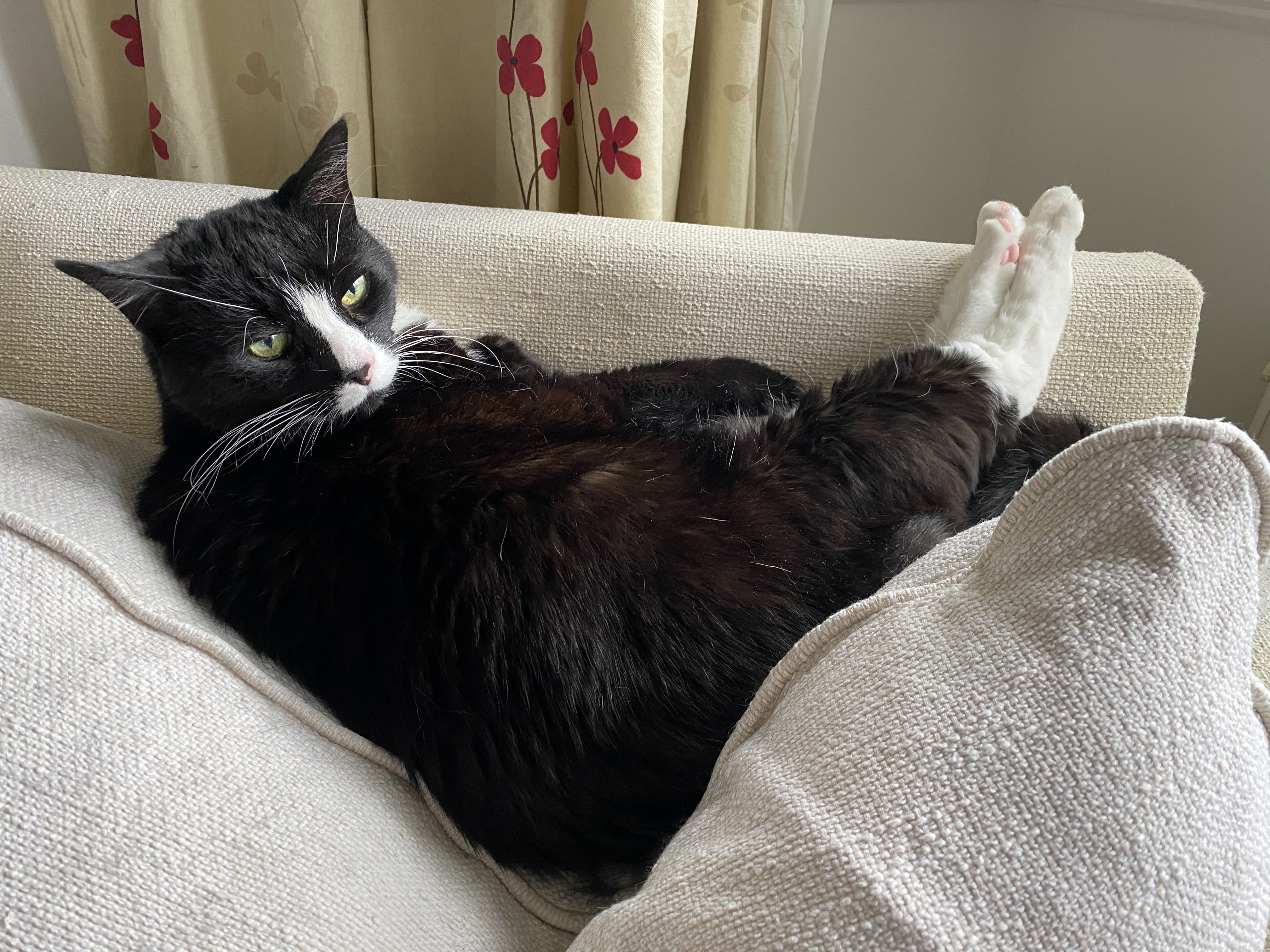
To end, I’ve mentioned before how Bruce Springsteen is proving himself a support to me, especially when my cat died last June. Sadly, his buddy decided to join him this February, and I’m finding it very hard. Here he is in a self-fashioned hammock, the crazy kid:
Anyway, along with stalwart David Bowie, Bruce continues to provide solace, so here he is singing about light (there are credits running over it which is a bit annoying but I really like this version):
It is a truth universally acknowledged that 2020 has been a big old pile of pants. Initially I felt guilty about seeking some escapism – it seemed to be another facet of privilege that escapism was available to me – but now I think if it keeps you sane, do whatever works to come out the other side (and I need to keep reminding myself that there will be the other side…) So here are two enjoyable, light comic novels that have helped me keep possession of my remaining marbles.
Firstly, Kate reminded me that the Lucia novels by EF Benson are perfect for this sort of read. Having read Queen Lucia back in April for the 1920 Club, I was keen to read the sequel Lucia in London (1927), especially as fans of Mapp and Lucia tell me the novels get better as they progress.
It opens with the death of Lucia’s aunt by marriage, who had been very unwell for many years and lived to a ripe old age. All things considered:
“it had been generally and perhaps reasonably hoped among his friends and those of his wife that the bereavement would not be regarded by either of them as an intolerable tragedy.”
But to do so would deny Lucia a chance at self-dramatisation, so of course she goes all out for grief. Her donning of black and a pained expression is wonderfully satirised by Benson, as are the social niceties of bereavement when no-one genuinely cares for the departed:
“Georgie held her hand a moment longer than was usual, and gave it a little extra pressure for the conveyance of sympathy. Lucia, to acknowledge that, pressed a little more, and Georgie tightened his grip again to show that he understood, until their respective finger-nails grew white with the conveyance and reception of sympathy. It was rather agonising, because a bit of skin on his little finger had got caught between two of the rings on his third finger, and he was glad when they quite understood each other.”
It soon becomes clear that Lucia plans to decamp to London, to the aunt’s very swish home, leaving Riseholme reeling. Georgie understands the impulse but is surprised that Lucia is quite so keen to leave:
“He wanted, ever so much, to have a little flat in London (or a couple of rooms would serve) just for a dip every now and then in the life which Lucia found so vapid. But he knew he wasn’t a strong, serious character like Lucia, whose only frivolities were artistic or Elizabethan.”
As readers we know that Lucia is entirely frivolous of course, and she throws herself into the contemporary London scene with gusto.
“What she wanted was the foam of the wave, the topmost, the most sunlit of the billows that rode the sea. Anything that had proved itself billowish was her game, and anything which showed signs of being a billow, even if it entailed a vegetarian lunch with cocktails and the possible necessity of being painted like the artist’s wife with an eyebrow in one corner of the picture and a substance like desiccated cauliflower in the centre.”
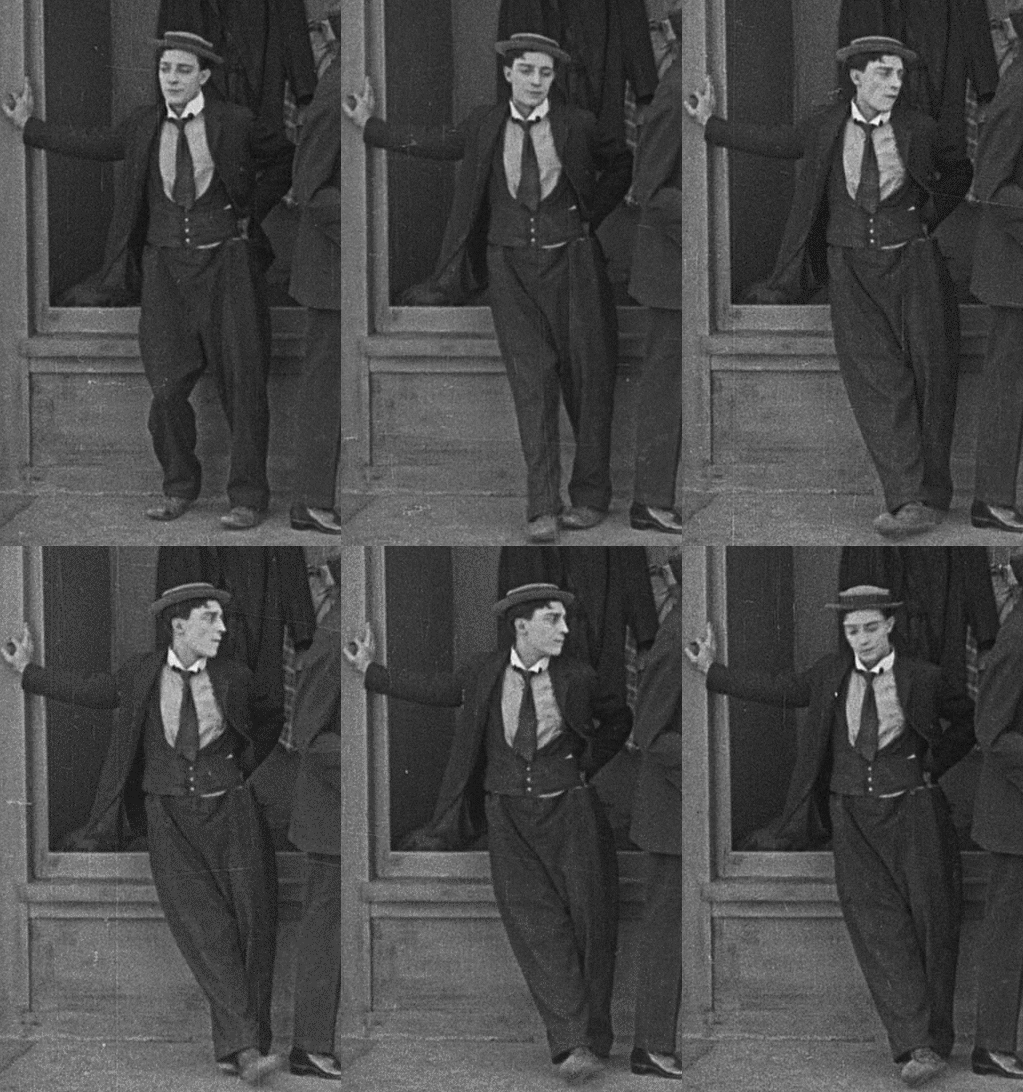
As a Londoner myself it struck me that nothing changes: 93 years on and the silliness of the fashionable London scene is still ripe for satirising. Benson pokes gentle fun, nobody is truly despicable or utterly destroyed. Personally I enjoyed the ongoing saga of Georgie’s Oxford bags, bought during “a moment of reckless sartorial courage”. Not everyone can carry off Oxford bags with the aplomb of Buster Keaton, after all:
Life at Riseholme continues at its usual pace – that is, a snail’s. It is a life they all enjoyed, one filled with enough little dramas and crises to keep them all amused. Now however, something is missing:
“Yet none of these things which, together with plenty of conversation and a little housekeeping and manicuring, had long made life such a busy and strenuous performance, seemed to offer an adequate stimulus. And he knew well enough what rendered them devoid of tonic: it was that Lucia was not here, and however much he told himself he did not want her, he like all the rest of Riseholme was beginning to miss her dreadfully. She aggravated and exasperated them: she was a hypocrite (all that pretence of not having read the Mozart duet, and desolation at Auntie’s death), a poseuse, a sham and a snob, but there was something about her that stirred you into violent though protesting activity, and though she might infuriate you, she prevented your being dull.”
Will Lucia make a splash in London? Will Riseholme find their way without her? Will she ever return? What do you think?
“Aren’t you feeling more Luciaphil? I’m sure you are. You must enjoy her: it shows such a want of humour to be annoyed with her.”
Now a musical interlude, but one of which I’m certain Lucia would not remotely approve. You can’t get more London than Chas and Dave:
Secondly, Ali’s lovely post 10 vintage books of joy reminded me I had Something Light by Margery Sharp (1960) in the TBR, and so I dug it out forthwith. I adore Margery Sharp and her well-observed but gentle humour was just what I needed.
It opens “Louisa Mary Datchett was very fond of men.” Unfortunately for Louisa, this means she keeps running round after various wet blankets, helping them keep on track, buying them yogurt and mopping their brows. She’s getting older and her profession as a dog photographer only just keeps her afloat, so she decides she needs to get married.
“ ‘It’s not the suffragettes who’d be proud of me,’ thought Louisa bitterly, ‘it’s the Salvation Army. I may be the modern woman, the femme sole with all her rights, and I’m very fond of men, but it’s time I looked out for myself. In fact it’s time I looked out for a rich husband, just as though I’d been born in a Victorian novel…’”
It’s a brilliant piece of characterisation that Louisa doesn’t come across as either a doormat or as mercenary. She’s a kind person, a wee bit lost, and trying to take the best decisions she can for a happy life.
We then follow Louisa’s various adventures trying to gain what she thinks she wants. She spends a week trying to secure a rich husband, another seven days rekindling an adolescent devotion and a further week acting as a housekeeper for a man whose ready-made family are appealing.
That’s pretty much it, plot-wise and there are no real surprises. In no way is this a criticism. A comfort read for me has a nice predictability to it and I enjoy watching things play out as I expect in an entertaining way.
What further makes this such an enjoyable read are the fond portraits of the various characters, and the little details. One suitor is frequently likened to a Sealyham terrier; bamboo framed spectacles are given far too much importance; Louisa wears a “rowdy housecoat, zebras on a pink ground”; the milkman is a constant source of sympathetic wisdom as well as dairy products; Louisa has to try and sell ugly beechnut jewellery on behalf of her Bohemian artist neighbour. Everyone is flawed, believably human, gently ribbed by the author. It’s an absolute delight.
“She was constantly being either sent for, like a fire engine, or dispatched, like a lifeboat, to the scene of some masculine disaster”
To end, an 80s pop classic as always, but presented in a lip sync scene of sibling bonding that makes me smile, and we all need things that make us smile right now:
Miracle of miracles, I have managed to join in with the 1920 Club, hosted by Karen at Kaggsy’s Bookish Ramblings and Simon at Stuck in a Book. My reading capacity is still not great due to all that’s happening in the world and my work remains manic, so I thought I might not make it, but here we go on it’s final day: a hastily written and fairly incoherent contribution from me 😊
Firstly, Queen Lucia by EF Benson, the first in his hugely popular Mapp and Lucia series. Back when we were allowed in bookshops, I’d picked up a lovely box set of the first three novels from my favourite charity bookshop so I’m glad the 1920 Club gave me an incentive to get started.
We meet Emmeline Lucas arriving back in her home of Riseholme from London, and deciding to send her fly on ahead with her luggage, in order to cause a stir amongst her neighbours:
“dramatic instincts that formed so large a part of her mentality, and made her always take by right divine, the leading part in the histrionic entertainments with which the cultured of Riseholme beguiled, or rather strenuously occupied, such moments that could be spared from their studies of art and literature, and their social engagements.”
Immediately we know all we need to know: nothing happens in Riseholme, and Lucia is the centre of nothing happening.
“Mrs Lucas amused herself, in the intervals of her pursuit of Art for Art’s sake, with being not only an ambassador but a monarch…Mrs Lucas, busy and serene, worked harder than any of subjects, and exercised control that was both popular and autocratic.”
Lucia is an unmitigated snob with pretensions of cultured appreciation: she is called Lucia in deference to her constantly peppering her talk with Italian phrases, a language she doesn’t speak; she names the rooms in her house after Shakespeare plays; she visibly winces at what she perceives to be poorly played music, in order to demonstrate her delicate sensibilities to her audience.
Lucia is of course, completely clueless. She is bourgeois and has no appreciation of art except in using it to structure her own artifice for the other equally clueless inhabitants of Riseholme. Her neighbours are both in thrall to her and object to her unchallenged reign. Georgie is her BFF who resents and adores Lucia (Benson can’t say he’s gay but devotes a good paragraph to explaining why there is no romantic interest between them); Mrs Daisy Quantock her frenemy and rival for being the epicentre of whatever the next Big Thing in Riseholme will be.
“the hours of the morning between breakfast and lunch were the times which the inhabitants of Riseholme chiefly devoted to spying on each other. They went about from shop to shop on household business, occasionally making purchases which they carried away with them in little paper parcels with convenient loops of string, but the real object of those excursions was to see what everybody else was doing, and learn what fresh interests had sprung up like mushrooms during the night.”
The plot is slight, as it’s meant to be, I think; Benson is showing the intrigues of an entirely ordinary, respectable English village. Daisy and Lucia jostle for the favour of a Guru, later Lucia is nearly dethroned when a genuine prima donna buys a holiday home in the village.
When the guru first made an appearance, my heart sank, expecting casual racism in spades. While there is undoubtedly some of that present, my sense on reading the novel was the portrayal was supposed to play to stereotypes. Without giving away spoilers, I think I was right, and what is being satirised is the ignorance of Riseholme residents.
Although the portrayal of Lucia and her acolytes is clear-sighted and relentless, it’s not cruel. Benson exposes their pretentions but he never leaves his characters devastated, only slightly chastened and all to quick to bounce back into their risible ways. This is gentle, genteel comedy and it’s never unkind.
I can’t say I found Queen Lucia laugh-out-loud funny, but I know fans of the series think the later books are better. It certainly raised a smile, had wonderful characterisation and provided some much-needed escapism during these troubled times.
The BBC adapted Mapp and Lucia in 2014. I’m not entirely convinced from this trailer, although Steve Pemberton looks perfectly cast as Georgie:
Secondly, as a big fan of Golden Age detective fiction, I have to include some as 1920 was a significant year in the genre, when Agatha Christie published Poirot’s first outing The Mysterious Affair at Styles. From the reviews I’ve read from other bloggers joining in with the 1920 Club it sounds a great read which I’ll definitely be catching up on. Another GA title from this year which I’ve chosen for this post is Freeman Wills Croft’s first novel, The Cask. You can read it in full here.
It begins with the titular cask arriving in London on a steamer. As a Londoner I enjoyed the description of the working docks, a time long gone:
“His goal was St. Katherine’s Docks, where the Bullfinch was berthed, and, passing across Tower Hill and round two sides of the grim old fortress, he pushed on till he reached the basin in which the steamer was lying. She was a long and rather low vessel of some 800 tons burden, with engines amidships, and a single black funnel ornamented with the two green bands that marked the Company’s boats. Recently out from her annual overhaul, she looked trim and clean in her new coat of black paint.”
Very different now, when it’s all massively overpriced flats and restaurants:
The cask is discovered to hold gold sovereigns and a human hand. Broughton, the clerk from the shipping company sent to check some cargo for a fussy client, seemed to me to have rather a cavalier attitude towards the grisly contents:
“That a serious crime had been committed he felt sure, and that it was his duty to report his discovery immediately he was no less certain. But there was the question of the consignment of wines.”
All the same, it’s not long before Inspector Burnley of Scotland Yard is on the trail. The first seven chapters depict a farcical chase around London after the extraordinarily well-travelled cask, before it is finally found and the murder victim therein exposed.
Burnley has to travel to France to investigate further, which I found rather glamorous considering it took a whole day, two trains and a ferry to get to Paris. There are also trips to Belgium and to Glasgow as Burnley and his French counterpart Inspector Lefarge piece together the activities of the titular container.
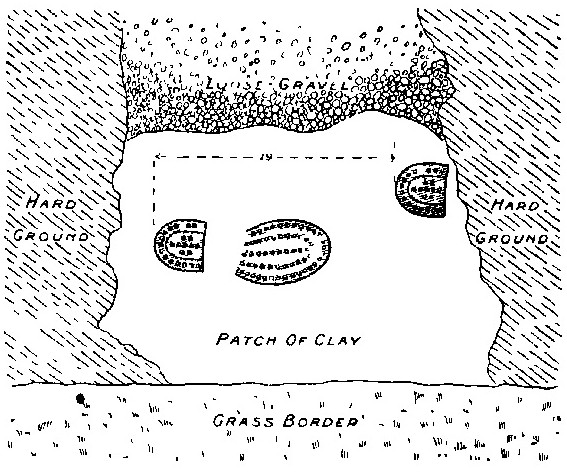
Despite it being an early title in the genre, there’s still some GA tropes to enjoy in this novel, including a diagram in Chapter VI of something I’m not sure really needed elucidating, but I’m very fond of maps and room plans in GA crime so I welcomed it nonetheless:
Blessedly, there aren’t too may of the prejudices often found in GA crime, despite my fears when the French setting became apparent. But Burnley likes France and is friends with Lafarge, which was a pleasant surprise. The working classes however, are somewhat colourfully portrayed:
“‘See ’ere, boss,’ the words now poured out of his mouth in a rapid stream, ‘I’ll tell you the truth, I will, swelp me Gawd. Listen to me.’”
As a lifelong Londoner I can assure you this is *exactly* how we sound, swelp me Gawd. Thankfully Croft soon abandons attempts at depicting the lower orders loquaciousness:
“Palmer’s statement, divested of its cockney slang and picturesque embellishments was as follows:—”
The Cask is a good, solid mystery. The puzzle is set up and we follow the police as they piece together what happened, step by step. If that makes it sound boring, it really isn’t. All the clues seem to point to one suspect but like the police, we’re really not sure he did it. I enjoyed this as an undemanding read but one that sustained my interest and attention, which is praise indeed at the moment, as I have the attention span of a particularly distractible goldfish.
To end, if there’s one thing associated with the 1920s, it’s the flapper. Here’s a clip from the 1920 silent film of that name, the whole of which is available to view on YouTube, and from this trailer looks quite fun:
This is my contribution to the third Persephone Readathon, hosted by Jessie at Dwell in Possibility.
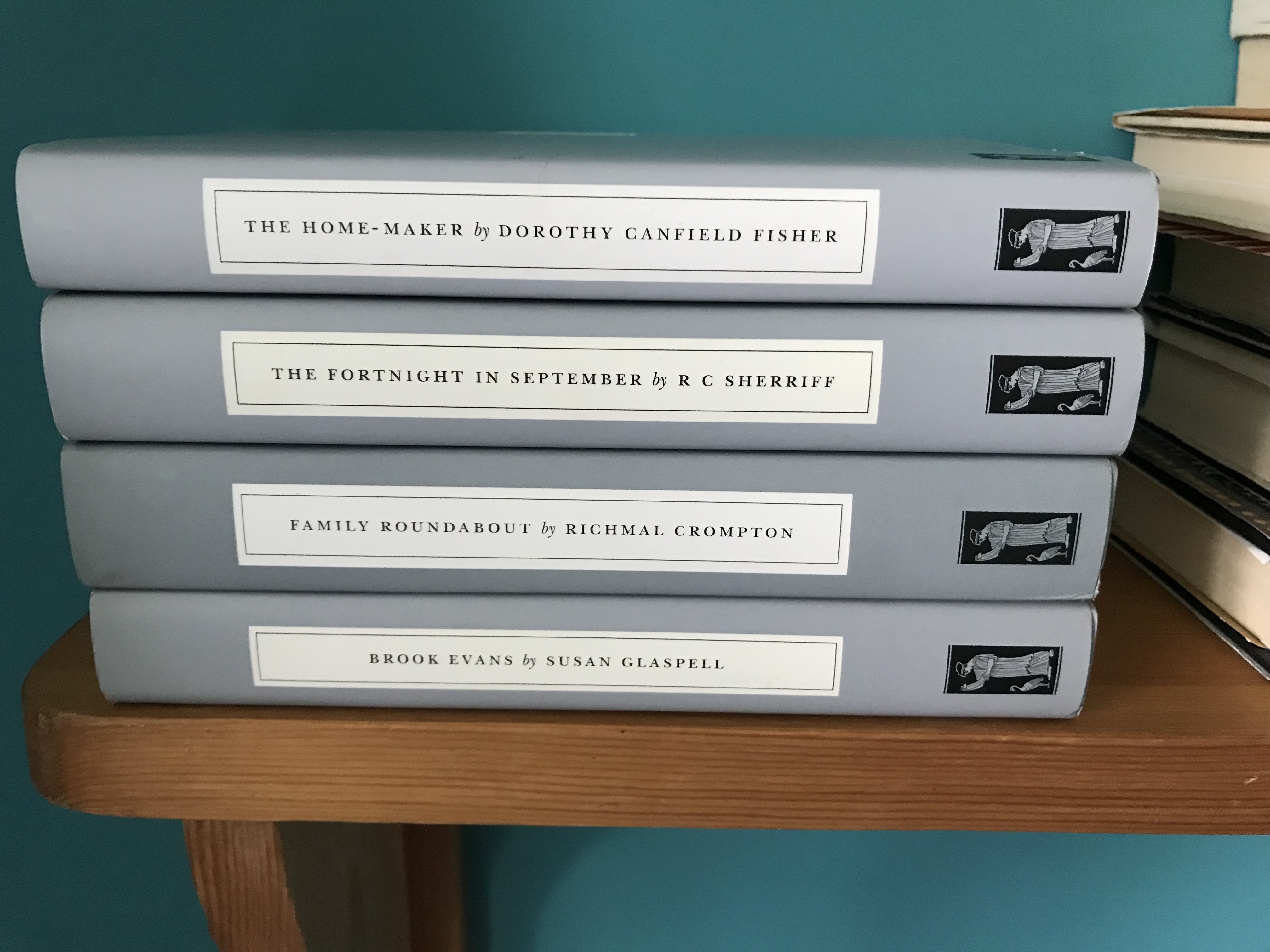
It became apparent very quickly this year that my 2018 book buying ban would have no discernible impact at all if I didn’t rein it in again. So although not officially on a ban, I hadn’t bought any books since March and I’m trying to get that TBR stack down a bit further. This post covers the last two Persephones I had left in the pile… please note the use of past tense there. Those of you who follow me on twitter will know this happened a few hours ago:
I live opposite the greatest charity bookshop ever – what am I supposed to do? Two still had the bookmarks! I left 3 more Persephones behind in there (OK, so I already had those, but still… 😉 )
Firstly, Miss Buncle’s Book by DE Stevenson (1934), which is Persephone No.81. This simple story was an absolute joy. Unassuming spinster Barbara Buncle is desperate for money after her dividends stop paying out due to the financial crash. She decides to write a novel, and as she frequently asserts she has no imagination, she bases it on her village and the people she knows.
The novel is a smash hit, and the villagers are furious, apart from the doctor and his wife:
“I confess it amused me, Ellen – I know this is heresy in Silverstream, but it amused me immensely. It didn’t strike me as satire, nor could I find anything nasty in it. You can read it both ways… I’m pretty certain that its just a simple story, written by a very innocent person – a person totally ignorant of the world and worldly matters – perhaps even rather a stupid person.”
He’s only part right. Barbara Buncle has no side to her, so those who read the novel, Disturber of the Peace, as a satire are wrong. But she is not stupid. She is clear-sighted and that is what has enabled her to make such piercing portraits of her neighbours. The socially pretentious local bully Mrs Featherstone Hogg is determined to root out whoever has written about her in such unflattering (honest) terms:
“Once they knew who it was they could decide what was to be done, everything depended on who the man was. Whether it was the sort of man who could be terrorised, ostracised, or horse-whipped. At the very least he could be made to apologise and hounded out of Silverstream.”
Yet for all their objections, the villagers start to blur the lines between fact and fiction even further. A romance invented by Barbara develops in real life, and a deception she thought she invented turns out to be right on the money.
Barbara remains humble and somewhat bemused by it all. She is a sweet, endearing heroine but not overly saccharine. She has a strong practical streak and this is what led her to write in the first place and write so honestly.
“It represented food and drink to Barbara Buncle, and, perhaps, a new winter coat and hat; but above all, freedom from that awful nightmare of worry, and sleep, and a quiet mind.”
Miss Buncle’s Book is charming. The portraits of the villagers are colourful but not silly, the plot is escapist but not ridiculous. A perfect antidote to our troubled times.
Secondly, Saplings by Noel Streatfeild (1945), which is Persephone No.16 and wasn’t remotely escapist. It charts the disintegration of a family during the Second World War. A clever stroke by Streatfeild is that the Wiltshire family has every privilege: they are well off, able to send their children to family members rather than generally evacuate, they can buy houses away from the city and the father isn’t called up to military service. Yet still the conflict wreaks havoc on both the adults and their four children.
I don’t know if it was because I read all of Streatfeild’s children’s books when I was young and her voice somehow set off a distant echo with me, but I loved this from the start. The opening scene sees parents Alex and Lena with their four young children, Tony, Laurel, Kim and Tuesday, at the beach. This being an interwar middle-class family, they also have a nanny and governess with them. Just as well, because Lena is not remotely maternal. She believes a mother’s role is to look lovely and be charming, and her children will never be her priority.
“He wanted to be a family man, bless him. The children were darlings, but she was not a family woman, she was utterly wife, and if it came to that, mistress too, and she meant to go on being just those things. It didn’t matter giving into him occasionally, letting him be all father. When they were alone she would brush all that away and have him where she wanted him.”
I found the frank discussion of Lena’s sexuality surprising for a novel of the period, and Streatfeild doesn’t judge her harshly because of it, but shows rather how this private need of Lena’s unfortunately has far-reaching consequences. The pressures of war will drive everyone close to breaking, and Lena’s focus on her own needs is disastrous for her children. However, I don’t want to say too much about plot because it’s very easy to give spoilers, and the joy of Saplings is seeing the subtle portraits of the four children emerge.
“Laurel had been crying. Her cheeks had a stiff shiny look. Alex’s heart was wrung. He wanted to sit down by her and tell her how gloomy the house would be without her. That of all his children she had more tentacles round his heart. That he detested packing her off to a boarding school. That every night he would look for her funny plain little face and brisk plaits and would mind afresh because they were not there. But he had never spoken to her like that and tonight, poor scrap, was not the night to start. One word might start her crying again.”
Laurel and Tony probably suffer most. They are the eldest two and in very different ways the things left unsaid by adults effects them both profoundly. Streatfeild is expert in portraying children’s points of view without ever being patronising or sentimental and we see how the unthinking actions of adults are taken as grave injustices by the children. This could have so easily gone wrong: Saplings portrayal of the impact of war on children could have been mawkish and sickly-sweet. But actually it is even funny at times: Kim is a self-dramatising and demanding presence, and Streatfeild shows how he is charming but also, like his mother, entirely self-focussed and constantly playing to audiences.
“Kim thought of chalk blue butterflies. He raised his eyes to the ceiling. He looked like a Hollywood choirboy rounding off a film in which the her or heroine’s soul in the in the last reel flies heavenwards.”
Saplings is expertly written and I really felt I was alongside the four children, immersed in their world. It shows the waste of war for everyone, adults and children alike. What is particularly devastating though, is the suggestion that the adults are in a better position to recover than the children. The war will end, but you only have one childhood, and for Tony, Laurel, Kim and Tuesday theirs has been torn to shreds by warfare, and by adults who systematically fail to recognise what the children need and offer them sanctuary.
“To keep homes safe was basically what most men were fighting for. Lena and Alex’s home was just the sort of set-up he himself was fighting to keep. Beautiful, orderly, full of children.”
Last year when I took part in the Persephone readathon I ended on Visage’s Fade to Grey in honour of those covers. Frankly, I think I outdid myself. This time, try as I might. I couldn’t think of an 80s classic to shoehorn in, so instead here’s a mention of Noel Streatfeild in a Hollywood blockbuster. You’ve Got Mail has always baffled me: why would you get together with the corporate capitalist pig who destroyed your family business and has lied to you almost constantly? Anyway, this is a nice mention of Streatfeild’s children’s books (2.18-3.10) and then I recommend watching The Shop Around the Corner which You’ve Got Mail is based on, but unlike the remake, is utterly charming.
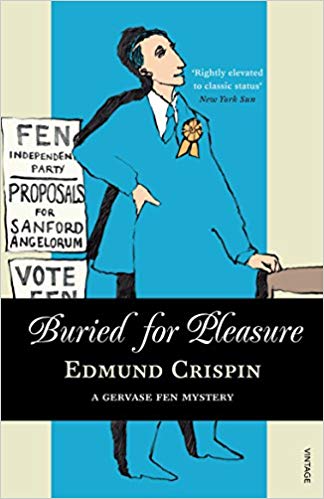
Buried for Pleasure – Edmund Crispin (1948) 176 pages
Although I’m not a big reader of contemporary crime, I do like a golden age mystery and I enjoy Crispin’s tales of amateur detective/Oxford professor Gervase Fen’s adventures. In Buried for Pleasure, Fen has left Oxford to travel to the delightfully named Sandford Angelorum, where he is standing for Parliament as an Independent.
“This panorama displeased Fen, he thought it blank and unenlivening. There was, however, nothing to be done about it except repine. He repined briefly and extracted himself and his luggage from the compartment.”
Fen stays at The Fish Inn where loud renovations undertaken by the owner blast him out of bed every morning. He seems surrounded by comely women – the bar manager, the bar maid, the local taxi driver. Thankfully once their attractiveness is established it isn’t dwelt on and there’s some good characterisation of women in this, which is not always present in GA novels. In fact, the resident detective novelist, Mr Judd, is quite scathing about the whole thing:
“Characterisation seems to me a very overrated element in fiction. I can never see why one should be obliged to have any of it at all, if one doesn’t want to. It limits the form so.”
Crispin pokes fun at everyone in this novel. Novelists, academics, and of course politicians all come in for a gentle ribbing. There is the response to Fen’s first loquacious, entirely meaningless political speech:
“ ‘You’re a natural, old boy … can you keep that sort of thing up?’
‘Indefinitely,’ Fen assured him. ‘The command of cliché comes of having had a literary training.’”
And the political system as a whole:
“ ‘Now, these Sandford people don’t know you as well as I do,’ Captain Watkyn pursued, with a confidence which their quarter-hour acquaintance did not seem to Fen entirely to justify, ‘and … they’re quite likely to elect some scoundrelly nitwit who’ll help send the country to the dogs. Therefore, they’ve got to be jollied along a bit – for their own good, d’you see?’
‘As Plato remarked.’
‘As whatsit remarked, yes.’”
This is not the GA novel to read if you’re in the mood for a good murder with plenty of suspects and clues to work out. This side of the novel – a poisoning before Fen arrives, a stabbing after he becomes resident in the village – is pretty negligible.
However, it’s funny, light, endearing, and doesn’t fall into many of the prejudices which can mar this genre, although the villagers are portrayed as a bit yokely.
Buried for Pleasure was just what I needed after the gothic tribulations of O Caledonia yesterday: complete and utter nonsense and none the worse for it 😀
Highland Fling was Nancy Mitford’s first novel and while not as sparkling as her later works there’s still much to enjoy here. It’s familiar Mitford territory: insane upper classes, Bright Young Things, serious issues treated lightly, light issues treated seriously, and it all works out in the end.
Walter is married to Sally and is entirely useless with money, powering through both their allowances so that he has to ponder “why shouldn’t I do some work? If you come to think of it, lots of people do. I might bring out a book of poems in handwriting with corrections.”
Thankfully for the reading public, they are asked instead to look after Sally’s relative’s enormous country pile in Scotland. They take their friend Albert, who has no idea what to do with himself after Eton and Oxford until “It had come to him during the night that he wished to be a great abstract painter”; and Jane, who “had taste without much intellect, her brain was like a mirror, reflecting the thoughts and ideas of her more intelligent friends and the books she read.”
Keeping company with these Bright Young Things are all the ancient types who descend on Dulloch Castle every year for the shooting season.
“Lord Prague, it may be noted, was to all intents and purposes dead, except on shooting days when he would come to life in the most astonishing manner”
There’s also the massively racist General Murgatroyd who is violent to his dog and didn’t get the come-uppance I’d hoped for (his racism is never condoned, although some portraits of Scottish locals leave a lot to be desired), Lady Prague who is astonishingly rude to all, and Lady Brenda who has the appearance of “an overbred horse”, not helped by her habit of blowing smoke through her nostrils.
What follows is this unlikely crowd getting on each other’s nerves, lying about a missing picnic, getting pregnant, getting engaged…
Thankfully the blood sports are not described in great detail, it’s more about the ridiculous antics of people on the shoot. I do wish someone had rescued Murgatroyd’s poor dog though.
Obviously you need a high tolerance for silly toffs to read Mitford. I enjoy her writing and I did think this was fun, but as I said at the start, not quite as incisive or as funny as she would later achieve.
“Nobody dies in childbirth now, my dear. It’s considered quite vieux jeu.”
To end, something that was absolutely nothing to do with the plot, but did make me smile. For those of us irritated by schoolkids playing music out loud on their mobile phones on public transport, Albert has this experience on the train:
“They then began to play vulgar jazz tunes on a portable gramophone, a noise which Albert found more supportable than their chatter.”
Today is Margery Sharp’s birthday, which I know thanks to Jane from Beyond Eden Rock; I’ve joined in the celebrations with Jane the last few years and I find starting the year with Margery is a sound way to begin if ever there was one 😊
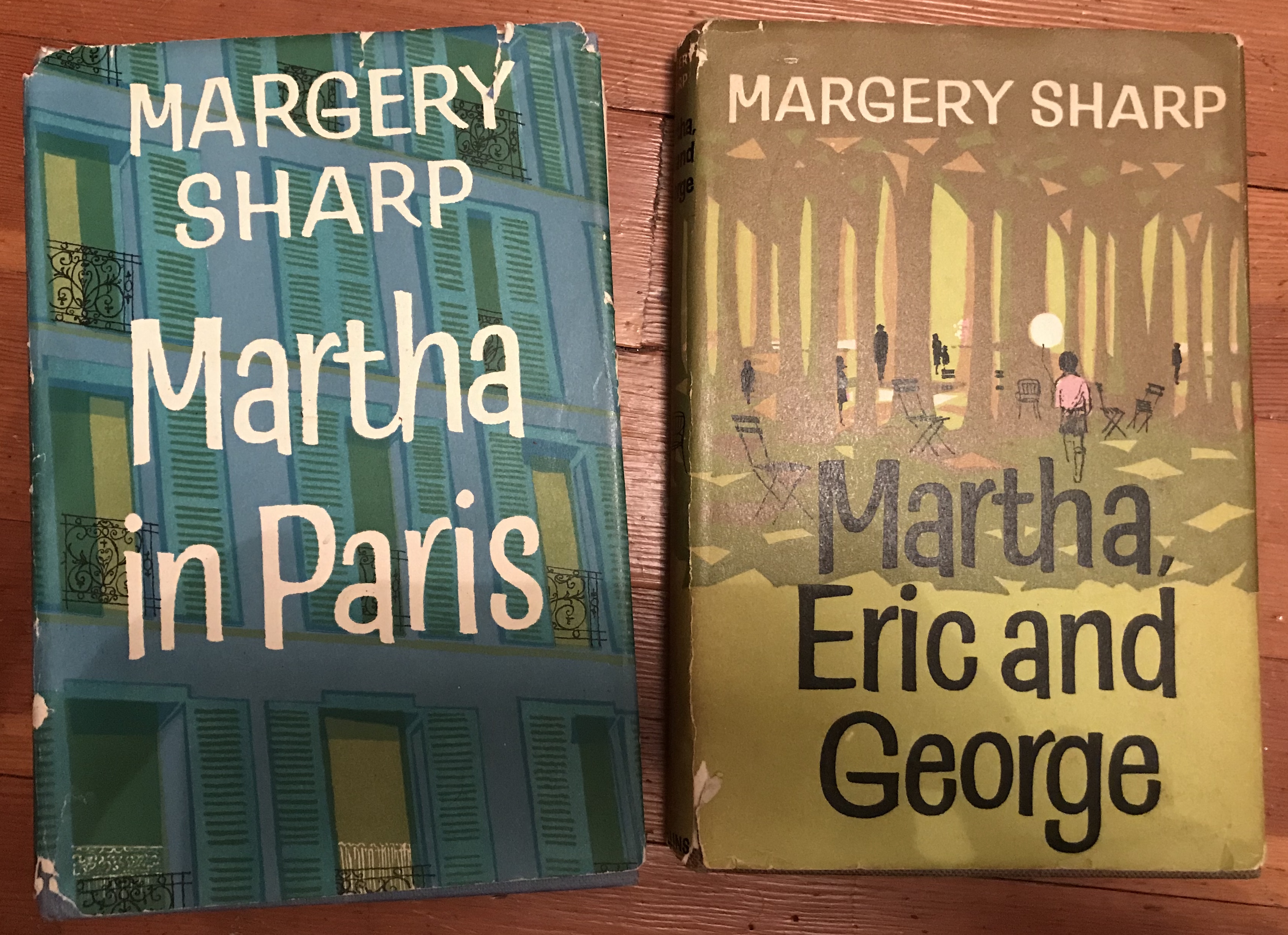
Two years ago I looked at The Eye of Love, which introduced the character of Martha, a strong-willed, self-possessed child. Sharp continues Martha’s story in two sequels, which I thought I’d look at today. These short novels work well individually but also when read together, as I did, the second giving more satisfying conclusion to the story.
Firstly, Martha in Paris (1962) which sees Martha aged 18, pursuing her art under the patronage of her childhood friend Mr Joyce, who recognises her for the genius she is and the future star she will become. He feels that to develop as an artist, she must go to Paris. Martha isn’t keen on Paris, but the prospect of staying forever with her sweet-natured Aunt Dolores means she agrees to go:
“Contrary to Mr Joyce’s prophesy, she learned to speak practically no French at all. She learnt to understand it; but […]it wasn’t as though she had anything she particularly wanted to say. The power of expressing thoughts, or emotions, was unnecessary to her; and not to be able to answer questions a positive advantage.”
Martha is still very much the stolid child we met in The Eye of Love. She is single-minded and focussed entirely on her work. She has feelings for a few people but they are deeply buried, clear-sighted and unsentimental. She is inexpressive because in the main other people are of no real consequence to her; she is indifferent to them and so has no need to seek an understanding with them.
She seems an unlikely candidate for love, but fellow Brit, bank clerk Eric Taylor falls for Martha. Or rather, he falls for who he thinks Martha is: a shy, self-effacing virgin like himself. Martha doesn’t deliberately mislead him, because she doesn’t really bother with him at all.
“Eric Taylor, in love, still wasn’t ready to make love. He felt himself he hadn’t yet quite got the hang…a parting pressure of the hand was the most he attempted; which upon Martha, who had a grip like a navvy’s, left no impression at all.”
Despite these inauspicious circumstances, their relationship develops because Martha is drawn to visit Eric and his mother at their flat, due to the prospect of nice bath. Now onto huge SPOILERS – if you don’t want to know, you’ll need to skip to the end of the post.
Inevitably, these two naïve people end up in a predictable fix: Martha gets pregnant. She carries on going to art class and doing well; she is overweight and wears baggy smocks so her pregnancy is easy to hide. She also decides that although she enjoys sex, she loves her work more, and so she is done with that side of life.
“It was time for Martha to gather her forces. No prospect had ever appalled her more, not even that of painting Christmas cards at Richmond, than this loyally-offered prospect of honourable matrimony.”
Martha is not an easily likeable character, as she disregards almost everyone she encounters. However, she never does this out of cruelty and never intends to hurt anyone. If you like Saga Noren from The Bridge (which I do), you’ll like Martha.
Some things have dated in Martha in Paris: a rather flippant treatment of the prospect of rape and a horrible racist phrase used in passing by one character. But in its treatment of sexual politics and gender roles it is remarkably progressive for its time. Martha is shown to find joy in sex without love. She is also shown to prioritise her career over all else. Sharp suggests that Martha behaves as men have done for centuries, and asks if we judge her harshly, are we doing so because she is a woman who resolutely fails to fulfil traditional gender roles?
Sharp continues to expand on the theme of gender expectations in the sequel Martha, Eric and George (1964); as a comic writer she does this explicitly but with wit so it’s never didactic.
“Young men are not accustomed to being loved and left, abandoned to bear alone the consequences of their folly, just as if they were young women.”
But this is exactly what happens to Eric Taylor. Martha leaves the baby with him and his mother to be raised, while she returns to England to focus on her painting.
“No dashing hussar abandoning a village maiden could have behaved more cavalierly. Not that Martha was in any other sense dashing, far from it; her outstanding characteristic was rather a blunt stolidity which only Eric in his innocence could have seen as virginal shyness.”
His mother, as Martha foresaw, embraces this new challenge to become a doting grandmother. She also revels in her status as rescuer of a poor abandoned baby.
“There were no such compensations for Eric. For once, it was the man who paid.”
Martha meanwhile, has become a hugely successful artist. Events conspire to send her back to Paris ten years after she left her son on the Taylors doorstep. She has no plans to see Eric or her son ever again, but of course things work out otherwise. George has grown up very much like his mother in temperament: self-possessed and single-minded. Martha has no maternal feelings whatsoever.
“She desired neither husband nor lover, nor to be admired, nor to make other women envious. All she wanted was to be unencumbered.”
What will happen to this disparate trio? I think Sharp is brilliant at endings: things work out well, without diminishing the characters or retreating into sentimentality. Martha, Eric and George was no exception to this.
To end, a sentiment with which Martha would certainly not agree:
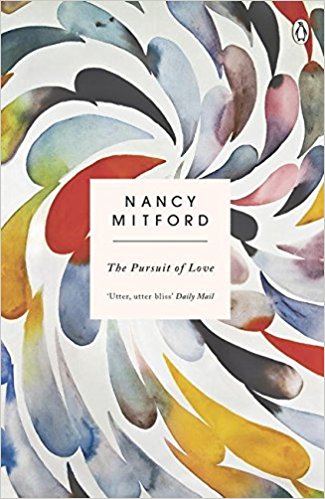
The Pursuit of Love – Nancy Mitford (1945, 192 pages)
The Pursuit of Love was Nancy Mitford’s first novel in a trilogy about the Radletts, a bonkers upper class family.
“My Uncle Matthew had four magnificent bloodhounds, with which he used to hunt his children. Two of us would go off with a good start to lay the trail, and Uncle Matthew and the rest would follow the hounds on horseback. It was great fun. Once he came to my home and hunted Linda and me all over Shenley Common. This caused the most tremendous stir locally, the Kentish weekenders on their way to church were appalled by the sight of four great hounds in full cry after two little girls.”
The narrator is Fanny, cousin to the Radletts and rather different in temperament. Her mother leads a peripatetic life according to which man she is with, earning her the nickname The Bolter. Fanny is therefore raised by her lovely Aunt Emily, and the two have a placid, ordered existence, but it is the chaotic holidays Fanny spends with the Radletts which occupy the story.
“The Radletts were always either on a peak of happiness or drowning in black waves of despair; their emotions were on no ordinary plane, they loved or they loathed, they laughed or they cried, they lived in a world of superlatives.”
It’s thinly disguised biograpy of course. The Radletts are home educated along similar lines to Nancy and her famous sisters: in French and horsewomanship, and not much else.
“They picked up a great deal of heterogeneous information, and gilded it with their own originality, while they bridged gulfs of ignorance with their charm and high spirits, they never acquired any habit of concentration, they were incapable of solid hard work. One result, in later life, was that they could not stand boredom, Storms and difficulties left them unmoved, but day after day of ordinary existence produced an unbearable torture of ennui, because they completely lacked any form of mental discipline.”
Fanny focuses the story on that of Linda, her cousin and best friend. Linda is more like The Bolter than Fanny ever is, and has a disastrous marriage to a Tory followed by a disastrous affair with a communist, before finding a true love. The Pursuit of Love is not romantic though, Mitford’s comic eye is far too sharp for that. If it wasn’t for this, my inverted snobbery may have come to the fore and left me thinking ‘So what? Who wants to read about a bunch of ill-educated, over-privileged idiots?’ Well, as it turns out, I do. I find Mitford truly funny and accomplished in her writing. No-one escapes her wit, least of all the upper-classes and their mores:
“The behaviour of civilised man really has nothing to do with nature … all is artificiality and art more or less perfected.”
She’s not above the downright silly either, such as describing a baby as “the usual horrid sight of a howling orange in a fine black wig”.
The Pursuit of Love does provide some intriguing insights into the mid-twentieth century landowning classes though, such as their attitude to travel in the post-war period:
“it would never have occurred to the Alconleighs to visit the continent for any other purpose than that of fighting”
The Pursuit of Love is very funny but there is a brittleness there; a sense that things easily splinter and true sadness and tragedy are only ever just below the surface. The ending emphasises this element and is truly moving, all the more so as it is something of a jolt given what has gone before.









 madame bibi lophile recommends
