“Literature illuminates life only for those to whom books are a necessity.” (Anthony Powell)

This is the seventh instalment in my 2024 resolution to read a book per month from Anthony Powell’s A Dance to the Music of Time sequence. Published between 1951 and 1975, and set from the early 1920s to the early 1970s, the sequence is narrated by Nicholas Jenkins, a man born into privilege and based on Powell himself.

The seventh volume, The Valley of Bones, was published in 1964 and is set at the start of World War Two, when Nick has joined the army as an officer.

I’ve said when reading previous novels in the sequence that I’m intrigued by Nick’s outsider’s view, as it’s not clear where it comes from since he seems so much a part of the society he portrays. In the army, the distinction is clearer. Nick finds himself billeted to South Wales within a company made up mostly of bankers, very different to his bohemian artsy London life.

“I indicated that I wrote for the papers, not mentioning books because, if not specifically in your line, authorship is an embarrassing subject for all concerned.”

Nick casts his sharp eye over these new associates in the same way he has for his friends, family and acquaintances up to this point. A central character is Captain Rowland Gwatkin, a man who seems simultaneously devoted to the army and entirely bewildered by it too:

“Gwatkin lacked in his own nature that grasp of ‘system’ for which he possessed such admiration. This deficiency was perhaps connected in some way with a kind of poetry within him…Romantic ideas about the way life is lived are often to be found in persons themselves fairly coarse- grained.”

Gwatkin is really tightly wound, and there is a sense of impending doom at best, destruction at worst with him.

Nick is an indifferent soldier, neither very good nor absolutely awful. There is some consideration of philosophical theories of war, but primarily Nick is interested in those who surround him:

“It is a misapprehension to suppose, as most people do, that the army is inherently different from all other communities. The hierarchy and discipline give an outward illusion of difference, but there are personalities of every sort in the army, as much as out of it.”

Powell brilliant portrays the simmering tensions in the company, both from the mix of personalities attempting to work together within and the increasing threat from Hitler without. There are those with alcohol problems, death by suicide, and broken hearts, yet the days mostly pass in utter tedium. Nothing changes even after the company is uprooted to a posting to Northern Ireland:

“At Castlemallock I knew despair. The proliferating responsibilities of an infantry officer, simple in themselves, yet, if properly carried out, formidable in their minutiae, impose a strain in wartime even on those to whom they are a lifelong professional habit; the excruciating boredom of exclusively male society is particularly irksome in areas at once remote from war, yet oppressed by war conditions.”

As Adjutant Maelgwyn-Jones observes: “That day will pass, as other days in the army pass.”

Yet there is some light relief too, such as an inspection from a visiting General, seemingly obsessed with breakfast foodstuffs:

“The General stood in silence, as if in great distress of mind, holding his long staff at arm’s length from him, while he ground it deep into the earth the surface of the barnhouse floor. He appeared to be trying to contemplate as objectively as possible the concept of being so totally excluded from the human family as to dislike porridge.”

And Nick does get some weekend leave in order to catch up with his family. There he finds people thrown together, behaving oddly and under strain. In other words, not so very different from his army posting. As his pregnant wife Isobel observes: “the war seems to have altered some people out of recognition and made others more than ever like themselves.”

In The Valley of Bones Anthony Powell shows himself uninterested in the glorification of war or in any sort of jingoism. He also doesn’t fall into the trap of a wholly satirical, detached point of view either. He manages a delicate balance between conveying the seriousness of war alongside the human inadequacies and frailties of those expected to enact it.

He also pulls an absolute masterstroke at the finish. The boredom, the admin, the essentially unthreatening – if somewhat self-destructive – colleagues are turned upside down in an instant, and Nick finds himself carried forward, powerless in a situation about which he has a deep sense of foreboding. It’s a chilling ending and I’m anxious to see how it plays out in the next volume, The Soldier’s Art.

“In the army – as in love – anxiety is an ever present factor where change is concerned.”

To end, a song absolutely synonymous with wartime Britain for many, which seems particularly apt for Nick as he’s always running into people he met previously:

“Love is at once always absurd and never absurd.” (Anthony Powell)

This is the sixth instalment in my 2024 resolution to read a book per month from Anthony Powell’s A Dance to the Music of Time sequence. Published between 1951 and 1975, and set from the early 1920s to the early 1970s, the sequence is narrated by Nicholas Jenkins, a man born into privilege and based on Powell himself.

The sixth volume, The Kindly Ones, was published in 1962 and is set around the start of World War Two. This felt a bit of a departure from previous volumes in some ways. We learn a lot more about Nick in this novel; he features much more directly in his own narrative. Powell also shockingly almost approaches a plot in The Kindly Ones, confounding my expectations 😀

The volume starts by looking back in time, with Nick remembering his childhood at Stonehurst, just before World War I broke out. My favourite character from At Lady Molly’s makes a reappearance: General Alymer Conyers, proving himself good in a crisis and kind to those who need it most.

He is visiting Nick’s parents, and I was interested to learn more about them. They are presented with the same clear-sighted economy with which Powell treats so many of his characters, which I found striking in consideration of close family. Nick doesn’t seem to like his father particularly, but there is no rancour or resentment there either:

“’I like to rest my mind after work,’ he would say. ‘I don’t like books that make me think.’

[…]

The one thing he hated, more than constituted authority itself, was to hear constituted authority questioned by anyone but himself. This is perhaps an endemic trait in all who love power, and my father had an absolute passion for power, although he was never in a position to wield it on a notable scale.”

Powell has a knack of presenting his characters with discernment, but without the heavy moral judgement which would make the volumes pretty unreadable. It’s an intelligent, sensitive approach and I think it contributes to writing that is so of its time still managing not to date badly.

It’s hard to see where Nick’s objectivity and distance from his entirely conventional upbringing has occurred, although his friend Moreland suggests maybe Nick’s life wasn’t as conservative as it seemed, in comparison to his own:

“’Ours was, after all, a very bourgeois Bohemianism,’ he used to say. ‘Attending the Chelsea Arts Ball in absolutely historically correct Renaissance costume was regarded as the height of dissipation by most of the artists we knew. Your own surroundings were far more bizarre.’”

Moreland isn’t doing so well, and in the second part of the novel Nick and Isobel have gone to stay with him and Matilda in the country.

“It became clear these fits of ennui were by no means a thing of the past. He would sit for hours without speaking, nursing a large tabby cat called Farinelli.”

They end up at a party with Sir Magnus Donners, where Nick’s old schoolfriend Templar is present with his wife Betty, who is thoroughly depressed. I was struck by the portrayals of female mental illness in this volume. Within this tale are two women who are suffering greatly and Powell treats them with understanding and compassion, never dismissing it with misogyny around ‘hysteria’ which I suspect was much more prevalent at the time.

At the start of the novel the Jenkins’ housemaid Billson has what we would probably now call a dissociative episode, which is where General Conyers intervenes in the manner I mentioned above. At Donner’s party years later, Nick’s compassion is with Betty rather than his friend:

“She had been shattered by the unequal battle. The exercise of powerful ‘charm’ is, in any case, more appreciated in public than in private life, exacting, as it does, almost as heavy demands on the receiver as the transmitter, demands often too onerous to be weighed satisfactorily against the many other, all too delicate, requirements of married life. No doubt affairs with other women played their part as well.”

The plot I was so surprised to find occurs in the next part of the story. During the childhood episode that begins the novel, we encounter mystic/charlatan Dr Trelawney. He reappears as Nick makes a visit to sort out his Uncle Giles’ effects at a seaside hotel and a somewhat dramatic scene ensues, which Nick helps to resolve by dredging up childhood memories. Dr Trelawney is a sinister character, as Nick observes in his room: “A scent vaguely disturbing, like Dr Trelawney’s own personality.” But he is not a comic creation, rather adding to the sense of foreboding around world events:

“There was something decidedly unpleasant about him, sinister, at the same time absurd, that combination of the ludicrous and alarming soon to be widely experienced by contact with those set in authority in wartime.”

If I’ve made The Kindly Ones sound very heavy though, I’ve done it an injustice. There are still plenty of comic moments to enjoy, such as the reappearance of the fortune-telling Mrs Erdleigh, who had met Nick’s late mother-in-law:

“’Lady Warminster was a woman amongst women,’ said Mrs Erdleigh.’ I shall never forget her gratitude when I revealed to her that Tuesday was the best day for the operation of revenge.’”

There is also Nick’s continued gentle ribbing of his brother-in-law: “Erridge, a rebel whose life had been exasperatingly lacking in persecution.”

And Widmerpool behaves with pomposity, even though he is always underscored by a sense of menace:

“I recognised that a world war was going to produce worse situations than Widmerpool’s getting above himself and using a coarsely military boisterousness of tone to which his civilian personality could make no claim.”

The novel ends with Nick getting his longed-for commission in the army as an officer. He could have joined as a squaddie but obviously that would never do 😀 (I can’t be too scathing about Nick’s reluctance/snobbery, given I’d be terrified to join the army and utterly useless if I did.)

I expect the next volume will cover the war years which have been building throughout the last few volumes. Given its title of The Valley of Bones, I wonder if Powell will allow Nick to sustain that ironic distance. I’ll be intrigued to find out.

“At the back of one’s mind sounded a haunting resonance, a faint disturbing buzz, that was not far from fear.”

“I record these speculations…to emphasise the difficulty in understanding, even remotely, why people behave as they do.” (Anthony Powell)

I’ve just managed to keep up my 2024 resolution to read a book per month from Anthony Powell’s A Dance to the Music of Time sequence this April! It’s been a bit of a month and May looks equally challenging so I won’t be doing my Novella a Day in May this year, though I will focus on novellas for the month as I had some lined up that I’m really keen to read.

Back to A Dance to the Music of Time! Published between 1951 and 1975, and set from the early 1920s to the early 1970s, the sequence is narrated by Nicholas Jenkins, a man born into privilege and based on Powell himself.

The fourth volume, At Lady Molly’s, was published in 1957 and is set in the 1930s before the start of World War Two. Politics is only mentioned very occasionally though, and the focus remains on the relationships between an insular set of people.

This is the volume where I started to get a sense of the dance. With marriages a strong theme, the characters circle around, encountering one another for periods before spinning off again. Others weave in and out.

 Nick is now working as a script writer and his affair has ended. At the start of the novel he is taken by a colleague to a party at Lady Molly Jeavons. Once again he runs into acquaintance/talisman Widmerpool:

“Yet, for some reason, I was quite glad to see him again. His reappearance, especially in that place, helped to prove somehow rather consolingly, that life continued its mysterious, patterned way. Widmerpool was a recurring milestone on the road”

Widmerpool is engaged to Mildred Haycock, who is quite a few years older than him and has a colourfully described past. Later we learn that Widmerpool’s political aspirations are growing, and there is a chilling speech he gives Nick over lunch at his club, in favour of appeasement of Hitler.

Once again I was struck by Powells astute, clear-sighted assessment of people. Surrounded as it is by a satirical comedy of manners, he can really pack a punch when he chooses.

“Sentiment and power, each in their way, supply something to feed the mind, if not the heart. They are therefore elements operated often to excess by persons in temperament unable to love at all, yet at the same time unwilling to be left out of the fun, or to bear the social stigma of living emotionally uninteresting lives.”

There are lighter portraits too of course. My favourite in At Lady Molly’s was retired General Alymer Conyers. In his eighties, he spends his retirement reading Virginia Woolf, practising the cello, and learning about psychoanalysis:

“‘Been reading a lot about it lately,’ said the General. ‘Freud – Jung – haven’t much use for Adler. Something in it, you know. Tells you why you do things. All the same, I didn’t find it much help in understanding Orlando.’

Once more he fell into a state of coma.”

Quiggin and Mona Templar reappear (“She was like a strapping statue of Venus conceived at a period when more than a touch of vulgarity had found its way into classical sculpture.” Ouch.) living in a cottage owned by Erridge, who is now Lord Warminster. The lord of the manor dresses in scrappy clothes, has a big beard and gives a lot of his money away to good causes. I work near Shoreditch so none of this sounds like remotely remarkable manhood to me, but to his 1930s aristocratic family he seems mad. I’ve read somewhere he may have been based on George Orwell!

Nick meets two of Erridge’s sisters when he visits, including Isabel, “a bit of a highbrow when she isn’t going to night clubs”. He falls in love at first sight but their courtship happens entirely away from the eyes of the reader. Powell’s interest isn’t romance, but rather the dynamics of relationships and how these play out in the wider world.

“Women may show some discrimination about whom they sleep with, but they’ll marry anybody.”

There are so many ways A Dance… is of its time (which I think is exactly as intended) but it also doesn’t age, through Powell’s astute characterisation. I was very struck by this comment early on in At Lady Molly’s:

“One of those men oddly prevalent in Victorian times who sought personal power through buffoonery”

You don’t have to look very far back through our Prime Ministers to find a much more recent example…

I absolutely whizzed through At Lady Molly’s and I’m really looking forward the next volume, Casanova’s Chinese Restaurant.

To end, a beautifully simple rendition of a song about Molly:

“The only thing that interferes with my learning is my education.” (Albert Einstein)

This is the fourth of my planned daily posts for the wonderful 1937 Club, running all week and hosted by Kaggsy at Kaggsy’s Bookish Ramblings and Simon at Stuck in a Book.

Today I’m looking at the fifth of Angela Thirkell’s Barchester novels, Summer Half. Although strictly speaking, Barchester only features now and again, most of the novel being set in Southbridge School and the master’s homes.

Reading Angela Thirkell can be a trepidatious experience. I really enjoy her comedy, but she can also be an unmitigated snob and racism can filter in too. Thankfully, although there were brief elements of both in this novel, they were always short-lived. There are also repeated references to hitting women thrown casually into conversation, although no suggestion it would actually occur.

Those elements aside, I was in the mood for a comic novel featuring events of no consequence, and that was exactly what I got. I really enjoyed it!

Summer Half begins with Colin Keith, the least interesting of the characters, deciding to take a job teaching the Mixed Fifth at the local public school, Southbridge. His father is keen for him to become a barrister, but Colin decides for wholly flimsy reasons to educate the young. He has no vocation for it and finds the prospect terrifying.

“He saw himself falling in love with the headmaster’s wife, nourishing unwholesome passions for fair-haired youths, carrying on feuds, intrigues, vendettas with other masters, being despised because he hated cricket, being equally despised because he didn’t know the names of birds, possibly being involved in a murder which he could never prove he hadn’t committed, certainly marrying the matron.”

None of the above happens and thankfully the Mixed Fifth decide they like him and don’t give him a hard time. The irrepressible Tony Morland from earlier Barchester novels features – now an adolescent – along with his friends Eric Swan and chameleon-loving Hacker.

“Hiding their eagerness under an air of ancient wisdom, critically kind, agreeably aloof, living private lives in the public eye, exploring every wilderness of the mind, yet concerned with a tie or scarf.”

The Masters live in school during term time, and so Colin befriends Everard Carter, a teacher of ability and dedication, who isn’t remotely sentimental about his charges but admits: “I’m wretched without them.” There is also grumpy, socially inept Philip Winter, (a communist!) engaged to Rose Birkett, the beautiful “sparrow-wit” daughter of the headmaster.

Rose is the nearest the novel has to a villain, and she isn’t really villainous. She’s just monumentally self-focussed and devoid of any capacity to comprehend anyone’s needs beyond her own. She enjoys male attention (presumably because admirers will want to please her) and continuously gets engaged:

“What significance, if any, she attached to the word engaged, no one had yet discovered, unless it meant being taken out in the cars of the successive young men to whom she became attached. Her parents very much hoped she would grow out of the habit in time, but for the present all they could do was tolerate young Mr Winter and hope for the best.”

Colin takes Everard Carter to his home over the holidays, where he promptly falls in loves with Kate Keith, Colin’s sister.  Her frankly pathological obsession with darning everyone’s clothes and sewing on buttons doesn’t stop Carter from falling in love at first sight: “he saw his journey’s end”.

Lydia, Colin’s youngest sister, is quite the contrast to Kate. She is boisterous and given to fits of passion over Horace and Shakespeare, while proclaiming a future for herself of staying unmarried and breeding golden cocker spaniels. She also has no qualms about ripping her clothes, stuffing her food, and starting arguments with people she has perceived as doing wrong by those she cares about.

Needless to say, Lydia and Tony become good friends. I thought they were perfectly suited, both being characters I like and enjoy immensely in books, yet would find irritating beyond belief in real life.

We follow this privileged set through a summer of school, picnics, punting on rivers, tennis, croquet, unfounded jealousies and rivalries which are resolved amicably, and the most English of love affairs:

“If he did touch her he thought he might go mad, and as he was right at the end of the pew farthest from the door, that would have been uncomfortable for everyone.”

Summer Half is an ensemble piece where everyone bumbles along together more or less agreeably. Spiky, rude Philip is quite the reformed character by the end, and Rose remains entirely unreformed but nor is she punished.

There are some great comic set pieces, including such dramas as an overflowing bath, and the cleaning of a pond to avoid church attendance. That’s about as high as the stakes get, which was entirely what I wanted.

Summer Half  is an enjoyable, escapist read with no aspirations towards being anything other than it is, as Thirkell’s disclaimer at the start would indicate: “It seems to me extremely improbable that any such school, masters, or boys could ever have existed.” Sometimes we need a break, and for me this was exactly the right novel at the right time.

To end, there are many songs about summer which I could choose, but I’ve opted for this completely bonkers video, set for reasons that are entirely unfathomable, in a boys boarding school. It’s no wonder our country’s in the state it is if this is what goes on at Eton:

“In the humble nutmeg, lies the power to change destinies” (Giles Milton, Nathaniel’s Nutmeg)

When Kaggsy at Kaggsy’s Bookish Ramblings and Simon at Stuck in a Book announced the 1937 Club reading event, I went scuttling off to the TBR and found seven lovely books to read:

So my plan is to post on one book a day as this wonderful event is running all week. However, various bloggers suggestions of what to read in the meantime made me realise I’d missed some, so my best laid plans may well change! The start of the week is sorted, but the end of week could well be subject to alteration 😀

Today I’m starting with Margery Sharp, whom I adore, so I’m delighted that the 1937 Club has prompted me to pick up The Nutmeg Tree.

Sharp’s insightful but gentle, humane comedic tone is perfectly realised in Julia, a woman we meet taking a bath for as long as it takes the bailiffs to leave. Once they do, she hurriedly heads off to France at the behest of her daughter Susan, whom she hasn’t seen since she was a toddler.

“Those nineteen months of being young Mrs Packett had exhausted her supply of maternal affection; and she was also aware that for a young child the life at Barton was far more suitable than the life she herself looked forward to, in Town. She hadn’t yet any definite plans about it, but she hoped and trusted that it would be very unsuitable indeed.”

Susan has been raised by her paternal grandparents after her father died in World War I. She is a Proper Young Lady, while Julia has led a ramshackle life, entirely of her choosing. Now Susan wants to get married, her grandmother doesn’t approve, and Susan has called in Julia for reinforcements.

She arrives in France having become semi-engaged to an attractive trapeze artist on the way there. Julia is completely delightful and while she doesn’t always behave honourably, she does behave warmly. She understands and enjoys people. Her daughter is almost the polar opposite:

“Julia, who could get intimate with a trapeze artist after five minutes conversation – who was intimate with the salesman after buying a pair of shoes – had talked for an hour to her own daughter, about the girl’s own father and lover, without the least intimacy at all.”

As with The Stone of Chastity, I was struck by Sharp’s liberal attitude towards sex. As far as I know she wasn’t a controversial author, so maybe attitudes like this were more prevalent in the 1930s than I’ve allowed for:

“If she took lovers more freely than most women it was largely because she could not bear to see men sad when it was so easy to make them happy. Her sensuousness was half compassion”

However, safe to say Susan would not share that view. She is, her mother realises, “a prig”. “Strong on logic, weak on human nature.” Susan is entirely inflexible. It becomes apparent that no-one particularly likes her, though she is loved and admired. Sharp is too subtle to demonise Susan though, or make her a villain. She is a not an unpleasant person, but just someone who is better suited to ideas and projects than to the realities of human society and all its complexities.

“‘It takes all sorts to make a world,’ thought Julia. But it was no use saying that to Susan.”

Meanwhile, Susan’s lover Bryan is, Julia realises, more like Julia herself. Convinced he will make Susan very unhappy, she wonders how on earth to maintain her fragile reconciliation with her daughter while not encouraging the match. As if this weren’t enough to contend with, another love interest arrives for Julia…

Sharp has all this play out with great comic pacing. I enjoyed the broader running jokes, whereby her mother-in-law Mrs Packett is convinced Julia owns a cake-shop despite absolutely no evidence of this, and proceeds with organising an entire business plan; and Julia’s continued attempts to impress people and pretend she is other than she is, by reading The Forsythe Saga – no-one is fooled and no-one cares.

The older Mrs Packett is only a secondary character, but I thought she was wonderful and wished Sharp had given her a novel to herself:

“It seemed to her more likely that her mother-in-law was of the type, not rare among Englishwomen, in whom full individuality blossoms only with age: one of those who, at sixty-one, suddenly startle their relatives by going up in aeroplanes or by marrying their chauffeurs.”

The Nutmeg Tree is not a fluffy read though. There’s a strong theme around choices – or lack thereof – for single women without money.  Julia has moments of real despair, Bryan reveals a really quite vicious side to himself, and I was very struck by this paragraph about dating soldiers home on leave from the war:

“You could be dining out with a man, having a perfectly lovely time, and suddenly across the room he would catch another man’s eye, or a man would pause by your table, and all at once they were somewhere else and you were left behind. It had seemed as if war were a sort of fourth dimension, into which they slipped back without even noticing, even out of your arms… so you never really knew them”

The Nutmeg Tree is a wonderful character study set within a well-paced comedy. In Julia, Sharp has created a well-rounded, wholly believable chancer, who the reader roots for because she is entirely without malice. Margery Sharp really is a joy.

To end, The Nutmeg Tree was adapted as Julia Misbehaves in 1948. Has anyone seen it? From the trailer it looks like it could be fun:

“Never despise the translator. He’s the mailman of human civilization.”(Alexander Pushkin)

This week I thought I’d use Kaggsy and Lizzy’s #ReadIndies event to focus on one indie publisher, and finally get to four books that have long been languishing in the TBR. Pushkin Press “publish some of the twentieth century’s most widely acclaimed and brilliant authors” and they are one of my favourite indies, ever-reliable. Which hasn’t stopped four from their Collection series remaining unread by me for far too long!

Today I’m starting with The Buddha’s Return by Gaito Gazdanov (1949-50, transl. Bryan Karetnyk 2014). Gazdanov was a Russian writer exiled in France and this short novel, described by the publishers as “part detective novel, part philosophical thriller, and part love story” is set in Paris, as much as it is set anywhere – reality is not a consistent concept in this story at all.

The narrator is a student who is experiencing prolonged periods of hallucinations. He tells us from the start that he is an unreliable storyteller:

“Nowhere was there any logical pattern in this, and the shifting chaos clearly failed to present even a remote semblance of any harmonious order. And so, accordingly, at that point in my life, which was marked by the constant attendance of chaos, my inner existence acquired an equally false unwavering character.”

We slide back and forth between a recognisable reality of his poverty-stricken life in Paris and his disturbing, disorienting visions, without always knowing which is which. Early on in the novel he falls to his death from a sheer mountainside, later he is arrested and interrogated by the Central State. The government’s accusations of treason are entirely surreal and illogical, yet this is also what makes them horribly believable.

There is political commentary running through the novel, but the kaleidoscopic nature of the narrative means it is not a sustained satire on any particular country, ruler or party, but rather a wider condemnation:

“The ignorant, villainous tyrants who so often ruled the world, and the inevitable and loathsome apocalyptic devastation apparently inherent in every era of human history.”

Around halfway through, more of a plot emerges as Pavel Alexandrovich, an older man whom the student befriended, is murdered and his golden statuette of Buddha stolen. As the last person to see Alexandrovich alive, the student falls under suspicion. The real-life interrogation by the investigators has shades of the surreal fantasy interrogation by the Central State:

“If we can find the statuette, you’ll be free to return home and continue your research on the Thirty Years War, the notes on which we found in your room. I must say, however, that I completely disagree with your conclusions, and in particular your appraisal of Richelieu.”

As that quote shows, there is humour in The Buddha’s Return and this lightens a tale which has a lot of dark elements: visceral war scenes, squalor, and of course murder.

Apparently, The Buddha’s Return was originally published in instalments and I can see it would work well in this format. I enjoyed it but for me the more plot-driven second half arrived at just the right time, when I’d started to feel it was losing momentum. As it was I enjoyed this consistently surprising tale which still had enough recognisable humanity in it to be involving, and I’d be keen to read more by Gazdanov.

“I have a suspicion that you just dreamt the whole thing up. It’s because you read too much, eat too little and spare hardly any thought for the most important thing at your age: love.”

“All fiction is about people, unless it’s about rabbits pretending to be people.” (Margaret Atwood)

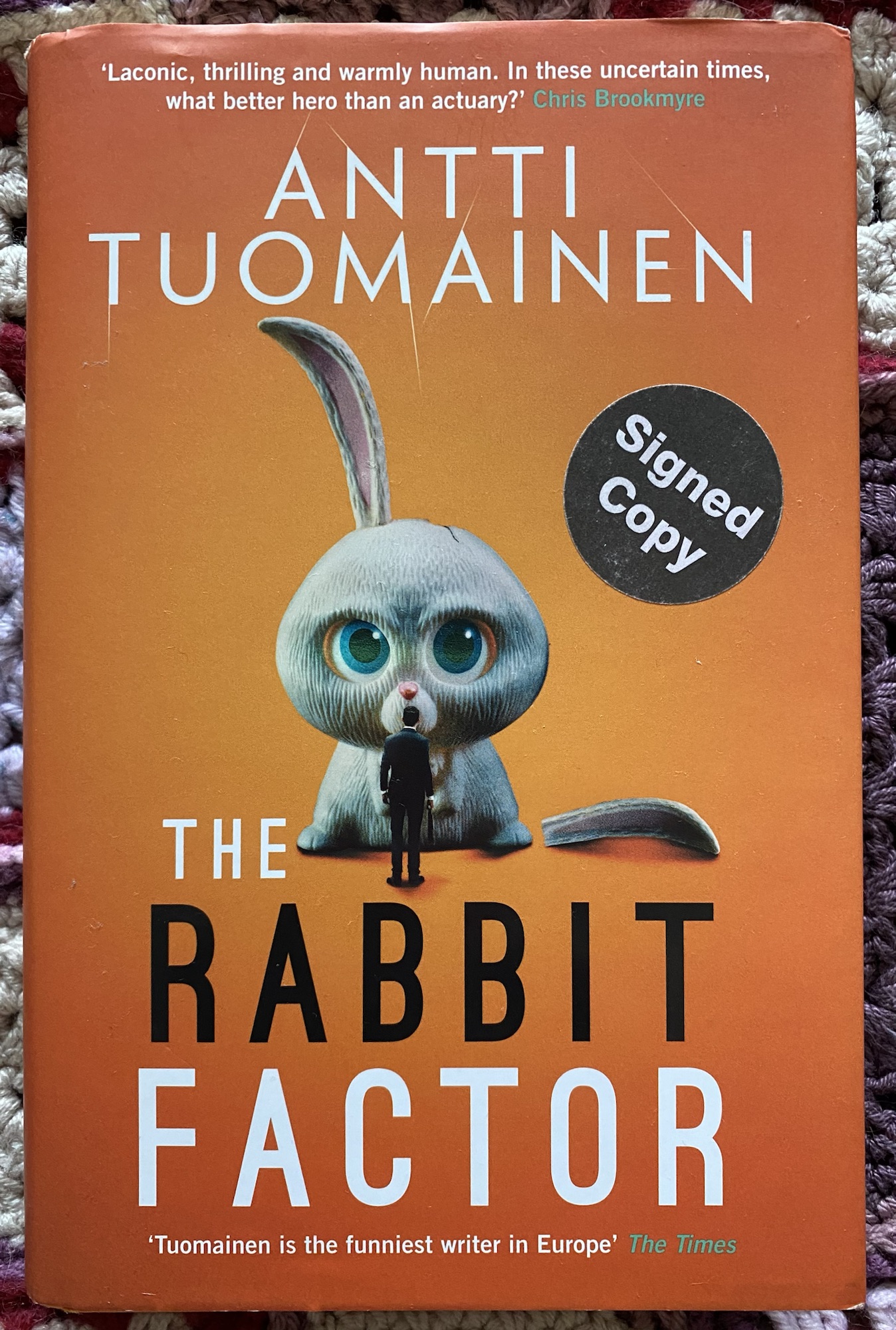
This is my first contribution to Kaggsy and Lizzy’s wonderful #ReadIndies event, running all month. The Rabbit Factor by Antti Tuomainen (2021, transl. David Hackston 2021) is published in the UK by Orenda Books, who describe themselves on their website as: “a small independent publisher based in South London. We publish literary fiction, with a heavy emphasis on crime/thrillers, and roughly half the list is in translation.”

The Rabbit Factor is the first in a trilogy about actuary Henri Koskinen, which had somehow completely passed me by until I read Annabel’s review of the final part, The Beaver Theory. A little while later I saw The Rabbit Theory in my local charity bookshop and took it as A Sign. (As I have mentioned before, I’ll take pretty much anything as A Sign in that shop, and it always results in me buying more books 😀 )

Henri is a man who likes a well ordered, predictable life: “At the age of forty-two I had only one deep-held wish. I wanted everything to be sensible.”

His job as an actuary suits him, using mathematics to predict risk. Unfortunately, what doesn’t suit him is the modern workplace – open plan, noisy and full of corporate-speak about self-actualisation. He is forced into resigning by his boss who hides his bullying behind pseudo-beneficent jargon.

Not long after, Henri is told his brother Juhani has died and he has inherited YouMeFun, an adventure park (not an amusement park) in Vantaa. Unfortunately, before he died his brother inherited their parents’ chaotic approach to life and so Henri finds himself faced with:

“An unbearable lack of organisation, staggering maintenance bills, unproductive use of man hours, economical recklessness, promises nobody could keep, carts that quite literally moved at tortoise speed? I raised my fingers to my throat and checked the position of my tie. It was impeccable.”

Juhani was also in hock to gangsters, two of which – Lizard Man and henchman AK – keep turning up to menace Henri with horrible regularity and conviction. No less threatening, but considerably less violent, is police officer Osmala who similarly seems very interested in YouMeFun and Henri. And so Henri finds himself under enormous pressure and with only his maths skills to fall back on.

“I resigned because I couldn’t stand watching my workplace turn into a playground. Then I inherited one.”

I think maybe this novel passed me by because it can be classified under Nordic-noir, and I don’t read a great deal of that. What I read I enjoy, but I choose carefully because I am a delicate flower and not really in the market for gruesome crimes. Now, there are gruesome deaths in The Rabbit Factor, but I managed these fine. The details aren’t dwelt upon and they are surrounded by such surreal silliness that the focus is more on the ridiculousness of Henri’s situation than violence.

The tone is also not noirish. One of the blurbs in my edition mentions the Coen brothers, and this is a good parallel: while there is darkness to the tale, there is also humour and humanity. Henri’s unlikely colleagues include Esa, the US-marine obsessed security officer; sweet Kristian who is unable to see that his total ineptitude is what prevents him from becoming general manger; Minttu K who seems to know about marketing if she could only stop self-medicating with alcohol; Venla who never arrives for a shift; and quietly efficient Johanna who runs the kitchen and actually seems able to do her job.

There is also Laura Helanto, manager and frustrated artist, who causes feelings to arise in Henri that he doesn’t fully understand. It’s a confusing time for him all round…

“But recent events have taught me that what once seemed likely, as per the laws of probability, is more often than not in the realm of the impossible. And vice versa: what once I would have been able to discount through a simple calculation of probability ratios and risk analysis is now in fact the entirety of my life.”

I really enjoyed The Rabbit Factor. The deadpan narration of Henri is so well-paced that it manages to also be completely engaging. His focus on detail grounds the ridiculousness of his situation so it remains believable, carrying the reader along on Henri’s absurd journey.

“Even as a child I saw mathematics as the key. People betrayed us, numbers did not. I was surrounded by chaos, but numbers represented order.”

The characterisation is equally finely balanced. Henri and his colleagues could so easily be caricatures but instead you end up rooting for these disparate individuals. Tuomainen isn’t remotely sentimental but he is kind to the people he creates. The humour is derived from the situation, never laughing at the people themselves. They change under Henri’s stewardship, and he in return finds himself behaving in ways that surprise him more than anyone:

“I say something I could never have imagined hearing myself say. ‘This doesn’t make any sense. But it has to be done.’”

Last year I decided I would buy one book a month from an independent publisher or bookshop. I think Henri would agree that the probability of my next two purchases in this regard being his adventures in The Moose Paradox and The Beaver Theory are pretty high…

To end, I was so tempted to choose Chas & Dave’s Rabbit, as I absolutely loved that song when I was little (it was released when I was four years old, and I thought they were singing about actual rabbits). But alas, my adult sensibilities prevent me from adding a song about silencing women to the blog 😀 So instead here is a literature-inspired song about drugs rabbits:

“Orange is red brought nearer to humanity by yellow.” (Wassily Kandinsky)

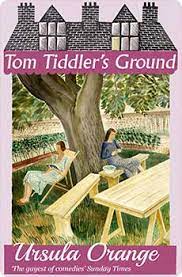
This is my contribution to Dean Street December hosted by Liz at Adventures in Reading, Running, and Working From Home. Tom Tiddler’s Ground by the delightfully named Ursula Orange (1941) is part of their Furrowed Middlebrow imprint and I thought it was an absolute joy.

It tells the story of Constance Smith and her childhood friend Caroline Cameron, who find themselves living together again in the early days of World War II. Caroline is urbane and worldly, leaving behind her life in London with her husband John. She is entirely self-focussed and amoral, but also quite caring regarding people. Despite her shortcomings, I really liked her.

Constance could not be more different. We are introduced to her early on through the thoughts of the billeting officer who is trying to persuade people in the quiet village of Chesterford to take evacuees:

“Mrs Latchford grimaced and lit a cigarette. A thoroughly unenviable job altogether, and she felt she deserved a few minutes respite with nice, schoolgirlish, foolish Constance Smith. Foolish? Well, of course, it always looked a little foolish to see a woman of over thirty behaving like an enthusiastic bride, even after two years of marriage. But apart from that and her volubility and her poppings out and her nippings in and all her silly mannerisms, was Constance at all foolish? Certainly she handled the relations-in-law-in-the-village situation well, or rather did not handle it at all, but accepted it so naturally and pleasantly that she might really be said to be on the best of terms with her sister-in-law, Mary Hodges, the local greengrocer’s wife.”

Her husband Alfred is an utterly self-centred snob, intent on social climbing and ashamed of his sister. He married well-to-do Constance for social advancement and he doesn’t love her. Caroline sees this clearly on arrival in the village with her daughter Margeurite.

The other evacuee is Mrs Gossage, who seems entirely disinterested in everyone, including her baby son Norman.  

We follow this unlikely group of housemates as they adjust to their much-changed living arrangements. The story moves between the characters but is told primarily from Caroline’s point of view, which I thought worked well. She has good insights into other people and is entirely clear-sighted about herself too:

“There was a certain note in her voice that led Caroline to suspect that Lavinia belonged to that large class of people who find children sweet, but rather prefer they should go and be sweet upstairs in the nursery. It was an attitude she entirely sympathised with and absolutely hated people for.”

Constance as narrator would be far too guileless to carry the reader along. And of course, Caroline’s arrival in the village offers an outsider’s view on the characters and various intrigues. But what is lovely too, is Caroline’s changing attitude towards the village. Initially she is greatly amused by everyone, but as time moves on she starts to see them as real people, her “strange lapses into sincerity” possibly becoming longer lasting. This isn’t a trite city-girl-learns-the-true-value-of-Things-when-forced-into-small-town-life tale however. Orange is not at all sentimental about people:

“Caroline, looking at the expression on Mary’s face, marvelled at the extraordinary cruelty of the thoroughly respectable woman.”

“There was no doubt Constance, in her misery, was very pathetic. There was no doubt she was also rather irritating.”

But there’s not a bitter tone either. I found the characters recognisable and portrayed with human understanding. Caroline would be rather a controversial figure for the time, but Orange doesn’t judge her.

“It’s my red finger-nails that put the idea of asking me into her head, I’m sure.”

I liked the fact that Caroline didn’t overly judge herself, which would seem somehow hypocritical, but she does recognise that her actions hurt people, which she regrets.

There are serious concerns in Tom Tiddler’s Ground; adultery, bigamy, child neglect and lack of choices for women. Somehow Orange balances that with a knowing humour without belittling the issues at all.

My favourite character was George, Constance’s gentle, drifting brother:

“What could you do with a man who loved women, who loved domestic life, but who (according to Constance) had never seemed to want to marry anyone in particular? A man who obviously adored other people’s children, but who had none of his own? A man who had plenty of personality and probably (under all that indolence) considerable abilities, but who had never settled any profession or career? The only answer was – nothing, you could do nothing with him. And […] that was, of course, what George preferred. Caroline liked him enormously.”

We learn more about George’s background, who to my twenty-first century eyes had PTSD from World War I. Orange builds to a satisfying denouement, tying up many characters pasts with the present in a way that promises a better future, despite the war.

I really loved Tom Tiddler’s Ground, and got very excited about the thought of exploring Ursula Orange further, thinking the humour and characterisation made her another Margery Sharp. However, Stacy Marking’s excellent introduction to this edition explains the publishers took exception to Caroline as a character, and so she adjusted her style for later books, which also contained more snobbery (somewhat in evidence here but not overly stressed – Mrs Gossage is definitely treated with condescension, but also compassion). If anyone has read any other novels by Ursula Orange I’d love to know how you found them, especially as DSP publish some other titles.

“‘I suppose we ought to be thinking about Christmas,’ said Constance, a few days later. Everybody became conscious of a very strong disinclination to think about anything of the sort.”

To end, it’s a time of year when Nat King Cole is on heavy rotation, and quite right too. Here he is singing about orange (sort of 😉 )

“I regret profoundly that I was not an American and not born in Greenwich Village.” (John Lennon)

The 1962 Club, hosted by Simon and Kaggsy, starts today and is running all week which I am very excited about 😊 The Club weeks are always great and I’m really looking forward to seeing the posts. This is the first of  what I hope will be three contributions, but as I never blog as much as I mean to, failure is almost inevitable!

The Golden Spur was Dawn Powell’s last novel, and it’s a humorous look at the bohemian arts scene of late 1950s New York, specifically Greenwich Village. This was a world Powell was very much a part of and my edition features an effusive introduction from Gore Vidal who was one of her close friends.

We are introduced to the artists and writers – both up and coming, and those very much faded and failing – their hangers-on and their varied associates through the outsider view of Jonathan Jaimison. He is in his late twenties and recently discovered that his father isn’t the domineering tyrant he grew up with, but someone from this scene, back when his mother was hanging out with Prohibition-era flappers.

So Jonathan leaves his Ohio home and soon makes his way to the titular bar, at the start of his quest to find his biological father:

“Through a gap in the plum velvet cafe curtains he could see the bar … He breathed deep of the heady New York air, that delirious narcotic of ancient sewer dust, gasoline fumes, roasting coffee beans, and the harsh smell of the sea that intoxicates inland nostrils. Then he pushed open the door.”

He’s quickly adopted by Lize and Darcy, two frenemies who sleep with the same male artists, although it’s not entirely clear why, as they seem to have no great fondness for men or for art:

“The girls never asked questions about a man’s private interests or listened when he tried to tell them. For them it was enough that he was a man and that he was there. Who needs a talking man?”

“That his newest canvas was gone should have told her something, but she wasn’t sure which was the new one because all his pictures looked alike to Lize. Great lozenges of red and white (‘I love blood,’ he always said), black and grey squares (‘I love chess,’ he’d say), long green spikes (‘I love asparagus’). All Lize had learned about art from her life with painters was that the big pictures were for museums and the little ones for art.”

As Jonathan makes his way in New York, he moves between two generations: the young artists and the fading interwar generation. There is a nostalgia for the Prohibition period and what New York was then which is beautifully evoked, alongside a recognition that New York is a city that continually makes itself and its inhabitants anew:

“Jonathan recognised New York as home. His whole appearance changed overnight, shoulders broadened, apologetic skulk became swagger; he looked strangers in the eye and found friendship wherever he turned. With the blight of Jaimison heritage removed, his future became marvellously incalculable, the city seemed born fresh for his delight. He took for granted that his mother’s little world, into which he had dropped, was the city’s very heart.”

Although The Golden Spur is described as a comic novel, I didn’t find it laugh-out-loud funny. Rather I’d describe it as affectionately satirical. It ribs the 1950s arts scene and the vacuous people drawn to it, but it never has a bitter or nasty tone:

“Anybody with a tube of paint and a board was an artist. But writers were not writers unless decently unpublished or forever muffled by a Foundation placebo.”

“‘I just want to be overestimated,’ Earl shouted, ‘like everybody else, goddammit.’”

Despite the overarching plot being Jonathan’s search, this really isn’t a plot-driven novel. Rather, the question of his paternity is a device to introduce the various characters and their world. It’s a novel to read for the evocation of the city, of a particular society found within it, and for the characterisation and the wit. In the way that Tales of the City was serialised in the San Franciso Chronicle, I felt The Golden Spur could have worked similarly in The Village Voice. It’s almost a series of sketches, albeit well realised ones.

I can’t say I loved this quite as much as Gore Vidal clearly did, but then he probably recognised a lot of the characters and situations within the novel. I still found a great deal to enjoy, and Powell certainly has a way with words:

“She was making more and more passes at the wrong men, then trying to recoup with stately cultural pronouncements in her refined Carolina accent, which she kept polished up like her grandfather’s shotgun, ready to bring recalcitrant suitors into line.”

To end, I was going to go with the song Little Lize because that’s the only other time I’ve come across the name. I thought it would be easy to get a good quality version as the massively successful Fisherman’s Friends have recorded it. But I couldn’t find a decent one so here they are instead singing about never leaving home. New York isn’t for everyone…

Novella a Day in May 2023 – No.21

“I feel I’m only going to write short stories and novellas from now on. Chekhov said, toward the end of his life, “Everything I read strikes me as not short enough.” And I agree.” Martin Amis

A Pelican at Blandings – PG Wodehouse (1969) 192 pages

After the destabilised plots, shifting characterisation and unanswered questions of Untold Night and Day yesterday, a very silly, plot-driven novella today, where everything is tied up neatly at the end.

PG Wodehouse needs no introduction and while I would say A Pelican at Blandings is not him on top form, spending a few hours with a middling Wodehouse is still an absolute joy and time well spent.

Poor Lord Emsworth just wants to be left alone with his pig, the Empress. She has refused a potato which is causing her doting owner a great deal of distress. Unfortunately people always seem to be insisting on joining him at Blandings Castle.

“She left the room, and Lord Emsworth sank back in his chair looking like the good old man in some melodrama of Victorian days whose mortgage the villain has just foreclosed. He felt none of the gentle glow he was accustomed to feel when one of his sisters removed herself from his presence.”

Lady Constance is back at Blandings Castle with a woman named Vanessa Polk in tow. What’s more, she has invited horrible Lord Alaric and his niece Linda Gilpin to stay there too. She has plans to marry Vanessa to Alaric. Lord Emsworth decides this is a bridge too far, and this is before he knows Alaric has invited Wilbur Trout to stay. He calls on his aptly named brother Galahad, the Pelican Club member of the title, to rescue him.

Galahad wastes no time in telling Constance what he thinks of avaricious Alaric:

“’Are you telling me that that human walrus has fallen in love at first sight with Vanessa Polk?’

‘Alaric is not a human walrus.’

‘You criticise my use of the word human?’

Lady Constance swallowed twice, and was thus able to overcome a momentary urge to hit her brother over the head with the glass vase containing gladioli. It is one of the tragedies of advancing age that the simple reactions of childhood have to be curbed.”

Meanwhile one of Galahad’s numerous godsons, bestowed on him by Pelican Club members, Johnny Halliday, is in love with Linda Gilpin but they are currently estranged.

There are also some shenanigans with a plan to steal a picture:

“It’s a thing that must be done at dead of night, the deader the better. We must arrange a rendezvous. Where can we meet? Not in the ruined chapel, because there isn’t a ruined chapel.”

Lacking a Jeeves (although I’m very fond of the butler Beach), thank goodness Lord Emsworth has Galahad! Will he stop Constance’s terrible matchmaking, sort out the picture theft, reunite his godson with his betrothed, and bring some peace to his benighted brother’s life?

Of course he will.

“’Clarence has an amazing story to relate. Relate your amazing story, Clarence.’

‘Er,’ said Lord Emsworth.

‘That’s not all there is of it.’ Gally assured the Duke. ‘There’s a lot more, and the dramatic interest mounts steadily as it goes on.’