Novella a Day in May 2025: No.28

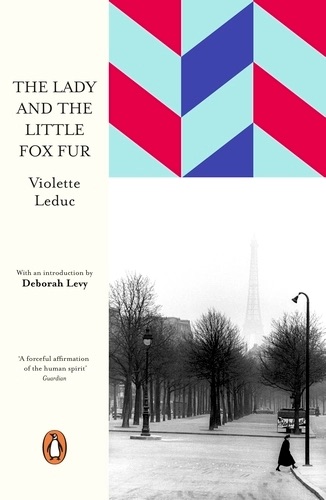
The Lady and the Little Fox Fur – Violette Leduc (1965, transl. Derek Coltman 1967) 80 pages

I found this novella, only slightly longer than a short story, incredibly moving. It follows the daily life of a frail, impoverished woman, living in a dilapidated attic room in Paris which shakes every few minutes when the Métro passes overhead.

Violette Leduc is not an author I know, but in the Introduction to my edition Deborah Levy describes her novels as “works of genius and also a bit peculiar.” Certainly Leduc has a way of skipping between images and realities that continually pulled me up short. Despite its brevity The Lady and the Little Fox Fur can’t be read quickly; the sentences have to be considered.

“Her coat was turning green with age. So much the better: it was a proof that her verdigris candlesticks in the pawn shop had not abandoned her. When the sun came out, there were two torches to light her way, the sun itself and its reflection in the window of Joris’, the shop that accepted la Semeuse coupons.”

That strange logic about the candlesticks demonstrates the frayed reasoning of The Lady, but also Leduc’s skill in layering images to evoke scenes and draw elements of her story together so clearly.

Her stylistic skill never distances the characters. A long time is spent on the hunger of The Lady, both physical and psychological. She is desperate for food, and she is desperately lonely. Every day she roams around her home city, unseen and disregarded.

“Wheat pancakes, fifty francs. The batter was spreading across the hotplate, the woman was scraping away the drips and making the edges neater with the point of her knife. But she would draw her nourishment later on from the crowd in the Métro: one cannot have everything.”

“They were workmen whose job it was to keep the flagstones level, and they put up with her there because they didn’t know she was there. The bollard she was sitting on had such stability, the place itself was so historic that she became a peasant woman who had ridden in from the Perche country to sell a farmhorse many centuries ago.”

The second part of the novella sees her take out a raggedy fox fur, which she found in rubbish when hunting for an orange to eat, to sell for food.

“There were moments when she had no saliva left to remember with, not even the pale pink water ices that her parents used to eat.”

It is desperation which drives her, as the fox fur provides warmth and companionship. Like a child, she anthropomorphises the inanimate object (as she does bugs in the floorboards and some of her furniture), showering him with kisses and affection.

The Lady and the Little Fox Fur could have been unbearably sentimental, but Leduc’s way of writing meant it wasn’t so. The Lady doesn’t pity herself and the portrayal evokes compassion and empathy rather than sympathy. She endures, repeatedly, throughout the challenges of her daily life.

“Happily, she noted, it was still not six o’clock: she was the ribbon in a little girl’s hair, fluttering in the breeze. After six, the wind in Paris grows stronger and disarranges all our principles.”

Novella a Day in May 2025 No.14

La Femme de Gilles – Madeleine Bourdouxhe (1937, transl. Faith Evans 1992) 122 pages

La Femme de Gilles is a curious read from a twenty-first century perspective. The protagonist Elisa is entirely bound up in her husband Gilles. Her existence is wholly for him: cooking for him, keeping his house, bearing his children that she loves only as an extension of him, sexual pleasure derived solely from pleasing him. It’s the extremity of these feelings at the obliteration of any personal motivation for her actions outside of Gilles that make her so extraordinary to my eyes.

So when Gilles starts an affair with Elisa’s sister Victorine, outwardly Elisa does very little:

“Whatever happened, whatever had already happened, the main thing was not to make a fuss, simply to watch, and act in subtle little ways to keep intact the love with which she’d surrounded him, and to which he would return one day. There was no escape from a love as strong as hers.”

Elisa’s initial realisation is heartbreaking, as she turns her back on Gilles and Victorine to get ready and accompany them to the cinema:

“One by one she fixed her gaze on some of the objects around her, things that made up her familiar world, then her eyes lit on her own hands as they closed the bag, and she saw they were trembling. Precisely at that moment Elisa knew that behind her back there was another world, a world that was complicated, threatening, unknown.”

In a such a short space, Bourdouxhe creates an acute psychological portrait, primarily of Elisa, but also of her unintentionally cruel husband and her vacuous sister:

“Afterwards it’s a question of trying to make sense of things, sense of life, and life doesn’t touch Victorine, it will never mark her smile or her eyes, which will stay young, clear, innocent for a long time. Unconscious offenders are the most dangerous of criminals.”

Yet she also sustains a real momentum to a story which primarily takes place in Elisa’s tortured head, and follows her inaction. It feels pacy and tense, even as Bourdouxhe steps outside of the narrative to directly address her characters:

“You are alone with the greatest pain you have ever known.”

Poor Elisa really is isolated. She can’t speak with her husband, her sister or her mother. The villagers in the remote area where she lives become aware and gossip about her. But Elisa doesn’t really want to leave, she just wants things to be as they once were:

Going from one place to another – is that really the world, or is it rather something very small, invisible, confused, something buried inside of us, something that we always take with us wherever we are, whether we’re here, or whether we are there? Whether we are far away or at home?”

La Femme de Gilles is an immersive read with incisive characterisation. Apparently Simone de Beauvoir was a fan (I tried to find what she said about it in the The Second Sex but my edition has a rubbish index). In her first novel, Bourdouxhe created a haunting narrative which I’m sure will stay with me.

“Words burst forth, recognised at last, while underneath other silences start to form.” (Annie Ernaux, The Years)

#ReadIndies is running all month hosted by Kaggsy and Lizzy and it has meant I’ve finally got to a book that I’ve been meaning to read for ages: The Years by Annie Ernaux (2008, transl. Alison L. Strayer 2018) published by Fitzcarraldo Editions.

A further incentive was that I really want to see the theatre adaptation which is currently running, and now I’ve read the book I have bought my ticket 😊

The Years is a book which deliberately avoids categorisation. Told in chronological order from 1941 to 2006 but in a fragmentary style, it is a memoir/autobiography/autofiction where Ernaux never uses the first person. She refers to ‘she’ for the more personal memories triggered by photographic images, and ‘we’ for considerations of the society and cultural influences experienced by ‘she’ at the time.

Growing up, she is aware of the poverty of her family, and dreams of escape. Ernaux captures so well the confusion of trying to find an authentic escape, trying to determine what she truly wants, alongside what advertising tells her she wants:

“Meanwhile, as we waited to be old enough to wear Rouge Baiser lipstick and perfume by Bourjois with a j as in joy, we collected plastic animals hidden in bags of coffee, and from Menier chocolate wrappers, Fables of La Fontaine stamps that we swapped with friends at break time.”

“It seems to her that education is more than just a way to escape poverty. It is a weapon of choice against stagnation in a kind of feminine condition that arouses her pity, the tendency to lose oneself in a man.”

There are strong feminist themes running throughout The Years, as she grows up on the brink of societal change. At the start:

“Nothing, not intelligence, education, or beauty mattered as much as a girl’s sexual reputation, that is, her value on the marriage market, which mothers scrupulously monitored as their mothers had done before them.”

Yet the 1960s are on their way… Ernaux pulls no punches in detailing the tyranny of menstrual cycles, and of “kitchen table abortions” before the contraceptive pill arrives and pregnancy terminations are legalised.

“Between the freedom of Bardot, the taunting of boys who claimed that virginity was bad for the health, and the dictates of Church and parents, we were left with no choices at all.”

The Years is lightened by humour too, such as this wry observation regarding her young feminist:

“Two future goals coexist inside her: (1) to be thin and blonde, (2) to be free, autonomous, and useful to the world. She dreams of herself as Mylène Demongeot and Simone de Beauvoir.”

The Years is a powerful evocation of a woman’s life at a specific time. Ernaux demonstrates so clearly how lives are bound up with the culture and the wider political forces in which they take place. It is impossible to consider the life in The Years without considering France in the same period. Yet this is an observation which occurs as she looks back, not at the time:

“Between what happens in the world and what happens to her, there is no point of convergence. They are two parallel series: one abstract, all information no sooner received them forgotten, the other all static shots.”

But as she grows older:

“What is most changed in her is the perception of time and her own location within it.”

And yet,plus ca change plus c’est la même chose, as Ernaux notes consumerism and its false promises endure:

“More than a sense of possession it was this feeling people sought on the shelves of Zara and H&M, instantly granted upon acquiring things, a supplement of being.”

The fragmentary style in The Years is perfect example of an experimental style being grounded by the story it wishes to tell, rather than being employed just for the sake of being different or to demonstrate the author’s cleverness. It conveys the experience of memory as well as the memories themselves. As a reader you are drawn into the layering of images, feelings and experiences in such a direct and immersive way, with all the intimacy of a first-person narrative despite the fact that Ernaux never articulates ‘I’.

“Everything will be erased in a second. The dictionary of words amassed between cradle and death bed, eliminated. All there will be is silence and no words to say it. Nothing will come out of the open mouth, neither I nor me. Language will continue to put the world into words. In conversation around a holiday table, we will be nothing but a first name, increasingly faceless, until we vanish into the vast anonymity of a distant generation.”

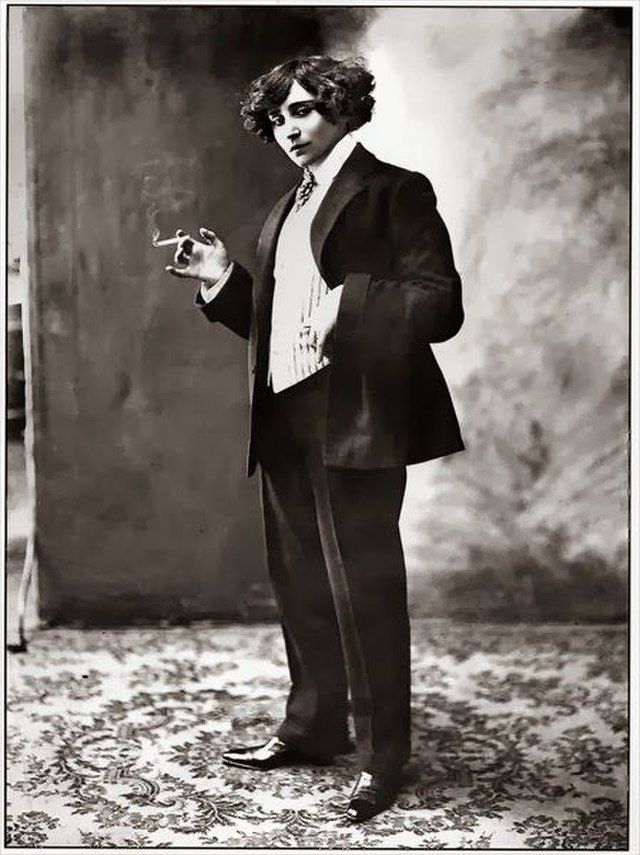
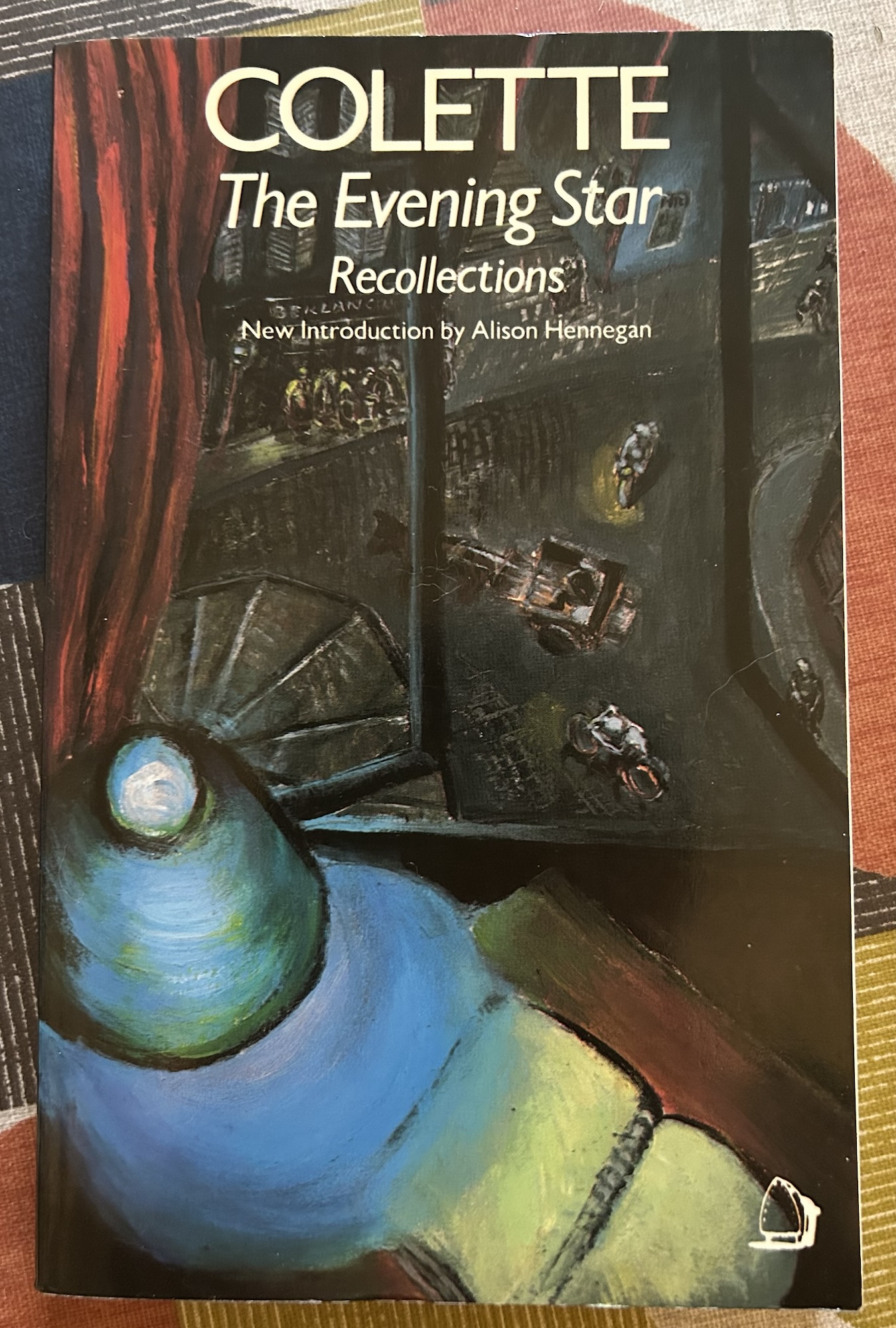
“January, month of empty pockets! Let us endure this evil month.” (Colette)

Happy Colette’s birthday! Regular readers will know how much I love Colette, and today I thought I’d look at two of her novellas which I had languishing in the TBR, La Vagabonde (The Vagabond) and L’Entrave (The Captive). Both follow periods in the life of Renée Néré, based on Colette’s experiences after her marriage to Willy ended.

In The Vagabond (1911, transl. © Martin Secker and Warburg 1954), Colette evokes beautifully her setting of Belle Époque music halls, and expertly weaves in her themes of aging, love and female freedom.

Renée has left her philandering husband Adolphe Taillandy and has no regrets about doing so. However, this has left her with no money, and so she has turned from her beloved writing to earn money on the stage.

“I had savoured the voluptuous pleasure of writing, the patient struggling with the phrase until it becomes supple and finally settles down, curled up like a tamed animal, the motionless lying in wait for a word by which in the end one ensnares it.”

She is in her early thirties, and painfully aware of aging in an industry that depends on appearance and artifice. Renée has a “face which is losing the habit of being looked at in daylight” and which poverty will not help. She enjoys the stage though, and the people in it.

“They swagger, tightly buttoned in a full-skirted overcoat of the fashion of two seasons ago; for the essential, the indispensable thing, is the possession not of a clean suit but of a ‘really classy’ overcoat which covers everything: threadbare waistcoat, shapeless jacket, trousers yellowed at the knees; a dashing, flashy overcoat, which makes an impression on the director or the agent, and which in the last resort enables one to throw off that ‘things aren’t shaping well’ in the jaunty tone of a man of means.”

Colette is not sentimental about the poverty or hardships of such a life. Early on she writes of the gradual but inevitable degradation of young chanteuse Jadin, in a way that is clear-sighted but heartbreaking.

Into Renée’s world comes Maxime Dufferein-Chautel, a rich feckless admirer. What follows is a love affair of sorts, one in which Renée never quite resolves her ambivalence.

“He does not want my well-being, this man, he merely wants me.”

“There are days when solitude, for someone of my age, is a heady wine which intoxicates you with freedom, others when it is a bitter tonic, and still others when it is a poison which makes you beat your head against the wall.”

Maxime is not unpleasant or abusive, but he is pretty dull:

“I forgive him all this ordinariness for the sake of a simplicity which has nothing humble about it, and because he finds nothing to say about himself.”

And Renée is painfully aware that getting into a relationship with him may require more than she is willing to give. As her friend Hamond points out:

“Be frank, Renée, be clear sighted, and tell me whether all your sacrifices [within marriage] haven’t only lost their value in your eyes since you recovered your free will? You assess them at their true worth now that you no longer love.”

Renée is offered a tour and vacillates about whether to go. Ultimately she does and her letters to Maxime form the latter part of the novella, although we never see Maxime’s replies. The Vagabond is determinedly Renée’s story and her voice.

“This evening I should not feel sleepy, and the spell of a book – even a brand new book with that smell of printers ink and paper fresh from the press that makes you think of coal and trains and departures! – even that spell will not be able to distract me from myself.”

Despite The Vagabond’s various urban settings, there is still plenty for fans of Colette’s depictions of the natural world to enjoy, such as this description of early Spring in Paris:  

“Towards the end of the afternoon, a mauve mist veils the avenues so that you do not know where they end, and the unexpected discovery of a wild hyacinth, with its three slender bells of artless blue swaying in the wind, has all the charm of a stolen joy.”

The Vagabond is slightly plotted with very little happening. It is not a slight tale though, but rather a distinctive plea for female independence alongside a consideration of how to reconcile this with romantic love and material necessity.

“Are you not he who, thinking he is giving, takes for himself? You came to share my life. To share, yes: to take your share!”

The Captive (1913, transl. Antonia White 1964) is set three years later. Renée is now financially solvent due to a legacy and whiling away her time in the south of France. She is still living the itinerant hotel-based life, unable to fully adjust to her new circumstances: “when a dog has been kept a long time on a lead, it does not go prancing off the moment you undo the catch of its chain”.

She finds herself with an unlikely trio of friends. There is young May, self-mythologising and fragile:

“Nature has drawn all the features of laughter itself in her round childish face; a Cupid’s bow mouth that tilts up at the corners like her mischievous eyes, a short little nose with quivering nostrils. But gaiety is not a perpetual fidgeting that betrays a lack of security, it is not chatter full of recriminations, nor is it a craving for everything that intoxicates. Gaiety, it seems to me, is something calmer, something healthier, something more serious.”

There is also May’s brutish lover Jean, and their friend, the opium-addicted Masseau.

“Yes, I’ve had enough of those people, it’s true. But, besides beginning to know myself, I’m also beginning to know the advantages and disadvantages of this extraordinary part of the world where mornings are enchanting and the nights, however starry, make one shiver in the discomfort of a double climate. Here cold nights are not invigorating and warm nights throb with fever rather than with passion.”

At the beginning of the novel Renée is determined to remain celibate. However, for reasons that entirely escaped this reader, she is attracted to Jean.

“A kiss, and everything becomes simple and enjoyable and superficial – and also a trifle coarse.”

She leaves Nice for Geneva to try and resist him, but they are eventually reunited. Their affair is wholly unsatisfactory for both of them. Colette explores the experience of a relationship based on sexual attraction without emotional intimacy, when the latter is also desired by both but remains elusive.

“I have insulted this lover, out there alone in the soft spring night, restoring his own identity; I have insulted him by giving him my body and supposing that this was enough. He has returned the insult.”

Like The Vagabond, it is Renée’s thoughts and experiences that the reader is privy to. We know very little about Jean and even less about what he thinks and feels. While he is not likeable, the portrayal of the affair is quite even-handed, as Renée acknowledges how little she is able to give of herself. What she does give may be as much a performance as any she made on the stage:

“You pretend to love me, you do love me. Every minute your love creates a woman better and more beautiful than myself whom you forced me to resemble.”

Somehow I didn’t find The Captive too depressing, although I’m not entirely sure why. There is something resilient about Renée even when she seems to be taking such sad decisions. Although she is adrift at this point in her life, I felt there was some hope she’d start to feel more anchored within herself soon.

“The darkness is ebbing. A faint wind stirs the trees, bringing a green smell of trampled grass. Behind the plane trees, the mound of the fortifications is emerging from the dusk and the sky is taking on the colour of a field of blue flax the subdued, slightly grey, slightly melancholy tint over summer dawn over Paris.”

To end, I was looking for archive footage from Folies Bergère to reflect Renée’s career, which led me to loads of cabaret footage, which led me to loads of Cabaret footage, which led me to this performance by Liza Minelli. Basically all roads lead to Liza 😀 I’ll never not be astonished by how the chair doesn’t move until she wants it to – the woman must have abs of steel:

“Writing is not a profession but a vocation of unhappiness.” (Georges Simenon)

November is the month of many reading events, and I definitely won’t manage them all, but I’m starting with Novellas in November, hosted by Cathy at 746 Books and BookishBeck.

I’m taking this as a good opportunity to carry on with my much-neglected Le Monde’s 100 Books of the Century reading challenge, reading Pietr the Latvian by Georges Simenon (1930, transl. David Bellos 2013) which is No.84 in the list.

This was Maigret’s first outing and Simenon clearly had a very thorough understanding of his policeman from the start. Like many Maigret stories it is novella length, coming in at 162 pages in my English translation.

“Not that he looked like a cartoon policeman. He didn’t have a moustache and he didn’t wear heavy boots. His clothes were well cut and made of fairly light worsted. He shaved every day and looked after his hands.

But his frame was proletarian. He was a big, bony man. Iron muscle shaped his jacket sleeves and quickly wore through knew trousers. He had a way of imposing himself just by standing there. His assertive presence had often irked many of his own colleagues.”

In this first story, Maigret is in pursuit of a thief and conman, Pietr the Latvian, who may not even be from Latvia. (I was anticipating some xenophobia, which there wasn’t in the novel, but be warned there is Antisemitism at points.)

There is intelligence that Pietr has travelled to Paris from the Netherlands and Maigret is tasked with apprehending him. At the Gare du Nord he thinks he spots Pietr, but is then called to a train to identify the body of a man who also matches the description.

Following the first man takes Maigret into the world of well-heeled Parisian hotels:

“Maigret persisted in being a big black unmoving stain amidst the gilding, the chandeliers, the comings and goings of silk evening gowns, fur coats and perfumed, sparkling silhouettes.”

Things become more complex as Maigret follows various leads around the first man. His unshowy, procedural approach is evident from the start as he doggedly pursues evidence throughout Paris and to Fécamp at the coast. The conman knows Maigret is closing in and the danger grows.

I’ve not read all the Maigrets as there are at least eleventy million of them, but I would say from my limited knowledge that this isn’t the strongest. For such a short novel, it is repetitive at times and I wonder if this is because it was published firstly as a serial. In that format the repetitions would work well, but in the novel they weakened the story and it could have done with an edit with the new format in mind.

However, there is still so much to enjoy. The evocation of Paris, the character of Maigret and the novella length make this a quick, entertaining read. Simenon’s affection for his creation is evident and this makes his Detective Chief Inspector so appealing.

“The Latvian was on a tightrope and still putting on a show of balance. In response to Maigret’s pipe he lit a cigar.”

Novella a Day in May 2023 – No.30

Four Soldiers – Hubert Mingarelli (2003 transl. Sam Taylor 2018) 155 pages

I really loved Hubert Mingarelli’s A Meal in Winter when I read it six years ago and so I was overjoyed to find a copy of Four Soldiers in my beloved local charity bookshop. This had a lot in common with its predecessor, being a sparse tale of servicemen which focussed on their humanity rather than their role in conflict. But it was resolutely its own tale too.

The four soldiers are friends thrown together by circumstance during the Russian Civil War in 1919. Resourceful, skilled Pavel, naïve gentle giant Kyabine, quiet, thoughtful Sifra and the narrator Benia. They keep each other company during the tedium of waiting for orders, close to the Romanian border:

“Because we didn’t know where we would be tomorrow. We had come out of the forest, the winter was over, but we didn’t know how much time we would stay here, nor where we would have to go next. The war wasn’t over, but as usual we didn’t know anything about the army’s operations. It was better not to think about it. We could already count ourselves lucky to have found this pond.”

What is so striking about the soldiers is how terribly young they are. We are never told their ages, but their behaviour, their lack of experience, their superstitions – all emphasise that they are little more than children caught up in something far beyond their control, for which they may have to pay the highest price.

Their concerns are ordinary, not political or idealistic. They play dice; they swim; they smoke; Pavel has nightmares; they take turns to sleep with a watch that contains a picture of a woman that they think brings them luck.

Mingarelli doesn’t seek to explain how they ended up there or what they hope for beyond it. By focussing on the present he is able to convey how caught they are by circumstance, how hope lingers but is unexpressed.  

“Barely had we finished drinking that tea before we became nostalgic for it. But, all the same, it was better than no tea at all.”

The simplicity of the plot, imagery and prose is so finely balanced. Mingarelli conveys a vital story that needs no adornment while at the same time driving home its importance and universality.

“I advanced. But I did so evermore sadly. The sadness was stronger than me. It was because of the smell of potatoes slung over my shoulder. It didn’t evoke anything precise, that smell. Not one specific event, in any case. What it evoked was just a distant time.”

Four Soldiers isn’t remotely sentimental or sensationalist, and it’s the ordinariness it depicts that makes it so devastating, and humane.

“The silence and the darkness covered us.

Then suddenly, almost in a whisper: ‘I wrote at the end that we had a good day.’

It was very strange and sweet to hear him say that, because, my God, it was true, wasn’t it? It had been a good day.”

Susan at A Life in Books, a great champion of novellas whose reviews are a significant contributor to my ever-spiralling TBR, has written about Four Soldiers here.

Novella a Day in May 2023 – No.17

Count d’Orgel’s Ball – Raymond Radiguet (1924, trans. 1989 Annapaola Cancogni) 160 pages

Raymond Radiguet was only twenty when he died, having published two novels, of which Count d’Orgel’s Ball was the second, some poetry and a play. He had led a life that brought him into contact with the foremost artists of the day, including Picasso and his lover Jean Cocteau, who wrote the foreword to the NYRB Classics edition I read.

This made me a bit trepidatious in approaching this novella, wondering if it was a piece of juvenilia that wouldn’t have otherwise garnered much attention. But I shouldn’t be so ageist, because I really found a lot to enjoy in Count d’Orgel’s Ball.

It tells the story of a love triangle amongst the beautiful and privileged in the 1920s. Mahaut is from an old family, and desperate for love when she marries young:

“She recovered some of the freshness of her early childhood when, at eighteen, she married Count Anne d’Orgel, one of our country’s best names. She fell madly in love with her husband who, in return showed her much gratitude and the warmest friendship, which he himself took for love.”

She adores her sociable and brilliant husband, who is fairly harmless but entirely vacuous:

“Nobody knew the reason for his prestige or, at least, for his brilliant reputation. His name had little to do with it since talent comes first even amongst those who worship names.”

Into their world comes François de Séryeuse, a young man not entirely enthralled by the Count’s charm and prestige. This works in his favour and the three spend more and more time together.

“He [the Count] adopted people more than he made friends with them. In return, he demanded a lot. He wanted to lead the way, to be in control.”

The Count doesn’t sustain control though, as François and Mahaut fall in love. For me this was the weakest point of the novella. Radiguet is excellent at observing people and social situations; he is incisive regarding pretention and social mores. Where the story falters for me is in creating fully rounded characters and the emotional ties between them. But perhaps I’m being unfair, as Radiguet is describing a world filled with shallow and/or naïve people. He doesn’t view them as having great emotional depth:

“It would be safe to say that François’ ideas on love were ready made. But since he had made them himself, he believed they were cut to size. He did not realise he had cut them out of limp feelings.”

The writing style is fluid and often scathing. It’s so readable and entirely unflinching in its view of a particular part of society at a particular time.

I thought there were a few rough edges at points in Count D’Orgel’s Ball; a tendency to tell rather than show, and characters as vehicles for social satire rather than fully recognisable people. But these are little quibbles and having written this novella at nineteen, I can only wonder what Radiguet would have achieved had he lived longer.

“Happiness is like good health: one is not aware of it.”

Novella a Day in May 2023 – No.13

Lost Profile – Françoise Sagan (1974 trans. Joanna Kilmartin 1976) 142 pages

This novella follows a young woman, Josée, as she leaves her abusive husband Alan and is drawn into the orbit of the controlling Julius A.Cram, all within the social sphere of incredibly rich Parisian socialites.  

Sagan has very little time for this echelon of society:

“We talked of this and that, in other words nothing, with the tact that characterises well-bred people once they are at table. It seems that it only takes a knife, a fork, a plate and the appearance of the first course to induce a kind of discretion.”

Josée does very little at the start of the novel and seems to drift around, content to be entirely idle, which makes her vulnerable. She blames herself for her husband’s abuse and then in leaving him finds herself controlled by another man, albeit in a very different way. Julius is an enigmatic character who also seems to operate on the periphery of their social set. Both are lonely in their way, and the people they pass time with are entirely self-involved, so with the exception of her friend Didier, there is no-one to warn Josée of the danger she is in.

“It was an idiosyncrasy common to each individual member of that little set to refer to all the rest as ‘the others’, as though he or she were a paragon of virtue and a superior intelligence who had strayed into a bunch of contemptible socialites.”

As Josée tries to get her life together, the reader has greater awareness than she does herself. We can what is happening in her circumstances that she remains blissfully unaware of, and we can see how these circumstances will play out. She is incisive and clearsighted regarding others, but not remotely self-reflective:

“They were an amiable couple, great friends of Irène Debout, who, having exiled themselves far from Paris out of a grotesque affectation for the simple life, spent their time when they came to the capital, roughly 100 times a year, extolling the charms of solitude. They lived for their weekend house parties.”

Lost Profile is a slight tale, but I always enjoy Sagan’s writing. This was mainly enjoyable for the bitchy portraits of the rich and idle – a quick read, just the right length for the subject matter.

“Perhaps, one day, I too would reach the point of being able to tolerate only a sort of carbon copy of myself, black and white, colourless and spineless. Ah yes, the time would come when I would bicycle without ever leaving my bathroom, chewing pills the while to send my feelings to sleep. Muscled legs and flabby heart, a serene face and a dead soul.”

I’ve mentioned before the terrible 1970s/early 80s Penguin covers for Sagan’s work, and this one is no exception:

Novella a Day in May 2023 – No.11

Broderie Anglaise – Violet Trefusis (1935 trans. Harcourt Brace Jovanovich Inc. 1985) 120 pages

My main reason for picking up Broderie Anglaise was an interest in Violet Trefusis because of her links to Vita Sackville-West, and through her, Virginia Woolf, rather than the novella itself. Although I did enjoy Hunt the Slipper when I read it a few years ago, I was primarily interested to see the characters of Vita and Virginia as conjured in this novella, and the portrait of Knole, Vita’s ancestral home.

Alexa is a celebrated English writer (no prizes for guessing who she represents) who is having an affair with Lord Shorne (Vita). Casting a long shadow over their liaison is his broken heart from a relationship with Anne, a distant cousin (Violet).

“He said to himself that this was exactly the companion he needed – humane and sympathetic and at the same time rather sexless.”

It’s worth noting that Broderie Anglaise was published in French and only translated for the Anglophone market in 1985. Victoria Glendinning says in her preface to this edition that she doesn’t think Vita or Virginia were aware of the novella’s existence. So although the portraits can be quite acidic at times, it’s definitely an easier read knowing that no-one they represented ever read them.

It’s difficult to convey the mind of a genius when you are not a genius. Trefusis wisely glosses over Alexa’s writing and sticks to her anxieties around her affair, and more mundane concerns:

“Alexa went and sat by the window, at the mercy of the light, now no one else was there. A sluggish drizzle was falling. She looked up at the sky. Its full, baroque clouds were like a gathering of Marlborough’s contemporaries – all scrolls and whorls, from their wigs to their shoes. The sky’s not very imaginative, she thought, it always reminds me of something.”

The first part of the novella is Alexa’s anticipation of meeting Anne, when a mutual (oblivious) friend arranges a meeting. She reflects on her affair with John and what little she knows of Anne. The affair is not romanticised; it’s treated with some degree of irony and humour.

“Arm in arm they went up the slippery staircase that led to the state apartments. Alexa supported him. He was the Lord, the ravisher. She was about to become his mistress. They had to go through eight drawing rooms in all – a long way for a couple who had been drinking.”

Violet definitely doesn’t idolise either Vita or herself in the character of Anne. I felt she treated all three as flawed people, struggling to understand the circumstances they found themselves in.

Where she did portray a monstrous person was in the character of Lady Shorne (Lady Sackville). Controlling, intrusive, inappropriate, surrounding herself with trappings – she was truly malevolent.

“The tiny room, cluttered with carefully illuminated pieces of amber, each one lit up from within by its own mocking flame; her hostess, sitting motionless like a big spider in the middle of her web – all combined to make Alexa ill at ease.”

Broderie Anglaise is slight, but it’s definitely worth a read, particularly for those with an interest in Woolf/VSW. The portrait of Lord Shorne’s home Otterways has echoes of Orlando’s estate, being as they are both portraits of Knole. It’s also interesting to see how the Russian Princess of Orlando (Violet) chose to portray herself given a chance. She can be a witty and precise observer:

“‘I use up all my vital force in my books. There’s nothing left over for life,’ she suggested, with the famous touching smile which was so admired in the literary world but which John found exasperating because it was to be seen in all her photographs.”

Ultimately I felt Violet wasn’t overly settling scores here, but rather making a plea for not idolising lovers, even when they are from glamorous families, or are the foremost writer of their generation. She suggests that truly seeing people and situations may be painful, but it is really the only way towards enduring and authentic relationships.

Although she does use a play on words at the end to give herself the final say. And why not, it’s her novella after all 😀

“This was just the sort of thing that irritated him most. She was sentimental when she should have been satirical, obstinate when she should have been amenable.”

Novella a Day in May 2023 – No.7

A Sunday in Ville-d’Avray – Dominique Barbéris (2019, trans. John Cullen 2021) 152 pages

For the first Sunday of this month of novella reading, a novella set on a Sunday! I was alerted to A Sunday in Ville-d’Avray by Jacqui’s excellent review and so I was delighted when I came across a copy in my local marvellous charity bookshop.

“On Sundays, you think about life.”

The narrator (referred to as Jane on the French flap blurb although I don’t remember her being named in the text) goes to visit her sister in the Parisian suburb of Ville d’Avray for the afternoon. The sisters have intermittent contact and Jane’s urbanite boyfriend Luc seems to have an ambiguous relationship with both his in-laws and the suburbs. For this visit she is alone:

“And so I was full of memories, I was in the melancholy state of mind that often comes over me when I go to see my sister, and I think I started by getting a little lost in Ville d’Avray, by driving through the provincial, peaceful streets of my sister’s neighbourhood, past private houses their gleaming bay windows, their porches, their phony airs (Art Deco villa, Norman country house), their gardens planted with rosebushes and cedars.”

Nothing really happens, and yet the afternoon is full of significance. The sisters sit out in the autumn afternoon and Claire Marie recounts a chaste affair with a man called Marc Hermann. He has both a mysterious past and present:

“She was almost sure that he was lying to her about a great many things, but she felt certain that he was alone and that his solitude was complete, so dense that she could perceive the space it occupied around him, and that solitude touched her heart.”

It is the atmosphere rather than the plot that gives this novella its power. It captures perfectly that quiet, subdued feeling of a Sunday afternoon, anticipating the activity of the week ahead. There is also an unsettling quality to it: the fading light as the sisters sit, the repeated references to the forests that surround the suburb where Claire Marie and Marc would walk; the fear of burglars and invasion.

Jane is at once the first-person narrator and the silent interlocutor. This is a novella of liminal spaces: temporal, geographical and psychological. Barbéris expertly holds the reader between these spaces in the story, destabilising the narrative.  Nothing overt is said or done, but gradually there is a sense of not trusting what we are being told. But should Jane not trust Claire Marie or should the reader not trust the narrator?

I’m sure the atmosphere of this novella will stay with me. A perfect Sunday afternoon read.

“Ever since the neighbour had mowed his lawn, the whole street smelled of cut grass. I don’t know why the smell of cut grass can give you such a feeling of sadness, and also such a violent desire to keep on living.”