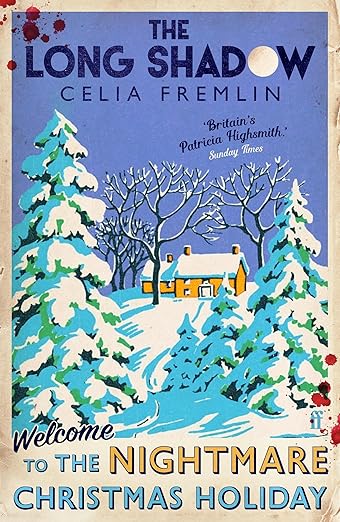
I’ve been meaning to read Celia Fremlin for a while, encouraged by JacquiWine’s excellent reviews. Happily, this coincided with my plan to read some Christmas-set golden age/cosy mysteries in December, as The Long Shadow (1975) builds its tension through a haunted group of houseguests throughout the festive period.
I immediately knew I was in for a treat with Fremlin. We join Imogen at the first party she’s attended since her husband died two months ago. We quickly learn that while she is grieving, she also recognises that Ivor was not a pleasant person. There is no sentimentality in her reflections.
“How Ivor would have loved being dead! It was a shame that he was missing it all. How he would have loved to watch the letters pouring in, day after day, by every post, in their tens and in their dozens, each one a tribute to himself.”
She also casts a critical eye over the niceties of solo party attendance:
“She’s a widow, that’s what she is. With wooden detachment, Imogen watched Myrtle’s social aplomb faltering before the task of finding something intriguing to say about Imogen: something at least as amusing as Dutch Elm disease.
She gave it up.”
There’s also some astute observations about the deeply odd ways that the English approach the bereaved:
“Even Edith Hartman from next door had at last stopped popping in with cups of tepid Oxo and soothing stories about people who had died of cancer recently.”
But soon Imogen has more to worry about than navigating social mores, as someone rings in the middle of the night, telling her they know she killed her husband.
Told from Imogen’s point of view, she is clear she didn’t kill him. She has little time to reflect though, as it’s not long before her adult step-children turn up; the somewhat reprobate son Robin, and acquisitive daughter Dot, with her husband Herbert and their two young sons, Vernon and Timmie.
More bafflingly, Robin brings an almost silent girl to the house who wafts around preparing macrobiotic food, and Ivor’s scatty second wife Cynthia flies in from Bermuda to also take up residence. Then someone starts moving Ivor’s papers and updating them, the children have faces visiting them in nightmares and see a man in a Santa costume sat in Ivor’s study, and Imogen begins to wonder if a ghost isn’t part of the company too…
“It was high time Ivor got moving. It wasn’t fair to be dead and yet to stay around like this, in every room, in every corner of the house”
As a reader we are meant to be sceptical of ghosts and suspect everyone else, and they certainly act suspiciously! All of the adults seem to be Up To Something but I certainly couldn’t work out what was going on.
The Long Shadow is well-paced at only 242 pages, with a finale that is satisfying and believable. There’s even a final comic twist right at the last sentence. It’s certainly made me keen to read more Fremlin and thankfully Faber have made more reissues available.
Although not heavily Christmas-themed, it’s a great Christmas read with its house full of extended family, things unspoken, and would be easily digested after a dinner of heavier festive fare 😊
To end, two of my favourite folk singers coming together to sing insults at each other in honour of Christmas (please note, they have updated some of Kirsty MacColl and Shane MacGowan’s name-calling, but the language remains decidedly colourful):
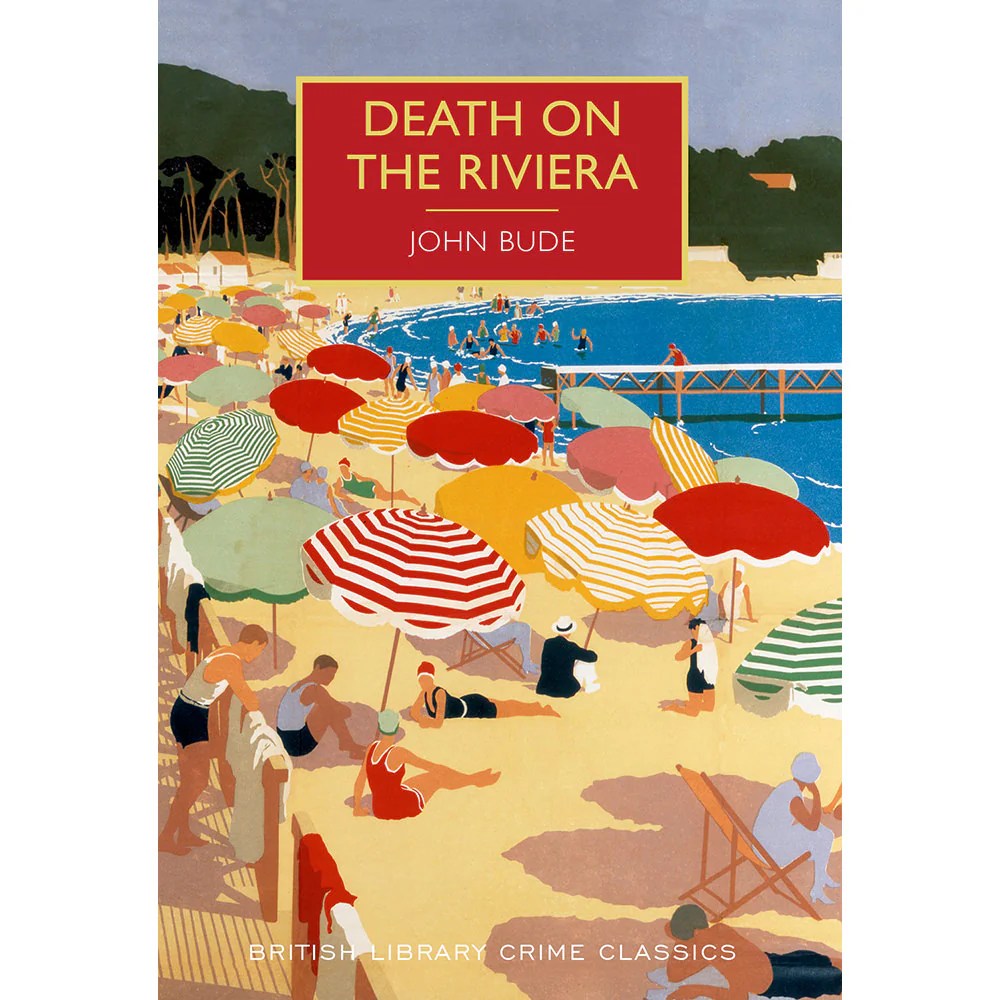
This is my final contribution to Kaggsy and Simon’s1952 Club which has been running all week. So far I’ve read two golden age mysteries for the club and I’m finishing with one too: Death on the Riviera by John Bude, in a pleasing British Library Crime Classics edition.
I read The Cheltenham Square Murder for the 1937 Club last year, and while I had enjoyed it, I didn’t think it was the strongest of Bude’s novels or a particularly perplexing mystery. This, I’m happy to report, was much stronger.
The story centres around the rich and privileged Nesta Hedderwick and her various assorted guests at her villa in the south of France.
“But for the nagging accusations of her weighing-machine life might have been perfect. She’d money; one of the loveliest villas in Menton; A large … collection of friends; splendid health; a sense of humour; and a virile capacity for enjoyment. Her husband, a successful but dyspeptic stockbroker, had died between the wars of ptomaine poisoning.”
Staying with Nesta are her niece Dilys; “smooth-faced bounder” Tony Shenton; Nesta’s companion Miss Pilligrew; beautiful Kitty; and a decidedly shifty artist:
“When Nesta had an artist living in the house she expected him to behave like one. Paul Latour certainly did his best to live up to the fin de siècle Bohemianism on which Nesta had directed her romantic ideas of the genre.”
Bude clearly has a lot of fun with Paul’s artistic swizz:
“A cod’s head capping the naked torso of a woman, balanced onto cactus leaves and garnished with the motif of lemons and spaghetti… Paul shrugged hopelessly.”
Although Dilys’ attitude to where she has found herself suggests Paul isn’t alone in his pretence:
“Just paste and cardboard and tinsel, like most of my aunt’s insufferable friends. Actually I find it rather boring. It gets that way after a time.”
So it seems the French Riviera is the perfect place for a counterfeiting operation, which is what brings DI Meredith and Acting-Sergeant Freddy Strang across La Manche, searching for Tony ‘Chalky’ Cobbett.
They work closely with Inspector Blampignon and refreshingly, the local police are shown to be entirely competent and pleasant to work with.
As the British and French police investigate the local forgers, Freddy runs into Dilys and they begin a very sweet romance, which brings the two threads smoothly together. When an acquaintance of the villa coterie goes missing, the police investigation widens.
One of my complaints with The Cheltenham Square Murder was that something completely and utterly obvious takes forever to be recognised by Meredith and I thought the same had happened here. Fortunately it turned out I’d fallen into exactly the assumption Bude had set up for the reader: at one point he has Meredith explain that when such an occurrence happens in mystery novels it always means the following…. a nice little meta joke with the reader which I appreciated 😊
Oddly, given the novel’s title, no-one is murdered until around page 160 of a 223 page novel. For my tastes, too long was spent on the counterfeiting and too little on people getting bumped off, but the investigation worked well and it was a steady police procedural without being plodding:
“He was visited by one of those revealing flashes of deduction that spring, not from any inspirational source, but from a clearly realised and logical appreciation of the facts.”
Death on the Riviera is well-paced and enjoyable, with enough characters for plenty of suspects without being completely baffling. The humour is gentle and light, and the setting beautifully evoked:
“It wouldn’t be easy, he realised, to take leave of this sunlit, sparkling coast with its terraced vineyards and olive groves, it palms and oleanders, it’s fantastic cacti, it’s mimosa-scented streets and impossibly blue seas. He thought of the Old Kent Road on a wet February night and shuddered.”
Today for the 1952 Club hosted by Kaggsy and Simon I’m looking at another golden age mystery. The Singing Sands by Josephine Tey features her regular detective, Inspector Alan Grant. It was found in her papers after she died and published posthumously, which usually makes my heart sink, but the novel seems pretty complete so I hope it was as she planned.
You can come across all sorts prejudices and snobberies in golden age crime and The Singing Sands has a strong one running throughout, which admittedly I’ve not encountered before in the genre: Tey is a total snob about Scotland. As far as I can work out her rules are:
Be Scottish
But speak with an English accent (by which I assume she means RP – I doubt my south London tones would cut the mustard)
Don’t be from the city
Especially don’t be from Glasgow
Be from the Highlands
Don’t be a nationalist
Really don’t be from Glasgow
I take great exception to her attitude to Glasgow – it’s a beautiful city full of friendly people. Every time I go I’m knocked out and I’m still giving serious consideration to moving there. In the end when I came across these attitudes I just rolled my eyes and skipped on, and it didn’t affect my enjoyment of the novel. But as a counterbalance I urge everyone to (re)visit wonderful Glasgow!
On with the novel! It opens with Grant struggling with his mental health and deciding to visit his cousin Laura (Lalla) and her family in the Highlands to recuperate. The background of what led to Grant reaching this point is never quite specified but he seems to be experiencing burnout/PTSD.
As he disembarks the train, the grumpy attendant is trying to rouse the passenger in berth B Seven. Grant realises he is dead, and his interest in faces (detailed extensively in The Daughter of Time which is where the title quote comes from but would have worked very well in this novel too) is piqued:
“What would bring a dark, thin young man with reckless eyebrows and a passion for alcohol to the Highlands at the beginning of March?”
He also picks up B Seven’s newspaper, which has some cryptic verse scribbled on it. Much as Grant tries to focus on his family and the fishing expeditions he had planned, his mind keeps being drawn back to B Seven. The verse leads him to visit some of the islands to identify the landmarks mentioned:
“There was nothing else in all the world but the green torn sea and the sands. He stood there looking at it, and remembering that the nearest land was America. Not since he had stood in the North African desert had he known that uncanny feeling that is born of unlimited space. That feeling of human diminution.”
Although his colleagues in London have identified the body and ruled accidental death, Grant thinks both these conclusions are questionable. Despite trying to recover from his work, he can’t let it go. He is aware that keeping his mind occupied can be useful, but it is a fine balance:
“Grant was very conscious that his obsession with B Seven was an unreasonable thing; abnormal; that it was part of his illness. That in his sober mind he would not have thought a second time about B Seven. He resented his obsession and clung to it. It was at once his bane and his refuge.”
We follow Grant as he heals, with the help of his beautiful environment, the understanding of his family, and his pursuit of the truth.
“But for B Seven he would not be sitting above this sodden world feeling like a king. New born and self-owning. He was something more than B Seven’s champion now: he was his debtor. His servant.”
The Singing Sands is not heavily plot-driven and the mystery is slight, but it is still an enjoyable read, if a slightly unusual approach to the genre. Grant’s dogged pursuit of the truth of a death which others seem quick to disregard makes him endearing, and there are lovely descriptions of the Highlands. It’s a quick read that doesn’t outstay its welcome, and it is compassionate in its portrayal of mental health.
“In matters where A was at spot X at 5:30pm on the umpteenth inst, Grant’s mind worked with the tidiness of a calculating machine. But in an affair where motive was all, he sat back and let his mind loose on the problem. Presently, if he left it alone, it would throw up the pattern that he needed.”
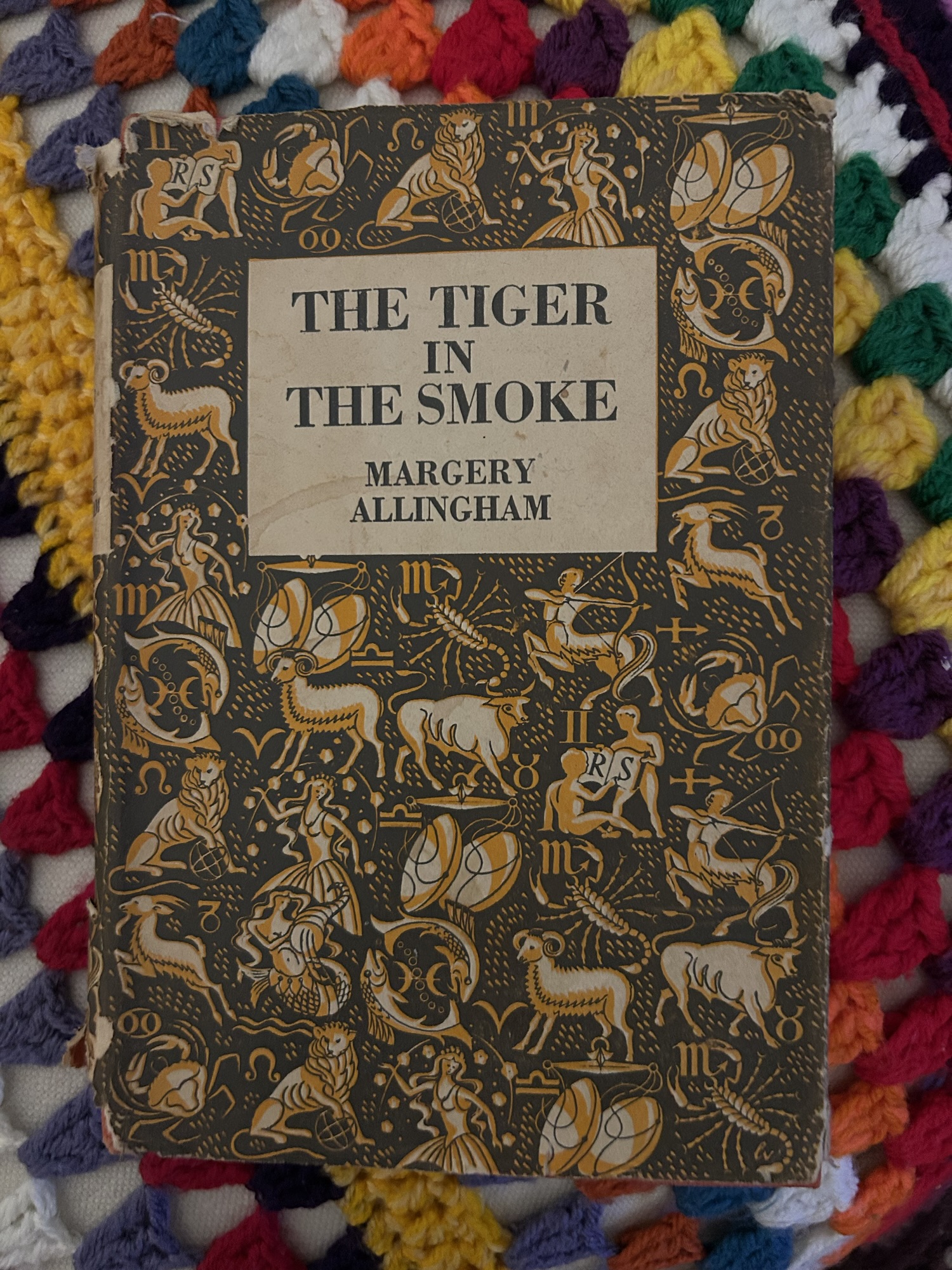
This is a contribution to Kaggsy and Simon’s 1952 Club, running all week. I found a few contenders in the TBR including several golden age mysteries, so I’m starting today with a pretty famous one, Tiger in the Smoke by Margery Allingham.
The titular smoke is a London pea-souper, a thick smog that chokes the airways and severely limits visibility – perfect for dastardly crimes to be committed!
“The fog was like a saffron blanket soaked in ice-water. It had hung over London all day and at last was beginning to descend. The sky was yellow as a duster and the rest was a granular black, overprinted in grey and lightened by occasional slivers of bright fish colour as a policeman turned in his wet cape.”
The story opens with Geoffrey Levett and Meg Elginbrodde crawling through the fog-bound traffic in a taxi. They are one of those wonderful postwar stiff-upper-lipped couples whose romantic chit-chat takes place along the following lines:
“Look, we’ll get out of this somehow and we’ll go through with the whole programme. We’ll have everything we planned, the kids and the house and the happiness, even the damned great wedding. It’ll be alright, I swear it, Meg.”
Love it!
The blight on their nuptials is that someone has been sending blurry photos to Meg of someone who could be her first husband Martin, presumed dead in the war. So she meets friend of the family – and Allingham’s regular detective – Albert Campion, along with Inspector Charlie Luke, at a train station.
It quickly emerges that the man is not her husband but a criminal named Duds Morrison. As the group begin to unravel what is going on and why, there is less mystery and more of a character study of a truly sinister criminal named Havoc. Inspector Luke is unnerved:
“Just then he had a presentiment, a warning from some experienced-born six sense, that he was about to encounter something rare and dangerous. The whiff of tiger crept to him through the fog.”
A gang of criminals appear and my heart sank a bit, as they all had various physical differences and I was braced for ableism. But while that is certainly present, the real menace in the book lies with Havoc, and Allingham labours over how physically perfect he is:
“His beauty, and he possessed a great deal […]
His face was remarkable, in feature it was excellent, conventionally handsome […]
Jail pallor, which of all complexions is the most hideous, could not destroy the firmness of his skin […]
He was a man who must have been a pretty boy, yet his face could never have been pleasant to look at. Its ruin lay in something quite peculiar, not in expression only but in something integral to the very structure. The man looked like a design for tragedy. Grief and torture and the furies were all there naked, and the eye was repelled even while it was violently attracted. He looked exactly what he was, unsafe.”
In other words, as beautiful and deadly as a tiger.
In comparison there is my favourite character, Canon Avril, Meg’s father:
“he asked so little of life that its frugal bounty amazed and delighted him. The older he grew and the poorer he became, the calmer and more contented appeared his fine gentle face.”
In fact, Tiger in the Smoke had an increasing amount of religious references and imagery as it went along (though it isn’t didactic at all) and I found myself reminded of Muriel Spark. I ended up googling Margery Allingham to see if she had a strong faith like Spark but couldn’t find it referenced. Tiger in the Smoke isn’t like Spark tonally, but it is certainly concerned with notions of good and evil in a similar way to her novels.
Although this is a Campion mystery, he barely features. Apparently the 1956 film cut him out entirely, and this wouldn’t be difficult at all. His sarcastic retainer Lugg also appears, and his wife Amanda along with Oates from Scotland Yard “a drooping figure in a disgraceful old mackintosh” but this could just as easily be a standalone novel.
While there isn’t a mystery as such, the plot is satisfyingly complex and the novel is expertly paced. The foggy atmosphere is used to full effect and Allingham creates a real page-turner. I was whizzing through Tiger in the Smoke to find out what happened.
It leads to a tense denouement, underpinned by a real sadness. A hugely satisfying start to my 1952 Club reading!
“Havoc was ‘police work’. There was no mystery surrounding his guilt. He was something to be trapped and killed, and Campion was no great man for blood sports.”
The 1937 Club is running all week, hosted by Kaggsy at Kaggsy’s Bookish Ramblings and Simon at Stuck in a Book. Often these Club years are a good opportunity to indulge in some golden age crime, and today I’m looking at one from the British Library Crime Classics series, which has been doing great work bringing many of them back.
I’ve read three other from the series by John Bude, all of which I enjoyed, so I was looking forward to The Cheltenham Square Murder.
Bude takes the trope of a closed circle of suspects and places them in a respectable square of Regency houses in the titular spa town.
“A quiet, residential backwater in which old people can grow becomingly older, undisturbed by the rush and clatter of a generation which has left them nothing but the memories of a past epoch.”
I always like a map or room plan in a novel and here we have a plan of the square and inhabitants, which wasn’t really needed but pleased me nonetheless.
The square couldn’t be more genteel. There is a man of the cloth and his sister; a doctor; a formidable spinster and her pack of dogs; two elderly sweet sisters; and a couple who look down on everyone but as they are titled no-one seems bothered.
The exceptions are Mr Buller, who seems a right wrong ‘un, and Captain Cotton who is a cad and a bounder. When the latter is shot in the head with an arrow through an open window while visiting the former, it sends everyone into a spiral.
“Rumour again stepped in. The Rev. Matthews was suspected of having connived with the murderer. Sir Wilfred and Lady Eleanor had fled from justice. Fitzgerald was the murderer. Dr. Pratt was the murderer. Poor Mr West had been arrested for the murder stepping onto the boat at Dover. Miss Boone had shot all her dogs and then attempted to take her own life. Currents and crosscurrents of suggestion and counter-suggestions crept into their shrinking ears and left the Misses Watt bewildered. They felt that at any moment, due to some horrible miscarriage of justice, they themselves might be warned that anything they had to say would be taken down in writing and (possibly) used in evidence.”
Thankfully, Superintendent Meredith, who has been such an effective sleuth in Budes other novels, is visiting his friend Aldous Barnet (from The Sussex Downs Murder) on the square, one of the few residents who doesn’t practice archery. It’s agreed Meredith can consult on the case.
Well, I can only think that taking the waters at Cheltenham has a stultifying effect on Meredith’s powers, because there is something so completely, blindingly obvious about the crime, that he somehow fails to consider until page 161. His second in command is local police Inspector Long who, despite his clumsily evoked regional accent and general attitude of misogyny, is portrayed as quite capable. He doesn’t notice this either.
This made for a slightly frustrating read, as who the murderer was became clear quite quickly too. I don’t mind it when I guess the outcomes with golden age mysteries as they are my comfort read, and I like a police procedural, but this felt a bit plodding.
There was still a lot to enjoy though. The exposure of rivalries, betrayals and tensions behind a respectable façade is always fun. The characterisation of the various neighbours is very well realised, and I also liked the setting and the use of the square as a way of expanding the country house murder story to a wider environment.
The humour is gentle, such as the Misses Watts panicking that they will be arrested, or the interrogation of a faded Bright Young Thing given to inappropriate chumminess:
“So you flatly deny it was you?
Absolutely flatly, old boy.”
The Cheltenham Square Murder ran to 285 pages in this edition and I think had it been 200 pages it would have been absolutely cracking. But as it was, still an enjoyable and diverting escapist read.
To end, of all the 80s pop videos I’ve posted on this blog, this might be the most 80s of all 😀
Although I read a lot of golden age detective fiction as it is my go-to comfort read, I rarely blog on it. I’m making an exception this week though, as The Crime at Black Dudley, the first Albert Campion mystery by Margery Allingham, was published in 1929. This makes it perfect for the 1929 Club, running all week and hosted by Simon and Kaggsy.
In this first outing, Campion is not the primary detective. This role falls instead to George Abbershaw:
“He was a smallish man, chubby and solemn, with a choir-boy expression and a head of ridiculous bright-red curls which gave him a somewhat fantastic appearance.
[…]
His book on pathology, treated with special reference to fatal wounds and the means of ascertaining their probable causes, was a standard work, and in view of his many services to the police in the past his name was well known and his opinion respected at the Yard.
At the moment he was on holiday, and the unusual care which he took over his toilet suggested that he had not come down to Black Dudley solely for the sake of recuperating in the Suffolk air.
Much to his own secret surprise and perplexity, he had fallen in love.
He recognized the symptoms at once and made no attempt at self-deception, but with his usual methodical thoroughness set himself to remove the disturbing emotion by one or other of the only two methods known to mankind – disillusionment or marriage.”
So George heads to a somewhat foreboding enormous country pile, home of Wyatt Petrie, an academic, and his uncle Colonel Coombe (there always seem to be Colonels in GA mysteries don’t there? They seem to have been much more prolific then.) There is to be a party of Bright Young Things descending for the weekend.
An isolated country house, a closed circle of characters not entirely well-known to one another, what could go wrong…? Early on, George is drawn to a wall display:
“Yet it was the actual centre-piece which commanded immediate interest. Mounted on a crimson plaque, at the point where the lance-heads made a narrow circle, was a long, fifteenth-century Italian dagger. The hilt was an exquisite piece of workmanship, beautifully chased and encrusted at the upper end with uncut jewels, but it was not this that first struck the onlooker. The blade of the Black Dudley Dagger was its most remarkable feature. Under a foot long, it was very slender and exquisitely graceful, fashioned from the steel that had in it a curious greenish tinge which lent the whole weapon an unmistakably sinister appearance. It seemed to shine out of the dark background like a living and malignant thing.”
How on earth will the murder take place? What weapon will possibly be used? That’s right, Colonel Coombe is poisoned. Only kidding, of course he’s stabbed with the heavily foreshadowed Black Dudley Dagger.
However, that is not the only dampener on the party. Two men, sinister associates of the deceased, proclaim that no-one is allowed to leave until a missing item is returned to them. They succeed in convincing everyone of their seriousness through direct and effective means. (One of them is German and my heart sank a bit, anticipating caricatured xenophobic villainy, but thankfully although there is some it’s not extensive, and it soon becomes apparent that *small spoiler* he is not the true villain).
What will George do? Can he unmask the murderer? Can he protect his beloved Meggie long enough to propose? Well, among the party is one Albert Campion. George finds him foolish and irritating. Silly George! It’s obvious to the reader that there is More To Albert Than Meets The Eye…
“Everybody looked at Mr Campion. He was leaning up against the balustrade, his fair hair hanging over his eyes, and for the first time it dawned upon Abbershaw that he was fully dressed, and not, as might have been expected, in the dinner-jacket he had worn on the previous evening.
His explanation was characteristic.
‘Most extraordinary,’ he said, in his slightly high-pitched voice. ‘The fellow set on me. Picked me up and started doing exercises with me as if I were a dumb-bell. I thought it was one of you fellows joking at first, but when he began to jump on me it percolated through that I was being massacred. Butchered to make a butler’s beano, in fact.’
He paused and smiled fatuously.”
The main flaw of The Crime at Black Dudley is that mysterious, capable, comic Campion is so clearly the hero that the story feels a bit unbalanced and lacking when he’s not around. He dominates until he suddenly doesn’t – leaving the story before the end. George sees it through for the reader, but it makes for something of an anti-climax.
However, that quibble aside, The Crime at Black Dudley is a very enjoyable golden age mystery. As well as the tropes already mentioned, there are trapdoors, secret passageways and international criminal gangs. It’s a short fun read, and it made me keen to spend more time with perplexing Campion. As the Bright Young Things might say, (but probably never did) even if it’s not entirely the cat’s pyjamas it is still a crashing good lark.
From the silly to the serious, and my usual disclaimer that I know Ernest Hemingway was a fairly terrible human. He treated women badly, he loved blood sports which is abhorrent, I have no doubt that had we ever met, Hemingway and I would have viewed each other with mutual contempt. I also know that I just adore his writing, in a way I can’t fully explain. I do like pared-back style, but there’s something indefinable in his writing that I just find so moving. A Farewell to Arms was published in 1929 and it opens:
“In the late summer of that year we lived in a house in a village that looked across the river and the plain to the mountains. In the bed of the river there were pebbles and boulders, dry and white in the sun, and the water was clear and swiftly moving and blue in the channels. Troops went by the house and down the road and the dust they raised powdered the leaves of the trees. The trunks of the trees too were dusty and the leaves fell early that year and we saw the troops marching along the road and the dust rising and leaves, stirred by the breeze, falling and the soldiers marching and afterwards the road bare and white except for the leaves.”
If I tell you I was already inexplicably tearful by the time I reached the end of that passage you know you’re not going to get a coherent or balanced review of this book in any way 😀
The novel follows the story of Frederic Henry, an American volunteer paramedic in Italy during the First World War, and his relationship with Catherine Barkley, an English nurse. Initially I found their behaviour rather silly, but then I had to remind myself that they were very young, and living through traumatic circumstances.
“I went out the door and suddenly I felt lonely and empty. I had treated seeing Catherine very lightly, I had gotten somewhat drunk and had nearly forgotten to come but when I could not see her there I was feeling lonely and hollow.”
“‘I’ll say just what you wish and I’ll do what you wish and then you will never want any other girls, will you?’ She looked at me very happily. ‘I’ll do what you want and say what you want and then I’ll be a great success, won’t I?’”
No Catherine, that’s a truly terrible idea. Familiarise yourself with feminist theory and pull yourself together!
I thought Hemingway’s iceberg style of writing, not spelling everything out and trusting the reader to fill in gaps, worked extremely well throughout. Being so matter-of-fact about war, death and injury drove home its seriousness rather than treating it lightly. It meant that nothing was made easier by a more descriptive or metaphorical style. Here Henry is wounded badly (skip the next quote if you’re at all squeamish!):
“I sat up straight and as I did so something inside my head moved like the weights on a doll’s eyes and it hit me inside behind my eyeballs. My legs felt warm and wet and my shoes were wet and warm inside. I knew that I was hit and leaned over and put my hand on my knee. My knee wasn’t there. My hand went in and my knee was down on my shin. I wiped my hand on my shirt and another floating light came very slowly down and I looked at my leg and was very afraid.”
A Farewell to Arms is not relentlessly bleak though. There are touches of humour between Henry and his friends, or in Henry’s observations of his medical care:
“I have noticed that doctors who fail in the practice of medicine have a tendency to seek one another’s company and aid in consultation. A doctor who cannot take out your appendix properly will recommend to you a doctor who will be unable to remove your tonsils with success. These were three such doctors.”
It’s also not bitter. Henry becomes disillusioned with the war but again, the iceberg style works well in presenting the hopelessness and destruction of ideals, without being cynical or maudlin, such as Henry’s conversation with his friend who is a priest:
‘I had hoped for something.’
‘Defeat?’
‘No. Something more.’
‘There isn’t anything more. Except victory. It may be worse.’
‘I hoped for a long time for victory.’
‘Me too.’
‘Now I don’t know.’
‘It has to be one or the other.’
‘I don’t believe in victory anymore.’
‘I don’t. But I don’t believe in defeat. Though it may be better.’
‘What do you believe in?’
‘In sleep,’ I said. He stood up.
It occurred to me towards the end of the novel, when Henry uses a racial slur, that until that point I hadn’t really considered whether I liked any of characters. At that point I reflected that I didn’t much. Catherine is somewhat underwritten, the first-person narrative reflecting Henry’s youthful egotism in love, and Henry himself wasn’t particularly easy to warm to. But actually this was irrelevant. Hemingway wasn’t asking the reader to like or not like his characters. He was presenting them as they were, as flawed humans caught up in violence and destruction, and pointing out utter futility of it all.
“I did not say anything. I was always embarrassed by the words sacred, glorious and sacrifice and the expression in vain. We had heard them, sometimes standing in the rain almost out of earshot, so that only the shouted words came through, and had read them, on proclamations that were slapped up by billposters over other proclamations, now for a long time, and I had seen nothing sacred, and the things that were glorious had no glory and the sacrifices were like the stockyards at Chicago if nothing was done with the meat except to bury it. There were many words that you could not stand to hear and finally only the names of places had dignity.”
To end, the trailer for the 1932 film adaptation starring Gary Cooper:
Happy Christmas everyone! I’ve picked 2 undemanding festive reads this week, as I for one am already finding my brain overtaxed – I blame all the twinkling lights.
To start, the irresistably titled Christmas With Dull People by Edwardian satirist Saki (republished this year by Daunt Books). This is a perfect stocking filler: 4 stories amounting to 48 pages, little bite-sized witticisms for when your brain is dribbling out of your ears trying to comprehend the inanities of Christmas telly as your stomach tries to digest a week’s worth of calories in one sitting.
The stories are so short I just want to give you a wee taster of what to expect, I can’t really say more or it will amount to paraphrasing the whole thing. Saki is wonderfully witty and contained but it does make the stories hard to review!
In the first story ‘Reginald’s Christmas Revel’ the titular man is trying to get through Christmas games with his relations.
“On Christmas evening we were supposed to be specially festive in the Old English Fashion. The hall was horribly draughty, but it seemed to be the proper place to revel in, and it was decorated with Japanese fans and Chinese lanterns, which gave it a very Old English effect.”
In the following story ‘Reginald on Christmas Presents’ he treats us to his opinions on the difficulty of festive gift-receiving:
“Then there are aunts. They are always a difficult class to deal with in the matter of presents. The trouble is that one never catches them really long enough. By the time one has educated them to an appreciation of the fact that one does not wear red woollen mittens in the West End, they die, or quarrel with the family, or do something equally inconsiderate. That is why the supply of trained aunts is always so precarious.”
We leave Reginald for ‘Bertie’s Christmas Eve’ in which Bertie, who “had in early life adopted the profession of n’er do well” treats his whole family appallingly in a farcical fashion.
Finally in ‘Down Pens’ a couple struggle with the thank you letter writing that inevitably follows the revelries:
“I’ve come to the end of my capacity for expressing servile amiability. Eleven letters today and nine yesterday, all couched in the same strain of ecstatic thankfulness”
I hope this has given you enough of an idea of Saki’s wit and humour to convince you. A real treat, and calorie-free to boot!
Creepy snowmen break:
Secondly, Arrest the Bishop? By Winifred Peck (1949) which I picked up after reading Ali’s review. This is a lovely golden age mystery set in 1920, at Christmas time, although the festivities are not lingered over.
Dr Broome, the Bishop of Evelake, has various people arriving at his Palace where he lives with his second wife, their staff (minus Moira the housekeeper who is in hospital) and Bobs, his secretary. Joining them are Judith, his flighty, adulterous daughter from his first marriage; Sue, his sensible daughter from his second; Dick, ex-military police and now a deacon; a Chancellor; a canon; and a group of young clerics. It is snowing heavily as you’d expect in a country house murder mystery, when the despicable Reverend Ulder arrives:
“when he focussed those eyes on you, with the secretive state of all creeping, slimy things and when his too oily manner stiffened into threats… the sensitive shuddered as if turning over a stone which conceals maggots”
This charmer is corrupt in just about every way you can imagine and having added blackmail to his repertoire, there is no shortage of suspects when he is poisoned. Dick helps out Chief Constable Mack with the investigation, but everyone seems so unlikely a murderer:
“Motive and opportunity alike seemed to point skeleton fingers at such preposterous figures – Judith – the Chancellor – Canon Wye – the Bishop himself!”
“Dick…was aware by now that his activities in the war would always seem to outsiders that of a sort of glorified policeman. Nor could he very well explain that til this day he had no experience whatever of suspecting Church dignitaries of murder.”
Mack seems determined to arrest the Bishop, while for Dick, the chief suspect is obsequious butler Soames:
“Had this chap been reading Wodehouse as a guide to butlers? For occasionally he would throw out such Jeeves-like sentiments with oily rectitude, in startling contrast to his usual sulky, aggressive manner.”
Despite their biases and their motley crew of suspects, of course they get there in the end. To be honest, the murderer is completely obvious, but this was part of the fun. I could just watch the investigation play out and enjoy this good-natured golden age mystery as a perfect comfort read for this time of year.
I contributed greatly to our team win at my work’s Christmas quiz this year, due to my specialist subject coming up: questionable late-20th century Christmas tunes. The clincher was knowing that this wasn’t Elvis Presley (trigger warning – creepy puppet):





 madame bibi lophile recommends