Or, you know, don’t. A friend of mine from the east coast of America asked me last week why all the weather reports in the UK were focussing on snowmageddon when really, very little happened. A German colleague is baffled every year by our total inability to deal with anything above a flurry. I have no answers for them. What I do have, in honour of the snow that barely made an appearance last week, is novels where there is serious snow. Snow that means business. Snow you have to dig yourself out of. If only because then I get to include this gif:

Firstly Snowblind by Ragnar Jonasson (2010, tr.2015 Quentin Bates 2015). I’m not a huge reader of crime fiction set any time after the middle of the last century, but I was convinced by the enthusiastic reviews of FictionFan and Sarah from Hard Book Habit, and the promise that this was like a golden age crime novel but with a contemporary, Icelandic setting (the author translated Agatha Christie into Icelandic when he was 17).
Rookie copper Ari Thor Arason leaves Reykjavik and his girlfriend behind to take a posting in the remote town of Siglufjordur, in the far north of Iceland. A place so small you don’t need to drive to get around, and only accessible via a mountain pass.
“On the right were the snow white mountains, magnificent and formidable, while on the other side was a terrifying, sheer drop onto the expanse of Skagafjordur. One mistake on a patch of ice and there would be no tomorrow…he relaxed as the tunnel entrance finally approached. They had made it all the way in one piece. But his relief was short-lived. He expected a broad, well-lit modern tunnel, but what lay in front of him looked forbidding. It was a narrow single track. Ari Thor later learned it had been carved through the mountainside more than forty years ago when there were only a few tunnels in Iceland. It didn’t help that water dripped here and there from the unseen rock ceiling above. Ari Thor suddenly felt himself struck by a feeling he had never experienced before – an overwhelming claustrophobia.”
As Ari Thor settles into life in place where everyone knows everyone and no-one locks their doors, a local celebrity falls down some stairs whilst drunk and dies (or did he? or was he?) When a woman is found close to death, bleeding out in the snow in her garden, the police start to suspect that the two may be linked. As “every winter is a heavy winter in Siglufjordur”, the mountain pass is soon made unpassable through an avalanche, and so essentially what Jonasson has done is use the snow to create a claustrophobic, tense, locked-room murder mystery (please commend me on my enormous restraint in avoiding snow-based puns like ‘chilling’ or ‘unsettling’, despite the fact it is both those things).
Snowblind is a short novel (252 pages in my edition) and so I can’t say much more without spoilers. What I will say is that it feels resolutely contemporary with references to the financial crash which devastated Iceland at the time (although for the once-busy port of Siglufjordur, “if there’s a recession here, it comes from the sea”) whilst at the same time being part of a tradition of non-gory, page-turning whodunits. Siglufjordur itself is wonderfully evoked, with a real sense of place created, whilst at the same time becoming a fictional other, and somewhat eerie.
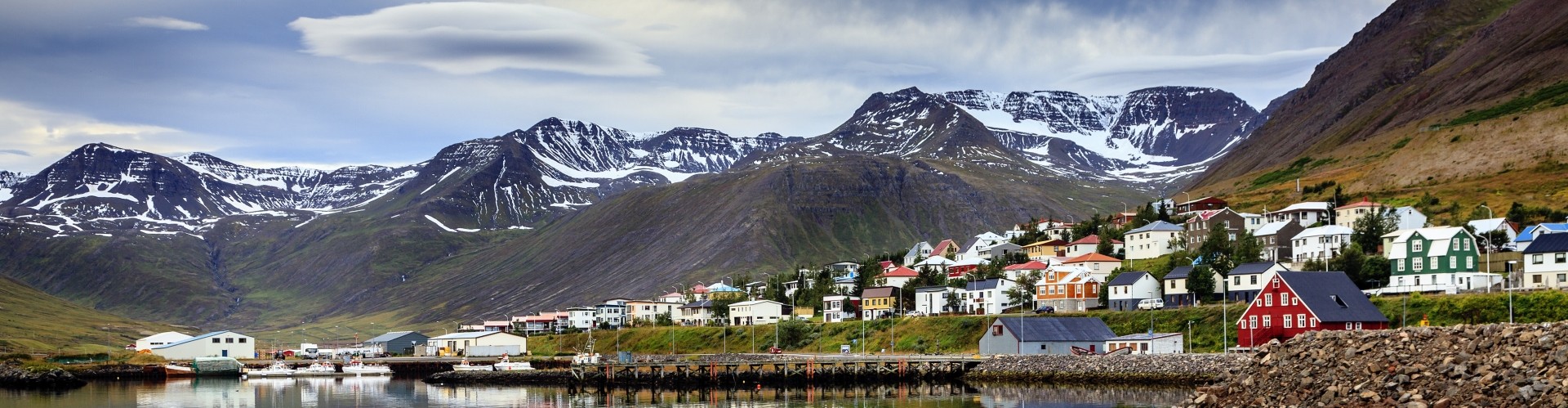
Siglufjordur
Image from here
“This peaceful little town was being compressed by the snow, no longer a familiar winter embrace but a threat like never before. The white was no longer pure, but tinged blood red.”
Secondly, Miss Smilla’s Feeling for Snow by Peter Hoeg (1992, tr. F David 1993) and one more stop on my Around the World in 80 Books Reading Challenge, hosted by Hard Book Habit (new year’s resolution from now on – stop being so euro-centric with this challenge). I distinctly remember all the hype around this novel when it first came out. Not that I’m slow on the uptake, but 24 years later, I’ve finally read it. These days we are awash with antisocial-genius detectives but back in the day Smilla Jaspersen may have been more of a novelty:
“I feel the same way about solitude as some people feel about the blessing of the church. It’s the light of grace for me.”
Smilla does need people, even if she doesn’t like to admit it, and when her neighbour, six year old Isiah, falls to his death from a roof, she is galvanised to act:
“Isiah’s death is an irregularity, an eruption that produced a fissure. That fissure has set me free. For a brief time, and I can’t explain how, I have been set in motion, I have become a foreign body skating on top of the ice.”
Smilla, half-Greenlandic, can read the snow and she knows Isiah’s last footprints tell a different story to the one the authorities are spinning. This is a theme throughout the novel, which is as much a commentary on post-colonial power structures as it a detective story. Smilla has a history of far left political activism and is not easily cowed by those trying to silence her. I found her a believable, idiosyncratic heroine and really enjoyed her matter-of-fact voice:
“The knives I keep in my apartment are just sharp enough to open envelopes with… I don’t need anything sharper. Otherwise, on bad days, it might easily occur to me that I could always go and stand in the bathroom and slit my throat. Against such a contingency it’s nice to have the added security of needing to go downstairs and borrow a decent knife from a neighbour.”
My quibble would be that I thought the story lost momentum a bit when Smilla left Denmark and journeyed towards Greenland; I think the return to the land of her childhood was inevitable so maybe it needed a heavier edit earlier in the novel. But overall, an intriguing premise for an intelligent mystery with a strong political message.
“Reading snow is like listening to music. To describe what you’ve read is to try and explain music in writing.”
To end, the unintentionally hilarious trailer for the film adaptation. So very earnest, so very heavy-handed 😀 (and yet still following the Hollywood tradition of whitewashing, unless Julia Ormond is part-indigenous Greenlander?)


 madame bibi lophile recommends