“It was an uncertain Spring.” (Virginia Woolf, The Years)

This is my final post for the brilliant1937 Club, which has been running all week and hosted by Kaggsy at Kaggsy’s Bookish Ramblings and Simon at Stuck in a Book. In the end I did stick to my planned reads for the week:

Apparently Leonard Woolf thought The Years the poorest of Virginia’s novels, but it was also far and away her best-selling work. So I was intrigued to know how I’d find it…

The titular years of this novel are 1880;1891;1907;1908;1910; 1911;1913;1914;1917;1918; and the Present Day. And so Woolf covers the end of the Victorian era to World War I and beyond, through the lens of the middle-class Pargiter family. Except for 1880, she portrays one day in their lives, some with significant events, others very ordinary.

In 1880, Rose Pargiter, mother to young adults Eleanor, Morris and Edward, teenagers Milly and Delia, and pre-teens Martin and Rose, is in bed in their London townhouse, dying from a long illness. Woolf captures the conflicted feelings and strain for the family around this time, particularly for Delia:

“She longed for her to die. There she was – soft, decayed but everlasting, lying in the cleft of the pillows, an obstacle, a prevention, an impediment to all life. She tried to whip up some feeling of affection, of pity. For instance, that summer, she told herself, at Sidmouth, when she called me up the garden steps…But the scene melted as she tried to look at it.”

Over in Oxford where Edward is studying, their cousin Kitty is trying to find a role for herself and struggling against the constraints of late Victorian womanhood:

“”When I was your age,” Miss Craddock continued, remembering her rôle as teacher, “I would have given my eyes to have the opportunities you have, to meet the people you meet; to know the people you know.”

“Old Chuffy?” said Kitty, remembering Miss Craddock’s profound admiration for that light of learning.

“You irreverent girl!” Miss Craddock expostulated. “The greatest historian of his age!”

“Well, he doesn’t talk history to me,” said Kitty, remembering the damp feel of a heavy hand on her knee.”

Each time Woolf jumps forward, she trusts the reader to keep up and doesn’t get bogged down by lots of explanation or exposition. We are given a snapshot the characters, whoever she is focussed on, and we fill in the gaps to a greater or lesser extent.

There are phrases and echoes across the different sections, tying them all together and giving a coherence to what could have been a more fragmentary, less satisfying novel. I also liked the repeated motif of starting each section with a birds-eye view of the time of year. I was particularly fond of this opening to 1908:

“It was March and the wind was blowing. But it was not “blowing.” It was scraping, scourging. It was so cruel. So unbecoming. Not merely did it bleach faces and raise red spots on noses; it tweaked up skirts; showed stout legs; made trousers reveal skeleton shins. There was no roundness, no fruit in it. Rather it was like the curve of a scythe which cuts, not corn, usefully; but destroys, revelling in sheer sterility. With one blast it blew out colour – even a Rembrandt in the National Gallery, even a solid ruby in a Bond Street window: one blast and they were gone. Had it any breeding place it was in the Isle of Dogs among tin cans lying beside a workhouse drab on the banks of a polluted city.”

As the above shows, Woolf grounds her tale in a recognisable topography and as always I found her descriptions of London detailed and realistic, and of Oxford too, even all these years later.

Alongside these recognisable realities, there was also plenty to enjoy regarding Woolf’s unique and arresting descriptive powers. I’m a big fan of Woolf and I just love her way of capturing inner moments, especially unreal, discombobulating moments, such as Eleanor at a dinner party during an air raid:

A little blur had come round the edges of things. It was the wine; it was the war. Things seemed to have lost their skins; to be freed from some surface hardness; even the chair with gilt claws, at which she was looking, seemed porous; it seemed to radiate out some warmth, some glamour, as she looked at it.”

Woolf brings all the characters together in the final section for a party given by Delia. She emphasises the fallacy of a reunion by highlighting the aloneness felt by many of the family. North, son of Morris, is back after many years abroad and feels detached from everything. His sister Peggy is somewhat bitter and frustrated. She tries to get Eleanor to talk about the Pargiters childhood, but Eleanor is much more interested in life now.

“That was odd, it was the second time that evening that somebody had talked about her life. And I haven’t got one, she thought. Oughtn’t a life to be something you could handle and produce? – a life of seventy odd years. But I’ve only the present moment, she thought. Here she was alive, now, listening to the fox-trot. […] Yes, things came back to her. A long strip of life lay behind her. Edward crying, Mrs. Levy talking; snow falling; a sunflower with a crack in it; the yellow omnibus trotting along the Bayswater Road. And I thought to myself, I’m the youngest person in this omnibus; now I’m the oldest…Millions of things came back to her. Atoms danced apart and massed themselves. But how did they compose what people called a life?”

There isn’t a plot so much in The Years, only as much as there are plots to any life. Woolf captures times and places for a particular family without trying to drive the novel unrealistically. Yet The Years is still a pacy read, the driving forces being the times that are lived through and the human will to carry on.  

To end, some footage of 1930s London, although I doubt Virginia ever got herself caught up with rush hour workers:
“Domestic life in the past was smelly, cold, dirty and uncomfortable, but we have much to learn from it.” (Lucy Worsley)

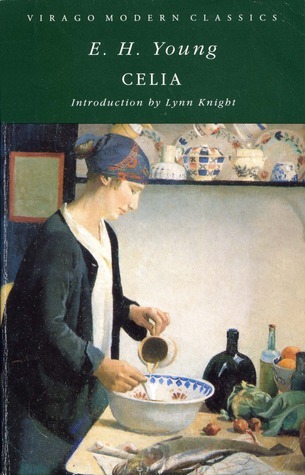
I’ve really enjoyed the three EH Young novels I’ve read but it’s been ages since I picked her up. I’m thankful to the 1937 Club, running all week and hosted by Kaggsy at Kaggsy’s Bookish Ramblings and Simon at Stuck in a Book for prompting me to get back to her!


Like the other novels by Young that I’ve read, Celia is set in the fictional Upper Radstowe (based on lovely Clifton in Bristol) amongst middle-class domestic life. Celia is forty-five, living in genteel shabbiness with her husband Gerald and their son Jimmy and daughter Catherine. She is quietly despairing.

Gerald is an architect who designs unimaginative houses that Celia despises: “here was the same puzzle of gain and loss, more money for the family and a little less beauty in the world.”

Young portrays with frankness that Celia and Gerald have a sexless marriage, because Celia cannot bear the thought of physical intimacy with her husband:

by neglecting some of the duties of a good housewife, she stored the energy necessary for avoiding friction; by avoiding as much as possible, Gerald’s demonstrations of affection, and she had almost perfected her technique, she could give him the friendship and the kindness which vanished when more was asked of her.”

But in all honesty, she also neglects those other housewife duties too because they hold no real interest for her. She is an indifferent housekeeper (I can definitely relate) and cook, and spends a lot of her time at step removed from her surroundings. She dreams of a lost love – Richard, the brother of schoolfriend Pauline – and talks to herself.

“She had always a secret pride in its intangible persistence, its difference from a love nourished by the senses, and a more secret fear that what gave it life was its dreamlike quality.”

Those around her are used to vagueness and detachment. Living nearby is her “very stupid” sister May, her solicitor husband Stephen and their daughters including Susan. Celia’s brother John inherited the family drapery business and also lives close by, with his wife Julia and their various offspring. Another sister Hester is living a scandalously single life in London.

May and Julia form a pair, keeping each other company with their distracting daily small rivalries.

“She was congratulating herself on a superior wit because these two had supplied her with so much unintentional amusement, but she knew she had supplied them with something they valued more than laughter, an opportunity for criticism and disapproval.”

As the above quote shows, Celia can be judgemental of others. There are times when she is really quite cruel to her relatives, telling them what to do and not being entirely kind about it. But she is also fond, loving, intelligent, silly and funny. She’s a wonderful, fully-rounded, very believable creation.

The least likable character is her brother John: “John’s sense of duty towards his family was chiefly confined to criticism.” Even loving wife Julia loses patience with him at one point:

“She was enraged by John’s masculine belief in the sufficiency of his lasting passion for her, his primitive conviction that she was honoured by it and for its sake must gladly endure his faults of character and his intolerance of her own. In this rarely candid moment, she searched her mind for any other reason why she should like him and could not find one, but he was a habit and she would have been lost without him.”

We follow the extended family through various dramas, some larger than others. Stephen takes himself off for a few days, leaving May wondering if she’s been abandoned. John has to face his eldest son not wanting to follow him into the business. Celia’s son Jimmy has a crush on May’s daughter Susan (first cousins – eek). Celia has to wrestle with her mother-in-law, and there various intrigues which amount to very little. As Celia observes:

I live in a teacup and forget it isn’t the whole world.”

However, Celia isn’t a comfort read. It is concerned with the realities of married life at a time when divorce was very rare and opportunities for women generally were very limited. Young portrays the frustrations, sadnesses, tedium, and even fear her characters experience alongside the small joys, affection and love in their lives.  It feels very real, and while it is not depressing it also doesn’t offer any false hope or sentiment either.

“The art of living, the only one Celia tried to practise, was as exacting as any other.”

By end of the novel the characters know themselves and each other slightly better, and have gained some wisdom and insight through small incremental steps. There are no major epiphanies and no huge outward changes. It is a finely written and closely observed tale of interwar middle-class lives that above everything else, carry on.

While it was an involving and affecting novel, I didn’t feel Celia was the strongest of Young’s work that I’ve read – there were too many superfluous characters and the light plotting couldn’t quite sustain the length. For me, it would have benefitted from cutting one branch of the family and around 100 pages. But EH Young not at her tip-top best is still so very good and there is a great deal to enjoy in Celia.

“She had a calm indifference to what anyone might think of her, not because she herself was indifferent people, but because while she was interested in herself, as any intelligent person must be, she did not expect or wish to arouse interest in others, she had no apologies to make for what she was not, or explanations of what she was.”

To end, a Bristolian classic:

“If one cannot command attention by one’s admirable qualities one can at least be a nuisance.” (Margery Allingham)

Although I read a lot of golden age detective fiction as it is my go-to comfort read, I rarely blog on it. I’m making an exception this week though, as The Crime at Black Dudley, the first Albert Campion mystery by Margery Allingham, was published in 1929. This makes it perfect for the 1929 Club, running all week and hosted by Simon and Kaggsy.

In this first outing, Campion is not the primary detective. This role falls instead to George Abbershaw:

“He was a smallish man, chubby and solemn, with a choir-boy expression and a head of ridiculous bright-red curls which gave him a somewhat fantastic appearance.

[…]

His book on pathology, treated with special reference to fatal wounds and the means of ascertaining their probable causes, was a standard work, and in view of his many services to the police in the past his name was well known and his opinion respected at the Yard.

At the moment he was on holiday, and the unusual care which he took over his toilet suggested that he had not come down to Black Dudley solely for the sake of recuperating in the Suffolk air.

Much to his own secret surprise and perplexity, he had fallen in love.

He recognized the symptoms at once and made no attempt at self-deception, but with his usual methodical thoroughness set himself to remove the disturbing emotion by one or other of the only two methods known to mankind – disillusionment or marriage.”

So George heads to a somewhat foreboding enormous country pile, home of Wyatt Petrie, an academic, and his uncle Colonel Coombe (there always seem to be Colonels in GA mysteries don’t there? They seem to have been much more prolific then.) There is to be a party of Bright Young Things descending for the weekend.

An isolated country house, a closed circle of characters not entirely well-known to one another, what could go wrong…? Early on, George is drawn to a wall display:

“Yet it was the actual centre-piece which commanded immediate interest. Mounted on a crimson plaque, at the point where the lance-heads made a narrow circle, was a long, fifteenth-century Italian dagger. The hilt was an exquisite piece of workmanship, beautifully chased and encrusted at the upper end with uncut jewels, but it was not this that first struck the onlooker. The blade of the Black Dudley Dagger was its most remarkable feature. Under a foot long, it was very slender and exquisitely graceful, fashioned from the steel that had in it a curious greenish tinge which lent the whole weapon an unmistakably sinister appearance. It seemed to shine out of the dark background like a living and malignant thing.”

How on earth will the murder take place? What weapon will possibly be used? That’s right, Colonel Coombe is poisoned. Only kidding, of course he’s stabbed with the heavily foreshadowed Black Dudley Dagger.

However, that is not the only dampener on the party. Two men, sinister associates of the deceased, proclaim that no-one is allowed to leave until a missing item is returned to them. They succeed in convincing everyone of their seriousness through direct and effective means. (One of them is German and my heart sank a bit, anticipating caricatured xenophobic villainy, but thankfully although there is some it’s not extensive, and it soon becomes apparent that *small spoiler* he is not the true villain).

What will George do? Can he unmask the murderer? Can he protect his beloved Meggie long enough to propose? Well, among the party is one Albert Campion. George finds him foolish and irritating. Silly George! It’s obvious to the reader that there is More To Albert Than Meets The Eye…

“Everybody looked at Mr Campion. He was leaning up against the balustrade, his fair hair hanging over his eyes, and for the first time it dawned upon Abbershaw that he was fully dressed, and not, as might have been expected, in the dinner-jacket he had worn on the previous evening.

His explanation was characteristic.

‘Most extraordinary,’ he said, in his slightly high-pitched voice. ‘The fellow set on me. Picked me up and started doing exercises with me as if I were a dumb-bell. I thought it was one of you fellows joking at first, but when he began to jump on me it percolated through that I was being massacred. Butchered to make a butler’s beano, in fact.’

He paused and smiled fatuously.”

The main flaw of The Crime at Black Dudley is that mysterious, capable, comic Campion is so clearly the hero that the story feels a bit unbalanced and lacking when he’s not around. He dominates until he suddenly doesn’t – leaving the story before the end. George sees it through for the reader, but it makes for something of an anti-climax.

However, that quibble aside, The Crime at Black Dudley is a very enjoyable golden age mystery. As well as the tropes already mentioned, there are trapdoors, secret passageways and international criminal gangs. It’s a short fun read, and it made me keen to spend more time with perplexing Campion. As the Bright Young Things might say, (but probably never did) even if it’s not entirely the cat’s pyjamas it is still a crashing good lark.


From the silly to the serious, and my usual disclaimer that I know Ernest Hemingway was a fairly terrible human. He treated women badly, he loved blood sports which is abhorrent, I have no doubt that had we ever met, Hemingway and I would have viewed each other with mutual contempt. I also know that I just adore his writing, in a way I can’t fully explain. I do like pared-back style, but there’s something indefinable in his writing that I just find so moving. A Farewell to Arms was published in 1929 and it opens:

“In the late summer of that year we lived in a house in a village that looked across the river and the plain to the mountains. In the bed of the river there were pebbles and boulders, dry and white in the sun, and the water was clear and swiftly moving and blue in the channels. Troops went by the house and down the road and the dust they raised powdered the leaves of the trees. The trunks of the trees too were dusty and the leaves fell early that year and we saw the troops marching along the road and the dust rising and leaves, stirred by the breeze, falling and the soldiers marching and afterwards the road bare and white except for the leaves.”

If I tell you I was already inexplicably tearful by the time I reached the end of that passage you know you’re not going to get a coherent or balanced review of this book in any way 😀

The novel follows the story of Frederic Henry, an American volunteer paramedic in Italy during the First World War, and his relationship with Catherine Barkley, an English nurse. Initially I found their behaviour rather silly, but then I had to remind myself that they were very young, and living through traumatic circumstances.

“I went out the door and suddenly I felt lonely and empty. I had treated seeing Catherine very lightly, I had gotten somewhat drunk and had nearly forgotten to come but when I could not see her there I was feeling lonely and hollow.”

“‘I’ll say just what you wish and I’ll do what you wish and then you will never want any other girls, will you?’ She looked at me very happily. ‘I’ll do what you want and say what you want and then I’ll be a great success, won’t I?’”

No Catherine, that’s a truly terrible idea. Familiarise yourself with feminist theory and pull yourself together!

I thought Hemingway’s iceberg style of writing, not spelling everything out and trusting the reader to fill in gaps, worked extremely well throughout. Being so matter-of-fact about war, death and injury drove home its seriousness rather than treating it lightly. It meant that nothing was made easier by a more descriptive or metaphorical style.  Here Henry is wounded badly (skip the next quote if you’re at all squeamish!):

“I sat up straight and as I did so something inside my head moved like the weights on a doll’s eyes and it hit me inside behind my eyeballs. My legs felt warm and wet and my shoes were wet and warm inside. I knew that I was hit and leaned over and put my hand on my knee. My knee wasn’t there. My hand went in and my knee was down on my shin. I wiped my hand on my shirt and another floating light came very slowly down and I looked at my leg and was very afraid.”

A Farewell to Arms is not relentlessly bleak though. There are touches of humour between Henry and his friends, or in Henry’s observations of his medical care:

“I have noticed that doctors who fail in the practice of medicine have a tendency to seek one another’s company and aid in consultation. A doctor who cannot take out your appendix properly will recommend to you a doctor who will be unable to remove your tonsils with success. These were three such doctors.”

It’s also not bitter. Henry becomes disillusioned with the war but again, the iceberg style works well in presenting the hopelessness and destruction of ideals, without being cynical or maudlin, such as Henry’s conversation with his friend who is a priest:

‘I had hoped for something.’

‘Defeat?’

‘No. Something more.’

‘There isn’t anything more. Except victory. It may be worse.’

‘I hoped for a long time for victory.’

‘Me too.’

‘Now I don’t know.’

‘It has to be one or the other.’

‘I don’t believe in victory anymore.’

‘I don’t. But I don’t believe in defeat. Though it may be better.’

‘What do you believe in?’

‘In sleep,’ I said. He stood up.

It occurred to me towards the end of the novel, when Henry uses a racial slur, that until that point I hadn’t really considered whether I liked any of characters. At that point I reflected that I didn’t much. Catherine is somewhat underwritten, the first-person narrative reflecting Henry’s youthful egotism in love, and Henry himself wasn’t particularly easy to warm to. But actually this was irrelevant. Hemingway wasn’t asking the reader to like or not like his characters. He was presenting them as they were, as flawed humans caught up in violence and destruction, and pointing out utter futility of it all.

“I did not say anything. I was always embarrassed by the words sacred, glorious and sacrifice and the expression in vain. We had heard them, sometimes standing in the rain almost out of earshot, so that only the shouted words came through, and had read them, on proclamations that were slapped up by billposters over other proclamations, now for a long time, and I had seen nothing sacred, and the things that were glorious had no glory and the sacrifices were like the stockyards at Chicago if nothing was done with the meat except to bury it. There were many words that you could not stand to hear and finally only the names of places had dignity.”

To end, the trailer for the 1932 film adaptation starring Gary Cooper: