“Admit that you deserve forgiveness.” (Niamh Mulvey, The Amendments)

This is my final post for Reading Ireland Month, hosted by Cathy at 746 Books. I’ve really enjoyed my reading for the event with so many strong, memorable voices, and this choice was no exception.

I heard about The Amendments by Niamh Mulvey (2024) through Susan’s review.  It was so appealing I decided it would be my indie bookshop purchase of the month (I need to stop saying I have a resolution to buy one book a month from an indie bookshop or publisher, because it’s never just one 😀 ) and it was a great choice.

There are three main timelines throughout the novel. In London, 2018 Nell’s partner Adrienne is pregnant with their first child and Nell is spiralling with anxiety and ambivalence.

“Adrienne, unfortunately, was not just an object, not just a saviour, not just a happy ending. Adrienne, it turned out, was a person with her own dreams and needs and desires. And those were: more life, more love, which was to say, which is to say – a baby.”

In Ireland, 1982 Nell’s mother Dolores has left home and moved to Dublin, where she becomes involved in a feminist group campaigning for pro-choice reproduction rights (one of the amendments of the title, the other taking place in 2018).

“‘The biggest problem in this country is that people are so scared of asking questions. I don’t know why we’re all so afraid of each other.’

Mary laughed suddenly as if she had only just realised this. She looked at Dolores, as if they were both sharing in this joke, this realisation, together, and Dolores laughed too, though she was uncertain, she felt there was so much she did not yet see.”

In Ireland 2001, studious Nell is struggling with her sexuality and has joined an all-female religious organisation hoping for answers:

“She returned to school that September feeling as if the things she used to count on were all changing in ways she did not at all approve of and this disapproval extended to include her own feelings.”

It is the escalation of events at this time which drive the novel. Nell is so confused, so full of feelings she doesn’t know what to do with, and this builds to a tragedy truly awful and very believable.

Loving Adrienne and recognising that her unresolved feelings from this time threaten her present, Nell agrees to couples therapy. But in order to be entirely honest with both herself and Adrienne, Nell needs to return home to Dolores.

Dolores has deep regrets from her past too, as well as her contemporary worries about Nell. What Mulvey demonstrates so clearly is how much can go unsaid even in relationships grounded in a deep love, and how damaging this can be.

“Dolores wakes up every day of her life with a feeling of worry around Nell, the pain is like a muscle that aches with overuse.”

In exploring the characters’ past and moving them towards a more hopeful future, Mulvey juggles the timelines and the themes with great subtlety. Multiple timelines are always tricky but these were finely balanced throughout and each enhanced the understanding of the other.

The healing that occurs felt hopeful without being sentimental. Nell achieves self-acceptance, if not quite self-forgiveness; resolution if not redemption.

I thought The Amendments was hugely accomplished and very readable. The various female characters were all well-realised and the plotting tight. Mulvey treats her characters with such humane compassion and I was rooting for them to be able to do the same.

“She looks at herself in the mirror and she reflects that all living things want to survive. And it is such a relief to include herself in that humble category of all living things.”

To end, an interesting interview with the author expanding on the societal context of The Amendments:

“People were capable of being many things at once.” (Sarah Gilmartin, Service)

I was a bit wary approaching Service by Sarah Gilmartin (2023) as I’d not long finished an issue-driven novel which I thought never quite managed to create characters who existed believably beyond the issue itself. Service has been described as a #MeToo novel, looking as it does at sexual assault and the structures that enable predators to not only get away with it, but thrive. However, when I saw it in my much-beloved charity bookshop during Cathy’s Reading Ireland Month it seemed perfect timing, and I also remembered that Susan had rated it.

The story is told from the point of view of three characters in alternating chapters.

Hannah, now in her thirties and selling her home as she and her husband divorce, looking back on time when she was a student and a waitress at T, a swanky restaurant reaping the rewards of boomtime Dublin;

“And there was Daniel, of course, we all loved Daniel. The skill, the swagger, the hair, even the naff red bandana that he sometimes wore during prep. We were in awe of him, of the fact that he didn’t seem to care about anything except the food. Serious cooking and good times, that was the dream we sold at T, over and over again.”

Daniel, the celebrity chef who oversaw T, now accused on Facebook of rape by an employee and facing criminal trial;

“Tomorrow the farce begins in earnest. Tomorrow I’ll see that ungrateful wench in person for the first time since she sat at her computer and pressed destroy.”

And his wife Julie, there throughout it all and trying to keep a home running for their teenage sons.

“I knew that you were not the kind of man who would come in the door of an evening and ask about your family. You were too full of your own stories, your voice set to megaphone inside your head, while the rest of us whispered asides. I knew this and I still said yes.”

This isn’t a he said/she said thriller – the way the stories and voices are presented it’s clear that Daniel did it. I thought this was a clever decision, as it frees Gilmartin instead to really focus on the characters’ lives within the various systems of enablement surrounding Daniel. He doesn’t see himself as a predator: why would he, when he is venerated – his toxic, controlling behaviour lauded?

“In that long, hot room that was fuelled by aggression and banter and occasional lines of speed, everything was sexualized.”

Daniel’s narrative is unreliable of course, and Gilmartin cleverly presents it in a way that the reader isn’t sure if he believes it himself. Is he consciously lying, or does he not recognise his actions as rape? He’s deluded enough to think all women want him really, and whether they say ‘no’ to him is a matter of indifference – like everything else they say. In a misogynistic culture where women are commodified and discardable the minute they reach thirty, their careers in front-of-house dependent not on skills or talent but on the approval of the straight-male gaze, where his own wife refers to ‘sluts’, he probably sees what he does as his entitlement.

I’ve seen some readers saying they vacillated with regard to the characters, but this wasn’t my experience with Hannah or Daniel. Where I did change somewhat was with Julie. I found her internalised misogyny infuriating, along with her astounding naivete that somehow a man who has plenty of women willing to sleep with him would therefore not assault anyone.

“How did I not know my husband was a predator? Somehow, I have no answer, beyond some ferocious thought, that all these years have meant nothing, marriage to mirage.”

“How do you weigh up the infinite exhibits of a decades-long marriage?”

But ultimately I saw her as a victim in the situation too, and it is Julie who pinpoints a fundamental societal attitude, so long ingrained, which silences women:

“I always had that ability, learned at such a young age – not to make a scene, not to dramatise, not to look for attention. Only the wrong kind of girls looked for attention.”

There is real tension in Hannah’s narrative as you know what is going to happen while desperately wishing it wouldn’t, and I thought the scene was handled sensitively and entirely non-gratuitously. The immediate fallout and enduring trauma are both believably portrayed.

When I initially read Service, I wondered if a limitation was the voices not being overly distinct from one another, but now, a few days on, I find Daniel’s voice has really stayed with me, the insidious toad (except I quite like toads). So unfortunately through not being able to shake him off I’ve realised my mini-criticism was mistaken!

The ending offered some hope while not being entirely unrealistic which I appreciated, not needing unrelenting bleak narratives right now. In an Author’s Note, Gilmartin explains that the barriers in the current legal system mean that the trial in the book would be unlikely to even occur in real life.

A girl like you.

It could be said in many different ways.”

“We cannot know from whose mouths the echoes of our lives will chime.” (Doireann Ní Ghríofa, A Ghost in the Throat)

I felt quite intimidated approaching A Ghost in the Throat by Doireann Ní Ghríofa (2020) for Cathy’s Reading Ireland Month. A piece of auto-fiction woven around a 18th century Irish-language lament, it sounded quite a challenge. Well, I picked it up and absolutely whizzed through it, finding it so compelling and intensely readable.

“When we first met, I was a child, and she had been dead for centuries.”

At the start of the book, Doireann Ní Ghríofa has three small children and is in the relentless, hazy, exhausting world of trying to keep a home for her family. She captures brilliantly the physical and emotional demands – particularly on women and on women’s bodies – of parenting. I’ve never had children and her visceral (but not shocking or gratuitous) portrait felt very real and immersive.

She loves motherhood and she finds pleasures in the domestic day to day, despite the pressures and demands of both:

“I coax many small joys from my world: clean sheets snapping on the line, laughing myself breathless in the arms of my husband, a garden slide bought for a song from the classifieds, a picnic on the beach, three small heads of hair washed to a shine, shopping list after  completed shopping list – tick tick tick – all my miniscule victories.”

But we are in no doubt that Ní Ghríofa’s life is not easy. She needs support, female support, and she finds it with eighteenth-century poet Eibhlín Dubh Ní Chonaill and her lament for husband – Caoineadh Airt Uí Laoghaire (The Keen for Art Ó Laoghaire) – who was killed by the British.

As Doireann Ní Ghríofa reads and re-reads the poem she has loved since childhood, she despairs at the limited translations and lack of information about the author:

How swiftly the academic gaze places her in a masculine shadow.”

As an Irish-language poet herself, Ní Ghríofa has translated her own poems and so she begins to translate the lament. It becomes something of an obsession, or at least a preoccupation, haunting her sleep-deprived life:

“between the twin forces of milk and text, weeks that soon pour into months, and then into years.”

She also juggles the demands of her own writing:

“I watched poems hurrying towards me through the dark. The city had lit something in me, something that pulsed, vulnerable as a fontanelle, something that trembled, as I did, between bliss and exhaustion.”

Ní Ghríofa brilliantly weaves in aspects of the lament alongside her own life. We learn of the difficulties she experienced in the past, as well as the challenges of her life now. There is a repeated refrain “this is a female text” as she explores how women’s lives have been obscured and disregarded throughout the centuries, and particularly women’s narratives:

“literature composed by women was not stored in books but in female bodies, living repositories of poetry and song.”

One of my favourite examples was this one:

“A family calendar scrawled with biro and pencil marks, each in the same hand – this is a female text.”

Ní Ghríofa writes about her family while keeping them obscured, respecting their privacy. This echoes her attempts to piece together Eibhlín Dubh Ní Chonaill’s life, existing as it did in spaces between the records of the men in her family. Eibhlín Dubh Ní Chonaill remains obscure and Ní Ghríofa has to use her imagination to fill in the considerable gaps.

Another echo is that Ní Ghríofa clearly adores her husband and children, and at one point rues the fact that she can’t write poetry for her husband the way Eibhlín Dubh Ní Chonaill does for hers. But actually I thought these very simply expressed sentences were a lovely tribute to him:

“With him, at last, I began to laugh. He entered my life with neither fanfare nor glamour. There was no elopement. He simply fell into step by my side, with his easy smile, his old t-shirts, his worn jeans, and his steady footfall.”

Although time is never specified, there is a sense of Ní Ghríofa’s family growing older and her work on the translation nearing an end, despite the frustrations:

“Such dedication, if nothing else, has permitted me to grow in slow intimacy with the poet herself, to discover the particular swerve of her thoughts and the pulse of her language.”

The translation is given at the end of the book.

I thought A Ghost in the Throat was incredibly accomplished. It manages to simultaneously convey the horrors witnessed by Eibhlín Dubh Ní Chonaill for English-speaking readers; the challenges of twenty-first century motherhood and female artistry; and the broader themes of women’s voices, lives and creativity being marginalised, with such a light touch. The writing is poetic but never overwritten and Ní Ghríofa’s voice so warm, honest and engaging.

“I have held her and held her, only to find that she holds me too, close as ink on paper and steady as a pulse.”

To end, the author reading from her work while sat in her car:

“Waiting for something to happen in the deathly, unhappy silence.” (Edna O’Brien, The Country Girls)

This is the first of what I hope will be a few posts for Cathy’s annual Reading Ireland Month aka The Begorrathon.

I really enjoyed August is a Wicked Month by Edna O’Brien when I read it a few years ago, and resolved to read The Country Girls trilogy. Admittedly it’s taken me a while but I have finally picked up the first in the trilogy, and O’Brien’s debut novel, The Country Girls (1960). Cathy and Kim are also hosting A Year with Edna O’Brien throughout 2025 so I’m joining in with that too 🙂

The girls of the title are Cait and Baba, growing up in 1950s rural Ireland, and the tale is told by Cait. Once again, I found O’Brien so intensely readable. She is great at small details that illuminate so much, without overwriting:

“Slowly I slid onto the floor and the linoleum was cold on the soles of my feet. My toes curled up instinctively. I owned slippers but Mama made me save them for when I was visiting my aunts and cousins; and we had rugs but they were rolled up and kept in drawers until visitors came in the summer-time from Dublin.”

Cait lives with her parents and man-of-all-work Hickey, on their farm which is hanging on by a thread, not helped by her father going on frequent alcohol benders. Her mother is loving but they all live in fear of her father’s return and the violence he brings.

“Her right shoulder sloped more than her left from carrying buckets. She was dragged down from heavy work, working to keep the place going, and at night-time making lampshades and fire-screens to make the house prettier.”

Baba’s family is better off financially, but they have their own sadnesses including her mother also self-medicating with alcohol. Baba can be a spiteful bully, but Cait experiences a growing awareness of how much Baba needs her too.

“Coy, pretty, malicious Baba was my friend and the person whom I feared most after my father.”

Village life is not idyllic in O’Brien’s world. There is a lot of poverty, there is violence, deep unhappiness and gossip. The girls are subject to the sexual attentions of much older men, even as they are at school.

Cait is academic and wins a scholarship to a convent school. Baba’s family pay for her to have a place too, and so the girls leave their village for the first time.

Baba despises the school with her whole being:

“Jesus, tis hell. I won’t stick it for a week. I’ll drink Lysol or any damn thing to get out of here. I’d rather be a Protestant.”

O’Brien brilliantly creates the cold, the disgusting food, the boredom and the oppressive rules laid down by the nuns.

“The whole dormitory was crying. You could hear the sobbing and choking under the covers. Smothered crying.

The head of my bed backed onto the head of another girl’s bed; and in the dark a hand came through the rungs and put a bun on my pillow.”

Eventually Baba engineers a way for her and Cait to leave, which to my twenty-first century eyes was very funny, but perhaps contributed to the banning of the book in Ireland and the burning of it by a priest when it was first published.

So in disgrace, the girls make their way to Dublin and all the seductions of city life, which Baba in particular is keen to embrace.

“Forever more I would be restless for crowds and lights and noise.”

The scandal The Country Girls created in 1960 seems very dated now. The only part I found concerning was a relationship that Cait begins with Mr Gentleman, a married man much older than she is, when she is still at school. This continues throughout the novel; it remains unconsummated but is wholly inappropriate and what we would now call grooming.

Apparently O’Brien wrote this in three weeks which is just extraordinary. Her evocations of environment and people, her ear for dialogue and her fluidity of style are all so well observed.

The novel ends on an anti-climax which initially I found an odd decision, but reflecting on it I think it is one of its strengths. It emphasises O’Brien’s choice to write about the realities of life for young women at that time, the life she knew. It insists on its truth, more than overly dramatic scenes, to engage the reader.

I’m looking forward to catching up with Cait and Baba in The Lonely Girl – hopefully it won’t take me another two years!

“I was not sorry to be leaving the old village. It was dead and tired and old and crumbling and falling down. The shops needed paint and there seemed to be fewer geraniums in the upstairs windows than there had been when I was a child.”

To end, a great interview with the author from the time of her memoir being published. She discusses The Country Girls around 11 minutes in:

“People are better inside your head.” (Donal Ryan, The Thing About December)

I never take enough books away with me. So having finished The Garden of Evening Mists during my New Forest weekend, I ducked into the Oxfam Bookshop in Lymington and was gratified to find a copy of The Queen of Dirt Island by Donal Ryan (2022). Ryan is one of my favourite contemporary authors and I was yet to read his most recent novel.

Characters from his previous novel Strange Flowers make a reappearance here, but they are not the main focus. The story belongs to Saoirse Aylward, her mother Eileen, and her paternal grandmother Nana who all live together in Nenagh, County Tipperary.

We follow Saoirse from her 1980s childhood to her thirties, with the tensions and strains, and unwavering warmth and love that the women create within their family home.

Saoirse’s father died a few days after she was born and she sometimes feels guilty for not feeling his loss.

“Every other house in the small estate that had children in it also had a father, a living one.

None of them looked like they were of much use except for cutting grass with the same shared lawnmower, taking turns to cut the verges in the small green area at the front of the estate and the smaller green at the back.”

The Aylward women are an enclosed, loving unit, viewed as somewhat eccentric by the rest of the town. Eileen is uninterested in men for the most part, her heart lying with her dead husband. She is sweary and gruff and no-one understands why she and her mother-in-law are living together.

“She realised that she and her mother rarely spoke properly at all. That most of mother’s speech was indirect, utterances flung around like fistfuls of confetti, vaguely aimed and scattering randomly. But she supposed this to be the way of all parents and child relationships. Her mother told her every single night that she loved her.”

Nana might be less sweary, but in her own way she is just as direct, such as when speaking to Saoirse about her Uncle Chris:

“Whatever he was at inside me he made a pure hames of my pipework. He started as he meant to go on, anyway, that’s for sure.”

His brother Paudie has a dramatic and mysterious life, helping on the farm until he is suddenly arrested and sent to prison.

“They never looked comfortable down here in the angular lowlands of the estate. They were shaped to the contours of hills and hedgerows, their feet only sure on giving ground.”

Yet it is Saoirse’s teenage years that bring the most disruption to the house. Ryan is excellent at capturing this time, such as this description of Saoirse’s first boyfriend:

“His miasma of Lynx and sweat and stolen cigarettes, his uncertain swagger, his damp hand in hers.”

But Saoirse is learning about the darker sides of life too, which have previously not infiltrated her safe home: self-harm, domestic abuse, suicide, sexual assault. Her mother and Nana can’t protect her from everything.

And within her family, there is a threatening presence: her uncle Richard. He is her mother’s brother, and while Eileen is estranged from her family, her father has left her the titular land. Richard wants it back, and this tension bubbles in the background through the years.

The tone of The Queen of Dirt Island felt very well-balanced, not shying away from trauma but not unrelentingly bleak either. Nana in particular provided humorous moments. The women all felt fully realised and believable, their voices beautifully evoked.

This is not a novel to read for positive portrayals of men, however. Nana advises young Saoirse:

“You only get one life, and no woman should spend any part of it being friends with men. That’s not what men are for.”

The Queen of Dirt Island is a warm-hearted book, compassionate to its flawed characters, which was a joy to read. I could have spent another 200 pages at least with the Aylward women.

Ryan writes with a poetic restraint, and the story is told through a series of vignettes. Each section is 500 words including a title, and at just 242 pages it’s a really quick read. Thankfully I’d also found a collection of Dorthe Nors short stories in the Oxfam bookshop so I managed to keep myself going on the return journey home 😉

“She was glad of mother’s unwavering impolitic nature, her peculiar loving manner, and she knew that Nana loved mother with the same gruff constancy.”

To end, the author reading one of the vignettes, which I read in an interview was based on a childhood experience with his mother:

“Santa Claus has the right idea – visit people only once a year.” (Victor Borge)

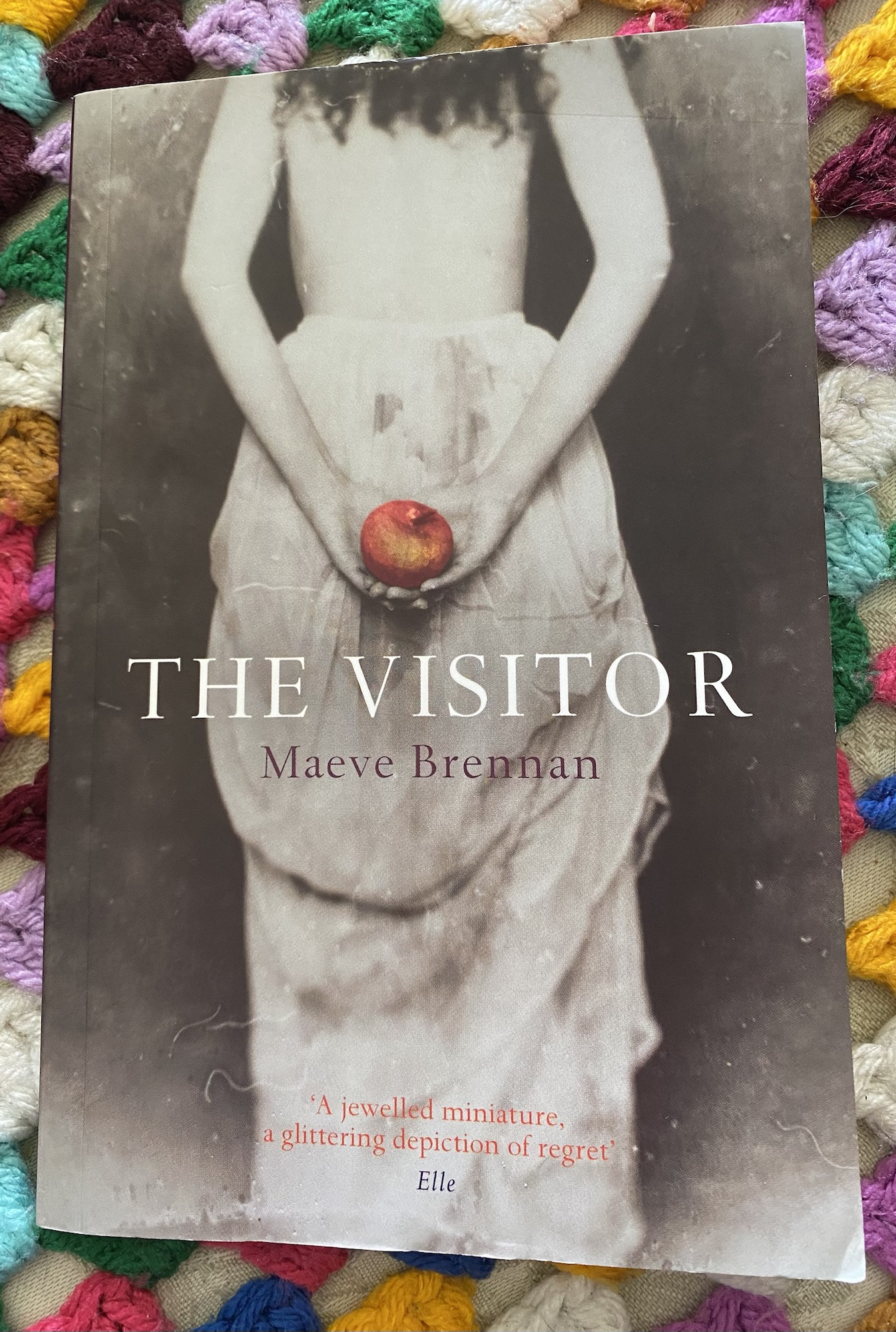
I received my copy of The Visitor by Maeve Brennan (written in the 1940s, published after her death in 2000) from lovely Karen at Kaggsy’s Bookish Ramblings, having read her wonderful review. I’d not read Brennan before and I was really keen to; having now read this 81 page novella I definitely want to explore her writing further.

Twenty-two year old Anastasia King returns to her grandmother’s house in Dublin, having spent six years in Paris with her mother who has now died.

“She was still the same, with her delicate and ruminative and ladylike face, and her hands clasped formerly in front of her. Anastasia thought, She is waiting for me to make some mistake.”

Little does Anastasia know she has already made the mistake by leaving with her mother. Her grandmother is entirely unforgiving and inflexible about the hurt caused to her son who has also died, and makes no allowances for Anastasia having been the child of the marriage.

Anastasia expects to be able to live with her grandmother as she has nowhere else to go, but her grandmother has other ideas. She does not view this house as Anastasia’s home any longer and is determined to keep her in the titular role. Her imperviousness and lack of welcome border on Gothic and I was reminded of Janet in O Caledonia by Elspeth Barker. The Visitor lacks the overt Gothic tones of that novel but they share the dislocation of a young adult in her own home and the almost eeriness that evokes.

“She turned and looked at the mirror, but it reflected only empty chairs, and the firelight played indifferently on polished furniture as it had once across her parents’ faces. There is the background, and it is exactly the same.”

Her grandmother’s elderly housekeeper Katharine does her best to welcome Anastasia, but her kindness is vastly outweighed by Mrs King’s seemingly endless bitterness. Brennan adds complexity to the tale with the introduction of old family friend Miss Kilbride. Anastasia’s actions towards Miss Kilbride stop the story becoming fairytale-like or straightforward. By portraying human beings in all their complexities Brennan doesn’t allow trite conclusions to be reached.

I don’t want to say too much about the novella as it’s so short, but its length doesn’t mean it lacks power. The loveless, withholding atmosphere that Mrs King creates is masterfully drawn and really gets under the reader’s skin. The ending is ambiguous and adds to the feeling of dislocation throughout the story. Brennan doesn’t waste a single word.

“Home is a place in the mind. When it is empty, it frets. It is fretful with memory, faces and places and times gone by. Beloved images rise up in disobedience and make a mirror for emptiness.”

“All good stories are told with varying degrees of reluctance.” (Claire Keegan)

As I mentioned in my last post, I’m disappointed not to be doing my novella a day in May project this year, but for my sanity something had to give! Simon is undertaking a book a day for the month which I’m sure will give me many ideas for next year 😊

I still plan to focus on novellas this month though, and last year when I read Small Things Like These by Claire Keegan, a few people mentioned that I read needed to read Foster. How right they were, it’s an extraordinary novella.

Apparently it started life as a New Yorker short story (it has two copyright dates) and although I haven’t read that version, as a novella I would say it is completely realised in just 88 pages.

A young girl is taken to the west of Ireland to live with the Kinsellas, her aunt and uncle, as her mother is heavily pregnant and struggling with the number of children she has to care for.  Her father gambles away the family heifer and there isn’t enough food to go round, or time for adequate physical or emotional care.

At the place where she is to spend the summer, chores are achieved daily on the farm and within the home. There is enough food and enough care.

“Her hands are like my mother’s hands but there is something else in them too, something I had never felt before and have no name for. I feel at such a loss for words but this is a new place, and new words are needed.”

Although the time is never specified, it seems to be around the 1970s/early 1980s as there is a discussion of hunger strikers. The narrator is nameless and we’re not sure of her age, but I would say somewhere around nine to eleven years old.

“I am in a spot where I can neither be what I always am nor turn into what I could be.”

Keegan trusts the reader not to need everything spelled out. We get a sense of the wider family dynamics and the feelings of various family members without them being explicitly stated. The slowly building bonds of trust and affection between the young narrator and the Kinsellas are so delicately evoked and tenderly realised.

A stunning scene sees the narrator and Mr Kinsella walking along the beach. When they turn around to walk back, he can only see her footprints

“’You must have carried me there.’

[..]

We stand then, to pause and look back out at the water.

‘See, there’s three lights now where there was only two before.’

I look out across the sea. There, the two lights are blinking as before, but with another, steady light, shining in between.

‘Can you see it?’ he says.

‘I can,’ I say. ‘It’s there.’

 And that is when he puts his arms around me and gathers me into them as though I were his own.”

There is also the gradual understanding by the narrator that a life is possible, and exists, beyond that which she has always known.

“But this is a different type of house. Here there is room, and time to think. There may even be money to spare.”

Throughout, there is an awareness that this is a temporary time, with a defined end date. The situation cannot endure and the narrator and the Kinsellas will have to part.

Foster is a stunning novella. A deeply moving and perfectly crafted gem, complete in itself, down to the final devastating line.

I’ve not seen the film adaptation of Foster, but it looks faithful, and beautifully shot:

“One of the luckiest things that can happen to you in life is, I think, to have a happy childhood.” (Agatha Christie)

My Name is Leon by Kit de Waal was published to great acclaim in 2016, and it was one of those books I kept meaning to read but putting off. I thought the story of a boy in the 1980s care system, trying to be reunited with his baby brother who has been adopted, would be unbearably sad.

Kit de Waal grew up in Birmingham with an Irish mother and father from St Kitts, and she holds dual Irish/British citizenship. So I decided that this year’s Reading Ireland 2024 aka the Begorrathon, hosted by Cathy at 746 Books was the time to finally get to it, and I’m so glad I did!

At the start of the novel Leon is almost nine years old and living with his mum Carol, with his father absent in prison. Carol’s just had a baby, Jake, who has blonde hair and blue eyes, unlike Leon who is mixed race. Leon is devoted to his younger sibling, and tries to take care of him as best he can.

“After a few weeks, Carol says Leon can’t go to school because it’s too wet and rainy. That means Leon can play all day and put the television on and make toast if he’s hungry. Carol leaves him in charge when she goes to the phone box and when she comes back she’s out of breath and asks him if the baby’s alright. Leon would never let anything happen to the baby so she worries for nothing.”

A child’s point of view is hard to get right but I thought de Waal created a really authentic voice for Leon (if you look at her Wiki page you’ll see her lifetime of experience that led to her writing this novel.) Leon is old beyond his years, but there is still so much he doesn’t understand.

“He hopes that Jake won’t grow up to be like his dad and say dangerous things in a quiet voice. Leon only smiled because it was polite. If the man comes back, Leon won’t smile a second time. He will be on his guard and he’ll protect Carol and Jake and then he won’t get shouted out.”

Carol has a complete breakdown, and so Leon and his brother are put into foster care, a situation Leon is familiar with.

“Social workers have two pretend faces, Pretend Happy and Pretend Sad. They’re not supposed to get angry so they make angry into sad. This time, they’re pretending to care about him and Jake and his mum.”

Maureen is the experienced carer who takes them both in and I thought she was a wonderful creation. Loving and caring, tough and optimistic. She’s flawed but she gets the important things – authentic, deep care for a child – right.

“He’s heard Maureen swearing loads of times, like when she called Margaret Thatcher a bloody cow because of the miners. And once she said Margaret Thatcher could kiss her arse and Leon laughed and got caught earwigging. Maureen says that if he keeps listening to people’s private conversations his ears will shrivel into prunes and drop off. Leon always checks his ears at night just in case.”

When a couple adopt Jake, we witness Leon’s heart shattering. Maureen objects to the siblings being split up, but the decision by social services is that it is better to have one child adopted – the blonde-haired, blue-eyed baby – than none at all. And in case this seems like a period piece, just a few years ago, a social worker told someone I know that children aged over seven and in care were ‘on the scrap heap’ because the majority only want to adopt babies.

“Maureen wipes Leon’s face with the corner of her dressing gown but because it’s made of the same silky stuff as the cushions his face is still wet and begins to itch.

‘You will be alright, Leon. You will be alright.’

Leon uses the tea towel again because it’s better for tears.”

The rest of the novel sees Leon plotting to reunite his family. This involves stealing money and stockpiling supplies. He’s confused, troubled, and furious. He’s intelligent, kind and vulnerable.

At the same time, he has many adults who care for him. Maureen and her purple-haired sister Sylvia; The Zebra his social worker “but out of all the social workers he’s ever had, she looks at him the most. And when he looks away, she stops speaking until he turns round.” When he discovers the local allotments, he makes friends with further adults. Tufty provides a black male role model, and there is also Mr Devlin, an Irish man whose traumatic past the reader picks up more quickly than Leon.

de Waal balances this story perfectly. The urban setting (which some readers on goodreads have assumed is London but I definitely thought was Birmingham, including the Handsworth riots), is evoked with authentic 1980s details including Curly Wurlys and BMXs. The realities of Leon’s life, racism, and police brutality are not shied away from, but they are shown to sit alongside kindness, compassion and selflessness.

“Leon eats his toast sitting on the carpet by the patio doors. It’s supposed to be summertime but the sky is the same colour as the garden slabs, dull and grey, like the road to school, the cut-through to the precinct or the dirty lane between the tower blocks and maisonettes.”

All the adults in Leon’s young life are flawed, but none are judged harshly. Carol is shown to be extremely unwell. The social workers take damaging decisions but it’s not through disregard of the children. Those who care for Leon make mistakes and struggle to take care of themselves at times, while providing love and respite for a young person with the odds stacked against him.

My Name is Leon is a story of someone learning how to mend a broken heart at an age when you really wish they had no idea of such pain. It’s a story of resilience and all that human beings can give one another, despite our myriad imperfections. I shoudn’t have left it lingering in the TBR for so long.

To end, the trailer for the BBC adaptation of My Name is Leon, which I’ll try and find to watch now. The cast looks stellar – Lenny Henry (who narrated the audiobook and bought the rights), Christopher Eccleston and the peerless Monica Dolan alongside Cole Martin in his first acting role as Leon:

“I must love a loathed enemy.” (Romeo and Juliet, Act 1 Scene V)

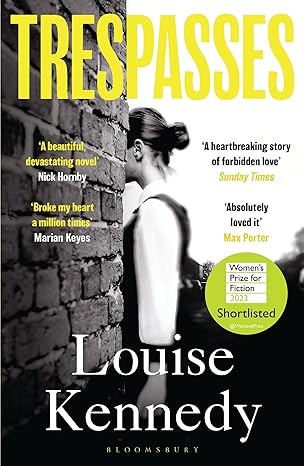
I’m not sure there’s much I can add to the cacophony of praise that Trespasses by Louise Kennedy (2022) has garnered. In fact I did consider not writing a post at all. But in the end because it moved me so much I thought I’d jot a few thoughts down as part of Reading Ireland 2024 aka the Begorrathon, hosted by Cathy at 746 Books. It’s also a stop on my Around the World in 80 Books reading challenge.

A summary of the plot doesn’t do this finely-crafted tale justice.

Cushla Lavery is a Catholic teacher, twenty-four years old and working at a school in a garrison town in 1970s Northern Ireland. She also helps out at her family’s pub, which is where she meets Michael Agnew – around twice her age, Protestant, and married. The attraction is instant and mutual.

“Countless times she had replayed the evening in her head, searching for the word or gesture or pronunciation that had repelled him, that had shown she was too young, too unsophisticated, too Catholic. It seemed piteous now that she had opened her college Irish books at Penny’s messy, elegant table, desperate to impress him. Perhaps she had been too obviously besotted with him.”

They know they have to keep their relationship secret. At the height of the Troubles, they are different religions and Michael already attracts attention through his work as a barrister defending those accused of killing members of the Royal Ulster Constabulary (RUC).

This is a time when politics and violence are woven through the daily lives of people in an immediate way. Cushla has to tread carefully around British soldiers in the pub, the threat of their brutality insidious and palpable. On the way to a party with her colleague and friend Gerry, they are stopped at an army checkpoint. At the flat where Cushla and Michael meet, she tells him not to sit with the lights on and curtains open, and her trepidation is not only due to their forbidden relationship…

Meanwhile, other aspects of life don’t stop. Her grieving mother Gina is self-medicating with gin. A boy in Cushla’s class, Davy McGeown, is bullied because he is from a mixed-marriage family and he ‘smells’ – his mother can’t hang the washing out because the neighbours throw dog dirt at it. His vulnerability is noticed by the priest Father Slattery, who everyone knows shouldn’t be left alone with children.

“Michael said there were all kinds of families. Cushla’s was an unhappy one. What was his like?”

The strain of daily life, living under the misuse of power both political and religious, is brilliantly realised. The narrative is incredibly tense, and the 1970s details are vivid.

The contrast of these tensions with the tender love between Cushla and Michael is subtly portrayed and never jars. Their relationship is believable, and while Michael is known to be “Fond of the women, by all accounts. Sure he’d charm the knickers off you.” he never seems creepy. Cushla is young but not naïve. They know what they have is unlikely to end well and yet they cling to it, the human need for love asserting itself over all that would seek to subdue it.

“She was overcome with a feeling of utter defeat. She wanted to lie on her bed and sleep, but had been unable to say no to him. It wasn’t because he had been kind to her. It was because each time she saw him she was afraid it would be the last time.”

It was the resilience Kennedy portrays which ultimately I found so moving. Not only with Cushla and Michael but in those that surround them, and particularly with Davy McGeown, a bright child caught up in a situation he barely comprehends.

“Booby trap. Incendiary device. Gelignite. Nitroglycerine. Petrol bomb. Rubber bullets. Saracen. Internment. The Special Powers Act. Vanguard. The vocabulary of a seven-year-old child now.”

Kennedy is not remotely sentimental but she is compassionate. She doesn’t judge people or the situation. Through creating recognisable, fully realised characters struggling to live the best way they can, Trespasses is a stunning exploration of the endurance of human spirit.

“For the umpteenth time Cushla wished her parents had called her Anne or Margaret or Rose – not Mary, with its connotations of Marian shrines and rosaries – any name that didn’t mark her out as so obviously a Catholic. She felt guilty for the thought which, she realised, also marked her as a Catholic.”

Novella a Day in May 2023 – No.26

Nights at the Alexandra – William Trevor (1987) 71 pages

Many of you will be aware that Cathy at 746 Books and Kim at Reading Matters are hosting their wonderful A Year with William Trevor reading event throughout 2023.

Earlier this month, Cathy reviewed Trevor’s novella Nights at the Alexandra, and it sounded so completely wonderful I knew I’d have to get to it before the end of May. I did and it was all I anticipated.

It opens with 58 year-old Harry remembering his life as a young adult, just about to leave school, during World War II. The Messingers – she English, he German – have moved to Ireland to avoid the prejudice their relationship would encounter in their countries of birth. She is much younger than her husband, and glamourous.

“I remember that more distinctly than any other moment in my life. She was already in the car when she spoke, and her tone of voice was not one normally employed when making a request. With a gentle imperiousness, she commanded what she wished, and before she drove away she glanced at me once, a smile flickering across her thin features.”

Harry is from a Protestant family, living in a Catholic town. He is expected to follow his father into the timberyard business – something his elder sister has already done by working in the office and which she bitterly resents.

“The family atmosphere was as it always was: my grandmothers silent in their dislike of one another, my brothers sniggering, my mother tired. Annie resentful, my father ebullient after an hour or so in the back bar of Viney’s hotel.”

Harry does not want to follow his father in any way. He is desperate for something else, without knowing what it is. The Messingers – particularly Mrs Messinger – with their large house, cigarettes and tea, affection and childlessness, stories and difference, offer this to Harry.

They offer him further escape when Mr Messinger decides to build the titular cinema in the town, named after his wife. Harry is able to have a job, and refuse the timberyard once and for all.

Nights at the Alexandra has such a subtle and finely-wrought tone. The relationships between the characters are beautifully evoked and in less-skilled hands could have easily descended into cliché. Instead Trevor gives us a story of human lives with all their pain and love, longing and helplessness, that somehow grants his characters some peace too. There are also moments of deadpan humour:

“My father lent his observations weight through his slow delivery of them, his tone suggesting revelations of import yet to come. But invariably this promise remained unfulfilled.”

Now, it could be said Reader, that my tears are not worth very much. I’ve always been a crier anyway, and currently I’m bereaved and pre-menopausal, so it doesn’t take much to set me off. But I wept at the end of Nights at the Alexandra. It was so completely realised, so moving and poetic, unsentimental and sympathetic. Perfection.