As I mentioned in my last post, I’m disappointed not to be doing my novella a day in May project this year, but for my sanity something had to give! Simon is undertaking a book a day for the month which I’m sure will give me many ideas for next year 😊
I still plan to focus on novellas this month though, and last year when I read Small Things Like These by Claire Keegan, a few people mentioned that I read needed to read Foster. How right they were, it’s an extraordinary novella.
Apparently it started life as a New Yorker short story (it has two copyright dates) and although I haven’t read that version, as a novella I would say it is completely realised in just 88 pages.
A young girl is taken to the west of Ireland to live with the Kinsellas, her aunt and uncle, as her mother is heavily pregnant and struggling with the number of children she has to care for. Her father gambles away the family heifer and there isn’t enough food to go round, or time for adequate physical or emotional care.
At the place where she is to spend the summer, chores are achieved daily on the farm and within the home. There is enough food and enough care.
“Her hands are like my mother’s hands but there is something else in them too, something I had never felt before and have no name for. I feel at such a loss for words but this is a new place, and new words are needed.”
Although the time is never specified, it seems to be around the 1970s/early 1980s as there is a discussion of hunger strikers. The narrator is nameless and we’re not sure of her age, but I would say somewhere around nine to eleven years old.
“I am in a spot where I can neither be what I always am nor turn into what I could be.”
Keegan trusts the reader not to need everything spelled out. We get a sense of the wider family dynamics and the feelings of various family members without them being explicitly stated. The slowly building bonds of trust and affection between the young narrator and the Kinsellas are so delicately evoked and tenderly realised.
A stunning scene sees the narrator and Mr Kinsella walking along the beach. When they turn around to walk back, he can only see her footprints
“’You must have carried me there.’
[..]
We stand then, to pause and look back out at the water.
‘See, there’s three lights now where there was only two before.’
I look out across the sea. There, the two lights are blinking as before, but with another, steady light, shining in between.
‘Can you see it?’ he says.
‘I can,’ I say. ‘It’s there.’
And that is when he puts his arms around me and gathers me into them as though I were his own.”
There is also the gradual understanding by the narrator that a life is possible, and exists, beyond that which she has always known.
“But this is a different type of house. Here there is room, and time to think. There may even be money to spare.”
Throughout, there is an awareness that this is a temporary time, with a defined end date. The situation cannot endure and the narrator and the Kinsellas will have to part.
Foster is a stunning novella. A deeply moving and perfectly crafted gem, complete in itself, down to the final devastating line.
I’ve not seen the film adaptation of Foster, but it looks faithful, and beautifully shot:
My Name is Leon by Kit de Waal was published to great acclaim in 2016, and it was one of those books I kept meaning to read but putting off. I thought the story of a boy in the 1980s care system, trying to be reunited with his baby brother who has been adopted, would be unbearably sad.
Kit de Waal grew up in Birmingham with an Irish mother and father from St Kitts, and she holds dual Irish/British citizenship. So I decided that this year’s Reading Ireland 2024 aka the Begorrathon, hosted by Cathy at 746 Books was the time to finally get to it, and I’m so glad I did!
At the start of the novel Leon is almost nine years old and living with his mum Carol, with his father absent in prison. Carol’s just had a baby, Jake, who has blonde hair and blue eyes, unlike Leon who is mixed race. Leon is devoted to his younger sibling, and tries to take care of him as best he can.
“After a few weeks, Carol says Leon can’t go to school because it’s too wet and rainy. That means Leon can play all day and put the television on and make toast if he’s hungry. Carol leaves him in charge when she goes to the phone box and when she comes back she’s out of breath and asks him if the baby’s alright. Leon would never let anything happen to the baby so she worries for nothing.”
A child’s point of view is hard to get right but I thought de Waal created a really authentic voice for Leon (if you look at her Wiki page you’ll see her lifetime of experience that led to her writing this novel.) Leon is old beyond his years, but there is still so much he doesn’t understand.
“He hopes that Jake won’t grow up to be like his dad and say dangerous things in a quiet voice. Leon only smiled because it was polite. If the man comes back, Leon won’t smile a second time. He will be on his guard and he’ll protect Carol and Jake and then he won’t get shouted out.”
Carol has a complete breakdown, and so Leon and his brother are put into foster care, a situation Leon is familiar with.
“Social workers have two pretend faces, Pretend Happy and Pretend Sad. They’re not supposed to get angry so they make angry into sad. This time, they’re pretending to care about him and Jake and his mum.”
Maureen is the experienced carer who takes them both in and I thought she was a wonderful creation. Loving and caring, tough and optimistic. She’s flawed but she gets the important things – authentic, deep care for a child – right.
“He’s heard Maureen swearing loads of times, like when she called Margaret Thatcher a bloody cow because of the miners. And once she said Margaret Thatcher could kiss her arse and Leon laughed and got caught earwigging. Maureen says that if he keeps listening to people’s private conversations his ears will shrivel into prunes and drop off. Leon always checks his ears at night just in case.”
When a couple adopt Jake, we witness Leon’s heart shattering. Maureen objects to the siblings being split up, but the decision by social services is that it is better to have one child adopted – the blonde-haired, blue-eyed baby – than none at all. And in case this seems like a period piece, just a few years ago, a social worker told someone I know that children aged over seven and in care were ‘on the scrap heap’ because the majority only want to adopt babies.
“Maureen wipes Leon’s face with the corner of her dressing gown but because it’s made of the same silky stuff as the cushions his face is still wet and begins to itch.
‘You will be alright, Leon. You will be alright.’
Leon uses the tea towel again because it’s better for tears.”
The rest of the novel sees Leon plotting to reunite his family. This involves stealing money and stockpiling supplies. He’s confused, troubled, and furious. He’s intelligent, kind and vulnerable.
At the same time, he has many adults who care for him. Maureen and her purple-haired sister Sylvia; The Zebra his social worker “but out of all the social workers he’s ever had, she looks at him the most. And when he looks away, she stops speaking until he turns round.” When he discovers the local allotments, he makes friends with further adults. Tufty provides a black male role model, and there is also Mr Devlin, an Irish man whose traumatic past the reader picks up more quickly than Leon.
de Waal balances this story perfectly. The urban setting (which some readers on goodreads have assumed is London but I definitely thought was Birmingham, including the Handsworth riots), is evoked with authentic 1980s details including Curly Wurlys and BMXs. The realities of Leon’s life, racism, and police brutality are not shied away from, but they are shown to sit alongside kindness, compassion and selflessness.
“Leon eats his toast sitting on the carpet by the patio doors. It’s supposed to be summertime but the sky is the same colour as the garden slabs, dull and grey, like the road to school, the cut-through to the precinct or the dirty lane between the tower blocks and maisonettes.”
All the adults in Leon’s young life are flawed, but none are judged harshly. Carol is shown to be extremely unwell. The social workers take damaging decisions but it’s not through disregard of the children. Those who care for Leon make mistakes and struggle to take care of themselves at times, while providing love and respite for a young person with the odds stacked against him.
My Name is Leon is a story of someone learning how to mend a broken heart at an age when you really wish they had no idea of such pain. It’s a story of resilience and all that human beings can give one another, despite our myriad imperfections. I shoudn’t have left it lingering in the TBR for so long.
To end, the trailer for the BBC adaptation of My Name is Leon, which I’ll try and find to watch now. The cast looks stellar – Lenny Henry (who narrated the audiobook and bought the rights), Christopher Eccleston and the peerless Monica Dolan alongside Cole Martin in his first acting role as Leon:
A summary of the plot doesn’t do this finely-crafted tale justice.
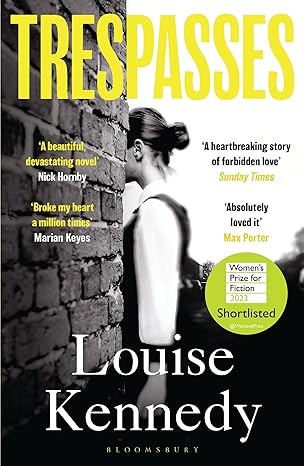
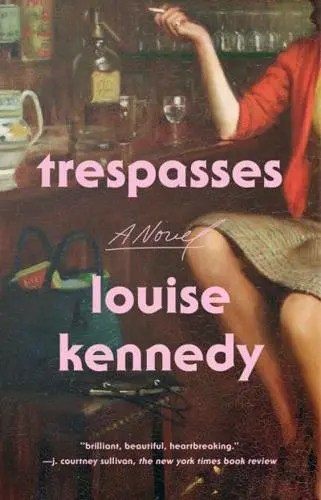
Cushla Lavery is a Catholic teacher, twenty-four years old and working at a school in a garrison town in 1970s Northern Ireland. She also helps out at her family’s pub, which is where she meets Michael Agnew – around twice her age, Protestant, and married. The attraction is instant and mutual.
“Countless times she had replayed the evening in her head, searching for the word or gesture or pronunciation that had repelled him, that had shown she was too young, too unsophisticated, too Catholic. It seemed piteous now that she had opened her college Irish books at Penny’s messy, elegant table, desperate to impress him. Perhaps she had been too obviously besotted with him.”
They know they have to keep their relationship secret. At the height of the Troubles, they are different religions and Michael already attracts attention through his work as a barrister defending those accused of killing members of the Royal Ulster Constabulary (RUC).
This is a time when politics and violence are woven through the daily lives of people in an immediate way. Cushla has to tread carefully around British soldiers in the pub, the threat of their brutality insidious and palpable. On the way to a party with her colleague and friend Gerry, they are stopped at an army checkpoint. At the flat where Cushla and Michael meet, she tells him not to sit with the lights on and curtains open, and her trepidation is not only due to their forbidden relationship…
Meanwhile, other aspects of life don’t stop. Her grieving mother Gina is self-medicating with gin. A boy in Cushla’s class, Davy McGeown, is bullied because he is from a mixed-marriage family and he ‘smells’ – his mother can’t hang the washing out because the neighbours throw dog dirt at it. His vulnerability is noticed by the priest Father Slattery, who everyone knows shouldn’t be left alone with children.
“Michael said there were all kinds of families. Cushla’s was an unhappy one. What was his like?”
The strain of daily life, living under the misuse of power both political and religious, is brilliantly realised. The narrative is incredibly tense, and the 1970s details are vivid.
The contrast of these tensions with the tender love between Cushla and Michael is subtly portrayed and never jars. Their relationship is believable, and while Michael is known to be “Fond of the women, by all accounts. Sure he’d charm the knickers off you.” he never seems creepy. Cushla is young but not naïve. They know what they have is unlikely to end well and yet they cling to it, the human need for love asserting itself over all that would seek to subdue it.
“She was overcome with a feeling of utter defeat. She wanted to lie on her bed and sleep, but had been unable to say no to him. It wasn’t because he had been kind to her. It was because each time she saw him she was afraid it would be the last time.”
It was the resilience Kennedy portrays which ultimately I found so moving. Not only with Cushla and Michael but in those that surround them, and particularly with Davy McGeown, a bright child caught up in a situation he barely comprehends.
“Booby trap. Incendiary device. Gelignite. Nitroglycerine. Petrol bomb. Rubber bullets. Saracen. Internment. The Special Powers Act. Vanguard. The vocabulary of a seven-year-old child now.”
Kennedy is not remotely sentimental but she is compassionate. She doesn’t judge people or the situation. Through creating recognisable, fully realised characters struggling to live the best way they can, Trespasses is a stunning exploration of the endurance of human spirit.
“For the umpteenth time Cushla wished her parents had called her Anne or Margaret or Rose – not Mary, with its connotations of Marian shrines and rosaries – any name that didn’t mark her out as so obviously a Catholic. She felt guilty for the thought which, she realised, also marked her as a Catholic.”
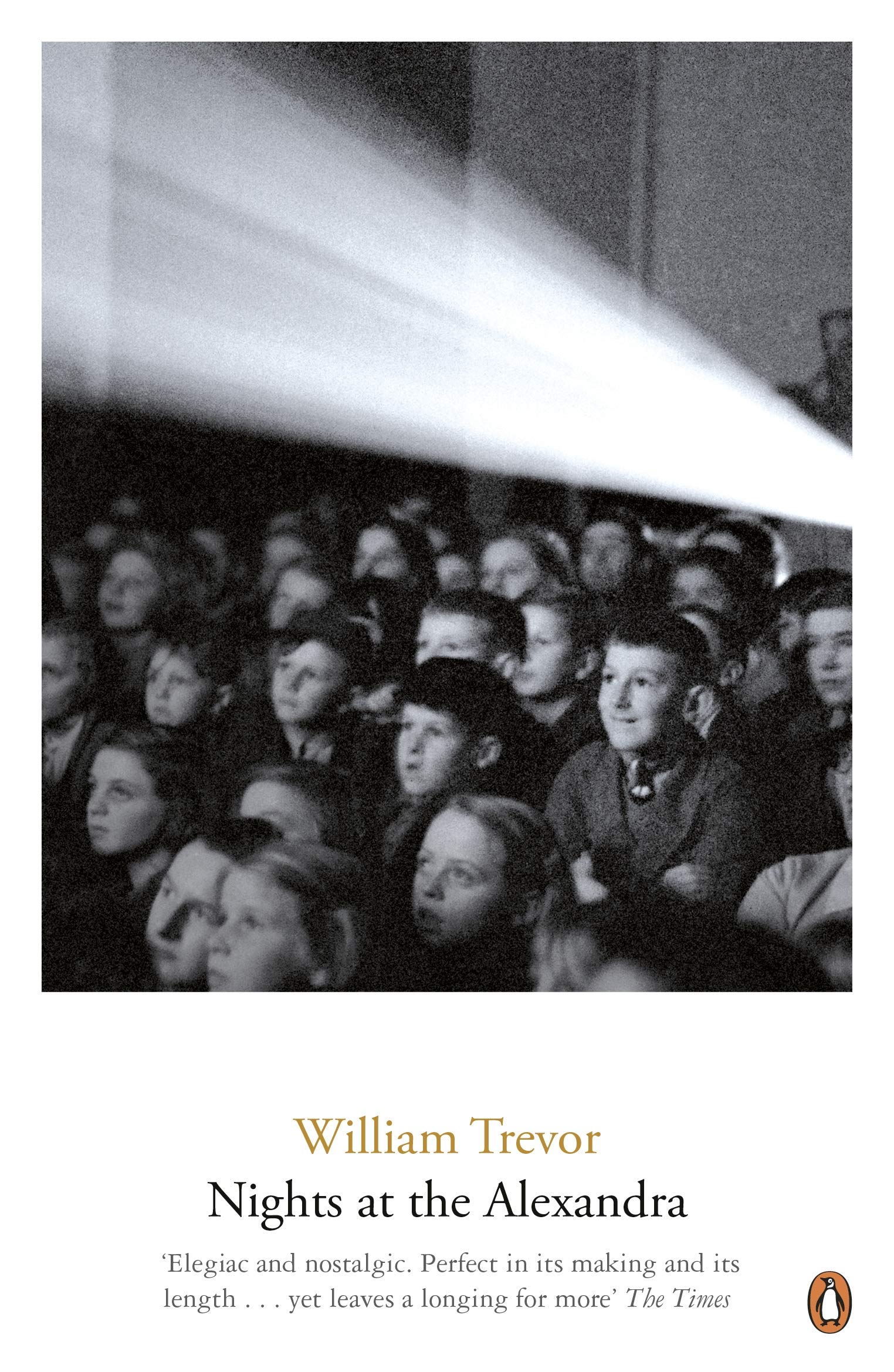
Nights at the Alexandra – William Trevor (1987) 71 pages
Many of you will be aware that Cathy at 746 Books and Kim at Reading Matters are hosting their wonderful A Year with William Trevor reading event throughout 2023.
It opens with 58 year-old Harry remembering his life as a young adult, just about to leave school, during World War II. The Messingers – she English, he German – have moved to Ireland to avoid the prejudice their relationship would encounter in their countries of birth. She is much younger than her husband, and glamourous.
“I remember that more distinctly than any other moment in my life. She was already in the car when she spoke, and her tone of voice was not one normally employed when making a request. With a gentle imperiousness, she commanded what she wished, and before she drove away she glanced at me once, a smile flickering across her thin features.”
Harry is from a Protestant family, living in a Catholic town. He is expected to follow his father into the timberyard business – something his elder sister has already done by working in the office and which she bitterly resents.
“The family atmosphere was as it always was: my grandmothers silent in their dislike of one another, my brothers sniggering, my mother tired. Annie resentful, my father ebullient after an hour or so in the back bar of Viney’s hotel.”
Harry does not want to follow his father in any way. He is desperate for something else, without knowing what it is. The Messingers – particularly Mrs Messinger – with their large house, cigarettes and tea, affection and childlessness, stories and difference, offer this to Harry.
They offer him further escape when Mr Messinger decides to build the titular cinema in the town, named after his wife. Harry is able to have a job, and refuse the timberyard once and for all.
Nights at the Alexandra has such a subtle and finely-wrought tone. The relationships between the characters are beautifully evoked and in less-skilled hands could have easily descended into cliché. Instead Trevor gives us a story of human lives with all their pain and love, longing and helplessness, that somehow grants his characters some peace too. There are also moments of deadpan humour:
“My father lent his observations weight through his slow delivery of them, his tone suggesting revelations of import yet to come. But invariably this promise remained unfulfilled.”
Now, it could be said Reader, that my tears are not worth very much. I’ve always been a crier anyway, and currently I’m bereaved and pre-menopausal, so it doesn’t take much to set me off. But I wept at the end of Nights at the Alexandra. It was so completely realised, so moving and poetic, unsentimental and sympathetic. Perfection.
Small Things Like These – Claire Keegan (2021) 110 pages
Claire Keegan’s short story collection Antarctica was the only work of hers I had read, but I remembered being really impressed by it. When Small Things Like These got so much love in blogosphere I knew I needed to pick her up again. Thankfully the planets aligned and I found a copy of it in a charity shop the very month I was focussing on novellas 😊
Bill Furlong is a coal merchant who lives a quiet life with his wife and young daughters in a 1980s Irish town. However, there is something in his past that means Bill has a sense of being an outsider. Perhaps it is this that means his compassion for people who are finding life harder and are homeless or struggling to make ends meet, or may be self-medicating with alcohol, is in contrast to those around him.
“Some nights, Furlong lay there with Eileen going over small things like these. Other times, after a day of heavy lifting or being delayed by a puncture and getting soaked out on the road, he’d come home and eat his fill and fall into bed early, then wake in the night sensing Eileen, heavy in sleep, at his side – and there he’d lie with his mind going round in circles, agitating, before finally he’d have to go down and put the kettle on, for tea.”
There is a Magdalene laundry in the town, and events conspire so that Bill becomes aware of the horrors that are taking place, sanctioned by state and church. His wife voices the general attitude when she says:
“‘If you want to get on in life, there’s things you have to ignore, so you can keep on.’”
However for Bill it is not so easy. The revelation comes at a time when he is questioning the purpose of his life, the daily toils and the wider meaning. So it is understandable that he is the one to break out from the conspiracy of wilful ignorance and silence that allows the abuse to continue.
“What would life be like, he wondered, if they were given time to think and reflect over things? Might their lives be different or much the same – or would they just lose the run of themselves?”
There is no way that the physical and psychological torture of the laundries can be captured in a 110 page novella, if ever, although there a couple of very distressing scenes. But I don’t think this is Keegan’s point. Instead she uses our pre-existing knowledge of the laundries to focus on putting us in the position of an ordinary person at that time. She demonstrates why he might take action, and what he could lose by doing so. The ambiguous ending, not without hope but not suggesting that Bill will avoid devastation, doesn’t allow for easy resolution.
Keegan is asking the reader to consider: what would you do? How much will you stand for, and how much are you prepared to lose? Knowing that throughout history atrocities have taken place while societies looked away, it is a powerful and enduring challenge.
“It would be the easiest thing in the world to lose everything, Furlong knew.”
This is slightly odd review, because what I think works about this novella is also why I have reservations about recommending it. But it absolutely worked for me, so I decided to include it when I only write about books I recommend.
Eimear McBride writes stream of consciousness novels. I’m fine with this style but I know it’s really off-putting for lots of people. If you are one of those but were thinking of giving McBride a try, I would say this is not the place to start. Strange Hotel doesn’t have the verve of A Girl is a Half-Formed Thing or The Lesser Bohemians. But these disclaimers aside, here is why I think it worked.
I would say Strange Hotel is a novel about grief. We follow an unnamed woman as she checks into hotels in Avignon, Prague, Oslo, Auckland and Austin. We never know why she is in any of these places. She drinks too easily and she sleeps with men she does not want to see again.
“Times have changed, she notes, as is her wont on those occasions of which, of late, there have been more than a few. Another unzipped bag, in another uninteresting hotel room, upon which she stares indifferently down at the folded clothes, or the shampoo congealing into them if she’s been unlucky which, on this occasion, she has not.”
She has a list of places she is working through, possibly as some sort of pilgrimage, possibly not.
She is both articulate and inarticulate, and the reader has to try and piece together what is going on for her. It’s not easy, and in that sense we are very much in the place she finds herself:
“Why is the world always such work? It’s harder to let the words into her body now or, maybe, out. They used to form and reform themselves in order to dole out whatever she had in mind, whatever meanings her body inclined to make them make. Now, they barely carry meaning beyond the literal wattle and daub. This does, occasionally, make her wistful for the savagery of before when, beholden to no one, the words did whatever they pleased. She wouldn’t mind going back to that.”
A lot of my job is concerned with grief and bereavement and I’ve recently experienced a personal bereavement. I think Strange Hotel brilliantly captures the disorientation, the unreality, the betweenness, the holding pattern of grief.
Hotels are a perfect setting for this theme, and stream of consciousness is the perfect style. The formality in tone that wasn’t apparent in McBride’s previous novels also captures the detachment and default behaviour the bereaved can find themselves experiencing.
I read Strange Hotel at exactly the right time, there was a lot that resonated. McBride is brilliant at what she does and she uses a difficult style expertly.
“The solitary purpose of keeping the world at the far end of a very long sentence.”
The Hotel ticks a lot of boxes for me: interwar setting, repressed Brits abroad, characters thrown together through transient living arrangements, and of course novella length. My concern was that it’s Elizabeth Bowen’s debut novel and her prose can be pretty impenetrable at the best of times, let alone when she’s still honing her craft. However that proved unfounded as I found this an easier read by Bowen standards – I really enjoyed it.
The titular institution is located on the Italian riviera and is filled with genteel Brits, mainly women. The novel opens with the fallout from a row between two perfect examples of such: the companions Miss Pym and Miss Fitzgerald. The former ends up walking to tennis courts with Mrs Kerr, quite a coup as Mrs Kerr holds all the power among the hotel residents. The reasons for her occupying this elevated position are never quite clear, but her absolute self-assurance and manipulativeness surely contribute.
Mrs Kerr is looking for Sydney Warren, a beautiful, studious young woman whose family are worried about her. Sydney has come away with her cousin Tessa Bellamy, who has a vague malady:
“She was distressed by any suggestion of impermanence; she was a lonely woman. One had to have Something in one’s life. She lay on a velvet sofa in her bedroom with the head pulled round away from the window and wished that she were religious woman and that it would be time for lunch and that Sydney would soon come in.”
The start of the novel is full of these pithy sketches of the residents. I especially enjoyed the elderly sisters-in-law Mrs and Miss Pinkerton:
“They were more closely allied to one another in the memory of Edward’s than they had either of them been to Edward himself…. Cherished little animosities reinforced their ties to one another; Rosina maintained to herself implacably that if she had been Edward’s wife she would have borne him children; Louisa was aware enough of this to be a little markedly generous to Rosina, who was not in a position to refuse anything that might be offered.”
They are hugely affronted by the arrival of an Anglican clergyman, James Milton, who unwittingly uses their reserved bathroom. Bowen is a brilliant observer of the manners and social customs of the hotel, treating it all with a wry affection:
“Beyond, down the long perspective to the foot of the stairs, one could see visitors take form with blank faces, then compose themselves for an entrance. Some who thought punctuality rather suburban would gaze into the unfilled immensity of the room for a moment, then vanish repelled. Others would advance swimmingly and talk from table to table across the emptiness, familiarly, like a party of pioneers. Men came in without their wives and did not always look up when these entered. Women appearing before their husbands remained alert, gazed into an opposite space resentfully, and ate with an air of temporising off the tips of their forks.”
Romantic relationships are treated with a great deal of scepticism in the novel: the pretty Lawrence sisters look to make pragmatic marriages; Mrs Lee-Mitterson panders to her ridiculous self-centred husband; it’s mentioned more than once how incompatible men and women are. It wouldn’t be a stretch at all to take a queer theory reading to many of the relationships in The Hotel, and it could also be read as demonstrating the value and endurance of platonic friendship.
The early character sketches and scene setting of The Hotel were completely wonderful, but for me the novella didn’t quite live up to this initial promise. I was drawn into the various relationships and shifting allegiances, and the disarray caused by the arrival of Mrs Kerr’s much anticipated, determinedly aloof son Ronald was very enjoyable. I think what stopped me unreservedly loving this was that I did find the characters ultimately quite distancing – Sydney Warren is meant to be reserved and a bit cold but I felt this distance as a reader too.
But still there was so much to enjoy and I found it a real treat.
“Notwithstanding the slight sense of degeneracy induced by reading novels before luncheon she had been enjoying Jude the Obscure.”
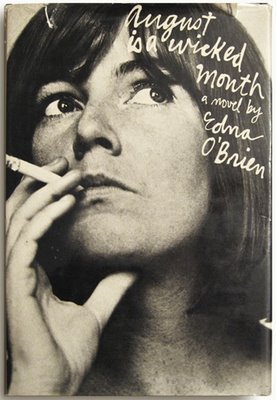
Many, many years ago, decades even, when I was a sixth-former (that’s Year 12, kids) my English teacher gave out a list of suggested reading for A levels. Somewhat surprisingly, I didn’t finish it entirely (although just in case that seems worryingly off-brand, I should say my name still went round to the teachers on a list as the pupil who borrowed most library books that year) and I can remember the few that escaped me. One was August is a Wicked Month, and having read it now I’m a bit surprised it was on a sixth-form reading list. Because it is explicit. But it’s also very realistic so maybe my teachers thought it was responsible reading 😀
Ellen is in her late twenties and her ex-husband has taken their son camping. Ellen is not good at being alone and managing feelings:
‘I’ll just be,’ she said. A rare thing for her, racked as she was with anxiety, wondering always what would happen next, if an affair would be eternal, or if she loved her son over much, or if the wheels of a car they sat in would fly off and leave them half dead on the roadside.
So she decides to go to the south of France for sun and anonymous sex:
“She had been brought up to believe in punishment; sin in a field and the long awful spell in the Magdalen laundry scrubbing it out, down on her knees getting cleansed. She longed to be free and young and naked with all the men in the world making love to her, all at once. Was that why he ran?”
Written in 1965, this is not a tale of the joys of sexual liberation and freedom. Despite the setting, the tale is not glamorous. Ellen falls in with a crowd that includes a film star, but its all lonely and sad and isolating. She may as well have stayed away,
“She wanted to go home, not to London to the pipes of light but home to the race to which she belonged: and then she shivered uncontrollably, knowing that their thoughts were no longer hers. She had vanished back into childhood and the dark springs of her terrors.”
Everything Ellen does seems a misstep but not comically so. Her confused interactions with people, failed flirtations and disappointing sex just serve to highlight the inadequacy of human communication and the tendency to look for solace in precisely the wrong places.
This was the first Edna O’Brien I’ve read and I thought her writing was wonderful. She has a way of building images in a way that is so startling and disconcerting, but recognisable:
“Yellow all around, the lemons in the trees like lobes of light, the odd lit bulb, and his face yellow like parchment, from age. His blue eyes were not dead but were something worse. They had the sick look of eyes that will wounded and for whom death would be a relief.”
She can also be incredibly spiky and unforgiving:
“Her hands were long and white and soft. Hands into which cream and money had been poured and unlike the face they were able to be beautiful without showing the umbrage of the unloved.”
The only misstep for me was an event towards the end that seemed unnecessarily dramatic and as if there wasn’t enough faith in Ellen’s story as it stood to carry the novella. But a minor quibble overall – I’ll definitely be seeking out the Country Girls trilogy after this.
This my contribution to Reading Ireland Month 2023, aka The Begorrathon, running all month and hosted by Cathy over at 746 Books. Do head over to Cathy’s blog to check out all the wonderful posts so far!
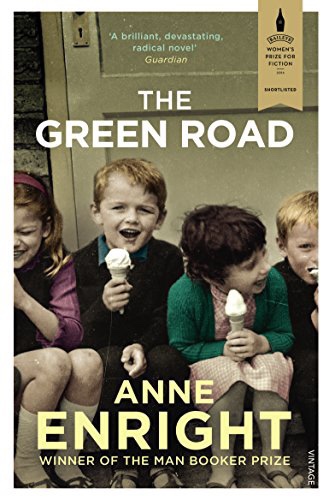
Anne Enright’s The Green Road (2015) has been languishing in the TBR for many years. I’m trying to get to grips with the toppling monster (hahahaha) as I had to acknowledge that any gains made in my book-buying ban of 2018 had been completely undone. So I’m really pleased this year’s Begorrathon finally prompted me to pull it from the shelf.
The Green Road is divided into two parts, Leaving, and Coming Home. The first part considers one of four siblings in turn, from 1980 onwards. Hanna as a small tearful child; Dan gradually emerging from the closet in 1991’s New York; Constance having a cancer scare back home in County Limerick in 1997; Emmet pursuing aid work in Mali in 2002.
Through each of these sections we learn about the individual, but also gain an emerging picture of the family, including their tempestuous self-focussed mother Rosaleen and silent father Pat. This means that when they all return home at the behest of widowed Rosaleen in 2005, we have a good idea of each of them and it’s intriguing to see how Christmas dinner will play out when they are all in the same room. The focus will be on the five rather than extended family:
“The only route to the Madigans Christmas table was through some previously accredited womb. Married. Blessed.”
The adult children approach the event with no small degree of trepidation. Rosaleen is not an easy woman. Demanding without explicitly stating what her demands are, while judging her children quite harshly. She doesn’t approve of Constance’s weight gain:
“Rosaleen believed a woman should be interesting. She should keep her figure, and always listen to the news.”
Or Dan’s values, influenced by his work in the art world:
“For an utterly pretentious boy, he was very set against pretension. Much fuss to make things simple. That was his style.”
Yet she loves them deeply and they must attend, for Rosaleen is threatening to sell the family home:
“Rosaleen was living in the wrong house, with the wrong colours on the walls, and no telling anymore what the right colour might be, even though she had chosen them herself and liked them and lived with them for years. And where could you put yourself if you could not feel at home in your own home? If the world turned into a series of lines and shapes, with nothing in the pattern to remind you what it was for.”
In this interview Enright says: “I don’t do plottedness. I do stories, I do slow recognition.” This is exactly it. There isn’t a lot of plot in The Green Road but it is such a compelling read. The characterisation is complex and wholly believable, with all of the family not behaving entirely well nor entirely badly. The relationships are so delicately drawn, with their mix of love and frustration, familiarity and the unknown, wonderfully evoked.
“Emmet closed his eyes and tilted his face up, and there she was: his mother, closing her eyes and lifting her head, in just the same way, down in the kitchen in Ardeevin. Her shadow moving through him. He had to shake her out of himself like a wet dog.”
I read The Green Road over a few hours and was sorry to come to the end, but it was perfectly paced and a wholly satisfying read. Enright is such a wonderful writer, able to articulate the small moments in life that can have such an impact even when they are barely recognised. She perfectly captures the immensity of the every day.
“She looked to her son, she looked him straight in the eye, and for a moment, Emmet felt himself to be known. Just a glimmer and then it was gone.”
You can read an interview with Enright talking about The Green Roadhere.
To end, an Irish film about family which I’ve enjoyed in the last week is the Oscar-winning An Irish Goodbye. For those of you who can get iPlayer, it’s available and only 23 minutes long (warning: there is a dead hare in the road – not gory – in the first few seconds of this trailer);
Today is Bloomsday, and the centenary of the publication of James Joyce’s Ulysses. I decided this meant I couldn’t put it off any longer and 2022 would be the year I finally cracked the spine on this tome (metaphorically of course – I don’t crack spines, I’m not an animal.)
When I read War and Peace back in 2017, I opted out of a review-type book post, intimidated at the thought of trying to say anything remotely coherent or interesting about such a revered novel. Instead I opted for a reading diary. Now here I am with a similarly revered, equally intimidating cornerstone of literature. There’s no way I can say anything useful about Ulysses, especially in its centenary year with all the celebratory events happening.
And so I present my Ulysses reading diary, neither coherent nor interesting! In fact, to manage any expectation of intellectual engagement with the genius of Joyce in this post, I should confess that the first hurdle I had to overcome in approaching the text was to get the Ulysses 31 theme tune out of my head (it’s probably unnecessary to explain here that I am a child of the 80s…)
Day 1
“Ulysses, Ulysseeeeees, soaring through all the galaxieeeeees….” Pesky earworm.
Normally if I’m told a book is difficult, I arrogantly assume I can do it. But Ulysses is genuinely intimidating. What I need to remind myself is:
I really love James Joyce. Genuinely, Dubliners is one of my favourite-ever books. So I might even enjoy Ulysses.
Other people have done it. I’ve even met some of them. Lovely bloggers left encouraging comments on my previous post where I explained what I planned to do. It’s definitely do-able.
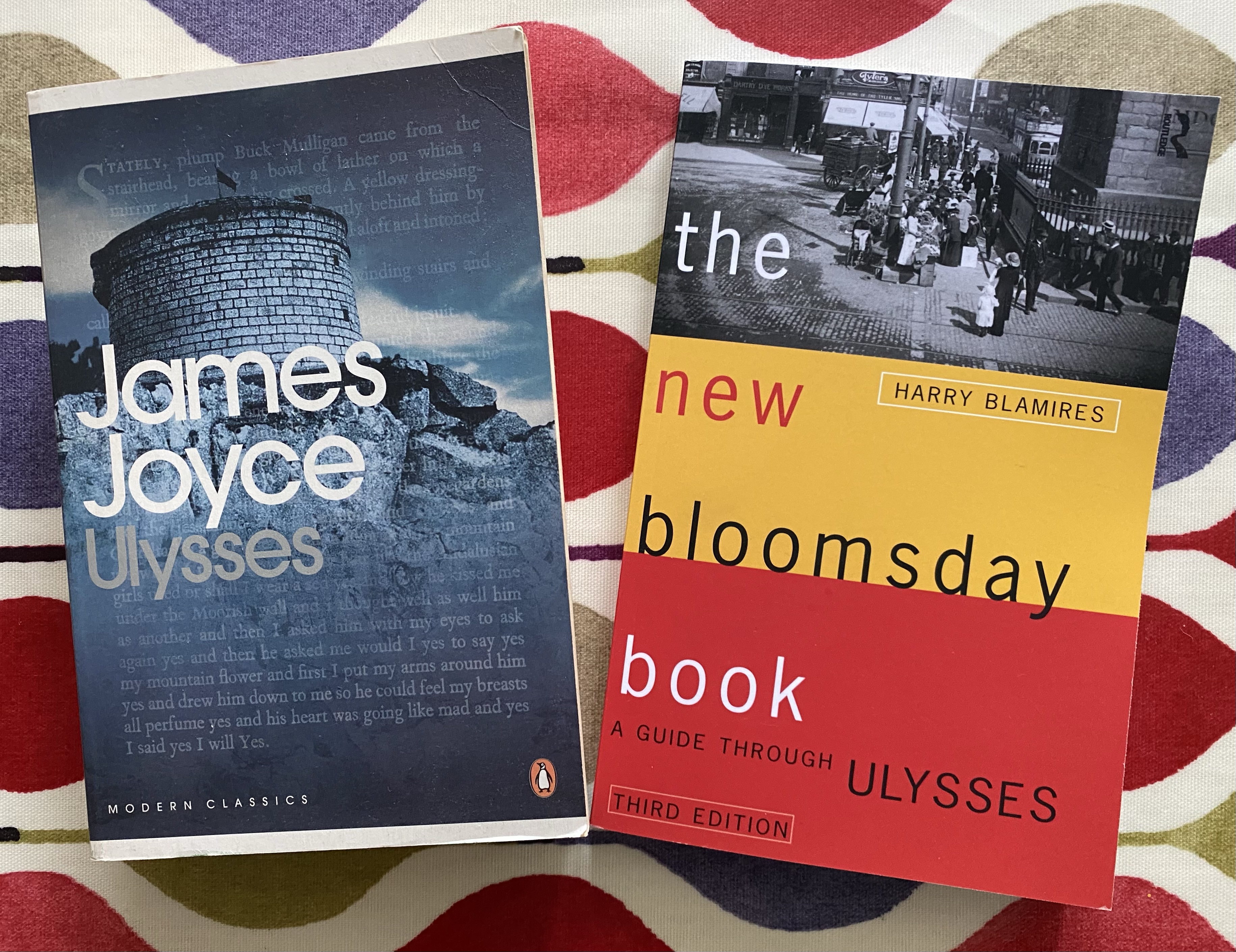
I am not going in unarmed. I have The New Bloomsday Book: A Guide Through Ulysses by Harry Blamires (3rd ed. 1996) at my side. I’m almost certain I read on twitter that this was a good thing, and surely twitter is never wrong??
I’ve read the 80+ page introduction to my edition and now wonder if I should gain degrees in Classical Civilisation/Modernism/European History/Religious Studies before even attempting this novel.
I’ll start tomorrow.
Pages read: None. Pages remaining: 933
Day 2
OK, possibly I overreacted. I think maybe I knew too much in advance. In the end, I was amazed I could make it to the end of a single sentence. But so far Ulysses is beautiful yet also sordid, and very readable. I’m glad I’ve got the reading companion though, as there was complex word play around the word ‘melon’ that I definitely wouldn’t have picked up on my own.
Pages read: 140 Pages remaining: 793
Day 3
For such a learned, intellectual novel, Ulysses also manages to be emotionally affecting. Now I’m just under a quarter of the way through I’m finding Leopold Bloom very moving. There’s something pathetic about him, and isolated and sad, even among the crowds of Dublin.
“I was happier then. Or was that I? Or am I now I? Twentyeight I was. She twentythree. When we left Lombard street west something changed. Could never like it again after Rudy. Can’t bring back time. Like holding water in your hand. Would you go back to then? Just beginning then. Would you? Are you not happy in your home you poor little naughty boy? Wants to sew on buttons for me. I must answer. Write it in the library.
Grafton street gay with housed awnings lured his senses. Muslin prints, silkdames and dowagers, jingle of harnesses, hoofthuds lowringing in the baking causeway. Thick feet that woman has in the white stockings. Hope the rain mucks them up on her.”
Pages read: 218 Pages remaining: 715
Day 4
Fair to say my pace has slackened off today. I woke up with the book on my face, which upon removal revealed two hungry cats giving me the death stare.
Pages read: 250 Pages remaining: 683
Days 5, 6, 7
I’m sure a more attentive reader would get a lot more out of Ulysses, but as an inattentive reader I’m still really enjoying it. I especially like the section which the companion tells me corresponds with The Wandering Rocks in Homer. It’s 19 sections where, by following many characters for a short time, Joyce creates the hustle and bustle of the afternoon of 16 June 1904 in Dublin. He does this as much through the inner lives of his characters and their interactions with one another, as with description. Having said that, here are some descriptions which caught me:
“Two carfuls of tourists passed slowly, their women sitting fore, gripping the handrests. Palefaces. Men’s arms frankly round their stunted forms. They looked from Trinity to the blind columned porch of the bank of Ireland where pigeons roocoocooed.”
“Stephen Dedalus watched through the webbed window the lapidary’s fingers prove a timedulled chain. Dust webbed the window and the showtrays. Dust darkened the toiling fingers with their vulture nails. Dust slept on dull coils of bronze and silver, lozenges of cinnabar, on rubies, leprous and winedark stones.
Born all in the dark wormy earth, cold specks of fire, evil, lights shining in the darkness. Where fallen archangels flung the stars of their brows. Muddy swinesnouts, hands, root and root, gripe and wrest them.”
“Moored under the trees of Charleville Mall Father Conmee saw a turfbarge, a towhorse with pendent head, a bargeman with a hat of dirty straw seated amidships, smoking and staring at a branch of poplar above him. It was idyllic: and Father Conmee reflected on the providence of the Creator who had made turf to be in bogs whence men might dig it out and bring it to town and hamlet to make fires in the houses of poor people.”
I’m very grateful for the companion guide. I’m reading part of Ulysses then the corresponding section in the guide, and this isn’t nearly as tedious as I anticipated. It reassures me that I’m picking up a lot, and it’s highlighting the things I didn’t have hope of recognising.
Among all this learning, my most significant take away is: I’m going to start using the phrase “I beg your parsnips.”
Pages read: 403 Pages remaining: 530
Day 8, 9, 10
More than 100 pages of very unpleasant scenes, filled with boorish, racist, drunk men. An effective contrast to Bloom’s sober gentleness and moderation, (although also some questionable voyeurism from him) but I was very glad to leave it behind.
I wasn’t keen on the following section set out like a play either, and Bloom and Stephen’s hallucinations weren’t the most pleasant reading.
It’s hot, my hayfever is terrible, I’m sleep deprived and grumpy so not the best reader right now. Don’t listen to me.
Pages read: 704 Pages remaining: 229
Days 11, 12
Thank goodness – back on a much more straightforward narrative (or as near to one as you get with Joyce) and I’m enjoying Ulysses again. (I don’t normally mind experimental narratives so I’m blaming my hayfever brain.) Lovely scenes between Bloom and Dedalus.
“Literally astounded at this piece of intelligence Bloom reflected. Though they didn’t see eye to eye in everything a certain analogy there somehow was as if both their minds were travelling, so to speak, in the one train of thought.”
Which is then followed by 50-odd pages of (surprisingly explicit, even by today’s standards) almost punctuation-free stream of consciousness – a brave choice to end and a masterstroke.
“…I dont like books with a Molly in them like that one he brought me about the one from Flanders a whore always shoplifting anything she could cloth and stuff and yards of it O this blanket is too heavy on me thats better I havent even one decent nightdress this thing gets all rolled under me…”
Pages read: 933 Pages remaining: zero!
So that’s me all done! And one of the Big Scary Tomes ticked off my Le Monde’s 100 Books of the Century Reading Challenge. While it doesn’t yet occupy a special place in my heart like Dubliners, I still got so much from Ulysses. It’s such an achievement to be simultaneously so epic and so determinedly everyday. I would definitely read it again, and I’d love to go to the Bloomsday events in Dublin, which I’m sure would mean I’d enjoy a re-read even more.
To end, an opportunity to indulge myself with one of the loves of my life, because here Kate Bush is singing Molly Bloom’s soliloquy:
P.S Virginia Woolf did modify her view of Ulysses at a later date: “very much more impressive than I judged. Still I think there is virtue & some lasting truth in first impressions; so I don’t cancell mine. I must read some of the chapters again. Probably the final beauty of writing is never felt by contemporaries”