“Happiness is having a large, loving, caring, close-knit family in another city.” (George Burns)

I hope you all had a wonderful Christmas! From my twitter feed, I know for some that means being as far away from relatives as possible 😉 If Christmas advertising were to be believed, we should all have families like this:
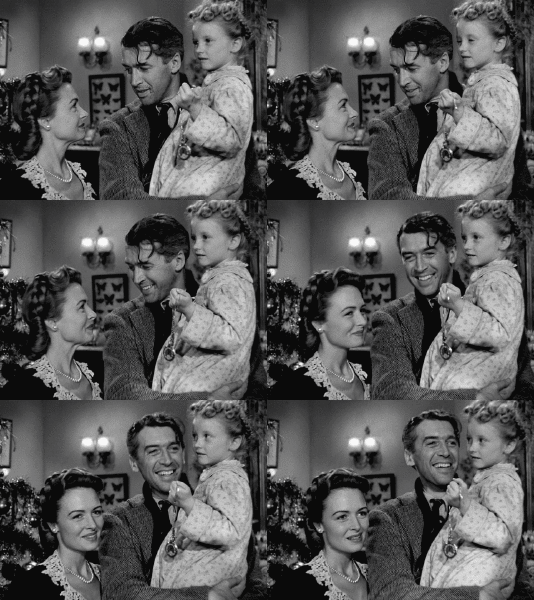
Whereas in fact the reality may be closer to this:
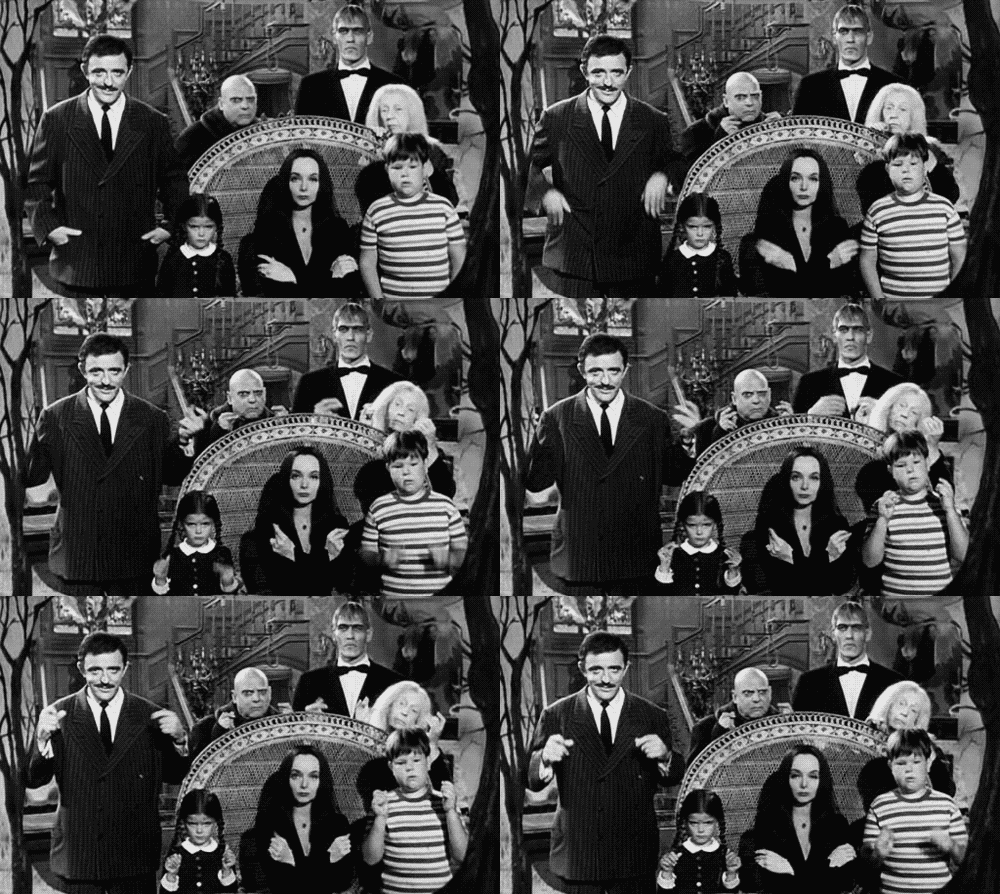
In which case I would say well done you, because I’m the only person alive who doesn’t like It’s a Wonderful Life *ducks for cover* whereas the Addams Family are awesome.  Whether you spent Christmas with George Bailey or Uncle Fester,  I thought this week might be a good time to look at families that are found in unexpected places.

Firstly, Plainsong by Kent Haruf (1999) which I picked up after loving Our Souls at Night so much and many bloggers recommended I start the Plainsong trilogy. All the things I enjoyed about Our Souls at Night were here: a gentle, unshowy voice, believable idiosyncratic characters, ordinary lives shown to have a delicate beauty.

Set in the fictional prairie community of Holt, Colorado, Plainsong focusses on a pregnant schoolgirl, Victoria Roubideaux, and one of her teachers, Tom Guthrie, who is splitting up with his wife. After Victoria is thrown out by her mother, another teacher, Maggie Jones, suggests to a pair of elderly brothers, Harold and Raymond McPheron, that they take her in.

“ You’re getting goddamn stubborn and hard to live with. That’s all I’ll say. Raymond, you’re my brother. But you’re getting flat unruly and difficult to abide. And I’ll say one thing more.

What?

This ain’t going to be no goddamn Sunday school picnic.

No it ain’t, Raymond said. But I don’t recall you ever attending Sunday school either.”

They offer Victoria a home, and the portrayal of their developing relationship with the young woman is just lovely. The brothers are set in their ways and unused to female company. Victoria is shy and unsure. The tentative gestures they make towards one another pay off and a tender, mutually nurturing affection develops.

“The brothers were watching her closely, a little desperately, sitting at the table, their faces sober and weathered but still kindly, still well meaning, with their smooth white foreheads shining like polished marble under the dining room light. I wouldn’t know, she said. I couldn’t say about that. I don’t know anything about it. Maybe you could explain it to me.

Well sure, Harold said. I reckon we could try.”

Meanwhile, Tom’s sons Ike and Bobby are struggling to come to terms with their mother’s depression and subsequent leave-taking. A similarly unexpected yet gentle cross-generational relationship develops between the boys and elderly, isolated Mrs Stearns who they know from their paper round.

“The timer dinged on the stove. They took the first oatmeal cookies out of the oven and now there was the smell of cinnamon and fresh baking in the dark little room. The boys sat at the table and ate the cookies together with the milk Mrs Stearns had poured out into blue glasses. She stood at the counter watching them  and sipped a cup of hot tea and ate a small piece of cookie, but she wasn’t hungry. After a while she smoked a cigarette and tapped ashes in the sink.

You boys don’t say very much, she said. I wonder what you’re thinking all the time.

About what?

About anything. About the cookies you made.

They’re good, Ike said.”

Plainsong is a gentle tale about all that human beings can give and be to one another, but it is not remotely sentimental or rose-tinted. Haruf shows, he doesn’t tell, with a restraint and subtlety that is easy to underestimate but is absolutely masterful. I find his writing incredibly moving. It’s going to be a real strain on my 2018 book buying ban not to rush out and buy the novels of his I don’t yet own.

Secondly, Sweet Bean Paste by Durian Sukegawa (2013, trans. Alison Watts, 2017). Again, this is a simply told tale of ordinary people, and it is truly heartwarming. The main protagonist is the decidedly unheroic Sentaro. He has a criminal record and is employed by people he owes money to. He sells dorayaki – pancakes filled with the titular paste – with no pride in or commitment to his work. One day Tokue, an elderly lady with a visible disability in her hands and face arrives in the shop:

“ ‘I had one of your dorayaki the other day. The pancake wasn’t too bad, I thought, but the bean paste, well…’

‘The bean paste?’

‘Yes. I couldn’t tell anything about the feelings of the person who made it.’

‘You couldn’t? That’s strange.’ Sentaro made a face as if to show how regrettable that was, though he knew full well his bean paste could to reveal no such thing.”

Sentaro employs Tokue on the understanding that she will not interact with the customers who he thinks will be put-off by her disability. Tokue’s delicious bean paste brings more customers to the shop and business begins to boom. As Sentaro and Tokue’s relationship develops, he begins to understand that she has survived Hansen’s disease (leprosy) but is still subject to significant stigma around the disease. One of the schoolgirl customers, Wakana, becomes very attached to Tokue, and they visit her at the asylum she continues to live in although the government has passed an act which means those with Hansen’s disease are no longer kept in isolation.

“Nevertheless human lives had been swallowed up by this place and for a hundred years, continually spurned. It felt to Sentaro as if the singular silence rose from the very earth beneath their feet, steeped as it was in sighs and regrets.”

Sweet Bean Paste is about living life to the full even when society is circumscribing it in cruel ways. It is about friendship’s power to heal and to empower. It is also about opening ourselves to experience the world in new and surprising ways, no matter our age. Tokue has an almost mystical relationship with her cooking, which enriches both her and those who consume her food.

“When I make sweet bean paste I observe closely the colour of the adzuki beans faces. I take in their voices. That might mean imagining a rainy day or the beautiful fine weather they have witnessed. I listen to their stories of the winds that blew on their journey to me.”

And so in the end, I think Sweet Bean Paste is about nourishment in all its forms; it is there for the taking if we have the wisdom to see it and the open hearts to embrace it.

To end, never let it be said that I shy away from the obvious:

“Whenever I think of the past, it brings back so many memories.” (Steven Wright)

I’m a month into my new job and the main effect it’s having is that my memory is shot to pieces. Trying to cram #allthefacts about one particular health condition into my head means all other knowledge has dribbled out of my ears. In fairness, my short and long-term memory has always been appalling and I used to claim I operated in a constantly shifting 3 hour window. This is currently down to about 30 minutes. Plus I got lost at Bank the other day, when I’ve lived in London MY WHOLE LIFE. And there’s a bloomin’ great building at Bank (guess which one) to help you orient yourself.

800px-Bank_of_England_Building,_London,_UK_-_Diliff

Where am I again? Oh, yeah…

So to console myself this week I’m looking at novels which explore memory. Its inherently unreliable nature means memory is a gift to novelists who want to consider how we construct reality and decide who we are. (At the moment I’m happy if I manage to construct a sentence, never mind reality and coherent sense of self).

Firstly, The Housekeeper and the Professor by Yoko Ogawa (2003, tr. Stephen Snyder 2008).I’m a huge admirer of Ogawa and her spare, stunning writing. In this short novel she details the relationship between a young housekeeper, her son, and the Professor she works for, who since a car accident in 1975 has a memory which lasts 80 minutes, though his memory from before the accident is intact.

“At the end of my first day, I noticed a new note on the cuff of his jacket. ‘The new housekeeper,’ it said. The words were written in tiny, delicate characters, and above them a sketch of a woman’s face. It looked like the work of a small child…but I knew instantly it was portrait of me. I imagined the Professor hurrying to draw this likeness before the memory had vanished. The note was proof of something, that he had interrupted his thinking for my sake.”

These notes cover the Professor’s suit and give him an eccentric experience which belies his brilliant mind. He is talented mathematician who sees numbers everywhere. His housekeeper became pregnant at 18 and needed to work to support her child; she is intelligent but not highly educated. Gradually though, he is able to convey the magic of numbers to her and her mind relishes the new challenge:

“With my finger I traced the trail of numbers from the ones the Professor had written to the ones I’d added, and they all seemed to flow together, as if we’d been connecting up the constellations in the night sky.”

Meanwhile Ogawa is able to convey the magic of numbers to the reader. There is no-one more resistant to mathematics than me – I won’t even play soduku. Yet the Housekeeper’s response to the discoveries the Professor opens up for her is so creative and joyful that I found myself carried along:

“I wondered why ordinary words seemed so exotic when they were used in relation to numbers. Amicable numbers or twin primes had a precise quality about them, and yet they sounded as though they’d been taken straight out of a poem. In my mind, the twins had matching outfits and stood holding hands as they waited in the number line.”

The titular characters and the Housekeeper’s son – nicknamed Root as his flat head reminds the Professor of the square root sign – form a tender alliance. The Professor cannot remember them from one day to the next, and yet he changes their lives forever, through his love of numbers and how he uses these to reach out to people.  The novel is a love story, but not a romance.  It is about the love of friends, of family, of vocation. It contains tragedy but also endurance beyond such, with Ogawa’s sparse style bringing the story a great delicacy. I adored it.

“I thought of the Professor whenever I saw a prime number – which, as it turned out, was almost everywhere I looked: price tags at the supermarket, house numbers above doors, on bus schedules or the expiration date on a package of ham, Root’s score on a test. On the face of it, these numbers faithfully played their official roles, but in secret they were primes and I knew that was what gave them their true meaning.”

Secondly, The Sea by John Banville, which won the Booker Prize in 2005. I’m still a bit conflicted about how I feel about this one, but it’s given me food for thought and is undoubtedly well-written, so I decided to add it to this blog where I only write about books I like. The Sea is narrated by Max Morden, coming to terms with the recent death of his wife. He returns to the holiday cottage which in his childhood was rented by a family, the Graces’, while Max and his family had a nearby chalet.

“I approached the Cedars circumspectly. How is it in childhood everything new that caught my interest had an aura of the uncanny, since according to all the authorities the uncanny is not some new thing but a thing known, returning in a different form, a revenant?”

The Sea is an effective exploration of memory as Max’s memories of the childhood holiday are jumbled alongside those of his marriage and especially his wife’s final illness. Chloe and Myles Grace are twins who never quite reveal themselves to Max, although he begins a tentative romance with Chloe.

“Her hands. Her eyes. Her bitten fingernails. All this I remember, intensely remember, yet it is all disparate, I cannot assemble it into a unity.”

As Max remembers the events of that summer he is forced to reflect on his wider choices and the man he is, particularly as he is now single again.

“Life, authentic life, is supposed to be all struggle, unflagging action and affirmation, the will butting its blunt head against the world’s wall, suchlike, but when I look back I see the greater part of my energies was always given over to the simple search for shelter, for comfort, for, yes, I admit, it, for cosiness.”

So… my reservations about this novel are weirdly some of its strengths. It is written in considered, careful prose, expertly structured overall to build to a conclusion that reconciles past and present. But for me it almost felt too considered, too artful. Then I wondered if Max, insecure about his social background, was supposed to be a slightly ponderous man out to prove his own cleverness? I’m not sure, I would have to read another of Banville’s novels to know. There are certainly moments of wry humour to lift the narrative at moments:

“these days I must take the world in small and carefully measured doses, it is a sort of homeopathic cure I am undergoing”

I’m undecided about Banville at present but I’ll certainly give him another try. If you’ve read him I’d really appreciate enlightenment as to his style and other novels that would be worth a read? The reason The Sea made it onto this determinedly positive blog was the final line of the novel, the final image. It was so powerful, such a perfect end, so moving and insightful: a moment of pure brilliance.

To end, it had to be either this or Elaine Paige dressed as a giant feline. Ultimately I decided to have my memories misty-water-coloured rather than alone in the moonlight. Take it away, Babs:

“Deep-versed in books and shallow in himself.” (John Milton)

Well, Milton’s got my number. My shallowness extends to books themselves –against conventional wisdom, I definitely judge by the cover.  Thank goodness I do, otherwise whole publishing marketing teams would be out of business.  This week I’m hoping other people aren’t as shallow as me as I’m starting a new job and I hope they overlook whatever gibbering first impression I make to see the hard-working-team-playing-but-definitely-not-a jobsworth- and-will-never-steal-your-lunch-from-the-fridge colleague within.

50ba5ea307fe9576ddd4d4bfcb86d13c

I was also thinking about first impressions and book covers following an interesting post by Lady Fancifull a few weeks back, about a marketing campaign which played on this exact bias.  Earlier in the year, I was persuaded by another blogger, Cathy at 746 books, to stop being so shallow when I won a book in her giveaway, encouraged by her great review, although its cover meant I would never have picked it up normally. So in this post I’m going to look at the book I was lucky enough to win, and a book whose cover would have attracted me even if I wasn’t already a fan of the author.

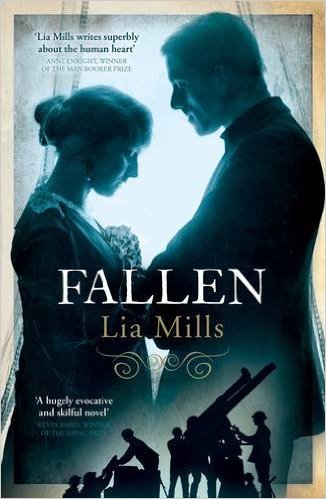
Firstly then, Fallen by Lia Mills (2014). Here’s the cover:

51v0yqwpal-_sx324_bo1204203200_

Yuck, right? Curlicues – seriously? I would never have picked this up, thinking it looked like a fluffy romance, which is not my taste at all. But while there is a love affair in Fallen, it is not romanticised. Mills is interested in the fallout from war on both those who served and those who remained behind (often women) and how a generation of young people were irrevocably damaged.

Katie Crilly is living in Dublin in 1915 and trying to find her way in a world where she doesn’t know what she wants, except that she definitely doesn’t want what others expect of her. Then her twin brother Liam announces he’s off to join the war effort.

 “He went into his room and shut the door. The latch clicked like a scold’s tongue, made me wish I’d a more generous heart. The silence on the landing was so deep I heard my own pulse tick.”

Liam dies, and Katie has to cope with profound grief, and the fact that her grief is commonplace:

“We’d heard that, in the Dardanelles, many of the Dublins were put off their boats into water that was too deep for them. Pulled under by the weight of their packs, they drowned, while Turkish bullets and mortar fire tore into their comrades and churned the sea red. The gas unleashed at Ypres, around the time that Liam died, was still claiming lives two months later. Every second person on Sackville Street wore a black armband, or a cuff.”

While all this is happening, the Easter Rising explodes onto the already wrecked population of Dublin. Katie finds herself stranded in the home of friends who are also giving shelter to a wounded soldier, Hubie, who knew Liam. Hubie, his wounds visible and invisible, is furious at the ignorance of those who have remained at home. Katie does not turn her face away from the horrors of war and recognises in Hubie a fellow haunted soul:

 “If you love someone, and that person dies, all that love becomes a burden, a weight accumulating, pooling inside you, with nowhere to go. What do you do with it? … Sometimes it gathered itself into a shape, a shadow, peeled itself off the ground and attached itself to my heel. It followed me and spoke, in Liam’s voice”

Fallen is about an ordinary life caught up in exceptional circumstances. It is about how to find meaning in a world where national events dwarf the individual. Ultimately it is a hopeful book, about how a fractured self can be rebuilt, whole but wholly different.

And it is very much about Dublin: Mills evokes a strong sense of place and Fallen was a perfect choice for Two Cities One Book, in the centenary year of the Easter Rising.

“There was something raw about the morning, as though layers of the city’s skin had rubbed off during the night.”

Secondly, The Nakano Thrift Shop by Hiromi Kawakami (2005, tr. Allison Markin Powell, 2016). I was excited to read this as I’d loved Strange Weather in Tokyo and was disappointed that none of Kawakami’s other work had been translated into English. The Nakano Thrift Shop was translated this year and like Strange Weather, the cover features one of Natsumi Hayashi’s beautiful levitating photographs:

Gorgeous, no? The pictures really capture the vibrancy, unpredictability and humour of Kawakami’s writing.

In The Nakano Thrift Shop, Hitomi takes a job at the eponymous business, uncertain of what she wants from life and hoping that the job will be undemanding:

“With its second-hand goods (not antiques), Mr Nakano’s shop was literally filled to overflowing…Mr Nakano would raise the shop’s shutter and, with a cigarette between his lips, he’d arrange the goods intended to tempt customers outside the front of the store…Sometimes ash from his cigarette fell on the turtle paperweight’s back, and Mr Nakano roughly brushed it off with a corner of the black apron that he always wore”

The owner has several ex-wives and a mistress. Despite his unprepossessing appearance, Mr Nakano has irresistible charm:

“I’d heard the phrase ‘a boyish grin’, but Mr Nakano’s grin was decidedly middle-aged. There was something scruffy about it. And yet, at the same time, it was also a winning smile. I suppose it’s the kind of smile that women, as they age, can’t resist”

Hitomi, Nakano, his artist sister Masayo and the driver Takeo form an unlikely quartet as they are thrown together. And really, very little happens. These four idiosyncratic, wholly believable characters rub along together in their day-to-day lives of triumphs and tragedies, some larger than others, explored through different objects in the shop. Takeo and Hitomi begin a tentative, on-again-off-again relationship that was heart-breaking, real and funny in its tenderness, misunderstanding, affection and frustration:

“I would eat a diet rich in vegetables, seaweed, and legumes, and every day would be sparkling and bright, my life brimming with health and vitality. While imagining this, I was again filled with a general sort of sadness. I definitely wasn’t sad because I was thinking about Takeo. Definitely not.”

This is not the novel to read when you’re in the mood for a heavily plotted, eventful story. Yet Kawakami captures the drama of everyday lives and their meaning. Her writing can also be startling, so while it is concerned with the ordinary it is never banal:

“The skin on Saskiko’s cheeks was glowing with an inner light. Just like the bottom of the gin jug, they reflected a dusky and beautiful radiance.”

The Nakano Thrift Shop is touching and life-affirming, but never sentimental. Fingers crossed for further translations…

To end, some shameless objectification of someone whose outward appearance has been my idea of perfection since 1981: